Key Literacy Skills
A summary
Key Literacy Skills
• These key literacy skills are used in every classroom, regardless of subject or grade
area. Using these, or slightly modified, headers on your assignment sheets will help students
understand that the skills exist from one subject area to the next.
Skill 1: Annotating
• You may annotate by writing
directly on a text, or using sticky
notes to arrange and re-arrange
your thoughts. Annotations force
you to identify details and consider
the text as an artefact. They also
allow you to return to a familiar text
at a later date, with your notes
already collected.
Skill 2: Summarizing
• When you summarize an article, you
are selecting only the most
important pieces of information that
are needed to fully communicate
the author’s ideas. By looking at the
highlighted passages you and your
group have constructed, you may
find you have already identified
Main and Supporting details,
required for a successful summary.
Skill 3: Inferring and Predicting
• When you infer, you are reaching a
conclusion on the basis of evidence and
reasoning. An inference is an “educated
guess” that is supported by your
own personal knowledge as well
as specific details from the text. You
are making an assumption based on the
facts you have in front of you, as well as
your prior experience. An inference can
be about something that has happened,
or that will happen in the future. It is
therefore related to the next skill
• Predicting allows you to form
expectations about what is to
come. Predicting requires that you
use prior knowledge and information
from the text to form an opinion about
text’s meaning, content, or intended
audience.
Skill 4: Connecting
• There are three main types of
connections: Text to Text, Text to World,
and Text to Self. Remember, a text can be –
but is not limited to – a book, an article, a
song, a video game, a painting, etc. A Text to
Text connection requires you to draw specific
links between the assigned text, and another
text of which you are familiar. A Text to
World connection requires you to draw
specific links between the assigned text, and
events occurring in the world around you.
A Text to Self connection requires you to
draw specific links between the text, and your
own personal life. Specific examples must be
used from both sources when creating a
textual connection.
Skill 5: Visualizing
Visualizing is the act of creating an
image in a readers mind. The image
should stimulate as many of the five
senses as
possible: Taste, Touch, Sight, Soun
d, and Smell. By visualizing a
can enhance their connection to a
text, or create stronger inferences.
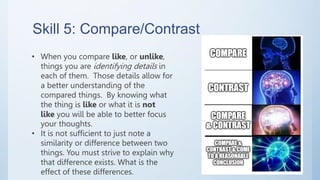
Skill 5: Compare/Contrast
• When you compare like, or unlike,
things you are identifying details in
each of them. Those details allow for
a better understanding of the
compared things. By knowing what
the thing is like or what it is not
like you will be able to better focus
your thoughts.
• It is not sufficient to just note a
similarity or difference between two
things. You must strive to explain why
that difference exists. What is the
effect of these differences.
Skill 6: Questioning
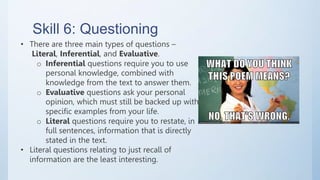
• There are three main types of questions –
Literal, Inferential, and Evaluative.
o Inferential questions require you to use
personal knowledge, combined with
knowledge from the text to answer them.
o Evaluative questions ask your personal
opinion, which must still be backed up with
specific examples from your life.
o Literal questions require you to restate, in
full sentences, information that is directly
stated in the text.
• Literal questions relating to just recall of
information are the least interesting.
Skill 7: Determining Main Ideas
• An article can have more than one Main
Idea. The Main Idea is the focus of the
article. It is supported by Supporting
Details that answer “how”, “what”, “when”, or
“where”. The Main Idea is often stated in the
topic sentence of a paragraph, or group of
paragraphs. The more specific details that
follow are the Supporting Details.
• If you are reading a novel, you would be
looking for the Theme. You are still looking for
supporting details, though the theme is
unlikely to be explicitly stated anywhere in the
novel.
– You are attempting to answer the question: “What
exactly is the author trying to argue here?” If this
were an essay, what would their thesis be?
– Even if you have similar ideas about the theme of a
novel, it is unlikely that you use the same pieces of
evidence as a neighbour to attempt to convince us
of the thesis.
Skill 8: Synthesis
• By combining ideas from your text, with ideas
from additional texts, as well as your own prior
knowledge you can come to a new, fuller,
understanding of a topic. Synthesizing allows you to
combine knowledge from multiple sources allowing
for new insights into a topic.
• Write the NAME of your story in the CENTRE BUBBLE. Next, fill the
other EIGHT bubbles with ONE WORD EACH. Each word should
be some the story made you THINK about. FINALLY think of
something most of the bubbles have in common. This will be
the THEME of your synthesis piece.
• Your synthesis should be a recreation of the main ideas from what
you read into a new format.
-A short story (500-1000 words)
-A collection of poetry (400-600 words)
-A short essay (500-800 words)
-A visual art piece (8.5” by 11”)
-A song list (5 songs with explanations)
-A short live-action video (1.5-3 mins in length)
-A short animated video (30 secs to 1.5 mins)
-A photo essay (7-10 images with explanations)

Key Literacy Skills.pptx

  • 1.
  • 2.
    Key Literacy Skills •These key literacy skills are used in every classroom, regardless of subject or grade area. Using these, or slightly modified, headers on your assignment sheets will help students understand that the skills exist from one subject area to the next.
  • 3.
    Skill 1: Annotating •You may annotate by writing directly on a text, or using sticky notes to arrange and re-arrange your thoughts. Annotations force you to identify details and consider the text as an artefact. They also allow you to return to a familiar text at a later date, with your notes already collected.
  • 4.
    Skill 2: Summarizing •When you summarize an article, you are selecting only the most important pieces of information that are needed to fully communicate the author’s ideas. By looking at the highlighted passages you and your group have constructed, you may find you have already identified Main and Supporting details, required for a successful summary.
  • 5.
    Skill 3: Inferringand Predicting • When you infer, you are reaching a conclusion on the basis of evidence and reasoning. An inference is an “educated guess” that is supported by your own personal knowledge as well as specific details from the text. You are making an assumption based on the facts you have in front of you, as well as your prior experience. An inference can be about something that has happened, or that will happen in the future. It is therefore related to the next skill • Predicting allows you to form expectations about what is to come. Predicting requires that you use prior knowledge and information from the text to form an opinion about text’s meaning, content, or intended audience.
  • 6.
    Skill 4: Connecting •There are three main types of connections: Text to Text, Text to World, and Text to Self. Remember, a text can be – but is not limited to – a book, an article, a song, a video game, a painting, etc. A Text to Text connection requires you to draw specific links between the assigned text, and another text of which you are familiar. A Text to World connection requires you to draw specific links between the assigned text, and events occurring in the world around you. A Text to Self connection requires you to draw specific links between the text, and your own personal life. Specific examples must be used from both sources when creating a textual connection.
  • 7.
    Skill 5: Visualizing Visualizingis the act of creating an image in a readers mind. The image should stimulate as many of the five senses as possible: Taste, Touch, Sight, Soun d, and Smell. By visualizing a can enhance their connection to a text, or create stronger inferences.
  • 8.
    Skill 5: Compare/Contrast •When you compare like, or unlike, things you are identifying details in each of them. Those details allow for a better understanding of the compared things. By knowing what the thing is like or what it is not like you will be able to better focus your thoughts. • It is not sufficient to just note a similarity or difference between two things. You must strive to explain why that difference exists. What is the effect of these differences.
  • 9.
    Skill 6: Questioning •There are three main types of questions – Literal, Inferential, and Evaluative. o Inferential questions require you to use personal knowledge, combined with knowledge from the text to answer them. o Evaluative questions ask your personal opinion, which must still be backed up with specific examples from your life. o Literal questions require you to restate, in full sentences, information that is directly stated in the text. • Literal questions relating to just recall of information are the least interesting.
  • 10.
    Skill 7: DeterminingMain Ideas • An article can have more than one Main Idea. The Main Idea is the focus of the article. It is supported by Supporting Details that answer “how”, “what”, “when”, or “where”. The Main Idea is often stated in the topic sentence of a paragraph, or group of paragraphs. The more specific details that follow are the Supporting Details. • If you are reading a novel, you would be looking for the Theme. You are still looking for supporting details, though the theme is unlikely to be explicitly stated anywhere in the novel. – You are attempting to answer the question: “What exactly is the author trying to argue here?” If this were an essay, what would their thesis be? – Even if you have similar ideas about the theme of a novel, it is unlikely that you use the same pieces of evidence as a neighbour to attempt to convince us of the thesis.
  • 11.
    Skill 8: Synthesis •By combining ideas from your text, with ideas from additional texts, as well as your own prior knowledge you can come to a new, fuller, understanding of a topic. Synthesizing allows you to combine knowledge from multiple sources allowing for new insights into a topic. • Write the NAME of your story in the CENTRE BUBBLE. Next, fill the other EIGHT bubbles with ONE WORD EACH. Each word should be some the story made you THINK about. FINALLY think of something most of the bubbles have in common. This will be the THEME of your synthesis piece. • Your synthesis should be a recreation of the main ideas from what you read into a new format. -A short story (500-1000 words) -A collection of poetry (400-600 words) -A short essay (500-800 words) -A visual art piece (8.5” by 11”) -A song list (5 songs with explanations) -A short live-action video (1.5-3 mins in length) -A short animated video (30 secs to 1.5 mins) -A photo essay (7-10 images with explanations)