Arithmetic 
Addition, Subtraction, 
Multiplication and Division
Arithmetic 
• Arithmetic refers to the basic mathematical operations from 
which all other mathematics is derived. 
• The most basic operation is addition. This is where you add 
one value to another. 
• The opposite of addition is subtraction. This is where you take 
one value from another. 
• Next we have multiplication, where you have a number of 
values which are all the same and you work out the total 
value. 
• And finally division, where you have one value which you wish 
to split into a number of portions, each of equal value.
Addition 
• The most basic of operations, addition, simply involves 
taking the total of two or more values. 
• The simplest way to do this is to count on from one 
value a number of spaces equal to the first. 
• All mathematics is built upon the principle that 1 + 1 
= 2. (Or 1 + 1 = 10, same thing). 
• When working with particularly large or particularly 
small numbers addition can be quite tricky. 
• When adding large pools of numbers together it can 
be quite easily to make a simple clerical error.
Addition 
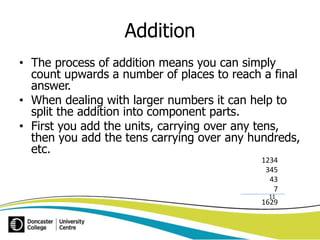
• The process of addition means you can simply 
count upwards a number of places to reach a final 
answer. 
• When dealing with larger numbers it can help to 
split the addition into component parts. 
• First you add the units, carrying over any tens, 
then you add the tens carrying over any hundreds, 
etc. 
1234 
345 
43 
7 
11 
1629
Addition 
• See if you can perform these simple additions. 
 17 + 8 
 23 + 15 
 9 + 14 
 41 + 34 
 12 + 5 
 18 + 33 
 19 + 47 
 35 + 21 
 25 + 6 
 5041 + 897 
 4327 + 421 
 5674 + 672 
 3997 + 212 
 0.034 + 0.4 
 0.5 + 0.21 
 0.04 + 0.07 
 325.7 + 3.4 
 0.1 + 0.01
Addition 
• See if you can perform these simple additions. 
 17 + 8 
 23 + 15 
 9 + 14 
 41 + 34 
 12 + 5 
 18 + 33 
 19 + 47 
 35 + 21 
 25 + 6 
 25 
 38 
 23 
 75 
 17 
 51 
 66 
 56 
 31 
 5041 + 897 
 4327 + 421 
 5674 + 672 
 3997 + 212 
 0.034 + 0.4 
 0.5 + 0.21 
 0.04 + 0.07 
 325.7 + 3.4 
 0.1 + 0.01 
 5938 
 4748 
 6346 
 4209 
 0.434 
 0.71 
 0.11 
 329.1 
 0.11
Addition 
• You had five days until your brother was due to be 
coming over to stay. Unfortunately he has had to 
postpone for another full week. How many days 
will it be before he arrives? 
• You receive a £60 fine in the post. You decide to 
take the matter to court but things go badly. You 
are asked to pay the original fine plus £125 in 
court costs. How much are you required to pay? 
y
Addition 
• You had five days until your brother was due to be 
coming over to stay. Unfortunately he has had to 
postpone for another full week. How many days 
will it be before he arrives? 
• 5 + 7 = 12 days 
• You receive a £60 fine in the post. You decide to 
take the matter to court but things go badly. You 
are asked to pay the original fine plus £125 in 
court costs. How much are you required to pay? 
• £185
Subtraction 
• Subtraction simply involves counting one number 
off of another. 
• Subtraction is literally the reverse of addition. 
• Like addition, when dealing with large pools of 
numbers, clerical errors can easily occur. 
• Subtraction can be tricky if the number you are 
subtracting from is smaller than the number you 
are using to do the subtraction. 
• Subtraction is something you are likely to use on 
regular basis when trying to budget.
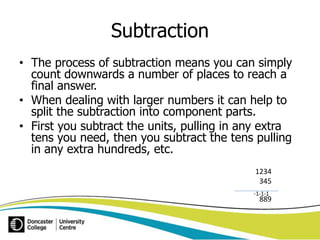
Subtraction 
• The process of subtraction means you can simply 
count downwards a number of places to reach a 
final answer. 
• When dealing with larger numbers it can help to 
split the subtraction into component parts. 
• First you subtract the units, pulling in any extra 
tens you need, then you subtract the tens pulling 
in any extra hundreds, etc. 
1234 
345 
-1-1-1 
889
Subtraction 
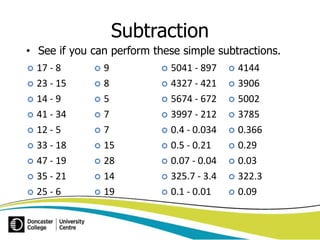
• See if you can perform these simple subtractions. 
 17 - 8 
 23 - 15 
 14 - 9 
 41 - 34 
 12 - 5 
 33 - 18 
 47 - 19 
 35 - 21 
 25 - 6 
 5041 - 897 
 4327 - 421 
 5674 - 672 
 3997 - 212 
 0.4 - 0.034 
 0.5 - 0.21 
 0.07 - 0.04 
 325.7 - 3.4 
 0.1 - 0.01
Subtraction 
• See if you can perform these simple subtractions. 
 17 - 8 
 23 - 15 
 14 - 9 
 41 - 34 
 12 - 5 
 33 - 18 
 47 - 19 
 35 - 21 
 25 - 6 
 9 
 8 
 5 
 7 
 7 
 15 
 28 
 14 
 19 
 5041 - 897 
 4327 - 421 
 5674 - 672 
 3997 - 212 
 0.4 - 0.034 
 0.5 - 0.21 
 0.07 - 0.04 
 325.7 - 3.4 
 0.1 - 0.01 
 4144 
 3906 
 5002 
 3785 
 0.366 
 0.29 
 0.03 
 322.3 
 0.09
Subtraction 
• You are cooking yourself dinner and following the 
recipe you placed the casserole dish in the oven at 
150oC. The recipe says to leave the dish in the 
oven for 2 hours. If it has been in the oven 
already for 25 minutes how long is left? 
• You are at the swimming pool doing lengths. You 
have set yourself a target of 50 lengths and have 
so far completed 36. How many more lengths 
must you complete to reach your target? 
y
Subtraction 
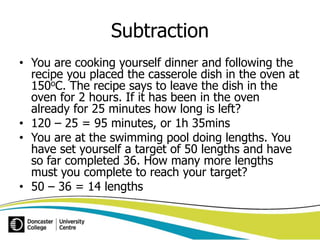
• You are cooking yourself dinner and following the 
recipe you placed the casserole dish in the oven at 
150oC. The recipe says to leave the dish in the 
oven for 2 hours. If it has been in the oven 
already for 25 minutes how long is left? 
• 120 – 25 = 95 minutes, or 1h 35mins 
• You are at the swimming pool doing lengths. You 
have set yourself a target of 50 lengths and have 
so far completed 36. How many more lengths 
must you complete to reach your target? 
• 50 – 36 = 14 lengths
Multiplication 
• Multiplication can be described as performing a 
number of additions simultaneously when all the 
values being added together are the same. 
• Another way to look at multiplication is to imagine 
you have a number of groups of equal value and 
that you are trying to find the collective total 
value. 
• When performing multiplication it doesn’t matter 
which way you look at it, the total value of six 
groups of four is the same as the total value of 
four groups of six.
Multiplication 
• As a process multiplication is simply a matter of 
carrying out a repeated addition. If you have 
seven groups of five, then five plus five is ten. 
Plus five is fifteen. Plus five is twenty. Plus five is 
twenty five. Plus five is thirty. Plus five is thirty 
five. 
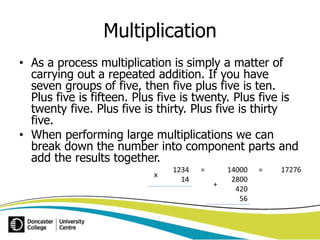
• When performing large multiplications we can 
break down the number into component parts and 
add the results together. 
1234 
14 
14000 
2800 
420 
56 
= 17276 
x 
= 
+
Multiplication 
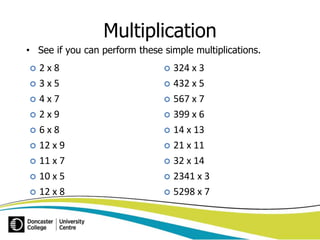
• See if you can perform these simple multiplications. 
 2 x 8 
 3 x 5 
 4 x 7 
 2 x 9 
 6 x 8 
 12 x 9 
 11 x 7 
 10 x 5 
 12 x 8 
 324 x 3 
 432 x 5 
 567 x 7 
 399 x 6 
 14 x 13 
 21 x 11 
 32 x 14 
 2341 x 3 
 5298 x 7
Multiplication 
• See if you can perform these simple multiplications. 
 2 x 8 
 3 x 5 
 4 x 7 
 2 x 9 
 6 x 8 
 12 x 9 
 11 x 7 
 10 x 5 
 12 x 8 
 16 
 15 
 28 
 18 
 48 
 108 
 77 
 50 
 96 
 324 x 3 
 432 x 5 
 567 x 7 
 399 x 6 
 14 x 13 
 21 x 11 
 32 x 14 
 2341 x 3 
 5298 x 7 
 972 
 2160 
 3969 
 2394 
 182 
 231 
 448 
 7023 
 37086
Multiplication 
• You need to buy three packs of soft white rolls for a 
barbeque you are having. Each pack costs £1.56, what 
is the total cost? 
• Each pack contains twelve rolls. How many rolls would 
have in total? 
• You are making the rolls and then cutting them into 
four and putting them out on plates so people can 
help themselves. How many portions are available?
Multiplication 
• You need to buy three packs of soft white rolls for a 
barbeque you are having. Each pack costs £1.56, what 
is the total cost? 
• 1.56 x 3 = £4.68 
• Each pack contains twelve rolls. How many rolls would 
have in total? 
• 12 x 3 = 36 rolls 
• You are making the rolls and then cutting them into 
four and putting them out on plates so people can 
help themselves. How many portions are available? 
• 36 x 4 = 144 portions
Division 
• Division is the reverse of multiplication, when you 
try to establish what number would be required to 
be added together x number of times to arrive at 
your answer. 
• Another way to look at division is to imagine you 
are trying to split a large value into a number of 
groups of equal value. 
• When performing division it does matter which 
way you look at it, splitting twenty four into six 
groups is not the same as splitting six into twenty 
four groups.
Division 
• The process of division involves splitting the number 
into equal groups. Checking how many times one 
number can fit inside another will tell you how many 
groups you can have. e.g. 4 fits inside 8 twice, so you 
could have 4 groups of 2. 
• When performing division with larger numbers it is 
easiest to work from the largest component of the 
number to the smallest. 
• Often when performing division you will be left with a 
remainder. In maths this can be expressed as a 
fraction or a decimal but sometimes in practical terms 
it is not possible to make use of the remainder.
Division 
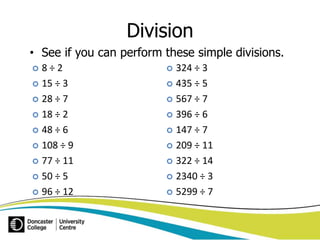
• See if you can perform these simple divisions. 
 8 ÷ 2 
 15 ÷ 3 
 28 ÷ 7 
 18 ÷ 2 
 48 ÷ 6 
 108 ÷ 9 
 77 ÷ 11 
 50 ÷ 5 
 96 ÷ 12 
 324 ÷ 3 
 435 ÷ 5 
 567 ÷ 7 
 396 ÷ 6 
 147 ÷ 7 
 209 ÷ 11 
 322 ÷ 14 
 2340 ÷ 3 
 5299 ÷ 7
Division 
• See if you can perform these simple divisions. 
 8 ÷ 2 
 15 ÷ 3 
 28 ÷ 7 
 18 ÷ 2 
 48 ÷ 6 
 108 ÷ 9 
 77 ÷ 11 
 50 ÷ 5 
 96 ÷ 12 
 4 
 5 
 4 
 9 
 8 
 12 
 7 
 10 
 8 
 324 ÷ 3 
 435 ÷ 5 
 567 ÷ 7 
 396 ÷ 6 
 147 ÷ 7 
 209 ÷ 11 
 322 ÷ 14 
 2340 ÷ 3 
 5299 ÷ 7 
 108 
 87 
 81 
 66 
 21 
 19 
 23 
 780 
 757
Division 
• You are hosting a children’s birthday party for 32 
children and have 4 cakes. How many portions should 
each cake be split into? 
• Your lottery syndicate of 12 members wins £96.12. 
How much should each member receive? 
• You are trying to work out how much you would have 
to put aside each week to raise £1400 in three years. 
What is the correct amount? 
r
Division 
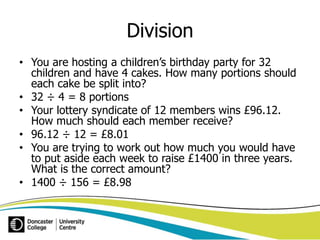
• You are hosting a children’s birthday party for 32 
children and have 4 cakes. How many portions should 
each cake be split into? 
• 32 ÷ 4 = 8 portions 
• Your lottery syndicate of 12 members wins £96.12. 
How much should each member receive? 
• 96.12 ÷ 12 = £8.01 
• You are trying to work out how much you would have 
to put aside each week to raise £1400 in three years. 
What is the correct amount? 
• 1400 ÷ 156 = £8.98
Arithmetic and Functional Skills 
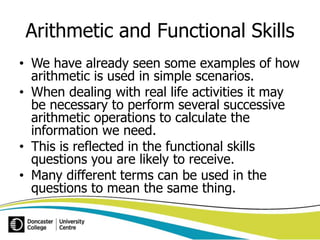
• We have already seen some examples of how 
arithmetic is used in simple scenarios. 
• When dealing with real life activities it may 
be necessary to perform several successive 
arithmetic operations to calculate the 
information we need. 
• This is reflected in the functional skills 
questions you are likely to receive. 
• Many different terms can be used in the 
questions to mean the same thing.
Functional Skills Example 
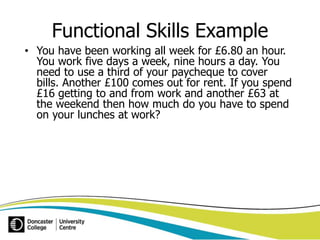
• You have been working all week for £6.80 an hour. 
You work five days a week, nine hours a day. You 
need to use a third of your paycheque to cover 
bills. Another £100 comes out for rent. If you spend 
£16 getting to and from work and another £63 at 
the weekend then how much do you have to spend 
on your lunches at work?
Functional Skills Example 
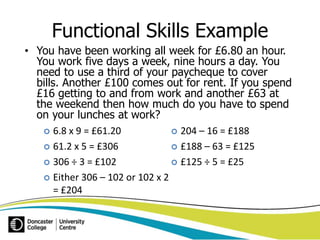
• You have been working all week for £6.80 an hour. 
You work five days a week, nine hours a day. You 
need to use a third of your paycheque to cover 
bills. Another £100 comes out for rent. If you spend 
£16 getting to and from work and another £63 at 
the weekend then how much do you have to spend 
on your lunches at work? 
 6.8 x 9 = £61.20 
 61.2 x 5 = £306 
 306 ÷ 3 = £102 
 Either 306 – 102 or 102 x 2 
= £204 
 204 – 16 = £188 
 £188 – 63 = £125 
 £125 ÷ 5 = £25
Functional Skills Example 
 You are baking for a party and you want to make sure you 
have enough cake for everyone. Their will be 22 people 
attending plus you and your partner. Each cake serves four 
people and requires 3 eggs to make. Eggs are sold at the local 
shop by the half dozen with a buy 2 get 1 free offer. If a 
carton of eggs costs 63 pence then how much will you have 
to spend on eggs to ensure you have enough?
Functional Skills Example 
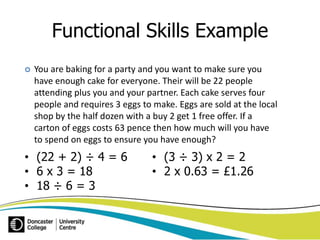
 You are baking for a party and you want to make sure you 
have enough cake for everyone. Their will be 22 people 
attending plus you and your partner. Each cake serves four 
people and requires 3 eggs to make. Eggs are sold at the local 
shop by the half dozen with a buy 2 get 1 free offer. If a 
carton of eggs costs 63 pence then how much will you have 
to spend on eggs to ensure you have enough? 
• (22 + 2) ÷ 4 = 6 
• 6 x 3 = 18 
• 18 ÷ 6 = 3 
• (3 ÷ 3) x 2 = 2 
• 2 x 0.63 = £1.26

Arithmetic

  • 1.
    Arithmetic Addition, Subtraction, Multiplication and Division
  • 2.
    Arithmetic • Arithmeticrefers to the basic mathematical operations from which all other mathematics is derived. • The most basic operation is addition. This is where you add one value to another. • The opposite of addition is subtraction. This is where you take one value from another. • Next we have multiplication, where you have a number of values which are all the same and you work out the total value. • And finally division, where you have one value which you wish to split into a number of portions, each of equal value.
  • 3.
    Addition • Themost basic of operations, addition, simply involves taking the total of two or more values. • The simplest way to do this is to count on from one value a number of spaces equal to the first. • All mathematics is built upon the principle that 1 + 1 = 2. (Or 1 + 1 = 10, same thing). • When working with particularly large or particularly small numbers addition can be quite tricky. • When adding large pools of numbers together it can be quite easily to make a simple clerical error.
  • 4.
    Addition • Theprocess of addition means you can simply count upwards a number of places to reach a final answer. • When dealing with larger numbers it can help to split the addition into component parts. • First you add the units, carrying over any tens, then you add the tens carrying over any hundreds, etc. 1234 345 43 7 11 1629
  • 5.
    Addition • Seeif you can perform these simple additions.  17 + 8  23 + 15  9 + 14  41 + 34  12 + 5  18 + 33  19 + 47  35 + 21  25 + 6  5041 + 897  4327 + 421  5674 + 672  3997 + 212  0.034 + 0.4  0.5 + 0.21  0.04 + 0.07  325.7 + 3.4  0.1 + 0.01
  • 6.
    Addition • Seeif you can perform these simple additions.  17 + 8  23 + 15  9 + 14  41 + 34  12 + 5  18 + 33  19 + 47  35 + 21  25 + 6  25  38  23  75  17  51  66  56  31  5041 + 897  4327 + 421  5674 + 672  3997 + 212  0.034 + 0.4  0.5 + 0.21  0.04 + 0.07  325.7 + 3.4  0.1 + 0.01  5938  4748  6346  4209  0.434  0.71  0.11  329.1  0.11
  • 7.
    Addition • Youhad five days until your brother was due to be coming over to stay. Unfortunately he has had to postpone for another full week. How many days will it be before he arrives? • You receive a £60 fine in the post. You decide to take the matter to court but things go badly. You are asked to pay the original fine plus £125 in court costs. How much are you required to pay? y
  • 8.
    Addition • Youhad five days until your brother was due to be coming over to stay. Unfortunately he has had to postpone for another full week. How many days will it be before he arrives? • 5 + 7 = 12 days • You receive a £60 fine in the post. You decide to take the matter to court but things go badly. You are asked to pay the original fine plus £125 in court costs. How much are you required to pay? • £185
  • 9.
    Subtraction • Subtractionsimply involves counting one number off of another. • Subtraction is literally the reverse of addition. • Like addition, when dealing with large pools of numbers, clerical errors can easily occur. • Subtraction can be tricky if the number you are subtracting from is smaller than the number you are using to do the subtraction. • Subtraction is something you are likely to use on regular basis when trying to budget.
  • 10.
    Subtraction • Theprocess of subtraction means you can simply count downwards a number of places to reach a final answer. • When dealing with larger numbers it can help to split the subtraction into component parts. • First you subtract the units, pulling in any extra tens you need, then you subtract the tens pulling in any extra hundreds, etc. 1234 345 -1-1-1 889
  • 11.
    Subtraction • Seeif you can perform these simple subtractions.  17 - 8  23 - 15  14 - 9  41 - 34  12 - 5  33 - 18  47 - 19  35 - 21  25 - 6  5041 - 897  4327 - 421  5674 - 672  3997 - 212  0.4 - 0.034  0.5 - 0.21  0.07 - 0.04  325.7 - 3.4  0.1 - 0.01
  • 12.
    Subtraction • Seeif you can perform these simple subtractions.  17 - 8  23 - 15  14 - 9  41 - 34  12 - 5  33 - 18  47 - 19  35 - 21  25 - 6  9  8  5  7  7  15  28  14  19  5041 - 897  4327 - 421  5674 - 672  3997 - 212  0.4 - 0.034  0.5 - 0.21  0.07 - 0.04  325.7 - 3.4  0.1 - 0.01  4144  3906  5002  3785  0.366  0.29  0.03  322.3  0.09
  • 13.
    Subtraction • Youare cooking yourself dinner and following the recipe you placed the casserole dish in the oven at 150oC. The recipe says to leave the dish in the oven for 2 hours. If it has been in the oven already for 25 minutes how long is left? • You are at the swimming pool doing lengths. You have set yourself a target of 50 lengths and have so far completed 36. How many more lengths must you complete to reach your target? y
  • 14.
    Subtraction • Youare cooking yourself dinner and following the recipe you placed the casserole dish in the oven at 150oC. The recipe says to leave the dish in the oven for 2 hours. If it has been in the oven already for 25 minutes how long is left? • 120 – 25 = 95 minutes, or 1h 35mins • You are at the swimming pool doing lengths. You have set yourself a target of 50 lengths and have so far completed 36. How many more lengths must you complete to reach your target? • 50 – 36 = 14 lengths
  • 15.
    Multiplication • Multiplicationcan be described as performing a number of additions simultaneously when all the values being added together are the same. • Another way to look at multiplication is to imagine you have a number of groups of equal value and that you are trying to find the collective total value. • When performing multiplication it doesn’t matter which way you look at it, the total value of six groups of four is the same as the total value of four groups of six.
  • 16.
    Multiplication • Asa process multiplication is simply a matter of carrying out a repeated addition. If you have seven groups of five, then five plus five is ten. Plus five is fifteen. Plus five is twenty. Plus five is twenty five. Plus five is thirty. Plus five is thirty five. • When performing large multiplications we can break down the number into component parts and add the results together. 1234 14 14000 2800 420 56 = 17276 x = +
  • 17.
    Multiplication • Seeif you can perform these simple multiplications.  2 x 8  3 x 5  4 x 7  2 x 9  6 x 8  12 x 9  11 x 7  10 x 5  12 x 8  324 x 3  432 x 5  567 x 7  399 x 6  14 x 13  21 x 11  32 x 14  2341 x 3  5298 x 7
  • 18.
    Multiplication • Seeif you can perform these simple multiplications.  2 x 8  3 x 5  4 x 7  2 x 9  6 x 8  12 x 9  11 x 7  10 x 5  12 x 8  16  15  28  18  48  108  77  50  96  324 x 3  432 x 5  567 x 7  399 x 6  14 x 13  21 x 11  32 x 14  2341 x 3  5298 x 7  972  2160  3969  2394  182  231  448  7023  37086
  • 19.
    Multiplication • Youneed to buy three packs of soft white rolls for a barbeque you are having. Each pack costs £1.56, what is the total cost? • Each pack contains twelve rolls. How many rolls would have in total? • You are making the rolls and then cutting them into four and putting them out on plates so people can help themselves. How many portions are available?
  • 20.
    Multiplication • Youneed to buy three packs of soft white rolls for a barbeque you are having. Each pack costs £1.56, what is the total cost? • 1.56 x 3 = £4.68 • Each pack contains twelve rolls. How many rolls would have in total? • 12 x 3 = 36 rolls • You are making the rolls and then cutting them into four and putting them out on plates so people can help themselves. How many portions are available? • 36 x 4 = 144 portions
  • 21.
    Division • Divisionis the reverse of multiplication, when you try to establish what number would be required to be added together x number of times to arrive at your answer. • Another way to look at division is to imagine you are trying to split a large value into a number of groups of equal value. • When performing division it does matter which way you look at it, splitting twenty four into six groups is not the same as splitting six into twenty four groups.
  • 22.
    Division • Theprocess of division involves splitting the number into equal groups. Checking how many times one number can fit inside another will tell you how many groups you can have. e.g. 4 fits inside 8 twice, so you could have 4 groups of 2. • When performing division with larger numbers it is easiest to work from the largest component of the number to the smallest. • Often when performing division you will be left with a remainder. In maths this can be expressed as a fraction or a decimal but sometimes in practical terms it is not possible to make use of the remainder.
  • 23.
    Division • Seeif you can perform these simple divisions.  8 ÷ 2  15 ÷ 3  28 ÷ 7  18 ÷ 2  48 ÷ 6  108 ÷ 9  77 ÷ 11  50 ÷ 5  96 ÷ 12  324 ÷ 3  435 ÷ 5  567 ÷ 7  396 ÷ 6  147 ÷ 7  209 ÷ 11  322 ÷ 14  2340 ÷ 3  5299 ÷ 7
  • 24.
    Division • Seeif you can perform these simple divisions.  8 ÷ 2  15 ÷ 3  28 ÷ 7  18 ÷ 2  48 ÷ 6  108 ÷ 9  77 ÷ 11  50 ÷ 5  96 ÷ 12  4  5  4  9  8  12  7  10  8  324 ÷ 3  435 ÷ 5  567 ÷ 7  396 ÷ 6  147 ÷ 7  209 ÷ 11  322 ÷ 14  2340 ÷ 3  5299 ÷ 7  108  87  81  66  21  19  23  780  757
  • 25.
    Division • Youare hosting a children’s birthday party for 32 children and have 4 cakes. How many portions should each cake be split into? • Your lottery syndicate of 12 members wins £96.12. How much should each member receive? • You are trying to work out how much you would have to put aside each week to raise £1400 in three years. What is the correct amount? r
  • 26.
    Division • Youare hosting a children’s birthday party for 32 children and have 4 cakes. How many portions should each cake be split into? • 32 ÷ 4 = 8 portions • Your lottery syndicate of 12 members wins £96.12. How much should each member receive? • 96.12 ÷ 12 = £8.01 • You are trying to work out how much you would have to put aside each week to raise £1400 in three years. What is the correct amount? • 1400 ÷ 156 = £8.98
  • 27.
    Arithmetic and FunctionalSkills • We have already seen some examples of how arithmetic is used in simple scenarios. • When dealing with real life activities it may be necessary to perform several successive arithmetic operations to calculate the information we need. • This is reflected in the functional skills questions you are likely to receive. • Many different terms can be used in the questions to mean the same thing.
  • 28.
    Functional Skills Example • You have been working all week for £6.80 an hour. You work five days a week, nine hours a day. You need to use a third of your paycheque to cover bills. Another £100 comes out for rent. If you spend £16 getting to and from work and another £63 at the weekend then how much do you have to spend on your lunches at work?
  • 29.
    Functional Skills Example • You have been working all week for £6.80 an hour. You work five days a week, nine hours a day. You need to use a third of your paycheque to cover bills. Another £100 comes out for rent. If you spend £16 getting to and from work and another £63 at the weekend then how much do you have to spend on your lunches at work?  6.8 x 9 = £61.20  61.2 x 5 = £306  306 ÷ 3 = £102  Either 306 – 102 or 102 x 2 = £204  204 – 16 = £188  £188 – 63 = £125  £125 ÷ 5 = £25
  • 30.
    Functional Skills Example  You are baking for a party and you want to make sure you have enough cake for everyone. Their will be 22 people attending plus you and your partner. Each cake serves four people and requires 3 eggs to make. Eggs are sold at the local shop by the half dozen with a buy 2 get 1 free offer. If a carton of eggs costs 63 pence then how much will you have to spend on eggs to ensure you have enough?
  • 31.
    Functional Skills Example  You are baking for a party and you want to make sure you have enough cake for everyone. Their will be 22 people attending plus you and your partner. Each cake serves four people and requires 3 eggs to make. Eggs are sold at the local shop by the half dozen with a buy 2 get 1 free offer. If a carton of eggs costs 63 pence then how much will you have to spend on eggs to ensure you have enough? • (22 + 2) ÷ 4 = 6 • 6 x 3 = 18 • 18 ÷ 6 = 3 • (3 ÷ 3) x 2 = 2 • 2 x 0.63 = £1.26