ELEV8
AmeriCorps Seminar
 November 16, 2012
What are the
Multiplication Basic Facts?
All combinations of single digit factors
 (0 - 9)
How many multiplication basic facts are there?
C-R-A Sequence
CONCRETE-REPRESENTATIONAL-ABSTRACT


Enables students to understand the concepts of
 mathematics prior to memorizing facts, algorithms,
 and operations.
CONCRETE
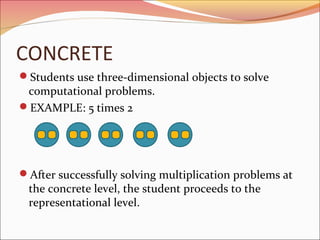
Students use three-dimensional objects to solve
 computational problems.
EXAMPLE: 5 times 2


After successfully solving multiplication problems at
 the concrete level, the student proceeds to the
 representational level.
REPRESENTATIONAL
Two-dimensional drawings are used to solve
 computational problems.
EXAMPLE: 7 times 3
 √√√
 √√√
 √√√
 √√√
 √√√
 √√√
 √√√
ABSTRACT
The student looks at the computation problem and
 tries to solve it without using objects or drawings.
The student reads the problem, remembers the
 answer, or thinks of a way to compute the answer,
 and writes the answer.
No objects or drawings are used unless the student is
 unable to solve the problem.
What Does It Mean to Understand the
Concept of Multiplication?
Equal groups
  3 bags of 5 cookies
Array/area
  3 rows with 5 seats in each row
Combinations
  Outfits made from 3 shirts and 5 pairs of pants
Multiplicative comparison
  Mike ate 5 cookies. Steve ate 3 times as many cookies
   as Mike did.
Thinking Strategies
Scaffold to support memorization
Include properties
  Zero, One, Commutative, Distributive
Include patterns and strategies
  Fives, Nines
  Skip counting
Practice Strategies
Games
Computer software
Flash cards
And more . . .
Assess What Facts
Students Know
Give students a page of basic facts problems
  “Just do the ones that are easy for you”
Examine the results to get a sense of where the
 class as a whole is.
Focus on what students do know through a
 lesson that analyzes the multiplication chart.
Have students keep a self-assessment chart,
 shading in the facts they know.
Thinking Strategies
Using Properties
Zero Property
Multiplicative Identity (One)
Commutative Property
Distributive Property
Zeros
 Zero Property:
  Multiplying any number
  by zero is equal to zero.
 “0 groups of __” or “__
  groups of 0”
  CA Standard 3.2.6 NS:
   “Understand the special
   properties of zero and one in
   multiplication.”
 Facts remaining:
   100 - 19 = 81
Ones
 Identity Element:
  Multiplying any number
  by one is equal to that
  number.
 “1 groups of __” or “__
  groups of 1”
  CA Standard 3.2.6 NS:
   “Understand the special
   properties of zero and one in
   multiplication.”
 Facts remaining:
   81 - 17 = 64
Twos
 The skip counting
  strategy helps students
  find the multiples of
  two.
 Facts remaining:
  64 - 15 = 49
Fives
 The skip counting
  strategy also helps
  students find the
  multiples of five.
 Help students realize
  what they already
  know.
 Facts remaining:
  49 - 13 = 36
Nines
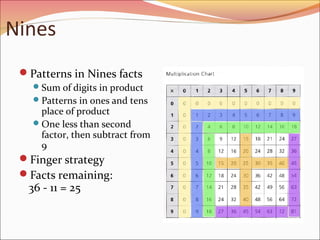
 Patterns in Nines facts
    Sum of digits in product
    Patterns in ones and tens
     place of product
    One less than second
     factor, then subtract from
     9
 Finger strategy
 Facts remaining:
  36 - 11 = 25
Commutative Property
“Turn-around” strategy
Definition of Commutative Property: numbers can be
 multiplied in any order and get the same result.
CA Standard 3.1.5 AF: “Recognize and use the
 commutative and associative properties of
 multiplication.”
The Commutative Property
Cuts the Job in Half!
  Only 20 facts left that
  can’t be “reasoned to” by
  using 0’s, 1’s, 2’s, 5’s, 9’s
  and Squares.
  After “commuting” or
  “turning around” the
  factors, only 10 tough facts
  remain!
  4x3
  6x3     6x4
  7x3     7x4     7x6
  8x3     8x4     8x6     8x7
Distributive Property
“Break-apart” strategy: you can separate a
 multiplication problem into two parts. For
 example, you can break up the first factor
 (number of groups or rows) into two parts.
  7 x 8 = (5 x 8) + (2 x 8)
  7 groups of 8 = 5 groups of 8 plus 2 groups of 8
Use known facts to get to unknown facts.
CA Standard 5.2.3AF: “Know and use the
 distributive property in equations and expressions
 with variables.”
Distributive Property
 Break up the first factor
   (number of groups or
   rows) into two parts.
  You can think, “6 rows of 7 is the
   same as 5 rows of 7 and
   1 more row of 7.”
 6 x 7 = (5 x 7) + (1 x 7)
Thinking Strategies Based on the
Distributive Property
    Use the “Facts of Five” to find Sixes:
            6 x 3= (5 x 3) + (1 x 3)
    You can think “6 x 3 means 5 groups of 3
             and 1 more group of 3”
            6 x 4= (5 x 4) + (1 x 4)
            6 x 7= (5 x 7) + (1 x 7)
           6 x 8 = (5 x 8) + (1 x 8)
        These are 4 of the 10 tough facts!
More Distributive Strategies
      • Use the “Facts of Five” to find Fours:
              4 x 6 = (5 x 6) - (1 x 6)
 You can think“4 groups of 6 = 5 groups of 6 minus 1
                     group of 6”.
               4 x 7 = (5 x 7) - (1 x 7)
              4 x 8 = (5 x 8) - (1 x 8)
            Three more of the tough facts!
Breaking Apart the Sevens
      Use the “Facts of Five” to find Sevens:
             7 x 3 = (5 x 3) + (2 x 3)
      You can think “7 x 3 means 5 groups of 3
              and 2 more groups of 3”
             7 x 4 = (5 x 4) + (2 x 4)
             7 x 6 = (5 x 6) + (2 x 6)
             7 x 8 = (5 x 8) + (2 x 8)
CA MR1.2 Determine when and how to break a problem
 into simpler parts.
Halving then Doubling
  If one factor is even, break it in half, multiply
                   it, then double it:
                  4 x 3 = (2 x 3) x 2
          You can think “To find 4 groups of 3,
            find 2 groups of 3 and double it.”
                  8 x 3 = (4 x 3) x 2
                  4 x 8 = (2 x 8) x 2
                  6 x 8 = (3 x 8) x 2
                  8 x 7 = (4 x 7) x 2
 This strategy is based on the Associative Property.
The CA Reasoning Standards
1.1   Analyze problems by identifying
      relationships, distinguishing relevant from
      irrelevant information, sequencing and
      prioritizing information, and observing
      patterns.
1.2 Determine when and how to break a problem
    into simpler parts.
2.2 Apply strategies and results from simpler
     problems to more complex problems.
The Common Core Standards
“Through skip counting, using area models, and
relating unknown combinations to known ones,
students will learn and become fluent with unfamiliar
combinations. For example, 3 x 4 is the same as 4 x 3;
6 x 5 is 5 more than 5 x 5; 6 x 8 is double 3 x 8.”
(Common Core Principles and Standards)
Practice Strategies
Games
 Examples:
     Circles and Stars
     The Array Game
     24 Game

Computer software
Flash cards
What are your most effective practice strategies?
The Array Game
Materials: Grid paper, Colored pencils, Dice
Object:          Fill the grid with arrays generated by
 rolling dice. Score by adding the products.
Multi-level:      Adjust the rules for generating
 factors and how the grid is to be filled to increase
 complexity.
Closing Comments
Timed tests don’t teach!
Link with division
  Fact families as a concept, not just a procedure
Linking reasoning with learning basic facts
 accomplishes many objectives at once!
References and Resources
 M. Burns (1991). Math by All Means: Multiplication Grade 3. New Rochelle,
  NY: Cuisenaire.
 L. Childs & L. Choate (1998). Nimble with Numbers (grades 1-2, 2-3, 3-4, 4-5, 5-
  6, 6-7). Palo Alto: Dale Seymour.
 J. Hulme (1991). Sea Squares. New York: Hyperion.
 L. Leutzinger (1999). Facts that Last. Chicago: Creative Publications.
 Tang, G. (2002). The Best of Times, New York: Scholastic Publications.
 Wickett & Burns (2001). Lessons for Extending Multiplication. Sausalito, CA
  Math Solutions Publications.
 24 Game: Suntex International

Contact us:   nbezuk@mail.sdsu.edu        moriarty@mail.sdsu.edu

Mathematical reasoning

  • 1.
  • 2.
    What are the MultiplicationBasic Facts? All combinations of single digit factors (0 - 9) How many multiplication basic facts are there?
  • 3.
    C-R-A Sequence CONCRETE-REPRESENTATIONAL-ABSTRACT Enables studentsto understand the concepts of mathematics prior to memorizing facts, algorithms, and operations.
  • 4.
    CONCRETE Students use three-dimensionalobjects to solve computational problems. EXAMPLE: 5 times 2 After successfully solving multiplication problems at the concrete level, the student proceeds to the representational level.
  • 5.
    REPRESENTATIONAL Two-dimensional drawings areused to solve computational problems. EXAMPLE: 7 times 3 √√√ √√√ √√√ √√√ √√√ √√√ √√√
  • 6.
    ABSTRACT The student looksat the computation problem and tries to solve it without using objects or drawings. The student reads the problem, remembers the answer, or thinks of a way to compute the answer, and writes the answer. No objects or drawings are used unless the student is unable to solve the problem.
  • 7.
    What Does ItMean to Understand the Concept of Multiplication? Equal groups 3 bags of 5 cookies Array/area 3 rows with 5 seats in each row Combinations Outfits made from 3 shirts and 5 pairs of pants Multiplicative comparison Mike ate 5 cookies. Steve ate 3 times as many cookies as Mike did.
  • 8.
    Thinking Strategies Scaffold tosupport memorization Include properties Zero, One, Commutative, Distributive Include patterns and strategies Fives, Nines Skip counting
  • 9.
  • 10.
    Assess What Facts StudentsKnow Give students a page of basic facts problems “Just do the ones that are easy for you” Examine the results to get a sense of where the class as a whole is. Focus on what students do know through a lesson that analyzes the multiplication chart. Have students keep a self-assessment chart, shading in the facts they know.
  • 11.
    Thinking Strategies Using Properties ZeroProperty Multiplicative Identity (One) Commutative Property Distributive Property
  • 12.
    Zeros Zero Property: Multiplying any number by zero is equal to zero. “0 groups of __” or “__ groups of 0”  CA Standard 3.2.6 NS: “Understand the special properties of zero and one in multiplication.” Facts remaining: 100 - 19 = 81
  • 13.
    Ones Identity Element: Multiplying any number by one is equal to that number. “1 groups of __” or “__ groups of 1”  CA Standard 3.2.6 NS: “Understand the special properties of zero and one in multiplication.” Facts remaining: 81 - 17 = 64
  • 14.
    Twos The skipcounting strategy helps students find the multiples of two. Facts remaining: 64 - 15 = 49
  • 15.
    Fives The skipcounting strategy also helps students find the multiples of five. Help students realize what they already know. Facts remaining: 49 - 13 = 36
  • 16.
    Nines Patterns inNines facts  Sum of digits in product  Patterns in ones and tens place of product  One less than second factor, then subtract from 9 Finger strategy Facts remaining: 36 - 11 = 25
  • 17.
    Commutative Property “Turn-around” strategy Definitionof Commutative Property: numbers can be multiplied in any order and get the same result. CA Standard 3.1.5 AF: “Recognize and use the commutative and associative properties of multiplication.”
  • 18.
    The Commutative Property Cutsthe Job in Half! Only 20 facts left that can’t be “reasoned to” by using 0’s, 1’s, 2’s, 5’s, 9’s and Squares. After “commuting” or “turning around” the factors, only 10 tough facts remain! 4x3 6x3 6x4 7x3 7x4 7x6 8x3 8x4 8x6 8x7
  • 19.
    Distributive Property “Break-apart” strategy:you can separate a multiplication problem into two parts. For example, you can break up the first factor (number of groups or rows) into two parts. 7 x 8 = (5 x 8) + (2 x 8) 7 groups of 8 = 5 groups of 8 plus 2 groups of 8 Use known facts to get to unknown facts. CA Standard 5.2.3AF: “Know and use the distributive property in equations and expressions with variables.”
  • 20.
    Distributive Property Breakup the first factor (number of groups or rows) into two parts.  You can think, “6 rows of 7 is the same as 5 rows of 7 and 1 more row of 7.” 6 x 7 = (5 x 7) + (1 x 7)
  • 21.
    Thinking Strategies Basedon the Distributive Property Use the “Facts of Five” to find Sixes: 6 x 3= (5 x 3) + (1 x 3) You can think “6 x 3 means 5 groups of 3 and 1 more group of 3” 6 x 4= (5 x 4) + (1 x 4) 6 x 7= (5 x 7) + (1 x 7) 6 x 8 = (5 x 8) + (1 x 8) These are 4 of the 10 tough facts!
  • 22.
    More Distributive Strategies • Use the “Facts of Five” to find Fours: 4 x 6 = (5 x 6) - (1 x 6) You can think“4 groups of 6 = 5 groups of 6 minus 1 group of 6”. 4 x 7 = (5 x 7) - (1 x 7) 4 x 8 = (5 x 8) - (1 x 8) Three more of the tough facts!
  • 23.
    Breaking Apart theSevens Use the “Facts of Five” to find Sevens: 7 x 3 = (5 x 3) + (2 x 3) You can think “7 x 3 means 5 groups of 3 and 2 more groups of 3” 7 x 4 = (5 x 4) + (2 x 4) 7 x 6 = (5 x 6) + (2 x 6) 7 x 8 = (5 x 8) + (2 x 8) CA MR1.2 Determine when and how to break a problem into simpler parts.
  • 24.
    Halving then Doubling If one factor is even, break it in half, multiply it, then double it: 4 x 3 = (2 x 3) x 2 You can think “To find 4 groups of 3, find 2 groups of 3 and double it.” 8 x 3 = (4 x 3) x 2 4 x 8 = (2 x 8) x 2 6 x 8 = (3 x 8) x 2 8 x 7 = (4 x 7) x 2 This strategy is based on the Associative Property.
  • 25.
    The CA ReasoningStandards 1.1 Analyze problems by identifying relationships, distinguishing relevant from irrelevant information, sequencing and prioritizing information, and observing patterns. 1.2 Determine when and how to break a problem into simpler parts. 2.2 Apply strategies and results from simpler problems to more complex problems.
  • 26.
    The Common CoreStandards “Through skip counting, using area models, and relating unknown combinations to known ones, students will learn and become fluent with unfamiliar combinations. For example, 3 x 4 is the same as 4 x 3; 6 x 5 is 5 more than 5 x 5; 6 x 8 is double 3 x 8.” (Common Core Principles and Standards)
  • 27.
    Practice Strategies Games Examples:  Circles and Stars  The Array Game  24 Game Computer software Flash cards What are your most effective practice strategies?
  • 28.
    The Array Game Materials:Grid paper, Colored pencils, Dice Object: Fill the grid with arrays generated by rolling dice. Score by adding the products. Multi-level: Adjust the rules for generating factors and how the grid is to be filled to increase complexity.
  • 29.
    Closing Comments Timed testsdon’t teach! Link with division Fact families as a concept, not just a procedure Linking reasoning with learning basic facts accomplishes many objectives at once!
  • 30.
    References and Resources M. Burns (1991). Math by All Means: Multiplication Grade 3. New Rochelle, NY: Cuisenaire.  L. Childs & L. Choate (1998). Nimble with Numbers (grades 1-2, 2-3, 3-4, 4-5, 5- 6, 6-7). Palo Alto: Dale Seymour.  J. Hulme (1991). Sea Squares. New York: Hyperion.  L. Leutzinger (1999). Facts that Last. Chicago: Creative Publications.  Tang, G. (2002). The Best of Times, New York: Scholastic Publications.  Wickett & Burns (2001). Lessons for Extending Multiplication. Sausalito, CA Math Solutions Publications.  24 Game: Suntex International Contact us: nbezuk@mail.sdsu.edu moriarty@mail.sdsu.edu

Editor's Notes

  • #3 81 basic multiplication facts
  • #9 Do we want to put the word reasoning on this slide?
  • #10 Maybe not include flash cards….maybe something about “ keep facts fresh” (Facts That Last); and an idea about not practicing facts unless they can be “reasoned to”
  • #18 Maybe this slide comes before the one with the graphic?
  • #21 Write a number sentence for this array Write 2 number sentences, one fo reach array What do you notice about the number sentence for the first array and the 2 number sentences for the other arrays? Use counters or grid paper
  • #25 In the interest of slide economy, maybe we should only mention strategies for the 10 tough facts?