
The document discusses solving "wicked problems" using a human-centric approach like design thinking. It explains that wicked problems have no clear solution and their understanding evolves over time as potential solutions are tested. In contrast, "tame problems" can be solved through deductive reasoning and established algorithms. The document then outlines design thinking techniques like defining user personas, brainstorming solutions, rapid prototyping, and validating ideas with users to iteratively understand and address wicked problems. It proposes an "Ice House Design Dojo" workshop series bringing together different thinking approaches to solve challenges.
Introduction to solving problems using a human-centric approach.
Distinction between Tame and Wicked Problems; their characteristics and how solutions vary.
Introduction to inductive, deductive, and abductive reasoning in problem solving.
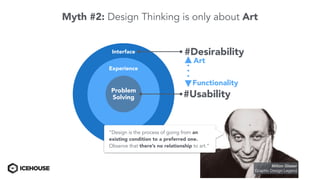
Focus on Design Thinking to approach Wicked Problems and debunking myths around it.Understanding desirability in design, its historical context from Skinner’s Box to behaviorism.
Discussing Fogg’s Behavior Model for effectiveness in user engagement and desirability.
Defining usability, the process of achieving it, and focusing on user personas.
The Design Sprint stages: Diverging, deciding, prototyping, and validating ideas.
Introduction to Ice House Design Dojo, emphasizing multi-disciplinary approaches to problem-solving.
Discussion of various methodologies and invitation for collaboration and contact.
How to solveany problem?
by using a human-centric approach…
Image Credit: Pexels
2.
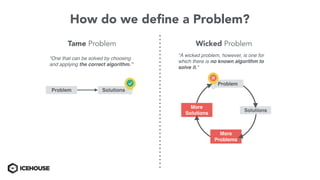
How do wedefine a Problem?
Tame Problem Wicked Problem
“One that can be solved by choosing
and applying the correct algorithm.”
“A wicked problem, however, is one for
which there is no known algorithm to
solve it.”
Problem Solutions
Problem
Solutions
More
Problems
More
Solutions
Wicked Problem
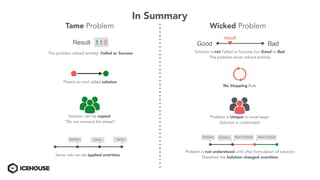
In Summary
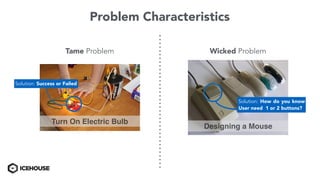
TameProblem
1 | 0Result
The problem solved entirely: Failed or Success
Good Bad
result
Solution is not Failed or Success but Good or Bad.
The problem never solved entirely.
No Stopping Rule
There’s an end called solution
Solution can be copied:
“Do not reinvent the wheel”
Problem is Unique in novel ways:
Solution is customized
Problem Solution New Problem New Solution
Problem is not understood until after formulation of solution:
Therefore the Solution changed overtime.
Same rule can be applied overtime
Solution Same Same
5.
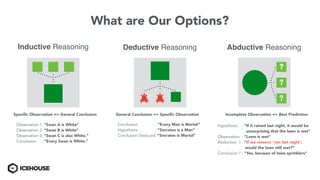
Inductive Reasoning
Specific Observation=> General Conclusion
Observation 1: “Swan A is White”
Observation 2: “Swan B is White”
Observation 3: “Swan C is also White.”
Conclusion : “Every Swan is White.”
General Conclusion => Specific Observation
X X
Conclusion : “Every Man is Mortal”
Hypothesis : “Socrates is a Man”
Conclusion Deduced: “Socrates is Mortal”
Deductive Reasoning
Incomplete Observation => Best Prediction
Hypothesis : “If it rained last night, it would be
unsurprising that the lawn is wet”
Observation : “Lawn is wet”
Abduction 1 : “If we remove ‘rain last night’,
would the lawn still wet?”
Conclusion 1 : “Yes, because of lawn sprinklers”
Abductive Reasoning
What are Our Options?
?
?
?
6.
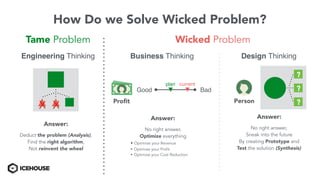
How Do weSolve Wicked Problem?
Wicked ProblemTame Problem
Design ThinkingBusiness Thinking
Answer:
No right answer,
Optimize everything
• Optimize your Revenue
• Optimize your Profit
• Optimize your Cost Reduction
Answer:
No right answer,
Sneak into the future
By creating Prototype and
Test the solution (Synthesis)
Engineering Thinking
Answer:
Deduct the problem (Analysis),
Find the right algorithm,
Not reinvent the wheel
Good Bad
currentplan
X X
?
?
?Profit Person
7.
How Do weSolve Wicked Problem?
Design Thinking
?
?
?
Source: http://uxpamagazine.org/using-your-logical-powers/
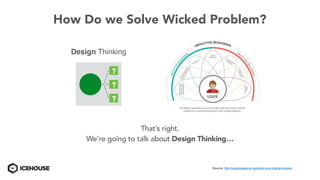
That’s right.
We’re going to talk about Design Thinking…
8.
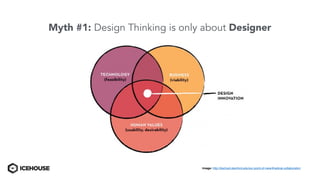
Myth #1: DesignThinking is only about Designer
image: http://dschool.stanford.edu/our-point-of-view/#radical-collaboration
Let’s talk about#Desirability
de·sir·a·bil·i·ty
dəˌzī(ə)rəˈbilədē/
noun
the quality of being desirable.
"we agree on the desirability of a negotiated settlement"
synonyms: appeal, attractiveness, allure
11.
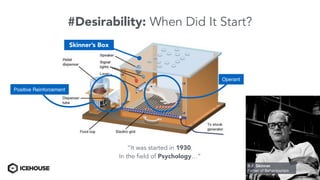
#Desirability: When DidIt Start?
Skinner’s Box
Operant
“It was started in 1930.
In the field of Psychology…”
Positive Reinforcement
B.F. Skinner
Father of Behaviourism
12.
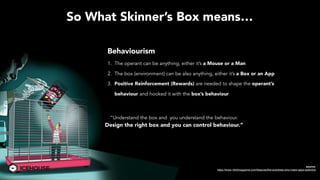
So What Skinner’sBox means…
Behaviourism
1. The operant can be anything, either it’s a Mouse or a Man
2. The box (environment) can be also anything, either it’s a Box or an App
3. Positive Reinforcement (Rewards) are needed to shape the operant’s
behaviour and hooked it with the box’s behaviour
source:
https://www.1843magazine.com/features/the-scientists-who-make-apps-addictive
“Understand the box and you understand the behaviour.
Design the right box and you can control behaviour.”
13.
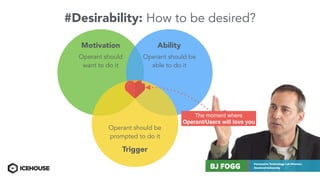
#Desirability: How tobe desired?
Motivation Ability
Trigger
Operant should
want to do it
Operant should be
able to do it
Operant should be
prompted to do it
The moment where
Operant/Users will love you
14.
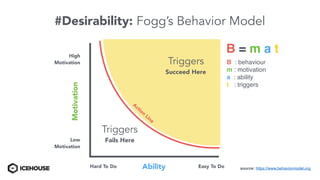
#Desirability: Fogg’s BehaviorModel
Triggers
Succeed Here
Ability
Motivation
Hard To Do Easy To Do
High
Motivation
Low
Motivation
A
ction
Line
Triggers
Fails Here
B = m a t
B : behaviour
m : motivation
a : ability
t : triggers
source: https://www.behaviormodel.org
15.
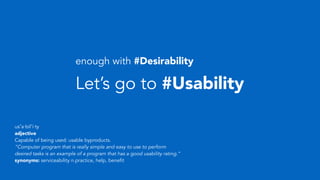
Let’s go to#Usability
us′a·bil′i·ty
adjective
Capable of being used: usable byproducts.
“Computer program that is really simple and easy to use to perform
desired tasks is an example of a program that has a good usability rating.”
synonyms: serviceability n.practice, help, benefit
enough with #Desirability
16.
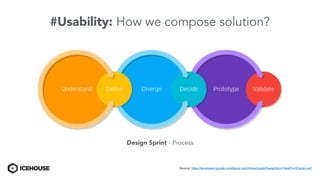
#Usability: How wecompose solution?
Design Sprint - Process
Source: https://developers.google.com/design-sprint/downloads/DesignSprint-NewFormFactors.pdf
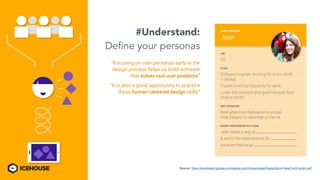
“Focusing on userpersonas early in the
design process helps us build software
that solves real user problems”
“It is also a good opportunity to practice
these human-centered design skills”
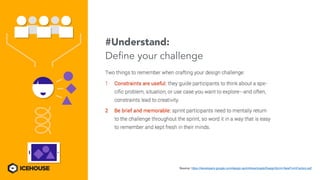
#Understand:
Define your personas
Source: https://developers.google.com/design-sprint/downloads/DesignSprint-NewFormFactors.pdf
19.
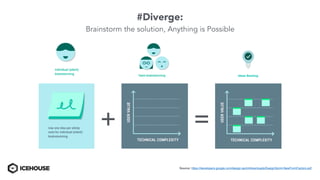
+ =
#Diverge:
Brainstorm thesolution, Anything is Possible
Ideas Backlog
Source: https://developers.google.com/design-sprint/downloads/DesignSprint-NewFormFactors.pdf
20.
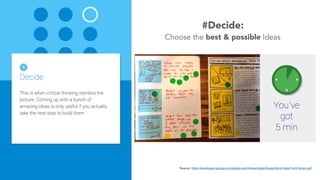
#Decide:
Choose the best& possible Ideas
Source: https://developers.google.com/design-sprint/downloads/DesignSprint-NewFormFactors.pdf
21.
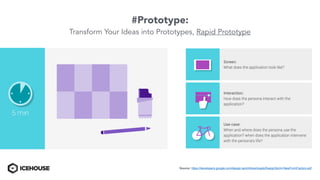
#Prototype:
Transform Your Ideasinto Prototypes, Rapid Prototype
Source: https://developers.google.com/design-sprint/downloads/DesignSprint-NewFormFactors.pdf
22.
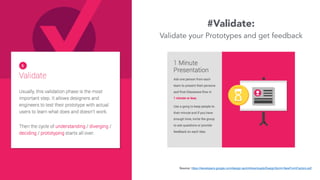
#Validate:
Validate your Prototypesand get feedback
Source: https://developers.google.com/design-sprint/downloads/DesignSprint-NewFormFactors.pdf
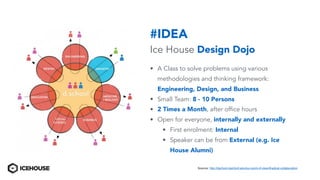
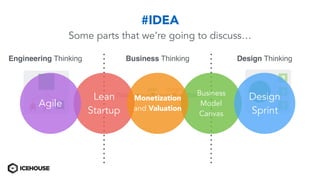
#IDEA
Ice House DesignDojo
Source: http://dschool.stanford.edu/our-point-of-view/#radical-collaboration
• A Class to solve problems using various
methodologies and thinking framework:
Engineering, Design, and Business
• Small Team: 8 - 10 Persons
• 2 Times a Month, after office hours
• Open for everyone, internally and externally
• First enrolment: Internal
• Speaker can be from External (e.g. Ice
House Alumni)
25.
Engineering Thinking DesignThinkingBusiness Thinking
Good Bad
currentplan
?
?
?
Business
Model
Canvas
Design
Sprint
Lean
Startup
Monetization
and ValuationX XAgile
#IDEA
Some parts that we’re going to discuss…