Layman’s guide
to doing Lean
Chirag Patel
Co-founder | Chicago Health 2.0 | @CHIHealthTech
Dir of Software Dev | ContextMedia | @ContextMediaInc
chirag@chicagohealthtech.org
@patelc75
How many of you
are doing lean?
How many of you
want to do lean but
too busy?
Who is early stage
and how early
stage are you?
“Get out of the
building”
- every Lean evangelist known
to man (easier said than done)
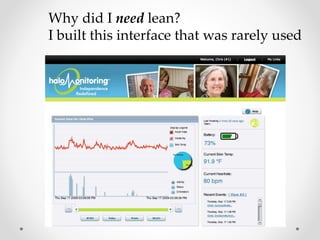
Why did I need lean?
I built this interface that was rarely used
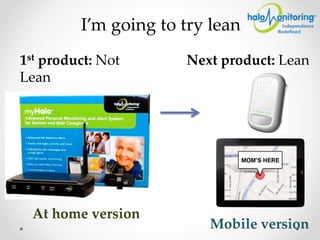
Mobile version
At home version
Next product: Lean1st product: Not
Lean
I’m going to try lean
Before I learned about
lean, I knew I wanted
to focus on user
stories instead of
features
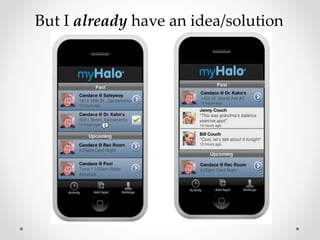
But I already have an idea/solution
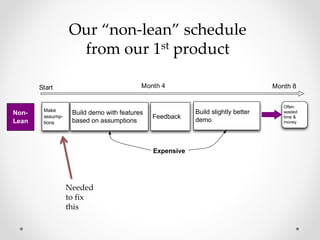
Our “non-lean” schedule
from our 1st product
Build demo with features
based on assumptions
Month 8Start Month 4
Feedback
Build slightly better
demo
Make
assump-
tions
Often
wasted
time &
money
Expensive
Non-
Lean
Needed
to fix
this
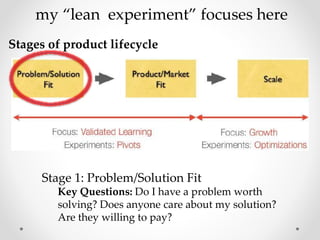
Stage 1: Problem/Solution Fit
Key Questions: Do I have a problem worth
solving? Does anyone care about my solution?
Are they willing to pay?
my “lean experiment” focuses here
Stages of product lifecycle
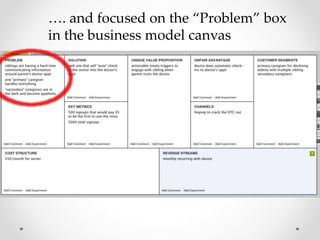
…. and focused on the “Problem” box
in the business model canvas
“Who do I think are
my early
evangelists?”
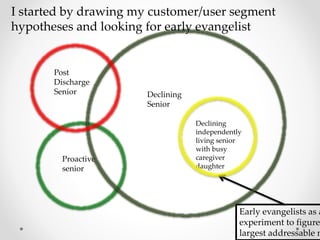
Proactive
senior
Early evangelists as a
experiment to figure
largest addressable m
Declining
Senior
I started by drawing my customer/user segment
hypotheses and looking for early evangelist
Post
Discharge
Senior
Declining
independently
living senior
with busy
caregiver
daughter
“It is better to be wrong than
vague. If you are wrong, you
iterate; if you are vague, you
have wasted your time and
cannot draw any conclusions.”
Cooper, Brant; Vlaskovits, Patrick; Blank, Steven (2010-10-15).
The Entrepreneur's Guide to Customer Development: A cheat
sheet to The Four Steps to the Epiphany (p. 74). Cooper-
Vlaskovits. Kindle Edition.
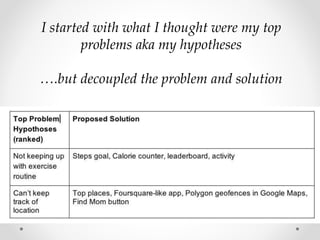
I started with what I thought were my top
problems aka my hypotheses
….but decoupled the problem and solution
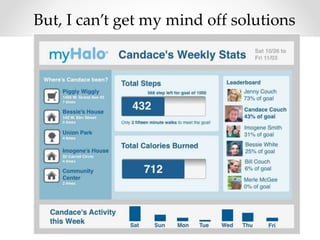
But, I can’t get my mind off solutions
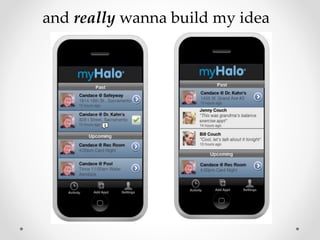
and really wanna build my idea
But gotta stay focused on
validating the problem
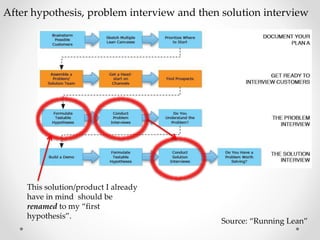
This solution/product I already
have in mind should be
renamed to my “first
hypothesis”.
After hypothesis, problem interview and then solution interview
Source: “Running Lean”
“How do I identify a
problem worth
solving?
What do I ask?”
I broadly asked
“What are your top
problems with
caregiving your mom?”
While focusing on the
ones I could solve
But also
“How are you
solving them
today?”
and
“And what does it cost
you to solve them?”
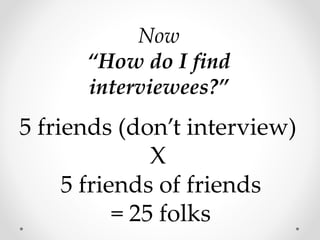
Now
“How do I find
interviewees?”
5 friends (don’t interview)
X
5 friends of friends
= 25 folks
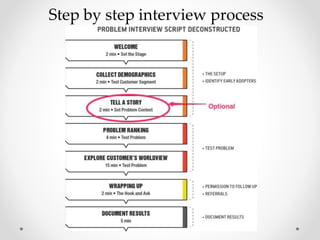
Step by step interview process
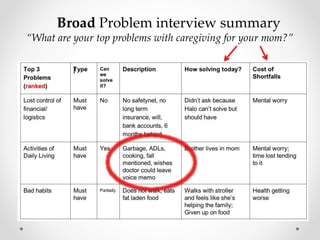
Broad Problem interview summary
“What are your top problems with caregiving for your mom?”
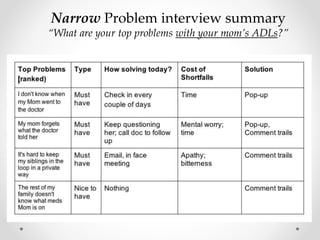
Narrow Problem interview summary
“What are your top problems with your mom’s ADLs?”
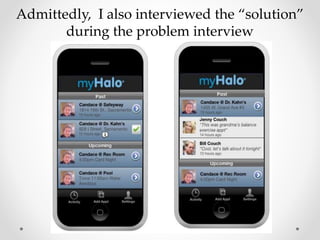
Admittedly, I also interviewed the “solution”
during the problem interview
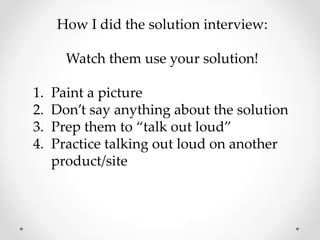
How I did the solution interview:
Watch them use your solution!
1. Paint a picture
2. Don’t say anything about the solution
3. Prep them to “talk out loud”
4. Practice talking out loud on another
product/site
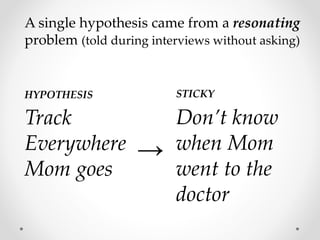
Track
Everywhere
Mom goes
A single hypothesis came from a resonating
problem (told during interviews without asking)
Don’t know
when Mom
went to the
doctor
→
HYPOTHESIS STICKY
Declining elderly seniors
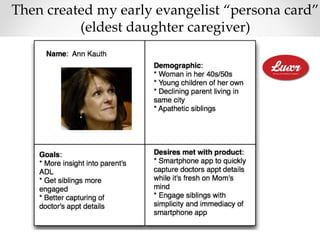
Then created my early evangelist “persona card”
(eldest daughter caregiver)
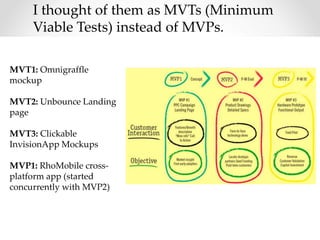
MVT1: Omnigraffle
mockup
MVT2: Unbounce Landing
page
MVT3: Clickable
InvisionApp Mockups
MVP1: RhoMobile cross-
platform app (started
concurrently with MVP2)
I thought of them as MVTs (Minimum
Viable Tests) instead of MVPs.
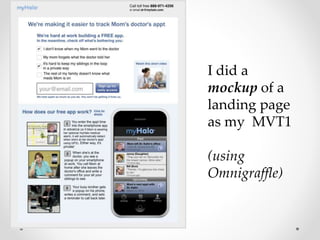
I did a
mockup of a
landing page
as my MVT1
(using
Omnigraffle)
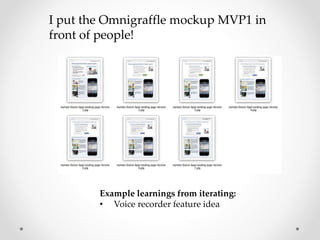
Example learnings from iterating:
• Voice recorder feature idea
I put the Omnigraffle mockup MVP1 in
front of people!
Declining elderly seniors
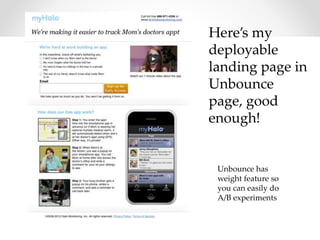
Here’s my
deployable
landing page in
Unbounce
page, good
enough!
Unbounce has
weight feature so
you can easily do
A/B experiments
To be charge
or
not to be charge?
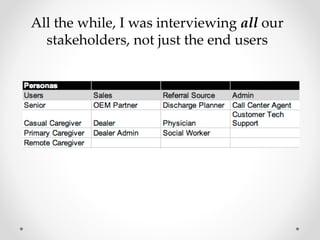
All the while, I was interviewing all our
stakeholders, not just the end users
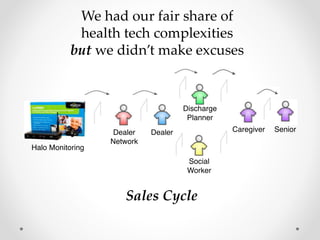
We had our fair share of
health tech complexities
but we didn’t make excuses
Sales Cycle
And learned a simple
message to the stakeholders
was absolutely essential
for our sales cycle
“Like Philips but automatic”
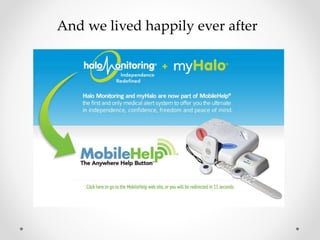
And we lived happily ever after
For me, lean is
validating learnings on
both the problem and
solution before
spending time and
money unnecessarily
So how did lean help me?
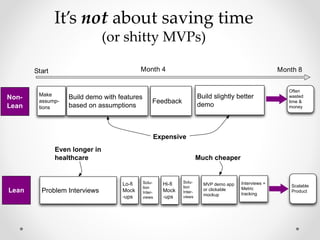
It’s not about saving time
(or shitty MVPs)
Build demo with features
based on assumptions
Problem Interviews
Lo-fi
Mock
-ups
Month 8Start Month 4
MVP demo app
or clickable
mockup
Solu-
tion
Inter-
views
Interviews +
Metric
tracking
Feedback
Hi-fi
Mock
-ups
Build slightly better
demo
Solu-
tion
Inter-
views
Make
assump-
tions
Often
wasted
time &
money
Scalable
Product
Expensive
Much cheaper
Non-
Lean
Lean
Even longer in
healthcare
Solve “empathy” and “stickiness early!
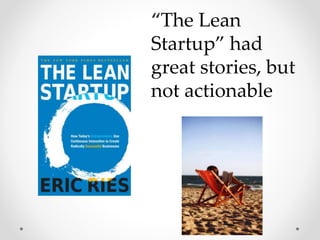
“The Lean
Startup” had
great stories, but
not actionable
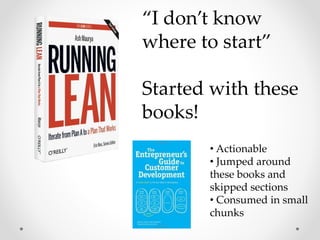
• Actionable
• Jumped around
these books and
skipped sections
• Consumed in small
chunks
“I don’t know
where to start”
Started with these
books!
Every week, I met with
another (trusted) startup
also doing lean
I started meeting advisors
early. Don’t wait for the
“right time”
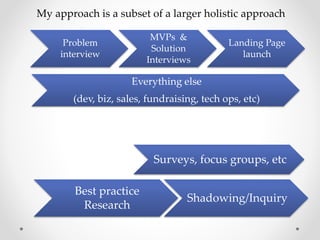
Problem
interview
MVPs &
Solution
Interviews
Landing Page
launch
Surveys, focus groups, etc
Best practice
Research
Shadowing/Inquiry
Everything else
(dev, biz, sales, fundraising, tech ops, etc)
My approach is a subset of a larger holistic approach
Leftover
Slides
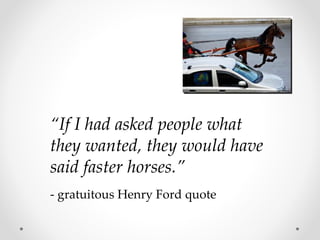
“If I had asked people what
they wanted, they would have
said faster horses.”
- gratuitous Henry Ford quote
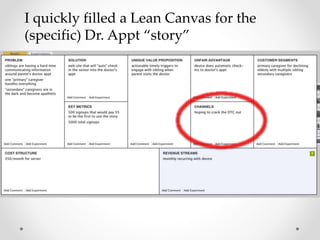
I quickly filled a Lean Canvas for the
(specific) Dr. Appt “story”

Chirag Lean pres for Matter

  • 1.
    Layman’s guide to doingLean Chirag Patel Co-founder | Chicago Health 2.0 | @CHIHealthTech Dir of Software Dev | ContextMedia | @ContextMediaInc chirag@chicagohealthtech.org @patelc75
  • 2.
    How many ofyou are doing lean? How many of you want to do lean but too busy? Who is early stage and how early stage are you?
  • 3.
    “Get out ofthe building” - every Lean evangelist known to man (easier said than done)
  • 4.
    Why did Ineed lean? I built this interface that was rarely used
  • 5.
    Mobile version At homeversion Next product: Lean1st product: Not Lean I’m going to try lean
  • 6.
    Before I learnedabout lean, I knew I wanted to focus on user stories instead of features
  • 7.
    But I alreadyhave an idea/solution
  • 8.
    Our “non-lean” schedule fromour 1st product Build demo with features based on assumptions Month 8Start Month 4 Feedback Build slightly better demo Make assump- tions Often wasted time & money Expensive Non- Lean Needed to fix this
  • 9.
    Stage 1: Problem/SolutionFit Key Questions: Do I have a problem worth solving? Does anyone care about my solution? Are they willing to pay? my “lean experiment” focuses here Stages of product lifecycle
  • 10.
    …. and focusedon the “Problem” box in the business model canvas
  • 11.
    “Who do Ithink are my early evangelists?”
  • 12.
    Proactive senior Early evangelists asa experiment to figure largest addressable m Declining Senior I started by drawing my customer/user segment hypotheses and looking for early evangelist Post Discharge Senior Declining independently living senior with busy caregiver daughter
  • 13.
    “It is betterto be wrong than vague. If you are wrong, you iterate; if you are vague, you have wasted your time and cannot draw any conclusions.” Cooper, Brant; Vlaskovits, Patrick; Blank, Steven (2010-10-15). The Entrepreneur's Guide to Customer Development: A cheat sheet to The Four Steps to the Epiphany (p. 74). Cooper- Vlaskovits. Kindle Edition.
  • 14.
    I started withwhat I thought were my top problems aka my hypotheses ….but decoupled the problem and solution
  • 15.
    But, I can’tget my mind off solutions
  • 16.
    and really wannabuild my idea
  • 17.
    But gotta stayfocused on validating the problem
  • 18.
    This solution/product Ialready have in mind should be renamed to my “first hypothesis”. After hypothesis, problem interview and then solution interview Source: “Running Lean”
  • 19.
    “How do Iidentify a problem worth solving? What do I ask?”
  • 20.
    I broadly asked “Whatare your top problems with caregiving your mom?” While focusing on the ones I could solve
  • 21.
    But also “How areyou solving them today?” and “And what does it cost you to solve them?”
  • 22.
    Now “How do Ifind interviewees?” 5 friends (don’t interview) X 5 friends of friends = 25 folks
  • 23.
    Step by stepinterview process
  • 24.
    Broad Problem interviewsummary “What are your top problems with caregiving for your mom?”
  • 25.
    Narrow Problem interviewsummary “What are your top problems with your mom’s ADLs?”
  • 26.
    Admittedly, I alsointerviewed the “solution” during the problem interview
  • 27.
    How I didthe solution interview: Watch them use your solution! 1. Paint a picture 2. Don’t say anything about the solution 3. Prep them to “talk out loud” 4. Practice talking out loud on another product/site
  • 28.
    Track Everywhere Mom goes A singlehypothesis came from a resonating problem (told during interviews without asking) Don’t know when Mom went to the doctor → HYPOTHESIS STICKY
  • 29.
    Declining elderly seniors Thencreated my early evangelist “persona card” (eldest daughter caregiver)
  • 30.
    MVT1: Omnigraffle mockup MVT2: UnbounceLanding page MVT3: Clickable InvisionApp Mockups MVP1: RhoMobile cross- platform app (started concurrently with MVP2) I thought of them as MVTs (Minimum Viable Tests) instead of MVPs.
  • 31.
    I did a mockupof a landing page as my MVT1 (using Omnigraffle)
  • 32.
    Example learnings fromiterating: • Voice recorder feature idea I put the Omnigraffle mockup MVP1 in front of people!
  • 33.
    Declining elderly seniors Here’smy deployable landing page in Unbounce page, good enough! Unbounce has weight feature so you can easily do A/B experiments
  • 34.
    To be charge or notto be charge?
  • 35.
    All the while,I was interviewing all our stakeholders, not just the end users
  • 36.
    We had ourfair share of health tech complexities but we didn’t make excuses Sales Cycle
  • 37.
    And learned asimple message to the stakeholders was absolutely essential for our sales cycle “Like Philips but automatic”
  • 38.
    And we livedhappily ever after
  • 39.
    For me, leanis validating learnings on both the problem and solution before spending time and money unnecessarily So how did lean help me?
  • 40.
    It’s not aboutsaving time (or shitty MVPs) Build demo with features based on assumptions Problem Interviews Lo-fi Mock -ups Month 8Start Month 4 MVP demo app or clickable mockup Solu- tion Inter- views Interviews + Metric tracking Feedback Hi-fi Mock -ups Build slightly better demo Solu- tion Inter- views Make assump- tions Often wasted time & money Scalable Product Expensive Much cheaper Non- Lean Lean Even longer in healthcare
  • 41.
    Solve “empathy” and“stickiness early!
  • 42.
    “The Lean Startup” had greatstories, but not actionable
  • 43.
    • Actionable • Jumpedaround these books and skipped sections • Consumed in small chunks “I don’t know where to start” Started with these books!
  • 44.
    Every week, Imet with another (trusted) startup also doing lean I started meeting advisors early. Don’t wait for the “right time”
  • 45.
    Problem interview MVPs & Solution Interviews Landing Page launch Surveys,focus groups, etc Best practice Research Shadowing/Inquiry Everything else (dev, biz, sales, fundraising, tech ops, etc) My approach is a subset of a larger holistic approach
  • 46.
  • 47.
    “If I hadasked people what they wanted, they would have said faster horses.” - gratuitous Henry Ford quote
  • 48.
    I quickly filleda Lean Canvas for the (specific) Dr. Appt “story”

Editor's Notes

  • #2  The reason I’m doing this is because we’ve advised/mentored/chatted with 20+ startups over the last 2 years and this is by far the #1 roadblock Happy to meet you 1:1
  • #3 Ash Maurya “Practice trumps theory” Why start this general? 1 Gives you the stakeholder’s (caregiver) worldview which is important when aquiring the customer. If the interview has 1 massive must have problem ahead of the one I can solve
  • #4 “Why I needed lean?’ “What did you did?” “How did I find time?” Why am I here? Made many mistakes and made assumption driven Problem that everyone has Easier said than done Doing everytihgn > hard to find time
  • #7 Why start this general? 1 Gives you the stakeholder’s (caregiver) worldview which is important when aquiring the customer. If the interview has 1 massive must have problem ahead of the one I can solve
  • #8 Story: 1. Who’s the first one to interact
  • #9 ENTREPRENUERS THINK THEY KNOW WHAT TO SOLVE Yea it's best consumed a little at a time. 20 min a day type thing so you can apply the concepts to your own development (at least mentally) This is the work we could have done before raising$1M – so much you can do without raising a lot of money!!!!! While we were in due diligence with the angels and VCs for our first $1M, we could have validated the feature needs and create stories without raising a lot of money
  • #10 Stage 2: Product/Market Fit Key Question: Have I built something people want and willing to pay enough for? Do I have repeatable and scalable sales model? Stage 3: Scale Key Question: How do I accelerate growth? Can I execute my flushed out business model?
  • #12 10% > 90% Why start this general? 1 Gives you the stakeholder’s (caregiver) worldview which is important when aquiring the customer. If the interview has 1 massive must have problem ahead of the one I can solve Early evangelists will thank you for the crappy solution that’s twice as good as existing solution; willing to take your MVP and you can learn from; you will move into early adopter How do I identoify (look up specific questions that I was going to ask) Example of problem interview questions that are specific
  • #13 Make physically smaller; yellow is not smallest Wholly in the circle
  • #15 I have the problem and solution tightly coupled and wil show how I am stripping them apart
  • #18 Why start this general? 1 Gives you the stakeholder’s (caregiver) worldview which is important when aquiring the customer. If the interview has 1 massive must have problem ahead of the one I can solve How do I identoify (look up specific questions that I was going to ask) Example of problem interview questions that are specific
  • #19 Problem and solution separation
  • #20 Why start this general? 1 Gives you the stakeholder’s (caregiver) worldview which is important when aquiring the customer. If the interview has 1 massive must have problem ahead of the one I can solve How do I identoify (look up specific questions that I was going to ask) Example of problem interview questions that are specific
  • #21 Adding context – “walk through the day” Why start this general? 1 Gives you the stakeholder’s (caregiver) worldview which is important when aquiring the customer. If the interview has 1 massive must have problem ahead of the one I can solve How do I identoify Example of problem interview questions that are specific
  • #22 Why start this general? 1 Gives you the stakeholder’s (caregiver) worldview which is important when aquiring the customer. If the interview has 1 massive must have problem ahead of the one I can solve There are workarounds! Don’t ask “Would you pay for this?” Example of problem interview questions that are specific
  • #23 I found Ann through my network A list of five names of people you know who share some of the characteristics (job, demographics, hobbies, industry, etc.) of your ideal early adopter customer. Log onto Facebook, LinkedIn, look at your Twitter followers, etc., and write down five names. Write an email to all five asking for introductions to five people they know, who might also share these characteristics. This is your first contact list. If you don’t know anyone with the same characteristics, simply ask your network for the names of five people who might! Pitfalls to avoid Don’t simply survey your friends and colleagues. While those people are likely to be friendly, their input is likely to be skewed. Use them to find people, not answers. Don’t rely on only one method of prospect acquisition, since this will likely limit the type of person (i.e., market segment) you speak with. ExperimentationCooper, Brant; Vlaskovits, Patrick; Blank, Steven (2010-10-15). The Entrepreneur's Guide to Customer Development: A cheat sheet to The Four Steps to the Epiphany (p. 76). Cooper-Vlaskovits. Kindle Edition. Prefer face-to-face interviews.Maurya, Ash (2012-02-24). Pick a neutral location.Maurya, Ash (2012-02-24) Don’t pay prospects Avoid recording Document immediately Do at least 10
  • #24 Alec Baldwin story Did I find tainting was an issue? Don’t try to confirm your own hypothesis
  • #25 COLUMN Type: Must Have, Nice to Have, Don’t Need COLUMN How solving today + Cost of Shortfall: Is that solution free or paid? More difficult if paid and was free before; Who to get the problem interviews? Friends and friends of friends vs ads on craigslist “Unknown” problems Rigid and fomulaic – gives an example “does this resonate with you” in the problem interview
  • #29 Did 3 more interviews and it kept resonating
  • #30 Update this
  • #31 RhoMObile – this is how engineers think Show how Pivotal Tracker works with screenshot with points\ Erin montague prototyping
  • #32 Getting to 10% How do I know I have an MVP?
  • #33 How to interviews eliminated features? During one of the 7 iterations, we interviewed a nurse and she mentioned a voice recording option. Cool, but don’t change the MVP!
  • #34 $5 charge Focus on problem checkboxes Define priority access – “Sign up to be notified” Facebook > priority access Maybe discount to monthly subscription
  • #37 Complexities User (senior) is not the payer (caregiver) Hardware schedule is 9 months out Complicated Sales channels Need a single message for new products (Rishi was right)
  • #40 20 health tech startups
  • #41 Yea it's best consumed a little at a time. 20 min a day type thing so you can apply the concepts to your own development (at least mentally) This is the work we could have done before raising$1M – so much you can do without raising a lot of money!!!!! While we were in due diligence with the angels and VCs for our first $1M, we could have validated the feature needs and create stories without raising a lot of money
  • #43 Talk about the Mixergy podcast and how Eric used lean principles to sell the book Book tours are bad. Pre-order is bad.
  • #44 yea it's best consumed a little at a time. 20 min a day type thing so you can apply the concepts to your own development (at least mentally) Rigid and fomulaic – gives an example “does this resonate with you” in the problem interview
  • #45 My friend Subbu started a lean launch ‘pod’ in which 4 (health tech ) companies met every 2 weeks Keep each other accountable!! Action items by the next 2 weeks. Accountability is more important because you have 10 other things going on. Weird dynamic but this is about openeness – this is a hidden characteristic of lean
  • #47 20 health tech startups
  • #48 Why am I here? Made many mistakes and made assumption driven