Level up your Problem-Solving skill
WWW.DANA.ID
Let’s start with a story…
WWW.DANA.ID
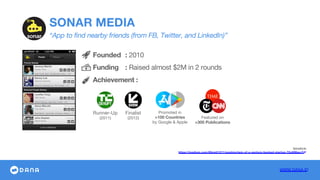
SONAR MEDIA
Founded : 2010
Funding : Raised almost $2M in 2 rounds
Runner-Up
(2011)
Finalist
(2012)
Achievement :
Promoted in
>100 Countries
by Google & Apple
Featured on
>300 Publications
“App to find nearby friends (from FB, Twitter, and LinkedIn)”
SOURCE:
https://medium.com/@brett1211/postmortem-of-a-venture-backed-startup-72c6f8bec7df
Segment
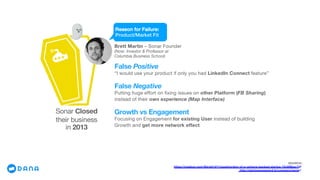
Sonar Closed
their business
in 2013
Brett Martin – Sonar Founder
(Now: Investor & Professor at
Columbia Business School)
SOURCE:
https://medium.com/@brett1211/postmortem-of-a-venture-backed-startup-72c6f8bec7df
http://startupgraveyard.io/company/sonar/
Reason for Failure:
Product/Market Fit
False Positive
“I would use your product if only you had LinkedIn Connect feature”
False Negative
Putting huge effort on fixing issues on other Platform (FB Sharing)
instead of their own experience (Map Interface)
Growth vs Engagement
Focusing on Engagement for existing User instead of building
Growth and get more network effect
WWW.DANA.ID
It’s not only about “How to Solve a Problem”
It’s also about
“Picking the Right Problem and
try to understand why”
WWW.DANA.ID
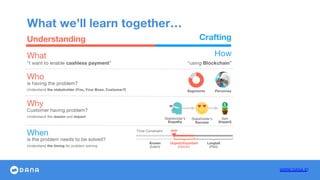
When
is the problem needs to be solved?
Understand the timing for problem solving
NOWTime Constraint
Known
(Learn)
Urgent/Important
(Deliver)
Longtail
(Plan)
What we’ll learn together…
CraftingUnderstanding
What How
“I want to enable cashless payment” “using Blockchain”
Who
is having the problem?
Segments PersonasUnderstand the stakeholder (You, Your Boss, Customer?)
Why
Customer having problem?
Understand the reason and impact
Stakeholder’s
Empathy
Stakeholder’s
Success
Gain
(Impact)
WWW.DANA.ID
Understanding the problem
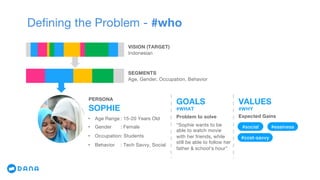
Defining the Problem - #who
VISION (TARGET)
Indonesian
SEGMENTS
Age, Gender, Occupation, Behavior
PERSONA
SOPHIE
• Age Range : 15-20 Years Old
• Gender : Female
• Occupation: Students
• Behavior : Tech Savvy, Social
GOALS
#WHAT
“Sophie wants to be
able to watch movie
with her friends, while
still be able to follow her
father & school’s hour”
Problem to solve
VALUES
#WHY
Expected Gains
#social
#cost-savvy
#easiness
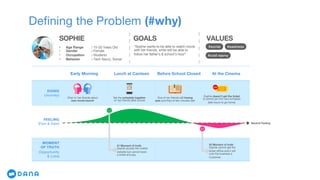
Early Morning Lunch at Canteen Before School Closed At the Cinema
DOING
(Journey)
FEELING
(Pain & Gain)
MOMENT
OF TRUTH
(Opportunity
& Loss)
Defining the Problem (#why)
Chat w/ her friends about
new movie launch
Set the schedule together
w/ her friends after school
One of her friends still having
quiz and they’re few minutes late
Sophie doesn’t get the ticket
& cannot join the next schedule
(late hours to go home)
Neutral Feeling
#1 Moment of truth
Sophie access the mobile
website but cannot book
a ticket and pay
#2 Moment of truth
Sophie cannot get the
ticket offline and it will
cost the business a
Customer
SOPHIE
• Age Range : 15-20 Years Old
• Gender : Female
• Occupation : Students
• Behavior : Tech Savvy, Social
GOALS
“Sophie wants to be able to watch movie
with her friends, while still be able to
follow her father’s & school’s hour”
VALUES
#social
#cost-savvy
#easiness
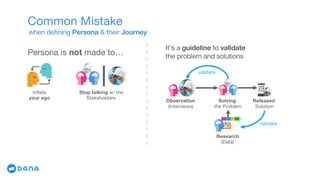
Persona is not made to…
Stop talking w/ the
Stakeholders
Observation
(Interviews)
Inflate
your ego
It’s a guideline to validate
the problem and solutions
Research
(Data)
Solving
the Problem
validate
Released
Solution
validate
Common Mistake
when defining Persona & their Journey
VIDEO
https://www.youtube.com/watch?v=yY96hTb8WgI
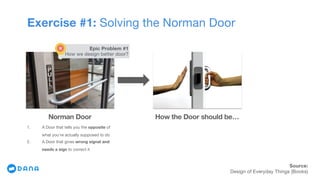
Exercise #1: Solving the Norman Door
Norman Door
1. A Door that tells you the opposite of
what you’re actually supposed to do
2. A Door that gives wrong signal and
needs a sign to correct it
Epic Problem #1
How we design better door?
How the Door should be…
Source:
Design of Everyday Things (Books)
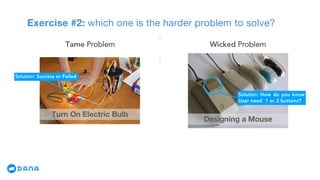
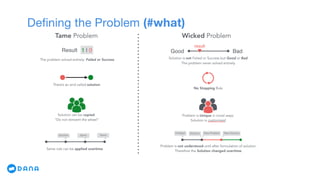
Wicked ProblemTame Problem
Turn On Electric Bulb
Solution: Success or Failed
Designing a Mouse
Solution: How do you know
User need 1 or 2 buttons?
Exercise #2: which one is the harder problem to solve?
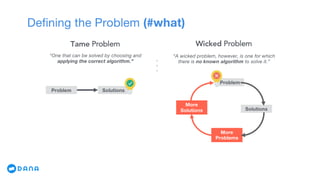
Defining the Problem (#what)
Tame Problem Wicked Problem
“One that can be solved by choosing and
applying the correct algorithm.”
“A wicked problem, however, is one for which
there is no known algorithm to solve it.”
Problem Solutions
Problem
Solutions
More
Problems
More
Solutions
Defining the Problem (#what)
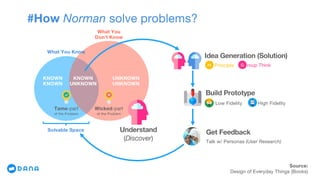
#How Norman solve problems?
What You Know
What You
Don’t Know
KNOWN
KNOWN
UNKNOWN
UNKNOWN
KNOWN
UNKNOWN
Tame-part
of the Problem
Wicked-part
of the Problem
Understand
(Discover)
Solvable Space
Idea Generation (Solution)
#1 Principle G roup Think
Build Prototype
Low Fidelity High Fidelity
Get Feedback
Talk w/ Personas (User Research)
Source:
Design of Everyday Things (Books)
WWW.DANA.ID
Solving a Problem
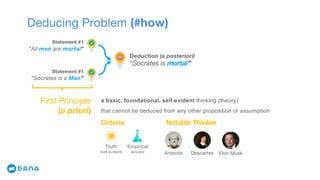
Deducing Problem (#how)
First Principle
(a priori)
Statement #1
“All men are mortal”
Statement #1
“Socrates is a Man”
Deduction (a posteriori)
“Socrates is mortal”
Notable Thinker
Elon MuskAristotle Descartes
a basic, foundational, self-evident thinking (theory)
that cannot be deduced from any other proposition or assumption
Empirical
(proven)
Criteria
Truth
(self-evident)
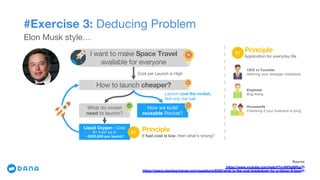
#Exercise 3: Deducing Problem
Elon Musk style…
I want to make Space Travel
available for everyone
How to launch cheaper?
Liquid Oxygen – Cost
$1-3 per kg or
~$200,000 per launch*
What do rocket
need to launch?
How we build
reusable Rocket?
https://www.youtube.com/watch?v=NV3sBlRgzTI
https://space.stackexchange.com/questions/8330/what-is-the-cost-breakdown-for-a-falcon-9-launch
Source:
#1
Principle
If fuel cost is low, then what’s wrong?
Launch cost the rocket,
Not only the fuel
Cost per Launch is High
#1
Principle
Application for everyday life
Housewife
Checking if your husband is lying
CEO or Founder
Defining your strategic milestone
Engineer
Bug fixing
KNOWN
KNOWN
UNKNOWN
UNKNOWN
KNOWN
UNKNOWN
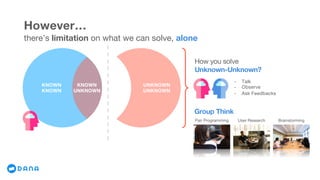
However…
there’s limitation on what we can solve, alone
Group Think
- Talk
- Observe
- Ask Feedbacks
How you solve
Unknown-Unknown?
Pair Programming User Research Brainstorming
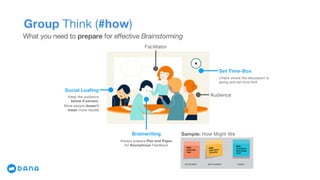
Group Think (#how)
What you need to prepare for effective Brainstorming
Keep the audience
below 8 person,
More people doesn’t
mean more results
Social Loafing
Brainwriting
Always prepare Pen and Paper
for Anonymous Feedback
Set Time-Box
Check where the discussion is
going and set time limit
Facilitator
Audience
Sample: How Might We
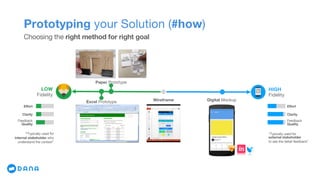
Prototyping your Solution (#how)
Paper Prototype
Digital Mockup
LOW
Fidelity
HIGH
Fidelity
Excel Prototype Wireframe
Effort
Clarity
Feedback
Quality
Effort
Clarity
Feedback
Quality
“Typically used for
internal stakeholder who
understand the context”
“Typically used for
external stakeholder
to see the detail feedback”
Choosing the right method for right goal
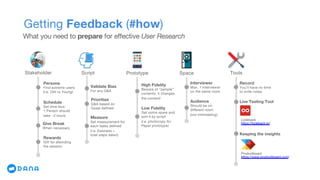
Getting Feedback (#how)
What you need to prepare for effective User Research
Stakeholder
Schedule
Set time-box:
1 Person should
take ~2 hours
Rewards
Gift for attending
the session
High Fidelity
Beware of “sample”
contents. it changes
the context!
Prototype
Low Fidelity
Get some spare and
sort it by script
(i.e. photocopy for
Paper prototype)
Space
Interviewer
Max. 1 interviewer
on the same room
Audience
Should be on
different room
(not intimidating)
Give Break
When necessary
Persona
Find extreme users
(i.e. Old vs Young)
Tools
Record
You’ll have no time
to write notes
Live Testing Tool
Lookback
https://lookback.io/
Keeping the insights
Productboard
https://www.productboard.com/
Prioritize
Q&A based on
Goals defined
Script
Validate Bias
For any Q&A
Measure
Set measurement for
each tasks defined
(i.e. Easiness =
total steps taken)
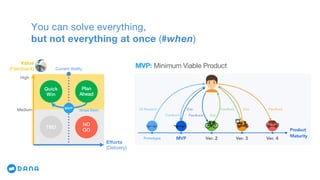
Value
(Feedback)
Efforts
(Delivery)
Current Ability
Quick
Win
Plan
Ahead
NO
GO
Medium
High
TBD
MVP
Scope Down
You can solve everything,
but not everything at once (#when)
MVP: Minimum Viable Product
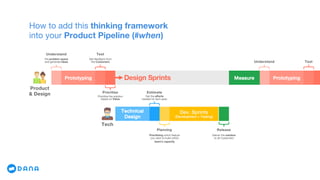
How to add this thinking framework
into your Product Pipeline (#when)
Dev. Sprints
(Development + Testing)
Prototyping
Technical
Design
Planning
Prioritizing which feature
you want to build within
team’s capacity
Understand Test
Prioritize Estimate
Prioritize the solution
based on Value
the problem space
and generate ideas
Get feedback from
the Customers
Get the efforts
needed for tech spec
Release
Deliver the solution
to all Customers
PrototypingMeasure
Understand Test
Product
& Design
Tech
Design Sprints
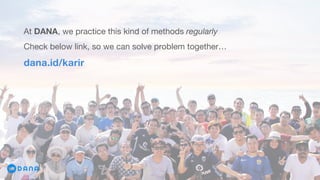
At DANA, we practice this kind of methods regularly
Check below link, so we can solve problem together…
dana.id/karir
WWW.DANA.ID
Thank You

Level Up your Problem Solving skills

  • 1.
    Level up yourProblem-Solving skill
  • 2.
  • 3.
    WWW.DANA.ID SONAR MEDIA Founded :2010 Funding : Raised almost $2M in 2 rounds Runner-Up (2011) Finalist (2012) Achievement : Promoted in >100 Countries by Google & Apple Featured on >300 Publications “App to find nearby friends (from FB, Twitter, and LinkedIn)” SOURCE: https://medium.com/@brett1211/postmortem-of-a-venture-backed-startup-72c6f8bec7df
  • 4.
    Segment Sonar Closed their business in2013 Brett Martin – Sonar Founder (Now: Investor & Professor at Columbia Business School) SOURCE: https://medium.com/@brett1211/postmortem-of-a-venture-backed-startup-72c6f8bec7df http://startupgraveyard.io/company/sonar/ Reason for Failure: Product/Market Fit False Positive “I would use your product if only you had LinkedIn Connect feature” False Negative Putting huge effort on fixing issues on other Platform (FB Sharing) instead of their own experience (Map Interface) Growth vs Engagement Focusing on Engagement for existing User instead of building Growth and get more network effect
  • 5.
    WWW.DANA.ID It’s not onlyabout “How to Solve a Problem” It’s also about “Picking the Right Problem and try to understand why”
  • 6.
    WWW.DANA.ID When is the problemneeds to be solved? Understand the timing for problem solving NOWTime Constraint Known (Learn) Urgent/Important (Deliver) Longtail (Plan) What we’ll learn together… CraftingUnderstanding What How “I want to enable cashless payment” “using Blockchain” Who is having the problem? Segments PersonasUnderstand the stakeholder (You, Your Boss, Customer?) Why Customer having problem? Understand the reason and impact Stakeholder’s Empathy Stakeholder’s Success Gain (Impact)
  • 7.
  • 8.
    Defining the Problem- #who VISION (TARGET) Indonesian SEGMENTS Age, Gender, Occupation, Behavior PERSONA SOPHIE • Age Range : 15-20 Years Old • Gender : Female • Occupation: Students • Behavior : Tech Savvy, Social GOALS #WHAT “Sophie wants to be able to watch movie with her friends, while still be able to follow her father & school’s hour” Problem to solve VALUES #WHY Expected Gains #social #cost-savvy #easiness
  • 9.
    Early Morning Lunchat Canteen Before School Closed At the Cinema DOING (Journey) FEELING (Pain & Gain) MOMENT OF TRUTH (Opportunity & Loss) Defining the Problem (#why) Chat w/ her friends about new movie launch Set the schedule together w/ her friends after school One of her friends still having quiz and they’re few minutes late Sophie doesn’t get the ticket & cannot join the next schedule (late hours to go home) Neutral Feeling #1 Moment of truth Sophie access the mobile website but cannot book a ticket and pay #2 Moment of truth Sophie cannot get the ticket offline and it will cost the business a Customer SOPHIE • Age Range : 15-20 Years Old • Gender : Female • Occupation : Students • Behavior : Tech Savvy, Social GOALS “Sophie wants to be able to watch movie with her friends, while still be able to follow her father’s & school’s hour” VALUES #social #cost-savvy #easiness
  • 10.
    Persona is notmade to… Stop talking w/ the Stakeholders Observation (Interviews) Inflate your ego It’s a guideline to validate the problem and solutions Research (Data) Solving the Problem validate Released Solution validate Common Mistake when defining Persona & their Journey
  • 11.
  • 12.
    Exercise #1: Solvingthe Norman Door Norman Door 1. A Door that tells you the opposite of what you’re actually supposed to do 2. A Door that gives wrong signal and needs a sign to correct it Epic Problem #1 How we design better door? How the Door should be… Source: Design of Everyday Things (Books)
  • 13.
    Wicked ProblemTame Problem TurnOn Electric Bulb Solution: Success or Failed Designing a Mouse Solution: How do you know User need 1 or 2 buttons? Exercise #2: which one is the harder problem to solve?
  • 14.
    Defining the Problem(#what) Tame Problem Wicked Problem “One that can be solved by choosing and applying the correct algorithm.” “A wicked problem, however, is one for which there is no known algorithm to solve it.” Problem Solutions Problem Solutions More Problems More Solutions
  • 15.
  • 16.
    #How Norman solveproblems? What You Know What You Don’t Know KNOWN KNOWN UNKNOWN UNKNOWN KNOWN UNKNOWN Tame-part of the Problem Wicked-part of the Problem Understand (Discover) Solvable Space Idea Generation (Solution) #1 Principle G roup Think Build Prototype Low Fidelity High Fidelity Get Feedback Talk w/ Personas (User Research) Source: Design of Everyday Things (Books)
  • 17.
  • 18.
    Deducing Problem (#how) FirstPrinciple (a priori) Statement #1 “All men are mortal” Statement #1 “Socrates is a Man” Deduction (a posteriori) “Socrates is mortal” Notable Thinker Elon MuskAristotle Descartes a basic, foundational, self-evident thinking (theory) that cannot be deduced from any other proposition or assumption Empirical (proven) Criteria Truth (self-evident)
  • 19.
    #Exercise 3: DeducingProblem Elon Musk style… I want to make Space Travel available for everyone How to launch cheaper? Liquid Oxygen – Cost $1-3 per kg or ~$200,000 per launch* What do rocket need to launch? How we build reusable Rocket? https://www.youtube.com/watch?v=NV3sBlRgzTI https://space.stackexchange.com/questions/8330/what-is-the-cost-breakdown-for-a-falcon-9-launch Source: #1 Principle If fuel cost is low, then what’s wrong? Launch cost the rocket, Not only the fuel Cost per Launch is High #1 Principle Application for everyday life Housewife Checking if your husband is lying CEO or Founder Defining your strategic milestone Engineer Bug fixing
  • 20.
    KNOWN KNOWN UNKNOWN UNKNOWN KNOWN UNKNOWN However… there’s limitation onwhat we can solve, alone Group Think - Talk - Observe - Ask Feedbacks How you solve Unknown-Unknown? Pair Programming User Research Brainstorming
  • 21.
    Group Think (#how) Whatyou need to prepare for effective Brainstorming Keep the audience below 8 person, More people doesn’t mean more results Social Loafing Brainwriting Always prepare Pen and Paper for Anonymous Feedback Set Time-Box Check where the discussion is going and set time limit Facilitator Audience Sample: How Might We
  • 22.
    Prototyping your Solution(#how) Paper Prototype Digital Mockup LOW Fidelity HIGH Fidelity Excel Prototype Wireframe Effort Clarity Feedback Quality Effort Clarity Feedback Quality “Typically used for internal stakeholder who understand the context” “Typically used for external stakeholder to see the detail feedback” Choosing the right method for right goal
  • 23.
    Getting Feedback (#how) Whatyou need to prepare for effective User Research Stakeholder Schedule Set time-box: 1 Person should take ~2 hours Rewards Gift for attending the session High Fidelity Beware of “sample” contents. it changes the context! Prototype Low Fidelity Get some spare and sort it by script (i.e. photocopy for Paper prototype) Space Interviewer Max. 1 interviewer on the same room Audience Should be on different room (not intimidating) Give Break When necessary Persona Find extreme users (i.e. Old vs Young) Tools Record You’ll have no time to write notes Live Testing Tool Lookback https://lookback.io/ Keeping the insights Productboard https://www.productboard.com/ Prioritize Q&A based on Goals defined Script Validate Bias For any Q&A Measure Set measurement for each tasks defined (i.e. Easiness = total steps taken)
  • 24.
    Value (Feedback) Efforts (Delivery) Current Ability Quick Win Plan Ahead NO GO Medium High TBD MVP Scope Down Youcan solve everything, but not everything at once (#when) MVP: Minimum Viable Product
  • 25.
    How to addthis thinking framework into your Product Pipeline (#when) Dev. Sprints (Development + Testing) Prototyping Technical Design Planning Prioritizing which feature you want to build within team’s capacity Understand Test Prioritize Estimate Prioritize the solution based on Value the problem space and generate ideas Get feedback from the Customers Get the efforts needed for tech spec Release Deliver the solution to all Customers PrototypingMeasure Understand Test Product & Design Tech Design Sprints
  • 26.
    At DANA, wepractice this kind of methods regularly Check below link, so we can solve problem together… dana.id/karir
  • 27.