How to select the appropriate method for
our study of Interest?
SELECT THE APPROPRIATE METHOD
Once you are well into your literature
review, it is time to start thinking
about the study you will design to
answer the gap you identified.
• Which methodology will you use
to gather the data for your
research?
• Will it be a qualitative,
quantitative, or mixed methods
methodology?
Let's look at how to find the
right research design strategy
IN 3 SIMPLE STEPS!
locate general
information on
research designs
and
methodologies
Gain background
knowledge
Choose the methodology
and methods for your
research
THE DIFFERENT RESEARCH METHODS
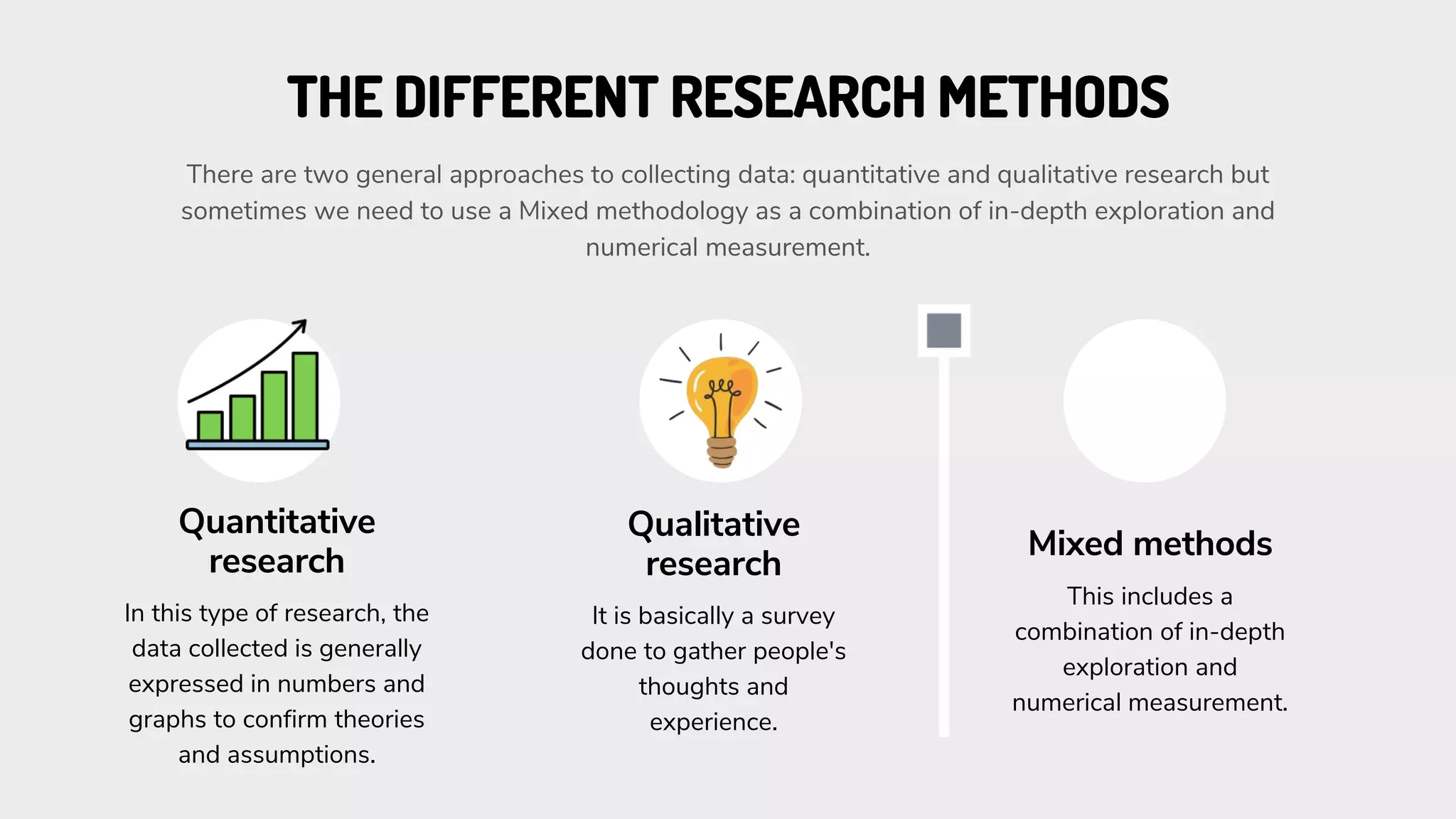
There are two general approaches to collecting data: quantitative and qualitative research but
sometimes we need to use a Mixed methodology as a combination of in-depth exploration and
numerical measurement.
In this type of research, the
data collected is generally
expressed in numbers and
graphs to confirm theories
and assumptions.
Quantitative
research
It is basically a survey
done to gather people's
thoughts and
experience.
Qualitative
research
This includes a
combination of in-depth
exploration and
numerical measurement.
Mixed methods
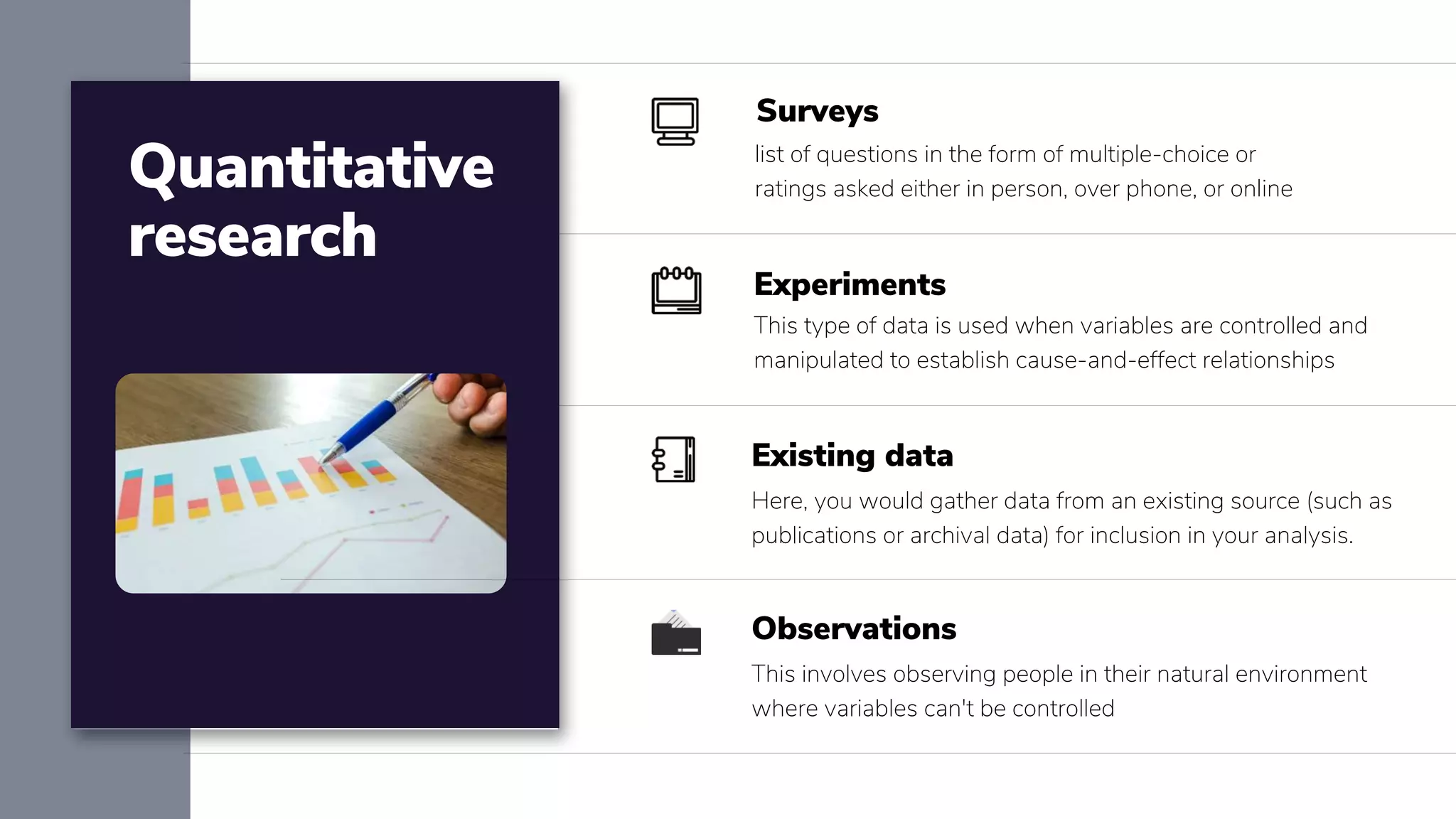
Quantitative
research
list of questions in the form of multiple-choice or
ratings asked either in person, over phone, or online
Surveys
This type of data is used when variables are controlled and
manipulated to establish cause-and-effect relationships
Experiments
Here, you would gather data from an existing source (such as
publications or archival data) for inclusion in your analysis.
Existing data
This involves observing people in their natural environment
where variables can't be controlled
Observations
This method involves asking open-ended
questions verbally to respondents
Interviews
An in-depth study of an event, an organization, a
person, or a group. Explain how you selected your case
study materials (such as texts or images) for your
analysis, the type of materials you analyzed, and how
you collected and selected them.
Case-study
Qualitative
research
Let us look at the techniques in
qualitative research.
A survey of published works by other
authors.
Literature-review
When to use
qualitative vs
quantitative research
works better if you want to
confirm or test something (a
theory or hypothesis)
Using quantitative
analysis
works better if you wish to
understand something
(concepts, thoughts,
experiences)
Using qualitative
research
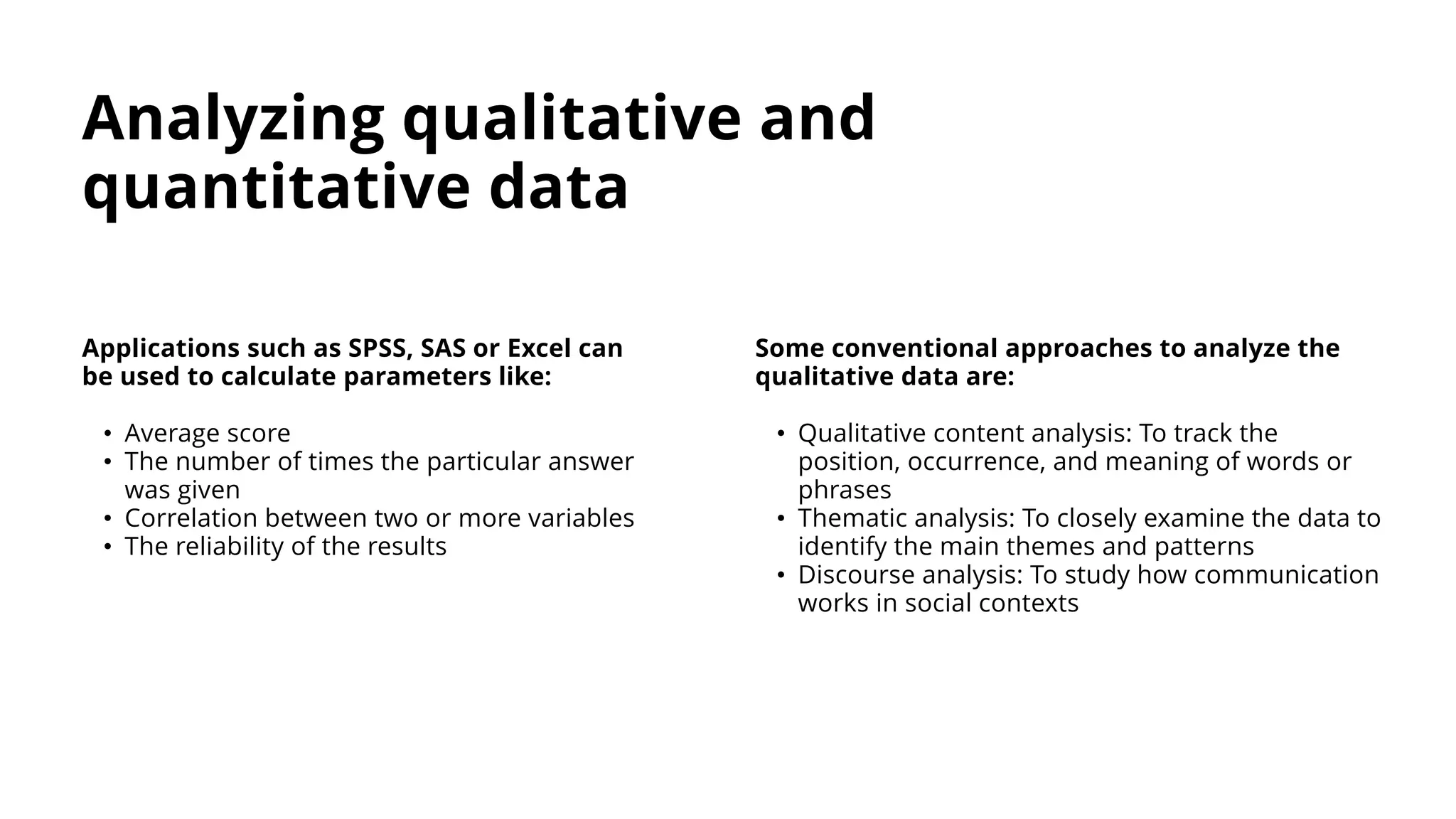
Analyzing qualitative and
quantitative data
Applications such as SPSS, SAS or Excel can
be used to calculate parameters like:
• Average score
• The number of times the particular answer
was given
• Correlation between two or more variables
• The reliability of the results
Some conventional approaches to analyze the
qualitative data are:
• Qualitative content analysis: To track the
position, occurrence, and meaning of words or
phrases
• Thematic analysis: To closely examine the data to
identify the main themes and patterns
• Discourse analysis: To study how communication
works in social contexts
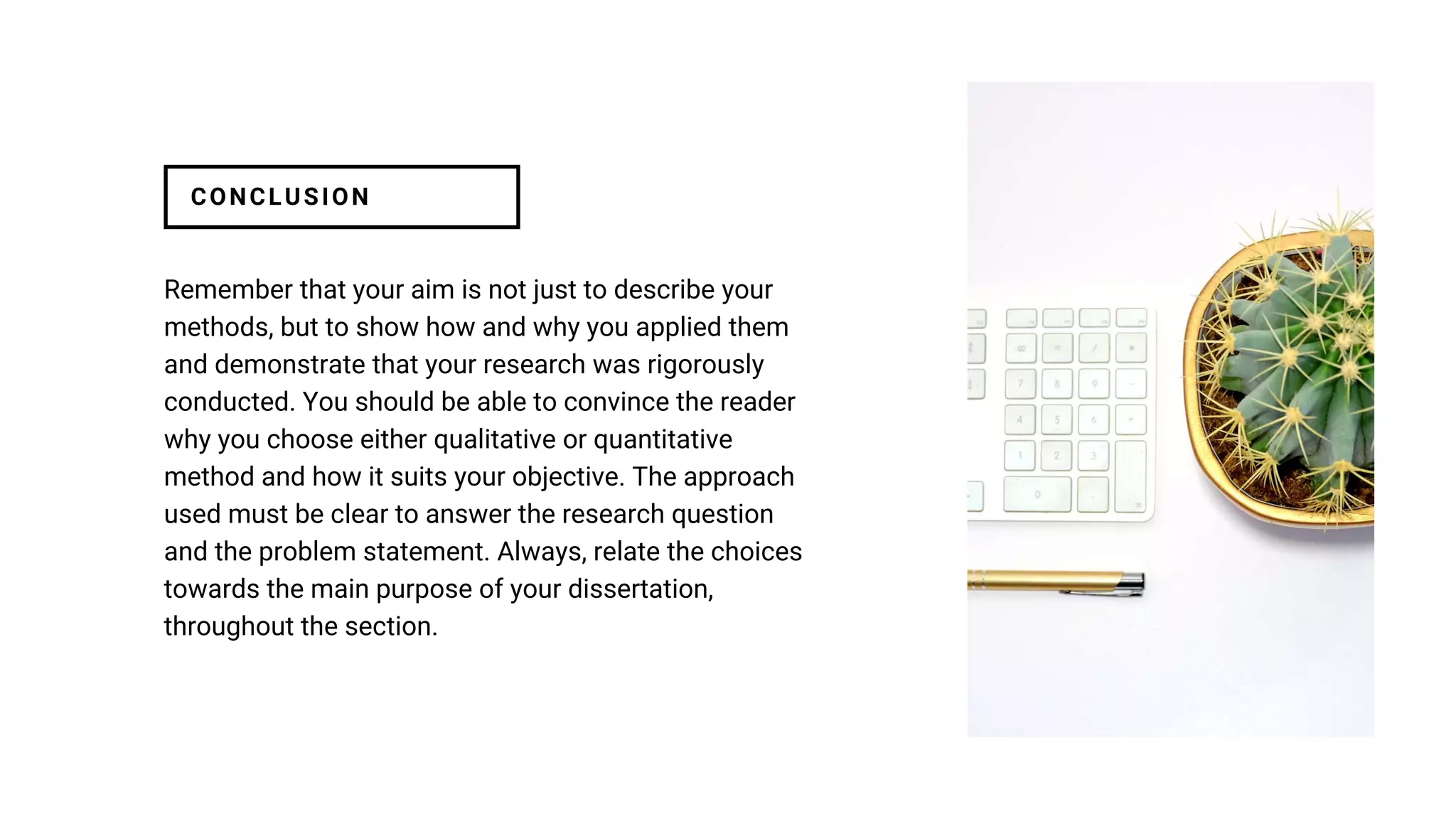
Remember that your aim is not just to describe your
methods, but to show how and why you applied them
and demonstrate that your research was rigorously
conducted. You should be able to convince the reader
why you choose either qualitative or quantitative
method and how it suits your objective. The approach
used must be clear to answer the research question
and the problem statement. Always, relate the choices
towards the main purpose of your dissertation,
throughout the section.
CONCLUSION
References
:
• https://www.editage.com/insights/how-to-choose-the-research-methodology-
best-suited-for-your-study?refer=scroll-to-1-article&refer-type=article
• Research Methods & Design
• Chapter 3 - Research Methodology: Data collection method and Research tools
• https://in.sagepub.com/sites/default/files/upm-
binaries/55588_Chapter_1_Sample_Creswell_Research_Design_4e.pdf
• https://www.collegeraptor.com/find-colleges/articles/tips-tools-advice/choose-
right-research-topic-5-easy-steps/
• https://www.researchgate.net/publication/343683240_Strategies_for_Selecting_
a_Research_Topic
Any Questions?
We're Done!!

How to select the appropriate method for our study of Interest?

  • 1.
    How to selectthe appropriate method for our study of Interest?
  • 2.
    SELECT THE APPROPRIATEMETHOD Once you are well into your literature review, it is time to start thinking about the study you will design to answer the gap you identified. • Which methodology will you use to gather the data for your research? • Will it be a qualitative, quantitative, or mixed methods methodology?
  • 3.
    Let's look athow to find the right research design strategy IN 3 SIMPLE STEPS!
  • 4.
    locate general information on researchdesigns and methodologies
  • 5.
    Gain background knowledge Choose themethodology and methods for your research
  • 6.
    THE DIFFERENT RESEARCHMETHODS There are two general approaches to collecting data: quantitative and qualitative research but sometimes we need to use a Mixed methodology as a combination of in-depth exploration and numerical measurement. In this type of research, the data collected is generally expressed in numbers and graphs to confirm theories and assumptions. Quantitative research It is basically a survey done to gather people's thoughts and experience. Qualitative research This includes a combination of in-depth exploration and numerical measurement. Mixed methods
  • 7.
    Quantitative research list of questionsin the form of multiple-choice or ratings asked either in person, over phone, or online Surveys This type of data is used when variables are controlled and manipulated to establish cause-and-effect relationships Experiments Here, you would gather data from an existing source (such as publications or archival data) for inclusion in your analysis. Existing data This involves observing people in their natural environment where variables can't be controlled Observations
  • 8.
    This method involvesasking open-ended questions verbally to respondents Interviews An in-depth study of an event, an organization, a person, or a group. Explain how you selected your case study materials (such as texts or images) for your analysis, the type of materials you analyzed, and how you collected and selected them. Case-study Qualitative research Let us look at the techniques in qualitative research. A survey of published works by other authors. Literature-review
  • 9.
    When to use qualitativevs quantitative research works better if you want to confirm or test something (a theory or hypothesis) Using quantitative analysis works better if you wish to understand something (concepts, thoughts, experiences) Using qualitative research
  • 10.
    Analyzing qualitative and quantitativedata Applications such as SPSS, SAS or Excel can be used to calculate parameters like: • Average score • The number of times the particular answer was given • Correlation between two or more variables • The reliability of the results Some conventional approaches to analyze the qualitative data are: • Qualitative content analysis: To track the position, occurrence, and meaning of words or phrases • Thematic analysis: To closely examine the data to identify the main themes and patterns • Discourse analysis: To study how communication works in social contexts
  • 11.
    Remember that youraim is not just to describe your methods, but to show how and why you applied them and demonstrate that your research was rigorously conducted. You should be able to convince the reader why you choose either qualitative or quantitative method and how it suits your objective. The approach used must be clear to answer the research question and the problem statement. Always, relate the choices towards the main purpose of your dissertation, throughout the section. CONCLUSION
  • 12.
    References : • https://www.editage.com/insights/how-to-choose-the-research-methodology- best-suited-for-your-study?refer=scroll-to-1-article&refer-type=article • ResearchMethods & Design • Chapter 3 - Research Methodology: Data collection method and Research tools • https://in.sagepub.com/sites/default/files/upm- binaries/55588_Chapter_1_Sample_Creswell_Research_Design_4e.pdf • https://www.collegeraptor.com/find-colleges/articles/tips-tools-advice/choose- right-research-topic-5-easy-steps/ • https://www.researchgate.net/publication/343683240_Strategies_for_Selecting_ a_Research_Topic
  • 13.