Selecting an Evaluation: Qualitative,
Quantitative, and
Mixed Methods Approaches
Presented By:
Md. Mostafijur Rahman
Supervised By:
Asif Imran
Lecturer, IIT, DU
Research Question
 How can be done evaluation of a research?
1/21/2015 2
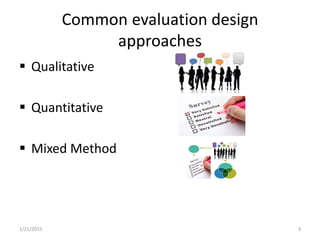
Common evaluation design
approaches
 Qualitative
 Quantitative
 Mixed Method
1/21/2015 3
Qualitative Approach
 non-numerical information
o open-ended survey question, dialogue from a focus
group, Brainstormed ideas etc.
 Advantages
o contextual information
o respondents are free to answer any way they would
like
 Disadvantages
o time consuming
o more expensive
1/21/2015 4
Quantitative Approach
 count or quantify all collected data
o annual income, height or weight, ‘hits’ on a website,
correct response in a driving test etc.
 Advantages
o extremely efficient method
o less expensive
o less monitoring needed
 Disadvantages
o does not include an explanation of ‘why’
o respondents are limited to a set of response options
1/21/2015 5
Mixed Method Approach
 incorporates both qualitative and quantitative
elements in such a way that the qualitative and
quantitative information complements each other.
 Advantages
o balances efficient data collection and analysis with data
that provides context
o costs are mitigated
o quickly and efficiently captures potentially large amounts
of data
 Disadvantages
o challenge of methods complement
o duplicative data collection methods double the cost
1/21/2015 6
Which Approach to Use?
o Consider the alignment of approach with the
goals and objectives of the evaluation.
1/21/2015 7
References
[1] Creswell, J. W. (2013). Qualitative, quantitative, and mixed
methods approaches (4th ed.). Thousand Oaks, CA: Sage.
[2] Maxwell, J. A. (2012). Qualitative research design: An
interactive approach (3rd ed.). Thousand Oaks, CA: Sage.
[3] Smith, R. A., & Davis, S. F. (2012). The psychologist as
detective: An introduction to conducting research in psychology
(6th ed.). London: Pearson.
1/21/2015 8
Any Question?
1/21/2015 9
Thank You
1/21/2015 10

Research methodology methods and techniques 2004

  • 1.
    Selecting an Evaluation:Qualitative, Quantitative, and Mixed Methods Approaches Presented By: Md. Mostafijur Rahman Supervised By: Asif Imran Lecturer, IIT, DU
  • 2.
    Research Question  Howcan be done evaluation of a research? 1/21/2015 2
  • 3.
    Common evaluation design approaches Qualitative  Quantitative  Mixed Method 1/21/2015 3
  • 4.
    Qualitative Approach  non-numericalinformation o open-ended survey question, dialogue from a focus group, Brainstormed ideas etc.  Advantages o contextual information o respondents are free to answer any way they would like  Disadvantages o time consuming o more expensive 1/21/2015 4
  • 5.
    Quantitative Approach  countor quantify all collected data o annual income, height or weight, ‘hits’ on a website, correct response in a driving test etc.  Advantages o extremely efficient method o less expensive o less monitoring needed  Disadvantages o does not include an explanation of ‘why’ o respondents are limited to a set of response options 1/21/2015 5
  • 6.
    Mixed Method Approach incorporates both qualitative and quantitative elements in such a way that the qualitative and quantitative information complements each other.  Advantages o balances efficient data collection and analysis with data that provides context o costs are mitigated o quickly and efficiently captures potentially large amounts of data  Disadvantages o challenge of methods complement o duplicative data collection methods double the cost 1/21/2015 6
  • 7.
    Which Approach toUse? o Consider the alignment of approach with the goals and objectives of the evaluation. 1/21/2015 7
  • 8.
    References [1] Creswell, J.W. (2013). Qualitative, quantitative, and mixed methods approaches (4th ed.). Thousand Oaks, CA: Sage. [2] Maxwell, J. A. (2012). Qualitative research design: An interactive approach (3rd ed.). Thousand Oaks, CA: Sage. [3] Smith, R. A., & Davis, S. F. (2012). The psychologist as detective: An introduction to conducting research in psychology (6th ed.). London: Pearson. 1/21/2015 8
  • 9.
  • 10.