Can I choose methodology to do
my research or thesis?
Dr. Ahmad Rasmi Albattat
Postgraduate Centre (PGC)
Management and Science University (MSU)
Shah Alam, Malaysia
Dr. Jacquline Tham
Postgraduate Centre (PGC)
Management and Science University (MSU)
Shah Alam, Malaysia
Dr. S. M. Ferdous Azam
Postgraduate Centre (PGC)
Management and Science University (MSU)
Shah Alam, Malaysia
Dr. Oday Q.A.
College of Engineering
University of Mosul
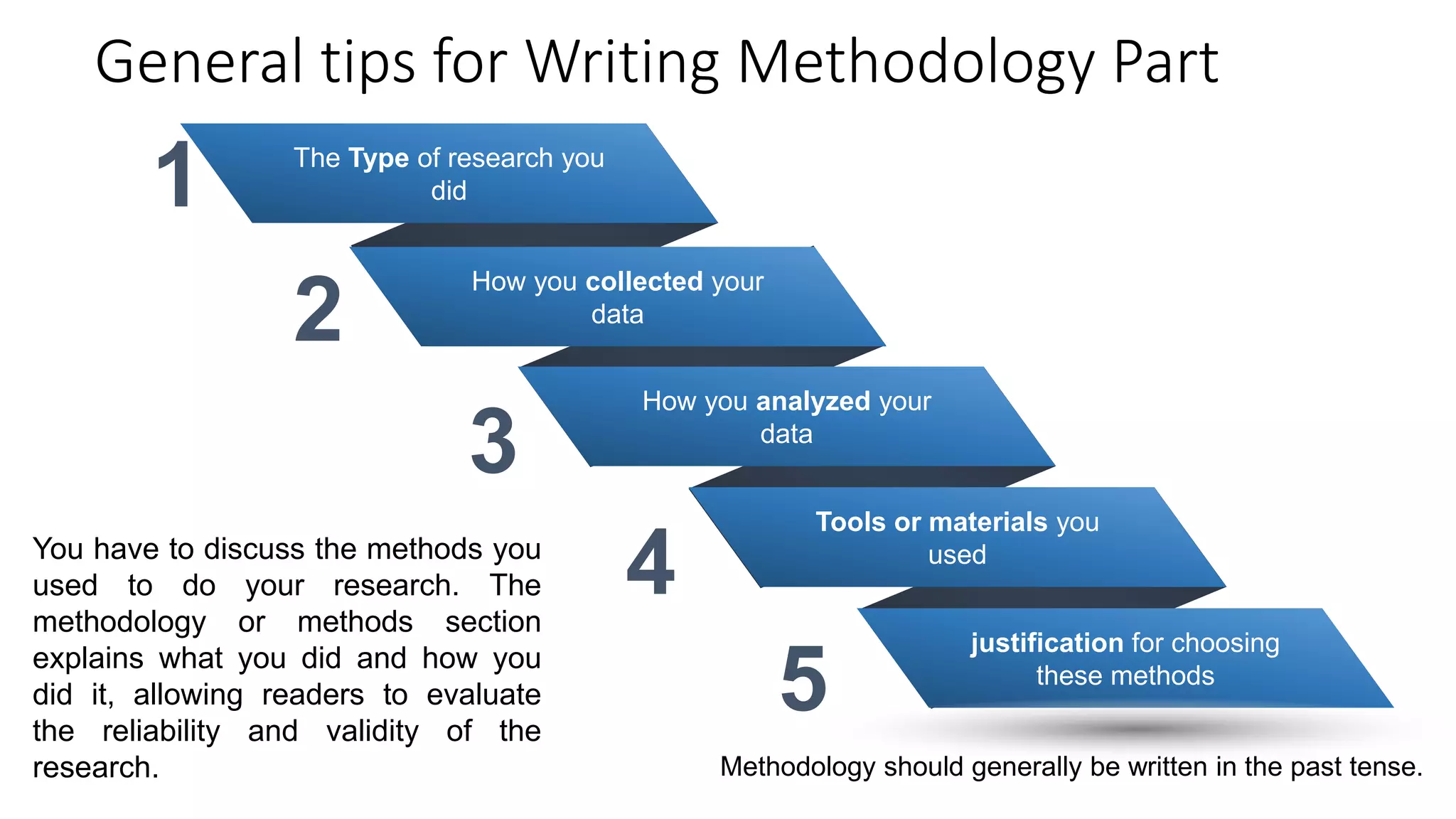
1 The Type of research you
did
2
How you collected your
data
How you analyzed your
data
3
You have to discuss the methods you
used to do your research. The
methodology or methods section
explains what you did and how you
did it, allowing readers to evaluate
the reliability and validity of the
research.
General tips for Writing Methodology Part
4
Tools or materials you
used
justification for choosing
these methods
5
Methodology should generally be written in the past tense.
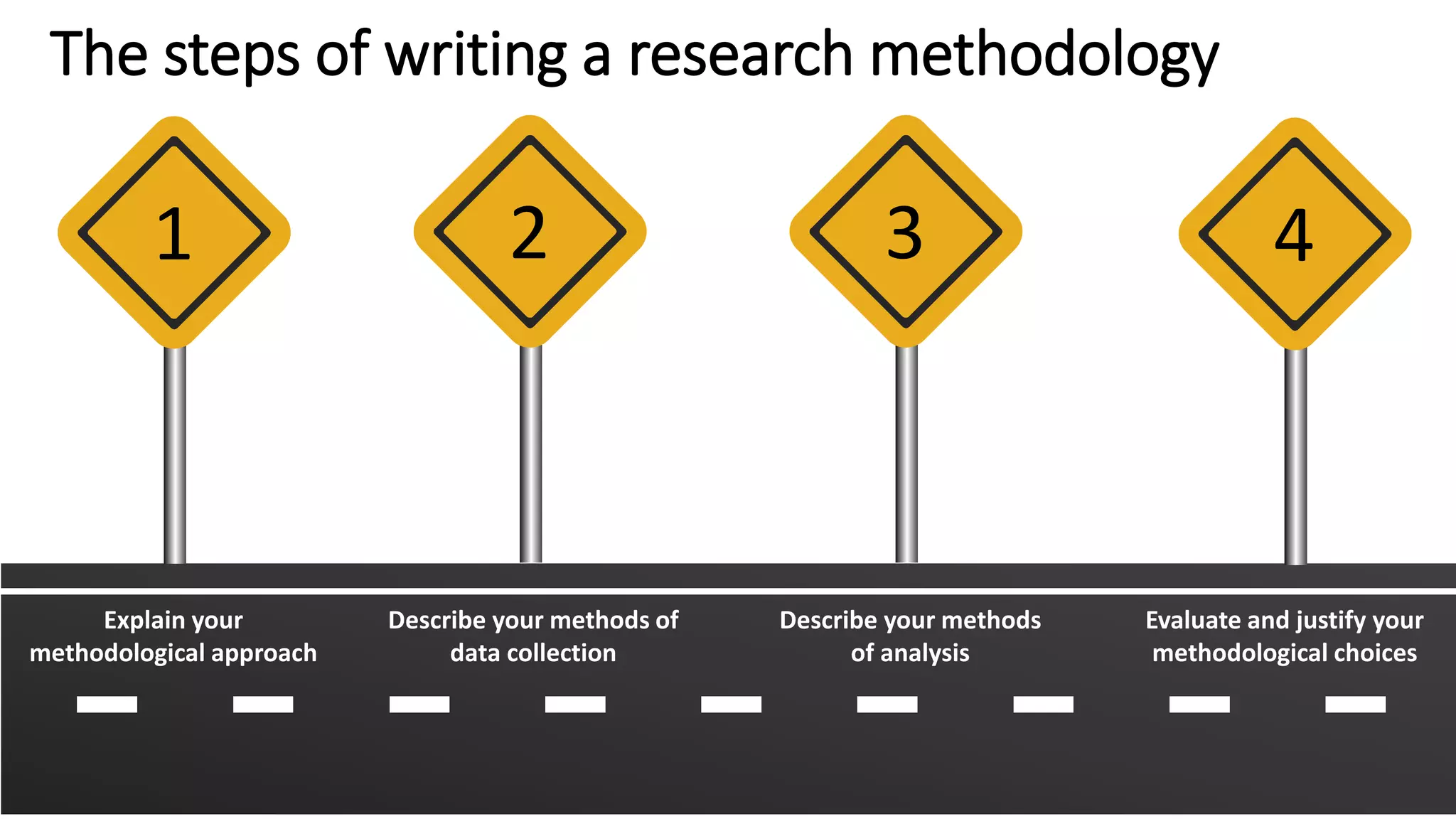
The steps of writing a research methodology
41 2 3
Explain your
methodological approach
Describe your methods of
data collection
Describe your methods
of analysis
Evaluate and justify your
methodological choices
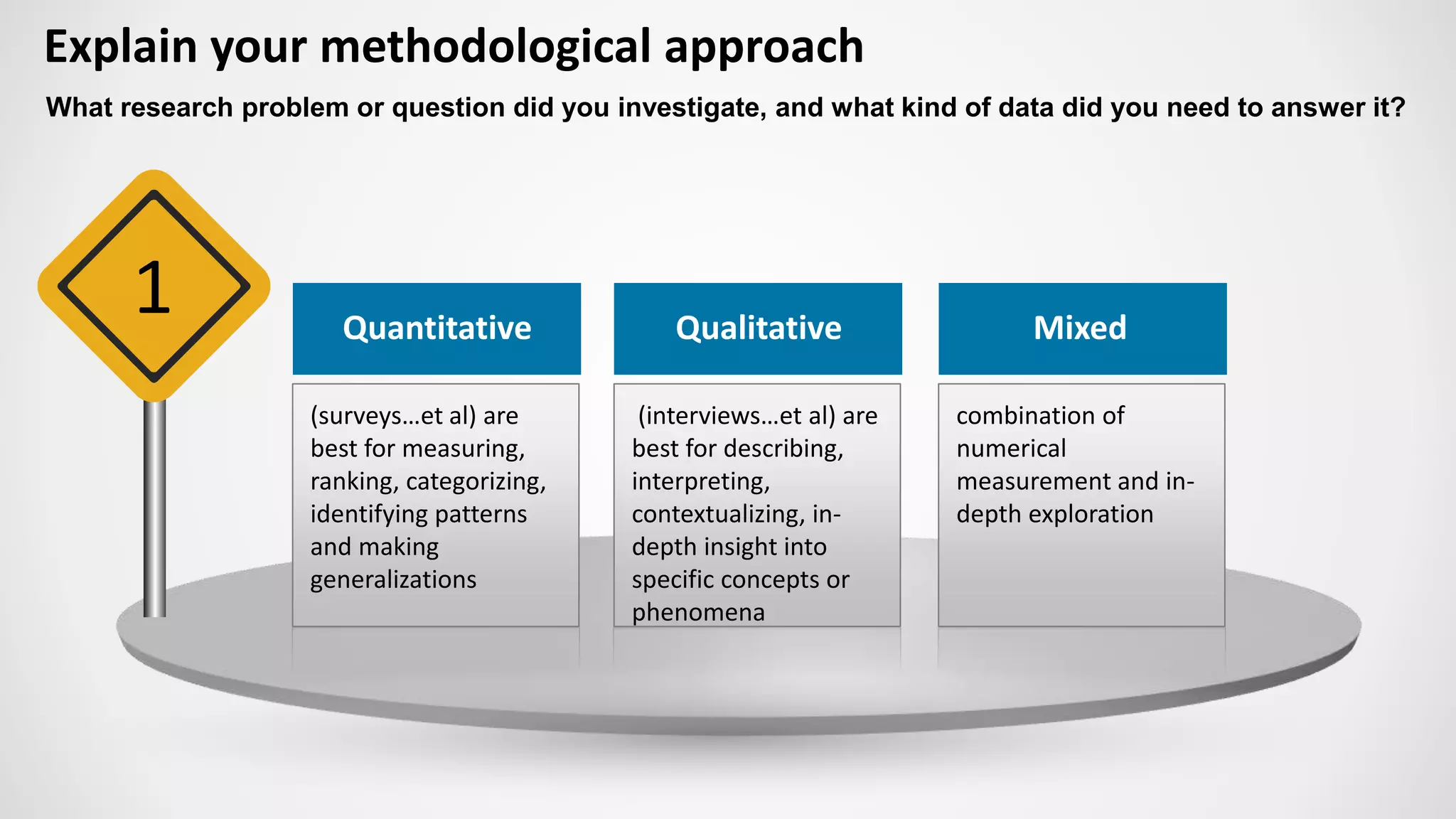
Explain your methodological approach
Quantitative
(surveys…et al) are
best for measuring,
ranking, categorizing,
identifying patterns
and making
generalizations
1
What research problem or question did you investigate, and what kind of data did you need to answer it?
Qualitative
(interviews…et al) are
best for describing,
interpreting,
contextualizing, in-
depth insight into
specific concepts or
phenomena
Mixed
combination of
numerical
measurement and in-
depth exploration
Describe your methods of data collection
2
you should give full details of the research methods. Outline the tools, procedures and materials you used to gather data,
and the criteria you used to select participants or sources.
Experiments
-How did you design
the experiment?
-How did you recruit
participants?
-How did you
manipulate and
measure the variables?
-What tools or
technologies did you
use in the experiment?
Quantitative
Surveys..
- How did you design the
questions and what form
did they take (e.g.
multiple choice, rating
scale)?
- What sampling
method did you use to
select participants?
-Did you conduct surveys
by phone, mail, online or
in person, and how long
did participants have to
respond?
-What was the sample
size and response rate?
Interviews or focus
groups:
- How did you find and
select participants?
- How many people
took part?
- What form did the
interviews take
(structured, semi-
structured,
unstructured)?
- How long were the
interviews and how
were they recorded?
Qualitative
observation
-What group or
community did you
observe and how did
you gain access to
them?
-How long did you
spend conducting the
research and where
was it located?
-How did you record
your data (e.g.
audiovisual recordings,
note-taking)?
Describe your methods of analysis
Quantitative
- How you prepared the data
before analyzing it (e.g. checking
for missing data, removing
outliers, transforming variables)
- software : PLS – Amos - SPSS
- Which statistical methods you
used (e.g. two-tailed t-test, simple
linear regression)
3
how you processed and analyzed the data. too much detail not good—you should not start presenting or discussing any of
your results at this stage.
Qualitative
- Content analysis:
- Thematic analysis:
- Discourse analysis:
- Software: Nvivo…..
Evaluate and justify your methodological choices
- why you chose these particular methods, especially if you
did not take the most standard approach to your topic.
- Discuss why other methods were not suitable for your
objectives,
- how this approach contributes new knowledge or
understanding.
- You can acknowledge limitations or weaknesses.
- You can cite ..
4
References
Date published February 25, 2019 by Shona McCombes. Date updated: March 13, 2020
https://www.scribbr.com/dissertation/methodology/
https://studymafia.org/researched-methodology-ppt-presentation-pdf/
Research Methodology
The word methodology can be spilt into:
- ‘ology’ means “study of” or “science of”.
Hence, research methodology can be defined as the study of methods by which
knowledge is gained.
It aims at the employment of correct procedures and guides for proper conduct of
the research.
It entails the procedures by which a researcher goes about
The aim is to provide a systematic work plan to solve a problem
‘method’ ‘ology’
Describing
Explaining and
Predicting the outcomes
Research Methodology (cont.)
Research methodology is concerned with the explanation of the following:
Why is a particular research study undertaken?
How is a research problem formulated?
What types of data are collected?
What particular method is used?
Why is a particular technique of data analysis used?
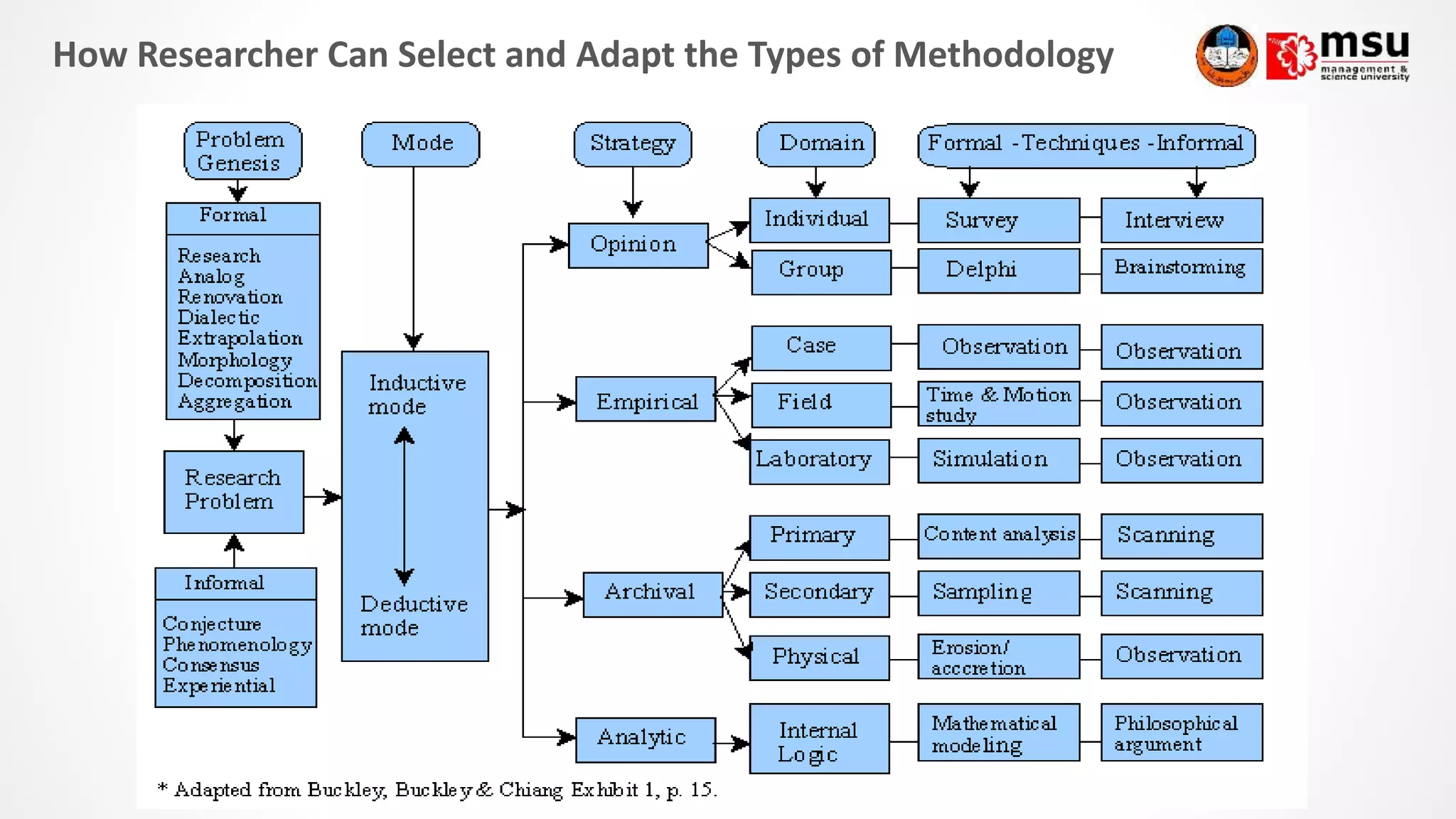
How Researcher Can Select and Adapt the Types of Methodology
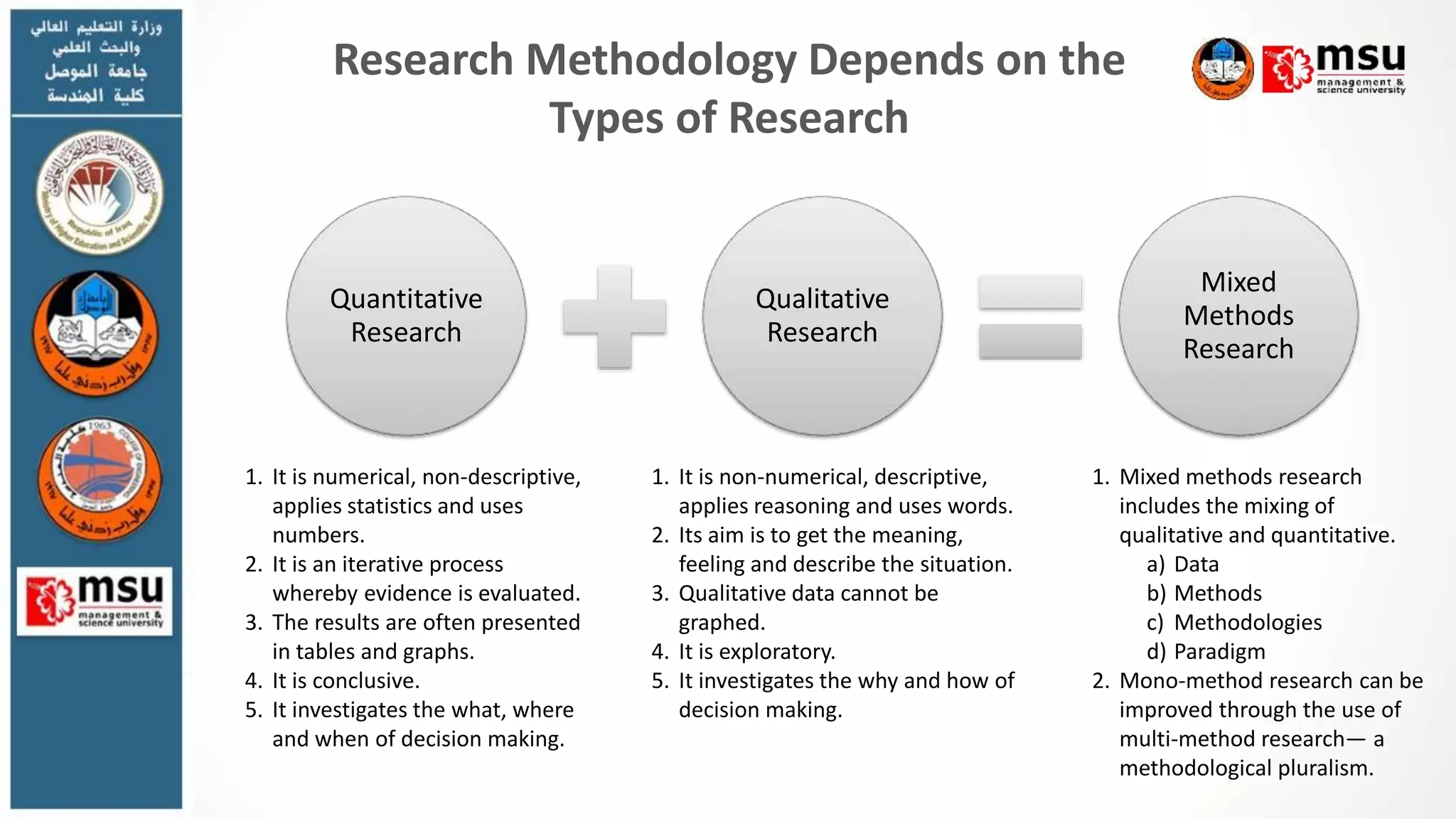
Research Methodology Depends on the
Types of Research
Quantitative
Research
Qualitative
Research
Mixed
Methods
Research
1. It is numerical, non-descriptive,
applies statistics and uses
numbers.
2. It is an iterative process
whereby evidence is evaluated.
3. The results are often presented
in tables and graphs.
4. It is conclusive.
5. It investigates the what, where
and when of decision making.
1. It is non-numerical, descriptive,
applies reasoning and uses words.
2. Its aim is to get the meaning,
feeling and describe the situation.
3. Qualitative data cannot be
graphed.
4. It is exploratory.
5. It investigates the why and how of
decision making.
1. Mixed methods research
includes the mixing of
qualitative and quantitative.
a) Data
b) Methods
c) Methodologies
d) Paradigm
2. Mono-method research can be
improved through the use of
multi-method research― a
methodological pluralism.
Research Methodology for the “Mixed
Methods” Research
Outline of Research:
Where is Research Methodology Located in the Thesis?
Abstract
• Chapter 1: Introduction
• Chapter 2 : Literature Review
• Chapter 3: Research Methodology
• Chapter 4: Analysis and Findings
• Chapter 5: Conclusion and Recommendation/ Conclusion and Implication
References
Appendix
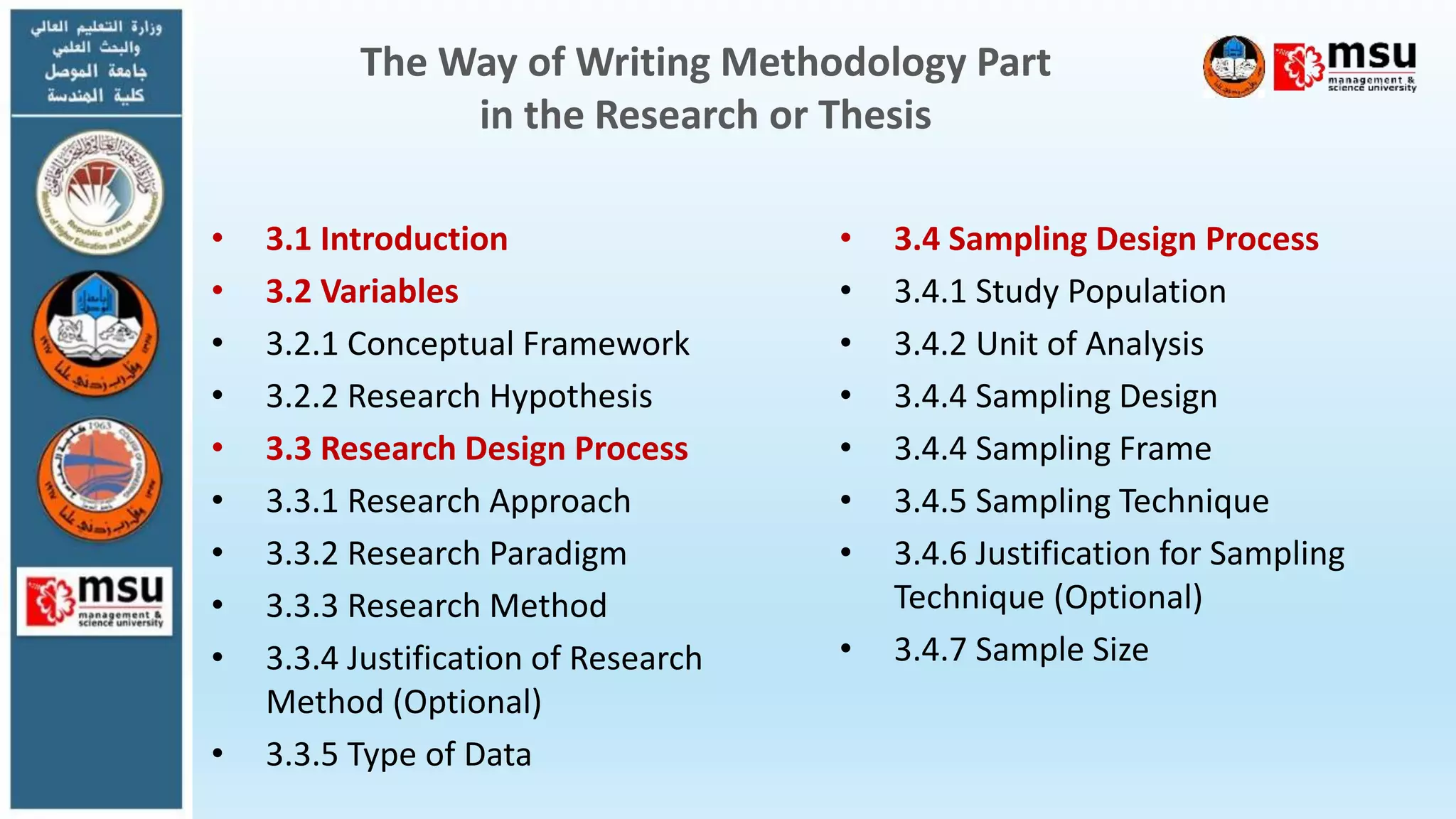
The Way of Writing Methodology Part
in the Research or Thesis
• 3.1 Introduction
• 3.2 Variables
• 3.2.1 Conceptual Framework
• 3.2.2 Research Hypothesis
• 3.3 Research Design Process
• 3.3.1 Research Approach
• 3.3.2 Research Paradigm
• 3.3.3 Research Method
• 3.3.4 Justification of Research
Method (Optional)
• 3.3.5 Type of Data
• 3.4 Sampling Design Process
• 3.4.1 Study Population
• 3.4.2 Unit of Analysis
• 3.4.4 Sampling Design
• 3.4.4 Sampling Frame
• 3.4.5 Sampling Technique
• 3.4.6 Justification for Sampling
Technique (Optional)
• 3.4.7 Sample Size
The Way of Writing Methodology Part
in the Research or Thesis (cont.)
• 3.5 Instrument Development Process
• 3.5.1. Instrument Development
• 3.5.2 Pre-Test and Item Modification
• 3.5.3 Reliability of the Questionnaire
• 3.5.4 Validity of the Measurement Scale
• 3.5.5 Instrumentation of Measurement
Items
• 3.6 Data Analysis Process
• 3.6.1 Data Collection
• 3.6.2 Data Coding
• 3.6.3 Data Analysis
• 3.6.4 Statistical Technique of Data
Analysis
• 3.6.5 Justification for Statistical Technique
(Optional)
• 3.6.6 Ethical Considerations
• 3.7 Findings from the Pilot Study
• 3.7.1 Demographic Information of the
Pilot Study
• 3.7.2 Company Information of the Pilot
Study (Optional)
• 3.7.3 Reliability of the Measurements
• 3.8 Chapter Summary
Terima Kasih ‫لكم‬ ‫شكرا‬

Can i choose methodology to do my research and thesis

  • 2.
    Can I choosemethodology to do my research or thesis? Dr. Ahmad Rasmi Albattat Postgraduate Centre (PGC) Management and Science University (MSU) Shah Alam, Malaysia Dr. Jacquline Tham Postgraduate Centre (PGC) Management and Science University (MSU) Shah Alam, Malaysia Dr. S. M. Ferdous Azam Postgraduate Centre (PGC) Management and Science University (MSU) Shah Alam, Malaysia Dr. Oday Q.A. College of Engineering University of Mosul
  • 3.
    1 The Typeof research you did 2 How you collected your data How you analyzed your data 3 You have to discuss the methods you used to do your research. The methodology or methods section explains what you did and how you did it, allowing readers to evaluate the reliability and validity of the research. General tips for Writing Methodology Part 4 Tools or materials you used justification for choosing these methods 5 Methodology should generally be written in the past tense.
  • 4.
    The steps ofwriting a research methodology 41 2 3 Explain your methodological approach Describe your methods of data collection Describe your methods of analysis Evaluate and justify your methodological choices
  • 5.
    Explain your methodologicalapproach Quantitative (surveys…et al) are best for measuring, ranking, categorizing, identifying patterns and making generalizations 1 What research problem or question did you investigate, and what kind of data did you need to answer it? Qualitative (interviews…et al) are best for describing, interpreting, contextualizing, in- depth insight into specific concepts or phenomena Mixed combination of numerical measurement and in- depth exploration
  • 6.
    Describe your methodsof data collection 2 you should give full details of the research methods. Outline the tools, procedures and materials you used to gather data, and the criteria you used to select participants or sources. Experiments -How did you design the experiment? -How did you recruit participants? -How did you manipulate and measure the variables? -What tools or technologies did you use in the experiment? Quantitative Surveys.. - How did you design the questions and what form did they take (e.g. multiple choice, rating scale)? - What sampling method did you use to select participants? -Did you conduct surveys by phone, mail, online or in person, and how long did participants have to respond? -What was the sample size and response rate? Interviews or focus groups: - How did you find and select participants? - How many people took part? - What form did the interviews take (structured, semi- structured, unstructured)? - How long were the interviews and how were they recorded? Qualitative observation -What group or community did you observe and how did you gain access to them? -How long did you spend conducting the research and where was it located? -How did you record your data (e.g. audiovisual recordings, note-taking)?
  • 7.
    Describe your methodsof analysis Quantitative - How you prepared the data before analyzing it (e.g. checking for missing data, removing outliers, transforming variables) - software : PLS – Amos - SPSS - Which statistical methods you used (e.g. two-tailed t-test, simple linear regression) 3 how you processed and analyzed the data. too much detail not good—you should not start presenting or discussing any of your results at this stage. Qualitative - Content analysis: - Thematic analysis: - Discourse analysis: - Software: Nvivo…..
  • 8.
    Evaluate and justifyyour methodological choices - why you chose these particular methods, especially if you did not take the most standard approach to your topic. - Discuss why other methods were not suitable for your objectives, - how this approach contributes new knowledge or understanding. - You can acknowledge limitations or weaknesses. - You can cite .. 4
  • 9.
    References Date published February25, 2019 by Shona McCombes. Date updated: March 13, 2020 https://www.scribbr.com/dissertation/methodology/ https://studymafia.org/researched-methodology-ppt-presentation-pdf/
  • 11.
    Research Methodology The wordmethodology can be spilt into: - ‘ology’ means “study of” or “science of”. Hence, research methodology can be defined as the study of methods by which knowledge is gained. It aims at the employment of correct procedures and guides for proper conduct of the research. It entails the procedures by which a researcher goes about The aim is to provide a systematic work plan to solve a problem ‘method’ ‘ology’ Describing Explaining and Predicting the outcomes
  • 12.
    Research Methodology (cont.) Researchmethodology is concerned with the explanation of the following: Why is a particular research study undertaken? How is a research problem formulated? What types of data are collected? What particular method is used? Why is a particular technique of data analysis used?
  • 13.
    How Researcher CanSelect and Adapt the Types of Methodology
  • 14.
    Research Methodology Dependson the Types of Research Quantitative Research Qualitative Research Mixed Methods Research 1. It is numerical, non-descriptive, applies statistics and uses numbers. 2. It is an iterative process whereby evidence is evaluated. 3. The results are often presented in tables and graphs. 4. It is conclusive. 5. It investigates the what, where and when of decision making. 1. It is non-numerical, descriptive, applies reasoning and uses words. 2. Its aim is to get the meaning, feeling and describe the situation. 3. Qualitative data cannot be graphed. 4. It is exploratory. 5. It investigates the why and how of decision making. 1. Mixed methods research includes the mixing of qualitative and quantitative. a) Data b) Methods c) Methodologies d) Paradigm 2. Mono-method research can be improved through the use of multi-method research― a methodological pluralism.
  • 15.
    Research Methodology forthe “Mixed Methods” Research
  • 16.
    Outline of Research: Whereis Research Methodology Located in the Thesis? Abstract • Chapter 1: Introduction • Chapter 2 : Literature Review • Chapter 3: Research Methodology • Chapter 4: Analysis and Findings • Chapter 5: Conclusion and Recommendation/ Conclusion and Implication References Appendix
  • 17.
    The Way ofWriting Methodology Part in the Research or Thesis • 3.1 Introduction • 3.2 Variables • 3.2.1 Conceptual Framework • 3.2.2 Research Hypothesis • 3.3 Research Design Process • 3.3.1 Research Approach • 3.3.2 Research Paradigm • 3.3.3 Research Method • 3.3.4 Justification of Research Method (Optional) • 3.3.5 Type of Data • 3.4 Sampling Design Process • 3.4.1 Study Population • 3.4.2 Unit of Analysis • 3.4.4 Sampling Design • 3.4.4 Sampling Frame • 3.4.5 Sampling Technique • 3.4.6 Justification for Sampling Technique (Optional) • 3.4.7 Sample Size
  • 18.
    The Way ofWriting Methodology Part in the Research or Thesis (cont.) • 3.5 Instrument Development Process • 3.5.1. Instrument Development • 3.5.2 Pre-Test and Item Modification • 3.5.3 Reliability of the Questionnaire • 3.5.4 Validity of the Measurement Scale • 3.5.5 Instrumentation of Measurement Items • 3.6 Data Analysis Process • 3.6.1 Data Collection • 3.6.2 Data Coding • 3.6.3 Data Analysis • 3.6.4 Statistical Technique of Data Analysis • 3.6.5 Justification for Statistical Technique (Optional) • 3.6.6 Ethical Considerations • 3.7 Findings from the Pilot Study • 3.7.1 Demographic Information of the Pilot Study • 3.7.2 Company Information of the Pilot Study (Optional) • 3.7.3 Reliability of the Measurements • 3.8 Chapter Summary
  • 19.