JC NARAG/SMSAT,2019
READING
Reading&WritingSkills
Process
THE
Reading is a language skill which can be developed through
constant practice. As some scholars found out, you can widen
your vocabulary and develop skills in writing when you read. As
a reader, you interact with what you read by asking questions,
analyzing the assertions, adding your own understanding, and
relating your experience to the message.
JC NARAG/SMSAT,2019
reading“Perceiving a written text in order to understand its contents. This can
be done silently (silent reading). The understanding that result is called
reading comprehension.Saying a written text aloud (oral reading). This
can be done with or without understanding of the content.” - Longman
Dictionary of Applied Linguistic
It is a process whereby one looks at and understands what has been
written. (William, 1984).
Rohani Ariffin (1992) in her book entitled Anthropology of Poetry for
Young People defines reading as a highly personal activity that is mainly
done silently, alone. There is a clear understanding that reading is
something related to the activity of acquiring information and it is done
either silently or aloud.
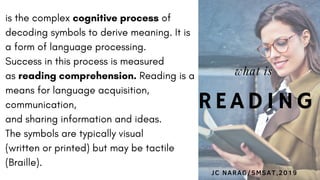
is the complex cognitive process of
decoding symbols to derive meaning. It is
a form of language processing.
Success in this process is measured
as reading comprehension. Reading is a
means for language acquisition,
communication,
and sharing information and ideas.
The symbols are typically visual
(written or printed) but may be tactile
(Braille).
READING
what is
JC NARAG/SMSAT,2019
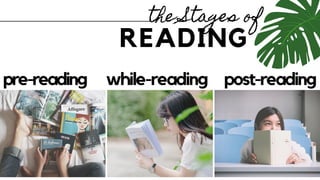
READING
the Stages of
pre-reading while-reading post-reading
aims to induce the readers’ motivation
to read and to activate their schema or
background knowledge.
Activities done during this stage include
previewing, freewriting, surveying,
questioning, making, assumptions
about the author,identifying the
purpose, and selecting a reading
system such as SQ3R (survey,
questions, read, recite, review).
pre-reading
JC NARAG/SMSAT,2019
while-reading
you may reread the text until you fully understand its
meaning. The specific skills in this stage include getting
the meaning of words through context clues, predicting,
inferencing, monitoring, comprehension, annotating the
text, and reflecting
JC NARAG/SMSAT,2019
The skills include reflecting,
summarizing, paraphrasing,
drawing, conclusions, making
graphic organizers, and
journal writing.
post-reading
JC NARAG/SMSAT,2019
READING
SKILLS
Basic
RAPID
READING aims to locate specific
information or main
ideas in a very short
span of time.
Examples of this
include skimming and
scanning, which are
both pre-reading
skills
RAPID
READING
Skimming – When you try to get the
general ideas by reading through the text
quickly, what you do is skimming. It is a
type of quick reading which aims to get the
main idea and to get the overview of the
material. It is usually done when reading
newspapers, magazines, books,
and letters.
Scanning – It is a quick reading strategy
which aims to get specific information
from a given text. This is useful in
locating the specific name of a board
passer, looking for an old email in your
inbox, or checking specific information in
a graph.
PREVIEWING
is a skill wherein a reader
looks over a material and
focuses on the information
he/she find relevant.
Previewing also allows
readers to set the purpose
and link the content of the
material to their
background knowledge.
This is during
pre-reading stage.
LITERAL
READING
involves the understanding
of ideas and facts that are
directly stated in the
printed material. Skills
under this category include
note-taking, paraphrasing,
and summarizing. These are
done in post-reading stage.
a. summarizing
b. paraphrasing
INFERENTIAL
READING
refers to the process of
deducing facts and ideas
not directly expressed in
the text. It is also known as
“reading between the
lines”.
This skill includes making
generalizations, inferences,
and conclusions. This is
applied during while-
reading stage.
CRITICAL
READING refers to the close and
thorough evaluation of the
claims in the text in terms of
relevance, validity, and
logic.
This skill includes
distinguishing facts from
opinions and detecting
logical fallacies. As with
inferential reading, critical
reading happens in the
while-reading stage.
TYPES OF READING
1. Developmental Reading – A
systematic instruction which aims to
develop the students’ reading skills.
2. Pleasure Reading – a more passive
type of reading that primarily aims to
provide enjoyment and entertainment.
3. Functional Reading – designed to
help students learn basic functional
reading ability
4. Remedial Reading – Aims to
correct the effects of poor
teaching and poor learning
SELECTING AND ORGANIZING
INFORMATION
Brainstorming
helps you generate topics and narrow them down to one.
I On a brainstorming list you simply jot down all the
words or ideas that come to mind about a topic. You can
make the list when you have many ideas; you can cross
out some of them as you limit the topic. Also, you can
refer to the list later on when your mind goes blank as
you write.
It is perhaps the most popular tool in generating creative
and rich ideas. It helps people establish patterns of ideas,
develop new ways of thinking, activate background
knowledge, and overcome mental block.
techniques in
Brainstorming
Listing
Idea mapping
Free writing
Through thesis
statements
1.
2.
3.
4.
Graphic Organizers
are visual representations of concepts
that help us structure information into
organizational patterns. They present
essential information and connect these
pieces of information into a coherent
framework
is used to compare and
contrast ideas and events.
This diagram uses two or
more overlapping circles
to show similar and
different
attributes.
is used
to represent hierarchy,
classification, and branching.
IT is useful in showing
relationships of scientific
categories, family trees, and
even lineages.
VENN
DIAGRAM
NETWORK
TREE
this is also called Semantic
Map. IT is used to
investigate and enumerate
various aspects of a central
idea, which could be a
concept, topic, or themes.
This central idea is placed at
the center of the map. The
details of the main idea
are placed on the sides of
the diagonals
is used to
show how events occurred
chronologically through a
long bar labeled with dates
and specific events.
Timelines can be linear or
comparative.
SPIDER MAP TIMELINE
Is used to better
understand the causal
relationship of a complex
phenomenon. It shows
the factors that cause a
specific event or
problem, as well as
details of each
cause.
FISHBONE MAP
Describes
how a series of events
interact to produce a set
of results repeatedly.
Some examples of events
that require a cycle are
water cycle,
metamorphosis, and
poverty cycle
CYCLE

Reading

  • 1.
  • 2.
    Reading is alanguage skill which can be developed through constant practice. As some scholars found out, you can widen your vocabulary and develop skills in writing when you read. As a reader, you interact with what you read by asking questions, analyzing the assertions, adding your own understanding, and relating your experience to the message. JC NARAG/SMSAT,2019
  • 3.
    reading“Perceiving a writtentext in order to understand its contents. This can be done silently (silent reading). The understanding that result is called reading comprehension.Saying a written text aloud (oral reading). This can be done with or without understanding of the content.” - Longman Dictionary of Applied Linguistic It is a process whereby one looks at and understands what has been written. (William, 1984). Rohani Ariffin (1992) in her book entitled Anthropology of Poetry for Young People defines reading as a highly personal activity that is mainly done silently, alone. There is a clear understanding that reading is something related to the activity of acquiring information and it is done either silently or aloud.
  • 4.
    is the complex cognitiveprocess of decoding symbols to derive meaning. It is a form of language processing. Success in this process is measured as reading comprehension. Reading is a means for language acquisition, communication, and sharing information and ideas. The symbols are typically visual (written or printed) but may be tactile (Braille). READING what is JC NARAG/SMSAT,2019
  • 5.
    READING the Stages of pre-readingwhile-reading post-reading
  • 6.
    aims to inducethe readers’ motivation to read and to activate their schema or background knowledge. Activities done during this stage include previewing, freewriting, surveying, questioning, making, assumptions about the author,identifying the purpose, and selecting a reading system such as SQ3R (survey, questions, read, recite, review). pre-reading JC NARAG/SMSAT,2019
  • 7.
    while-reading you may rereadthe text until you fully understand its meaning. The specific skills in this stage include getting the meaning of words through context clues, predicting, inferencing, monitoring, comprehension, annotating the text, and reflecting JC NARAG/SMSAT,2019
  • 8.
    The skills includereflecting, summarizing, paraphrasing, drawing, conclusions, making graphic organizers, and journal writing. post-reading JC NARAG/SMSAT,2019
  • 9.
  • 10.
    RAPID READING aims tolocate specific information or main ideas in a very short span of time. Examples of this include skimming and scanning, which are both pre-reading skills
  • 11.
    RAPID READING Skimming – Whenyou try to get the general ideas by reading through the text quickly, what you do is skimming. It is a type of quick reading which aims to get the main idea and to get the overview of the material. It is usually done when reading newspapers, magazines, books, and letters. Scanning – It is a quick reading strategy which aims to get specific information from a given text. This is useful in locating the specific name of a board passer, looking for an old email in your inbox, or checking specific information in a graph.
  • 12.
    PREVIEWING is a skillwherein a reader looks over a material and focuses on the information he/she find relevant. Previewing also allows readers to set the purpose and link the content of the material to their background knowledge. This is during pre-reading stage.
  • 13.
    LITERAL READING involves the understanding ofideas and facts that are directly stated in the printed material. Skills under this category include note-taking, paraphrasing, and summarizing. These are done in post-reading stage. a. summarizing b. paraphrasing
  • 14.
    INFERENTIAL READING refers to theprocess of deducing facts and ideas not directly expressed in the text. It is also known as “reading between the lines”. This skill includes making generalizations, inferences, and conclusions. This is applied during while- reading stage.
  • 15.
    CRITICAL READING refers tothe close and thorough evaluation of the claims in the text in terms of relevance, validity, and logic. This skill includes distinguishing facts from opinions and detecting logical fallacies. As with inferential reading, critical reading happens in the while-reading stage.
  • 16.
    TYPES OF READING 1.Developmental Reading – A systematic instruction which aims to develop the students’ reading skills. 2. Pleasure Reading – a more passive type of reading that primarily aims to provide enjoyment and entertainment. 3. Functional Reading – designed to help students learn basic functional reading ability 4. Remedial Reading – Aims to correct the effects of poor teaching and poor learning
  • 17.
  • 18.
    Brainstorming helps you generatetopics and narrow them down to one. I On a brainstorming list you simply jot down all the words or ideas that come to mind about a topic. You can make the list when you have many ideas; you can cross out some of them as you limit the topic. Also, you can refer to the list later on when your mind goes blank as you write. It is perhaps the most popular tool in generating creative and rich ideas. It helps people establish patterns of ideas, develop new ways of thinking, activate background knowledge, and overcome mental block.
  • 19.
    techniques in Brainstorming Listing Idea mapping Freewriting Through thesis statements 1. 2. 3. 4.
  • 20.
    Graphic Organizers are visualrepresentations of concepts that help us structure information into organizational patterns. They present essential information and connect these pieces of information into a coherent framework
  • 21.
    is used tocompare and contrast ideas and events. This diagram uses two or more overlapping circles to show similar and different attributes. is used to represent hierarchy, classification, and branching. IT is useful in showing relationships of scientific categories, family trees, and even lineages. VENN DIAGRAM NETWORK TREE
  • 22.
    this is alsocalled Semantic Map. IT is used to investigate and enumerate various aspects of a central idea, which could be a concept, topic, or themes. This central idea is placed at the center of the map. The details of the main idea are placed on the sides of the diagonals is used to show how events occurred chronologically through a long bar labeled with dates and specific events. Timelines can be linear or comparative. SPIDER MAP TIMELINE
  • 23.
    Is used tobetter understand the causal relationship of a complex phenomenon. It shows the factors that cause a specific event or problem, as well as details of each cause. FISHBONE MAP Describes how a series of events interact to produce a set of results repeatedly. Some examples of events that require a cycle are water cycle, metamorphosis, and poverty cycle CYCLE