HOW TO MAKE
AN
ACTION PLAN
KNOW WHAT YOU WANT TO
DO
The less clear you are about what you want to
do, the less effective your plan will be. Try to
specifically define what you want to achieve as
early as possible — preferably before starting
your project.
WORK BACKWARDS FROM
YOUR END GOAL
Identify your end goal, then list everything you need to do to
accomplish it. Depending on your goal, you may even consider
different ways to reach your goal. After you know what you need
to accomplish, break this down into actionable steps to help you
create a more realistic plan. Keep in mind that your plan may
change as you work toward your goal, so stay flexible.
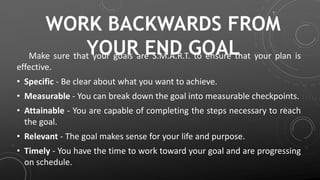
WORK BACKWARDS FROM
YOUR END GOALMake sure that your goals are S.M.A.R.T. to ensure that your plan is
effective.
• Specific - Be clear about what you want to achieve.
• Measurable - You can break down the goal into measurable checkpoints.
• Attainable - You are capable of completing the steps necessary to reach
the goal.
• Relevant - The goal makes sense for your life and purpose.
• Timely - You have the time to work toward your goal and are progressing
on schedule.
BE SPECIFIC AND REALISTIC IN
YOUR PLANNING
• Having a specific goal is just the beginning: you need to be specific
and realistic in every aspect of your project — for example, by stating
specific and achievable schedules, milestones, and final outcomes.
• Being specific and realistic while planning a long project is all about
pro-actively reducing stress that can accompany poorly planned
projects such as missed deadlines and exhausting long hours.
SET MEASURABLE
MILESTONES
• Milestones mark significant stages along the road to achieving your end goal.
Create milestones easily by starting at the end (the accomplishment of the goal)
and working your way backwards to your present day and circumstances.
• Having milestones can help you — and if applicable, your team — stay motivated
by breaking the work into smaller chunks and tangible goals so that you don’t
need to wait until the project is completely finished to feel as though you’ve
accomplished something.
• Don’t leave too much time or too little time between milestones — spacing them
two weeks apart has been found to be effective.
BREAK LARGE TASKS INTO SMALLER,
MORE MANAGEABLE CHUNKS
• Some tasks or milestones may seem more daunting to achieve than others.
• If you’re feeling overwhelmed by a large task, you can help ease your anxiety and
make it feel more doable by breaking it down into smaller, more manageable
chunks.
• You can break it into three smaller chunks: research, analysis, and writing. You can
break it down even smaller by choosing specific articles and books that you need
to read, and setting deadlines for analyzing them and writing about them.
MAKE SCHEDULED LISTS
• Make a list of tasks that you need to complete in
order to hit your milestones. A list on its own will not
be effective — you must write this list into a timeline
associated with specific, realistic actions.
PUT TIMELINES ON
EVERYTHING
• Without specific time frames and deadlines, work will
definitely expand to fill the time allotted, and some tasks
may never get completed.
• No matter what action items you choose for which phase of
your action plan, it is essential that a time frame be
attached to absolutely everything.
CREATE A VISUAL
REPRESENTATION
• Once you’ve listed your action items and set a specific timeline, the
next step is to create some type of visual representation of your plan.
You might use a flow chart, a Gantt chart, a spreadsheet, or some
other type of business tool to accomplish this.
• Keep this visual representation in an easily accessible place — even
on a wall in your office or study room, if possible.
MARK THINGS OFF AS YOU GO
• Marking things off as you go will not only feel satisfying, it will help
you keep on track lest you forget what you’ve already done.
• This is particularly important if you’re working with other people. If
you’re working with other people, you might consider using a shared
online document so that everyone can check in no matter where they
are.
KEEP A RECORD OF
EVERYTHING
• As you work through your action plan, keep notes of
everything. You may find it helpful to have a binder with
different tabs in it to section off different aspects of your
planning process. Some examples of sections:
Ideas/Miscellaneous notes, Daily Schedules, Monthly
Schedules, Milestones, Research, Follow-up and Individuals
involved/Contacts.
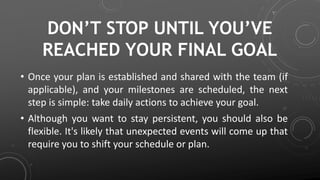
DON’T STOP UNTIL YOU’VE
REACHED YOUR FINAL GOAL
• Once your plan is established and shared with the team (if
applicable), and your milestones are scheduled, the next
step is simple: take daily actions to achieve your goal.
• Although you want to stay persistent, you should also be
flexible. It's likely that unexpected events will come up that
require you to shift your schedule or plan.
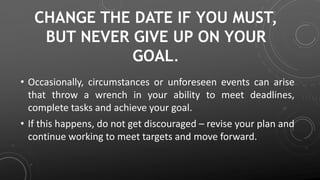
CHANGE THE DATE IF YOU MUST,
BUT NEVER GIVE UP ON YOUR
GOAL.
• Occasionally, circumstances or unforeseen events can arise
that throw a wrench in your ability to meet deadlines,
complete tasks and achieve your goal.
• If this happens, do not get discouraged – revise your plan and
continue working to meet targets and move forward.
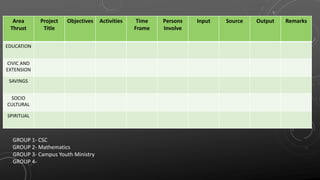
Area
Thrust
Project
Title
Objectives Activities Time
Frame
Persons
Involve
Input Source Output Remarks
EDUCATION
CIVIC AND
EXTENSION
SAVINGS
SOCIO
CULTURAL
SPIRITUAL
GROUP 1- CSC
GROUP 2- Mathematics
GROUP 3- Campus Youth Ministry
GROUP 4-
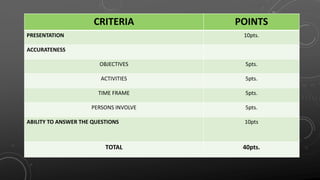
CRITERIA POINTS
PRESENTATION 10pts.
ACCURATENESS
OBJECTIVES 5pts.
ACTIVITIES 5pts.
TIME FRAME 5pts.
PERSONS INVOLVE 5pts.
ABILITY TO ANSWER THE QUESTIONS 10pts
TOTAL 40pts.
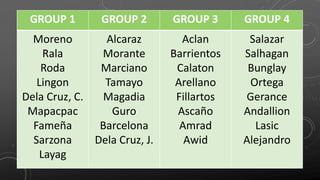
GROUP 1 GROUP 2 GROUP 3 GROUP 4
Moreno
Rala
Roda
Lingon
Dela Cruz, C.
Mapacpac
Fameña
Sarzona
Layag
Alcaraz
Morante
Marciano
Tamayo
Magadia
Guro
Barcelona
Dela Cruz, J.
Aclan
Barrientos
Calaton
Arellano
Fillartos
Ascaño
Amrad
Awid
Salazar
Salhagan
Bunglay
Ortega
Gerance
Andallion
Lasic
Alejandro

How to make an action plan

  • 1.
  • 2.
    KNOW WHAT YOUWANT TO DO The less clear you are about what you want to do, the less effective your plan will be. Try to specifically define what you want to achieve as early as possible — preferably before starting your project.
  • 3.
    WORK BACKWARDS FROM YOUREND GOAL Identify your end goal, then list everything you need to do to accomplish it. Depending on your goal, you may even consider different ways to reach your goal. After you know what you need to accomplish, break this down into actionable steps to help you create a more realistic plan. Keep in mind that your plan may change as you work toward your goal, so stay flexible.
  • 4.
    WORK BACKWARDS FROM YOUREND GOALMake sure that your goals are S.M.A.R.T. to ensure that your plan is effective. • Specific - Be clear about what you want to achieve. • Measurable - You can break down the goal into measurable checkpoints. • Attainable - You are capable of completing the steps necessary to reach the goal. • Relevant - The goal makes sense for your life and purpose. • Timely - You have the time to work toward your goal and are progressing on schedule.
  • 5.
    BE SPECIFIC ANDREALISTIC IN YOUR PLANNING • Having a specific goal is just the beginning: you need to be specific and realistic in every aspect of your project — for example, by stating specific and achievable schedules, milestones, and final outcomes. • Being specific and realistic while planning a long project is all about pro-actively reducing stress that can accompany poorly planned projects such as missed deadlines and exhausting long hours.
  • 6.
    SET MEASURABLE MILESTONES • Milestonesmark significant stages along the road to achieving your end goal. Create milestones easily by starting at the end (the accomplishment of the goal) and working your way backwards to your present day and circumstances. • Having milestones can help you — and if applicable, your team — stay motivated by breaking the work into smaller chunks and tangible goals so that you don’t need to wait until the project is completely finished to feel as though you’ve accomplished something. • Don’t leave too much time or too little time between milestones — spacing them two weeks apart has been found to be effective.
  • 7.
    BREAK LARGE TASKSINTO SMALLER, MORE MANAGEABLE CHUNKS • Some tasks or milestones may seem more daunting to achieve than others. • If you’re feeling overwhelmed by a large task, you can help ease your anxiety and make it feel more doable by breaking it down into smaller, more manageable chunks. • You can break it into three smaller chunks: research, analysis, and writing. You can break it down even smaller by choosing specific articles and books that you need to read, and setting deadlines for analyzing them and writing about them.
  • 8.
    MAKE SCHEDULED LISTS •Make a list of tasks that you need to complete in order to hit your milestones. A list on its own will not be effective — you must write this list into a timeline associated with specific, realistic actions.
  • 9.
    PUT TIMELINES ON EVERYTHING •Without specific time frames and deadlines, work will definitely expand to fill the time allotted, and some tasks may never get completed. • No matter what action items you choose for which phase of your action plan, it is essential that a time frame be attached to absolutely everything.
  • 10.
    CREATE A VISUAL REPRESENTATION •Once you’ve listed your action items and set a specific timeline, the next step is to create some type of visual representation of your plan. You might use a flow chart, a Gantt chart, a spreadsheet, or some other type of business tool to accomplish this. • Keep this visual representation in an easily accessible place — even on a wall in your office or study room, if possible.
  • 11.
    MARK THINGS OFFAS YOU GO • Marking things off as you go will not only feel satisfying, it will help you keep on track lest you forget what you’ve already done. • This is particularly important if you’re working with other people. If you’re working with other people, you might consider using a shared online document so that everyone can check in no matter where they are.
  • 12.
    KEEP A RECORDOF EVERYTHING • As you work through your action plan, keep notes of everything. You may find it helpful to have a binder with different tabs in it to section off different aspects of your planning process. Some examples of sections: Ideas/Miscellaneous notes, Daily Schedules, Monthly Schedules, Milestones, Research, Follow-up and Individuals involved/Contacts.
  • 13.
    DON’T STOP UNTILYOU’VE REACHED YOUR FINAL GOAL • Once your plan is established and shared with the team (if applicable), and your milestones are scheduled, the next step is simple: take daily actions to achieve your goal. • Although you want to stay persistent, you should also be flexible. It's likely that unexpected events will come up that require you to shift your schedule or plan.
  • 14.
    CHANGE THE DATEIF YOU MUST, BUT NEVER GIVE UP ON YOUR GOAL. • Occasionally, circumstances or unforeseen events can arise that throw a wrench in your ability to meet deadlines, complete tasks and achieve your goal. • If this happens, do not get discouraged – revise your plan and continue working to meet targets and move forward.
  • 15.
    Area Thrust Project Title Objectives Activities Time Frame Persons Involve InputSource Output Remarks EDUCATION CIVIC AND EXTENSION SAVINGS SOCIO CULTURAL SPIRITUAL GROUP 1- CSC GROUP 2- Mathematics GROUP 3- Campus Youth Ministry GROUP 4-
  • 16.
    CRITERIA POINTS PRESENTATION 10pts. ACCURATENESS OBJECTIVES5pts. ACTIVITIES 5pts. TIME FRAME 5pts. PERSONS INVOLVE 5pts. ABILITY TO ANSWER THE QUESTIONS 10pts TOTAL 40pts.
  • 17.
    GROUP 1 GROUP2 GROUP 3 GROUP 4 Moreno Rala Roda Lingon Dela Cruz, C. Mapacpac Fameña Sarzona Layag Alcaraz Morante Marciano Tamayo Magadia Guro Barcelona Dela Cruz, J. Aclan Barrientos Calaton Arellano Fillartos Ascaño Amrad Awid Salazar Salhagan Bunglay Ortega Gerance Andallion Lasic Alejandro