Planning a Report
You will be able to…
Explain the stages of planning and
structuring a report
Apply and evaluate the processes
Start planning for your next report
LJMU Academic Achievement Team
How have you been planning reports so far?
Let’s take a few minutes to reflect….
Planning is essential because…
… a report communicates the findings of an investigation. So, think of planning it as going for a
walk: get to your destination clearly and logically, without detours.
A report has clear sections that tell
the reader:
what you did
why and how you did it
what you found out
why that is important
In your groups, can you match the
title of the report section with the
description of what goes in it?
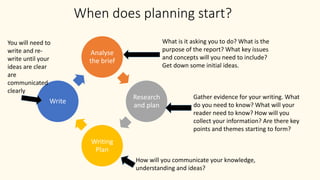
Analyse
the brief
Research
and plan
Writing
Plan
Write
When does planning start?
What is it asking you to do? What is the
purpose of the report? What key issues
and concepts will you need to include?
Get down some initial ideas.
Gather evidence for your writing. What
do you need to know? What will your
reader need to know? How will you
collect your information? Are there key
points and themes starting to form?
How will you communicate your knowledge,
understanding and ideas?
You will need to
write and re-
write until your
ideas are clear
are
communicated
clearly
Conduct an experiment to assess the relationship between university
students’ study habits and their levels of anxiety before exams. The report
will be presented to LJMU’s Academic Achievement Team to inform their
planned programme for Directed Study Week.
THEN:
 Think about what you already know about the
topic
Make a rough plan or diagram of all relevant
material
 Ask yourself: What do I need to find out?
Where and how might I gather the
information?
 Start to form aims and objectives
FIRST:
Identify the subject, key
terms, audience and
purpose.
Analyse
the brief
Conduct an experiment to assess the relationship between university
students’ study habits and their levels of anxiety before exams. The report
will be presented to LJMU’s Academic Achievement Team to inform their
planned programme in Directed Study Week.
Start to plan out the type of information
you would need to include.
How will you decide? How will you
gather this information?
What are your aims and objectives?
Analyse
the brief
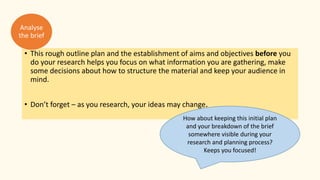
• This rough outline plan and the establishment of aims and objectives before you
do your research helps you focus on what information you are gathering, make
some decisions about how to structure the material and keep your audience in
mind.
• Don’t forget – as you research, your ideas may change.
Analyse
the brief
How about keeping this initial plan
and your breakdown of the brief
somewhere visible during your
research and planning process?
Keeps you focused!
Reading, Research and Note-Making
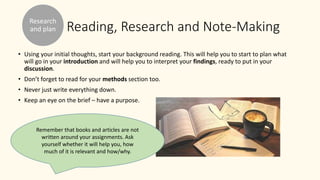
• Using your initial thoughts, start your background reading. This will help you to start to plan what
will go in your introduction and will help you to interpret your findings, ready to put in your
discussion.
• Don’t forget to read for your methods section too.
• Never just write everything down.
• Keep an eye on the brief – have a purpose.
Research
and plan
Remember that books and articles are not
written around your assignments. Ask
yourself whether it will help you, how
much of it is relevant and how/why.
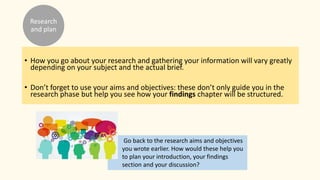
• How you go about your research and gathering your information will vary greatly
depending on your subject and the actual brief.
• Don’t forget to use your aims and objectives: these don’t only guide you in the
research phase but help you see how your findings chapter will be structured.
Research
and plan
Go back to the research aims and objectives
you wrote earlier. How would these help you
to plan your introduction, your findings
section and your discussion?
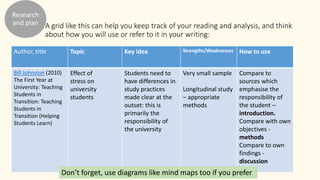
A grid like this can help you keep track of your reading and analysis, and think
about how you will use or refer to it in your writing:
Author, title Topic Key idea Strengths/Weaknesses How to use
Bill Johnston (2010)
The First Year at
University: Teaching
Students in
Transition: Teaching
Students in
Transition (Helping
Students Learn)
Effect of
stress on
university
students
Students need to
have differences in
study practices
made clear at the
outset: this is
primarily the
responsibility of
the university
Very small sample
Longitudinal study
– appropriate
methods
Compare to
sources which
emphasise the
responsibility of
the student –
introduction.
Compare with own
objectives -
methods
Compare to own
findings -
discussion
Don’t forget, use diagrams like mind maps too if you prefer
Research
and plan
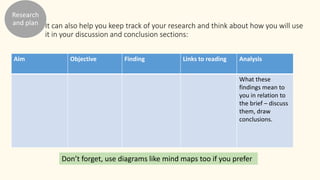
It can also help you keep track of your research and think about how you will use
it in your discussion and conclusion sections:
Aim Objective Finding Links to reading Analysis
What these
findings mean to
you in relation to
the brief – discuss
them, draw
conclusions.
Don’t forget, use diagrams like mind maps too if you prefer
Research
and plan
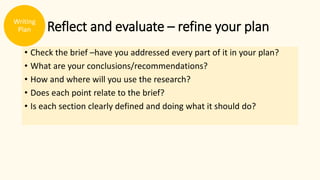
Reflect and evaluate – refine your plan
• Check the brief –have you addressed every part of it in your plan?
• What are your conclusions/recommendations?
• How and where will you use the research?
• Does each point relate to the brief?
• Is each section clearly defined and doing what it should do?
Writing
Plan
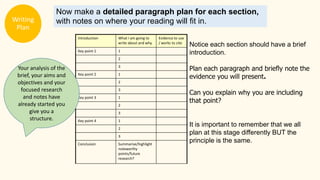
Introduction What I am going to
write about and why.
Evidence to use
/ works to cite
Key point 1 1
2
3
Key point 2 1
2
3
Key point 3 1
2
3
Key point 4 1
2
3
Conclusion Summarise/highlight
noteworthy
points/future
research?
Notice each section should have a brief
introduction.
Plan each paragraph and briefly note the
evidence you will present.
Can you explain why you are including
that point?
It is important to remember that we all
plan at this stage differently BUT the
principle is the same.
Writing
Plan
Now make a detailed paragraph plan for each section,
with notes on where your reading will fit in.
Your analysis of the
brief, your aims and
objectives and your
focused research
and notes have
already started you
give you a
structure.
Planning your paragraphs: WEED
What is your paragraph about? This will be your topic
sentence. Try writing each of these first
Explanation: what do you mean?
Examples: illustrate your point with examples.
Do: What do I do with this information? How is it
relevant? Keep thinking ‘So what?’. Relate to brief and
particular section.
Writing
Plan
Your findings section is mostly descriptive, so
you may need think about how you present
them to show some ‘D’ meaning, e.g. a graph
of significant statistics from across your
research.
So, thinking back to your reflections
at the start of this session, what will
you start trying to do to make
improvements to your report
planning?
This is a really useful online tool you
could use to help organise your
report planning.

Planning a report

  • 1.
    Planning a Report Youwill be able to… Explain the stages of planning and structuring a report Apply and evaluate the processes Start planning for your next report LJMU Academic Achievement Team
  • 2.
    How have youbeen planning reports so far? Let’s take a few minutes to reflect….
  • 3.
    Planning is essentialbecause… … a report communicates the findings of an investigation. So, think of planning it as going for a walk: get to your destination clearly and logically, without detours. A report has clear sections that tell the reader: what you did why and how you did it what you found out why that is important In your groups, can you match the title of the report section with the description of what goes in it?
  • 4.
    Analyse the brief Research and plan Writing Plan Write Whendoes planning start? What is it asking you to do? What is the purpose of the report? What key issues and concepts will you need to include? Get down some initial ideas. Gather evidence for your writing. What do you need to know? What will your reader need to know? How will you collect your information? Are there key points and themes starting to form? How will you communicate your knowledge, understanding and ideas? You will need to write and re- write until your ideas are clear are communicated clearly
  • 5.
    Conduct an experimentto assess the relationship between university students’ study habits and their levels of anxiety before exams. The report will be presented to LJMU’s Academic Achievement Team to inform their planned programme for Directed Study Week. THEN:  Think about what you already know about the topic Make a rough plan or diagram of all relevant material  Ask yourself: What do I need to find out? Where and how might I gather the information?  Start to form aims and objectives FIRST: Identify the subject, key terms, audience and purpose. Analyse the brief
  • 6.
    Conduct an experimentto assess the relationship between university students’ study habits and their levels of anxiety before exams. The report will be presented to LJMU’s Academic Achievement Team to inform their planned programme in Directed Study Week. Start to plan out the type of information you would need to include. How will you decide? How will you gather this information? What are your aims and objectives? Analyse the brief
  • 7.
    • This roughoutline plan and the establishment of aims and objectives before you do your research helps you focus on what information you are gathering, make some decisions about how to structure the material and keep your audience in mind. • Don’t forget – as you research, your ideas may change. Analyse the brief How about keeping this initial plan and your breakdown of the brief somewhere visible during your research and planning process? Keeps you focused!
  • 8.
    Reading, Research andNote-Making • Using your initial thoughts, start your background reading. This will help you to start to plan what will go in your introduction and will help you to interpret your findings, ready to put in your discussion. • Don’t forget to read for your methods section too. • Never just write everything down. • Keep an eye on the brief – have a purpose. Research and plan Remember that books and articles are not written around your assignments. Ask yourself whether it will help you, how much of it is relevant and how/why.
  • 9.
    • How yougo about your research and gathering your information will vary greatly depending on your subject and the actual brief. • Don’t forget to use your aims and objectives: these don’t only guide you in the research phase but help you see how your findings chapter will be structured. Research and plan Go back to the research aims and objectives you wrote earlier. How would these help you to plan your introduction, your findings section and your discussion?
  • 10.
    A grid likethis can help you keep track of your reading and analysis, and think about how you will use or refer to it in your writing: Author, title Topic Key idea Strengths/Weaknesses How to use Bill Johnston (2010) The First Year at University: Teaching Students in Transition: Teaching Students in Transition (Helping Students Learn) Effect of stress on university students Students need to have differences in study practices made clear at the outset: this is primarily the responsibility of the university Very small sample Longitudinal study – appropriate methods Compare to sources which emphasise the responsibility of the student – introduction. Compare with own objectives - methods Compare to own findings - discussion Don’t forget, use diagrams like mind maps too if you prefer Research and plan
  • 11.
    It can alsohelp you keep track of your research and think about how you will use it in your discussion and conclusion sections: Aim Objective Finding Links to reading Analysis What these findings mean to you in relation to the brief – discuss them, draw conclusions. Don’t forget, use diagrams like mind maps too if you prefer Research and plan
  • 12.
    Reflect and evaluate– refine your plan • Check the brief –have you addressed every part of it in your plan? • What are your conclusions/recommendations? • How and where will you use the research? • Does each point relate to the brief? • Is each section clearly defined and doing what it should do? Writing Plan
  • 13.
    Introduction What Iam going to write about and why. Evidence to use / works to cite Key point 1 1 2 3 Key point 2 1 2 3 Key point 3 1 2 3 Key point 4 1 2 3 Conclusion Summarise/highlight noteworthy points/future research? Notice each section should have a brief introduction. Plan each paragraph and briefly note the evidence you will present. Can you explain why you are including that point? It is important to remember that we all plan at this stage differently BUT the principle is the same. Writing Plan Now make a detailed paragraph plan for each section, with notes on where your reading will fit in. Your analysis of the brief, your aims and objectives and your focused research and notes have already started you give you a structure.
  • 14.
    Planning your paragraphs:WEED What is your paragraph about? This will be your topic sentence. Try writing each of these first Explanation: what do you mean? Examples: illustrate your point with examples. Do: What do I do with this information? How is it relevant? Keep thinking ‘So what?’. Relate to brief and particular section. Writing Plan Your findings section is mostly descriptive, so you may need think about how you present them to show some ‘D’ meaning, e.g. a graph of significant statistics from across your research.
  • 15.
    So, thinking backto your reflections at the start of this session, what will you start trying to do to make improvements to your report planning? This is a really useful online tool you could use to help organise your report planning.

Editor's Notes

  • #6 You will need to tailor your information depending on who the audience is – it is a piece of informative writing! Read your assessment criteria – look in your module handbook, and don’t forget the learning objectives too. Your brief should contain important information about audience and purpose – what are their key concerns? What do they want to know? Have they asked for recommendations?
  • #7 Keep relating this to planning – they are starting to plan their report by planning the information they need to know, how they will find it – feeds into what they will include in their introduction and methods sections and looks towards their findings. Relate back to the first activity – keep asking them where this will go. See how a plan starts to emerge even here!
  • #9 Avoid reading through whole books and chapters which you hope will be useful. Instead, use your rough plan as a guide and search for relevant pages/paragraphs. Skim and scan for information, and use the index of a book to find relevant pages and paragraphs. Read in short bursts – 15-20 minutes - then stop and ask yourself: how is this relevant to my essay? How does it link to what I already know? What more do I need to find out on this and why? Take notes with the essay title in mind. What might be useful? How will I use this? And remember to record the source of information when you take the note.
  • #10 Really explain this – their aims will help them to think about the order of what will be included in the section and how they link.
  • #11 Mind mapping also works but use the same features
  • #12 Mind mapping also works but use the same features
  • #13 Check the question –have you addressed every part of it in your plan? It is easy to overlook parts of the question, especially if your reading has led you in new directions. You may need to go back and think about a new area of the question, or do some more reading to fill a gap. Have your ideas changed about the structure of the essay? If you have changed your mind about your main points, or want to find space for some new material from your reading, you may need to cut down some sections and expand others. Decisions made now will save a lot of confusion when you start to write. How and where will you use the research? Is it really all useful? Decide where you will use the points as evidence or examples in your essay and put notes in your detailed plan. Do not be afraid to leave some things out altogether. Keep all your research notes, but be selective about what goes into the final essay plan. Can you express each main point as a topic sentence? Specify each point the essay will make by writing the main point of each paragraph in a single sentence. You may end up with 8-12 sentences that give you a summary or ‘overview’ of the whole argument, and tell you that you have a well-structured essay plan. Does each point relate to the question? Check you have not gone off track, and that the paragraphs are in the most logical order.
  • #14 Ask them for some egs from their planning so far – what are their premises, turn them into sentences