Proyecto Integrador III
Teacher: Miguel Vinicio Ponce Medina
Students:
• Ángelo Salazar Muñoz
• Sandra Pico Guevara
TEN QUESTIONS TO
ASK YOURSELF AS YOU
PLAN YOUR PROJECT
Hold on!
Before you start,
ANALYZE
these 10 questions:
WHAT´S THE PURPOSE OF
YOUR PROJECT?
The answers determine:
• The motive that led the project to take place
• The person who proposed the development of the project
• All the beneficiaries of the project.
• The possible scenarios if the project would not take place
1
WHOM DO YOU NEED TO
INVOLVE?
2
Different participants are needed at specific times.
For instance:
• DRIVERS look for the project´s outcomes
• SUPPORTERS contribute to the success of the
project
• OBSERVERS are interested in the project
WHAT RESULTS WILL YOU
PRODUCE?
3
• Establish the desired outcomes
• Specify the tools to measure the results
• Determine the performance of the results after being
used.
• Make sure the outcomes meet the expectations of the
contributors.
WHAT CONSTRAINS MUST
YOU SATISFY?
4
Identify all the weaknesses, threats, and barriers you may
face. For example:
LIMITATIONS: Restrictions set by outsiders
NEEDS: Restrictions established by the entire team
WHAT ASSUMPTIONS ARE
YOU MAKING?
5
• Make a list of the assumptions at every stage of
the project.
• These forecasts may alter the flow of the project
• Decisions are based on assumptions to reduce the
risks
WHAT WORK HAS TO BE DONE?
6
For all the team members, establish:
• THE WORK TO BE DONE: Specify in detail each step in the
process
• INPUTS: All the human and non-human resources
• EXPECTED RESULTS: Desired outcomes at every stage
• INTERDEPENDENCIES AND RELATIONSHIPS: The
connection among the activities and their logistic
• DURATIONS: The time needed to complete each activity
WHEN DOES EACH ACTIVITY
START AND END?
7
Elaborate a detailed schedule with due dates and wanted results.
Take into consideration:
• DURATION: The specific time, hourly or daily, for each
activity to be completed
• INTERINDEPENDENCIES: What must be completed before
starting the next activity
• RESOURCE AVAILABILITY: How accessible are the supplies
that are needed
WHO WILL PERFORM THE
PROJECT?
8
For a more precise budget, it is essential to determine:
• Workers´ names, position, titles, skills and knowledge
• Assign specific duties when working with others
• Level of effort investment
• Schedule hours with specific work time
WHAT OTHER RESOURCES
DO YOU NEED?
9
Clearly Specify:
• Equipment, facilities, services, suppliers, and funds.
• The precise time when they are needed
WHAT CAN GO WRONG?
10
• Be realistic about the RISKS and DANGERS
• Develop a plan to minimize the THREATS
TEN TIPS FOR BEING A
BETTER PROJECT
MANAGER
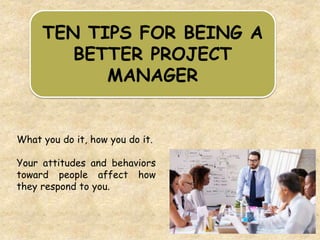
What you do it, how you do it.
Your attitudes and behaviors
toward people affect how
they respond to you.
Be a “Why” Person
Be a “Can Do” Person
• Look for the reasons behind requests and actions.
• Understanding why helps you make sure you respond
appropriately to team members.
• First, look to understand the reasons behind other
people’s requests and actions; then share your
findings with other people.
• Look at all problems as challenges, and do everything you can to find
ways to overcome them.
• Be creative, flexible, and tenacious.
• Keep working at the problem until you solve it.
1
2
Think about the Big Picture
• Keep events in perspective.
• Understand where you want to go and how your plan will get you there.
• Recognize the effect your actions have on current and future efforts.
• Share your vision with other people.
Think in Detail
• If you don’t think through your project’s issues, who will?
• The more clearly you describe your intended results, the more easily people
can recognize the benefits associated with your project.
• And the more clearly you define your intended work, the more often people
will ask important and insightful questions and believe that they can perform
the work successfully.
• Clarity leads to increased personal motivation and reduced chances of
mistakes.
3
4
Assume Cautiously
• Take the time to find out the facts; use assumptions only as a last resort.
• With every assumption comes a risk that you’re wrong. The fewer
assumptions you make, the more confidence you can have in your plan.
View People as Allies, Not Adversaries
• Focus on common goals, not individual agendas.
• Making people feel comfortable encourages brainstorming, creative
thinking, and the willingness to try new ideas.
• But viewing and treating people as adversaries can put them on the
defensive and encourage them to become enemies.
5
6
Say What You Mean, and Mean What You Say
• Communicate clearly. Be specific by letting people know exactly what you
mean.
• Tell them what you want them to know, what you want them to do, and what
you’ll do for them.
• Don’t leave these details up to their imaginations.
• Being vague just increases the chances for misunderstandings and mistakes.
Respect Other People
• Focus on people’s strengths rather than their weaknesses.
• In each person on your team, find a quality that you can respect.
• People work harder and enjoy their work more when they’re around others
who appreciate them and their efforts.
7
8
Acknowledge Good Performance
• Take a moment to acknowledge good performance.
• When someone does something good, tell the person, tell the person’s
boss, tell other team members, and tell the person’s peers that you
appreciate the effort and its results.
• Recognizing good performance confirms to a person the accuracy and
value of his work.
• When acknowledging a person’s performance, mention the quality of
the
• results he accomplished as well as the effort he invested.
• Be specific, tell the person exactly what he did or produced that you
appreciate.
• Be sure to provide your feedback promptly; don’t wait weeks or
months before recognizing someone for his hard work.
9
Be a Manager and a Leader
• Attend to people as well as to information, processes, and systems.
• Create and share your vision and excitement with your team
members, but don’t forget to share a sense of order and efficiency,
too.
• Encourage people to strive for outstanding results, and provide the
guidance and support to help them achieve those results.
10

Project iii. interactive_activity

  • 1.
    Proyecto Integrador III Teacher:Miguel Vinicio Ponce Medina Students: • Ángelo Salazar Muñoz • Sandra Pico Guevara
  • 2.
    TEN QUESTIONS TO ASKYOURSELF AS YOU PLAN YOUR PROJECT Hold on! Before you start, ANALYZE these 10 questions:
  • 3.
    WHAT´S THE PURPOSEOF YOUR PROJECT? The answers determine: • The motive that led the project to take place • The person who proposed the development of the project • All the beneficiaries of the project. • The possible scenarios if the project would not take place 1
  • 4.
    WHOM DO YOUNEED TO INVOLVE? 2 Different participants are needed at specific times. For instance: • DRIVERS look for the project´s outcomes • SUPPORTERS contribute to the success of the project • OBSERVERS are interested in the project
  • 5.
    WHAT RESULTS WILLYOU PRODUCE? 3 • Establish the desired outcomes • Specify the tools to measure the results • Determine the performance of the results after being used. • Make sure the outcomes meet the expectations of the contributors.
  • 6.
    WHAT CONSTRAINS MUST YOUSATISFY? 4 Identify all the weaknesses, threats, and barriers you may face. For example: LIMITATIONS: Restrictions set by outsiders NEEDS: Restrictions established by the entire team
  • 7.
    WHAT ASSUMPTIONS ARE YOUMAKING? 5 • Make a list of the assumptions at every stage of the project. • These forecasts may alter the flow of the project • Decisions are based on assumptions to reduce the risks
  • 8.
    WHAT WORK HASTO BE DONE? 6 For all the team members, establish: • THE WORK TO BE DONE: Specify in detail each step in the process • INPUTS: All the human and non-human resources • EXPECTED RESULTS: Desired outcomes at every stage • INTERDEPENDENCIES AND RELATIONSHIPS: The connection among the activities and their logistic • DURATIONS: The time needed to complete each activity
  • 9.
    WHEN DOES EACHACTIVITY START AND END? 7 Elaborate a detailed schedule with due dates and wanted results. Take into consideration: • DURATION: The specific time, hourly or daily, for each activity to be completed • INTERINDEPENDENCIES: What must be completed before starting the next activity • RESOURCE AVAILABILITY: How accessible are the supplies that are needed
  • 10.
    WHO WILL PERFORMTHE PROJECT? 8 For a more precise budget, it is essential to determine: • Workers´ names, position, titles, skills and knowledge • Assign specific duties when working with others • Level of effort investment • Schedule hours with specific work time
  • 11.
    WHAT OTHER RESOURCES DOYOU NEED? 9 Clearly Specify: • Equipment, facilities, services, suppliers, and funds. • The precise time when they are needed
  • 12.
    WHAT CAN GOWRONG? 10 • Be realistic about the RISKS and DANGERS • Develop a plan to minimize the THREATS
  • 13.
    TEN TIPS FORBEING A BETTER PROJECT MANAGER What you do it, how you do it. Your attitudes and behaviors toward people affect how they respond to you.
  • 14.
    Be a “Why”Person Be a “Can Do” Person • Look for the reasons behind requests and actions. • Understanding why helps you make sure you respond appropriately to team members. • First, look to understand the reasons behind other people’s requests and actions; then share your findings with other people. • Look at all problems as challenges, and do everything you can to find ways to overcome them. • Be creative, flexible, and tenacious. • Keep working at the problem until you solve it. 1 2
  • 15.
    Think about theBig Picture • Keep events in perspective. • Understand where you want to go and how your plan will get you there. • Recognize the effect your actions have on current and future efforts. • Share your vision with other people. Think in Detail • If you don’t think through your project’s issues, who will? • The more clearly you describe your intended results, the more easily people can recognize the benefits associated with your project. • And the more clearly you define your intended work, the more often people will ask important and insightful questions and believe that they can perform the work successfully. • Clarity leads to increased personal motivation and reduced chances of mistakes. 3 4
  • 16.
    Assume Cautiously • Takethe time to find out the facts; use assumptions only as a last resort. • With every assumption comes a risk that you’re wrong. The fewer assumptions you make, the more confidence you can have in your plan. View People as Allies, Not Adversaries • Focus on common goals, not individual agendas. • Making people feel comfortable encourages brainstorming, creative thinking, and the willingness to try new ideas. • But viewing and treating people as adversaries can put them on the defensive and encourage them to become enemies. 5 6
  • 17.
    Say What YouMean, and Mean What You Say • Communicate clearly. Be specific by letting people know exactly what you mean. • Tell them what you want them to know, what you want them to do, and what you’ll do for them. • Don’t leave these details up to their imaginations. • Being vague just increases the chances for misunderstandings and mistakes. Respect Other People • Focus on people’s strengths rather than their weaknesses. • In each person on your team, find a quality that you can respect. • People work harder and enjoy their work more when they’re around others who appreciate them and their efforts. 7 8
  • 18.
    Acknowledge Good Performance •Take a moment to acknowledge good performance. • When someone does something good, tell the person, tell the person’s boss, tell other team members, and tell the person’s peers that you appreciate the effort and its results. • Recognizing good performance confirms to a person the accuracy and value of his work. • When acknowledging a person’s performance, mention the quality of the • results he accomplished as well as the effort he invested. • Be specific, tell the person exactly what he did or produced that you appreciate. • Be sure to provide your feedback promptly; don’t wait weeks or months before recognizing someone for his hard work. 9
  • 19.
    Be a Managerand a Leader • Attend to people as well as to information, processes, and systems. • Create and share your vision and excitement with your team members, but don’t forget to share a sense of order and efficiency, too. • Encourage people to strive for outstanding results, and provide the guidance and support to help them achieve those results. 10