Empirical Research
Empirical research is the process of testing a
hypothesis using experimentation, direct or indirect
observation and experience.
Steps in Conducting Empirical Research
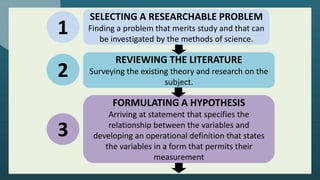
The chart below shows the steps researchers
commonly follow investigating a problem.
SELECTING A RESEARCHABLE PROBLEM
Finding a problem that merits study and that can
be investigated by the methods of science.
REVIEWING THE LITERATURE
Surveying the existing theory and research on the
subject.
FORMULATING A HYPOTHESIS
Arriving at statement that specifies the
relationship between the variables and
developing an operational definition that states
the variables in a form that permits their
measurement
1
2
3
CHOOSING A RESEARCH DESIGN
Determining whether to test the hypothesis by
designing an experiment, conducting
interviews, observing the way people behave in
particular situations, examining existing
records and historical evidence, or combining
these procedures.
COLLECTING THE DATA
Gathering the data and recording it in
accordance with the specifications of the
research design.
4
5
ANALYZING THE RESULTS
Searching for meaningful links between the facts
that emerged in the course of the research.
STATING CONCLUSIONS
Indicating the outcome of the study, extracting
the broader meaning of the work for other
knowledge and research, and suggesting future
directions for future research.
6
7
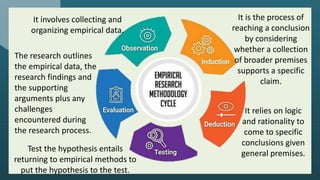
Test the hypothesis entails
returning to empirical methods to
put the hypothesis to the test.
It is the process of
reaching a conclusion
by considering
whether a collection
of broader premises
supports a specific
claim.
It relies on logic
and rationality to
come to specific
conclusions given
general premises.
It involves collecting and
organizing empirical data.
The research outlines
the empirical data, the
research findings and
the supporting
arguments plus any
challenges
encountered during
the research process.
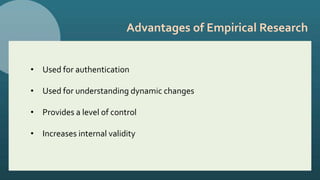
• Used for authentication
• Used for understanding dynamic changes
• Provides a level of control
• Increases internal validity
Advantages of Empirical Research
• Time consuming
• Expensive
• Difficult to acquire consent/permission
• Collection of data can be a problem
Disadvantages of Empirical Research
• It is used to validate various hypotheses or refute them in the face of evidence.
• It increases human knowledge and continue doing it to keep advancing in
various fields.
Importance of Empirical Research

EMPIRICAL RESEARCH METHOD Part2.pptx

  • 2.
    Empirical Research Empirical researchis the process of testing a hypothesis using experimentation, direct or indirect observation and experience.
  • 3.
    Steps in ConductingEmpirical Research The chart below shows the steps researchers commonly follow investigating a problem.
  • 4.
    SELECTING A RESEARCHABLEPROBLEM Finding a problem that merits study and that can be investigated by the methods of science. REVIEWING THE LITERATURE Surveying the existing theory and research on the subject. FORMULATING A HYPOTHESIS Arriving at statement that specifies the relationship between the variables and developing an operational definition that states the variables in a form that permits their measurement 1 2 3
  • 5.
    CHOOSING A RESEARCHDESIGN Determining whether to test the hypothesis by designing an experiment, conducting interviews, observing the way people behave in particular situations, examining existing records and historical evidence, or combining these procedures. COLLECTING THE DATA Gathering the data and recording it in accordance with the specifications of the research design. 4 5
  • 6.
    ANALYZING THE RESULTS Searchingfor meaningful links between the facts that emerged in the course of the research. STATING CONCLUSIONS Indicating the outcome of the study, extracting the broader meaning of the work for other knowledge and research, and suggesting future directions for future research. 6 7
  • 7.
    Test the hypothesisentails returning to empirical methods to put the hypothesis to the test. It is the process of reaching a conclusion by considering whether a collection of broader premises supports a specific claim. It relies on logic and rationality to come to specific conclusions given general premises. It involves collecting and organizing empirical data. The research outlines the empirical data, the research findings and the supporting arguments plus any challenges encountered during the research process.
  • 8.
    • Used forauthentication • Used for understanding dynamic changes • Provides a level of control • Increases internal validity Advantages of Empirical Research
  • 9.
    • Time consuming •Expensive • Difficult to acquire consent/permission • Collection of data can be a problem Disadvantages of Empirical Research
  • 10.
    • It isused to validate various hypotheses or refute them in the face of evidence. • It increases human knowledge and continue doing it to keep advancing in various fields. Importance of Empirical Research