Chapter 13


                          Progress and
                          Performance
                         Measurement
                         and Evaluation


McGraw-Hill/Irwin        © 2008 The McGraw-Hill Companies, All Rights Reserved
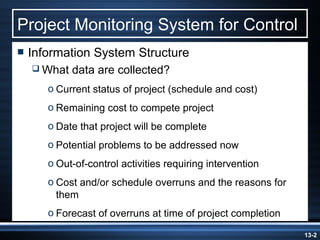
Project Monitoring System for Control
 Information   System Structure
   What   data are collected?
     o Current status of project (schedule and cost)
     o Remaining cost to compete project
     o Date that project will be complete
     o Potential problems to be addressed now
     o Out-of-control activities requiring intervention
     o Cost and/or schedule overruns and the reasons for
       them
     o Forecast of overruns at time of project completion

                                                            13-2
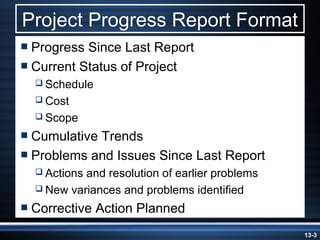
Project Progress Report Format
 Progress Since Last Report
 Current Status of Project
   Schedule
   Cost
   Scope

 CumulativeTrends
 Problems and Issues Since Last Report
   Actionsand resolution of earlier problems
   New variances and problems identified

 Corrective   Action Planned
                                                13-3
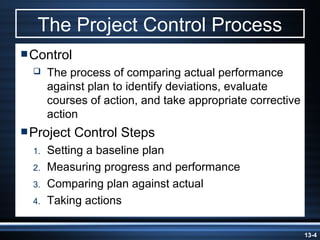
The Project Control Process
Control
      The process of comparing actual performance
       against plan to identify deviations, evaluate
       courses of action, and take appropriate corrective
       action
Project    Control Steps
  1.   Setting a baseline plan
  2.   Measuring progress and performance
  3.   Comparing plan against actual
  4.   Taking actions

                                                            13-4
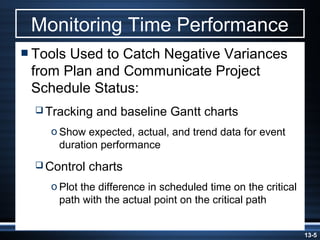
Monitoring Time Performance
 ToolsUsed to Catch Negative Variances
 from Plan and Communicate Project
 Schedule Status:
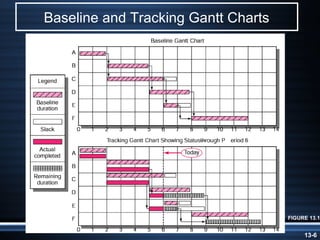
   Tracking   and baseline Gantt charts
    o Show expected, actual, and trend data for event
      duration performance
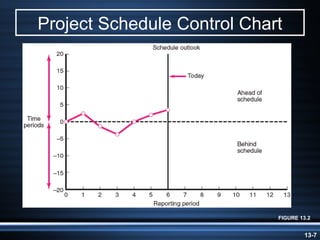
   Control   charts
    o Plot the difference in scheduled time on the critical
      path with the actual point on the critical path


                                                              13-5
Baseline and Tracking Gantt Charts


                                     FIGURE 13.1


                                          13-6
Project Schedule Control Chart


                             FIGURE 13.2


                                     13-7
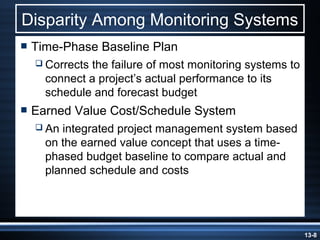
Disparity Among Monitoring Systems
 Time-Phase   Baseline Plan
   Corrects
           the failure of most monitoring systems to
   connect a project’s actual performance to its
   schedule and forecast budget
 Earned   Value Cost/Schedule System
   Anintegrated project management system based
   on the earned value concept that uses a time-
   phased budget baseline to compare actual and
   planned schedule and costs


                                                       13-8
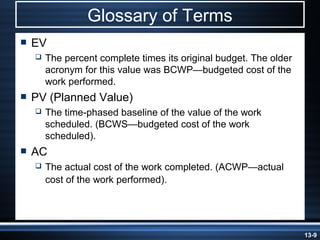
Glossary of Terms
   EV
       The percent complete times its original budget. The older
        acronym for this value was BCWP—budgeted cost of the
        work performed.
   PV (Planned Value)
       The time-phased baseline of the value of the work
        scheduled. (BCWS—budgeted cost of the work
        scheduled).
   AC
       The actual cost of the work completed. (ACWP—actual
        cost of the work performed).


                                                                    13-9
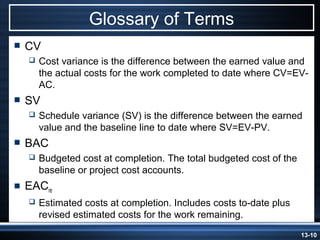
Glossary of Terms
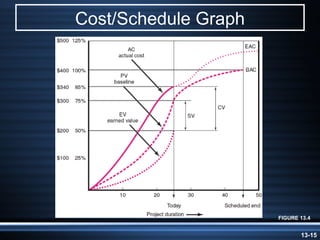
   CV
       Cost variance is the difference between the earned value and
        the actual costs for the work completed to date where CV=EV-
        AC.
   SV
       Schedule variance (SV) is the difference between the earned
        value and the baseline line to date where SV=EV-PV.
   BAC
       Budgeted cost at completion. The total budgeted cost of the
        baseline or project cost accounts.
   EACre
       Estimated costs at completion. Includes costs to-date plus
        revised estimated costs for the work remaining.
                                                                      13-10
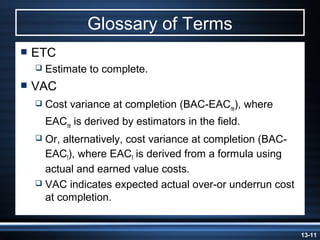
Glossary of Terms
 ETC
     Estimate to complete.
 VAC
     Cost variance at completion (BAC-EACre), where
      EACre is derived by estimators in the field.
   Or, alternatively, cost variance at completion (BAC-
    EACf), where EACf is derived from a formula using
    actual and earned value costs.
   VAC indicates expected actual over-or underrun cost
    at completion.


                                                           13-11
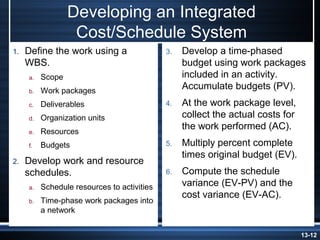
Developing an Integrated
                   Cost/Schedule System
1.   Define the work using a                 3.   Develop a time-phased
     WBS.                                         budget using work packages
     a.   Scope                                   included in an activity.
     b.   Work packages
                                                  Accumulate budgets (PV).
     c.   Deliverables                       4.   At the work package level,
     d.   Organization units                      collect the actual costs for
     e.   Resources
                                                  the work performed (AC).
     f.   Budgets                            5.   Multiply percent complete
                                                  times original budget (EV).
2.   Develop work and resource
     schedules.                              6.   Compute the schedule
     a.   Schedule resources to activities        variance (EV-PV) and the
                                                  cost variance (EV-AC).
     b.   Time-phase work packages into
          a network


                                                                                 13-12
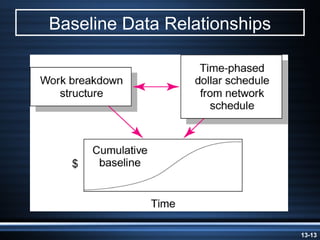
Baseline Data Relationships


                              13-13
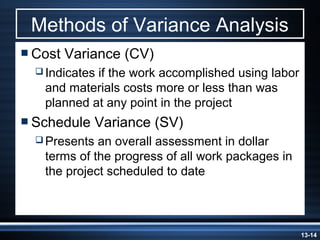
Methods of Variance Analysis
 Cost   Variance (CV)
   Indicates
            if the work accomplished using labor
   and materials costs more or less than was
   planned at any point in the project
 Schedule     Variance (SV)
   Presents an overall assessment in dollar
   terms of the progress of all work packages in
   the project scheduled to date


                                                   13-14
Cost/Schedule Graph


                      FIGURE 13.4


                             13-15
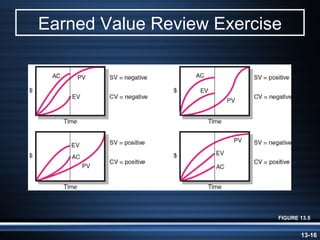
Earned Value Review Exercise


                           FIGURE 13.5


                                  13-16
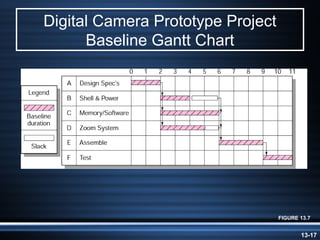
Digital Camera Prototype Project
      Baseline Gantt Chart


                                   FIGURE 13.7


                                          13-17
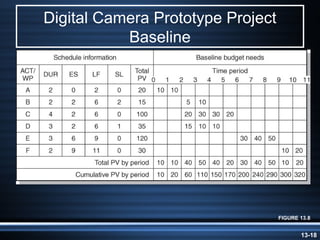
Digital Camera Prototype Project
           Baseline


                                   FIGURE 13.8


                                          13-18
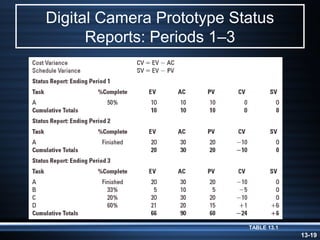
Digital Camera Prototype Status
      Reports: Periods 1–3


                           TABLE 13.1
                                        13-19
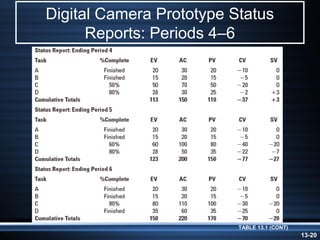
Digital Camera Prototype Status
      Reports: Periods 4–6


                          TABLE 13.1 (CONT)
                                              13-20
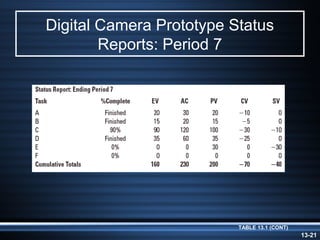
Digital Camera Prototype Status
        Reports: Period 7


                          TABLE 13.1 (CONT)
                                              13-21
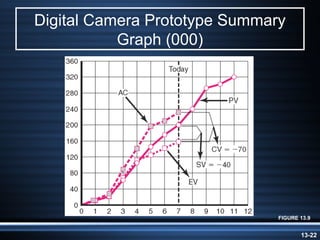
Digital Camera Prototype Summary
           Graph (000)


                               FIGURE 13.9


                                      13-22
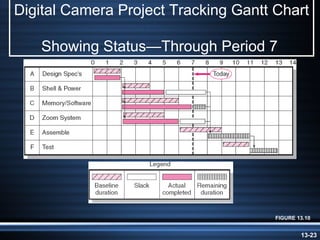
Digital Camera Project Tracking Gantt Chart

   Showing Status—Through Period 7


                                      FIGURE 13.10


                                              13-23
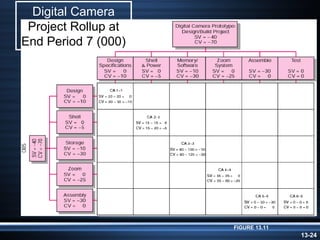
Digital Camera
 Project Rollup at
End Period 7 (000)


                     FIGURE 13.11
                                    13-24
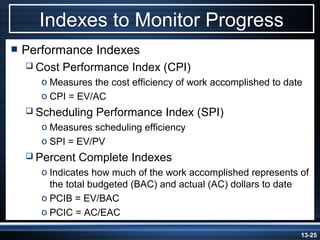
Indexes to Monitor Progress
 Performance    Indexes
   Cost   Performance Index (CPI)
    o Measures the cost efficiency of work accomplished to date
    o CPI = EV/AC
   Scheduling   Performance Index (SPI)
    o Measures scheduling efficiency
    o SPI = EV/PV
   Percent   Complete Indexes
    o Indicates how much of the work accomplished represents of
      the total budgeted (BAC) and actual (AC) dollars to date
    o PCIB = EV/BAC
    o PCIC = AC/EAC

                                                              13-25
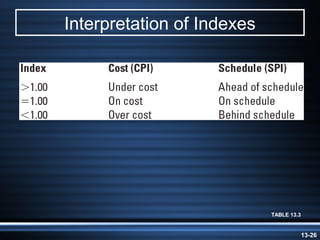
Interpretation of Indexes


                            TABLE 13.3


                                         13-26
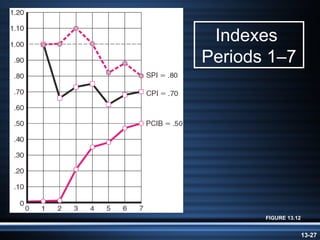
Indexes
Periods 1–7


       FIGURE 13.12


                      13-27
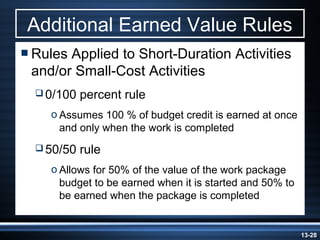
Additional Earned Value Rules
 RulesApplied to Short-Duration Activities
 and/or Small-Cost Activities
   0/100   percent rule
    o Assumes 100 % of budget credit is earned at once
      and only when the work is completed
   50/50   rule
    o Allows for 50% of the value of the work package
      budget to be earned when it is started and 50% to
      be earned when the package is completed


                                                          13-28
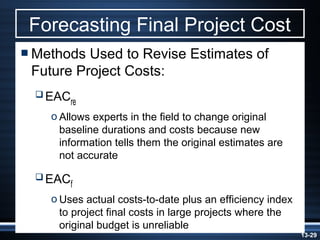
Forecasting Final Project Cost
 Methods Used to Revise Estimates of
 Future Project Costs:
   EAC
         re
    o Allows experts in the field to change original
      baseline durations and costs because new
      information tells them the original estimates are
      not accurate

   EAC
         f
    o Uses actual costs-to-date plus an efficiency index
      to project final costs in large projects where the
      original budget is unreliable
                                                           13-29
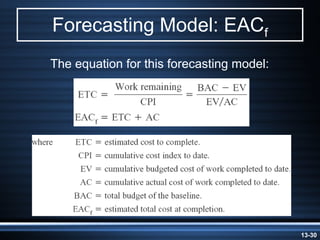
Forecasting Model: EACf
The equation for this forecasting model:


                                           13-30
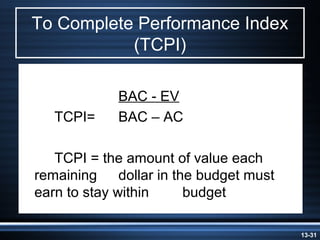
To Complete Performance Index
           (TCPI)

             BAC - EV
   TCPI=     BAC – AC

   TCPI = the amount of value each
remaining     dollar in the budget must
earn to stay within       budget

                                          13-31

Chap013 4er1

  • 1.
    Chapter 13 Progress and Performance Measurement and Evaluation McGraw-Hill/Irwin © 2008 The McGraw-Hill Companies, All Rights Reserved
  • 2.
    Project Monitoring Systemfor Control  Information System Structure  What data are collected? o Current status of project (schedule and cost) o Remaining cost to compete project o Date that project will be complete o Potential problems to be addressed now o Out-of-control activities requiring intervention o Cost and/or schedule overruns and the reasons for them o Forecast of overruns at time of project completion 13-2
  • 3.
    Project Progress ReportFormat  Progress Since Last Report  Current Status of Project  Schedule  Cost  Scope  CumulativeTrends  Problems and Issues Since Last Report  Actionsand resolution of earlier problems  New variances and problems identified  Corrective Action Planned 13-3
  • 4.
    The Project ControlProcess Control  The process of comparing actual performance against plan to identify deviations, evaluate courses of action, and take appropriate corrective action Project Control Steps 1. Setting a baseline plan 2. Measuring progress and performance 3. Comparing plan against actual 4. Taking actions 13-4
  • 5.
    Monitoring Time Performance ToolsUsed to Catch Negative Variances from Plan and Communicate Project Schedule Status:  Tracking and baseline Gantt charts o Show expected, actual, and trend data for event duration performance  Control charts o Plot the difference in scheduled time on the critical path with the actual point on the critical path 13-5
  • 6.
    Baseline and TrackingGantt Charts FIGURE 13.1 13-6
  • 7.
    Project Schedule ControlChart FIGURE 13.2 13-7
  • 8.
    Disparity Among MonitoringSystems  Time-Phase Baseline Plan  Corrects the failure of most monitoring systems to connect a project’s actual performance to its schedule and forecast budget  Earned Value Cost/Schedule System  Anintegrated project management system based on the earned value concept that uses a time- phased budget baseline to compare actual and planned schedule and costs 13-8
  • 9.
    Glossary of Terms  EV  The percent complete times its original budget. The older acronym for this value was BCWP—budgeted cost of the work performed.  PV (Planned Value)  The time-phased baseline of the value of the work scheduled. (BCWS—budgeted cost of the work scheduled).  AC  The actual cost of the work completed. (ACWP—actual cost of the work performed). 13-9
  • 10.
    Glossary of Terms  CV  Cost variance is the difference between the earned value and the actual costs for the work completed to date where CV=EV- AC.  SV  Schedule variance (SV) is the difference between the earned value and the baseline line to date where SV=EV-PV.  BAC  Budgeted cost at completion. The total budgeted cost of the baseline or project cost accounts.  EACre  Estimated costs at completion. Includes costs to-date plus revised estimated costs for the work remaining. 13-10
  • 11.
    Glossary of Terms ETC  Estimate to complete.  VAC  Cost variance at completion (BAC-EACre), where EACre is derived by estimators in the field.  Or, alternatively, cost variance at completion (BAC- EACf), where EACf is derived from a formula using actual and earned value costs.  VAC indicates expected actual over-or underrun cost at completion. 13-11
  • 12.
    Developing an Integrated Cost/Schedule System 1. Define the work using a 3. Develop a time-phased WBS. budget using work packages a. Scope included in an activity. b. Work packages Accumulate budgets (PV). c. Deliverables 4. At the work package level, d. Organization units collect the actual costs for e. Resources the work performed (AC). f. Budgets 5. Multiply percent complete times original budget (EV). 2. Develop work and resource schedules. 6. Compute the schedule a. Schedule resources to activities variance (EV-PV) and the cost variance (EV-AC). b. Time-phase work packages into a network 13-12
  • 13.
  • 14.
    Methods of VarianceAnalysis  Cost Variance (CV)  Indicates if the work accomplished using labor and materials costs more or less than was planned at any point in the project  Schedule Variance (SV)  Presents an overall assessment in dollar terms of the progress of all work packages in the project scheduled to date 13-14
  • 15.
    Cost/Schedule Graph FIGURE 13.4 13-15
  • 16.
    Earned Value ReviewExercise FIGURE 13.5 13-16
  • 17.
    Digital Camera PrototypeProject Baseline Gantt Chart FIGURE 13.7 13-17
  • 18.
    Digital Camera PrototypeProject Baseline FIGURE 13.8 13-18
  • 19.
    Digital Camera PrototypeStatus Reports: Periods 1–3 TABLE 13.1 13-19
  • 20.
    Digital Camera PrototypeStatus Reports: Periods 4–6 TABLE 13.1 (CONT) 13-20
  • 21.
    Digital Camera PrototypeStatus Reports: Period 7 TABLE 13.1 (CONT) 13-21
  • 22.
    Digital Camera PrototypeSummary Graph (000) FIGURE 13.9 13-22
  • 23.
    Digital Camera ProjectTracking Gantt Chart Showing Status—Through Period 7 FIGURE 13.10 13-23
  • 24.
    Digital Camera ProjectRollup at End Period 7 (000) FIGURE 13.11 13-24
  • 25.
    Indexes to MonitorProgress  Performance Indexes  Cost Performance Index (CPI) o Measures the cost efficiency of work accomplished to date o CPI = EV/AC  Scheduling Performance Index (SPI) o Measures scheduling efficiency o SPI = EV/PV  Percent Complete Indexes o Indicates how much of the work accomplished represents of the total budgeted (BAC) and actual (AC) dollars to date o PCIB = EV/BAC o PCIC = AC/EAC 13-25
  • 26.
  • 27.
    Indexes Periods 1–7 FIGURE 13.12 13-27
  • 28.
    Additional Earned ValueRules  RulesApplied to Short-Duration Activities and/or Small-Cost Activities  0/100 percent rule o Assumes 100 % of budget credit is earned at once and only when the work is completed  50/50 rule o Allows for 50% of the value of the work package budget to be earned when it is started and 50% to be earned when the package is completed 13-28
  • 29.
    Forecasting Final ProjectCost  Methods Used to Revise Estimates of Future Project Costs:  EAC re o Allows experts in the field to change original baseline durations and costs because new information tells them the original estimates are not accurate  EAC f o Uses actual costs-to-date plus an efficiency index to project final costs in large projects where the original budget is unreliable 13-29
  • 30.
    Forecasting Model: EACf Theequation for this forecasting model: 13-30
  • 31.
    To Complete PerformanceIndex (TCPI) BAC - EV TCPI= BAC – AC TCPI = the amount of value each remaining dollar in the budget must earn to stay within budget 13-31