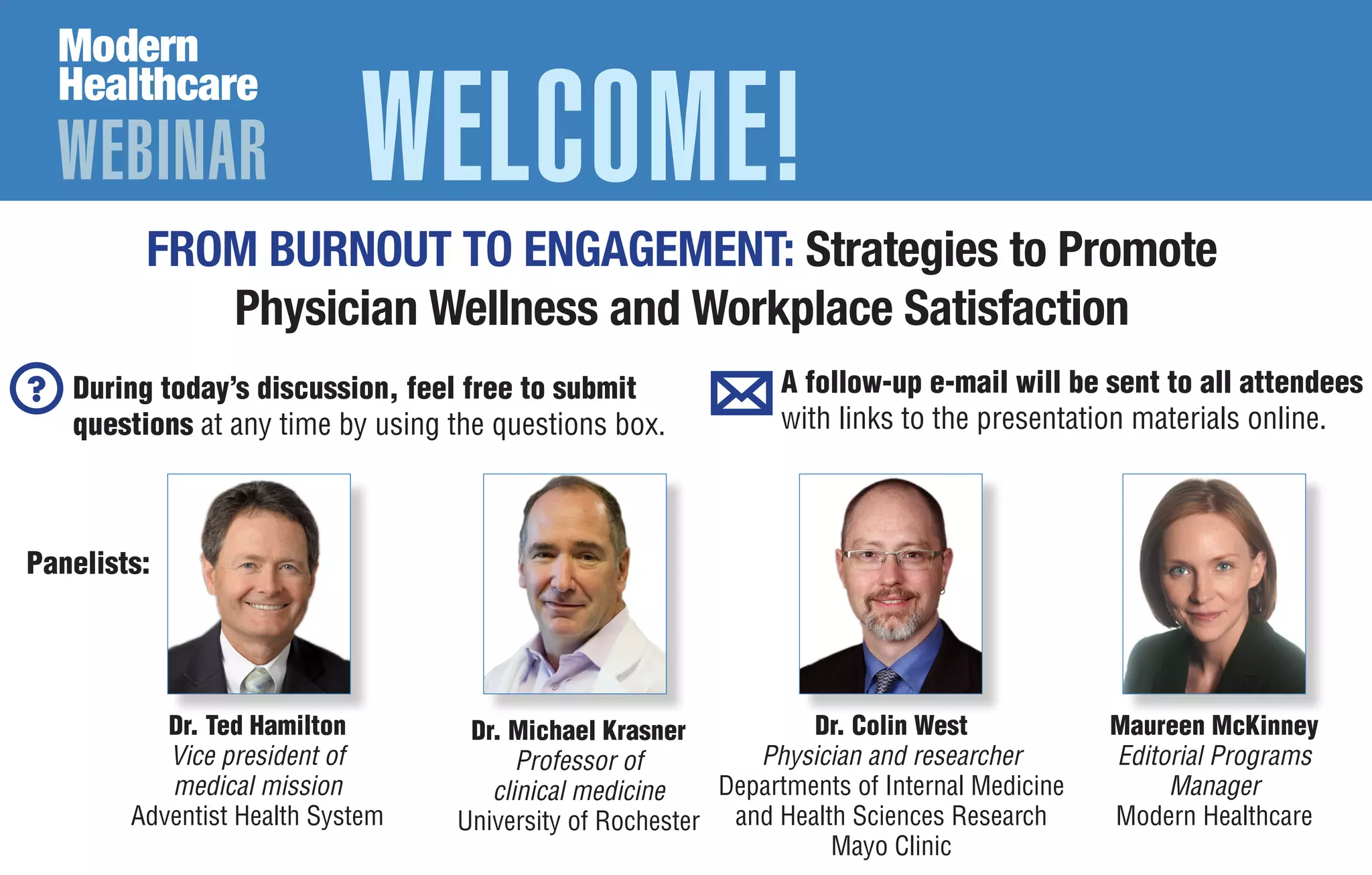
WEBINAR WELCOME!
Dr. Colin West
Physician and researcher
Departments of Internal Medicine
and Health Sciences Research
Mayo Clinic
Dr. Michael Krasner
Professor of
clinical medicine
University of Rochester
Maureen McKinney
Editorial Programs
Manager
Modern Healthcare
During today’s discussion, feel free to submit
questions at any time by using the questions box.
A follow-up e-mail will be sent to all attendees
with links to the presentation materials online.
Dr. Ted Hamilton
Vice president of
medical mission
Adventist Health System
Panelists:
FROM BURNOUT TO ENGAGEMENT: Strategies to Promote
Physician Wellness and Workplace Satisfaction
WEBINAR HOUSEKEEPING
NOW SPEAKING
Please use the questions box on your webinar
dashboard to submit questions to our moderator
WEBINAR
FROM BURNOUT TO ENGAGEMENT: Strategies to Promote
Physician Wellness and Workplace Satisfaction
Maureen McKinney
Editorial Programs
Manager
Modern Healthcare
NOW SPEAKING
WEBINAR
FROM BURNOUT TO ENGAGEMENT: Strategies to Promote
Physician Wellness and Workplace Satisfaction
Please use the questions box on your webinar
dashboard to submit questions to our moderator
Dr. Colin West
Physician and researcher
Departments of Internal Medicine
and Health Sciences Research
Mayo Clinic
What is Burnout?
Burnout is a syndrome of:
depersonalization
emotional exhaustion
low personal accomplishment
leading to decreased effectiveness at work.
Burnout among Practicing Physicians
National Data (Shanafelt et al., Arch Intern Med 2012)
Burnout: 45.8%
Emotional exhaustion: 37.9%
Depersonalization: 29.4%
Burnout by Specialty (National)
0 10 20 30 40 50 60 70
Prev Med/Occupat Med/Enviro Med
Dermatology
Pediatrics - General
Pathology
Radiation Oncology
Other
Pediatric Subspecialty
Neurosurgery
Psychiatry
Urology
General Surgery Subspecialty
Ophthalmology
Internal Medicine Subspecialty
General Surgery
Average Burnout All Physicians
Participating
Physical medicine and Rehab
Radiology
Obstetrics and Gynecology
Anesthesiology
Orthopedic Surgery
Otolaryngology
Family Medicine
Neurology
Internal Medicine - General
Emergency Medicine
% Reporting Burnout
Emergency Medicine
General Internal Medicine
Neurology
Family Medicine
Otolaryngology
Orthopedic Surgery
Anesthesiology
OB/GYN
Radiology
Physical medicine/Rehab
Average all physicians
General Surgery
Internal Medicine Subspecialty
Ophthalmology
General Surgery Sub-specialty
Urology
Psychiatry
Neurosurgery
Preventative/Occupational Medicine
Pediatric Subspecialty
Other
Radiation Oncology
Pathology
General Pediatrics
Dermatology
Shanafelt et al.
Arch Intern Med 2012
Consequences of Physician Burnout
• Medical errors1-3
• Impaired professionalism5,6
• Reduced patient satisfaction7
• Staff turnover and reduced hours8
• Depression and suicidal ideation9,10
• Motor vehicle crashes and near-misses11
1JAMA 296:1071, 2JAMA 304:1173, 3JAMA 302:1294, 4Annals IM 136:358, 5Annals Surg 251:995,
6JAMA 306:952, 7Health Psych 12:93, 8JACS 212:421, 9Annals IM 149:334, 10Arch Surg 146:54,
11Mayo Clin Proc 2012
Physician Burnout: Key Drivers
• Excessive workload
• Inefficient environment, inadequate support
• Loss autonomy/flexibility
• Problems with work-life integration
• Loss of meaning in work
Intervention Trial
• RCT testing if an established, portable, low-cost
curriculum administered during regular work hours can
promote meaning and reduce burnout
– Arm A (Intervention):
• meet 90 minutes (12:30-2) every other wk (60 mins protected
time, ~1% FTE)
• 9 months
• Facilitated curriculum, small groups of 6-8 physicians
– Arm B (Control):
• Receive 60 minutes every other week for
professional/administrative tasks (~1% FTE)
• Outcomes assessed quarterly, 3 months post, 12 months
post
West et al., JAMA Intern Med. 2014:174:527-33
Conclusions
• A small amount of protected time during the workday
resulted in improved meaning from work and
reductions in burnout
– Effects larger in facilitated small group arm than in “free time”
control arm, particularly in promoting meaning and reducing
depersonalization.
– Follow-up study data found sustained benefits at 1 year after
the close of the study.
West et al., JAMA Intern Med 2014:174:527-33
Second Intervention Trial
DOM faculty
N=550
Volunteers
N=125
Non-
volunteers
N=425
Intervention
N=64
Waitlist Control
N=61
Current
Practice
Conclusions
• Compared to the wait-listed control group, the facilitated
small group intervention improved:
– Depersonalization
– Personal accomplishment
– Overall QOL
– Depression
– Meaning from work
– Social isolation at work
– Job satisfaction
– Likelihood of leaving in next 2 years
• Initial intervention shows benefit with sustained changes
over subsequent 6 months.
Individual Strategies
• Identify Values
• Debunk myth of delayed gratification
• What matters to you most (integrate values)
• Integrate personal and professional life
• Optimize meaning in work
• Flow
• Choose/focus practice
• Nurture personal wellness activities
• Calibrate distress level
• Self-care (exercise, sleep, regular medical care)
• Relationships (connect w/ colleagues; personal)
• Religious/spiritual practice
• Mindfulness
• Personal interests (hobbies)
What Can Organizations Do?
• Be value oriented
• Promote values of the medical profession
• Congruence between values and expectations
• Provide adequate resources (efficiency)
• Organization and work unit level
• Promote autonomy
• Flexibility, input, sense control
• Promote work-life integration
• Promote meaning in work
Burnout: Key Drivers
• Excessive workload
• Inefficient environment, inadequate support
• Loss autonomy/flexibility
• Problems with work-life integration
• Loss of meaning in work
NOW SPEAKING
Please use the questions box on your webinar
dashboard to submit questions to our moderator
WEBINAR
FROM BURNOUT TO ENGAGEMENT: Strategies to Promote
Physician Wellness and Workplace Satisfaction
Dr. Michael Krasner
Professor of clinical medicine
University of Rochester
Medicine in Crisis
Crisis of meaning
Crisis of identity
Crisis of purpose
Crisis of role
Sir Luke Fildes, The Doctor 1867 Oil on canvas, The Tate Britain, London
Toll , B. JAMA June 20, 2012
HYPOTHESES:
Resilience is a capacity that can be grown
Lower quality of technical
care
Riskier prescribing
practices
More medication errors
Lower patient adherence to
treatment
More unsafe behaviors (e.g.
needlestick injuries, not
following protocols)
Lower patient satisfaction
Erosion of altruism and
empathy
Unprofessional conduct
Poor relationships with
staff and patients
Higher attrition and job
turnover higher
recruitment costs
Fahrenkopf et al. 2008; DiMatteo et al. 1991; Williams et al. 2009; Shanafelt et al. 2005; Dyrbye et al.
2010; Haas et al 2000; Sundquist et al 2000; Krasner et al. 2009; Buchbinder et al. 2001
Clinician
resilience
(well-being –
burnout)
Quality of care
(safety –
errors)
Quality of caring
(compassion -
detachment)
Shanafelt, T. D., et al. (2002). Burnout and self-reported patient care in an internal medicine residency program.
Ann Intern Med, 136, 358-367; Shanafelt, T. D., et al. (2005). Relationship between increased personal
well-being and enhanced empathy among internal medicine residents. J Gen Intern Med, 20, 559-564.
Three components:
Emotional exhaustion
I just can’t do any more
Depersonalization (cynicism)
Every good deed gets punished
Low personal accomplishment
No matter how hard I work, nothing improves
The ability of an individual to respond to stress
in a healthy, adaptive way such that personal
goals are achieved at minimal psychological
and physical cost; resilient individuals not only
“bounce back” rapidly after challenges but also
grow stronger in the process.
Epstein & Krasner 2013
Howe A et al 2012
Burnout Resilience
Withdrawn Present
Emotionally exhausted Energized
Defeated Bouncing back
Going through the motions Fully engaged
Brittle, rigid Bending, not breaking
Cynical, hopeless Capacity for positivity
Hypercritical A light touch
Feeling ineffective Becoming stronger
Treading water Moving forward
AFGO Welcoming change
Optimism
More and more I have come to
admire resilience.
Not the simple resistance of a pillow,
whose foam
returns over and over to the same
shape, but the sinuous
tenacity of a tree: finding the light
newly blocked on one side,
it turns in another. A blind
intelligence, true.
But out of such persistence arose
turtles, rivers,
mitochondria, figs -- all this resinous,
unretractable earth.
~ Jane Hirshfield ~
Mindfulness
• Integral to professional competence
• A quality of consciousness
• Attends to the context in which the contents of
consciousness are expressed
• Can be cultivated, grown, expanded
• Attentive observation, critical curiosity, beginner’s
mind, presence
• The awareness that arises out of paying attention on
purpose, in the present moment, without judgment
(Kabat-Zinn 1994)
Why should mindfulness matter to
clinicians?
• Quality of care
• Empathy
• Avoids cognitive traps and resulting errors
• Clearer assessments
• Promotes a more participatory medicine
Moment-to-moment purposeful
awareness of one’s own mental and
physical processes during every day
work with the goal of practicing with
clarity and compassion
Epstein RM 1999
Resilience and
well-being
Quality of care
Quality of caring
Mindful
practice
Participation in a mindful communication program was
associated with sustained improvements (<.001) in:
Patient-centered attitudes (empathy, psychosocial orientation)
Physician well-being (burnout, mood)
Personality (increased emotional stability).
Associations were mediated by changes in mindfulness.
Participants identified three themes: community, skills
development, and giving oneself permission to take
time for self-development
Results replicated in Spain and North America
RESILIENCE = INTENTION +
COMMUNITY + SKILLS +
ENGAGEMENT + SUPPORT
Other programs
Baystate Medical Center
Boston University
Brown University
Dalhousie University
Dartmouth Medical School
Drexel University
Duke University
East Carolina University
Georgetown University
Göteborg, Sweden
Hamilton Ontario Health Systems
Harvard Medical School
Hong Kong University
Jefferson Medical College
Mayo Medical School
McGill University
Monash University
Oakland University
Ohio State University
Oregon Health Sciences
University
Universidad Autónoma de
Barcelona
University of Iowa
Université de Montreal
University of California, San
Diego
University of Massachusetts
University of Rochester
University of Toronto
University of Wisconsin
www.mindfulpractice.urmc.edu
NOW SPEAKING
Please use the questions box on your webinar
dashboard to submit questions to our moderator
WEBINAR
FROM BURNOUT TO ENGAGEMENT: Strategies to Promote
Physician Wellness and Workplace Satisfaction
Dr. Ted Hamilton
Vice president of
medical mission
Adventist Health System
WALL STREET JOURNAL
American doctors are unhappy . . .
and it’s hurting patients.
If you want to change the culture of an
organization, you don’t have to get
everybody…you have to get the square
root of N. It will take on a life of its own
and drive itself ahead.
W. Edwards Deming
“SQUARE ROOT OF N”
• 649 physicians
• 281 spouses / family members
• 10,249 total number of sessions
PHYSICIAN SUPPORT SERVICES
4
• Clinical burnout
• Depression / mood disorders
• Marital / relationship issues
• Anger management / boundary issues
• Addiction / substance abuse
CLINICAL ISSUES
FINDING MEANING IN MEDICINE
SCHWARTZ ROUNDS
• Physician Support Service
• Meaning in Medicine
• Schwartz Rounds
• Physician On-Boarding
THE BIG FOUR
8
forphysicianwellbeing.org
WEBINAR
TODAY’S PANELISTS
FROM BURNOUT TO ENGAGEMENT: Strategies to Promote
Physician Wellness and Workplace Satisfaction
During today’s discussion, feel free to submit questions at any time by using the questions box
Dr. Colin West
Physician and researcher
Departments of Internal Medicine
and Health Sciences Research
Mayo Clinic
Dr. Michael Krasner
Professor of
clinical medicine
University of Rochester
Maureen McKinney
Editorial Programs
Manager
Modern Healthcare
Dr. Ted Hamilton
Vice president of
medical mission
Adventist Health System
Expect a follow-up email within two weeks
with links to presentation materials and
information about how to offer feedback.
For more information about
upcoming webinars, please visit
ModernHealthcare.com/webinars
WEBINAR THANK YOU FOR ATTENDING
Thanks also to our panelists:
Dr. Colin West
Physician and researcher
Departments of Internal
Medicine and Health
Sciences Research
Mayo Clinic
Dr. Michael Krasner
Professor of
clinical medicine
University of Rochester
Maureen McKinney
Editorial Programs
Manager
Modern Healthcare
Dr. Ted Hamilton
Vice president of
medical mission
Adventist Health System
FROM BURNOUT TO ENGAGEMENT: Strategies to Promote
Physician Wellness and Workplace Satisfaction

From Burnout to Engagement: Strategies to Promote Physician Wellness and Workplace Satisfaction

  • 1.
    WEBINAR WELCOME! Dr. ColinWest Physician and researcher Departments of Internal Medicine and Health Sciences Research Mayo Clinic Dr. Michael Krasner Professor of clinical medicine University of Rochester Maureen McKinney Editorial Programs Manager Modern Healthcare During today’s discussion, feel free to submit questions at any time by using the questions box. A follow-up e-mail will be sent to all attendees with links to the presentation materials online. Dr. Ted Hamilton Vice president of medical mission Adventist Health System Panelists: FROM BURNOUT TO ENGAGEMENT: Strategies to Promote Physician Wellness and Workplace Satisfaction
  • 2.
  • 3.
    NOW SPEAKING Please usethe questions box on your webinar dashboard to submit questions to our moderator WEBINAR FROM BURNOUT TO ENGAGEMENT: Strategies to Promote Physician Wellness and Workplace Satisfaction Maureen McKinney Editorial Programs Manager Modern Healthcare
  • 4.
    NOW SPEAKING WEBINAR FROM BURNOUTTO ENGAGEMENT: Strategies to Promote Physician Wellness and Workplace Satisfaction Please use the questions box on your webinar dashboard to submit questions to our moderator Dr. Colin West Physician and researcher Departments of Internal Medicine and Health Sciences Research Mayo Clinic
  • 5.
    What is Burnout? Burnoutis a syndrome of: depersonalization emotional exhaustion low personal accomplishment leading to decreased effectiveness at work.
  • 6.
    Burnout among PracticingPhysicians National Data (Shanafelt et al., Arch Intern Med 2012) Burnout: 45.8% Emotional exhaustion: 37.9% Depersonalization: 29.4%
  • 7.
    Burnout by Specialty(National) 0 10 20 30 40 50 60 70 Prev Med/Occupat Med/Enviro Med Dermatology Pediatrics - General Pathology Radiation Oncology Other Pediatric Subspecialty Neurosurgery Psychiatry Urology General Surgery Subspecialty Ophthalmology Internal Medicine Subspecialty General Surgery Average Burnout All Physicians Participating Physical medicine and Rehab Radiology Obstetrics and Gynecology Anesthesiology Orthopedic Surgery Otolaryngology Family Medicine Neurology Internal Medicine - General Emergency Medicine % Reporting Burnout Emergency Medicine General Internal Medicine Neurology Family Medicine Otolaryngology Orthopedic Surgery Anesthesiology OB/GYN Radiology Physical medicine/Rehab Average all physicians General Surgery Internal Medicine Subspecialty Ophthalmology General Surgery Sub-specialty Urology Psychiatry Neurosurgery Preventative/Occupational Medicine Pediatric Subspecialty Other Radiation Oncology Pathology General Pediatrics Dermatology Shanafelt et al. Arch Intern Med 2012
  • 8.
    Consequences of PhysicianBurnout • Medical errors1-3 • Impaired professionalism5,6 • Reduced patient satisfaction7 • Staff turnover and reduced hours8 • Depression and suicidal ideation9,10 • Motor vehicle crashes and near-misses11 1JAMA 296:1071, 2JAMA 304:1173, 3JAMA 302:1294, 4Annals IM 136:358, 5Annals Surg 251:995, 6JAMA 306:952, 7Health Psych 12:93, 8JACS 212:421, 9Annals IM 149:334, 10Arch Surg 146:54, 11Mayo Clin Proc 2012
  • 9.
    Physician Burnout: KeyDrivers • Excessive workload • Inefficient environment, inadequate support • Loss autonomy/flexibility • Problems with work-life integration • Loss of meaning in work
  • 10.
    Intervention Trial • RCTtesting if an established, portable, low-cost curriculum administered during regular work hours can promote meaning and reduce burnout – Arm A (Intervention): • meet 90 minutes (12:30-2) every other wk (60 mins protected time, ~1% FTE) • 9 months • Facilitated curriculum, small groups of 6-8 physicians – Arm B (Control): • Receive 60 minutes every other week for professional/administrative tasks (~1% FTE) • Outcomes assessed quarterly, 3 months post, 12 months post West et al., JAMA Intern Med. 2014:174:527-33
  • 11.
    Conclusions • A smallamount of protected time during the workday resulted in improved meaning from work and reductions in burnout – Effects larger in facilitated small group arm than in “free time” control arm, particularly in promoting meaning and reducing depersonalization. – Follow-up study data found sustained benefits at 1 year after the close of the study. West et al., JAMA Intern Med 2014:174:527-33
  • 12.
    Second Intervention Trial DOMfaculty N=550 Volunteers N=125 Non- volunteers N=425 Intervention N=64 Waitlist Control N=61 Current Practice
  • 13.
    Conclusions • Compared tothe wait-listed control group, the facilitated small group intervention improved: – Depersonalization – Personal accomplishment – Overall QOL – Depression – Meaning from work – Social isolation at work – Job satisfaction – Likelihood of leaving in next 2 years • Initial intervention shows benefit with sustained changes over subsequent 6 months.
  • 14.
    Individual Strategies • IdentifyValues • Debunk myth of delayed gratification • What matters to you most (integrate values) • Integrate personal and professional life • Optimize meaning in work • Flow • Choose/focus practice • Nurture personal wellness activities • Calibrate distress level • Self-care (exercise, sleep, regular medical care) • Relationships (connect w/ colleagues; personal) • Religious/spiritual practice • Mindfulness • Personal interests (hobbies)
  • 15.
    What Can OrganizationsDo? • Be value oriented • Promote values of the medical profession • Congruence between values and expectations • Provide adequate resources (efficiency) • Organization and work unit level • Promote autonomy • Flexibility, input, sense control • Promote work-life integration • Promote meaning in work
  • 16.
    Burnout: Key Drivers •Excessive workload • Inefficient environment, inadequate support • Loss autonomy/flexibility • Problems with work-life integration • Loss of meaning in work
  • 17.
    NOW SPEAKING Please usethe questions box on your webinar dashboard to submit questions to our moderator WEBINAR FROM BURNOUT TO ENGAGEMENT: Strategies to Promote Physician Wellness and Workplace Satisfaction Dr. Michael Krasner Professor of clinical medicine University of Rochester
  • 18.
    Medicine in Crisis Crisisof meaning Crisis of identity Crisis of purpose Crisis of role
  • 19.
    Sir Luke Fildes,The Doctor 1867 Oil on canvas, The Tate Britain, London
  • 20.
    Toll , B.JAMA June 20, 2012
  • 21.
    HYPOTHESES: Resilience is acapacity that can be grown
  • 22.
    Lower quality oftechnical care Riskier prescribing practices More medication errors Lower patient adherence to treatment More unsafe behaviors (e.g. needlestick injuries, not following protocols) Lower patient satisfaction Erosion of altruism and empathy Unprofessional conduct Poor relationships with staff and patients Higher attrition and job turnover higher recruitment costs Fahrenkopf et al. 2008; DiMatteo et al. 1991; Williams et al. 2009; Shanafelt et al. 2005; Dyrbye et al. 2010; Haas et al 2000; Sundquist et al 2000; Krasner et al. 2009; Buchbinder et al. 2001
  • 23.
    Clinician resilience (well-being – burnout) Quality ofcare (safety – errors) Quality of caring (compassion - detachment) Shanafelt, T. D., et al. (2002). Burnout and self-reported patient care in an internal medicine residency program. Ann Intern Med, 136, 358-367; Shanafelt, T. D., et al. (2005). Relationship between increased personal well-being and enhanced empathy among internal medicine residents. J Gen Intern Med, 20, 559-564.
  • 24.
    Three components: Emotional exhaustion Ijust can’t do any more Depersonalization (cynicism) Every good deed gets punished Low personal accomplishment No matter how hard I work, nothing improves
  • 25.
    The ability ofan individual to respond to stress in a healthy, adaptive way such that personal goals are achieved at minimal psychological and physical cost; resilient individuals not only “bounce back” rapidly after challenges but also grow stronger in the process. Epstein & Krasner 2013 Howe A et al 2012
  • 26.
    Burnout Resilience Withdrawn Present Emotionallyexhausted Energized Defeated Bouncing back Going through the motions Fully engaged Brittle, rigid Bending, not breaking Cynical, hopeless Capacity for positivity Hypercritical A light touch Feeling ineffective Becoming stronger Treading water Moving forward AFGO Welcoming change
  • 27.
    Optimism More and moreI have come to admire resilience. Not the simple resistance of a pillow, whose foam returns over and over to the same shape, but the sinuous tenacity of a tree: finding the light newly blocked on one side, it turns in another. A blind intelligence, true. But out of such persistence arose turtles, rivers, mitochondria, figs -- all this resinous, unretractable earth. ~ Jane Hirshfield ~
  • 29.
    Mindfulness • Integral toprofessional competence • A quality of consciousness • Attends to the context in which the contents of consciousness are expressed • Can be cultivated, grown, expanded • Attentive observation, critical curiosity, beginner’s mind, presence • The awareness that arises out of paying attention on purpose, in the present moment, without judgment (Kabat-Zinn 1994)
  • 30.
    Why should mindfulnessmatter to clinicians? • Quality of care • Empathy • Avoids cognitive traps and resulting errors • Clearer assessments • Promotes a more participatory medicine
  • 31.
    Moment-to-moment purposeful awareness ofone’s own mental and physical processes during every day work with the goal of practicing with clarity and compassion Epstein RM 1999
  • 32.
    Resilience and well-being Quality ofcare Quality of caring Mindful practice
  • 34.
    Participation in amindful communication program was associated with sustained improvements (<.001) in: Patient-centered attitudes (empathy, psychosocial orientation) Physician well-being (burnout, mood) Personality (increased emotional stability). Associations were mediated by changes in mindfulness. Participants identified three themes: community, skills development, and giving oneself permission to take time for self-development Results replicated in Spain and North America
  • 35.
    RESILIENCE = INTENTION+ COMMUNITY + SKILLS + ENGAGEMENT + SUPPORT
  • 36.
    Other programs Baystate MedicalCenter Boston University Brown University Dalhousie University Dartmouth Medical School Drexel University Duke University East Carolina University Georgetown University Göteborg, Sweden Hamilton Ontario Health Systems Harvard Medical School Hong Kong University Jefferson Medical College Mayo Medical School McGill University Monash University Oakland University Ohio State University Oregon Health Sciences University Universidad Autónoma de Barcelona University of Iowa Université de Montreal University of California, San Diego University of Massachusetts University of Rochester University of Toronto University of Wisconsin
  • 38.
  • 39.
    NOW SPEAKING Please usethe questions box on your webinar dashboard to submit questions to our moderator WEBINAR FROM BURNOUT TO ENGAGEMENT: Strategies to Promote Physician Wellness and Workplace Satisfaction Dr. Ted Hamilton Vice president of medical mission Adventist Health System
  • 40.
    WALL STREET JOURNAL Americandoctors are unhappy . . . and it’s hurting patients.
  • 41.
    If you wantto change the culture of an organization, you don’t have to get everybody…you have to get the square root of N. It will take on a life of its own and drive itself ahead. W. Edwards Deming “SQUARE ROOT OF N”
  • 42.
    • 649 physicians •281 spouses / family members • 10,249 total number of sessions PHYSICIAN SUPPORT SERVICES
  • 43.
    4 • Clinical burnout •Depression / mood disorders • Marital / relationship issues • Anger management / boundary issues • Addiction / substance abuse CLINICAL ISSUES
  • 44.
  • 45.
  • 46.
    • Physician SupportService • Meaning in Medicine • Schwartz Rounds • Physician On-Boarding THE BIG FOUR
  • 47.
  • 48.
    WEBINAR TODAY’S PANELISTS FROM BURNOUTTO ENGAGEMENT: Strategies to Promote Physician Wellness and Workplace Satisfaction During today’s discussion, feel free to submit questions at any time by using the questions box Dr. Colin West Physician and researcher Departments of Internal Medicine and Health Sciences Research Mayo Clinic Dr. Michael Krasner Professor of clinical medicine University of Rochester Maureen McKinney Editorial Programs Manager Modern Healthcare Dr. Ted Hamilton Vice president of medical mission Adventist Health System
  • 49.
    Expect a follow-upemail within two weeks with links to presentation materials and information about how to offer feedback. For more information about upcoming webinars, please visit ModernHealthcare.com/webinars WEBINAR THANK YOU FOR ATTENDING Thanks also to our panelists: Dr. Colin West Physician and researcher Departments of Internal Medicine and Health Sciences Research Mayo Clinic Dr. Michael Krasner Professor of clinical medicine University of Rochester Maureen McKinney Editorial Programs Manager Modern Healthcare Dr. Ted Hamilton Vice president of medical mission Adventist Health System FROM BURNOUT TO ENGAGEMENT: Strategies to Promote Physician Wellness and Workplace Satisfaction