How ShouldYou Pay High Performers?
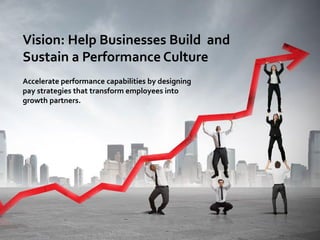
Vision: Help Businesses Build and
Sustain a Performance Culture
Accelerate performance capabilities by designing
pay strategies that transform employees into
growth partners.
If you do that…
• Quality of talent will improve.
• Employee engagement will expand.
• Performance will be magnified.
• Business growth will be accelerated.
• Shareholder value will increase.
44
Where We are Headed
 Why is pay for high performers
an issue?
▪ Talent Trends
 Who are the high performers—
the ones you have and the ones
you will need?
▪ Key Criteria
 How do you pay high
performers?
▪ 6 Rules
55
Why is high performer pay an issue?
66
CEO Talent Concerns
One of the biggest headaches for CEOs
is making sure that the organization has
the right people to cope with what lies
ahead. There’s the basic question of
planning for the skills that are needed
now and in the future: Which roles will
be automated? What new roles will be
needed to manage and run emerging
technology? What skills should the
company be looking for, and training
their people for? Where will we find the
people we need?
PwC’s 18th Annual Global CEO Survey
77
But more importantly, CEOs need to be
sure that the business is fit to react
quickly to whatever the future may
throw at it – and that means filling it
with adaptable, creative people, working
in a culture where energy fizzes and
ideas spark into life. If they can’t be
found, they must be created.
PwC’s 18th Annual Global CEO Survey (continued)
88
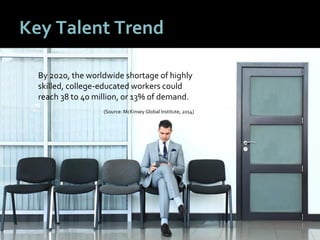
Key Talent Trend
By 2020, the worldwide shortage of highly
skilled, college-educated workers could
reach 38 to 40 million, or 13% of demand.
(Source: McKinsey Global Institute, 2014)
99
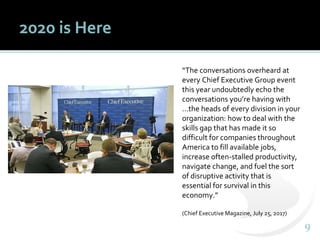
2020 is Here
“The conversations overheard at
every Chief Executive Group event
this year undoubtedly echo the
conversations you’re having with
…the heads of every division in your
organization: how to deal with the
skills gap that has made it so
difficult for companies throughout
America to fill available jobs,
increase often-stalled productivity,
navigate change, and fuel the sort
of disruptive activity that is
essential for survival in this
economy.”
(Chief Executive Magazine, July 25, 2017)
1010
Employee Empowerment
Employees today have increased
bargaining power, the job market is
highly transparent, and attracting
top-skilled workers is a highly
competitive activity. Companies are
now investing in analytics tools to
figure out why people leave, and the
topics of purpose, engagement, and
culture weigh on the minds of
business leaders everywhere.
(Deloitte 2015 Study & Report)
1111
Governing Thought
Pay the least amount you can
“get away with” to attract the
best talent available and drive
the maximum performance
possible.
1212
Those Days are Gone
1313
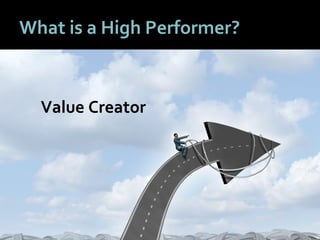
What is a High Performer?
Value Creator
1414
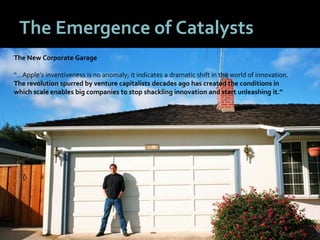
The Emergence of Catalysts
The New Corporate Garage
“…Apple’s inventiveness is no anomaly; it indicates a dramatic shift in the world of innovation.
The revolution spurred by venture capitalists decades ago has created the conditions in
which scale enables big companies to stop shackling innovation and start unleashing it.”
1515
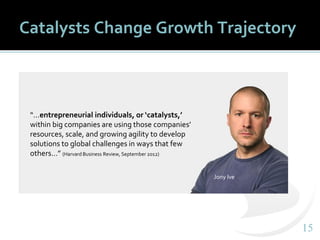
Catalysts Change Growth Trajectory
“…entrepreneurial individuals, or ‘catalysts,’
within big companies are using those companies’
resources, scale, and growing agility to develop
solutions to global challenges in ways that few
others…” (Harvard Business Review, September 2012)
Jony Ive
1616
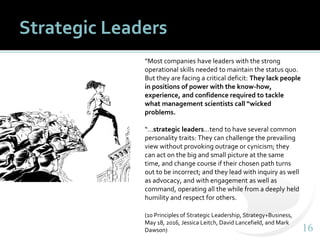
Strategic Leaders
“Most companies have leaders with the strong
operational skills needed to maintain the status quo.
But they are facing a critical deficit: They lack people
in positions of power with the know-how,
experience, and confidence required to tackle
what management scientists call “wicked
problems.
“…strategic leaders…tend to have several common
personality traits: They can challenge the prevailing
view without provoking outrage or cynicism; they
can act on the big and small picture at the same
time, and change course if their chosen path turns
out to be incorrect; and they lead with inquiry as well
as advocacy, and with engagement as well as
command, operating all the while from a deeply held
humility and respect for others.
(10 Principles of Strategic Leadership, Strategy+Business,
May 18, 2016, Jessica Leitch, David Lancefield, and Mark
Dawson)
1717
What it Means
• Companies need catalysts
who are strategic leaders.
• Catalysts must focus on areas
of strategic impact
• Catalysts are scarce.
• Scarcity creates competition
• Competition requires a unique
and comprehensive value
proposition
1818
6 Rules for Paying High Performers
1. Establish a performance framework
2. Define value creation
3. Choose a pay philosophy & structure
4. Emphasize long-term value sharing
5. Be innovative
6. Frame a partnership
…plus a bonus rule.
1919
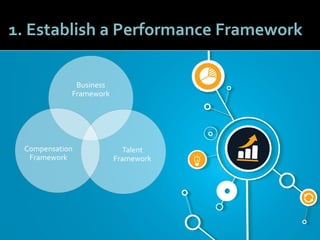
1. Establish a Performance Framework
Business
Framework
Talent
Framework
Compensation
Framework
2020
Business Framework
Phase One
 Define Growth Expectations
(Vision)
▪ Key outcomes that must be achieved
 Define Business Model and
Strategy
▪ Performance Engine
▪ How the company will compete
▪ Where are growth opportunities?
 Identify Roles and Expectations
▪ Establish Performance Criteria
▪ Define “Success”
Business
Framework
2121
Compensation Framework
Phase Two
 Establish a pay
philosophy
▪ Expansive vs. Selective—or
Hybrid
▪ Define what the company is
willing to pay for
 Engineer a pay strategy
▪ Structure
▪ Mindset
 Adopt a “Total Rewards”
Approach
Compensation
Framework
2222
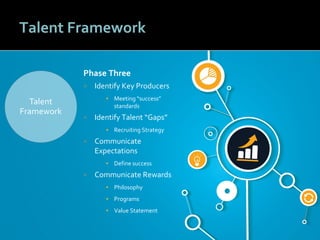
Talent Framework
Phase Three
 Identify Key Producers
▪ Meeting “success”
standards
 Identify Talent “Gaps”
▪ Recruiting Strategy
 Communicate
Expectations
▪ Define success
 Communicate Rewards
▪ Philosophy
▪ Programs
▪ Value Statement
Talent
Framework
2323
2. Define Value Creation
Value attributable to the
productivity and performance of
human capital.
2424
2. Calculating Value Creation
Focus on
Productivity Profit
2525
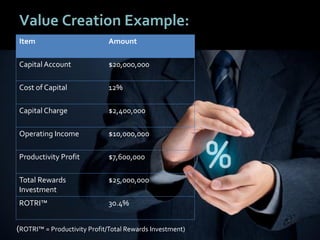
Value Creation Example:
Item Amount
Capital Account $20,000,000
Cost of Capital 12%
Capital Charge $2,400,000
Operating Income $10,000,000
Productivity Profit $7,600,000
Total Rewards
Investment
$25,000,000
ROTRI™ 30.4%
(ROTRI™ = Productivity Profit/Total Rewards Investment)
2626
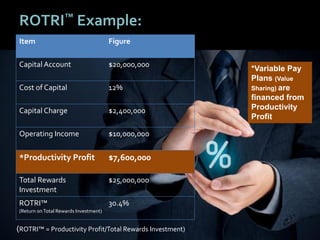
ROTRI™ Example:
Item Figure
Capital Account $20,000,000
Cost of Capital 12%
Capital Charge $2,400,000
Operating Income $10,000,000
*Productivity Profit $7,600,000
Total Rewards
Investment
$25,000,000
ROTRI™
(Return onTotal Rewards Investment)
30.4%
(ROTRI™ = Productivity Profit/Total Rewards Investment)
*Variable Pay
Plans (Value
Sharing) are
financed from
Productivity
Profit
2727
3. Choose a Pay Philosophy & Structure
 How value creation is defined.
 How value is shared—and with
whom.
 Market pay standards.
 How guaranteed pay and value-
sharing will be balanced.
 How short and long-term value-
sharing will be balanced.
 When or if equity will be shared.
 How merit pay is defined.
2828
Pay Structure
 Expansive
 Selective
Workspan (World at Work)
The War for Stars, May 2012
2929
Expansive Approach
Strives to retain virtually every employee under the theory that everyone is
needed or they wouldn’t be there. Largely egalitarian.
“Why upset our harmonious culture by creating an elite group that receives
special treatment? All our employees are critical and perform well, and
most are not going to leave.”
3030
Expansive Approach
 Easy to administer
 Does not usually support an organization’s efforts to raise overall
performance
 Discourages and disengages high performers
3131
Selective Approach
Identifies, nurtures and works to retain the high
performers at all levels of the organization.
Seeks to produce a cycle that, in the long term, will not only retain
existing high performers, but create and attract more high
performers and generate ever-improving standards of
performance and organizational results.
3232
Selective Approach
 Sets high performance standards
 Acknowledges the company is in a war for stars
 Recognizes high performers always have an
opportunity to move
3333
Which approach makes the most sense?
3434
4. Focus on Long-Term Value Sharing
3535
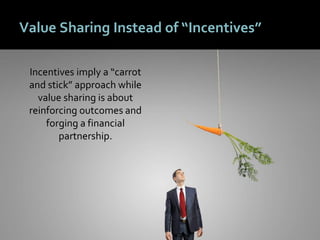
Value Sharing Instead of “Incentives”
Incentives imply a “carrot
and stick” approach while
value sharing is about
reinforcing outcomes and
forging a financial
partnership.
3636
What High Performers Want
 There is a philosophy that guides
pay decisions and I relate to it.
 There is a mechanism for sharing
value with those who help
produce it.
 I have some control over how
much I can earn if I produce.
 I feel a sense of partnership with
ownership.
3737
Long-Term Value-Sharing & Catalysts
 Single most important component in
attracting and retaining “catalysts”
 Should be used in every size
organization
 Creates “wealth multiplier” mindset
 Ties employees to vision and growth
plan of the company
 Most under-utilized plan in most
private companies
3838
Financial “Hierarchy of Needs”
Cash Flow & Living Standard
Risk Protection
Retirement Planning
Value Sharing
Wealth Accumulation
Qualified & Executive
Retirement Plans
Comprehensive, Flexible
Benefits Plan
Short & Long-Term Incentive
Plans
Salary & Bonus
Wealth Multiplier Philosophy
Clear Pay Philosophy
1
2
3
4
5
3939
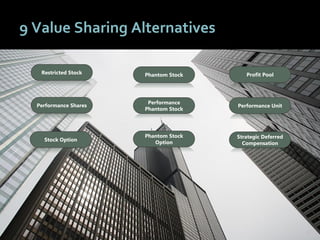
9 Value Sharing Alternatives
Stock Option
Performance Shares
Restricted Stock
Phantom Stock
Option
Performance
Phantom Stock
Phantom Stock Profit Pool
Performance Unit
Strategic Deferred
Compensation
4040
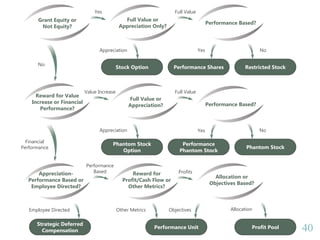
Grant Equity or
Not Equity?
Full Value or
Appreciation Only?
Yes
Appreciation
Stock Option
Full Value
Performance Based?
Yes
Performance Shares
No
Restricted Stock
No
Reward for Value
Increase or Financial
Performance?
Value Increase
Full Value or
Appreciation?
Appreciation
Phantom Stock
Option
Full Value
Performance Based?
Yes
Performance
Phantom Stock
No
Phantom Stock
Financial
Performance
Appreciation-
Performance Based or
Employee Directed?
Performance
Based Reward for
Profit/Cash Flow or
Other Metrics?
Profits
Allocation or
Objectives Based?
Allocation
Profit Pool
ObjectivesOther Metrics
Performance Unit
Employee Directed
Strategic Deferred
Compensation
4141
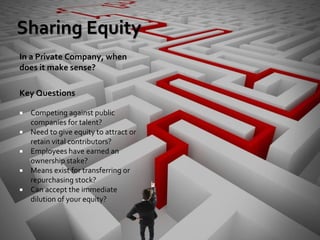
Sharing Equity
In a Private Company, when
does it make sense?
Key Questions
 Competing against public
companies for talent?
 Need to give equity to attract or
retain vital contributors?
 Employees have earned an
ownership stake?
 Means exist for transferring or
repurchasing stock?
 Can accept the immediate
dilution of your equity?
4242
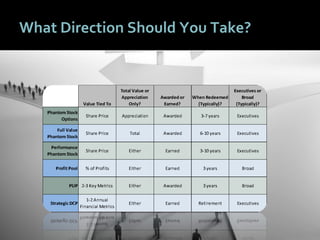
What Direction Should You Take?
4343
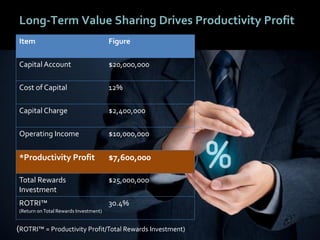
Long-Term Value Sharing Drives Productivity Profit
Item Figure
Capital Account $20,000,000
Cost of Capital 12%
Capital Charge $2,400,000
Operating Income $10,000,000
*Productivity Profit $7,600,000
Total Rewards
Investment
$25,000,000
ROTRI™
(Return onTotal Rewards Investment)
30.4%
(ROTRI™ = Productivity Profit/Total Rewards Investment)
4444
5. Be Innovative
4545
Trends for Paying High Performers
 Performance Agreements
 Opt-In Plans
 Internal Venture Capital
4646
Performance Agreements
Prominent Media Company
 High performers excluded from profit sharing-
type incentive plan
 Annual negotiated “deal”
 “Deal sheet”
 Quarterly self-evaluation
4747
Performance Agreement
Outcomes
 High performance threshold
 Small or even $0 payouts can occur
 High-risk, high-upside
 Mentoring environment
 Ownership mindset
 High retention
4848
Opt-In Plans
Most Ideal in Start-Up Environment
 Opt for:
 “Higher” salary plus modest incentives
 “Low” or no salary and high upside through short and long-term value
sharing
 Tied to a revenue or profit-sharing formula
 Volatility: payments lowered &/or deferred
 Opt-In periods may differ
4949
Opt-In Plans
Outcomes
 Employees feel in control
 Owners limit exposure
 Highly flexible
 “Shared” entrepreneurial experience
 Promotes an ownership mindset
 “Self-identifies” key performers
5050
Internal Venture Capital
Highly Entrepreneurial
Approach
 Larger organizations
 Establish venture capital
account
 Define access criteria
 Fund innovative ideas
 Performance criteria set
 Value sharing plan tied to
performance criteria
 Accompanied by performance
agreements or “opt-in” comp
plans
5151
Internal Venture Capital
Outcomes
 Accelerate innovation
 Attract catalysts
 Share risk
 Identify potential future leaders
and owners
5252
6. Frame a Partnership
5353
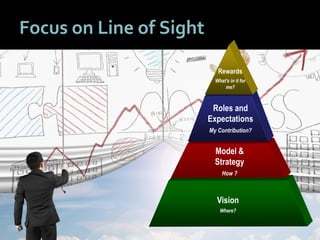
Focus on Line of Sight
Vision
Where?
Model &
Strategy
How ?
Roles and
Expectations
My Contribution?
Rewards
What’s in it for
me?
5454
Market a Future that’s Relevant
 Communicate desire for a
growth partnership
 Demonstrate commitment
 To the future business
 To key contributors
 Promote don’t just
communicate
 Be consistent
5555
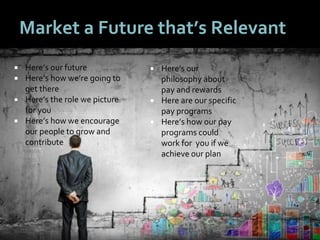
Market a Future that’s Relevant
 Here’s our future
 Here’s how we’re going to
get there
 Here’s the role we picture
for you
 Here’s how we encourage
our people to grow and
contribute
 Here’s our
philosophy about
pay and rewards
 Here are our specific
pay programs
 Here’s how our pay
programs could
work for you if we
achieve our plan
5656
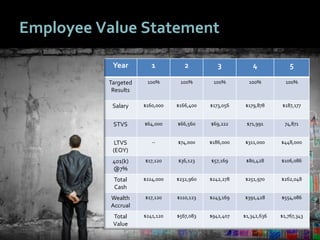
Employee Value Statement
Year 1 2 3 4 5
Targeted
Results
100% 100% 100% 100% 100%
Salary $160,000 $166,400 $173,056 $179,878 $187,177
STVS $64,000 $66,560 $69,222 $71,991 74,871
LTVS
(EOY)
-- $74,000 $186,000 $311,000 $448,000
401(k)
@7%
$17,120 $36,123 $57,169 $80,428 $106,086
Total
Cash
$224,000 $232,960 $242,278 $251,970 $262,048
Wealth
Accrual
$17,120 $110,123 $243,169 $391,428 $554,086
Total
Value
$241,120 $567,083 $942,407 $1,342,636 $1,767,343
5757
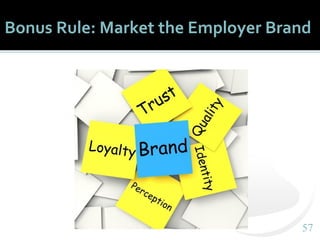
Bonus Rule: Market the Employer Brand
5858
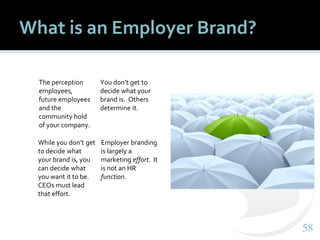
What is an Employer Brand?
The perception
employees,
future employees
and the
community hold
of your company.
You don’t get to
decide what your
brand is. Others
determine it.
While you don’t get
to decide what
your brand is, you
can decide what
you want it to be.
CEOs must lead
that effort.
Employer branding
is largely a
marketing effort. It
is not an HR
function.
5959
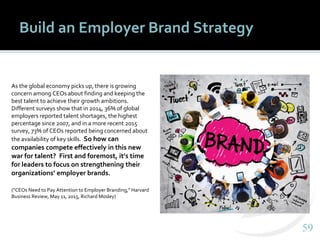
Build an Employer Brand Strategy
As the global economy picks up, there is growing
concern among CEOs about finding and keeping the
best talent to achieve their growth ambitions.
Different surveys show that in 2014, 36% of global
employers reported talent shortages, the highest
percentage since 2007, and in a more recent 2015
survey, 73% of CEOs reported being concerned about
the availability of key skills. So how can
companies compete effectively in this new
war for talent? First and foremost, it’s time
for leaders to focus on strengthening their
organizations’ employer brands.
(“CEOs Need to Pay Attention to Employer Branding,” Harvard
Business Review, May 11, 2015, Richard Mosley)
6060
6 Rules for Paying High Performers
1. Establish a performance framework
2. Define value creation
3. Choose a pay philosophy & structure
4. Emphasize long-term value sharing
5. Be innovative
6. Frame a partnership
…plus a bonus rule.
6161
www.BonusRight.com
www.bonusright.com
6262
 New SaaS tool
 Build and manage
your bonus plan
online.
6363
Today’s Presenter:
Ken Gibson
SeniorVice President
(949) 265-5703
kgibson@vladvisors.com
7700 Irvine Center Drive, Suite 930  Irvine, CA 92618  949-852-2288
www.VLadvisors.com  www.PhantomStockOnline.com  www.BonusRight.com
ThankYou!

How Should You Pay High Performers?

  • 1.
    How ShouldYou PayHigh Performers?
  • 2.
    Vision: Help BusinessesBuild and Sustain a Performance Culture Accelerate performance capabilities by designing pay strategies that transform employees into growth partners.
  • 3.
    If you dothat… • Quality of talent will improve. • Employee engagement will expand. • Performance will be magnified. • Business growth will be accelerated. • Shareholder value will increase.
  • 4.
    44 Where We areHeaded  Why is pay for high performers an issue? ▪ Talent Trends  Who are the high performers— the ones you have and the ones you will need? ▪ Key Criteria  How do you pay high performers? ▪ 6 Rules
  • 5.
    55 Why is highperformer pay an issue?
  • 6.
    66 CEO Talent Concerns Oneof the biggest headaches for CEOs is making sure that the organization has the right people to cope with what lies ahead. There’s the basic question of planning for the skills that are needed now and in the future: Which roles will be automated? What new roles will be needed to manage and run emerging technology? What skills should the company be looking for, and training their people for? Where will we find the people we need? PwC’s 18th Annual Global CEO Survey
  • 7.
    77 But more importantly,CEOs need to be sure that the business is fit to react quickly to whatever the future may throw at it – and that means filling it with adaptable, creative people, working in a culture where energy fizzes and ideas spark into life. If they can’t be found, they must be created. PwC’s 18th Annual Global CEO Survey (continued)
  • 8.
    88 Key Talent Trend By2020, the worldwide shortage of highly skilled, college-educated workers could reach 38 to 40 million, or 13% of demand. (Source: McKinsey Global Institute, 2014)
  • 9.
    99 2020 is Here “Theconversations overheard at every Chief Executive Group event this year undoubtedly echo the conversations you’re having with …the heads of every division in your organization: how to deal with the skills gap that has made it so difficult for companies throughout America to fill available jobs, increase often-stalled productivity, navigate change, and fuel the sort of disruptive activity that is essential for survival in this economy.” (Chief Executive Magazine, July 25, 2017)
  • 10.
    1010 Employee Empowerment Employees todayhave increased bargaining power, the job market is highly transparent, and attracting top-skilled workers is a highly competitive activity. Companies are now investing in analytics tools to figure out why people leave, and the topics of purpose, engagement, and culture weigh on the minds of business leaders everywhere. (Deloitte 2015 Study & Report)
  • 11.
    1111 Governing Thought Pay theleast amount you can “get away with” to attract the best talent available and drive the maximum performance possible.
  • 12.
  • 13.
    1313 What is aHigh Performer? Value Creator
  • 14.
    1414 The Emergence ofCatalysts The New Corporate Garage “…Apple’s inventiveness is no anomaly; it indicates a dramatic shift in the world of innovation. The revolution spurred by venture capitalists decades ago has created the conditions in which scale enables big companies to stop shackling innovation and start unleashing it.”
  • 15.
    1515 Catalysts Change GrowthTrajectory “…entrepreneurial individuals, or ‘catalysts,’ within big companies are using those companies’ resources, scale, and growing agility to develop solutions to global challenges in ways that few others…” (Harvard Business Review, September 2012) Jony Ive
  • 16.
    1616 Strategic Leaders “Most companieshave leaders with the strong operational skills needed to maintain the status quo. But they are facing a critical deficit: They lack people in positions of power with the know-how, experience, and confidence required to tackle what management scientists call “wicked problems. “…strategic leaders…tend to have several common personality traits: They can challenge the prevailing view without provoking outrage or cynicism; they can act on the big and small picture at the same time, and change course if their chosen path turns out to be incorrect; and they lead with inquiry as well as advocacy, and with engagement as well as command, operating all the while from a deeply held humility and respect for others. (10 Principles of Strategic Leadership, Strategy+Business, May 18, 2016, Jessica Leitch, David Lancefield, and Mark Dawson)
  • 17.
    1717 What it Means •Companies need catalysts who are strategic leaders. • Catalysts must focus on areas of strategic impact • Catalysts are scarce. • Scarcity creates competition • Competition requires a unique and comprehensive value proposition
  • 18.
    1818 6 Rules forPaying High Performers 1. Establish a performance framework 2. Define value creation 3. Choose a pay philosophy & structure 4. Emphasize long-term value sharing 5. Be innovative 6. Frame a partnership …plus a bonus rule.
  • 19.
    1919 1. Establish aPerformance Framework Business Framework Talent Framework Compensation Framework
  • 20.
    2020 Business Framework Phase One Define Growth Expectations (Vision) ▪ Key outcomes that must be achieved  Define Business Model and Strategy ▪ Performance Engine ▪ How the company will compete ▪ Where are growth opportunities?  Identify Roles and Expectations ▪ Establish Performance Criteria ▪ Define “Success” Business Framework
  • 21.
    2121 Compensation Framework Phase Two Establish a pay philosophy ▪ Expansive vs. Selective—or Hybrid ▪ Define what the company is willing to pay for  Engineer a pay strategy ▪ Structure ▪ Mindset  Adopt a “Total Rewards” Approach Compensation Framework
  • 22.
    2222 Talent Framework Phase Three Identify Key Producers ▪ Meeting “success” standards  Identify Talent “Gaps” ▪ Recruiting Strategy  Communicate Expectations ▪ Define success  Communicate Rewards ▪ Philosophy ▪ Programs ▪ Value Statement Talent Framework
  • 23.
    2323 2. Define ValueCreation Value attributable to the productivity and performance of human capital.
  • 24.
    2424 2. Calculating ValueCreation Focus on Productivity Profit
  • 25.
    2525 Value Creation Example: ItemAmount Capital Account $20,000,000 Cost of Capital 12% Capital Charge $2,400,000 Operating Income $10,000,000 Productivity Profit $7,600,000 Total Rewards Investment $25,000,000 ROTRI™ 30.4% (ROTRI™ = Productivity Profit/Total Rewards Investment)
  • 26.
    2626 ROTRI™ Example: Item Figure CapitalAccount $20,000,000 Cost of Capital 12% Capital Charge $2,400,000 Operating Income $10,000,000 *Productivity Profit $7,600,000 Total Rewards Investment $25,000,000 ROTRI™ (Return onTotal Rewards Investment) 30.4% (ROTRI™ = Productivity Profit/Total Rewards Investment) *Variable Pay Plans (Value Sharing) are financed from Productivity Profit
  • 27.
    2727 3. Choose aPay Philosophy & Structure  How value creation is defined.  How value is shared—and with whom.  Market pay standards.  How guaranteed pay and value- sharing will be balanced.  How short and long-term value- sharing will be balanced.  When or if equity will be shared.  How merit pay is defined.
  • 28.
    2828 Pay Structure  Expansive Selective Workspan (World at Work) The War for Stars, May 2012
  • 29.
    2929 Expansive Approach Strives toretain virtually every employee under the theory that everyone is needed or they wouldn’t be there. Largely egalitarian. “Why upset our harmonious culture by creating an elite group that receives special treatment? All our employees are critical and perform well, and most are not going to leave.”
  • 30.
    3030 Expansive Approach  Easyto administer  Does not usually support an organization’s efforts to raise overall performance  Discourages and disengages high performers
  • 31.
    3131 Selective Approach Identifies, nurturesand works to retain the high performers at all levels of the organization. Seeks to produce a cycle that, in the long term, will not only retain existing high performers, but create and attract more high performers and generate ever-improving standards of performance and organizational results.
  • 32.
    3232 Selective Approach  Setshigh performance standards  Acknowledges the company is in a war for stars  Recognizes high performers always have an opportunity to move
  • 33.
  • 34.
    3434 4. Focus onLong-Term Value Sharing
  • 35.
    3535 Value Sharing Insteadof “Incentives” Incentives imply a “carrot and stick” approach while value sharing is about reinforcing outcomes and forging a financial partnership.
  • 36.
    3636 What High PerformersWant  There is a philosophy that guides pay decisions and I relate to it.  There is a mechanism for sharing value with those who help produce it.  I have some control over how much I can earn if I produce.  I feel a sense of partnership with ownership.
  • 37.
    3737 Long-Term Value-Sharing &Catalysts  Single most important component in attracting and retaining “catalysts”  Should be used in every size organization  Creates “wealth multiplier” mindset  Ties employees to vision and growth plan of the company  Most under-utilized plan in most private companies
  • 38.
    3838 Financial “Hierarchy ofNeeds” Cash Flow & Living Standard Risk Protection Retirement Planning Value Sharing Wealth Accumulation Qualified & Executive Retirement Plans Comprehensive, Flexible Benefits Plan Short & Long-Term Incentive Plans Salary & Bonus Wealth Multiplier Philosophy Clear Pay Philosophy 1 2 3 4 5
  • 39.
    3939 9 Value SharingAlternatives Stock Option Performance Shares Restricted Stock Phantom Stock Option Performance Phantom Stock Phantom Stock Profit Pool Performance Unit Strategic Deferred Compensation
  • 40.
    4040 Grant Equity or NotEquity? Full Value or Appreciation Only? Yes Appreciation Stock Option Full Value Performance Based? Yes Performance Shares No Restricted Stock No Reward for Value Increase or Financial Performance? Value Increase Full Value or Appreciation? Appreciation Phantom Stock Option Full Value Performance Based? Yes Performance Phantom Stock No Phantom Stock Financial Performance Appreciation- Performance Based or Employee Directed? Performance Based Reward for Profit/Cash Flow or Other Metrics? Profits Allocation or Objectives Based? Allocation Profit Pool ObjectivesOther Metrics Performance Unit Employee Directed Strategic Deferred Compensation
  • 41.
    4141 Sharing Equity In aPrivate Company, when does it make sense? Key Questions  Competing against public companies for talent?  Need to give equity to attract or retain vital contributors?  Employees have earned an ownership stake?  Means exist for transferring or repurchasing stock?  Can accept the immediate dilution of your equity?
  • 42.
  • 43.
    4343 Long-Term Value SharingDrives Productivity Profit Item Figure Capital Account $20,000,000 Cost of Capital 12% Capital Charge $2,400,000 Operating Income $10,000,000 *Productivity Profit $7,600,000 Total Rewards Investment $25,000,000 ROTRI™ (Return onTotal Rewards Investment) 30.4% (ROTRI™ = Productivity Profit/Total Rewards Investment)
  • 44.
  • 45.
    4545 Trends for PayingHigh Performers  Performance Agreements  Opt-In Plans  Internal Venture Capital
  • 46.
    4646 Performance Agreements Prominent MediaCompany  High performers excluded from profit sharing- type incentive plan  Annual negotiated “deal”  “Deal sheet”  Quarterly self-evaluation
  • 47.
    4747 Performance Agreement Outcomes  Highperformance threshold  Small or even $0 payouts can occur  High-risk, high-upside  Mentoring environment  Ownership mindset  High retention
  • 48.
    4848 Opt-In Plans Most Idealin Start-Up Environment  Opt for:  “Higher” salary plus modest incentives  “Low” or no salary and high upside through short and long-term value sharing  Tied to a revenue or profit-sharing formula  Volatility: payments lowered &/or deferred  Opt-In periods may differ
  • 49.
    4949 Opt-In Plans Outcomes  Employeesfeel in control  Owners limit exposure  Highly flexible  “Shared” entrepreneurial experience  Promotes an ownership mindset  “Self-identifies” key performers
  • 50.
    5050 Internal Venture Capital HighlyEntrepreneurial Approach  Larger organizations  Establish venture capital account  Define access criteria  Fund innovative ideas  Performance criteria set  Value sharing plan tied to performance criteria  Accompanied by performance agreements or “opt-in” comp plans
  • 51.
    5151 Internal Venture Capital Outcomes Accelerate innovation  Attract catalysts  Share risk  Identify potential future leaders and owners
  • 52.
    5252 6. Frame aPartnership
  • 53.
    5353 Focus on Lineof Sight Vision Where? Model & Strategy How ? Roles and Expectations My Contribution? Rewards What’s in it for me?
  • 54.
    5454 Market a Futurethat’s Relevant  Communicate desire for a growth partnership  Demonstrate commitment  To the future business  To key contributors  Promote don’t just communicate  Be consistent
  • 55.
    5555 Market a Futurethat’s Relevant  Here’s our future  Here’s how we’re going to get there  Here’s the role we picture for you  Here’s how we encourage our people to grow and contribute  Here’s our philosophy about pay and rewards  Here are our specific pay programs  Here’s how our pay programs could work for you if we achieve our plan
  • 56.
    5656 Employee Value Statement Year1 2 3 4 5 Targeted Results 100% 100% 100% 100% 100% Salary $160,000 $166,400 $173,056 $179,878 $187,177 STVS $64,000 $66,560 $69,222 $71,991 74,871 LTVS (EOY) -- $74,000 $186,000 $311,000 $448,000 401(k) @7% $17,120 $36,123 $57,169 $80,428 $106,086 Total Cash $224,000 $232,960 $242,278 $251,970 $262,048 Wealth Accrual $17,120 $110,123 $243,169 $391,428 $554,086 Total Value $241,120 $567,083 $942,407 $1,342,636 $1,767,343
  • 57.
    5757 Bonus Rule: Marketthe Employer Brand
  • 58.
    5858 What is anEmployer Brand? The perception employees, future employees and the community hold of your company. You don’t get to decide what your brand is. Others determine it. While you don’t get to decide what your brand is, you can decide what you want it to be. CEOs must lead that effort. Employer branding is largely a marketing effort. It is not an HR function.
  • 59.
    5959 Build an EmployerBrand Strategy As the global economy picks up, there is growing concern among CEOs about finding and keeping the best talent to achieve their growth ambitions. Different surveys show that in 2014, 36% of global employers reported talent shortages, the highest percentage since 2007, and in a more recent 2015 survey, 73% of CEOs reported being concerned about the availability of key skills. So how can companies compete effectively in this new war for talent? First and foremost, it’s time for leaders to focus on strengthening their organizations’ employer brands. (“CEOs Need to Pay Attention to Employer Branding,” Harvard Business Review, May 11, 2015, Richard Mosley)
  • 60.
    6060 6 Rules forPaying High Performers 1. Establish a performance framework 2. Define value creation 3. Choose a pay philosophy & structure 4. Emphasize long-term value sharing 5. Be innovative 6. Frame a partnership …plus a bonus rule.
  • 61.
  • 62.
    6262  New SaaStool  Build and manage your bonus plan online.
  • 63.
    6363 Today’s Presenter: Ken Gibson SeniorVicePresident (949) 265-5703 kgibson@vladvisors.com 7700 Irvine Center Drive, Suite 930  Irvine, CA 92618  949-852-2288 www.VLadvisors.com  www.PhantomStockOnline.com  www.BonusRight.com ThankYou!