How toTransform
Entitlement into Stewardship
VisionLink’s Focus: Help Business Leaders Build and
Sustain a High Performance Culture
Accelerate performance through pay strategies that
transform employees into growth partners.
If you do that…
• Quality of talent will improve.
• Employee engagement will expand.
• Performance will be magnified.
• Business growth will be accelerated.
• Shareholder value will increase.
44
Setting the Stage
Conversation between
CEO and his CFO
Neighbor
CFO: “What would you be
looking for if you were hiring a
CFO?”
CEO: “I’d be looking for a
business partner.”
55
Entitled—Word Association
 Expected
 Presumed
 Deserved
 Anticipated
 Assumed
 Demanded
 Implicit
66
Signs of Entitlement
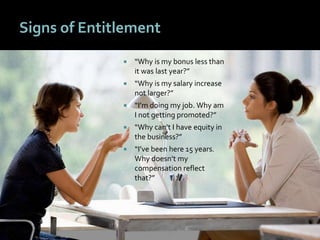
 “Why is my bonus less than
it was last year?”
 “Why is my salary increase
not larger?”
 “I’m doing my job. Why am
I not getting promoted?”
 “Why can’t I have equity in
the business?”
 “I’ve been here 15 years.
Why doesn’t my
compensation reflect
that?”
77
Stewardship—Word Association
 Ownership
 Accountability
 Engagement
 Leadership
 Responsibility
 Purposeful
 Proactive
88
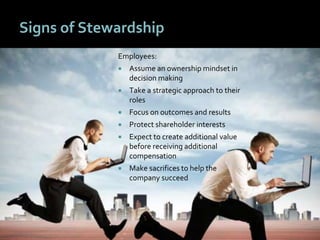
Signs of Stewardship
Employees:
 Assume an ownership mindset in
decision making
 Take a strategic approach to their
roles
 Focus on outcomes and results
 Protect shareholder interests
 Expect to create additional value
before receiving additional
compensation
 Make sacrifices to help the
company succeed
99
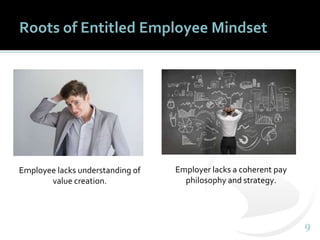
Roots of Entitled Employee Mindset
Employee lacks understanding of
value creation.
Employer lacks a coherent pay
philosophy and strategy.
1010
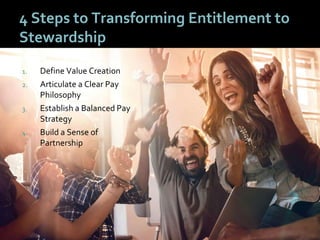
4 Steps to Transforming Entitlement to
Stewardship
1. Define Value Creation
2. Articulate a Clear Pay
Philosophy
3. Establish a Balanced Pay
Strategy
4. Build a Sense of
Partnership
1111
1. Define Value Creation
Value attributable to the
productivity and performance of
human capital.
1212
Calculating Value Creation
Focus on
Productivity Profit
1313
Value Creation Example:
Item Amount
Capital Account $20,000,000
Cost of Capital 12%
Capital Charge $2,400,000
Operating Income $10,000,000
Productivity Profit $7,600,000
Total Rewards
Investment
$25,000,000
ROTRI™ 30.4%
(ROTRI™ = Productivity Profit/Total Rewards Investment)
1414
ROTRI™ Example:
Item Figure
Capital Account $20,000,000
Cost of Capital 12%
Capital Charge $2,400,000
Operating Income $10,000,000
*Productivity Profit $7,600,000
Total Rewards
Investment
$25,000,000
ROTRI™
(Return onTotal Rewards Investment)
30.4%
(ROTRI™ = Productivity Profit/Total Rewards Investment)
*Variable Pay
Plans (Value
Sharing) are
financed from
Productivity
Profit
1515
2. Articulate a Clear Pay Philosophy
A written statement of what the
company is willing to “pay for.”
Tie it to value creation.
1616
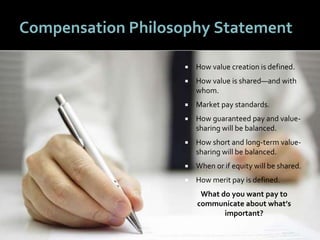
Compensation Philosophy Statement
 How value creation is defined.
 How value is shared—and with
whom.
 Market pay standards.
 How guaranteed pay and value-
sharing will be balanced.
 How short and long-term value-
sharing will be balanced.
 When or if equity will be shared.
 How merit pay is defined.
What do you want pay to
communicate about what’s
important?
1717
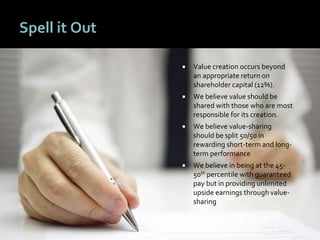
Spell it Out
 Value creation occurs beyond
an appropriate return on
shareholder capital (12%).
 We believe value should be
shared with those who are most
responsible for its creation.
 We believe value-sharing
should be split 50/50 in
rewarding short-term and long-
term performance
 We believe in being at the 45-
50th percentile with guaranteed
pay but in providing unlimited
upside earnings through value-
sharing
1818
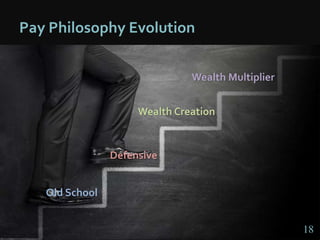
Old School
Defensive
Wealth Creation
Wealth Multiplier
18
Pay Philosophy Evolution
1919
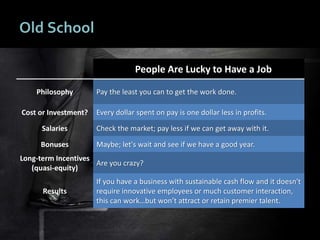
Old School
People Are Lucky to Have a Job
Philosophy Pay the least you can to get the work done.
Cost or Investment? Every dollar spent on pay is one dollar less in profits.
Salaries Check the market; pay less if we can get away with it.
Bonuses Maybe; let's wait and see if we have a good year.
Long-term Incentives
(quasi-equity)
Are you crazy?
Results
If you have a business with sustainable cash flow and it doesn't
require innovative employees or much customer interaction,
this can work…but won’t attract or retain premier talent.
2020
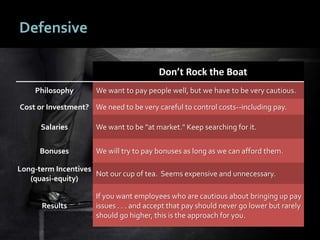
Defensive
Don’t Rock the Boat
Philosophy We want to pay people well, but we have to be very cautious.
Cost or Investment? We need to be very careful to control costs--including pay.
Salaries We want to be "at market." Keep searching for it.
Bonuses We will try to pay bonuses as long as we can afford them.
Long-term Incentives
(quasi-equity)
Not our cup of tea. Seems expensive and unnecessary.
Results
If you want employees who are cautious about bringing up pay
issues . . . and accept that pay should never go lower but rarely
should go higher, this is the approach for you.
2121
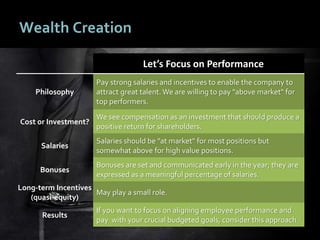
Wealth Creation
Let’s Focus on Performance
Philosophy
Pay strong salaries and incentives to enable the company to
attract great talent. We are willing to pay "above market" for
top performers.
Cost or Investment?
We see compensation as an investment that should produce a
positive return for shareholders.
Salaries
Salaries should be "at market" for most positions but
somewhat above for high value positions.
Bonuses
Bonuses are set and communicated early in the year; they are
expressed as a meaningful percentage of salaries.
Long-term Incentives
(quasi-equity)
May play a small role.
Results
If you want to focus on aligning employee performance and
pay with your crucial budgeted goals, consider this approach.
2222
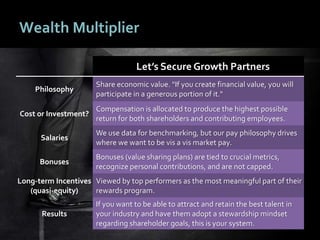
Wealth Multiplier
Let’s Secure Growth Partners
Philosophy
Share economic value. "If you create financial value, you will
participate in a generous portion of it."
Cost or Investment?
Compensation is allocated to produce the highest possible
return for both shareholders and contributing employees.
Salaries
We use data for benchmarking, but our pay philosophy drives
where we want to be vis a vis market pay.
Bonuses
Bonuses (value sharing plans) are tied to crucial metrics,
recognize personal contributions, and are not capped.
Long-term Incentives
(quasi-equity)
Viewed by top performers as the most meaningful part of their
rewards program.
Results
If you want to be able to attract and retain the best talent in
your industry and have them adopt a stewardship mindset
regarding shareholder goals, this is your system.
2323
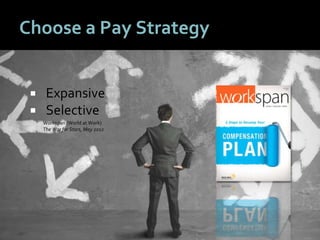
Choose a Pay Strategy
 Expansive
 Selective
Workspan (World at Work)
The War for Stars, May 2012
2424
Expansive Approach
Strives to retain virtually every employee under the theory that everyone is
needed or they wouldn’t be there. Largely egalitarian.
“Why upset our harmonious culture by creating an elite group that receives
special treatment? All our employees are critical and perform well, and
most are not going to leave.”
2525
Expansive Approach
 Easy to administer
 Does not usually support an organization’s efforts to raise overall
performance
 Discourages and disengages high performers
2626
Selective Approach
Identifies, nurtures and works to
retain the high performers at all levels
of the organization.
Seeks to produce a cycle that, in the long term, will not only retain
existing high performers, but create and attract more high
performers and generate ever-improving standards of
performance and organizational results.
2727
Selective Approach
 Sets high performance standards
 Acknowledges the company is in a
war for stars
 Recognizes high performers always
have an opportunity to move
2828
Which approach makes the most sense?
2929
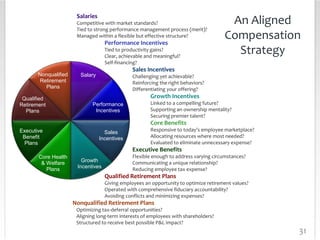
3. Establish a Balanced Pay Strategy
3030
Eight Components of Pay
Benefits
 Core benefits
 Executive benefits
 Qualified retirement plans
 Supplemental retirement plans
Compensation
 Salary
 Performance incentives
 Sales incentives
 Growth incentives
Incentives should be in the form of value sharing.
3131
Salary
Performance
Incentives
Sales
Incentives
Growth
Incentives
Core Health
& Welfare
Plans
Executive
Benefit
Plans
Qualified
Retirement
Plans
Nonqualified
Retirement
Plans
Salaries
Competitive with market standards?
Tied to strong performance management process (merit)?
Managed within a flexible but effective structure?
Performance Incentives
Tied to productivity gains?
Clear, achievable and meaningful?
Self-financing?
Sales Incentives
Challenging yet achievable?
Reinforcing the right behaviors?
Differentiating your offering?
Growth Incentives
Linked to a compelling future?
Supporting an ownership mentality?
Securing premier talent?
Core Benefits
Responsive to today’s employee marketplace?
Allocating resources where most needed?
Evaluated to eliminate unnecessary expense?
Executive Benefits
Flexible enough to address varying circumstances?
Communicating a unique relationship?
Reducing employee tax expense?
Qualified Retirement Plans
Giving employees an opportunity to optimize retirement values?
Operated with comprehensive fiduciary accountability?
Avoiding conflicts and minimizing expenses?
Nonqualified Retirement Plans
Optimizing tax-deferral opportunities?
Aligning long-term interests of employees with shareholders?
Structured to receive best possible P&L impact?
An Aligned
Compensation
Strategy
3232
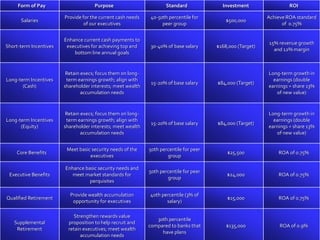
Form of Pay Purpose Standard Investment ROI
Salaries
Provide for the current cash needs
of our executives
40-50th percentile for
peer group
$500,000
Achieve ROA standard
of 0.75%
Short-term Incentives
Enhance current cash payments to
executives for achieving top and
bottom line annual goals
30-40% of base salary $168,000 (Target)
15% revenue growth
and 12% margin
Long-term Incentives
(Cash)
Retain execs; focus them on long-
term earnings growth; align with
shareholder interests; meet wealth
accumulation needs
15-20% of base salary $84,000 (Target)
Long-term growth in
earnings (double
earnings = share 13%
of new value)
Long-term Incentives
(Equity)
Retain execs; focus them on long-
term earnings growth; align with
shareholder interests; meet wealth
accumulation needs
15-20% of base salary $84,000 (Target)
Long-term growth in
earnings (double
earnings = share 13%
of new value)
Core Benefits
Meet basic security needs of the
executives
50th percentile for peer
group
$25,500 ROA of 0.75%
Executive Benefits
Enhance basic security needs and
meet market standards for
perquisites
50th percentile for peer
group
$24,000 ROA of 0.75%
Qualified Retirement
Provide wealth accumulation
opportunity for executives
40th percentile (3% of
salary)
$15,000 ROA of 0.75%
Supplemental
Retirement
Strengthen rewards value
proposition to help recruit and
retain executives; meet wealth
accumulation needs
30th percentile
compared to banks that
have plans
$135,000 ROA of 0.9%
3333
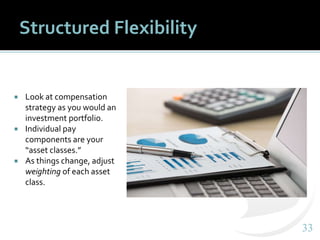
Structured Flexibility
 Look at compensation
strategy as you would an
investment portfolio.
 Individual pay
components are your
“asset classes.”
 As things change, adjust
weighting of each asset
class.
3434
Build a Total Compensation Structure
A total compensation
structure gives you a
comprehensive view of all
compensation and benefit
plans and ensures
operational integrity.
3535
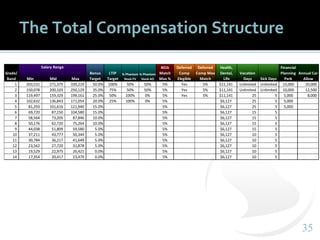
The Total Compensation Structure
Min Mid Max
1 203,531 271,375 339,219 50.0% 100% 50% 50% 5% Yes 5% $11,141 Unlimited Unlimited 15,000 20,000
2 150,078 200,103 250,129 35.0% 75% 50% 50% 5% Yes 5% $11,141 Unlimited Unlimited 10,000 12,500
3 119,497 159,329 199,161 25.0% 50% 100% 0% 5% Yes 5% $11,141 25 5 5,000 8,000
4 102,632 136,843 171,054 20.0% 25% 100% 0% 5% $6,127 25 5 5,000
5 81,293 101,616 121,940 15.0% 5% $6,127 25 5 5,000
6 69,720 87,150 104,580 15.0% 5% $6,127 15 5
7 58,564 73,205 87,846 10.0% 5% $6,127 15 5
8 50,176 62,720 75,264 10.0% 5% $6,127 15 5
9 44,038 51,809 59,580 5.0% 5% $6,127 15 5
10 37,211 43,777 50,344 5.0% 5% $6,127 10 5
11 30,784 36,217 41,649 5.0% 5% $6,127 10 5
12 23,562 27,720 31,878 5.0% 5% $6,127 10 5
13 19,529 22,975 26,421 0.0% 5% $6,127 10 5
14 17,354 20,417 23,479 0.0% 5% $6,127 10 5
Annual Car
Allow
Grade/
Band Sick Days
Salary Range
Bonus
Target
LTIP
Target
Financial
Planning
Perk
Deferred
Comp
Elegible
Deferred
Comp Max
Match
401k
Match
Max %
Vacation
Days
% Phantom
Stock FV
% Phantom
Stock AO
Health,
Dental,
Life
3636
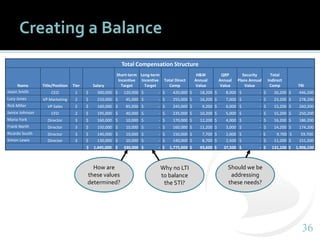
Creating a Balance
Total Compensation Structure
Name Title/Position Tier Salary
Short-term
Incentive
Target
Long-term
Incentive
Target
Total Direct
Comp
H&W
Annual
Value
QRP
Annual
Value
Security
Plans Annual
Value
Total
Indirect
Comp TRI
Jason Smith CEO 1 $ 300,000 $ 120,000 $ - $ 420,000 $ 18,200 $ 8,000 $ - $ 26,200 $ 446,200
Lucy Jones VP Marketing 2 $ 210,000 $ 45,000 $ - $ 255,000 $ 16,200 $ 7,000 $ - $ 23,200 $ 278,200
Rick Miller VP Sales 2 $ 160,000 $ 85,000 $ - $ 245,000 $ 9,200 $ 6,000 $ - $ 15,200 $ 260,200
Janice Johnson CFO 2 $ 195,000 $ 40,000 $ - $ 235,000 $ 10,200 $ 5,000 $ - $ 15,200 $ 250,200
Maria York Director 3 $ 160,000 $ 10,000 $ - $ 170,000 $ 12,200 $ 4,000 $ - $ 16,200 $ 186,200
Frank North Director 3 $ 150,000 $ 10,000 $ - $ 160,000 $ 11,200 $ 3,000 $ - $ 14,200 $ 174,200
Ricardo South Director 3 $ 140,000 $ 10,000 $ - $ 150,000 $ 7,700 $ 2,000 $ - $ 9,700 $ 59,700
Simon Lewis Director 3 $ 130,000 $ 10,000 $ - $ 140,000 $ 8,700 $ 2,500 $ - $ 11,200 $ 151,200
$ 1,445,000 $ 330,000 $ - $ 1,775,000 $ 93,600 $ 37,500 $ - $ 131,100 $ 1,906,100
How are
these values
determined?
Why no LTI
to balance
the STI?
Should we be
addressing
these needs?
3737
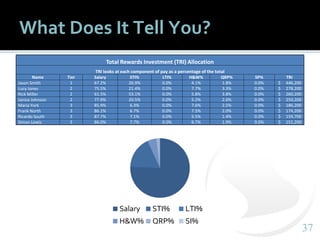
What Does It Tell You?
Total Rewards Investment (TRI) Allocation
TRI looks at each component of pay as a percentage of the total
Name Tier Salary STI% LTI% H&W% QRP% SP% TRI
Jason Smith 1 67.2% 26.9% 0.0% 4.1% 1.8% 0.0% $ 446,200
Lucy Jones 2 75.5% 21.4% 0.0% 7.7% 3.3% 0.0% $ 278,200
Rick Miller 2 61.5% 53.1% 0.0% 5.8% 3.8% 0.0% $ 260,200
Janice Johnson 2 77.9% 20.5% 0.0% 5.2% 2.6% 0.0% $ 250,200
Maria York 3 85.9% 6.3% 0.0% 7.6% 2.5% 0.0% $ 186,200
Frank North 3 86.1% 6.7% 0.0% 7.5% 2.0% 0.0% $ 174,200
Ricardo South 3 87.7% 7.1% 0.0% 5.5% 1.4% 0.0% $ 159,700
Simon Lewis 3 86.0% 7.7% 0.0% 6.7% 1.9% 0.0% $ 151,200
Salary STI% LTI%
H&W% QRP% SI%
3838
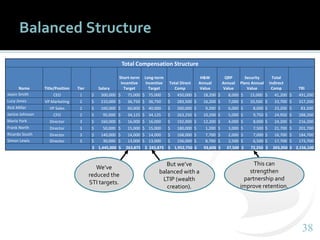
Balanced Structure
Total Compensation Structure
Name Title/Position Tier Salary
Short-term
Incentive
Target
Long-term
Incentive
Target
Total Direct
Comp
H&W
Annual
Value
QRP
Annual
Value
Security
Plans Annual
Value
Total
Indirect
Comp TRI
Jason Smith CEO 1 $ 300,000 $ 75,000 $ 75,000 $ 450,000 $ 18,200 $ 8,000 $ 15,000 $ 41,200 $ 491,200
Lucy Jones VP Marketing 2 $ 210,000 $ 36,750 $ 36,750 $ 283,500 $ 16,200 $ 7,000 $ 10,500 $ 33,700 $ 317,200
Rick Miller VP Sales 2 $ 160,000 $ 60,000 $ 40,000 $ 260,000 $ 9,200 $ 6,000 $ 8,000 $ 23,200 $ 83,200
Janice Johnson CFO 2 $ 95,000 $ 34,125 $ 34,125 $ 263,250 $ 10,200 $ 5,000 $ 9,750 $ 24,950 $ 288,200
Maria York Director 3 $ 160,000 $ 16,000 $ 16,000 $ 192,000 $ 12,200 $ 4,000 $ 8,000 $ 24,200 $ 216,200
Frank North Director 3 $ 50,000 $ 15,000 $ 15,000 $ 180,000 $ 1,200 $ 3,000 $ 7,500 $ 21,700 $ 201,700
Ricardo South Director 3 $ 140,000 $ 14,000 $ 14,000 $ 168,000 $ 7,700 $ 2,000 $ 7,000 $ 16,700 $ 184,700
Simon Lewis Director 3 $ 30,000 $ 13,000 $ 13,000 $ 156,000 $ 8,700 $ 2,500 $ 6,500 $ 17,700 $ 173,700
$ 1,445,000 $ 263,875 $ 243,875 $ 1,952,750 $ 93,600 $ 37,500 $ 72,250 $ 203,350 $ 2,156,100
We’ve
reduced the
STI targets.
But we’ve
balanced with a
LTIP (wealth
creation).
This can
strengthen
partnership and
improve retention.
3939
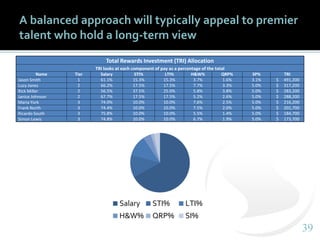
A balanced approach will typically appeal to premier
talent who hold a long-term view
Total Rewards Investment (TRI) Allocation
TRI looks at each component of pay as a percentage of the total
Name Tier Salary STI% LTI% H&W% QRP% SP% TRI
Jason Smith 1 61.1% 15.3% 15.3% 3.7% 1.6% 3.1% $ 491,200
Lucy Jones 2 66.2% 17.5% 17.5% 7.7% 3.3% 5.0% $ 317,200
Rick Miller 2 56.5% 37.5% 25.0% 5.8% 3.8% 5.0% $ 283,200
Janice Johnson 2 67.7% 17.5% 17.5% 5.2% 2.6% 5.0% $ 288,200
Maria York 3 74.0% 10.0% 10.0% 7.6% 2.5% 5.0% $ 216,200
Frank North 3 74.4% 10.0% 10.0% 7.5% 2.0% 5.0% $ 201,700
Ricardo South 3 75.8% 10.0% 10.0% 5.5% 1.4% 5.0% $ 184,700
Simon Lewis 3 74.8% 10.0% 10.0% 6.7% 1.9% 5.0% $ 173,700
Salary STI% LTI%
H&W% QRP% SI%
4040
4. Create a Sense of Partnership
4141
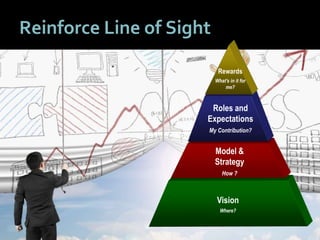
Reinforce Line of Sight
Vision
Where?
Model &
Strategy
How ?
Roles and
Expectations
My Contribution?
Rewards
What’s in it for
me?
4242
Market a Future that’s Relevant
 Here’s our future
 Here’s how we’re going to
get there
 Here’s the role we picture
for you
 Here’s how we encourage
our people to grow and
contribute
 Here’s our
philosophy about
pay and rewards
 Here are our specific
pay programs
 Here’s how our pay
programs could
work for you if we
achieve our plan
4343
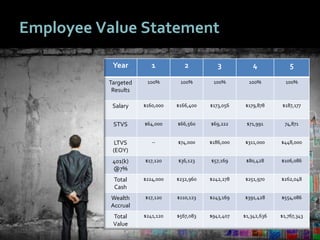
Employee Value Statement
Year 1 2 3 4 5
Targeted
Results
100% 100% 100% 100% 100%
Salary $160,000 $166,400 $173,056 $179,878 $187,177
STVS $64,000 $66,560 $69,222 $71,991 74,871
LTVS
(EOY)
-- $74,000 $186,000 $311,000 $448,000
401(k)
@7%
$17,120 $36,123 $57,169 $80,428 $106,086
Total
Cash
$224,000 $232,960 $242,278 $251,970 $262,048
Wealth
Accrual
$17,120 $110,123 $243,169 $391,428 $554,086
Total
Value
$241,120 $567,083 $942,407 $1,342,636 $1,767,343
4444
Key Questions
 What do you want your employees to be?
 What will your employees need to do if they are going to become that?
 What will your employees need to believe before they will do that?
 What will your employees need to know before they will believe that?
4545
4 Steps to Transforming Entitlement to
Stewardship
1. Define Value Creation
2. Articulate a Clear Pay
Philosophy
3. Establish a Balanced Pay
Strategy
4. Build a Sense of
Partnership
4646
Today’s Presenter:
Ken Gibson
SeniorVice President
(949) 265-5703
kgibson@vladvisors.com
7700 Irvine Center Drive, Suite 930  Irvine, CA 92618  949-852-2288
www.VLadvisors.com  www.PhantomStockOnline.com  www.BonusRight.com
ThankYou!

How to Transform Entitlement into Stewardship

  • 1.
  • 2.
    VisionLink’s Focus: HelpBusiness Leaders Build and Sustain a High Performance Culture Accelerate performance through pay strategies that transform employees into growth partners.
  • 3.
    If you dothat… • Quality of talent will improve. • Employee engagement will expand. • Performance will be magnified. • Business growth will be accelerated. • Shareholder value will increase.
  • 4.
    44 Setting the Stage Conversationbetween CEO and his CFO Neighbor CFO: “What would you be looking for if you were hiring a CFO?” CEO: “I’d be looking for a business partner.”
  • 5.
    55 Entitled—Word Association  Expected Presumed  Deserved  Anticipated  Assumed  Demanded  Implicit
  • 6.
    66 Signs of Entitlement “Why is my bonus less than it was last year?”  “Why is my salary increase not larger?”  “I’m doing my job. Why am I not getting promoted?”  “Why can’t I have equity in the business?”  “I’ve been here 15 years. Why doesn’t my compensation reflect that?”
  • 7.
    77 Stewardship—Word Association  Ownership Accountability  Engagement  Leadership  Responsibility  Purposeful  Proactive
  • 8.
    88 Signs of Stewardship Employees: Assume an ownership mindset in decision making  Take a strategic approach to their roles  Focus on outcomes and results  Protect shareholder interests  Expect to create additional value before receiving additional compensation  Make sacrifices to help the company succeed
  • 9.
    99 Roots of EntitledEmployee Mindset Employee lacks understanding of value creation. Employer lacks a coherent pay philosophy and strategy.
  • 10.
    1010 4 Steps toTransforming Entitlement to Stewardship 1. Define Value Creation 2. Articulate a Clear Pay Philosophy 3. Establish a Balanced Pay Strategy 4. Build a Sense of Partnership
  • 11.
    1111 1. Define ValueCreation Value attributable to the productivity and performance of human capital.
  • 12.
  • 13.
    1313 Value Creation Example: ItemAmount Capital Account $20,000,000 Cost of Capital 12% Capital Charge $2,400,000 Operating Income $10,000,000 Productivity Profit $7,600,000 Total Rewards Investment $25,000,000 ROTRI™ 30.4% (ROTRI™ = Productivity Profit/Total Rewards Investment)
  • 14.
    1414 ROTRI™ Example: Item Figure CapitalAccount $20,000,000 Cost of Capital 12% Capital Charge $2,400,000 Operating Income $10,000,000 *Productivity Profit $7,600,000 Total Rewards Investment $25,000,000 ROTRI™ (Return onTotal Rewards Investment) 30.4% (ROTRI™ = Productivity Profit/Total Rewards Investment) *Variable Pay Plans (Value Sharing) are financed from Productivity Profit
  • 15.
    1515 2. Articulate aClear Pay Philosophy A written statement of what the company is willing to “pay for.” Tie it to value creation.
  • 16.
    1616 Compensation Philosophy Statement How value creation is defined.  How value is shared—and with whom.  Market pay standards.  How guaranteed pay and value- sharing will be balanced.  How short and long-term value- sharing will be balanced.  When or if equity will be shared.  How merit pay is defined. What do you want pay to communicate about what’s important?
  • 17.
    1717 Spell it Out Value creation occurs beyond an appropriate return on shareholder capital (12%).  We believe value should be shared with those who are most responsible for its creation.  We believe value-sharing should be split 50/50 in rewarding short-term and long- term performance  We believe in being at the 45- 50th percentile with guaranteed pay but in providing unlimited upside earnings through value- sharing
  • 18.
    1818 Old School Defensive Wealth Creation WealthMultiplier 18 Pay Philosophy Evolution
  • 19.
    1919 Old School People AreLucky to Have a Job Philosophy Pay the least you can to get the work done. Cost or Investment? Every dollar spent on pay is one dollar less in profits. Salaries Check the market; pay less if we can get away with it. Bonuses Maybe; let's wait and see if we have a good year. Long-term Incentives (quasi-equity) Are you crazy? Results If you have a business with sustainable cash flow and it doesn't require innovative employees or much customer interaction, this can work…but won’t attract or retain premier talent.
  • 20.
    2020 Defensive Don’t Rock theBoat Philosophy We want to pay people well, but we have to be very cautious. Cost or Investment? We need to be very careful to control costs--including pay. Salaries We want to be "at market." Keep searching for it. Bonuses We will try to pay bonuses as long as we can afford them. Long-term Incentives (quasi-equity) Not our cup of tea. Seems expensive and unnecessary. Results If you want employees who are cautious about bringing up pay issues . . . and accept that pay should never go lower but rarely should go higher, this is the approach for you.
  • 21.
    2121 Wealth Creation Let’s Focuson Performance Philosophy Pay strong salaries and incentives to enable the company to attract great talent. We are willing to pay "above market" for top performers. Cost or Investment? We see compensation as an investment that should produce a positive return for shareholders. Salaries Salaries should be "at market" for most positions but somewhat above for high value positions. Bonuses Bonuses are set and communicated early in the year; they are expressed as a meaningful percentage of salaries. Long-term Incentives (quasi-equity) May play a small role. Results If you want to focus on aligning employee performance and pay with your crucial budgeted goals, consider this approach.
  • 22.
    2222 Wealth Multiplier Let’s SecureGrowth Partners Philosophy Share economic value. "If you create financial value, you will participate in a generous portion of it." Cost or Investment? Compensation is allocated to produce the highest possible return for both shareholders and contributing employees. Salaries We use data for benchmarking, but our pay philosophy drives where we want to be vis a vis market pay. Bonuses Bonuses (value sharing plans) are tied to crucial metrics, recognize personal contributions, and are not capped. Long-term Incentives (quasi-equity) Viewed by top performers as the most meaningful part of their rewards program. Results If you want to be able to attract and retain the best talent in your industry and have them adopt a stewardship mindset regarding shareholder goals, this is your system.
  • 23.
    2323 Choose a PayStrategy  Expansive  Selective Workspan (World at Work) The War for Stars, May 2012
  • 24.
    2424 Expansive Approach Strives toretain virtually every employee under the theory that everyone is needed or they wouldn’t be there. Largely egalitarian. “Why upset our harmonious culture by creating an elite group that receives special treatment? All our employees are critical and perform well, and most are not going to leave.”
  • 25.
    2525 Expansive Approach  Easyto administer  Does not usually support an organization’s efforts to raise overall performance  Discourages and disengages high performers
  • 26.
    2626 Selective Approach Identifies, nurturesand works to retain the high performers at all levels of the organization. Seeks to produce a cycle that, in the long term, will not only retain existing high performers, but create and attract more high performers and generate ever-improving standards of performance and organizational results.
  • 27.
    2727 Selective Approach  Setshigh performance standards  Acknowledges the company is in a war for stars  Recognizes high performers always have an opportunity to move
  • 28.
  • 29.
    2929 3. Establish aBalanced Pay Strategy
  • 30.
    3030 Eight Components ofPay Benefits  Core benefits  Executive benefits  Qualified retirement plans  Supplemental retirement plans Compensation  Salary  Performance incentives  Sales incentives  Growth incentives Incentives should be in the form of value sharing.
  • 31.
    3131 Salary Performance Incentives Sales Incentives Growth Incentives Core Health & Welfare Plans Executive Benefit Plans Qualified Retirement Plans Nonqualified Retirement Plans Salaries Competitivewith market standards? Tied to strong performance management process (merit)? Managed within a flexible but effective structure? Performance Incentives Tied to productivity gains? Clear, achievable and meaningful? Self-financing? Sales Incentives Challenging yet achievable? Reinforcing the right behaviors? Differentiating your offering? Growth Incentives Linked to a compelling future? Supporting an ownership mentality? Securing premier talent? Core Benefits Responsive to today’s employee marketplace? Allocating resources where most needed? Evaluated to eliminate unnecessary expense? Executive Benefits Flexible enough to address varying circumstances? Communicating a unique relationship? Reducing employee tax expense? Qualified Retirement Plans Giving employees an opportunity to optimize retirement values? Operated with comprehensive fiduciary accountability? Avoiding conflicts and minimizing expenses? Nonqualified Retirement Plans Optimizing tax-deferral opportunities? Aligning long-term interests of employees with shareholders? Structured to receive best possible P&L impact? An Aligned Compensation Strategy
  • 32.
    3232 Form of PayPurpose Standard Investment ROI Salaries Provide for the current cash needs of our executives 40-50th percentile for peer group $500,000 Achieve ROA standard of 0.75% Short-term Incentives Enhance current cash payments to executives for achieving top and bottom line annual goals 30-40% of base salary $168,000 (Target) 15% revenue growth and 12% margin Long-term Incentives (Cash) Retain execs; focus them on long- term earnings growth; align with shareholder interests; meet wealth accumulation needs 15-20% of base salary $84,000 (Target) Long-term growth in earnings (double earnings = share 13% of new value) Long-term Incentives (Equity) Retain execs; focus them on long- term earnings growth; align with shareholder interests; meet wealth accumulation needs 15-20% of base salary $84,000 (Target) Long-term growth in earnings (double earnings = share 13% of new value) Core Benefits Meet basic security needs of the executives 50th percentile for peer group $25,500 ROA of 0.75% Executive Benefits Enhance basic security needs and meet market standards for perquisites 50th percentile for peer group $24,000 ROA of 0.75% Qualified Retirement Provide wealth accumulation opportunity for executives 40th percentile (3% of salary) $15,000 ROA of 0.75% Supplemental Retirement Strengthen rewards value proposition to help recruit and retain executives; meet wealth accumulation needs 30th percentile compared to banks that have plans $135,000 ROA of 0.9%
  • 33.
    3333 Structured Flexibility  Lookat compensation strategy as you would an investment portfolio.  Individual pay components are your “asset classes.”  As things change, adjust weighting of each asset class.
  • 34.
    3434 Build a TotalCompensation Structure A total compensation structure gives you a comprehensive view of all compensation and benefit plans and ensures operational integrity.
  • 35.
    3535 The Total CompensationStructure Min Mid Max 1 203,531 271,375 339,219 50.0% 100% 50% 50% 5% Yes 5% $11,141 Unlimited Unlimited 15,000 20,000 2 150,078 200,103 250,129 35.0% 75% 50% 50% 5% Yes 5% $11,141 Unlimited Unlimited 10,000 12,500 3 119,497 159,329 199,161 25.0% 50% 100% 0% 5% Yes 5% $11,141 25 5 5,000 8,000 4 102,632 136,843 171,054 20.0% 25% 100% 0% 5% $6,127 25 5 5,000 5 81,293 101,616 121,940 15.0% 5% $6,127 25 5 5,000 6 69,720 87,150 104,580 15.0% 5% $6,127 15 5 7 58,564 73,205 87,846 10.0% 5% $6,127 15 5 8 50,176 62,720 75,264 10.0% 5% $6,127 15 5 9 44,038 51,809 59,580 5.0% 5% $6,127 15 5 10 37,211 43,777 50,344 5.0% 5% $6,127 10 5 11 30,784 36,217 41,649 5.0% 5% $6,127 10 5 12 23,562 27,720 31,878 5.0% 5% $6,127 10 5 13 19,529 22,975 26,421 0.0% 5% $6,127 10 5 14 17,354 20,417 23,479 0.0% 5% $6,127 10 5 Annual Car Allow Grade/ Band Sick Days Salary Range Bonus Target LTIP Target Financial Planning Perk Deferred Comp Elegible Deferred Comp Max Match 401k Match Max % Vacation Days % Phantom Stock FV % Phantom Stock AO Health, Dental, Life
  • 36.
    3636 Creating a Balance TotalCompensation Structure Name Title/Position Tier Salary Short-term Incentive Target Long-term Incentive Target Total Direct Comp H&W Annual Value QRP Annual Value Security Plans Annual Value Total Indirect Comp TRI Jason Smith CEO 1 $ 300,000 $ 120,000 $ - $ 420,000 $ 18,200 $ 8,000 $ - $ 26,200 $ 446,200 Lucy Jones VP Marketing 2 $ 210,000 $ 45,000 $ - $ 255,000 $ 16,200 $ 7,000 $ - $ 23,200 $ 278,200 Rick Miller VP Sales 2 $ 160,000 $ 85,000 $ - $ 245,000 $ 9,200 $ 6,000 $ - $ 15,200 $ 260,200 Janice Johnson CFO 2 $ 195,000 $ 40,000 $ - $ 235,000 $ 10,200 $ 5,000 $ - $ 15,200 $ 250,200 Maria York Director 3 $ 160,000 $ 10,000 $ - $ 170,000 $ 12,200 $ 4,000 $ - $ 16,200 $ 186,200 Frank North Director 3 $ 150,000 $ 10,000 $ - $ 160,000 $ 11,200 $ 3,000 $ - $ 14,200 $ 174,200 Ricardo South Director 3 $ 140,000 $ 10,000 $ - $ 150,000 $ 7,700 $ 2,000 $ - $ 9,700 $ 59,700 Simon Lewis Director 3 $ 130,000 $ 10,000 $ - $ 140,000 $ 8,700 $ 2,500 $ - $ 11,200 $ 151,200 $ 1,445,000 $ 330,000 $ - $ 1,775,000 $ 93,600 $ 37,500 $ - $ 131,100 $ 1,906,100 How are these values determined? Why no LTI to balance the STI? Should we be addressing these needs?
  • 37.
    3737 What Does ItTell You? Total Rewards Investment (TRI) Allocation TRI looks at each component of pay as a percentage of the total Name Tier Salary STI% LTI% H&W% QRP% SP% TRI Jason Smith 1 67.2% 26.9% 0.0% 4.1% 1.8% 0.0% $ 446,200 Lucy Jones 2 75.5% 21.4% 0.0% 7.7% 3.3% 0.0% $ 278,200 Rick Miller 2 61.5% 53.1% 0.0% 5.8% 3.8% 0.0% $ 260,200 Janice Johnson 2 77.9% 20.5% 0.0% 5.2% 2.6% 0.0% $ 250,200 Maria York 3 85.9% 6.3% 0.0% 7.6% 2.5% 0.0% $ 186,200 Frank North 3 86.1% 6.7% 0.0% 7.5% 2.0% 0.0% $ 174,200 Ricardo South 3 87.7% 7.1% 0.0% 5.5% 1.4% 0.0% $ 159,700 Simon Lewis 3 86.0% 7.7% 0.0% 6.7% 1.9% 0.0% $ 151,200 Salary STI% LTI% H&W% QRP% SI%
  • 38.
    3838 Balanced Structure Total CompensationStructure Name Title/Position Tier Salary Short-term Incentive Target Long-term Incentive Target Total Direct Comp H&W Annual Value QRP Annual Value Security Plans Annual Value Total Indirect Comp TRI Jason Smith CEO 1 $ 300,000 $ 75,000 $ 75,000 $ 450,000 $ 18,200 $ 8,000 $ 15,000 $ 41,200 $ 491,200 Lucy Jones VP Marketing 2 $ 210,000 $ 36,750 $ 36,750 $ 283,500 $ 16,200 $ 7,000 $ 10,500 $ 33,700 $ 317,200 Rick Miller VP Sales 2 $ 160,000 $ 60,000 $ 40,000 $ 260,000 $ 9,200 $ 6,000 $ 8,000 $ 23,200 $ 83,200 Janice Johnson CFO 2 $ 95,000 $ 34,125 $ 34,125 $ 263,250 $ 10,200 $ 5,000 $ 9,750 $ 24,950 $ 288,200 Maria York Director 3 $ 160,000 $ 16,000 $ 16,000 $ 192,000 $ 12,200 $ 4,000 $ 8,000 $ 24,200 $ 216,200 Frank North Director 3 $ 50,000 $ 15,000 $ 15,000 $ 180,000 $ 1,200 $ 3,000 $ 7,500 $ 21,700 $ 201,700 Ricardo South Director 3 $ 140,000 $ 14,000 $ 14,000 $ 168,000 $ 7,700 $ 2,000 $ 7,000 $ 16,700 $ 184,700 Simon Lewis Director 3 $ 30,000 $ 13,000 $ 13,000 $ 156,000 $ 8,700 $ 2,500 $ 6,500 $ 17,700 $ 173,700 $ 1,445,000 $ 263,875 $ 243,875 $ 1,952,750 $ 93,600 $ 37,500 $ 72,250 $ 203,350 $ 2,156,100 We’ve reduced the STI targets. But we’ve balanced with a LTIP (wealth creation). This can strengthen partnership and improve retention.
  • 39.
    3939 A balanced approachwill typically appeal to premier talent who hold a long-term view Total Rewards Investment (TRI) Allocation TRI looks at each component of pay as a percentage of the total Name Tier Salary STI% LTI% H&W% QRP% SP% TRI Jason Smith 1 61.1% 15.3% 15.3% 3.7% 1.6% 3.1% $ 491,200 Lucy Jones 2 66.2% 17.5% 17.5% 7.7% 3.3% 5.0% $ 317,200 Rick Miller 2 56.5% 37.5% 25.0% 5.8% 3.8% 5.0% $ 283,200 Janice Johnson 2 67.7% 17.5% 17.5% 5.2% 2.6% 5.0% $ 288,200 Maria York 3 74.0% 10.0% 10.0% 7.6% 2.5% 5.0% $ 216,200 Frank North 3 74.4% 10.0% 10.0% 7.5% 2.0% 5.0% $ 201,700 Ricardo South 3 75.8% 10.0% 10.0% 5.5% 1.4% 5.0% $ 184,700 Simon Lewis 3 74.8% 10.0% 10.0% 6.7% 1.9% 5.0% $ 173,700 Salary STI% LTI% H&W% QRP% SI%
  • 40.
    4040 4. Create aSense of Partnership
  • 41.
    4141 Reinforce Line ofSight Vision Where? Model & Strategy How ? Roles and Expectations My Contribution? Rewards What’s in it for me?
  • 42.
    4242 Market a Futurethat’s Relevant  Here’s our future  Here’s how we’re going to get there  Here’s the role we picture for you  Here’s how we encourage our people to grow and contribute  Here’s our philosophy about pay and rewards  Here are our specific pay programs  Here’s how our pay programs could work for you if we achieve our plan
  • 43.
    4343 Employee Value Statement Year1 2 3 4 5 Targeted Results 100% 100% 100% 100% 100% Salary $160,000 $166,400 $173,056 $179,878 $187,177 STVS $64,000 $66,560 $69,222 $71,991 74,871 LTVS (EOY) -- $74,000 $186,000 $311,000 $448,000 401(k) @7% $17,120 $36,123 $57,169 $80,428 $106,086 Total Cash $224,000 $232,960 $242,278 $251,970 $262,048 Wealth Accrual $17,120 $110,123 $243,169 $391,428 $554,086 Total Value $241,120 $567,083 $942,407 $1,342,636 $1,767,343
  • 44.
    4444 Key Questions  Whatdo you want your employees to be?  What will your employees need to do if they are going to become that?  What will your employees need to believe before they will do that?  What will your employees need to know before they will believe that?
  • 45.
    4545 4 Steps toTransforming Entitlement to Stewardship 1. Define Value Creation 2. Articulate a Clear Pay Philosophy 3. Establish a Balanced Pay Strategy 4. Build a Sense of Partnership
  • 46.
    4646 Today’s Presenter: Ken Gibson SeniorVicePresident (949) 265-5703 kgibson@vladvisors.com 7700 Irvine Center Drive, Suite 930  Irvine, CA 92618  949-852-2288 www.VLadvisors.com  www.PhantomStockOnline.com  www.BonusRight.com ThankYou!

Editor's Notes