Cen
ter
f

he edge
t
r
o
“We are shifting from a world where the
key source of strategic advantage was
in protecting and extracting value from
a given set of knowledge stocks […]
into a world in which the focus of value
creation is effective participation in
knowledge flows, which are constantly
being renewed”
Thomas L. Friedman in review of “The Shift Index”
January 19, 2010, NY Times
What should be keeping
you up at night?
That is what we bring to the table.
What is created on the edge of technology,
markets, geographies and demographics strikes
at the very heart of a business.
Our mission is to identify and explore emerging
opportunities related to shifts that aren’t yet on
your management agenda, but ought
to be.
What’s really driving intensifying
competitive pressures?
What long-term
opportunities
are available?
What needs to be done today
to change course?

Businesses are exposed to more
disruptions and competitive
threats than ever before.
But we have good news — within great change
is great opportunity.
Deloitte Center for the Edge helps leaders
understand the fundamental changes shaping
the world, navigate the short-term challenges
and identify long-term opportunities to mobilize
for exceptional performance.
Based in Silicon Valley, Australia and the
Netherlands, we conduct original research and
provide perspectives to help senior executives
capitalize on emerging opportunities from the
edges of business and technology.
The Big Shift & Power of Pull
Access, Attract and Achieve
Pull enables us to access information, attract
the people and resources most relevant to our
efforts, and achieve concrete goals that realize
our greater potential – it’s how we see ourselves
navigating the Big Shift and taking advantage
of long-term opportunities.

“In The Power of Pull John Hagel
and John Seely Brown highlight
fascinating new ways in which
passionate thinking, creative
solutions and committed action
can—and will—make it possible for
us to seize opportunities and remain
in step with change.”
Bill Clinton, 42nd President of the United States of America

The Big Shift
Advances in core to digital technology continue to shift power from
institutions to individuals. We tend to focus on short-term challenges, but
what happens if we miss long-term changes and opportunities?
The Shift Index
How do you measure the Big Shift?

Foundation

Flow
Impact

Foundation index: Developments in the technological and
political foundations underlying market changes
Flow index: How flows of capital, information, and talent are
changing the business landscape
Impact index: Impacts of these changes on competition,
volatility, and performance across industries

Flow

Impact

The Shift Index tracks 25 metrics across the past four decades to help executives understand the
nature of technological change in a globalized world. Our work enables organizations to evolve
and effectively harness new capabilities to better align with the underlying currents of the Big Shift.
Scaling Edges

In a fast-moving world, playing on the edge is the best way to
get an edge
To thrive in the Big Shift, today’s companies must move from
innovating at a product or service level to innovating across
their entire institutions – and they often come with obstacles.
The Scaling Edges methodology helps businesses focus on lowinvestment, high-growth-potential opportunities—“edges”—with
fundamentally different business practices that can ultimately
transform the core of the organization.
By focusing on the edges a company can better identify projects that align with the
deeper forces of the Big Shift. In the long run, such edges are most likely to show the
greatest sustainable returns.
By forcing the edges to leverage
external resources rather than
internal support, they can avoid the
organizational resistance that often
attacks new efforts.
Instead of focusing solely on
short-term outcomes, edges help
companies tap into the
opportunities of tomorrow. In this
way, edges become conduits of
transformation and institutional
innovation.

Focus on edges rather than the
core
Leverage external resources
Accelerate learning through
rapid iteration
Work Environment Redesign

9

D E S I G N

Talent management isChallengemore than
specific
hiring or training.
teaming

Releva
conne

Executives understand the importance of cultivating talent but it’s not enough to hire the right
people. Companies must create work environments that are designed to foster employee
Strengthen
“Chan
development and performance.
high-impact

connections
The workplace can have a significant impact

encou

on an employee’s ability to learn, engage, and
excel. Our study on Work Environment Redesign
draws from more than 75 organizations to explore this interaction. We outline the goals and
design principles that will help you redesign your
work environment for higher performance. With
these tools, executives can attract and retain
Amplify
talent, amplify learning and productivity, shape Adap
the perception of the brand, and, ultimately,
Impact
space
grow a more dynamic and competitive workforce.

Mutual
ownership

9

Smar
captu
share

D E S I G N
Well-executed Shaping Strategies
redefine the nature of competition.

In times of turbulence and
disruption, most companies fall into
reactive strategies.
However, through proactive
innovation some companies may
be able to re-shape their industries.
Shaping Strategies are intentional
efforts to transform an industry
toward an outcome that benefits
all participants. By demonstrating
a compelling vision — and a
commitment to that vision — a

company may be able to mobilize
a mass of players to support the
organization’s strategic objectives.
There are three main components of a successful
shaping strategy:
•	 Shaping View: Articulate a compelling vision
that aligns with the big picture and identifies
clear opportunities for all participants.
•	 Shaping Platform: Provide a set of clear standards, practices, and support structures that
organize the activities of participants while
making it more cost-effective to be in the
platform.
•	 Actions and Assets: Demonstrate your commitment with actions that build trust in the
intentions of the organizer and assets that
incentivize participation in the platform.
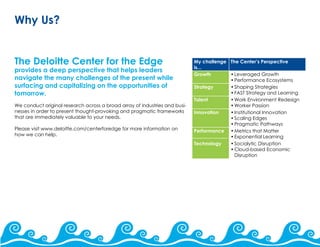
Why Us?
The Deloitte Center for the Edge

provides a deep perspective that helps leaders
navigate the many challenges of the present while
surfacing and capitalizing on the opportunities of
tomorrow.

We conduct original research across a broad array of industries and businesses in order to present thought-provoking and pragmatic frameworks
that are immediately valuable to your needs.
Please visit www.deloitte.com/centerforedge for more information on
how we can help.

My challenge The Center’s Perspective
is...
Growth
•	Leveraged Growth
•	Performance Ecosystems
Strategy
•	Shaping Strategies
•	FAST Strategy and Learning
Talent
•	Work Environment Redesign
•	Worker Passion
Innovation
•	Institutional Innovation
•	Scaling Edges
•	Pragmatic Pathways
Performance •	Metrics that Matter
•	Exponential Learning
Technology
•	Socialytic Disruption
•	Cloud-based Economic
Disruption
About the leaders

Bertoen

Tamara Samoylova
Head of Research
tsamoylova@
deloitte.com

John Hagel III
Co-Chairman
jhagel@
deloitte.com

Blythe Aronowitz
Chief of Staff
baronowitz@
deloitte.com

JSB
Independent
Co-Chairman
jsb@johnseelybrown.
com

Maggie Wooll
Senior Editor
mwooll@
deloitte.com

Duleesha Kulasooriya
Head of Strategy
dkulasooriya@
deloitte.com

Wassili Bertoen
C4Edge, Europe
Wassili Bertoen
WBertoen@
deloitte.nl

Peter Williams
C4Edge, Australia
Peter Williams
pewilliams@
deloitte.com.au

John Hagel has nearly 30 years’ experience as a
management consultant, author, speaker, and
entrepreneur and has effectively used IT strategies to reshape businesses. He has authored
several best-selling books including Net Gain, Net
Worth, and The Power of Pull.
John Seely Brown (JSB) serves on numerous public and private boards of directors (Amazon,
Corning, Varian Medical Systems), and had a
long tenure as chief scientist at Xerox PARC’s Research Center. JSB has published more than 100
papers and several books, including The Social
Life of Information, The Only Sustainable Edge,
The Power of Pull, and A New Culture of Learning.

For more information about the
Center’s unique perspective, visit us at:
www.deloitte.com/centerforedge
Peter Williams

Deloitte Center for the Edge

  • 1.
  • 2.
    “We are shiftingfrom a world where the key source of strategic advantage was in protecting and extracting value from a given set of knowledge stocks […] into a world in which the focus of value creation is effective participation in knowledge flows, which are constantly being renewed” Thomas L. Friedman in review of “The Shift Index” January 19, 2010, NY Times
  • 3.
    What should bekeeping you up at night? That is what we bring to the table. What is created on the edge of technology, markets, geographies and demographics strikes at the very heart of a business. Our mission is to identify and explore emerging opportunities related to shifts that aren’t yet on your management agenda, but ought to be.
  • 4.
    What’s really drivingintensifying competitive pressures? What long-term opportunities are available? What needs to be done today to change course? Businesses are exposed to more disruptions and competitive threats than ever before. But we have good news — within great change is great opportunity. Deloitte Center for the Edge helps leaders understand the fundamental changes shaping the world, navigate the short-term challenges and identify long-term opportunities to mobilize for exceptional performance. Based in Silicon Valley, Australia and the Netherlands, we conduct original research and provide perspectives to help senior executives capitalize on emerging opportunities from the edges of business and technology.
  • 5.
    The Big Shift& Power of Pull Access, Attract and Achieve Pull enables us to access information, attract the people and resources most relevant to our efforts, and achieve concrete goals that realize our greater potential – it’s how we see ourselves navigating the Big Shift and taking advantage of long-term opportunities. “In The Power of Pull John Hagel and John Seely Brown highlight fascinating new ways in which passionate thinking, creative solutions and committed action can—and will—make it possible for us to seize opportunities and remain in step with change.” Bill Clinton, 42nd President of the United States of America The Big Shift Advances in core to digital technology continue to shift power from institutions to individuals. We tend to focus on short-term challenges, but what happens if we miss long-term changes and opportunities?
  • 6.
    The Shift Index Howdo you measure the Big Shift? Foundation Flow Impact Foundation index: Developments in the technological and political foundations underlying market changes Flow index: How flows of capital, information, and talent are changing the business landscape Impact index: Impacts of these changes on competition, volatility, and performance across industries Flow Impact The Shift Index tracks 25 metrics across the past four decades to help executives understand the nature of technological change in a globalized world. Our work enables organizations to evolve and effectively harness new capabilities to better align with the underlying currents of the Big Shift.
  • 7.
    Scaling Edges In afast-moving world, playing on the edge is the best way to get an edge To thrive in the Big Shift, today’s companies must move from innovating at a product or service level to innovating across their entire institutions – and they often come with obstacles. The Scaling Edges methodology helps businesses focus on lowinvestment, high-growth-potential opportunities—“edges”—with fundamentally different business practices that can ultimately transform the core of the organization. By focusing on the edges a company can better identify projects that align with the deeper forces of the Big Shift. In the long run, such edges are most likely to show the greatest sustainable returns. By forcing the edges to leverage external resources rather than internal support, they can avoid the organizational resistance that often attacks new efforts. Instead of focusing solely on short-term outcomes, edges help companies tap into the opportunities of tomorrow. In this way, edges become conduits of transformation and institutional innovation. Focus on edges rather than the core Leverage external resources Accelerate learning through rapid iteration
  • 8.
    Work Environment Redesign 9 DE S I G N Talent management isChallengemore than specific hiring or training. teaming Releva conne Executives understand the importance of cultivating talent but it’s not enough to hire the right people. Companies must create work environments that are designed to foster employee Strengthen “Chan development and performance. high-impact connections The workplace can have a significant impact encou on an employee’s ability to learn, engage, and excel. Our study on Work Environment Redesign draws from more than 75 organizations to explore this interaction. We outline the goals and design principles that will help you redesign your work environment for higher performance. With these tools, executives can attract and retain Amplify talent, amplify learning and productivity, shape Adap the perception of the brand, and, ultimately, Impact space grow a more dynamic and competitive workforce. Mutual ownership 9 Smar captu share D E S I G N
  • 9.
    Well-executed Shaping Strategies redefinethe nature of competition. In times of turbulence and disruption, most companies fall into reactive strategies. However, through proactive innovation some companies may be able to re-shape their industries. Shaping Strategies are intentional efforts to transform an industry toward an outcome that benefits all participants. By demonstrating a compelling vision — and a commitment to that vision — a company may be able to mobilize a mass of players to support the organization’s strategic objectives. There are three main components of a successful shaping strategy: • Shaping View: Articulate a compelling vision that aligns with the big picture and identifies clear opportunities for all participants. • Shaping Platform: Provide a set of clear standards, practices, and support structures that organize the activities of participants while making it more cost-effective to be in the platform. • Actions and Assets: Demonstrate your commitment with actions that build trust in the intentions of the organizer and assets that incentivize participation in the platform.
  • 10.
    Why Us? The DeloitteCenter for the Edge provides a deep perspective that helps leaders navigate the many challenges of the present while surfacing and capitalizing on the opportunities of tomorrow. We conduct original research across a broad array of industries and businesses in order to present thought-provoking and pragmatic frameworks that are immediately valuable to your needs. Please visit www.deloitte.com/centerforedge for more information on how we can help. My challenge The Center’s Perspective is... Growth • Leveraged Growth • Performance Ecosystems Strategy • Shaping Strategies • FAST Strategy and Learning Talent • Work Environment Redesign • Worker Passion Innovation • Institutional Innovation • Scaling Edges • Pragmatic Pathways Performance • Metrics that Matter • Exponential Learning Technology • Socialytic Disruption • Cloud-based Economic Disruption
  • 11.
    About the leaders Bertoen TamaraSamoylova Head of Research tsamoylova@ deloitte.com John Hagel III Co-Chairman jhagel@ deloitte.com Blythe Aronowitz Chief of Staff baronowitz@ deloitte.com JSB Independent Co-Chairman jsb@johnseelybrown. com Maggie Wooll Senior Editor mwooll@ deloitte.com Duleesha Kulasooriya Head of Strategy dkulasooriya@ deloitte.com Wassili Bertoen C4Edge, Europe Wassili Bertoen WBertoen@ deloitte.nl Peter Williams C4Edge, Australia Peter Williams pewilliams@ deloitte.com.au John Hagel has nearly 30 years’ experience as a management consultant, author, speaker, and entrepreneur and has effectively used IT strategies to reshape businesses. He has authored several best-selling books including Net Gain, Net Worth, and The Power of Pull. John Seely Brown (JSB) serves on numerous public and private boards of directors (Amazon, Corning, Varian Medical Systems), and had a long tenure as chief scientist at Xerox PARC’s Research Center. JSB has published more than 100 papers and several books, including The Social Life of Information, The Only Sustainable Edge, The Power of Pull, and A New Culture of Learning. For more information about the Center’s unique perspective, visit us at: www.deloitte.com/centerforedge Peter Williams