



Creating People
        Advantage 2012
Mastering HR Challenges in a Two-Speed World
The Boston Consulting Group (BCG) is a              The World Federation of People Manage-
global management consulting firm and the           ment Associations (WFPMA) is a global net-
world’s leading advisor on business strategy.       work of professionals in people manage-
We partner with clients from the private,           ment. It was founded in 1976 to aid the
public, and not-for-profit sectors in all regions   development and improve the effectiveness
to identify their highest-value opportunities,      of professional people management all over
address their most critical challenges, and         the world. Its members are predominantly
transform their enterprises. Our customized         continental federations, which are made of
approach combines deep insight into the dy-         up of more than 90 national personnel asso-
namics of companies and markets with close          ciations representing over 600,000 people
collaboration at all levels of the client organi-   management professionals. For more infor-
zation. This ensures that our clients achieve       mation, please visit www.wfpma.com.
sustainable competitive advantage, build
more capable organizations, and secure last-
ing results. Founded in 1963, BCG is a private
company with 77 offices in 42 countries. For
more information, please visit bcg.com.
Creating People
Advantage 2012
Mastering HR Challenges in a Two-Speed World


                     Rainer Strack            Pieter Haen

                     Jean-Michel Caye         Horacio Quiros

                     Vikram Bhalla

                     Peter Tollman

                     Carsten von der Linden


October 2012 | The Boston Consulting Group
Contents


                       	 3	   Executive Summary

                       	 6	   The Big Picture: Global Trends in 2012
                       	 7	   The World’s Top Priorities for 2012
                       	 9	   Under the Radar, But in Need of Attention
                       	10	   The Perception Gap on Critical Capabilities

                       	12	   The Case for Integrated Sourcing Management

                       2
                       	 0	   Building Up Your Critical Assets:
                       		     Talent and Leadership Development
                       	20	   Building Talent: Six Essential Steps
                       	21	   How Do Companies Stack Up?

                       	 4	
                       2      Managing People in the World’s Fastest-Growing
                       		     Economies
                       	24	   Falling Short in Key HR Capabilities
                       	25	   Wanted: Strong Managerial, Leadership, and Technical Skills
                       	25	   Employee Development and Retention Strategies

                       	 8 	 Enabling Workforce Flexibility in
                       2
                       		a Two-Speed World
                       	29	 Understanding Surpluses and Shortages
                       	31	 Coping with Contradiction: Managing the People Side
                       		 of Transformation

                       	 4	
                       3      HR Governance: Global or Local?
                       	35	   Where Global Governance Counts Most
                       	36	   When Maintaining Local Flexibility Matters

                       	 7	 Appendix I: FOCUS report—From Capability
                       3
                       		to Profitability

                       	 7	
                       4      Appendix II: Methodology

                       	 8	
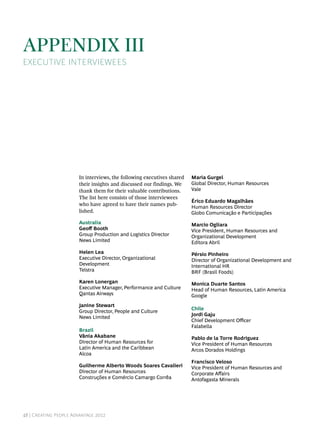
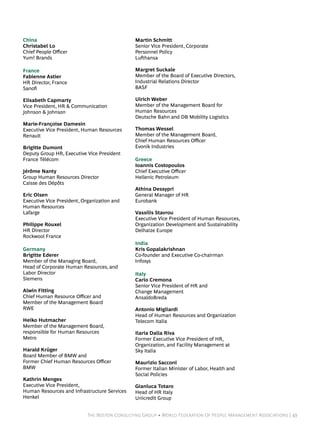
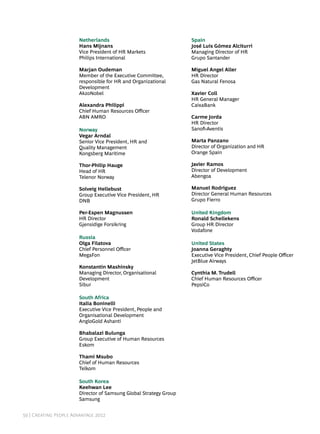
                       4      Appendix III: Executive Interviewees

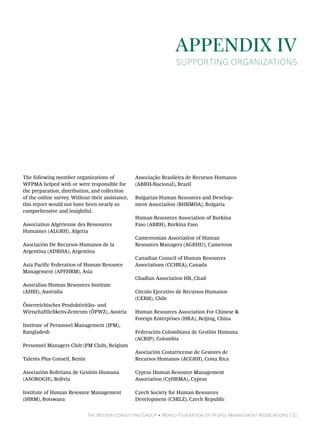
                       	51	   Appendix IV: Supporting Organizations

                       	 4	
                       5      Note to the Reader


2 | Creating People Advantage 2012
Executive Summary


B    usiness leaders throughout the world continue to struggle
     with the complexities of a two-speed world: they face economic
crisis in Europe and weak growth in the developed economies while also
facing rapid growth in the developing world. Volatility and uncertainty
have become the new constant. These realities create difficult people-
management challenges that range from keeping up with supply-and-
demand fluctuations to ensuring an adequate talent pipeline for the
future. Aggravating these challenges are the growing talent shortage
and rising leadership deficits, which are fueled in part by profound
demographic changes and are expected to worsen significantly in the
coming years. This situation creates a buyer’s market for talented
individuals.

Many companies recognize that today, more than ever, their people have
become their most critical competitive asset. But they need to sharpen their
efforts, integrate processes for greater impact, and manage globally while
allowing for regional adaptation. That’s a tall order—particularly consid-
ering the resource squeeze that has forced many HR organizations to do
more with less.

This global report, the third conducted by The Boston Consulting
Group and the World Federation of People Management Associa-
tions (WFPMA), examines critical trends in people management
by exploring 22 key HR topics that our Creating People Advan-
tage research has explored every year since 2007. (The first joint
BCG/WFPMA report was completed in 2008. BCG has also part-
nered with the European Association for People Management in
three similar surveys with a European focus.)

••   We explore the topics in terms of both their current and future im-
     portance to companies and how they relate to companies’ existing
     strengths. We also probe the practices and strategies that highly
     capable companies have implemented to boost their people-man-
     agement efforts.


      The Boston Consulting Group • World Federation Of People Management Associations | 3
••   The online survey polled 4,288 executives from companies
                            throughout numerous industries, 102 countries, and six major
                            regions. We also interviewed 63 executives (both within HR and
                            beyond) from well-known companies all around the world.

                       ••   This report presents our findings and analysis of the 22 HR topics
                            that constituted the core of the survey. Also included are short case
                            studies on individual companies.

                       ••   In addition, we have inserted in the Appendix of this report our
                            Creating People Advantage prepublication highlighting one of the
                            most significant findings from our research this year: the correla-
                            tion between companies’ capabilities in people management and
                            their economic performance.

                       This year, the critical topics—those considered of the greatest ur-
                       gency—remained the same as in our 2010 global survey. Three
                       topics stand out as the most critical.

                       ••   Managing talent ranks at the top of our survey respondents’ critical
                            list. Given the growing scarcity of talent worldwide, this is hardly
                            surprising.

                       ••   Improving leadership development, another still-critical topic, was
                            rated second highest in urgency.

                       ••   Strategic workforce planning maintained its ranking as a crucially
                            important topic for the future, as companies struggle with forecast-
                            ing long-term scenarios for workforce supply and demand.

                       Each of the report’s six chapters focuses on the people manage-
                       ment topics of highest relevance this year. Drawing on the survey
                       findings and interviews, we offer analysis of the current perfor-
                       mance and challenges, along with strategies and tactics to help
                       leaders set priorities and take action.

                       ••   “The Big Picture: Global Trends in 2012” provides a summary
                            of survey results, showing the topics executives consider most
                            important today and in the future—and which ones most need
                            improvement.

                       ••   “The Case for Integrated Sourcing Management” emphasizes the
                            importance of a holistic approach to people sourcing, from people
                            planning and employer branding to formulating a recruiting strat-
                            egy and retaining employees. By integrating their sourcing activi-
                            ties, companies can ensure consistency across their messages and
                            achieve important synergies.

                       ••   “Building Up Your Critical Assets: Talent and Leadership Develop-
                            ment” discusses the importance of six key—and highly interdepen-
                            dent—steps in developing talent and leadership, from developing
                            a talent strategy to creating a talent magnet culture.


4 | Creating People Advantage 2012
••   “Managing People in the World’s Fastest-Growing Economies” de-
     lineates the specific skill shortages and capability gaps that plague
     companies operating in high-growth markets.

••   “Enabling Workforce Flexibility in a Two-Speed World” highlights
     a rising challenge facing the majority of companies in our survey:
     simultaneous workforce shortages in some areas and surpluses
     elsewhere. The chapter describes useful strategies for deploying
     talent effectively to reconcile these imbalances.

••   “HR Governance: Global or Local?” looks at the three levels of HR
     governance that companies currently practice across 16 key HR ac-
     tivities. Moreover, we also discuss what could be the most effective
     approach in each activity.

An additional element rounds out and enhances the content of
the report.

The Focus report From Capability to Profitability: Realizing the Value of
People Management compares the practices of high-performing compa-
nies against those of lower-performing ones in key areas and in doz-
ens of activities, including talent management, leadership develop-
ment, and performance management and rewards. The report finds
that companies that demonstrated proficiency in 22 key HR areas ex-
perienced revenue growth that was up to 3.5 times higher and profit
margins that were 2.1 times higher than those of less capable compa-
nies. Such data may provide important insights as leaders decide how
best to invest their people-management resources.


      The Boston Consulting Group • World Federation Of People Management Associations | 5
The Big Picture
Global Trends in 2012


                                    S   ince the previous BCG/WFPMA global
                                        survey was conducted in 2010, we’ve wit-
                                     nessed improvements in capabilities across
                                                                                                          their people-management skills—a trend
                                                                                                          that recognizes and affirms the competitive
                                                                                                          advantage that people increasingly repre-
                                     some topics. (A European survey was con-                             sent. At the same time, several topics re-
                                     ducted in 2011.) The shaky global economy                            tained low ratings in both future importance
                                     and chronic business uncertainties appear to                         and companies’ capabilities—a situation
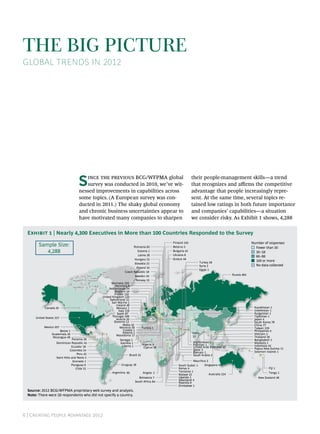
                                     have motivated many companies to sharpen                             we consider risky. As Exhibit 1 shows, 4,288

 Exhibit 1 | Nearly 4,300 Executives in More than 100 Countries Responded to the Survey
                                                                                            Finland 102                                           Number of responses
       Sample Size:                                                   Romania 82            Belarus 3                                               Fewer than 30
          4,288                                                           Estonia 1         Bulgaria 42                                             30–59
                                                                          Latvia 28         Ukraine 8
                                                                                                                                                    60–99
                                                                       Hungary 22           Greece 44
                                                                                                               Turkey 39
                                                                                                                                                    100 or more
                                                                       Slovakia 23
                                                                                                               Syria 3                              No data collected
                                                                         Poland 10
                                                                                                               Egypt 1
                                                                Czech Republic 58
                                                                        Sweden 44                                                    Russia 464
                                                                        Norway 33
                                                    Germany 210
                                                       Denmark 8
                                                   Netherlands 74
                                                      Belgium 54
                                                      France 150
                                              United Kingdom 120
                                                   Switzerland 55
                                                    San Marino 1
                                                        Ireland 48
           Canada 20                                    Monaco 1                                                                                   Kazakhstan 1
                                                          Italy 119                                                                                Uzbekistan 1
                                                         Spain 87                                                                                  Kyrgyzstan 1
                                                     Portugal 108                                                                                  Tajikistan 1
     United States 337                                  Austria 10                                                                                 Japan 4
                                                      Slovenia 13                                                                                  South Korea 78
                                                              Malta 43                                                                             China 77
           Mexico 207                                      Morocco 29        Tunisia 1                                                             Taiwan 339
                     Belize 1                                 Croatia 1                                                                            Philippines 4
                Guatemala 20                                  Albania 1                                   India                                    Vietnam 2
                                                        Macedonia 17                                      17
                Nicaragua 48                                                                                                                       Thailand 20
                                Panama 29                  Senegal 1                                                                               Bangladesh 1
                    Dominican Republic 41                  Gambia 1                                       Afghanistan 1                            Malaysia 1
                                                                               Nigeria 4                  Pakistan 1                               Indonesia 42
                                Ecuador 59                  Liberia 1           Cyprus 18                 United Arab Emirates 37
                                                                                                          Qatar 2                                  Papua New Guinea 11
                               Colombia 34                                                                                                         Solomon Islands 1
                                    Peru 42                                                               Bahrain 1
                                                                   Brazil 32                              Saudi Arabia 2
                    Saint Kitts and Nevis 2
                                 Grenada 1                                                                Mauritius 3
                                Paraguay 6                  Uruguay 18                         South Sudan 1      Singapore 4
                                   Chile 31                                                    Kenya 4                                                      Fiji 1
                                                     Argentina 60              Angola 2        Tanzania 1                                                   Tonga 1
                                                                                               Malawi 22             Australia 224
                                                                           Botswana 7          Uganda 1                                              New Zealand 46
                                                                                               Swaziland 4
                                                                        South Africa 84        Rwanda 8
                                                                                               Zimbabwe 1
 Source: 2012 BCG/WFPMA proprietary web survey and analysis.
 Note: There were 59 respondents who did not specify a country.


6 | Creating People Advantage 2012
executives from six major regions and more                      study looks at how challenges in HR and
than 100 countries responded to our online                      people management are evolving; we base
survey this year.                                               our analysis on 22 topics that we have iden-
                                                                tified as key priorities among our survey re-
The respondents, a mix of HR executives                         spondents. As we have in the past, the latest
(88 percent of the total) and non-HR                            survey asked executives three questions on
executives (12 percent), represented                            each HR topic: How capable was their com-
companies spanning more than 15 industry                        pany in that topic today? How important was
sectors. The services, public, and industrial                   the topic currently? And what future impor-
goods sectors collectively accounted for                        tance did they assign the topic? The most
35 percent of the responses. We also                            pressing challenges—those ranked most im-
conducted 63 in-depth interviews with a mix                     portant in the future and in which compa-
of HR and non-HR executives from well-                          nies also showed the lowest current capabil-
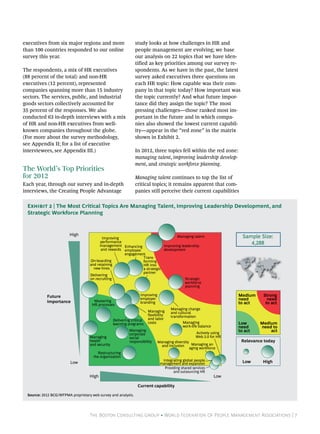
known companies throughout the globe.                           ity—appear in the “red zone” in the matrix
(For more about the survey methodology,                         shown in Exhibit 2.
see Appendix II; for a list of executive
interviewees, see Appendix III.)                                In 2012, three topics fell within the red zone:
                                                                managing talent, improving leadership develop-
                                                                ment, and strategic workforce planning.
The World’s Top Priorities
for 2012                                                        Managing talent continues to top the list of
Each year, through our survey and in-depth                      critical topics; it remains apparent that com-
interviews, the Creating People Advantage                       panies still perceive their current capabilities

  Exhibit 2 | The Most Critical Topics Are Managing Talent, Improving Leadership Development, and
  Strategic Workforce Planning


                         High                                                     Managing talent                         Sample Size:
                                           Improving
                                          performance
                                          management Enhancing             Improving leadership
                                                                                                                             4,288
                                          and rewards employee             development
                                                      engagement
                                                               Trans-
                                    On-boarding                forming
                                    and retaining              HR into
                                      new hires                a strategic
                                                               partner
                                    Delivering
                                    on recruiting                                      Strategic
                                                                                       workforce
                                                                                       planning

            Future                                                  Improving                                           Medium    Strong
                                      Mastering
                                                                    employer                                            need        need
            importance                                              branding                                            to act     to act
                                     HR processes
                                                                                       Managing change
                                                                         Managing      and cultural
                                                                         flexibility    transformation
                                                   Delivering critical   and labor
                                                   learning programs     costs                Managing                  Low      Medium
                                                                                              work-life balance         need     need to
                                                             Managing
                                                                                                      Actively using
                                                                                                                        to act       act
                                                             corporate
                                    Managing                 social                                   Web 2.0 for HR
                                    health                   responsibility     Managing diversity                       Relevance today
                                    and security                                  and inclusion     Managing an
                                                                                                   aging workforce
                                        Restructuring
                                      the organization
                                                                                  Integrating global people               Low     High
                         Low                                                     management and expansion
                                                                                   Providing shared services
                                                                                        and outsourcing HR
                                    High                                                                          Low

                                                                  Current capability

  Source: 2012 BCG/WFPMA proprietary web survey and analysis.


                                    The Boston Consulting Group • World Federation Of People Management Associations | 7
to be insufficient to cover expected future de-                                                                ing programs)—or simply leave it to chance.
                                   mands. This is hardly surprising, given the                                                                    Moreover, companies need to make leader-
                                   growing shortage of talent worldwide.                                                                          ship planning an integral part of their people-
                                                                                                                                                  planning efforts, rather than simply focus on
                                                                                                                                                  CEO and senior-executive succession.
                                   “If you have the right people, the                                                                             Strategic workforce planning maintained its
                                   business will be able to face any                                                                              ranking as a crucially important topic for the
                                   challenge and provide the right                                                                                future, as companies struggle with forecast-
                                                                                                                                                  ing long-term scenarios for workforce supply
                                   set of services and solutions for                                                                              and demand. Predicting future supply and
                                   your clients.”                                                                                                 demand at a job-family level is challenging
                                                                                                                                                  enough in healthy economic times; in volatile
                                   Senior executive, Asian technology                                                                             times, the challenge is even greater. Increas-
                                   company                                                                                                        ingly, strategic workforce planning calls for
                                                                                                                                                  more robust models that integrate it tightly
                                                                                                                                                  with other sourcing activities.
                                   Improving leadership development, another
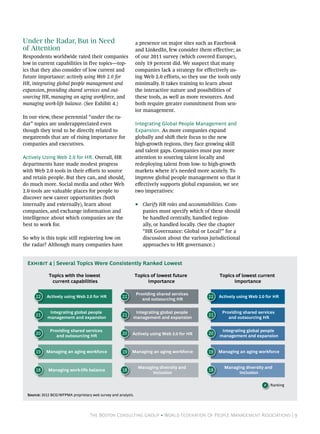
                                   still-critical topic, was rated the second most                                                                Throughout most of the regions represented
                                   urgent in terms of current capabilities and                                                                    in our survey, these three topics were consis-
                                   future importance. Top executives increas-                                                                     tently ranked utmost in relevance, with man-
                                   ingly need to place greater emphasis on de-                                                                    aging talent and improving leadership develop-
                                   veloping future leaders, rather than leave                                                                     ment at the very top of the respondents’ list.
                                   the task to HR (and traditional formal train-                                                                  (See Exhibit 3.)


 Exhibit 3 | Managing Talent and Improving Leadership Development Ranked High in Many Countries

                                                                                               Matrix analysis

                                       Americas                                                             Europe                                                      Middle East                                       Asia-Pacific
                                                                                                                                                                         & Africa
                                                                                                                                                                                            United Arab
                                                                                                                                                                     Middle East


                                                                                                                                                                                                          Asia-Pacific
                                       Argentina
                            Americas


                                                                                                  Germany


                                                                                                                               Romania


                                                                                                                                                           Kingdom


                                                                                                                                                                                                                        Australia
                                                                                                                                                                                            Emirates
                                                                                                                    Portugal


                                                                                                                                                                     & Africa
                                                                               Finland


                                                                                                                                                                                                                                                     Taiwan
                                                   Mexico


                                                                     Europe


                                                                                         France
                                                            United


                                                                                                                                                           United
                            overall


                                                                     overall


                                                                                                                                                                     overall


                                                                                                                                                                                                          overall
                                                                                                                                         Russia
                                                            States


                                                                                                                                                                                                                                             Korea
                                                                                                                                                                                                                                     China
                                                                                                                                                                                   South


                                                                                                                                                                                                                                             South
                                                                                                                                                                                   Africa
                                                                                                                                                   Spain
                                                                                                            Italy


  Managing talent              1          1          1        2         1        1         1        1        1         1         1         1        1         1          1           2          3             1            1          3        1       2

  Improving leadership         2          2          2        1         2        4         2        4        3         2         6         4        2         2          5           4          1             2            2          2        2       3
  development
  Strategic workforce          3          5          7        3         3        2         5        2        5       14          2         2        7         5          2           1          6             3            3          1        3       1
  planning
  Enhancing employee           4          3          3        4         5        6         6       16        4       15         12         3        3         7          6           7          2            10            4          5       18      15
  engagement
  Managing change and          6        12          13        6         4        3         3        6        2         4         4         9        6         8          7           8          5             6            5          9        4       5
  cultural transformation
  Actively using Web 2.0       7          8          5        5         6        5         8        8       14         8         5        13       10         3          8           5         10             4            6          8        9       8
  for HR
  Transforming HR into a      11          6         15       13         8       15        16        7        6         6        16         6        4        14          4           3         15             5          15           4        5       4
  strategic partner
  Managing work-life           5        16           4       12        10       17         7        5       15         5        14        14       11        16          3           6          9            17          17           13      11      11
  balance
  Improving performance        8          4         14       10        12        7         9       17        9         3        13         5        5         9          12         14          8             9            9          6       12       7
  management and rewards
  Improving employer          17        15          12       17        13       11         4       13       10         7         3        11        8        12          14         11         18            12          13           19      17      13
  branding

                                                                                                                                                                  Overall Rank              1 2 3 4 5                               Rank 1 2 3 4 5


 Source: 2012 BCG/WFPMA proprietary web survey and analysis.
 Note: Data from countries with more than 75 respondents—and from Argentina and United Arab Emirates. Ranking based on combined values of future
 importance and current capabilities. Sorting based on number of top 5 rankings per topic across regions and countries.


8 | Creating People Advantage 2012
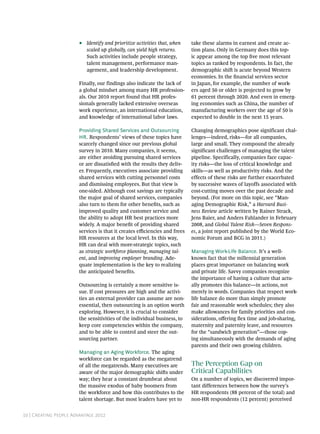
Under the Radar, But in Need                                    a presence on major sites such as Facebook
of Attention                                                    and LinkedIn, few consider them effective; as
Respondents worldwide rated their companies                     of our 2011 survey (which covered Europe),
low in current capabilities in five topics—top-                 only 19 percent did. We suspect that many
ics that they also consider of low current and                  companies lack a strategy for effectively us-
future importance: actively using Web 2.0 for                   ing Web 2.0 efforts, so they use the tools only
HR, integrating global people management and                    minimally. It takes training to learn about
expansion, providing shared services and out-                   the interactive nature and possibilities of
sourcing HR, managing an aging workforce, and                   these tools, as well as more resources. And
managing work-life balance. (See Exhibit 4.)                    both require greater commitment from sen-
                                                                ior management.
In our view, these perennial “under the ra-
dar” topics are underappreciated even                           Integrating Global People Management and
though they tend to be directly related to                      Expansion. As more companies expand
megatrends that are of rising importance for                    globally and shift their focus to the new
companies and executives.                                       high-growth regions, they face growing skill
                                                                and talent gaps. Companies must pay more
Actively Using Web 2.0 for HR. Overall, HR                      attention to sourcing talent locally and
departments have made modest progress                           redeploying talent from low- to high-growth
with Web 2.0 tools in their efforts to source                   markets where it’s needed more acutely. To
and retain people. But they can, and should,                    improve global people management so that it
do much more. Social media and other Web                        effectively supports global expansion, we see
2.0 tools are valuable places for people to                     two imperatives:
discover new career opportunities (both
internally and externally), learn about                         ••   Clarify HR roles and accountabilities. Com-
companies, and exchange information and                              panies must specify which of these should
intelligence about which companies are the                           be handled centrally, handled region-
best to work for.                                                    ally, or handled locally. (See the chapter
                                                                     “HR Governance: Global or Local?” for a
So why is this topic still registering low on                        discussion about the various jurisdictional
the radar? Although many companies have                              approaches to HR governance.)


  Exhibit 4 | Several Topics Were Consistently Ranked Lowest

             Topics with the lowest                             Topics of lowest future                Topics of lowest current
              current capabilities                                   importance                              importance

                                                                Providing shared services
      22    Actively using Web 2.0 for HR             22           and outsourcing HR
                                                                                                  22   Actively using Web 2.0 for HR


              Integrating global people                      Integrating global people                  Providing shared services
      21     management and expansion
                                                      21    management and expansion
                                                                                                  21       and outsourcing HR


              Providing shared services                                                                 Integrating global people
      20         and outsourcing HR
                                                      20    Actively using Web 2.0 for HR         20   management and expansion


      19    Managing an aging workforce               19    Managing an aging workforce           19   Managing an aging workforce


                                                                 Managing diversity and                  Managing diversity and
      18     Managing work-life balance               18               inclusion
                                                                                                  18           inclusion

                                                                                                                            #   Ranking

  Source: 2012 BCG/WFPMA proprietary web survey and analysis.


                                    The Boston Consulting Group • World Federation Of People Management Associations | 9
••   Identify and prioritize activities that, when   take these alarms in earnest and create ac-
                            scaled up globally, can yield high returns.     tion plans. Only in Germany does this top-
                            Such activities include people strategy,        ic appear among the top five most relevant
                            talent management, performance man-             topics as ranked by respondents. In fact, the
                            agement, and leadership development.            demographic shift is acute beyond Western
                                                                            economies. In the financial services sector
                       Finally, our findings also indicate the lack of      in Japan, for example, the number of work-
                       a global mindset among many HR profession-           ers aged 50 or older is projected to grow by
                       als. Our 2010 report found that HR profes-           61 percent through 2020. And even in emerg-
                       sionals generally lacked extensive overseas          ing economies such as China, the number of
                       work experience, an international education,         manufacturing workers over the age of 50 is
                       and knowledge of international labor laws.           expected to double in the next 15 years.

                       Providing Shared Services and Outsourcing            Changing demographics pose significant chal-
                       HR. Respondents’ views of these topics have          lenges—indeed, risks—for all companies,
                       scarcely changed since our previous global           large and small. They compound the already
                       survey in 2010. Many companies, it seems,            significant challenges of managing the talent
                       are either avoiding pursuing shared services         pipeline. Specifically, companies face capac-
                       or are dissatisfied with the results they deliv-     ity risks—the loss of critical knowledge and
                       er. Frequently, executives associate providing       skills—as well as productivity risks. And the
                       shared services with cutting personnel costs         effects of these risks are further exacerbated
                       and dismissing employees. But that view is           by successive waves of layoffs associated with
                       one-sided. Although cost savings are typically       cost-cutting moves over the past decade and
                       the major goal of shared services, companies         beyond. (For more on this topic, see “Man-
                       also turn to them for other benefits, such as        aging Demographic Risk,” a Harvard Busi-
                       improved quality and customer service and            ness Review article written by Rainer Strack,
                       the ability to adopt HR best practices more          Jens Baier, and Anders Fahlander in February
                       widely. A major benefit of providing shared          2008, and Global Talent Risk—Seven Respons-
                       services is that it creates efficiencies and frees   es, a joint report published by the World Eco-
                       HR resources at the local level. In this way,        nomic Forum and BCG in 2011.)
                       HR can deal with more-strategic topics, such
                       as strategic workforce planning, managing tal-       Managing Work-Life Balance. It’s a well-
                       ent, and improving employer branding. Ade-           known fact that the millennial generation
                       quate implementation is the key to realizing         places great importance on balancing work
                       the anticipated benefits.                            and private life. Savvy companies recognize
                                                                            the importance of having a culture that actu-
                       Outsourcing is certainly a more sensitive is-        ally promotes this balance—in actions, not
                       sue. If cost pressures are high and the activi-      merely in words. Companies that respect work-
                       ties an external provider can assume are non-        life balance do more than simply promote
                       essential, then outsourcing is an option worth       fair and reasonable work schedules; they also
                       exploring. However, it is crucial to consider        make allowances for family priorities and con-
                       the sensitivities of the individual business, to     siderations, offering flex time and job-sharing,
                       keep core competencies within the company,           maternity and paternity leave, and resources
                       and to be able to control and steer the out-         for the “sandwich generation”—those cop-
                       sourcing partner.                                    ing simultaneously with the demands of aging
                                                                            parents and their own growing children.
                       Managing an Aging Workforce. The aging
                       workforce can be regarded as the megatrend
                       of all the megatrends. Many executives are           The Perception Gap on
                       aware of the major demographic shifts under          Critical Capabilities
                       way; they hear a constant drumbeat about             On a number of topics, we discovered impor-
                       the massive exodus of baby boomers from              tant differences between how the survey’s
                       the workforce and how this contributes to the        HR respondents (88 percent of the total) and
                       talent shortage. But most leaders have yet to        non-HR respondents (12 percent) perceived


10 | Creating People Advantage 2012
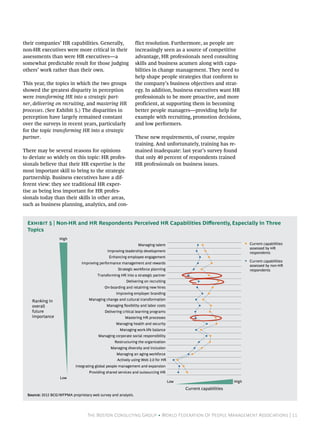
their companies’ HR capabilities. Generally,                    flict resolution. Furthermore, as people are
non-HR executives were more critical in their                   increasingly seen as a source of competitive
assessments than were HR executives—a                           advantage, HR professionals need consulting
somewhat predictable result for those judging                   skills and business acumen along with capa-
others’ work rather than their own.                             bilities in change management. They need to
                                                                help shape people strategies that conform to
This year, the topics in which the two groups                   the company’s business objectives and strat-
showed the greatest disparity in perception                     egy. In addition, business executives want HR
were transforming HR into a strategic part-                     professionals to be more proactive, and more
ner, delivering on recruiting, and mastering HR                 proficient, at supporting them in becoming
processes. (See Exhibit 5.) The disparities in                  better people managers—providing help for
perception have largely remained constant                       example with recruiting, promotion decisions,
over the surveys in recent years, particularly                  and low performers.
for the topic transforming HR into a strategic
partner.                                                        These new requirements, of course, require
                                                                training. And unfortunately, training has re-
There may be several reasons for opinions                       mained inadequate: last year’s survey found
to deviate so widely on this topic: HR profes-                  that only 40 percent of respondents trained
sionals believe that their HR expertise is the                  HR professionals on business issues.
most important skill to bring to the strategic
partnership. Business executives have a dif-
ferent view: they see traditional HR exper-
tise as being less important for HR profes-
sionals today than their skills in other areas,
such as business planning, analytics, and con-


  Exhibit 5 | Non-HR and HR Respondents Perceived HR Capabilities Differently, Especially in Three
  Topics
                   High
                                                                 Managing talent                                         Current capabilities
                                                                                                                         assessed by HR
                                              Improving leadership development                                           respondents
                                               Enhancing employee engagement
                                                                                                                         Current capabilities
                                Improving performance management and rewards
                                                                                                                         assessed by non-HR
                                                     Strategic workforce planning                                        respondents
                                        Transforming HR into a strategic partner
                                                          Delivering on recruiting
                                            On-boarding and retaining new hires
                                                   Improving employer branding

    Ranking in                      Managing change and cultural transformation
    overall                                   Managing flexibility and labor costs
    future                                   Delivering critical learning programs
    importance                                           Mastering HR processes
                                                   Managing health and security
                                                      Managing work-life balance
                                         Managing corporate social responsibility
                                                  Restructuring the organization
                                                Managing diversity and inclusion
                                                    Managing an aging workforce
                                                    Actively using Web 2.0 for HR
                            Integrating global people management and expansion
                                    Providing shared services and outsourcing HR
                    Low
                                                                                     Low                          High
                                                                                           Current capabilities
  Source: 2012 BCG/WFPMA proprietary web survey and analysis.


                                   The Boston Consulting Group • World Federation Of People Management Associations | 11
The Case for Integrated
Sourcing Management


                       T   he demographic data show un-
                           equivocally that companies face major
                       challenges in filling their job pipelines with
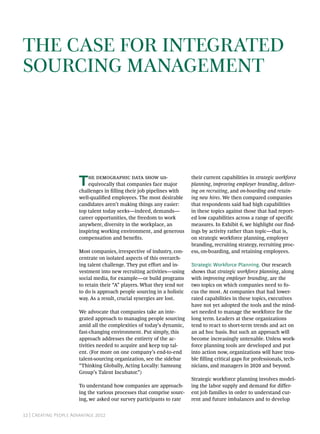
                                                                         their current capabilities in strategic workforce
                                                                         planning, improving employer branding, deliver-
                                                                         ing on recruiting, and on-boarding and retain-
                       well-qualified employees. The most desirable      ing new hires. We then compared companies
                       candidates aren’t making things any easier:       that respondents said had high capabilities
                       top talent today seeks—indeed, demands—           in these topics against those that had report-
                       career opportunities, the freedom to work         ed low capabilities across a range of specific
                       anywhere, diversity in the workplace, an          measures. In Exhibit 6, we highlight our find-
                       inspiring working environment, and generous       ings by activity rather than topic—that is,
                       compensation and benefits.                        on strategic workforce planning, employer
                                                                         branding, recruiting strategy, recruiting proc-
                       Most companies, irrespective of industry, con-    ess, on-boarding, and retaining employees.
                       centrate on isolated aspects of this overarch-
                       ing talent challenge. They put effort and in-     Strategic Workforce Planning. Our research
                       vestment into new recruiting activities—using     shows that strategic workforce planning, along
                       social media, for example—or build programs       with improving employer branding, are the
                       to retain their “A” players. What they tend not   two topics on which companies need to fo-
                       to do is approach people sourcing in a holistic   cus the most. At companies that had lower-
                       way. As a result, crucial synergies are lost.     rated capabilities in these topics, executives
                                                                         have not yet adopted the tools and the mind-
                       We advocate that companies take an inte-          set needed to manage the workforce for the
                       grated approach to managing people sourcing       long term. Leaders at these organizations
                       amid all the complexities of today’s dynamic,     tend to react to short-term trends and act on
                       fast-changing environment. Put simply, this       an ad hoc basis. But such an approach will
                       approach addresses the entirety of the ac-        become increasingly untenable. Unless work-
                       tivities needed to acquire and keep top tal-      force planning tools are developed and put
                       ent. (For more on one company’s end-to-end        into action now, organizations will have trou-
                       talent-sourcing organization, see the sidebar     ble filling critical gaps for professionals, tech-
                       “Thinking Globally, Acting Locally: Samsung       nicians, and managers in 2020 and beyond.
                       Group’s Talent Incubator.”)
                                                                         Strategic workforce planning involves model-
                       To understand how companies are approach-         ing the labor supply and demand for differ-
                       ing the various processes that comprise sourc-    ent job families in order to understand cur-
                       ing, we asked our survey participants to rate     rent and future imbalances and to develop


12 | Creating People Advantage 2012
strategies for addressing them. Alarmingly,                            workforce planning, only 32 percent of re-
however, strategic workforce planning re-                              spondents indicated that they have a mid-
mains an uncommon practice, used by only                               term supply-and-demand model in place.
a minority of the companies covered by our                             Fewer than half that number—15 percent—
survey.                                                                use a long-term model.

Just as a sales strategy requires a customer                           To model supply, a company first assesses its
segmentation, we believe, a people strategy                            existing internal capacity, then looks at nat-
requires a people segmentation. Therefore,                             ural attrition, retirement, and other trends
the prerequisite step in strategic workforce                           (such as potential workforce reductions driv-
planning is creating job families. Having clas-                        en by the economic outlook or company
sifications of job families fosters transparen-                        projections). Supply modeling also entails
cy throughout all the units of a company, yet,                         surveying labor sources—for instance, deter-
less than half of survey respondents report-                           mining how many new MBAs and engineers
ed that their companies used job families as                           the education system is producing. Demand
a part of efforts in strategic workforce plan-                         modeling is significantly more complicated,
ning. (See Exhibit 7.) The next step is supply-                        for many reasons. For one thing, it depends
and-demand modeling, which enables a com-                              on understanding the corporate strategy sev-
pany to simulate the labor pool a company                              eral years out, and from that, extrapolating
expects to have—as well as the amount that                             human-capital needs. Among those surveyed,
the business environment is expected to re-                            37 percent said their companies had a clear
quire. Although it’s the central element of                            view of capacity gaps for each job family.


  Exhibit 6 | Strategic Workforce Planning and Employer Branding Are Sourcing Activities Requiring Focus
     Integrated                      Strategic              Employer            Recruiting           Recruiting
     sourcing                        workforce              branding             strategy             process              On-boarding            Retention
     management                      planning


                                                                                                   A speedy initial
                                                        Systematic analysis                          response to            Personal
                                  Forecasting is                            The importance of                                                 Retention measures
     Main                                               to understand each                            interested          development
                                     difficult,                               online channels is                                                must be established
                                                          targeted group's                          candidates is         opportunities
     challenges                   especially over
                                                          specific needs is
                                                                                frequently
                                                                                                                        should be offered
                                                                                                                                               to track personal
                                   the long term                             underestimated         crucial—and                                  development
                                                            often lacking                           often lacking           early on


                                        3.3x                   2.5x                 1.4x                 1.6x                  2.3x                  2.0x
                                   ...more likely          ... more likely   ... more likely to ... faster in moving       ... more likely   ...more likely to
     Compared with                 to implement              to conduct    regard social media from an unofficial           to identify the  define career tracks
     companies with                  long-term              quantitative        as a valuable   position opening to        development       for individuals'
     low-rated                      forecasting           and qualitative          channel             approval         needs of new hires     development
                                                        research on target                                                     early on
     capabilities,                                             groups
     companies with
     highly rated                       2.4x                   2.8x                 1.3x                 1.7x                  1.8x                  1.8x
     capabilities                 ...more likely to ...more likely to have    ... more likely to ... faster in moving    ... more likely to    ...more likely to
     are...1                   provide transparency     an established           consider the        from position      assign mentors to      implement 360-
                                 for capacity gaps process for refining         company's web approval to the initial          new hires        degree feedback
                                    per job family   the employer brand      site an opportunity   recruiting action                               processes

                                  Demand-driven           The employer's      Targeted groups      Interfaces to the    On-boarding begins Clear development
                                 people planning is      value proposition    are mapped with       businesses are        right after the  paths are discussed
                                 based on business        is defined using     job-group needs       clearly defined       offer is accepted    at the interview
     Best                            scenarios               research on                                                                           stage
                                                          targeted groups      The talent pool        Recruiting             Cultural
     practices                   Capacity planning                            strategy includes      channels are          on-boarding      Trainee programs
                                 is tailored to skill     Communication         push and pull          tracked          (Boot-camp events,       span the
                                       clusters            is targeted to        approaches                              buddy programs,      organization
                                                          specific groups                                                    mentoring)

  Source: 2012 BCG/WFPMA proprietary web survey and analysis.
  1
    Companies with highly rated capabilities in a topic were those averaging a rating of 4 or 5 on a scale from 1 to 5; companies with low-rated capabilities
  averaged 1 or 2 on a scale from 1 to 5).


                                       The Boston Consulting Group • World Federation Of People Management Associations | 13
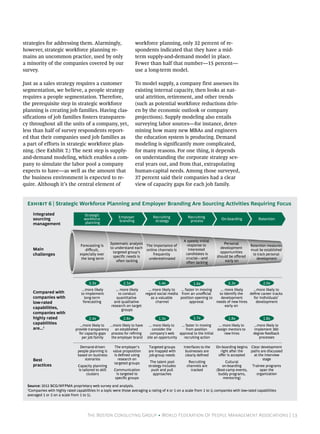
Thinking Globally, Acting Locally
                          Samsung Group’s Talent Incubator
                          In the late 1990s, as part of its global          begins with a panel consisting of an inter-
                          growth strategy, Samsung Group undertook          viewer from Korea and an interviewer from
                          various HR initiatives to strengthen its          abroad; the pair assess the appropriateness
                          global leadership. As part of these efforts, it   of the candidate’s background and person-
                          established a new unit, the Global Strategy       ality. In the second step, a case interview
                          Group (GSG), in 1997. The expectation was         is conducted to evaluate the candidate’s
                          that GSG members—high-potential em-               general problem-solving capabilities, and
                          ployees recruited from the world’s top MBA        a presentation session tests for leadership
                          programs—would provide a fresh global             potential, presence, communication skills,
                          perspective and innovative ideas to help          and intellectual abilities.
                          enhance the company’s performance. In
                          return, Samsung would offer these employ-         New GSG hires receive considerable
                          ees a stimulating career in a dynamic and         on-boarding support, beginning with an
                          fast-growing Asian conglomerate.                  intensive two-week orientation program
                                                                            designed to provide an introduction to
                          At its core, GSG seeks to satisfy two over-       Samsung, its key industries, and South Ko-
                          arching goals. First, it assembles a group        rean culture. Additional sessions over the
                          of foreign talent that can serve as strategic     subsequent six months include a detailed
                          advisors to executives in Samsung’s affili-       introduction to the operations of Sam-
                          ates and subsidiaries. Second, it develops        sung’s affiliates, training in problem-solving
                          and positions members to assume signifi-          and project management, and an overview
                          cant leadership positions upon their transi-      of core consulting skills. GSG prefers that
                          tion from GSG, and to, eventually, become         its members stay with GSG for at least one
                          leaders in Samsung’s headquarters and             year, during which time they participate
                          overseas subsidiaries.                            in in-house consulting projects and are
                                                                            mentored by senior GSG members and
                          As GSG has grown in size and complexity,          GSG alumni. The GSG employees also work
                          considerable attention and effort has fo-         with Samsung’s affiliate companies to learn
                          cused on core aspects of the management           more about the various businesses.
                          of human capital at the company, including
                          people planning, recruiting, on-boarding,         GSG employees are asked to choose be-
                          and retaining employees. Over time, GSG           tween one of two career tracks: consulting
                          has emerged as an example of an inte-             or industry. Those on the consulting track
                          grated, end-to-end recruiter and developer        act as generalists and provide advisory
                          of global talent.                                 services—such as corporate strategy and
                                                                            business development work—to Samsung
                          In order to create a focused and inte-            affiliates. After two years with the company,
                          grated human-capital action plan, GSG             members can choose either to stay in GSG
                          receives the affiliate companies’ global          or to transition to affiliate management. By
                          talent requirements annually, including           contrast, those opting for the industry track
                          the skills needed to support the specific         work on industry-specific projects—such
                          corporate strategies at each of the compa-        as developing marketing strategies for new
                          nies, and it incorporates them into GSG’s         products—for the affiliates that they would
                          people planning.                                  ultimately like to transition to when their
                                                                            year at GSG is complete.
                          As an initial step in the recruitment proc-
                          ess, GSG screens candidates for both their        In addition to finding strong candidates,
                          global orientation as well as their local         Samsung concentrates on retaining its best
                          “fit.” Next, a two-step interview process         performers. For example, GSG employees


14 | Creating People Advantage 2012
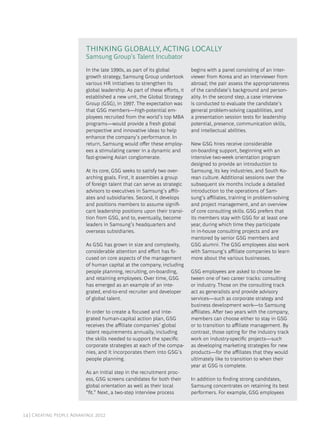
Thinking Globally, Acting Locally

   transitioning to affiliate companies are       and it has been engaged by nearly every
   sometimes sent as a team—or are sent           affiliate company and by all of the busi-
   to affiliates that already have a number of    ness units within Samsung Electronics.
   GSG alumni. The idea is that the cultural      As a leadership program, GSG has seen
   cohesion and solidarity that these employ-     the number of its alumni quadruple over
   ees forged in GSG will motivate them to        the last four years, and they are having a
   stay together as a leadership team. As one     significant impact in domestic and over-
   GSG member explained, “GSG’s culture is        seas business operations. One top execu-
   like that of business school. When you first   tive said of GSG, “Their project work never
   come to Seoul, you join a diverse group of     fails to give me new perspectives.” These
   people with whom you develop deep bonds        new perspectives, have, in turn, added to
   through work, exploration of a new place,      Samsung’s success and continue to further
   and numerous group activities.”                globalize Samsung.

   GSG has been successful at bringing fresh
   ideas to Samsung’s many business units,


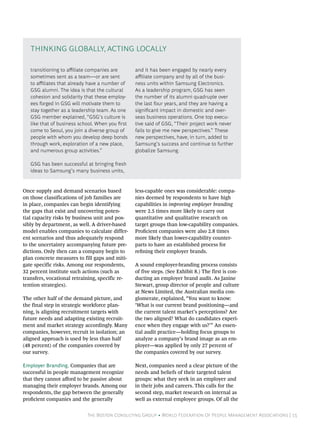
Once supply and demand scenarios based            less-capable ones was considerable: compa-
on those classifications of job families are      nies deemed by respondents to have high
in place, companies can begin identifying         capabilities in improving employer branding
the gaps that exist and uncovering poten-         were 2.5 times more likely to carry out
tial capacity risks by business unit and pos-     quantitative and qualitative research on
sibly by department, as well. A driver-based      target groups than low-capability companies.
model enables companies to calculate differ-      Proficient companies were also 2.8 times
ent scenarios and thus adequately respond         more likely than lower-capability counter-
to the uncertainty accompanying future pre-       parts to have an established process for
dictions. Only then can a company begin to        refining their employer brands.
plan concrete measures to fill gaps and miti-
gate specific risks. Among our respondents,       A sound employer-branding process consists
32 percent institute such actions (such as        of five steps. (See Exhibit 8.) The first is con-
transfers, vocational retraining, specific re-    ducting an employer brand audit. As Janine
tention strategies).                              Stewart, group director of people and culture
                                                  at News Limited, the Australian media con-
The other half of the demand picture, and         glomerate, explained, “You want to know:
the final step in strategic workforce plan-       ‘What is our current brand positioning—and
ning, is aligning recruitment targets with        the current talent market’s perceptions? Are
future needs and adapting existing recruit-       the two aligned? What do candidates experi-
ment and market strategy accordingly. Many        ence when they engage with us?’” An essen-
companies, however, recruit in isolation; an      tial audit practice—holding focus groups to
aligned approach is used by less than half        analyze a company’s brand image as an em-
(48 percent) of the companies covered by          ployer—was applied by only 27 percent of
our survey.                                       the companies covered by our survey.

Employer Branding. Companies that are             Next, companies need a clear picture of the
successful in people management recognize         needs and beliefs of their targeted talent
that they cannot afford to be passive about       groups: what they seek in an employer and
managing their employer brands. Among our         in their jobs and careers. This calls for the
respondents, the gap between the generally        second step, market research on internal as
proficient companies and the generally            well as external employee groups. Of all the


                            The Boston Consulting Group • World Federation Of People Management Associations | 15
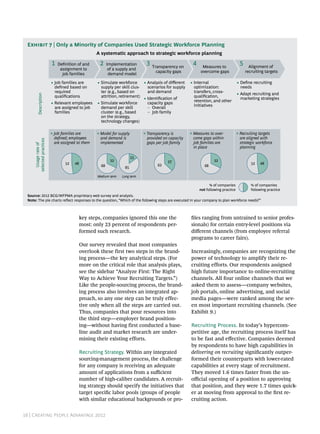
Exhibit 7 | Only a Minority of Companies Used Strategic Workforce Planning
                                                   A systematic approach to strategic workforce planning

                          1   Definition of and       2     Implementation       3   Transparency on
                                                                                                         4     Measures to
                                                                                                                                       5     Alignment of
                               assignment to                of a supply and
                                                                                      capacity gaps           overcome gaps                recruiting targets
                                job families                demand model

                          • Job families are        • Simulate workforce     • Analysis of different     • Internal                    • Define recruiting
                            defined based on           supply per skill clus-   scenarios for supply       optimization:                 needs
                            required                  ter (e.g., based on      and demand                 transfers, cross-           • Adapt recruiting and
         Description


                            qualifications             attrition, retirement) • Identification of           qualification,                 marketing strategies
                                                                                                          retention, and other
                          • Relevant employees      • Simulate workforce       capacity gaps
                                                                                                          initiatives
                            are assigned to job       demand per skill         – Overall
                            families                  cluster (e.g., based     – Job family
                                                      on the strategy,
                                                      technology changes)

                          » Job families are        » Model for supply         » Transparency is        » Measures to over-           » Recruiting targets
                            defined; employees         and demand is              provided on capacity     come gaps within              are aligned with
     selected practices


                            are assigned to them      implemented                gaps per job family      job families are              strategic workforce
       Usage rate of


                                                                                                          in place                      planning

                                                                         15
                                                             32                             37                       32
                                  52   48                                             63                                                      52    48
                                                      68            85                                          68

                                                    Medium term    Long term

                                                                                                                   % of companies             % of companies
                                                                                                             not following practice           following practice
 Source: 2012 BCG/WFPMA proprietary web survey and analysis.
 Note: The pie charts reflect responses to the question, “Which of the following steps are executed in your company to plan workforce needs?”


                                            key steps, companies ignored this one the                   files ranging from untrained to senior profes-
                                            most: only 23 percent of respondents per-                   sionals) for certain entry-level positions via
                                            formed such research.                                       different channels (from employee referral
                                                                                                        programs to career fairs).
                                            Our survey revealed that most companies
                                            overlook these first two steps in the brand-                Increasingly, companies are recognizing the
                                            ing process—the key analytical steps. (For                  power of technology to amplify their re-
                                            more on the critical role that analysis plays,              cruiting efforts. Our respondents assigned
                                            see the sidebar “Analyze First: The Right                   high future importance to online-recruiting
                                            Way to Achieve Your Recruiting Targets.”)                   channels. All four online channels that we
                                            Like the people-sourcing process, the brand-                asked them to assess—company websites,
                                            ing process also involves an integrated ap-                 job portals, online advertising, and social
                                            proach, so any one step can be truly effec-                 media pages—were ranked among the sev-
                                            tive only when all the steps are carried out.               en most important recruiting channels. (See
                                            Thus, companies that pour resources into                    Exhibit 9.)
                                            the third step—employer brand position-
                                            ing—without having first conducted a base-                  Recruiting Process. In today’s hypercom-
                                            line audit and market research are under-                   petitive age, the recruiting process itself has
                                            mining their existing efforts.                              to be fast and effective. Companies deemed
                                                                                                        by respondents to have high capabilities in
                                            Recruiting Strategy. Within any integrated                  delivering on recruiting significantly outper-
                                            sourcing-management process, the challenge                  formed their counterparts with lower-rated
                                            for any company is receiving an adequate                    capabilities at every stage of recruitment.
                                            amount of applications from a sufficient                    They moved 1.6 times faster from the un-
                                            number of high-caliber candidates. A recruit-               official opening of a position to approving
                                            ing strategy should specify the initiatives that            that position, and they were 1.7 times quick-
                                            target specific labor pools (groups of people               er at moving from approval to the first re-
                                            with similar educational backgrounds or pro-                cruiting action.


16 | Creating People Advantage 2012
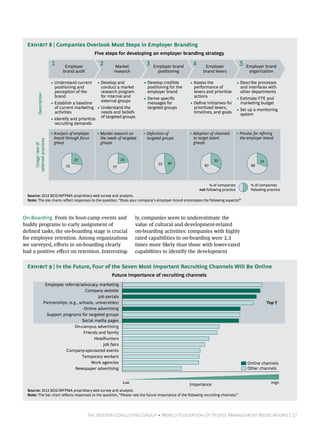
Exhibit 8 | Companies Overlook Most Steps in Employer Branding
                                                     Five steps for developing an employer branding strategy

                            1       Employer
                                                       2        Market
                                                                                 3   Employer brand
                                                                                                         4      Employer
                                                                                                                                       5   Employer brand
                                   brand audit                 research                positioning             brand levers                 organization

                            • Understand current      • Develop and             • Develop credible      • Assess the                  • Describe processes
                              positioning and           conduct a market          positioning for the     performance of                and interfaces with
                              perception of the         research program          employer brand          levers and prioritize         other departments
          Description


                              brand                     for internal and                                  actions                     • Estimate FTE and
                                                                                • Derive specific
                                                        external groups           messages for          • Define initiatives for         marketing budget
                            • Establish a baseline
                              of current marketing • Understand the               targeted groups         prioritized levers,         • Set up a monitoring
                              activities              needs and beliefs                                   timelines, and goals          system
                                                      of targeted groups
                            • Identify and prioritize
                              recruiting demands

                            » Analysis of employer    » Market research on      » Definition of          » Adoption of channels        » Process for refining
                              brand through focus       the needs of targeted     targeted groups         to target talent              the employer brand
      selected practices


                              group                     groups                                            groups
        Usage rate of


                                         27                          23                                              33                            31
                                                                                        53   47
                                    73                         77                                               67                            69


                                                                                                                   % of companies             % of companies
                                                                                                             not following practice           following practice
  Source: 2012 BCG/WFPMA proprietary web survey and analysis.
  Note: The pie charts reflect responses to the question, “Does your company’s employer brand encompass the following aspects?”


On-Boarding. From its boot-camp events and                                  ly, companies seem to underestimate the
buddy programs to early assignment of                                       value of cultural and development-related
defined tasks, the on-boarding stage is crucial                             on-boarding activities: companies with highly
for employee retention. Among organizations                                 rated capabilities in on-boarding were 2.3
we surveyed, efforts in on-boarding clearly                                 times more likely than those with lower-rated
had a positive effect on retention. Interesting-                            capabilities to identify the development

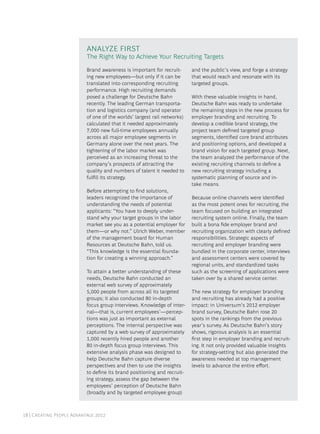
  Exhibit 9 | In the Future, Four of the Seven Most Important Recruiting Channels Will Be Online
                                                              Future importance of recruiting channels
                         Employee referral/advocacy marketing
                                                Company website
                                                       Job portals
                        Partnerships (e.g., schools, universities)                                                                                      Top 7
                                               Online advertising
                          Support programs for targeted groups
                                              Social media pages
                                         On-campus advertising
                                               Friends and family
                                                    Headhunters
                                                         Job fairs
                                    Company-sponsored events
                                              Temporary workers
                                                   Work agencies                                                                            Online channels
                                         Newspaper advertising                                                                              Other channels


                                                                      Low                                                                                 High
                                                                                                        Importance
  Source: 2012 BCG/WFPMA proprietary web survey and analysis.
  Note: The bar chart reflects responses to the question, “Please rate the future importance of the following recruiting channels.”


                                                 The Boston Consulting Group • World Federation Of People Management Associations | 17
Analyze First
                           The Right Way to Achieve Your Recruiting Targets

                           Brand awareness is important for recruit-      and the public’s view, and forge a strategy
                           ing new employees—but only if it can be        that would reach and resonate with its
                           translated into corresponding recruiting       targeted groups.
                           performance. High recruiting demands
                           posed a challenge for Deutsche Bahn            With these valuable insights in hand,
                           recently. The leading German transporta-       Deutsche Bahn was ready to undertake
                           tion and logistics company (and operator       the remaining steps in the new process for
                           of one of the worlds’ largest rail networks)   employer branding and recruiting. To
                           calculated that it needed approximately        develop a credible brand strategy, the
                           7,000 new full-time employees annually         project team defined targeted group
                           across all major employee segments in          segments, identified core brand attributes
                           Germany alone over the next years. The         and positioning options, and developed a
                           tightening of the labor market was             brand vision for each targeted group. Next,
                           perceived as an increasing threat to the       the team analyzed the performance of the
                           company’s prospects of attracting the          existing recruiting channels to define a
                           quality and numbers of talent it needed to     new recruiting strategy including a
                           fulfill its strategy.                          systematic planning of source and in-
                                                                          take means.
                           Before attempting to find solutions,
                           leaders recognized the importance of           Because online channels were identified
                           understanding the needs of potential           as the most potent ones for recruiting, the
                           applicants: “You have to deeply under-         team focused on building an integrated
                           stand why your target groups in the labor      recruiting system online. Finally, the team
                           market see you as a potential employer for     built a bona fide employer brand and
                           them—or why not.” Ulrich Weber, member         recruiting organization with clearly defined
                           of the management board for Human              responsibilities. Strategic aspects of
                           Resources at Deutsche Bahn, told us.           recruiting and employer branding were
                           “This knowledge is the essential founda-       bundled in the corporate center, interviews
                           tion for creating a winning approach.”         and assessment centers were covered by
                                                                          regional units, and standardized tasks
                           To attain a better understanding of these      such as the screening of applications were
                           needs, Deutsche Bahn conducted an              taken over by a shared service center.
                           external web survey of approximately
                           5,000 people from across all its targeted      The new strategy for employer branding
                           groups; it also conducted 80 in-depth          and recruiting has already had a positive
                           focus group interviews. Knowledge of inter-    impact: in Universum’s 2012 employer
                           nal—that is, current employees’—percep-        brand survey, Deutsche Bahn rose 20
                           tions was just as important as external        spots in the rankings from the previous
                           perceptions. The internal perspective was      year’s survey. As Deutsche Bahn’s story
                           captured by a web survey of approximately      shows, rigorous analysis is an essential
                           1,000 recently hired people and another        first step in employer branding and recruit-
                           80 in-depth focus group interviews. This       ing. It not only provided valuable insights
                           extensive analysis phase was designed to       for strategy-setting but also generated the
                           help Deutsche Bahn capture diverse             awareness needed at top management
                           perspectives and then to use the insights      levels to advance the entire effort.
                           to define its brand positioning and recruit-
                           ing strategy, assess the gap between the
                           employees’ perception of Deutsche Bahn
                           (broadly and by targeted employee group)


18 | Creating People Advantage 2012
needs of new hires early on, and they were      Retention efforts powerfully underscore
1.8 times more likely to assign mentors to      the integrated nature of people sourcing:
new hires.                                      without them, all the preceding planning and
                                                recruiting steps will be for naught. At Sky
Retention. Our results show that in most        Italia, executives clearly understand this: key
regions of the world, the lack of retention     talent retention is their primary indicator for
measures related to personnel development       measuring the effectiveness of their talent
is typically the primary reason employees       management. “We are a young company,
give for leaving. According to our survey,      and we realize that outside our walls there
companies with highly rated capabilities in     are many other opportunities available
retention were twice as likely as those with    to talent,” said Ilaria Dalla Riva, former
lower-rated capabilities to define career       executive vice president of HR, organization,
tracks for development. Only about a quarter    and facility management at Sky Italia. “High
of the companies surveyed worldwide em-         retention rates are our way of measuring
ployed 360-degree feedback processes when       whether we are winning our battle for
planning their workforce needs, yet compa-      talent.”
nies whose retention capabilities were rated
highly were 1.8 times more likely than their
counterparts with lower-rated capabilities to
use 360-degree feedback processes.


                           The Boston Consulting Group • World Federation Of People Management Associations | 19
Building Up Your
Critical Assets
Talent and Leadership Development


                       B    usiness leaders today are well aware
                            that a company’s most important asset is
                       its talent. And respondents to the BCG/
                                                                        place, one that conforms to the requirements
                                                                        of the twenty-first century: notably, it should
                                                                        promote adaptiveness and should enable the
                       WFPMA survey affirmed this: among all 22         company to deal with constant change and
                       HR topics, managing talent was ranked            rapidly shifting challenges.
                       highest in future importance by the execu-
                       tives we surveyed. Yet the survey also showed    Third, talent sourcing has to be fine-tuned to
                       that respondents did not consider current        ensure workforce diversity—not only cultur-
                       corporate capabilities in managing talent as     al and gender diversity but also diversity in
                       coming close to matching the perceived           thinking and working styles. The company’s
                       future relevance of the topic. It’s much the     value proposition and brand as an employ-
                       same story for the topic improving leadership    er should address the organization’s specif-
                       development, which received a high overall       ic talent needs, and the recruiting and on-
                       rating in future importance and a corre-         boarding processes be adapted and tailored
                       spondingly low one in current capability.        to the various groups of talent that the com-
                                                                        pany is targeting.
                       Without strong leadership, companies cannot
                       manage talent effectively. Over the next dec-    Fourth, the company needs to focus on tal-
                       ade, therefore, the competition for both tal-    ent development acceleration through programs
                       ent and leaders will only intensify. How can     that build capabilities internally. Fifth, to es-
                       companies sharpen their focus to shore up        tablish a culture of talent engagement and af-
                       their most important asset—and create com-       filiation, compensation and benefits must be
                       petitive advantage?                              competitive. Leaders also need to tackle re-
                                                                        tention problems strategically, and promote
                                                                        superior performance and collaboration
                       Building Talent: Six Essential Steps             through their own actions as well as through
                       To achieve and sustain a talent advantage        behavioral incentives and rewards. Sixth and
                       over rivals, companies need to take action in    finally, with these elements in place, a talent
                       six key areas. First, every company must de-     magnet culture emerges. As a company’s gov-
                       velop a talent strategy that corresponds to      ernance of its talent, employer brand, and
                       market conditions and business needs while       other components of corporate culture steadi-
                       also generating suitable economic returns.       ly improves, the company will increasingly at-
                       These returns should, of course, be tracked by   tract the very talent it desires, gaining power-
                       metrics. Second, a leadership model must be in   ful advantage as an employer and a business.


20 | Creating People Advantage 2012
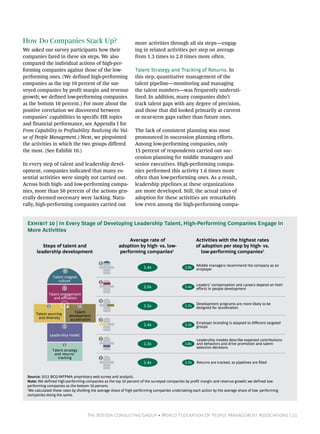
How Do Companies Stack Up?                                        more activities through all six steps—engag-
We asked our survey participants how their                        ing in related activities per step on average
companies fared in these six steps. We also                       from 1.3 times to 2.0 times more often.
compared the individual actions of high-per-
forming companies against those of the low-                       Talent Strategy and Tracking of Returns. In
performing ones. (We defined high-performing                      this step, quantitative management of the
companies as the top 10 percent of the sur-                       talent pipeline—monitoring and managing
veyed companies by profit margin and revenue                      the talent numbers—was frequently underuti-
growth; we defined low-performing companies                       lized. In addition, many companies didn’t
as the bottom 10 percent.) For more about the                     track talent gaps with any degree of precision,
positive correlation we discovered between                        and those that did looked primarily at current
companies’ capabilities in specific HR topics                     or near-term gaps rather than future ones.
and financial performance, see Appendix I for
From Capability to Profitability: Realizing the Val-              The lack of consistent planning was most
ue of People Management.) Next, we pinpointed                     pronounced in succession planning efforts.
the activities in which the two groups differed                   Among low-performing companies, only
the most. (See Exhibit 10.)                                       15 percent of respondents carried out suc-
                                                                  cession planning for middle managers and
In every step of talent and leadership devel-                     senior executives. High-performing compa-
opment, companies indicated that many es-                         nies performed this activity 1.6 times more
sential activities were simply not carried out.                   often than low-performing ones. As a result,
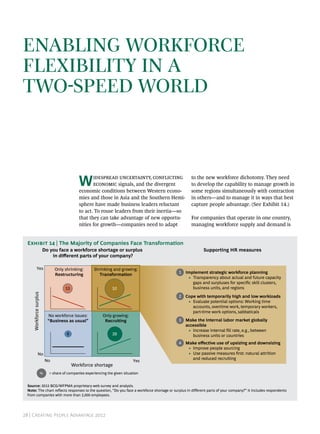
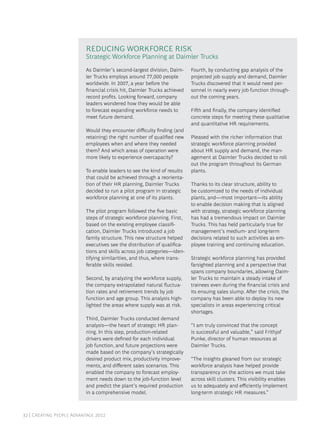
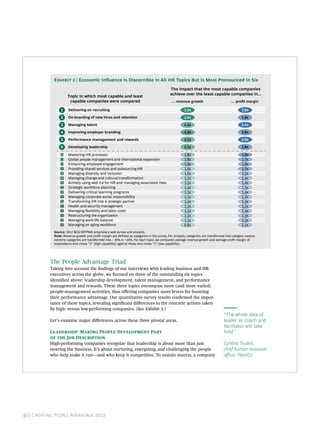
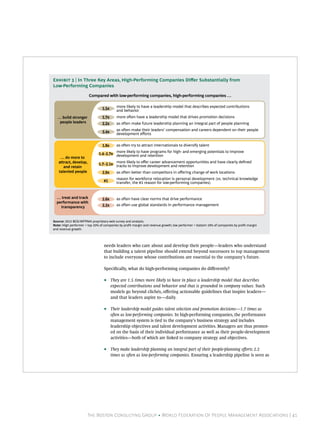
Across both high- and low-performing compa-                       leadership pipelines at these organizations
nies, more than 50 percent of the actions gen-                    are more developed. Still, the actual rates of
erally deemed necessary were lacking. Natu-                       adoption for these activities are remarkably
rally, high-performing companies carried out                      low even among the high-performing compa-


  Exhibit 10 | In Every Stage of Developing Leadership Talent, High-Performing Companies Engage in
  More Activities
                                                            Average rate of                            Activities with the highest rates
          Steps of talent and                           adoption by high- vs. low-                     of adoption per step by high- vs.
       leadership development                           performing companies1                            low-performing companies1

                                             6                                                         Middle managers recommend the company as an
                                                                       1.4x                     2.8x   employer
                         6
                  Talent magnet
                     culture                 5
                                                                                                       Leaders' compensation and careers depend on their
                         5                                             2.0x                     3.4x   efforts in people development
              Talent engagement
                 and affiliation
                                             4
                                                                                                       Development programs are more likely to be
              3                     4                                  1.5x                     1.7x   designed for acceleration
                                Talent
       Talent sourcing       development
        and diversity         acceleration   3
                                                                                                       Employer branding is adapted to different targeted
                         2                                             1.4x                     2.3x   groups

               Leadership model
                                             2                                                         Leadership models describe expected contributions
                         1                                             1.3x                     1.8x   and behaviors and drive promotion and talent-
                                                                                                       selection decisions
                  Talent strategy
                   and returns
                     tracking                1
                                                                       1.4x                     1.7x   Returns are tracked, so pipelines are filled


  Source: 2012 BCG/WFPMA proprietary web survey and analysis.
  Note: We defined high-performing companies as the top 10 percent of the surveyed companies by profit margin and revenue growth; we defined low-
  performing companies as the bottom 10 percent.
  1
    We calculated these rates by dividing the average share of high-performing companies undertaking each action by the average share of low- performing
  companies doing the same.


                                        The Boston Consulting Group • World Federation Of People Management Associations | 21
nies, which overall engaged in activities sup-    employer brand. Rarely do they adapt their
                       porting talent strategy and the tracking of       brand messaging—in particular, the employer
                       returns 1.4 times more often than low per-        value proposition aimed at different targeted
                       formers.                                          groups of employees. Right now, companies
                                                                         are missing out on the large pool of potential
                       Leadership Model. Most companies covered          employees from various targeted groups, such
                       by our survey had a leadership model, but         as international, female, and experienced
                       most of these models were steeped in twen-        hires. Among the low-performing companies,
                       tieth-century principles and were outdated.       for instance, only 12 percent tailored their
                       Moreover, most companies failed to use their      branding to attract specific groups. A greater
                       model consistently. Looking at the adoption       percentage of high-performers (27 percent)
                       rates by group, we found that only 33 percent     engaged in this activity, but the practice is
                       of the low-performing companies had a lead-       still uncommon.
                       ership model that described leaders’ expect-
                       ed contributions and behaviors and drove
                       decisions about talent selection and promo-
                       tion. Among high-performing companies, the
                                                                         “We are investing in our people
                       adoption rate was considerably better: 59 per-    resources through a program
                       cent, making them and 1.8 times more likely       designed to continuously develop
                       than low-performing companies to have such
                       a model.                                          the competencies of our people
                                                                         in Italy. We offer a free online
                       To update its leadership model—and ensure
                       that it was tangible to leaders—BMW sev-          university program to qualified
                       eral years ago introduced its Management          employees. It is a big success: so
                       House. “As a premium brand in the automo-
                       tive industry with worldwide operations, we
                                                                         far, more than 2,000 employees
                       realized that our leaders must do more than       have applied, about 8 percent of
                       just manage the business,” explained Harald
                                                                         our total workforce.”
                       Krüger, a BMW board member and former
                       chief human resources officer.                    Antonio Migliardi, head of HR and
                                                                         organization of Telecom Italia
                       The Management House, a companywide
                       model, represents the key areas of leadership
                       skills in which BMW’s leaders must excel.         Talent Development Acceleration. Companies
                       More recently, BMW opened its Treffpunkt          need to devote attention to the acceleration
                       Führung, or Leadership Center (also known         of talent management. “Top management at
                       as its “Leadership Platform”). At the center,     Santander is deeply involved in talent devel-
                       400 square meters of office space are divided     opment. The CEO is personally involved in
                       into 10 different rooms, each devoted to a dif-   the professional development of every one
                       ferent concept linked to the leadership mod-      of the top 300 executives in the company. He
                       el. Teams advance from room to room, dis-         also leads the Council for our Corporate Uni-
                       cussing each concept and its origins at BMW,      versity, which is extremely active,” explained
                       along with the company’s strategy and basic       José Luis Gómez Alciturri, managing director
                       principles. In a hands-on exercise, team mem-     of HR at Grupo Santander. However, 46 per-
                       bers assemble the concepts into a physical        cent of the low-performing companies had no
                       model—a house, built out of wooden blocks.        program for developing talent among middle
                       In a facilitated workshop, team members           managers—neither training nor on-the-job
                       translate their goals for achieving leadership    initiatives. Given the importance respondents
                       excellence into concrete, day-to-day actions.     placed on talent development, these low
                                                                         numbers are somewhat alarming.
                       Talent Sourcing and Diversity. When it comes
                       to practices within talent sourcing, we found     Talent Engagement and Affiliation. In peo-
                       that few companies adequately assess their        ple management as a whole, the most criti-


22 | Creating People Advantage 2012
cal success factor for a company may well be      Talent Magnet Culture. Finally, when it
the level of engagement and affiliation of em-    comes to fostering talent magnet culture, the
ployees. When employees are motivated, they       vast majority of companies came up short.
perform better, identify more closely with        Only 33 percent of respondents from high-
their work, treat their colleagues better, help   performing companies and 24 percent of re-
create a positive environment and culture of      spondents from low-performing companies
performance, and are less likely to leave the     reported that their organizations tended to
company. “Today, most companies’ incen-           this step. The evidence is best reflected in the
tives are primarily financial, which does not     amount of time executives said they devote
guarantee that workers are motivated,” said       to managing talent each year: on average,
Francisco Veloso, vice president of human re-     fewer than seven days at the low-perform-
sources and corporate affairs at Antofagasta      ing companies, versus 25 days or more at the
Minerals, the Chilean mining company. “The        high-performing companies. (For more about
challenge is to make people do what is best       talent management, see the April 2012 BCG
for the company, while at the same time, they     Perspective “When Growth Outstrips Talent”
do what they truly want.”                         by Jean-Michel Caye, Vikram Bhalla, Marcos
                                                  Aguiar, and Christoph Nettesheim.) Moreover,
For these reasons, the widespread inattention     few companies integrated their talent proc-
to talent engagement and affiliation is a seri-   esses, an approach that’s critical to success.
ous concern. Again, companies often identify
essential activities but fail to follow through   The recommended practices that we surveyed
on them regularly or even at all. For example,    are hardly new or radical. So what explains
54 percent of the low-performing companies        our findings? The limited adoption of these ap-
established clear norms and expectations for      proaches could be, quite simply, the result of
superior performance, but then did not apply      scarce resources—budget cuts prompted by
these standards consistently. The same held       the financial crisis. Overhead functions, such
true when it came to evaluating the people-       as HR, are frequently the hardest hit. Another
development efforts made by leaders; low-         possibility is that the high unemployment rates
performing companies often engaged in this        stemming from the recent global recession may
activity (48 percent of low-performing compa-     have executives questioning the very notion of
nies, in fact) but without consequence—that       a talent shortage. But this attitude is danger-
is, the efforts have no impact on the leaders’    ously short-sighted. The global recession may
career advancement or compensation.               have caused only a slight dip in demand, but
                                                  by all accounts, the talent supply in the next
Although companies overall are erratic in         few decades is expected to shrink dramatically.
their efforts to advance talent engagement        Companies must do everything in their power
and affiliation, the high-performing compa-       to overcome their short-term orientation and
nies nonetheless outpaced the low perform-        recognize the long-term strategic challenges—
ers dramatically in such efforts, with an av-     and threats—they face in securing the talent
erage difference of twice as much activity by     they’ll need over the coming years.
the high performers across the set of specif-
ic practices we examined. “We believe that
our talent culture is reinforced through our
leadership, which is why we evaluate our
leadership along these dimensions,” said
Ronald Schellekens, group HR director at
Vodafone.


                            The Boston Consulting Group • World Federation Of People Management Associations | 23
Managing People in the
World’s Fastest-Growing
Economies


                       R    apid growth in fast-growing econo-
                            mies has captured the imaginations of
                       multinationals and local businesses seeking
                                                                          mounting the above-described issues if they
                                                                          weren’t also struggling with capabilities in
                                                                          several of the HR topics in our study. To
                       to capitalize on new opportunities. Yet these      better understand those challenges, we or-
                       same companies face a complex, interrelated        ganized the 22 HR topics in order of their
                       set of challenges that make it difficult for       future importance as ranked by our respon-
                       them to secure the talent they need to             dents based in the BRICS countries (Brazil,
                       succeed in these markets. To surmount these        Russia, India, China, and South Africa)—and
                       challenges, companies will need to improve         we then compared these respondents’ rat-
                       their capabilities to meet critical HR impera-     ings with those of the rest of our respondents.
                       tives, such as recruiting, on-boarding and         (See Exhibit 11.)
                       retention, leadership development, and talent
                       management.                                        Interestingly, the BRICS-based respondents
                                                                          prioritized the topics differently than did re-
                       Among the biggest challenges companies in          spondents overall. Improving performance
                       the fast-growing economies face is the one         management and rewards, on-boarding and re-
                       common to all companies today: the grow-           taining new hires, and managing talent—top-
                       ing talent shortage. Already, companies have       ics with a clear relationship to talent devel-
                       been finding it increasingly difficult to locate   opment and retention—were their topmost
                       and hold onto talent in emerging markets.          priorities. Furthermore, throughout all the
                       And the problem will only worsen over the          topics, companies in the BRICS countries
                       coming decades, as the growth of these econ-       lagged behind the non-BRICS companies in
                       omies outpaces that of the talent supply. The      their current capabilities.
                       shortage is exacerbated further by an inad-
                       equate educational pipeline: institutions are      Specifically, in the ten most important top-
                       turning out graduates who lack the kinds of        ics for the BRICS-based companies overall,
                       skills businesses value most, such as problem      we discovered big gaps in BRICS capabili-
                       solving and critical thinking.                     ties in managing talent, mastering HR process-
                                                                          es, and delivering on recruiting. Clearly, if they
                                                                          are to excel in people management in their
                       Falling Short in Key HR                            fast-growing markets, the BRICS-based com-
                       Capabilities                                       panies need to devote as much attention to
                       Companies doing business in emerging na-           core HR topics as they do to development
                       tions might have a fighting chance of sur-         and retention.


24 | Creating People Advantage 2012
Exhibit 11 | Companies in Fast-Growing Economies Need to Boost Capabilities Significantly in Many
  HR Topics
                     High
                             1 Improving performance management and rewards                                              Current capabilities
                                                                                                                         assessed by
                             2 On-boarding and retaining new hires                                                       BRICS companies1
                             3 Managing talent
                                                                                                                         Current capabilities
                             4 Enhancing employee engagement
                                                                                                                         assessed by non-
                             5 Improving employer branding                                                               BRICS companies1
                             6 Improving leadership development
                             7 Strategic workforce planning
                             8 Mastering HR processes
                             9 Delivering critical learning programs
                            10 Delivering on recruiting
       Future               11 Managing flexibility and labor costs
       importance
                            12 Managing health and security
       ranking
                            13 Managing change and cultural transformation
                            14 Transforming HR into a strategic partner
                            15 Managing corporate social responsibility
                            16 Managing work-life balance
                            17 Restructuring the organization
                            18 Managing an aging workforce
                            19 Managing diversity and inclusion
                            20 Actively using Web 2.0 for HR
                            21 Integrating global people management and expansion
                            22 Providing shared services and outsourcing HR
                      Low                                                           Low                           High
                                                                                           Current capabilities

  Source: 2012 BCG/WFPMA proprietary web survey and analysis.
  1
    The BRICS countries are Brazil, Russia, India, China, and South Africa.


Wanted: Strong Managerial, Lead-                                     held especially for management skills at mid-
ership, and Technical Skills                                         level corporations in Russia’s capital-inten-
The capabilities shortfall becomes even                              sive industries.
more urgent when considered in the context
of the critical shortages in skills and work-
force groups that BRICS-based companies                              Employee Development and
face. When we evaluated responses from the                           Retention Strategies
BRICS countries separately, some interesting                         How can companies overcome the HR chal-
patterns emerged. (See Exhibit 12.)                                  lenges facing them in their operations within
                                                                     BRICS and other emerging economies? Given
To be sure, across BRICS countries, respon-                          the inadequacies in higher education, it’s clear
dents identified managerial, leadership, and                         that they’ll need to take matters into their
technical skills as the skills most lacking in                       own hands and focus their efforts on two ar-
their country or region. Similarly, they ranked                      eas: developing and retaining employees with
shortages in their management and R&D                                the most promising leadership, managerial,
workforce groups as most critical. When we                           and technical skills. This is particularly im-
examined the data at the country level, we                           portant, because attrition rates are generally
identified interesting differences that we be-                       higher. “In emerging markets, the greater chal-
lieve reflect the unique characteristics of each                     lenge is keeping good managers, as people are
nation’s economy. For example, in Russia,                            generally less loyal to employers,” observed
technical skills were not considered in short                        Hans Mijnans, vice president of HR markets at
supply, and R&D skills were not perceived as                         Philips International. For numerous HR topics,
lacking. However, the economy seems to lack                          the gap between their perceived importance
experienced managers who can run manu-                               and the companies’ current capabilities is sig-
facturing operations or capital projects. This                       nificant. (See Exhibit 13.)


                                       The Boston Consulting Group • World Federation Of People Management Associations | 25
Exhibit 12 | In BRICS Countries, Lacking Skills Are Reflected in a Shortage of Related Workforce Groups
                                                                 Top 5 ranking of the most critical shortages in skills and workforce groups

                                                                  All BRICS
                                Most critical shortages          respondents        Brazil           Russia            India            China          South Africa

                       Managerial skills                              1                3                1                1                1                  3
     Skill cluster


                       Leadership skills                              2                2                6                3                2                  2

                       Technical skills                               3                1                4                2                4                  1

                       Teamwork and communication                     4                7                5                4                3                  7

                       Foreign language skills                        5                4                2                6                5                  8

                       Management                                     1                1                1                2                1                  1
     Workforce group


                       Research and development                       2                2                7                1                2                  2

                       Marketing and sales                            3                5                5                3                3                  8

                       Human resources                                4                3                3                6                4                  7

                       Manufacturing and operations                   5                7                2                7                5                  6

                                                                                                                                              1    2     3   4    5


 Source: 2012 BCG/WFPMA proprietary web survey and analysis.
 Note: The table reflects responses to the questions, “Which skills are most lacking in the pool of potential or current employees in this country/region?
 Please rank first, second, and third.” and “How critical are the staff shortages for each of the following groups in this country/region? Please rate criticality.”


                                           Career Development Practices. We offer sever-                 range from half a year’s to a full year’s salary.
                                           al ways to fill the gaps in three key areas of ca-            That’s why it is essential to follow up invest-
                                           reer development that require great attention.                ments in career development with strong re-
                                                                                                         tention practices.
                                           ••   Hold career development discussions. Dur-
                                                ing these discussions, employees can                     ••   Offer clearly defined career paths. Reinforce
                                                share their career goals, and managers                        career development discussions by describ-
                                                can define the skills needed to achieve                       ing how career paths operate within the
                                                those goals. Managers can also identify                       organization. For instance, how do talented
                                                new challenges and job experiences that                       engineers advance into the managerial
                                                would help employees acquire or build                         ranks? How do line managers move into
                                                the requisite skills. Offering accelerated                    executive positions? What successive roles
                                                job rotation, project-leadership opportuni-                   must people occupy to progress through
                                                ties, and a variety of assignments can help                   their desired career paths, and what forms
                                                employees strengthen their leadership,                        of support will they receive from their
                                                managerial, or technical skills.                              supervisors as well as through formal com-
                                                                                                              panywide development programs?
                                           ••   Assess employee performance along defined
                                                criteria—and communicate those criteria to               ••   Ensure that espoused values are also prac-
                                                employees. For example, as employees                          ticed. Thanks to social media, employees
                                                move from individual-contributor roles to                     can quickly learn about and comment on
                                                managerial roles, their effectiveness will                    the day-to-day realities of career prospects
                                                be judged on such criteria as their ability                   inside their companies. An organization
                                                to develop other leaders, to delegate, and                    that espouses such values as “We invest in
                                                to manage team dynamics.                                      our people” yet doesn’t put these values
                                                                                                              into practice will quickly be identified as
                                           Talent Retention Practices. Developing tal-                        a fraud. One way to ensure that practiced
                                           ent takes time and money; in some positions,                       values match espoused values is to make
                                           the bill for talent development can easily                         all managers and executives—not just


26 | Creating People Advantage 2012
Exhibit 13 | Wide Gaps Between Capabilities and Importance Indicate Urgent Action Is Needed in
 Development and Retention
                       Development actions                                                             Retention actions

      Establish regular development discussions                                    Offer clearly defined career paths
      between employees and managers
                                                                                   Introduce a competitive
      Run companywide capability-                                                  compensation system
      building programs
                                                                                   Ensure that stated values are practiced
      Conduct 360-degree feedback
                                                                                   Track and improve employee satisfaction
      Institutionalize employee feedback process
                                                                                   Introduce a culture of meritocracy
      Assess employee performance                                                  Support new hires through early
      along defined criteria                                                        and frequent career discussions
                                                                                   Introduce nonmonetary recognition
      Offer job rotation                                                            programs
      Offer cross-business unit or cross-                                           Offer rapid career progression
      functional projects
      Offer training courses to employees                                           Provide mentoring
      at all levels
                                                                                   Offer more responsibility
      Establish teams whose members have
      different educational backgrounds                                             Manage health and security
      Establish teams with multicultural
      backgrounds                                                                  Offer more prestigious external-facing titles


        Capabilities       Importance             Low                 High                                                   Low                   High

 Source: 2012 BCG/WFPMA proprietary web survey and analysis.
 Note: The data reflect responses to the question, “Please rate the importance of—and your company’s capabilities in—the following retention and
 engagement measures in this country/region.”


     HR—responsible for delivering on the                       Tackling the talent challenges confronting
     company’s career-opportunity promises to                   businesses in fast-growing economies won’t
     employees. “The key to reducing attrition                  be easy. But companies must start now if
     in emerging markets is to make employ-                     they hope to gain—and sustain—a competi-
     ees feel that they are part of something                   tive edge in these regions. By establishing
     larger, to give them a sense of family and                 practices aimed at developing and retain-
     pride,” said Vegar Arndal, senior vice                     ing their most promising leaders, managers,
     president of HR and quality management                     and technical stars, organizations can keep
     at Kongsberg Maritime, a Norwegian mar-                    and cultivate the skills they need, rather than
     itime-technology company. This calls for                   having to search farther afield for increasing-
     careful attention to performance manage-                   ly scarce resources.
     ment. For instance, senior managers can
     be held accountable for key performance
     indicators (KPIs) such as attrition rates
     among high-potential employees.

••   Foster a culture of meritocracy. In an
     organizational culture defined largely by
     meritocracy, people know that they will
     be recognized and rewarded on the basis
     of their performance. To develop a
     culture of meritocracy, start by clarifying
     decision rights. Augment clear decision
     rights with a strong performance-man-
     agement system based on explicit
     objectives; clear, timely, and specific
     feedback; and metrics that link compen-
     sation to performance.


                                      The Boston Consulting Group • World Federation Of People Management Associations | 27
Enabling Workforce
Flexibility in a
Two-Speed World


                                              W      idespread uncertainty, conflicting
                                                     economic signals, and the divergent
                                              economic conditions between Western econo-
                                                                                                    to the new workforce dichotomy. They need
                                                                                                    to develop the capability to manage growth in
                                                                                                    some regions simultaneously with contraction
                                              mies and those in Asia and the Southern Hemi-         in others—and to manage it in ways that best
                                              sphere have made business leaders reluctant           capture people advantage. (See Exhibit 14.)
                                              to act. To rouse leaders from their inertia—so
                                              that they can take advantage of new opportu-          For companies that operate in one country,
                                              nities for growth—companies need to adapt             managing workforce supply and demand is


 Exhibit 14 | The Majority of Companies Face Transformation
                        Do you face a workforce shortage or surplus                                        Supporting HR measures
                            in different parts of your company?

             Yes                 Only shrinking:       Shrinking and growing:
                                                                                            1   Implement strategic workforce planning
                                 Restructuring           Transformation
                                                                                                 • Transparency about actual and future capacity
                                                                                                   gaps and surpluses for specific skill clusters,
                                      13                          52                               business units, and regions
    Workforce surplus


                                                                                            2   Cope with temporarily high and low workloads
                                                                                                 • Evaluate potential options: Working time
                                                                                                   accounts, overtime work, temporary workers,
                                                                                                   part-time work options, sabbaticals
                             No workforce issues:           Only growing:
                             “Business as usual”             Recruiting                     3   Make the internal labor market globally
                                                                                                accessible
                                                                                                 • Increase internal fill rate, e.g., between
                                       6                          29                               business units or countries
                                                                                            4   Make effective use of upsizing and downsizing
                                                                                                 • Improve people sourcing
                No                                                                               • Use passive measures first: natural attrition
                            No                                                                     and reduced recruiting
                                                                              Yes
                                           Workforce shortage
                        %    = share of companies experiencing the given situation


 Source: 2012 BCG/WFPMA proprietary web survey and analysis.
 Note: The chart reflects responses to the question, “Do you face a workforce shortage or surplus in different parts of your company?” It includes respondents
 from companies with more than 2,000 employees.


28 | Creating People Advantage 2012
no easy task. In addition to the various needs                      business units, and job groups. These com-
of different business units and subunits, there                     panies exist in a state of constant transfor-
is a different, and often overlapping, mix of                       mation.
job profiles across units. In one unit, an em-
ployee may be redundant, while another                              We asked our respondents whether they
unit may be desperately searching for some-                         faced shortages, surpluses, or both—or if
one with his or her precise qualifications. To                      their workforce situation was business as
make matters worse, a company in this posi-                         usual. Among companies with more than
tion would likely be terminating the employ-                        2,000 employees, 29 percent of respondents
ee with severance pay in the first unit, only to                    said that they are recruiting new employ-
face a headhunter’s fee for filling the opening                     ees throughout all of their businesses, while
in the other unit. Consider how those redun-                        13 percent said they are downsizing across
dant expenses might add up, simply because                          the board. Yet the majority (52 percent) are
existing employees could not be redeployed                          undergoing transformation—building up
to areas of need.                                                   their workforce in certain regions, business
                                                                    units, and job groups, while laying off em-
                                                                    ployees in others. These companies are ad-
Understanding Surpluses                                             justing not only to global economic shifts
and Shortages                                                       (and shifts in demand) but also to the differ-
With global companies, the scenario de-                             ent business realities in their various markets:
scribed above occurs many times over. The                           the shortage of managerial talent in emerging
complexity gets compounded, with surplus-                           markets, for example, alongside decelerating
es and shortages occurring simultaneous-                            demand in the more-established markets in
ly throughout a matrix of different regions,                        which recession lingers. As Exhibit 15 shows,


  Exhibit 15 | Transformation Is Most Prevalent in Health Care, Banking, and Technology/Media/
  Telecommunications
                  Sector                                Percentage of companies facing workforce shortage or surplus

      Health care                                                                  68                                        10           10             12

      Banking                                                                 60                                      13                       24                  3
      Technology, media, and
                                                                              60                                        19                          19             2
      telecommunications (TMT)
      Public services                                                      56                                 6                     34                         4

      Industrial goods                                                50                                11                          37                             2

      Energy                                                          49                                      21                    18                   12

      Consumer coods                                                46                                 15                          33                          6

      Other                                                    38                             15                           36                             11


      Overall                                                            52                                  13                      29                        6

                                                                                                                                                       Trans-
                                                                                                             Workforce Yes Restructuring             formation
                                                                                                             surplus   No   “Business                Recruiting
                                                                                                                                  as usual”
                                                                                                                                     No                  Yes
                                                                                                                                   Workforce shortage
  Source: 2012 BCG/WFPMA proprietary web survey and analysis.
  Note: The chart reflects responses to the question, “Do you face a workforce shortage or surplus in different parts of your company?” The data include
  respondents from companies with more than 2,000 employees.


                                      The Boston Consulting Group • World Federation Of People Management Associations | 29
more companies in Western economies than
                                “We must raise productivity even                                    anywhere else. (See Exhibit 16.) Sixty per-
                                                                                                    cent of the companies located in Europe (ex-
                                more and thus reduce the cost                                       cluding Southern Europe) and 53 percent of
                                of labor per unit. This requires                                    North American companies were undergo-
                                                                                                    ing transformation. The widespread transfor-
                                not only investing in technol-                                      mation in these regions reflects the extensive
                                ogy, but also working to boost                                      dislocations that established multinational
                                                                                                    companies are experiencing throughout their
                                employees’ adaptability, involve-                                   global operations. A hefty percentage of com-
                                ment in the company, and en-                                        panies were recruiting across all locations
                                gagement with management on                                         (30 percent in North America, 23 percent in
                                                                                                    Europe); some were also restructuring across
                                setting and achieving corporate                                     all locations (7 percent in North America,
                                objectives.”                                                        11 percent in Europe).

                                Maurizio Sacconi, former Italian                                    By contrast, a small proportion of companies
                                Minister of Labor, Health and Social                                reported facing no workforce issues (10 per-
                                                                                                    cent in North America, 6 percent in Europe).
                                Policies                                                            A similar pattern emerged for companies
                                                                                                    based in the Pacific region. Because the ma-
                                                                                                    jority of responses in this region came from
                                even across industries, this state of transfor-                     Australia, the similarities to the other de-
                                mation was the most common mode. From a                             veloped economies are not surprising. More
                                regional perspective, transformation affects                        companies (65 percent) faced transformation


 Exhibit 16 | Transformation Prevails in North America, Europe, and the Pacific Region


                       North                                                                       Europe1
                      America
                                                                                                 11%           60%
                     7%        53%
                                                                                                  6%           23%
                   10%         30%

                                                        Southern
                                                         Europe
                                                     37%         35%                                                                          Asia

                                                       9%        19%                                                                     3%          40%

                                                                                                                                         5%          52%

                                                                                                 Middle East
                                                                                                  & Africa
                           Latin
                                                                                                10%            40%
                          America
                       17%         38%                                                            5%           45%                     Pacific Region

                          5%         40%                                                                                                 5%          65%

                                                                                                                       Trans-            0%          30%
                                                                                 Workforce Yes Restructuring         formation
                                                                                 surplus   No   “Business            Recruiting
                                                                                                       as usual”
                                                                                                          No            Yes
                                                                                                        Workforce shortage
 Source: 2012 BCG/WFPMA proprietary web survey and analysis.
 Note: The chart reflects responses to the question, “Do you face a workforce shortage or surplus in different parts of your company?” The data include
 respondents from companies with more than 2,000 employees.
 1
  Excludes Southern Europe.


30 | Creating People Advantage 2012
in the Pacific region than in any other region,      with transformation issues is gaining trans-
possibly because of the disparity in workforce       parency into the actual and potential future
realities between rural areas (with their scar-      capacity gaps and surpluses in the workforce,
city of workers) and the big cities (where sur-      based on a supply and demand model. (See
pluses are common).                                  the sidebar “Reducing Workforce Risk: Stra-
                                                     tegic Workforce Planning at Daimler Trucks”
Which region leads in expansion? Consid-             to learn how Daimler Trucks adopted strate-
ering the high growth rates in Asia, it is           gic workforce planning to manage talent sup-
no surprise that recruiting exceeded every           ply and demand throughout its manufactur-
other state of growth for Asian companies            ing plants.)
(52 percent of companies). Another sizeable
share of Asian companies faced transforma-
tion (40 percent), whereas restructuring and
“business as usual” were rare conditions for
                                                     “The HR function has a central
Asian companies.                                     role in trying to solve these
                                                     misalignments, working together
The situation was similar in Africa and the
Middle East and in Latin America, where re-          with production and plant
cruiting was also the prevailing state of affairs.   management. HR must support
In these regions, however, the percentage of
companies in transformation was slightly low-        proper workload planning,
er than in Asia, and the share of companies in       ensuring that resources are
a restructuring state was slightly higher.
                                                     sized correctly and that flexibility
Unlike companies in other regions, companies         and restructuring measures
in Southern Europe indicated that they are
primarily experiencing restructuring—a real-
                                                     are applied ethically. This is
ity that is hardly surprising, given the extent of   an important responsibility—
the economic crisis in Greece, Spain, and Por-       as well as an important
tugal, and the looming threat of crisis in Italy.
Still nearly as many companies in that re-           challenge—for HR.”
gion—35 percent—were undergoing transfor-            Carlo Cremona, senior vice president
mation. We see this as a reflection of the glob-
al nature of business—not to mention a boon          of HR and change management,
to many companies that can now rely on their         AnsaldoBreda
far-flung operations as a source of growth.

                                                     Coping with Temporarily High and Low Work-
Coping with Contradiction:                           loads. If transformation is primarily a func-
Managing the People Side of                          tion of temporary increases or decreases in
Transformation                                       workload in different parts of the company,
As most companies around the world are fac-          the company can adopt targeted—and tem-
ing transformation, it’s important to under-         porary—coping strategies. Our survey re-
stand the factors that foster success in this        spondents generally considered working time
realm. We’ve identified four “pillars” (pre-         accounts (which enable employees to bank
requisites) of success: implementing strategic       overtime, for example, and then draw upon it
workforce planning, coping with temporarily          at a later, often slower work period) as an ef-
high and low workloads, making a company’s           fective means of coping with both high and
internal labor market globally accessible, and       low workload situations. Overtime work and
instituting effective measures for downsizing        the use of third-party contractors are effective
and upsizing.                                        in meeting high workloads. Providing part-
                                                     time work options for certain segments of the
Implementing Strategic Workforce Planning.           workforce is useful for dealing with temporar-
The first priority when adequately dealing           ily low workloads.


                              The Boston Consulting Group • World Federation Of People Management Associations | 31
Reducing Workforce Risk
                          Strategic Workforce Planning at Daimler Trucks

                          As Daimler’s second-largest division, Daim-     Fourth, by conducting gap analysis of the
                          ler Trucks employs around 77,000 people         projected job supply and demand, Daimler
                          worldwide. In 2007, a year before the           Trucks discovered that it would need per-
                          financial crisis hit, Daimler Trucks achieved   sonnel in nearly every job function through-
                          record profits. Looking forward, company        out the coming years.
                          leaders wondered how they would be able
                          to forecast expanding workforce needs to        Fifth and finally, the company identified
                          meet future demand.                             concrete steps for meeting these qualitative
                                                                          and quantitative HR requirements.
                          Would they encounter difficulty finding (and
                          retaining) the right number of qualified new    Pleased with the richer information that
                          employees when and where they needed            strategic workforce planning provided
                          them? And which areas of operation were         about HR supply and demand, the man-
                          more likely to experience overcapacity?         agement at Daimler Trucks decided to roll
                                                                          out the program throughout its German
                          To enable leaders to see the kind of results    plants.
                          that could be achieved through a reorienta-
                          tion of their HR planning, Daimler Trucks       Thanks to its clear structure, ability to
                          decided to run a pilot program in strategic     be customized to the needs of individual
                          workforce planning at one of its plants.        plants, and—most important—its ability
                                                                          to enable decision making that is aligned
                          The pilot program followed the five basic       with strategy, strategic workforce planning
                          steps of strategic workforce planning. First,   has had a tremendous impact on Daimler
                          based on the existing employee classifi-        Trucks. This has held particularly true for
                          cation, Daimler Trucks introduced a job         management’s medium- and long-term
                          family structure. This new structure helped     decisions related to such activities as em-
                          executives see the distribution of qualifica-   ployee training and continuing education.
                          tions and skills across job categories—iden-
                          tifying similarities, and thus, where trans-    Strategic workforce planning has provided
                          ferable skills resided.                         farsighted planning and a perspective that
                                                                          spans company boundaries, allowing Daim-
                          Second, by analyzing the workforce supply,      ler Trucks to maintain a steady intake of
                          the company extrapolated natural fluctua-       trainees even during the financial crisis and
                          tion rates and retirement trends by job         its ensuing sales slump. After the crisis, the
                          function and age group. This analysis high-     company has been able to deploy its new
                          lighted the areas where supply was at risk.     specialists in areas experiencing critical
                                                                          shortages.
                          Third, Daimler Trucks conducted demand
                          analysis—the heart of strategic HR plan-        “I am truly convinced that the concept
                          ning. In this step, production-related          is successful and valuable,” said Frithjof
                          drivers were defined for each individual        Punke, director of human resources at
                          job function, and future projections were       Daimler Trucks.
                          made based on the company’s strategically
                          desired product mix, productivity improve-      “The insights gleaned from our strategic
                          ments, and different sales scenarios. This      workforce analysis have helped provide
                          enabled the company to forecast employ-         transparency on the actions we must take
                          ment needs down to the job-function level       across skill clusters. This visibility enables
                          and predict the plant’s required production     us to adequately and efficiently implement
                          in a comprehensive model.                       long-term strategic HR measures.”


32 | Creating People Advantage 2012
Making a Company’s Internal Labor Market           Half the companies covered by our survey
Globally Accessible. All other things being        terminated employees or did not extend
equal, filling jobs internally is always prefer-   fixed-term contracts. Natural attrition was
able. Linking the internal labor market to a       the most common downsizing method in the
workforce planning system increases the            Pacific region—where 80 percent of respon-
efficiency of a company’s workforce. So does       dents said their companies relied on this ap-
creating transparency for employees by             proach. Companies in North America relied
sharing information about the jobs available       on termination more than any other region—
throughout the company. Surveyed compa-            most likely because these companies urgent-
nies that combined both measures filled            ly needed to shed employees during the pro-
positions internally 1.5 times more frequently     tracted economic downturn and because
that did those companies that lacked the           there are few restrictions to downsizing in a
measures.                                          largely nonunionized workforce.

Instituting Effective Measures for Downsiz-
ing and Upsizing. (See the chapter “The Case
for Integrated Sourcing Management” for a
discussion of upsizing.) Downsizing is often
a critical issue, because it can affect not only
the atmosphere within a company but also
the public perception of that company. To
prevent negative repercussions, it is critically
important to choose carefully the most appro-
priate means for achieving workforce reduc-
tions. Worldwide, the two approaches used
most frequently are passive and are thus de-
void of negative impact: allowing natural at-
trition and reducing recruitment activities.
Both approaches were used by about 55 per-
cent of respondents.


                             The Boston Consulting Group • World Federation Of People Management Associations | 33
HR Governance
Global or Local?


                       A    s we’ve shown, sound people manage-
                            ment has become increasingly challeng-
                       ing. The overarching issue of contradictory
                                                                           asked respondents to rate the effectiveness
                                                                           of the current approach to standardization in
                                                                           each activity.
                       workforce conditions—oversupply in some
                       regions or areas of the business and short-         Of the three degrees of standardization, the
                       ages elsewhere—along with today’s highly            most commonly indicated approach was com-
                       globalized environment, puts greater de-            bining global guidelines with local adjust-
                       mands on HR than ever before. What exactly          ments. (See Exhibit 17.) Although this ap-
                       are the implications of these massive shifts        proach appears to combine the advantages of
                       on HR governance? Which people-manage-              global management with those of a local ap-
                       ment activities are best managed at the             proach, this form of standardization was not
                       global level, so that companies can reduce          necessarily rated the most effective by re-
                       complexity, ensure consistency, realize             spondents.
                       continuous improvement—and achieve
                       economies of scale? And which ones are              By contrast, for most activities—strategic,
                       more effectively managed at the regional            functional, as well as administrative—respon-
                       level, so that local laws, practices, and culture   dents rated global standardization as slightly
                       are adhered to?                                     more effective than the combination of glob-
                                                                           al guidelines with local adjustments. We see
                       In this concluding chapter, we explore cur-         several reasons for this.
                       rent practices as well as solutions for these
                       pressing questions. In our survey, we asked         When an activity is globally standardized, HR
                       respondents from larger companies to char-          and senior executives gain visibility into the
                       acterize the extent to which 16 HR activities       actual work performed across all units and
                       are standardized at their organizations. For        are able to track performance, fill gaps, and
                       each activity, we asked respondents if the          monitor effectiveness. At the same time, glob-
                       company managed the activity globally, is-          ally standardizing a strategic HR activity al-
                       sued global guidelines that units were al-          lows for greater impact—particularly in other
                       lowed to modify according to local norms, or        activities directly related to global competi-
                       managed the activity on a purely local basis.       tiveness, such as employer branding, compen-
                       (These questions focused only on the stan-          sation, and development and training. Said
                       dardization of the management of the respec-        Kathrin Menges, executive vice president of
                       tive activity and did not explore whether the       human resources at Henkel, a global compa-
                       activity itself was centralized.) Then we           ny with brands and technologies for consum-


34 | Creating People Advantage 2012
Exhibit 17 | Most HR Activities Are Adjusted Locally—Although Global Standardization Is Considered
  the Most Effective Approach

                           Activity                                   Degree of standardization                                                     Perceived effectiveness
                                                               Fully         Guidelines and                          Globally                    Fully       Guidelines and     Globally
                                                             localized      local adjustments                      standardized                localized   local adjustments standardized

                                     Talent management          17                        45                                 38                   2.7            2.8             3.1
      Strategic
                                           HR controlling        23                            46                                31               2.4            2.7             3.2
      activities
                                          People strategy       17                            54                                 29               2.7            2.8             3.1

                               Performance management           18                       38                                 44                    2.7            2.9             3.2
                                       Employer branding         20                       41                                39                    2.6            2.7             3.2
                              Compensation and benefits           20                                58                             22              3.1            3.1             3.3
                               Development and training              27                                 57                            16          2.7            2.9             3.1
      Functional
                                    Change management                 31                                54                            15          2.7            2.7             2.8
      activities
                                               Recruiting              35                                    51                       14          3.1            3.0             2.9
                                             On-boarding                   44                                     44                   12         2.8            3.0             2.9
                                     Health management                          57                                     33              10         3.1            3.0             3.3
                                           Labor relations                          65                                  26                 9      3.4            3.2             3.2

                                                    HR IT        22                      34                             44                        2.6            2.7             2.8

      Administrative         Employee data management                 30                       35                            35                   2.9            2.8             3.2
      activities                                   Payroll                      56                                 26                 18          3.5            3.2             3.4
                                        Employee support                    51                                    34                  15          3.0            3.0             3.3
                                                                                                   Percentage of respondents

                                                                                x
                                                                                         Average perceived effectiveness on a scale                             Highest average perceived
                                                                                         from 1 (lowest) to 5 (highest)                                        effectiveness per activity


  Source: 2012 BCG/WFPMA proprietary web survey and analysis.
  Note: The data reflect responses to the question, “Please choose the level of standardization of the following HR processes and activities. Please also rate
  effectiveness of the current level of standardization.”


er and industrial businesses: “Our experience                          approaches to HR IT and performance man-
with global HR reporting lines has been very                           agement to be among the most effective of
good. The company gives HR issues high pri-                            those we asked them about.
ority and supports globally standardized tal-
ent management.”                                                       Several activities—including talent manage-
                                                                       ment, employer branding, and employee
Of course, the most effective degree of stan-                          data management—were globally standard-
dardization will be determined by the specif-                          ized nearly as often as they were governed
ics of each company, so one cannot simply                              by global guidelines with local adjustments.
conclude from our findings that global stan-                           Yet for these activities, many companies are
dardization is the one correct approach for all                        increasingly seeing the value of a global ap-
companies to take in their HR activities.                              proach.

                                                                       Employer branding, for example, powerfully
Where Global Governance                                                illustrates why global standards are often
Counts Most                                                            more favorable. As Jordi Gaju, chief develop-
Among the activities we looked at, HR IT and                           ment officer of Falabella, said, “We believe
performance management had the highest                                 that the whole company is more attractive
rates of global standardization (cited by                              than its parts, because it offers flexibility and
44 percent of respondents). This may be ex-                            mobility. That’s a big potential advantage in
plained by the economies of scale in HR IT                             recruiting.” Because branding involves many
by an increase of transparency and fairness                            component activities—such as planning, re-
in performance management. Moreover, re-                               search, identifying and adapting market
spondents perceived globally standardized                              channels to reach targeted employee seg-


                                      The Boston Consulting Group • World Federation Of People Management Associations | 35
ments—it is best done systematically and ho-        For three topics—payroll, labor relations, and
                       listically. The evidence supports this reason-      recruiting—a fully localized approach was
                       ing: globally standardized employer branding        considered most effective. As labor relations
                       was perceived by respondents as being the           are very specific to each country, the high ef-
                       most effective of the three approaches (it          fectiveness ratings for fully localizing this ac-
                       earned an average rating of 3.2).                   tivity are quite understandable. Yet payroll
                                                                           can be bundled to a certain extent, so it is
                       Globally standardized governance was also           surprising that the fully localized approach
                       considered more effective for talent manage-        was considered the most effective. Interest-
                       ment and employee data management.                  ingly, for recruiting, the majority of compa-
                       Yet companies are far from achieving this           nies used the guidelines-with-local-adjust-
                       level of governance, as reflected in the com-       ments approach. So why would respondents
                       ments of a senior executive at a major Eu-          perceive a fully localized approach to be
                       ropean telco. “We operate too much on the           more effective? They might believe that head-
                       ‘I know the person’ principle,” the manager         quarters is not attuned to local market reali-
                       said, “which leads to very poor succession          ties and is tying their hands to an extent, ei-
                       planning.”                                          ther by skimping on necessary resources or
                                                                           discouraging or preventing certain activities.
                       The gap between current standardization lev-        When it comes to the strategies and activities
                       els and perceived optimal levels is even wider      involved in competing for local talent, com-
                       for four other activities; people strategy,         panies must take into account local practices.
                       change management, development and train-
                       ing, and employee support. These activities         Overall, we see that the governance model
                       are rarely standardized globally, although          has to be selected very carefully, depending
                       global standardization is considered the most       on the respective activity but also on the spe-
                       effective approach. This is particularly critical   cific external and internal realities of each
                       because leadership development was the top-         company. To meet—and master—the many
                       ic ranked second-highest in future impor-           challenges of a rapidly changing, increasingly
                       tance among all 22 HR topics. (See the chap-        globalized landscape, companies as a whole,
                       ter “The Big Picture: Global Trends in 2012.”)      and HR departments in particular, need to re-
                       Needless to say, people management should           consider their existing governance models.
                       be the most strategic of all HR activities and      It’s easy to lose sight of a big-picture issue
                       will most likely benefit from a standardized        like governance. But given the irrevocably
                       approach.                                           global nature of business, and the need for an
                                                                           integrated systemic approach to HR, compa-
                                                                           nies that treat HR governance with the same
                       When Maintaining Local                              sense of urgency as they do any of the indi-
                       Flexibility Matters                                 vidual HR activities it entails can only gain
                       Finally, we discovered that global standard-        competitive advantage.
                       ization was not considered the ideal level of
                       governance for several HR activities. On-
                       boarding is the one activity for which global
                       guidelines with local adjustments was consid-
                       ered more effective than global standardiza-
                       tion. It may be that a uniform approach
                       makes sense for such activities as providing
                       introductory training, assigning well-defined
                       tasks to new hires, and familiarizing new em-
                       ployees with department strategy and goals
                       and company culture. But the ability to adapt
                       certain processes and activities gives units the
                       latitude they need to follow local practices
                       and market norms—which has competitive
                       implications.


36 | Creating People Advantage 2012
Appendix I
             FOCUS REPORT—From Capability to Profitability


Reprint of the Creating People Advantage prepublication, released in July 2012


 From Capability to
 Protability
 Realizing the Value of People Management


 Rainer Strack, Jean-Michel Caye, Carsten von der Linden,
 Horacio Quiros, and Pieter Haen

 July 


             The Boston Consulting Group • World Federation Of People Management Associations | 37
I     the nancial crisis, departmental budgets have increasingly
             been allocated on the basis of return on investment. For HR departments,
           quantifying the economic value of people management is a tricky proposition. Yet
           now is not the time for companies to skimp on their people expenditures. With
           the pressures of globalization, the growing scarcity of talent, and an employer-
           employee relationship frayed by persistent economic pressures, companies
           today—more than ever—must regard their human capital as an asset worthy of
           continual investment.

           There’s yet another compelling reason to remain committed to investing in people:
           companies that do so enjoy better economic performance. Those that excel in
           leadership development, talent management, and performance management, for
           example, experience substantially higher revenue growth and prot margins. For
           the companies that keep dedicating capital to their human capital, what is the
           nature of this connection? What are they doing right?

           The Boston Consulting Group and the World Federation of People Management
           Associations (WFPMA) recently conducted major research to probe the relationship
           between people management capabilities and nancial performance. We surveyed
           4,288 HR and non-HR managers on their current HR capabilities and challenges,
           the strategies and approaches they use to address these challenges, and the difficul-
           ties they foresee in attracting, managing, and developing people.


           People Practices and the Bottom Line
           Our analysis conrmed what “people” companies have long sensed: good people
           practices confer a performance advantage. But just how strong is the correlation to
           economic performance? As a preliminary test, we looked at Fortune magazine’s
           “100 Best Companies to Work For.” Consider the average growth in share price for
           these companies between 2001 and 2011. (See Exhibit 1.) The perennial “100 Best”
           (that is, the companies that have made the list for three or more years) outper-
           formed the S&P 500 in eight out of ten years—and over the course of the decade,
           they cumulatively beat the S&P 500 by 99 percentage points.

           Does this mean that good HR practices drive good performance? Or that good
           performance enables good HR practices? To claim a direct cause-and-effect link
           here would be overreaching. But probing the relationship between HR practices
           and business performance is a worthwhile exercise if it sheds light on those activi-
           ties that seem to be particularly benecial.


           T B C G                                                            


38 | Creating People Advantage 2012
E  | “People” Companies Outperform the Market Average
          Cumulative growth rate of share price (%)1
          150
                                                People companies                            Companies that made
                                                  outperform the                            Fortune’s “100 Best
                                                                                  +109
                                                 market average in                          Companies to Work For”
          100                                  eight out of ten years                       list at least three times
                                                                                            in the past ten years²
                                                                                  +99
                                                                              percentage
           50                                                                   points


                                                                                            S&P 500
             0
                                                                                   +10


          –50
             2001 2002 2003 2004 2005 2006 2007 2008 2009 2010 2011
                                                                                    Year
          Sources: 2012 BCG/WFPMA proprietary web survey and analysis.
          1
           Based on end-of-year closing prices.
          2
           Average growth rate of companies’ share prices in percent (weighted by 2001 share prices), dependent on
          sample composition for each particular year.


      We then asked our BCG/WFPMA survey participants to rate their current capability in
      the 22 HR topics that comprise the framework of our annual Creating People
      Advantage study. Moreover, we asked them to report their company’s revenue growth
      from 2010 through 2011 and average prot margin in 2011. In 21 out of 22 topics, we
      identied a positive correlation between capability and performance: companies that
      rated their current capabilities “very high” experienced signicantly greater revenue
      growth and higher average prot margins than those characterizing their capabilities as
      “low.” (See Exhibit 2.) Even mastering classic HR processes showed a markedly positive
      impact on nancial performance. These results underscore the fact that people man-
      agement is a holistic process. Because the impacts of the 22 topics are interrelated, it’s
      important to excel in all of them.

      High-performing companies consistently did more in all major activities within
      these topics than their low-performing peers, but in certain activities their efforts
      truly stood out. For six topics in particular, the correlation between capability and
      economic performance was striking: recruiting, on-boarding new hires and employ-
      ee retention, talent management, employer branding, performance management
      and rewards, and leadership development. For example, companies adept at
      recruiting enjoyed 3.5 times the revenue growth and 2.0 times the prot margin of
      their less capable peers. In talent management, the highly capable enjoyed more
      than twice the revenue growth and prot margin of those less capable. And compa-
      nies that are serious about leadership development experienced 2.1 times the
      revenue growth and 1.8 times the prot margin.

      This prompted the question: what concrete actions correlate with business perfor-
      mance? In other words, what do the high-performing companies—the top 10 percent
      by revenue growth and prot margin—do differently from the bottom 10 percent?


                                                                                  F C  P


The Boston Consulting Group • World Federation Of People Management Associations | 39
E  | Economic Inuence Is Discernible in All HR Topics But Is Most Pronounced in Six
                                                                                              The impact that the most capable companies
                                                                                              achieve over the least capable companies in...
                      Topic in which most capable and least
                       capable companies were compared                                         … revenue growth                          … profit margin

                 1    Delivering on recruiting                                                          3.5x                                    2.0x

                 2    On-boarding of new hires and retention                                            2.5x                                    1.9x

                 3    Managing talent                                                                   2.2x                                    2.1x

                 4    Improving employer branding                                                       2.4x                                    1.8x

                 5    Performance management and rewards                                                2.1x                                    2.0x

                 6    Developing leadership                                                             2.1x                                    1.8x

                  7   Mastering HR processes                                                            1.8x                                    1.8x
                  8   Global people management and international expansion                              1.8x                                    1.7x
                  9   Enhancing employee engagement                                                     1.8x                                    1.6x
                 10   Providing shared services and outsourcing HR                                      1.6x                                    1.7x
                 11   Managing diversity and inclusion                                                  1.6x                                    1.5x
                 12   Managing change and cultural transformation                                       1.5x                                    1.4x
                 13   Actively using web 2.0 for HR and managing associated risks                       1.5x                                    1.4x
                 14   Strategic workforce planning                                                      1.4x                                    1.5x
                 15   Delivering critical learning programs                                             1.5x                                    1.4x
                 16   Managing corporate social responsibility                                          1.5x                                    1.3x
                 17   Transforming HR into a strategic partner                                          1.4x                                    1.4x
                 18   Health and security management                                                    1.2x                                    1.5x
                 19   Managing flexibility and labor costs                                               1.2x                                    1.4x
                 20   Restructuring the organization                                                    1.2x                                    1.3x
                 21   Managing work-life balance                                                        1.1x                                    1.2x
                 22   Managing an aging workforce                                                       0.8x                                    1.1x
             Source: 2012 BCG/WFPMA proprietary web survey and analysis.
             Note: Revenue growth and profit margin are defined as categories in the survey. For analysis, categories are transformed into category means;
             extreme categories are transformed into – 20% or +20%. For each topic, we compared average revenue growth and average profit margin of
             respondents who chose “5” (high capability) against those who chose “1“ (low capability).


           The People Advantage Triad
           Taking into account the ndings of our interviews with leading business and HR
           executives across the globe, we focused on three of the outstanding six topics
           identied above: leadership development, talent management, and performance
           management and rewards. These three topics encompass more (and more varied)
           people-management activities, thus offering companies more levers for boosting
           their performance advantage. Our quantitative survey results conrmed the impor-
           tance of these topics, revealing signicant differences in the concrete actions taken
           by high- versus low-performing companies. (See Exhibit 3.)
                                                                                                                                    “The whole idea of
           Let’s examine major differences across these three pivotal areas.                                                         leader as coach and
                                                                                                                                    facilitator will take
           L: M P D P                                                                               hold.”
             J D
           High-performing companies recognize that leadership is about more than just                                              Cynthia Trudell,
           steering the business. It’s about nurturing, energizing, and challenging the people                                      chief human resources
           who help make it run—and who keep it competitive. To sustain success, a company                                          officer, PepsiCo


           T B C G                                                                                       


40 | Creating People Advantage 2012
E  | In Three Key Areas, High-Performing Companies Differ Substantially from
Low-Performing Companies

                        Compared with low-performing companies, high-performing companies …

                                           more likely to have a leadership model that describes expected contributions
                                 1.5x      and behavior
   … build stronger              1.7x      more oen have a leadership model that drives promotion decisions
    people leaders               2.2x      as oen make future leadership planning an integral part of people planning
                                           as oen make their leaders’ compensation and careers dependent on their people
                                 3.4x      development efforts


                                 1.8x      as oen try to attract internationals to diversify talent
                                           more likely to have programs for high- and emerging potentials to improve
                              1.4–2.7x development and retention
    … do more to
   attract, develop,                       more likely to offer career advancement opportunities and have clearly defined
                              1.7–2.1x tracks to improve development and retention
      and retain
   talented people               2.9x      as oen better than competitors in offering change of work locations
                                           reason for workforce relocation is personal development (vs. technical knowledge
                                  #1       transfer, the #1 reason for low-performing companies)


  … treat and track              2.6x      as oen have clear norms that drive performance
  performance with
                                 2.2x      as oen use global standards in performance management
    transparency


Source: 2012 BCG/WFPMA proprietary web survey and analysis.
Note: High performer = top 10% of companies by profit margin and revenue growth; low performer = bottom 10% of companies by profit margin
and revenue growth.


                                  needs leaders who care about and develop their people—leaders who understand
                                  that building a talent pipeline should extend beyond successors to top management
                                  to include everyone whose contributions are essential to the company’s future.

                                  Specically, what do high-performing companies do differently?

                                  •     They are 1.5 times more likely to have in place a leadership model that describes
                                        expected contributions and behavior and that is grounded in company values. Such
                                        models go beyond clichés, offering actionable guidelines that inspire leaders—
                                        and that leaders aspire to—daily.

                                  •     Their leadership model guides talent selection and promotion decisions—1.7 times as
                                        oen as low-performing companies. In high-performing companies, the performance
                                        management system is tied to the company’s business strategy and includes
                                        leadership objectives and talent development activities. Managers are thus promot-
                                        ed on the basis of their individual performance as well as their people-development
                                        activities—both of which are linked to company strategy and objectives.

                                  •     They make leadership planning an integral part of their people-planning efforts 2.2
                                        times as oen as low-performing companies. Ensuring a leadership pipeline is seen as


                                                                                                           F C  P


                       The Boston Consulting Group • World Federation Of People Management Associations | 41
an ongoing practice and not an ad hoc effort. High-performing companies embed
               their leadership planning in their comprehensive strategic workforce planning.
               They divide their entire workforce, from leaders to entry-level personnel, into job
               families and conduct long-term supply-and-demand analysis, which they use to
               plan concrete actions for their recruitment and training and development efforts.

           •   They make leaders’ compensation and career advancement dependent in part on
               leaders’ people-development efforts 3.4 times as oen as low-performing companies
               do. High-performing companies do not relegate people development to the HR
               function. Instead, they view their leaders as the frontline developers of talent.
               Leaders are best positioned to see people in action and to recognize, shape, and
               inspire potential talent. They are also best positioned to cultivate in their direct
               reports the kind of leadership traits valued by the company (and those neces-
               sary for success in the twenty-rst century, such as the adaptive leadership quali-
               ties we’ve observed in today’s best-run companies).1 As Jordi Gaju, chief devel-
               opment officer at the Chilean retailer Falabella, said, “Every boss must become
               a human resources manager.” To make sure their leaders embrace this responsi-
               bility, high-performing companies link career advancement, performance
               bonuses, and other rewards to leaders’ people-development activities.

           T M: P,   B D
           R
           Excellence in one critical HR area won’t compensate for shortcomings in another.
           Having an attractive employer brand might help you nab the talent, but it’s not
           enough to help you hold on to it. High-performing companies understand this well;
           they distinguish themselves from the rest in the sheer extent of their talent-devel-
           opment efforts. (For an example of the multifaceted approach to talent manage-                 “Our employer brand
           ment, see the sidebar “How L’Oréal Is Building a Talent Advantage.”)                          is attractive, so I’m
                                                                                                         sure we have a lot of
           They know, for example, that global talent risk is soaring, and they therefore realize        talent. The problem
           the importance of building—rather than just “buying”—talent.2 As we discussed in              is, we lose many good
           the December 2011 BCG article “Make Talent, Not War,” relying too heavily on                  people because they
           external talent oen leads to bidding contests that can diminish the quality of new           are not identied as
           hires, yield bad matches, increase turnover, and raise expenses.3 Mindful of the              talent, and we don’t
           urgency of the talent shortage, high-performing companies also accelerate critical            create sufficient
           activities wherever possible.                                                                 career-development
                                                                                                         opportunities for
           According to our survey, high-performing companies capitalize on a broad array of             them.”
           strategies, initiatives, methodologies, and programs to ensure they have the talent
           they need, now and in the future. These efforts include the following:                         Deputy group senior
                                                                                                         vice president, human
           •   They are 1.8 times as likely as low-performing companies to try to attract interna-       resources, leading
               tional employees. High-performing companies recognize the strategic and practi-           European telco
               cal importance of diversifying the talent base. As companies’ operations and
               customer bases each become more globalized, local talent that understands
               local markets will give companies greater long-term competitive advantage.
               Furthermore, high-performing companies’ interest in international talent
               applies across the experience spectrum. These companies are 40 percent more
               active in managing an international talent pool for senior leaders.


           T B C G                                                               


42 | Creating People Advantage 2012
HOW L’ORÉAL IS BUILDING A TALENT ADVANTAGE
          With 27 global brands and €20.3 bil-      Projecting out ve years, leaders
          lion in 2011 sales, L’Oréal Group         then calculate the number of people
          dominates the global beauty-prod-         needed by geography, function, and
          ucts market. And it has every             managerial level. The modeling
          intention of remaining number one,        pinpoints oversupplies and gaps,
          with a growth target for the next         enabling L’Oréal to take preventive
          decade of more than 1 billion new         action. For example, it allows the
          customers.                                company to modulate the career
                                                    pace of certain employee groups
          The linchpin of its growth strategy is    early enough to avoid frustrating
          building what the company calls its       talent in the event of a slowdown—
          “talent advantage.” L’Oréal has           or to accelerate it to ll any talent or
          adopted a strategic approach to devel-    experience gaps that might arise.
          oping its talent portfolio and allocat-   HR also projects the costs and
          ing resources. Its purpose: to support    potential return on investment of
          growth by ensuring a steady supply of     various scenarios. “Talent planning
          leaders and key competencies in           helps us to strategize growth and to
          critical geographies.                     support our ongoing transforma-
                                                    tion,” said Jean-Claude Le Grand,
          Using quantitative models, HR and         global senior vice president of
          business leaders analyze anticipat-       executive talent.
          ed business needs—such as sources
          of growth or expanded production—         This supply-and-demand methodol-
          to identify the company’s future          ogy helps L’Oréal to efficiently
          talent needs. They also examine           leverage its multifaceted talent
          HR’s needs; for example, how much         system, which is designed to boost
          on-boarding will be required as a         executive talent development. The
          result of recruitment efforts?             system involves the following:


      •   High-performing companies are 1.4 to 2.7 times more likely to provide development
          programs for “emerging” as well as “high” potentials. They actively work to lever-
          age and retain existing talent at both ends of the talent development chain.
          They systematically dene development requirements for high-potential
          employees; for example, they maintain a list of critical assignments appropriate
          for the development of high potentials much more oen than low-performing
          companies do. High-performing companies also dene talent more broadly—not
          just in identifying emerging potentials but also in seeking and nurturing diverse,
          complementary thinkers and those with deep functional expertise, rather than
          just management track candidates.

      •   High-performing companies are 1.7 to 2.1 times more likely to offer career advance-
          ment opportunities with clearly dened career tracks. High-performing companies
          provide a broad menu of horizontal as well as vertical opportunities. Doing so
          keeps employees satised and professionally fullled while also helping compa-
          nies retain the full range of talent necessary for enterprise success.


                                                                F C  P


The Boston Consulting Group • World Federation Of People Management Associations | 43
HOW L’ORÉAL IS BUILDING A TALENT ADVANTAGE
               (continued)

               •   Incentivizing leaders to identify and    •   Enhancing career visibility and
                   develop talent on their team. This           leadership expectations by estab-
                   measure helps embed the talent               lishing clear, uniform denitions
                   culture while promoting mentoring.           of talent and performance
                                                                standards.
               •   Motivating talent to migrate to
                   strategic, high-growth zones by          Among its many benets, L’Oréal’s
                   linking career development opportu-      talent-planning program reinforces
                   nities to these areas, through           the business-HR partnership by
                   proactive rotation and interna-          creating a common understanding of
                   tional mobility.                         the company’s major business
                                                            priorities and their HR implications.
               •   Appointing talent managers in critical   As Jérôme Tixier, group HR director,
                   markets to reinforce local recruit-      observed, “The focus and involve-
                   ing, promote the employer brand          ment of our managers and HR is
                   locally, and optimize on-boarding.       what makes our company a true
                   This initiative is also designed to      talent builder.”
                   minimize the high turnover
                   common in emerging markets.

               •   Establishing talent incubators to help
                   feed the pipeline. Through special
                   yearlong assignments, talent
                   development is accelerated, and
                   people are placed in management
                   roles quickly.


           •   High-performing companies are 2.9 times as oen better than their competition in
               offering a change of work location. Moreover, the number-one reason for workforce
               relocation for high-performing companies is personal development—unlike low-perform-
               ing companies, which use relocation primarily to ll local knowledge gaps. High-
               performing companies actively foster employees’ individual development, and
               relocation and job rotation are among the development opportunities they provide.
               They recognize that beyond job stability and a good salary, today’s employee seeks
               a fullling work experience as well as the opportunity for personal growth. In
               particular, those employees from the so-called Millennial generation have greater
               expectations and are more willing to leave employers that can’t meet them. As the
               vice president of HR at a major media company said, “We believe that creating a
               fast-paced, stimulating environment that fosters individuals’ growth is a much more
               engaging environment to work in than one that is purely prot-oriented.”

           Together, these quantied ndings highlight what employee surveys tell us: a
           variety of enriching talent-management programs and practices are the main
           reason people stay with their employers—compensation alone won’t do.


           T B C G                                                              


44 | Creating People Advantage 2012
P M  R: C N,
                          M P I
                          Many high-performing companies link managers’ bonuses or other incentives with
                          business KPIs to ensure managers are aligned with company strategy and goals. But
                          these companies also know that performance management goes beyond ensuring
                          employee alignment. High-performing companies understand the importance of a
     “We have a rmly     well-constructed, balanced performance-management system in motivating and
   established perfor-    developing employees.
 mance-management
 process in place with    To foster—and sustain—excellent employee performance, companies need to
clear and transparent     create the right incentives. Developing a culture of meritocracy is key. High-
 performance criteria.    performing companies recognize the value of fair, transparent measurement and
   We apply it consis-    rewards systems in promoting such a culture.
      tently across the
  entire organization.    •    They have clear norms that drive performance—2.6 times as oen as low-perform-
    This enables us to         ing companies. Employees understand clearly what constitutes superior perfor-
continuously promote           mance and, just as clearly, what is unacceptable. A performance management
   our top performers          system that is overly complicated or obscure, however, can hamper employee
      and, at the same         engagement. Organizations that don’t clarify unacceptable performance—and
   time, motivate and          then surprise employees with repercussions—may engender ill will and risk
      manage all other         tarnishing the company’s reputation. And those that don’t clearly explain their
performance groups.”           rewards system undermine workforce cohesiveness and even risk losing
                               valuable talent.
         HR executive,
          global telco    •    High-performing companies have global performance-management standards in place
                               2.2 times as oen as low-performing ones. Although many corporate HR depart-
                               ments provide guidance on performance standards throughout their organiza-
                               tions, units continue to follow localized standards at most companies. High-per-
                               forming companies use state-of-the-art performance-management methods and
                               systems and ensure that these are adopted on a global basis.

                          In all the activities we studied, high-performing companies reward behavior, not
                          just results, to a greater degree than low-performing companies. And while they put
                          greater stock in performance management systems, they do not get mired in
                          process. They avoid bureaucratic or protracted review processes that can actually
                          allow problems to worsen. High-performing companies emphasize feedback and
                          open discussion, as well as more frequent, oen informal, reviews. These have the
                          added benet of motivating employees.


                          Critical Mass Counts
                          It’s no news that being well-rounded in people management represents an invest-
                          ment in the company’s long-term success. But at many companies today, that
                          investment is at risk—even as talent risk has escalated. Before leaders yield to the
                          temptation to cut back on people spending, they must keep in mind that people
                          management has become an imperative.

                          The good news is that it’s not just an imperative; it’s an investment with a tangi-
                          ble, near-term return. As we’ve shown, the correlation between people capabilities


                                                                                 F C  P


                  The Boston Consulting Group • World Federation Of People Management Associations | 45
and economic success is undeniable. People management mastery translates into
           economic success—and competitive advantage.

           But excelling in leadership development, talent management, and performance
           management is not enough. Being a people company means doing more across the
           entire spectrum of people management activities, from employer branding to
           employee retention.

           And critical mass matters: companies must be good at many activities, and they
           must integrate those activities. Moreover, it’s not enough to carry out important
           people-management activities in a step-by-step, linear fashion. Each critical topic,
           and the critical activities it entails, needs to be carried out in parallel. There is an
           integrated logic in how a company builds, for example, its talent management, lead-
           ership development, and performance management efforts. So apply as many
           levers as possible simultaneously. That’s the key to keeping the supply of talent and
           leadership—along with economic performance—steady and sustainable.


           N
           1. See Winning Practices of Adaptive Leadership Teams, BCG Focus, April 2012.
           2. See Global Talent Risk—Seven Responses, a report published by the World Economic Forum in
           collaboration with BCG in 2011.
           3. “Make Talent, Not War,” BCG article, December 2011; derived from Creating People Advantage 2011:
           Time to Act—Certainties in Uncertain Times, BCG report, September 2011.


           T B C G                                                                       


46 | Creating People Advantage 2012
Appendix II
                                                                                                        Methodology


We started our original research in 2006 by       assessing the current and future importance
compiling a list of 40 topics in human re-        of each topic and rating their organization’s
sources and subsequently whittling the list       current capabilities in the topics on a scale of
down to the 17 most relevant topics. We nar-      1 (low) to 5 (high).
rowed the field by conducting an exhaustive
literature search in general business publica-    To adjust for high- or low-scoring tendencies
tions as well as in HR journals. In our litera-   among online survey participants in particu-
ture search, we considered how the number         lar countries and markets, we normalized the
of mentions for each topic had changed over       assessment of current capabilities, current
time, and we ranked each topic according to       importance, and future importance for each
whether interest in it had been increasing or     country and industry.
declining. Next, in order to discover emerging
topics whose importance might not have            In the four optional sections, respondents
been captured in the literature search, we        could answer questions on people sourcing
gathered input on the topics from HR experts      approaches, the requirements of people man-
within BCG and WFPMA.                             agement in BRICS countries, approaches to
                                                  transformation issues, and talent and leader-
New topics have since been added and others       ship development.
removed, based on changing trends and shift-
ing priorities. The original list of topics was   We conducted the online survey from Febru-
expanded to 21 in 2008 for a survey that fo-      ary 2012 through June 2012, receiving 4,288
cused exclusively on Europe. This year’s glob-    responses from executives in 102 countries.
al report covers 22 topics.                       In conjunction with the survey, we inter-
                                                  viewed 63 executives. In these one-on-one in-
The 2012 survey consisted of two parts: a         terviews, we explored in greater depth the
mandatory portion and a second portion            HR topics and practices covered in the survey.
seeking responses in any of four optional sec-
tions. In the mandatory section, respondents
were asked questions about themselves and
their organizations. Moreover, we asked the
companies covered by the survey to report         Note
their revenue growth and average profit-mar-      1. Due to a technical adjustment, there were two differ-
                                                  ent response-category ranges used for these questions
gin change from 2010 through 2011.1 (Re-          (e.g., “10 percent to 20 percent” versus “10.1 percent to
spondents were also asked to rate 22 topics,      20 percent”), which showed no impact on the results.


                            The Boston Consulting Group • World Federation Of People Management Associations | 47
Appendix III
Executive Interviewees


                       In interviews, the following executives shared   Maria Gurgel
                       their insights and discussed our findings. We    Global Director, Human Resources
                       thank them for their valuable contributions.     Vale
                       The list here consists of those interviewees
                                                                        Érico Eduardo Magalhães
                       who have agreed to have their names pub-
                                                                        Human Resources Director
                       lished.                                          Globo Comunicação e Participações
                       Australia                                        Marcio Ogliara
                       Geoff Booth                                      Vice President, Human Resources and
                       Group Production and Logistics Director          Organizational Development
                       News Limited                                     Editora Abril
                       Helen Lea                                        Pérsio Pinheiro
                       Executive Director, Organizational               Director of Organizational Development and
                       Development                                      International HR
                       Telstra                                          BRF (Brasil Foods)
                       Karen Lonergan                                   Monica Duarte Santos
                       Executive Manager, Performance and Culture       Head of Human Resources, Latin America
                       Qantas Airways                                   Google
                       Janine Stewart
                                                                        Chile
                       Group Director, People and Culture
                                                                        Jordi Gaju
                       News Limited
                                                                        Chief Development Officer
                                                                        Falabella
                       Brazil
                       Vânia Akabane                                    Pablo de la Torre Rodriguez
                       Director of Human Resources for                  Vice President of Human Resources
                       Latin America and the Caribbean                  Arcos Dorados Holdings
                       Alcoa
                                                                        Francisco Veloso
                       Guilherme Alberto Woods Soares Cavalieri         Vice President of Human Resources and
                       Director of Human Resources                      Corporate Affairs
                       Construções e Comércio Camargo Corrêa            Antofagasta Minerals


48 | Creating People Advantage 2012
China                                         Martin Schmitt
Christabel Lo                                 Senior Vice President, Corporate
Chief People Officer                          Personnel Policy
Yum! Brands                                   Lufthansa

France                                        Margret Suckale
Fabienne Astier                               Member of the Board of Executive Directors,
HR Director, France                           Industrial Relations Director
Sanofi                                        BASF

Elisabeth Capmarty                            Ulrich Weber
Vice President, HR & Communication            Member of the Management Board for
Johnson & Johnson                             Human Resources
                                              Deutsche Bahn and DB Mobility Logistics
Marie-Françoise Damesin
Executive Vice President, Human Resources     Thomas Wessel
Renault                                       Member of the Management Board,
                                              Chief Human Resources Officer
Brigitte Dumont                               Evonik Industries
Deputy Group HR, Executive Vice President
France Télécom                                Greece
                                              Ioannis Costopoulos
Jérôme Nanty                                  Chief Executive Officer
Group Human Resources Director                Hellenic Petroleum
Caisse des Dépôts
                                              Athina Dessypri
Eric Olsen                                    General Manager of HR
Executive Vice President, Organization and    Eurobank
Human Resources
Lafarge                                       Vassilis Stavrou
                                              Executive Vice President of Human Resources,
Philippe Rouxel                               Organization Development and Sustainability
HR Director                                   Delhaize Europe
Rockwool France
                                              India
Germany                                       Kris Gopalakrishnan
Brigitte Ederer                               Co-founder and Executive Co-chairman
Member of the Managing Board,                 Infosys
Head of Corporate Human Resources, and
Labor Director                                Italy
Siemens                                       Carlo Cremona
                                              Senior Vice President of HR and
Alwin Fitting                                 Change Management
Chief Human Resource Officer and              AnsaldoBreda
Member of the Management Board
RWE                                           Antonio Migliardi
                                              Head of Human Resources and Organization
Heiko Hutmacher                               Telecom Italia
Member of the Management Board,
responsible for Human Resources               Ilaria Dalla Riva
Metro                                         Former Executive Vice President of HR,
                                              Organization, and Facility Management at
Harald Krüger                                 Sky Italia
Board Member of BMW and
Former Chief Human Resources Officer          Maurizio Sacconi
BMW                                           Former Italian Minister of Labor, Health and
                                              Social Policies
Kathrin Menges
Executive Vice President,                     Gianluca Totaro
Human Resources and Infrastructure Services   Head of HR Italy
Henkel                                        Unicredit Group


                           The Boston Consulting Group • World Federation Of People Management Associations | 49
Netherlands                                 Spain
                       Hans Mijnans                                José Luis Gómez Alciturri
                       Vice President of HR Markets                Managing Director of HR
                       Philips International                       Grupo Santander

                       Marjan Oudeman                              Miguel Angel Aller
                       Member of the Executive Committee,          HR Director
                       responsible for HR and Organizational       Gas Natural Fenosa
                       Development
                       AkzoNobel                                   Xavier Coll
                                                                   HR General Manager
                       Alexandra Philippi                          CaixaBank
                       Chief Human Resources Officer
                       ABN AMRO                                    Carme Jorda
                                                                   HR Director
                       Norway                                      Sanofi-Aventis
                       Vegar Arndal
                       Senior Vice President, HR and               Marta Panzano
                       Quality Management                          Director of Organization and HR
                       Kongsberg Maritime                          Orange Spain

                       Thor-Philip Hauge                           Javier Ramos
                       Head of HR                                  Director of Development
                       Telenor Norway                              Abengoa

                       Solveig Hellebust                           Manuel Rodriguez
                       Group Executive Vice President, HR          Director General Human Resources
                       DNB                                         Grupo Fierro

                       Per-Espen Magnussen                         United Kingdom
                       HR Director                                 Ronald Schellekens
                       Gjensidige Forsikring                       Group HR Director
                                                                   Vodafone
                       Russia
                       Olga Filatova                               United States
                       Chief Personnel Officer                     Joanna Geraghty
                       MegaFon                                     Executive Vice President, Chief People Officer
                                                                   JetBlue Airways
                       Konstantin Mashinsky
                       Managing Director, Organisational           Cynthia M. Trudell
                       Development                                 Chief Human Resources Officer
                       Sibur                                       PepsiCo

                       South Africa
                       Italia Boninelli
                       Executive Vice President, People and
                       Organisational Development
                       AngloGold Ashanti

                       Bhabalazi Bulunga
                       Group Executive of Human Resources
                       Eskom

                       Thami Msubo
                       Chief of Human Resources
                       Telkom

                       South Korea
                       Keehwan Lee
                       Director of Samsung Global Strategy Group
                       Samsung


50 | Creating People Advantage 2012
Appendix IV
                                                                   Supporting Organizations


The following member organizations of             Associação Brasileira de Recursos Humanos
WFPMA helped with or were responsible for         (ABRH-Nacional), Brazil
the preparation, distribution, and collection
of the online survey. Without their assistance,   Bulgarian Human Resources and Develop-
this report would not have been nearly so         ment Association (BHRMDA), Bulgaria
comprehensive and insightful.
                                                  Human Resources Association of Burkina
Association Algérienne des Ressources             Faso (ABRH), Burkina Faso
Humaines (ALGRH), Algeria
                                                  Cameroonian Association of Human
Asociación De Recursos Humanos de la              Resources Managers (AGRHU), Cameroon
Argentina (ADRHA), Argentina
                                                  Canadian Council of Human Resources
Asia Pacific Federation of Human Resource         Associations (CCHRA), Canada
Management (APFHRM), Asia
                                                  Chadian Association HR, Chad
Australian Human Resources Institute
(AHRI), Australia                                 Círculo Ejecutivo de Recursos Humanos
                                                  (CERH), Chile
Österreichisches Produktivitäts- und
Wirtschaftlichkeits-Zentrum (ÖPWZ), Austria       Human Resources Association For Chinese &
                                                  Foreign Enterprises (HRA), Beijing, China
Institute of Personnel Management (IPM),
Bangladesh                                        Federación Colombiana de Gestión Humana
                                                  (ACRIP), Colombia
Personnel Managers Club (PM Club), Belgium
                                                  Asociación Costarricense de Gestores de
Talents Plus Conseil, Benin                       Recursos Humanos (ACGRH), Costa Rica

Asociación Boliviana de Gestión Humana            Cyprus Human Resource Management
(ASOBOGH), Bolivia                                Association (CyHRMA), Cyprus

Institute of Human Resource Management            Czech Society for Human Resources
(iHRM), Botswana                                  Development (CSRLZ), Czech Republic


                              The Boston Consulting Group • World Federation Of People Management Associations | 51
Institute of HRM,                               Ivoirian Network of Human Resources
                       Democratic Republic of Congo                    Managers (RIGRH), Ivory Coast

                       The Association of Human Resource               Japan Society for Human Resource
                       Managers in Denmark (PID), Denmark              Management ( JSHRM), Japan

                       Asociación Dominicana de Administradores        Institute of Human Resource Management
                       de Gestión Humana (ADOARH),                     (IHRM), Kenya
                       Dominican Republic
                                                                       Latvian Association for Personnel
                       Asociación de Directores de Personal del        Management (LAPM), Latvia
                       Ecuador (ADPE), Ecuador
                                                                       Macedonian Human Resource Association
                       Egyptian Human Resource Management              (MHRA), Macedonia
                       Association (EHRMA), Egypt
                                                                       Institute of People Management Malawi
                       Estonian Association for Personnel              (IPMM), Malawi
                       Development (PARE), Estonia
                                                                       Malaysian Institute of Human Resource
                       Finnish Association for Human Resource          Management (MIHRM), Malaysia
                       Management (HENRY), Finland
                                                                       Malian Association RH, Mali
                       Association Nationale des Ressources
                       Humaines (ANDRH), France                        Foundation for Human Resources
                                                                       Development (FHRD), Malta
                       Deutsche Gesellschaft für Personalführung
                       e.V. (DGFP), Germany                            Mauritanian Association for HR, Mauritius

                       Greek Personnel Management Association          Asociación Mexicana en Dirección de
                       (SSDP), Greece                                  Recursos Humanos, A.C. (AMEDIRH),
                                                                       Mexico
                       Asociación de Gerentes de Recursos
                       Humanos de Guatemala (AGRH),                    Association Nationale des Gestionnaires et
                       Guatemala                                       Formateurs des Ressources Humaines
                                                                       (AGEF), Morocco
                       Hong Kong Institute of Human Resource
                       Management (HKIHRM), Hong Kong                  Namibia Institute for People Management
                                                                       (IPM), Namibia
                       Hungarian Association for Human Resources
                       Management (OHE), Hungary                       Nederlandse Vereniging voor Personeels-
                                                                       management & Organisatieontwikkeling
                       National Institute of Personnel Management      (NVP), Netherlands
                       (NIPM), India
                                                                       Human Resources Institute of New Zealand
                       Confederation of Indian Industry (CII), India   (HRINZ), New Zealand

                       Perhimpunan Manajemen Sumberdaya                Asociación de Ejecutivos de Recursos
                       Manusia (PMSM) Indonesia, Indonesia             Humanos de Nicaragua (AERHNIC),
                                                                       Nicaragua
                       Chartered Institute of Personnel and
                       Development (CIPD), Ireland                     Niger Association of HR, Niger

                       Associazione Italiana Per La Direzione Del      Chartered Institute of Personnel Management
                       Personale (AIDP), Italy                         of Nigeria (CIPMN), Nigeria


52 | Creating People Advantage 2012
HR Norge, Norway                                 Asociación Española de Dirección y Desarrol-
                                                 lo de Personas (AEDIPE), Spain
Asociación Nacional de Profesionales de Recur-
sos Humanos de Panamá (ANREH), Panama            Institute of Personnel Management Sri Lanka,
                                                 Sri Lanka
Papua New Guinea Human Resources Insti-
tute (PNGHRI), Papua New Guinea                  Institute of Personnel Management—Swazi-
                                                 land, Swaziland
Asociación Paraguaya de Recursos Humanos
(APARH), Paraguay                                Centrum för Personal and Utveckling, Sweden

Asociación Peruana de Recursos Humanos           HR Swiss - Schweizerische Gesellschaft für
(APERHU), Peru                                   Human Resources Management, Switzerland

People Management Association of the Phil-       Chinese Taipei—Chinese Human Resource
ippines (PMAP), Philippines                      Management Association (CHRMA), Taiwan

Polish Human Resources Management Asso-          Human Resource Association of Tanzania,
ciation (PHRMA), Poland                          Tanzania

Associação Portuguesa dos Gestores e Técni-      Personnel Management Association of Thai-
cos dos Recursos Humanos (AGP), Portugal         land (PMAT), Thailand

HR Management Club, Romania                      Togolese Association RH, Togo

National Personnel Managers’ Union               Association des Responsables de Formation
(ARMC), Russia                                   et de Gestion Humaine dans les Entreprises
                                                 (ARFORGHE), Tunisia
Arabian Society for Human Resource Man-
agement (ASHRM), Saudi Arabia                    İnsan Yönetimi Derneği (PERYÖN), Turkey

L’Association Nationale des Directeurs et        Human Resource Managers’ Association of
Cadres de la fonction Personnel du Sénégal       Uganda (HRMAU), Uganda
(ANDCPS), Senegal
                                                 Federal Authority for Government of Human
Organization Association of HR Professionals,    Resources (FAHR), United Arab Emirates
Serbia
                                                 Chartered Institute of Personnel and Devel-
Singapore Human Resources Institute (SHRI),      opment (CIPD), United Kingdom
Singapore
                                                 Asociación de Profesionales Uruguayos en
Slovak Association for Human Resources           Gestión Humana (ADPUGH), Uruguay
Management and Development (ZRRLZ),
Slovakia                                         Society for Human Resource Management
                                                 (SHRM), U.S.
Slovenian Association for Human Resource
Management and Industrial Relations              Asociación Venezolana de Gestión Humana
(ZDKDS), Slovenia                                (AVGH), Venezuela

Institute of People Management (IPM),            Zambia Institute of Human Resources Man-
South Africa                                     agement (ZIHRM), Zambia

Korea Management Association (KMA),              Institute of Personnel Management of Zimba-
South Korea                                      bwe (IPMZ), Zimbabwe


                            The Boston Consulting Group • World Federation Of People Management Associations | 53
note to the reader

This report, the third installment in     Acknowledgments                             Furthermore, we are grateful for the
our joint research on current and fu-     We would like to thank the many exec-       support we received from various BCG
ture HR challenges, presents new and      utives who shared their thoughts dur-       experts in coordinating and conduct-
detailed results on the global situa-     ing interviews, as well as the execu-       ing interviews and for their expert ad-
tion. It is based on a close collabora-   tives who completed the online survey.      vice: Vassilis Antioniades, Jens Baier,
tion between The Boston Consulting        The insights and expertise of these in-     Jorge Becerra, Kilian Berz, Rolf Bixner,
Group and the World Federation of         dividuals have greatly enriched this re-    Dag Fredrik Bjørnland, Thomas
People Management Associations            port. A list of interviewees who were       Bradtke, Joonyoung Byeon, Ximena
(WFPMA).                                  willing to be named is provided in Ap-      Rodríguez Calvo, Gennaro Casale,
                                          pendix III. We thank Christian Adler,       Sami Chabenne, Jacques Chapuis, Ugo
BCG has worked closely with leading       Vinciane Beauchene, David Bendig,           Cotroneo, Leyre de Álvaro García, Ro-
companies around the world on a wide      Jacqueline Betz, Florian Grassl, David      man Deniskin, Ralf Dicke, Artem
range of HR issues, helping with HR       Hörmeyer, Dominik Keupp, Matthias           Doubov, Sighinolfi Enrica, Giuseppe
strategy, management, KPIs, and stra-     Kern, Alexander Kluger, June Limberis,      Falco, Sarah Franks, Paulo Gonçalves,
tegic workforce planning. BCG has as-     Stefanie Michor, Cleo Race, Martin          Emile Gostelie, Antoine Gourevitch,
sisted its clients in managing talent,    Scheunemann, Ulrich Schlattmann,            Katrin Gruber, Knut Haanæs, Karin
organizing HR functions, managing         Sebastian Ullrich, and other BCG col-       Hinshaw, Adam Saga Ikdal, Lisa Ivers,
performance, redeploying the work-        leagues for their research and analy-       Maria Kartalou, Klaus Kessler, Carsten
force, and managing demographic risk.     sis, and Lauren Keller Johnson, John        Kratz, Huib Kurstjens, Rachel Lee,
It has also helped companies establish    Kerr, and Jan Koch for their help in        Reinhold Leichtfuss, Gustavo Loforte,
shared service centers and outsourc-      writing this report.                        Daniel López, Jan Willem Maas, Jo-
ing arrangements.                                                                     chen Messelink, Stéphanie Mingardon,
                                          The authors also thank the members          Rutger Mohr, Gustavo Nieponice,
WFPMA and its member associa-             of the BCG and WFPMA steering com-          Christian Orglmeister, Krister Hauge
tions have worked to enhance the          mittees for their help with this project.   Paulsen, Anthony Pralle, Pedro Rapal-
quality of HR management and to           From BCG: Jens Baier, Vikram Bhalla,        lo, Steve Richardson, Josef Rick, Knut
develop and elevate professional          Andrew Dyer, Christian Orglmeister,         Olav Rød, Fabrice Roghé, Henning
standards. Through its programs, HR       Pappudu Sriram, Simon Targett, Peter        Schierholz, Hajime Shoji, Giacomo Sil-
executives have opportunities to gar-     Tollman, and Roselinde Torres. From         vestri, Stefano Siragusa, Marty Smits,
ner insights and exchange ideas that      WFPMA: Filippo Abramo, Fernando             Silvia Sonneveld, Nick South, Pappudu
enhance corporate and personal ca-        Ariceta, Stephanie Bird, Leovigildo         Sriram, Rend Stephan, Georg Sticher,
pabilities in HR.                         Canto, Ernesto G. Espinosa, Carolyn         Kjetil V. Støve, Matthias Tauber, Rose-
                                          Gould, Francis Mok, Jorge Jauregui Mo-      linde Torres, Paul Tranter, Gunnar
We believe that our findings will ap-     rales, Tiisetso Tsukudu, and Chat-          Hjorth Vestby, Marc Vos, Ian Wachters,
peal to HR professionals and senior       phong Wongsuk.                              Rahul Wadhawan, Monica Wegner,
business executives alike. On the basis                                               Karsten Wildberger, Olfert de Wit, Rob
of the positive feedback from our pre-    We extend further thanks to the             Wolleswinkel, and Veronique Yang.
vious reports, we plan to continue our    WFPMA country organizations that
regular research in HR issues.            supported this study. A complete list of    Finally, we thank the editorial and pro-
                                          the supporting organizations is             duction team that worked on this re-
                                          provided in Appendix IV.                    port: Katherine Andrews, Gary
                                                                                      Callahan, Sarah Davis, Mary DeVience,
                                                                                      Oliver Dost, Kim Friedman, Abigail
                                                                                      Garland, Bernd Linde, Sara Strassen-
                                                                                      reiter, and Laura Scurini.


54 | Creating People Advantage 2012
For Further Contact                         Pieter Haen
If you would like discuss our observa-      President
tions and conclusions, please contact       World Federation of People
one of the authors listed below:            Management Associations
                                            +31 343 578 140
Rainer Strack                               pieterhaen@duurstedegroep.com
Senior Partner and Managing Director
Europe and Africa Leader,                   Horacio Quiros
People and Organization Practice            Past President
Global Topic Coleader, HR                   World Federation of People
Coleader, Creating People Advantage         Management Associations
Research                                    +54 11 4342 6163
BCG Düsseldorf                              hquiros@grupoclarin.com
+49 2 11 30 11 30
strack.rainer@bcg.com

Jean-Michel Caye
Senior Partner and Managing Director
Global Topic Coleader, HR
Coleader, Creating People Advantage
Research
BCG Paris
+33 1 40 17 10 10
caye.jean-michel@bcg.com

Vikram Bhalla
Senior Partner and Managing Director
Asia-Pacific Leader, People and Organiza-
tion Practice
BCG Mumbai
+91 22 6749 7000
bhalla.vikram@bcg.com

Peter Tollman
Senior Partner and Managing Director
Americas Leader, People and Organization
Practice
BCG Boston
+1 617 973-1200
tollman.peter@bcg.com

Carsten von der Linden
Project Leader
BCG Munich
+49 89 231 740
vonderlinden.carsten@bcg.com


                               The Boston Consulting Group • World Federation Of People Management Associations | 55
© The Boston Consulting Group, Inc. and World Federation of People Management Associations, 2012. All rights reserved.

For information or permission to reprint, please contact BCG at:
E-mail: 	 bcg-info@bcg.com
Fax: 	    +1 617 850 3901, attention BCG/Permissions
Mail: 	   BCG/Permissions
	         The Boston Consulting Group, Inc.
	One Beacon Street
	         Boston, MA 02108
	USA

For a complete list of WFPMA publications and information about how to obtain copies, please visit our website at www.wfpma.com.

To find the latest BCG content and register to receive e-alerts on this topic or others, please visit bcgperspectives.com.

Follow bcg.perspectives on Facebook and Twitter.

10/12                             The Boston Consulting Group • World Federation Of People Management Associations | C
BCG creating people advantage 2012

BCG creating people advantage 2012

  • 1.
    Creating People Advantage 2012 Mastering HR Challenges in a Two-Speed World
  • 2.
    The Boston ConsultingGroup (BCG) is a The World Federation of People Manage- global management consulting firm and the ment Associations (WFPMA) is a global net- world’s leading advisor on business strategy. work of professionals in people manage- We partner with clients from the private, ment. It was founded in 1976 to aid the public, and not-for-profit sectors in all regions development and improve the effectiveness to identify their highest-value opportunities, of professional people management all over address their most critical challenges, and the world. Its members are predominantly transform their enterprises. Our customized continental federations, which are made of approach combines deep insight into the dy- up of more than 90 national personnel asso- namics of companies and markets with close ciations representing over 600,000 people collaboration at all levels of the client organi- management professionals. For more infor- zation. This ensures that our clients achieve mation, please visit www.wfpma.com. sustainable competitive advantage, build more capable organizations, and secure last- ing results. Founded in 1963, BCG is a private company with 77 offices in 42 countries. For more information, please visit bcg.com.
  • 3.
    Creating People Advantage 2012 MasteringHR Challenges in a Two-Speed World Rainer Strack Pieter Haen Jean-Michel Caye Horacio Quiros Vikram Bhalla Peter Tollman Carsten von der Linden October 2012 | The Boston Consulting Group
  • 4.
    Contents 3 Executive Summary 6 The Big Picture: Global Trends in 2012 7 The World’s Top Priorities for 2012 9 Under the Radar, But in Need of Attention 10 The Perception Gap on Critical Capabilities 12 The Case for Integrated Sourcing Management 2 0 Building Up Your Critical Assets: Talent and Leadership Development 20 Building Talent: Six Essential Steps 21 How Do Companies Stack Up? 4 2 Managing People in the World’s Fastest-Growing Economies 24 Falling Short in Key HR Capabilities 25 Wanted: Strong Managerial, Leadership, and Technical Skills 25 Employee Development and Retention Strategies 8 Enabling Workforce Flexibility in 2 a Two-Speed World 29 Understanding Surpluses and Shortages 31 Coping with Contradiction: Managing the People Side of Transformation 4 3 HR Governance: Global or Local? 35 Where Global Governance Counts Most 36 When Maintaining Local Flexibility Matters 7 Appendix I: FOCUS report—From Capability 3 to Profitability 7 4 Appendix II: Methodology 8 4 Appendix III: Executive Interviewees 51 Appendix IV: Supporting Organizations 4 5 Note to the Reader 2 | Creating People Advantage 2012
  • 5.
    Executive Summary B usiness leaders throughout the world continue to struggle with the complexities of a two-speed world: they face economic crisis in Europe and weak growth in the developed economies while also facing rapid growth in the developing world. Volatility and uncertainty have become the new constant. These realities create difficult people- management challenges that range from keeping up with supply-and- demand fluctuations to ensuring an adequate talent pipeline for the future. Aggravating these challenges are the growing talent shortage and rising leadership deficits, which are fueled in part by profound demographic changes and are expected to worsen significantly in the coming years. This situation creates a buyer’s market for talented individuals. Many companies recognize that today, more than ever, their people have become their most critical competitive asset. But they need to sharpen their efforts, integrate processes for greater impact, and manage globally while allowing for regional adaptation. That’s a tall order—particularly consid- ering the resource squeeze that has forced many HR organizations to do more with less. This global report, the third conducted by The Boston Consulting Group and the World Federation of People Management Associa- tions (WFPMA), examines critical trends in people management by exploring 22 key HR topics that our Creating People Advan- tage research has explored every year since 2007. (The first joint BCG/WFPMA report was completed in 2008. BCG has also part- nered with the European Association for People Management in three similar surveys with a European focus.) •• We explore the topics in terms of both their current and future im- portance to companies and how they relate to companies’ existing strengths. We also probe the practices and strategies that highly capable companies have implemented to boost their people-man- agement efforts. The Boston Consulting Group • World Federation Of People Management Associations | 3
  • 6.
    •• The online survey polled 4,288 executives from companies throughout numerous industries, 102 countries, and six major regions. We also interviewed 63 executives (both within HR and beyond) from well-known companies all around the world. •• This report presents our findings and analysis of the 22 HR topics that constituted the core of the survey. Also included are short case studies on individual companies. •• In addition, we have inserted in the Appendix of this report our Creating People Advantage prepublication highlighting one of the most significant findings from our research this year: the correla- tion between companies’ capabilities in people management and their economic performance. This year, the critical topics—those considered of the greatest ur- gency—remained the same as in our 2010 global survey. Three topics stand out as the most critical. •• Managing talent ranks at the top of our survey respondents’ critical list. Given the growing scarcity of talent worldwide, this is hardly surprising. •• Improving leadership development, another still-critical topic, was rated second highest in urgency. •• Strategic workforce planning maintained its ranking as a crucially important topic for the future, as companies struggle with forecast- ing long-term scenarios for workforce supply and demand. Each of the report’s six chapters focuses on the people manage- ment topics of highest relevance this year. Drawing on the survey findings and interviews, we offer analysis of the current perfor- mance and challenges, along with strategies and tactics to help leaders set priorities and take action. •• “The Big Picture: Global Trends in 2012” provides a summary of survey results, showing the topics executives consider most important today and in the future—and which ones most need improvement. •• “The Case for Integrated Sourcing Management” emphasizes the importance of a holistic approach to people sourcing, from people planning and employer branding to formulating a recruiting strat- egy and retaining employees. By integrating their sourcing activi- ties, companies can ensure consistency across their messages and achieve important synergies. •• “Building Up Your Critical Assets: Talent and Leadership Develop- ment” discusses the importance of six key—and highly interdepen- dent—steps in developing talent and leadership, from developing a talent strategy to creating a talent magnet culture. 4 | Creating People Advantage 2012
  • 7.
    •• “Managing People in the World’s Fastest-Growing Economies” de- lineates the specific skill shortages and capability gaps that plague companies operating in high-growth markets. •• “Enabling Workforce Flexibility in a Two-Speed World” highlights a rising challenge facing the majority of companies in our survey: simultaneous workforce shortages in some areas and surpluses elsewhere. The chapter describes useful strategies for deploying talent effectively to reconcile these imbalances. •• “HR Governance: Global or Local?” looks at the three levels of HR governance that companies currently practice across 16 key HR ac- tivities. Moreover, we also discuss what could be the most effective approach in each activity. An additional element rounds out and enhances the content of the report. The Focus report From Capability to Profitability: Realizing the Value of People Management compares the practices of high-performing compa- nies against those of lower-performing ones in key areas and in doz- ens of activities, including talent management, leadership develop- ment, and performance management and rewards. The report finds that companies that demonstrated proficiency in 22 key HR areas ex- perienced revenue growth that was up to 3.5 times higher and profit margins that were 2.1 times higher than those of less capable compa- nies. Such data may provide important insights as leaders decide how best to invest their people-management resources. The Boston Consulting Group • World Federation Of People Management Associations | 5
  • 8.
    The Big Picture GlobalTrends in 2012 S ince the previous BCG/WFPMA global survey was conducted in 2010, we’ve wit- nessed improvements in capabilities across their people-management skills—a trend that recognizes and affirms the competitive advantage that people increasingly repre- some topics. (A European survey was con- sent. At the same time, several topics re- ducted in 2011.) The shaky global economy tained low ratings in both future importance and chronic business uncertainties appear to and companies’ capabilities—a situation have motivated many companies to sharpen we consider risky. As Exhibit 1 shows, 4,288 Exhibit 1 | Nearly 4,300 Executives in More than 100 Countries Responded to the Survey Finland 102 Number of responses Sample Size: Romania 82 Belarus 3 Fewer than 30 4,288 Estonia 1 Bulgaria 42 30–59 Latvia 28 Ukraine 8 60–99 Hungary 22 Greece 44 Turkey 39 100 or more Slovakia 23 Syria 3 No data collected Poland 10 Egypt 1 Czech Republic 58 Sweden 44 Russia 464 Norway 33 Germany 210 Denmark 8 Netherlands 74 Belgium 54 France 150 United Kingdom 120 Switzerland 55 San Marino 1 Ireland 48 Canada 20 Monaco 1 Kazakhstan 1 Italy 119 Uzbekistan 1 Spain 87 Kyrgyzstan 1 Portugal 108 Tajikistan 1 United States 337 Austria 10 Japan 4 Slovenia 13 South Korea 78 Malta 43 China 77 Mexico 207 Morocco 29 Tunisia 1 Taiwan 339 Belize 1 Croatia 1 Philippines 4 Guatemala 20 Albania 1 India Vietnam 2 Macedonia 17 17 Nicaragua 48 Thailand 20 Panama 29 Senegal 1 Bangladesh 1 Dominican Republic 41 Gambia 1 Afghanistan 1 Malaysia 1 Nigeria 4 Pakistan 1 Indonesia 42 Ecuador 59 Liberia 1 Cyprus 18 United Arab Emirates 37 Qatar 2 Papua New Guinea 11 Colombia 34 Solomon Islands 1 Peru 42 Bahrain 1 Brazil 32 Saudi Arabia 2 Saint Kitts and Nevis 2 Grenada 1 Mauritius 3 Paraguay 6 Uruguay 18 South Sudan 1 Singapore 4 Chile 31 Kenya 4 Fiji 1 Argentina 60 Angola 2 Tanzania 1 Tonga 1 Malawi 22 Australia 224 Botswana 7 Uganda 1 New Zealand 46 Swaziland 4 South Africa 84 Rwanda 8 Zimbabwe 1 Source: 2012 BCG/WFPMA proprietary web survey and analysis. Note: There were 59 respondents who did not specify a country. 6 | Creating People Advantage 2012
  • 9.
    executives from sixmajor regions and more study looks at how challenges in HR and than 100 countries responded to our online people management are evolving; we base survey this year. our analysis on 22 topics that we have iden- tified as key priorities among our survey re- The respondents, a mix of HR executives spondents. As we have in the past, the latest (88 percent of the total) and non-HR survey asked executives three questions on executives (12 percent), represented each HR topic: How capable was their com- companies spanning more than 15 industry pany in that topic today? How important was sectors. The services, public, and industrial the topic currently? And what future impor- goods sectors collectively accounted for tance did they assign the topic? The most 35 percent of the responses. We also pressing challenges—those ranked most im- conducted 63 in-depth interviews with a mix portant in the future and in which compa- of HR and non-HR executives from well- nies also showed the lowest current capabil- known companies throughout the globe. ity—appear in the “red zone” in the matrix (For more about the survey methodology, shown in Exhibit 2. see Appendix II; for a list of executive interviewees, see Appendix III.) In 2012, three topics fell within the red zone: managing talent, improving leadership develop- ment, and strategic workforce planning. The World’s Top Priorities for 2012 Managing talent continues to top the list of Each year, through our survey and in-depth critical topics; it remains apparent that com- interviews, the Creating People Advantage panies still perceive their current capabilities Exhibit 2 | The Most Critical Topics Are Managing Talent, Improving Leadership Development, and Strategic Workforce Planning High Managing talent Sample Size: Improving performance management Enhancing Improving leadership 4,288 and rewards employee development engagement Trans- On-boarding forming and retaining HR into new hires a strategic partner Delivering on recruiting Strategic workforce planning Future Improving Medium Strong Mastering employer need need importance branding to act to act HR processes Managing change Managing and cultural flexibility transformation Delivering critical and labor learning programs costs Managing Low Medium work-life balance need need to Managing Actively using to act act corporate Managing social Web 2.0 for HR health responsibility Managing diversity Relevance today and security and inclusion Managing an aging workforce Restructuring the organization Integrating global people Low High Low management and expansion Providing shared services and outsourcing HR High Low Current capability Source: 2012 BCG/WFPMA proprietary web survey and analysis. The Boston Consulting Group • World Federation Of People Management Associations | 7
  • 10.
    to be insufficientto cover expected future de- ing programs)—or simply leave it to chance. mands. This is hardly surprising, given the Moreover, companies need to make leader- growing shortage of talent worldwide. ship planning an integral part of their people- planning efforts, rather than simply focus on CEO and senior-executive succession. “If you have the right people, the Strategic workforce planning maintained its business will be able to face any ranking as a crucially important topic for the challenge and provide the right future, as companies struggle with forecast- ing long-term scenarios for workforce supply set of services and solutions for and demand. Predicting future supply and your clients.” demand at a job-family level is challenging enough in healthy economic times; in volatile Senior executive, Asian technology times, the challenge is even greater. Increas- company ingly, strategic workforce planning calls for more robust models that integrate it tightly with other sourcing activities. Improving leadership development, another still-critical topic, was rated the second most Throughout most of the regions represented urgent in terms of current capabilities and in our survey, these three topics were consis- future importance. Top executives increas- tently ranked utmost in relevance, with man- ingly need to place greater emphasis on de- aging talent and improving leadership develop- veloping future leaders, rather than leave ment at the very top of the respondents’ list. the task to HR (and traditional formal train- (See Exhibit 3.) Exhibit 3 | Managing Talent and Improving Leadership Development Ranked High in Many Countries Matrix analysis Americas Europe Middle East Asia-Pacific & Africa United Arab Middle East Asia-Pacific Argentina Americas Germany Romania Kingdom Australia Emirates Portugal & Africa Finland Taiwan Mexico Europe France United United overall overall overall overall Russia States Korea China South South Africa Spain Italy Managing talent 1 1 1 2 1 1 1 1 1 1 1 1 1 1 1 2 3 1 1 3 1 2 Improving leadership 2 2 2 1 2 4 2 4 3 2 6 4 2 2 5 4 1 2 2 2 2 3 development Strategic workforce 3 5 7 3 3 2 5 2 5 14 2 2 7 5 2 1 6 3 3 1 3 1 planning Enhancing employee 4 3 3 4 5 6 6 16 4 15 12 3 3 7 6 7 2 10 4 5 18 15 engagement Managing change and 6 12 13 6 4 3 3 6 2 4 4 9 6 8 7 8 5 6 5 9 4 5 cultural transformation Actively using Web 2.0 7 8 5 5 6 5 8 8 14 8 5 13 10 3 8 5 10 4 6 8 9 8 for HR Transforming HR into a 11 6 15 13 8 15 16 7 6 6 16 6 4 14 4 3 15 5 15 4 5 4 strategic partner Managing work-life 5 16 4 12 10 17 7 5 15 5 14 14 11 16 3 6 9 17 17 13 11 11 balance Improving performance 8 4 14 10 12 7 9 17 9 3 13 5 5 9 12 14 8 9 9 6 12 7 management and rewards Improving employer 17 15 12 17 13 11 4 13 10 7 3 11 8 12 14 11 18 12 13 19 17 13 branding Overall Rank 1 2 3 4 5 Rank 1 2 3 4 5 Source: 2012 BCG/WFPMA proprietary web survey and analysis. Note: Data from countries with more than 75 respondents—and from Argentina and United Arab Emirates. Ranking based on combined values of future importance and current capabilities. Sorting based on number of top 5 rankings per topic across regions and countries. 8 | Creating People Advantage 2012
  • 11.
    Under the Radar,But in Need a presence on major sites such as Facebook of Attention and LinkedIn, few consider them effective; as Respondents worldwide rated their companies of our 2011 survey (which covered Europe), low in current capabilities in five topics—top- only 19 percent did. We suspect that many ics that they also consider of low current and companies lack a strategy for effectively us- future importance: actively using Web 2.0 for ing Web 2.0 efforts, so they use the tools only HR, integrating global people management and minimally. It takes training to learn about expansion, providing shared services and out- the interactive nature and possibilities of sourcing HR, managing an aging workforce, and these tools, as well as more resources. And managing work-life balance. (See Exhibit 4.) both require greater commitment from sen- ior management. In our view, these perennial “under the ra- dar” topics are underappreciated even Integrating Global People Management and though they tend to be directly related to Expansion. As more companies expand megatrends that are of rising importance for globally and shift their focus to the new companies and executives. high-growth regions, they face growing skill and talent gaps. Companies must pay more Actively Using Web 2.0 for HR. Overall, HR attention to sourcing talent locally and departments have made modest progress redeploying talent from low- to high-growth with Web 2.0 tools in their efforts to source markets where it’s needed more acutely. To and retain people. But they can, and should, improve global people management so that it do much more. Social media and other Web effectively supports global expansion, we see 2.0 tools are valuable places for people to two imperatives: discover new career opportunities (both internally and externally), learn about •• Clarify HR roles and accountabilities. Com- companies, and exchange information and panies must specify which of these should intelligence about which companies are the be handled centrally, handled region- best to work for. ally, or handled locally. (See the chapter “HR Governance: Global or Local?” for a So why is this topic still registering low on discussion about the various jurisdictional the radar? Although many companies have approaches to HR governance.) Exhibit 4 | Several Topics Were Consistently Ranked Lowest Topics with the lowest Topics of lowest future Topics of lowest current current capabilities importance importance Providing shared services 22 Actively using Web 2.0 for HR 22 and outsourcing HR 22 Actively using Web 2.0 for HR Integrating global people Integrating global people Providing shared services 21 management and expansion 21 management and expansion 21 and outsourcing HR Providing shared services Integrating global people 20 and outsourcing HR 20 Actively using Web 2.0 for HR 20 management and expansion 19 Managing an aging workforce 19 Managing an aging workforce 19 Managing an aging workforce Managing diversity and Managing diversity and 18 Managing work-life balance 18 inclusion 18 inclusion # Ranking Source: 2012 BCG/WFPMA proprietary web survey and analysis. The Boston Consulting Group • World Federation Of People Management Associations | 9
  • 12.
    •• Identify and prioritize activities that, when take these alarms in earnest and create ac- scaled up globally, can yield high returns. tion plans. Only in Germany does this top- Such activities include people strategy, ic appear among the top five most relevant talent management, performance man- topics as ranked by respondents. In fact, the agement, and leadership development. demographic shift is acute beyond Western economies. In the financial services sector Finally, our findings also indicate the lack of in Japan, for example, the number of work- a global mindset among many HR profession- ers aged 50 or older is projected to grow by als. Our 2010 report found that HR profes- 61 percent through 2020. And even in emerg- sionals generally lacked extensive overseas ing economies such as China, the number of work experience, an international education, manufacturing workers over the age of 50 is and knowledge of international labor laws. expected to double in the next 15 years. Providing Shared Services and Outsourcing Changing demographics pose significant chal- HR. Respondents’ views of these topics have lenges—indeed, risks—for all companies, scarcely changed since our previous global large and small. They compound the already survey in 2010. Many companies, it seems, significant challenges of managing the talent are either avoiding pursuing shared services pipeline. Specifically, companies face capac- or are dissatisfied with the results they deliv- ity risks—the loss of critical knowledge and er. Frequently, executives associate providing skills—as well as productivity risks. And the shared services with cutting personnel costs effects of these risks are further exacerbated and dismissing employees. But that view is by successive waves of layoffs associated with one-sided. Although cost savings are typically cost-cutting moves over the past decade and the major goal of shared services, companies beyond. (For more on this topic, see “Man- also turn to them for other benefits, such as aging Demographic Risk,” a Harvard Busi- improved quality and customer service and ness Review article written by Rainer Strack, the ability to adopt HR best practices more Jens Baier, and Anders Fahlander in February widely. A major benefit of providing shared 2008, and Global Talent Risk—Seven Respons- services is that it creates efficiencies and frees es, a joint report published by the World Eco- HR resources at the local level. In this way, nomic Forum and BCG in 2011.) HR can deal with more-strategic topics, such as strategic workforce planning, managing tal- Managing Work-Life Balance. It’s a well- ent, and improving employer branding. Ade- known fact that the millennial generation quate implementation is the key to realizing places great importance on balancing work the anticipated benefits. and private life. Savvy companies recognize the importance of having a culture that actu- Outsourcing is certainly a more sensitive is- ally promotes this balance—in actions, not sue. If cost pressures are high and the activi- merely in words. Companies that respect work- ties an external provider can assume are non- life balance do more than simply promote essential, then outsourcing is an option worth fair and reasonable work schedules; they also exploring. However, it is crucial to consider make allowances for family priorities and con- the sensitivities of the individual business, to siderations, offering flex time and job-sharing, keep core competencies within the company, maternity and paternity leave, and resources and to be able to control and steer the out- for the “sandwich generation”—those cop- sourcing partner. ing simultaneously with the demands of aging parents and their own growing children. Managing an Aging Workforce. The aging workforce can be regarded as the megatrend of all the megatrends. Many executives are The Perception Gap on aware of the major demographic shifts under Critical Capabilities way; they hear a constant drumbeat about On a number of topics, we discovered impor- the massive exodus of baby boomers from tant differences between how the survey’s the workforce and how this contributes to the HR respondents (88 percent of the total) and talent shortage. But most leaders have yet to non-HR respondents (12 percent) perceived 10 | Creating People Advantage 2012
  • 13.
    their companies’ HRcapabilities. Generally, flict resolution. Furthermore, as people are non-HR executives were more critical in their increasingly seen as a source of competitive assessments than were HR executives—a advantage, HR professionals need consulting somewhat predictable result for those judging skills and business acumen along with capa- others’ work rather than their own. bilities in change management. They need to help shape people strategies that conform to This year, the topics in which the two groups the company’s business objectives and strat- showed the greatest disparity in perception egy. In addition, business executives want HR were transforming HR into a strategic part- professionals to be more proactive, and more ner, delivering on recruiting, and mastering HR proficient, at supporting them in becoming processes. (See Exhibit 5.) The disparities in better people managers—providing help for perception have largely remained constant example with recruiting, promotion decisions, over the surveys in recent years, particularly and low performers. for the topic transforming HR into a strategic partner. These new requirements, of course, require training. And unfortunately, training has re- There may be several reasons for opinions mained inadequate: last year’s survey found to deviate so widely on this topic: HR profes- that only 40 percent of respondents trained sionals believe that their HR expertise is the HR professionals on business issues. most important skill to bring to the strategic partnership. Business executives have a dif- ferent view: they see traditional HR exper- tise as being less important for HR profes- sionals today than their skills in other areas, such as business planning, analytics, and con- Exhibit 5 | Non-HR and HR Respondents Perceived HR Capabilities Differently, Especially in Three Topics High Managing talent Current capabilities assessed by HR Improving leadership development respondents Enhancing employee engagement Current capabilities Improving performance management and rewards assessed by non-HR Strategic workforce planning respondents Transforming HR into a strategic partner Delivering on recruiting On-boarding and retaining new hires Improving employer branding Ranking in Managing change and cultural transformation overall Managing flexibility and labor costs future Delivering critical learning programs importance Mastering HR processes Managing health and security Managing work-life balance Managing corporate social responsibility Restructuring the organization Managing diversity and inclusion Managing an aging workforce Actively using Web 2.0 for HR Integrating global people management and expansion Providing shared services and outsourcing HR Low Low High Current capabilities Source: 2012 BCG/WFPMA proprietary web survey and analysis. The Boston Consulting Group • World Federation Of People Management Associations | 11
  • 14.
    The Case forIntegrated Sourcing Management T he demographic data show un- equivocally that companies face major challenges in filling their job pipelines with their current capabilities in strategic workforce planning, improving employer branding, deliver- ing on recruiting, and on-boarding and retain- well-qualified employees. The most desirable ing new hires. We then compared companies candidates aren’t making things any easier: that respondents said had high capabilities top talent today seeks—indeed, demands— in these topics against those that had report- career opportunities, the freedom to work ed low capabilities across a range of specific anywhere, diversity in the workplace, an measures. In Exhibit 6, we highlight our find- inspiring working environment, and generous ings by activity rather than topic—that is, compensation and benefits. on strategic workforce planning, employer branding, recruiting strategy, recruiting proc- Most companies, irrespective of industry, con- ess, on-boarding, and retaining employees. centrate on isolated aspects of this overarch- ing talent challenge. They put effort and in- Strategic Workforce Planning. Our research vestment into new recruiting activities—using shows that strategic workforce planning, along social media, for example—or build programs with improving employer branding, are the to retain their “A” players. What they tend not two topics on which companies need to fo- to do is approach people sourcing in a holistic cus the most. At companies that had lower- way. As a result, crucial synergies are lost. rated capabilities in these topics, executives have not yet adopted the tools and the mind- We advocate that companies take an inte- set needed to manage the workforce for the grated approach to managing people sourcing long term. Leaders at these organizations amid all the complexities of today’s dynamic, tend to react to short-term trends and act on fast-changing environment. Put simply, this an ad hoc basis. But such an approach will approach addresses the entirety of the ac- become increasingly untenable. Unless work- tivities needed to acquire and keep top tal- force planning tools are developed and put ent. (For more on one company’s end-to-end into action now, organizations will have trou- talent-sourcing organization, see the sidebar ble filling critical gaps for professionals, tech- “Thinking Globally, Acting Locally: Samsung nicians, and managers in 2020 and beyond. Group’s Talent Incubator.”) Strategic workforce planning involves model- To understand how companies are approach- ing the labor supply and demand for differ- ing the various processes that comprise sourc- ent job families in order to understand cur- ing, we asked our survey participants to rate rent and future imbalances and to develop 12 | Creating People Advantage 2012
  • 15.
    strategies for addressingthem. Alarmingly, workforce planning, only 32 percent of re- however, strategic workforce planning re- spondents indicated that they have a mid- mains an uncommon practice, used by only term supply-and-demand model in place. a minority of the companies covered by our Fewer than half that number—15 percent— survey. use a long-term model. Just as a sales strategy requires a customer To model supply, a company first assesses its segmentation, we believe, a people strategy existing internal capacity, then looks at nat- requires a people segmentation. Therefore, ural attrition, retirement, and other trends the prerequisite step in strategic workforce (such as potential workforce reductions driv- planning is creating job families. Having clas- en by the economic outlook or company sifications of job families fosters transparen- projections). Supply modeling also entails cy throughout all the units of a company, yet, surveying labor sources—for instance, deter- less than half of survey respondents report- mining how many new MBAs and engineers ed that their companies used job families as the education system is producing. Demand a part of efforts in strategic workforce plan- modeling is significantly more complicated, ning. (See Exhibit 7.) The next step is supply- for many reasons. For one thing, it depends and-demand modeling, which enables a com- on understanding the corporate strategy sev- pany to simulate the labor pool a company eral years out, and from that, extrapolating expects to have—as well as the amount that human-capital needs. Among those surveyed, the business environment is expected to re- 37 percent said their companies had a clear quire. Although it’s the central element of view of capacity gaps for each job family. Exhibit 6 | Strategic Workforce Planning and Employer Branding Are Sourcing Activities Requiring Focus Integrated Strategic Employer Recruiting Recruiting sourcing workforce branding strategy process On-boarding Retention management planning A speedy initial Systematic analysis response to Personal Forecasting is The importance of Retention measures Main to understand each interested development difficult, online channels is must be established targeted group's candidates is opportunities challenges especially over specific needs is frequently should be offered to track personal the long term underestimated crucial—and development often lacking often lacking early on 3.3x 2.5x 1.4x 1.6x 2.3x 2.0x ...more likely ... more likely ... more likely to ... faster in moving ... more likely ...more likely to Compared with to implement to conduct regard social media from an unofficial to identify the define career tracks companies with long-term quantitative as a valuable position opening to development for individuals' low-rated forecasting and qualitative channel approval needs of new hires development research on target early on capabilities, groups companies with highly rated 2.4x 2.8x 1.3x 1.7x 1.8x 1.8x capabilities ...more likely to ...more likely to have ... more likely to ... faster in moving ... more likely to ...more likely to are...1 provide transparency an established consider the from position assign mentors to implement 360- for capacity gaps process for refining company's web approval to the initial new hires degree feedback per job family the employer brand site an opportunity recruiting action processes Demand-driven The employer's Targeted groups Interfaces to the On-boarding begins Clear development people planning is value proposition are mapped with businesses are right after the paths are discussed based on business is defined using job-group needs clearly defined offer is accepted at the interview Best scenarios research on stage targeted groups The talent pool Recruiting Cultural practices Capacity planning strategy includes channels are on-boarding Trainee programs is tailored to skill Communication push and pull tracked (Boot-camp events, span the clusters is targeted to approaches buddy programs, organization specific groups mentoring) Source: 2012 BCG/WFPMA proprietary web survey and analysis. 1 Companies with highly rated capabilities in a topic were those averaging a rating of 4 or 5 on a scale from 1 to 5; companies with low-rated capabilities averaged 1 or 2 on a scale from 1 to 5). The Boston Consulting Group • World Federation Of People Management Associations | 13
  • 16.
    Thinking Globally, ActingLocally Samsung Group’s Talent Incubator In the late 1990s, as part of its global begins with a panel consisting of an inter- growth strategy, Samsung Group undertook viewer from Korea and an interviewer from various HR initiatives to strengthen its abroad; the pair assess the appropriateness global leadership. As part of these efforts, it of the candidate’s background and person- established a new unit, the Global Strategy ality. In the second step, a case interview Group (GSG), in 1997. The expectation was is conducted to evaluate the candidate’s that GSG members—high-potential em- general problem-solving capabilities, and ployees recruited from the world’s top MBA a presentation session tests for leadership programs—would provide a fresh global potential, presence, communication skills, perspective and innovative ideas to help and intellectual abilities. enhance the company’s performance. In return, Samsung would offer these employ- New GSG hires receive considerable ees a stimulating career in a dynamic and on-boarding support, beginning with an fast-growing Asian conglomerate. intensive two-week orientation program designed to provide an introduction to At its core, GSG seeks to satisfy two over- Samsung, its key industries, and South Ko- arching goals. First, it assembles a group rean culture. Additional sessions over the of foreign talent that can serve as strategic subsequent six months include a detailed advisors to executives in Samsung’s affili- introduction to the operations of Sam- ates and subsidiaries. Second, it develops sung’s affiliates, training in problem-solving and positions members to assume signifi- and project management, and an overview cant leadership positions upon their transi- of core consulting skills. GSG prefers that tion from GSG, and to, eventually, become its members stay with GSG for at least one leaders in Samsung’s headquarters and year, during which time they participate overseas subsidiaries. in in-house consulting projects and are mentored by senior GSG members and As GSG has grown in size and complexity, GSG alumni. The GSG employees also work considerable attention and effort has fo- with Samsung’s affiliate companies to learn cused on core aspects of the management more about the various businesses. of human capital at the company, including people planning, recruiting, on-boarding, GSG employees are asked to choose be- and retaining employees. Over time, GSG tween one of two career tracks: consulting has emerged as an example of an inte- or industry. Those on the consulting track grated, end-to-end recruiter and developer act as generalists and provide advisory of global talent. services—such as corporate strategy and business development work—to Samsung In order to create a focused and inte- affiliates. After two years with the company, grated human-capital action plan, GSG members can choose either to stay in GSG receives the affiliate companies’ global or to transition to affiliate management. By talent requirements annually, including contrast, those opting for the industry track the skills needed to support the specific work on industry-specific projects—such corporate strategies at each of the compa- as developing marketing strategies for new nies, and it incorporates them into GSG’s products—for the affiliates that they would people planning. ultimately like to transition to when their year at GSG is complete. As an initial step in the recruitment proc- ess, GSG screens candidates for both their In addition to finding strong candidates, global orientation as well as their local Samsung concentrates on retaining its best “fit.” Next, a two-step interview process performers. For example, GSG employees 14 | Creating People Advantage 2012
  • 17.
    Thinking Globally, ActingLocally transitioning to affiliate companies are and it has been engaged by nearly every sometimes sent as a team—or are sent affiliate company and by all of the busi- to affiliates that already have a number of ness units within Samsung Electronics. GSG alumni. The idea is that the cultural As a leadership program, GSG has seen cohesion and solidarity that these employ- the number of its alumni quadruple over ees forged in GSG will motivate them to the last four years, and they are having a stay together as a leadership team. As one significant impact in domestic and over- GSG member explained, “GSG’s culture is seas business operations. One top execu- like that of business school. When you first tive said of GSG, “Their project work never come to Seoul, you join a diverse group of fails to give me new perspectives.” These people with whom you develop deep bonds new perspectives, have, in turn, added to through work, exploration of a new place, Samsung’s success and continue to further and numerous group activities.” globalize Samsung. GSG has been successful at bringing fresh ideas to Samsung’s many business units, Once supply and demand scenarios based less-capable ones was considerable: compa- on those classifications of job families are nies deemed by respondents to have high in place, companies can begin identifying capabilities in improving employer branding the gaps that exist and uncovering poten- were 2.5 times more likely to carry out tial capacity risks by business unit and pos- quantitative and qualitative research on sibly by department, as well. A driver-based target groups than low-capability companies. model enables companies to calculate differ- Proficient companies were also 2.8 times ent scenarios and thus adequately respond more likely than lower-capability counter- to the uncertainty accompanying future pre- parts to have an established process for dictions. Only then can a company begin to refining their employer brands. plan concrete measures to fill gaps and miti- gate specific risks. Among our respondents, A sound employer-branding process consists 32 percent institute such actions (such as of five steps. (See Exhibit 8.) The first is con- transfers, vocational retraining, specific re- ducting an employer brand audit. As Janine tention strategies). Stewart, group director of people and culture at News Limited, the Australian media con- The other half of the demand picture, and glomerate, explained, “You want to know: the final step in strategic workforce plan- ‘What is our current brand positioning—and ning, is aligning recruitment targets with the current talent market’s perceptions? Are future needs and adapting existing recruit- the two aligned? What do candidates experi- ment and market strategy accordingly. Many ence when they engage with us?’” An essen- companies, however, recruit in isolation; an tial audit practice—holding focus groups to aligned approach is used by less than half analyze a company’s brand image as an em- (48 percent) of the companies covered by ployer—was applied by only 27 percent of our survey. the companies covered by our survey. Employer Branding. Companies that are Next, companies need a clear picture of the successful in people management recognize needs and beliefs of their targeted talent that they cannot afford to be passive about groups: what they seek in an employer and managing their employer brands. Among our in their jobs and careers. This calls for the respondents, the gap between the generally second step, market research on internal as proficient companies and the generally well as external employee groups. Of all the The Boston Consulting Group • World Federation Of People Management Associations | 15
  • 18.
    Exhibit 7 |Only a Minority of Companies Used Strategic Workforce Planning A systematic approach to strategic workforce planning 1 Definition of and 2 Implementation 3 Transparency on 4 Measures to 5 Alignment of assignment to of a supply and capacity gaps overcome gaps recruiting targets job families demand model • Job families are • Simulate workforce • Analysis of different • Internal • Define recruiting defined based on supply per skill clus- scenarios for supply optimization: needs required ter (e.g., based on and demand transfers, cross- • Adapt recruiting and Description qualifications attrition, retirement) • Identification of qualification, marketing strategies retention, and other • Relevant employees • Simulate workforce capacity gaps initiatives are assigned to job demand per skill – Overall families cluster (e.g., based – Job family on the strategy, technology changes) » Job families are » Model for supply » Transparency is » Measures to over- » Recruiting targets defined; employees and demand is provided on capacity come gaps within are aligned with selected practices are assigned to them implemented gaps per job family job families are strategic workforce Usage rate of in place planning 15 32 37 32 52 48 63 52 48 68 85 68 Medium term Long term % of companies % of companies not following practice following practice Source: 2012 BCG/WFPMA proprietary web survey and analysis. Note: The pie charts reflect responses to the question, “Which of the following steps are executed in your company to plan workforce needs?” key steps, companies ignored this one the files ranging from untrained to senior profes- most: only 23 percent of respondents per- sionals) for certain entry-level positions via formed such research. different channels (from employee referral programs to career fairs). Our survey revealed that most companies overlook these first two steps in the brand- Increasingly, companies are recognizing the ing process—the key analytical steps. (For power of technology to amplify their re- more on the critical role that analysis plays, cruiting efforts. Our respondents assigned see the sidebar “Analyze First: The Right high future importance to online-recruiting Way to Achieve Your Recruiting Targets.”) channels. All four online channels that we Like the people-sourcing process, the brand- asked them to assess—company websites, ing process also involves an integrated ap- job portals, online advertising, and social proach, so any one step can be truly effec- media pages—were ranked among the sev- tive only when all the steps are carried out. en most important recruiting channels. (See Thus, companies that pour resources into Exhibit 9.) the third step—employer brand position- ing—without having first conducted a base- Recruiting Process. In today’s hypercom- line audit and market research are under- petitive age, the recruiting process itself has mining their existing efforts. to be fast and effective. Companies deemed by respondents to have high capabilities in Recruiting Strategy. Within any integrated delivering on recruiting significantly outper- sourcing-management process, the challenge formed their counterparts with lower-rated for any company is receiving an adequate capabilities at every stage of recruitment. amount of applications from a sufficient They moved 1.6 times faster from the un- number of high-caliber candidates. A recruit- official opening of a position to approving ing strategy should specify the initiatives that that position, and they were 1.7 times quick- target specific labor pools (groups of people er at moving from approval to the first re- with similar educational backgrounds or pro- cruiting action. 16 | Creating People Advantage 2012
  • 19.
    Exhibit 8 |Companies Overlook Most Steps in Employer Branding Five steps for developing an employer branding strategy 1 Employer 2 Market 3 Employer brand 4 Employer 5 Employer brand brand audit research positioning brand levers organization • Understand current • Develop and • Develop credible • Assess the • Describe processes positioning and conduct a market positioning for the performance of and interfaces with perception of the research program employer brand levers and prioritize other departments Description brand for internal and actions • Estimate FTE and • Derive specific external groups messages for • Define initiatives for marketing budget • Establish a baseline of current marketing • Understand the targeted groups prioritized levers, • Set up a monitoring activities needs and beliefs timelines, and goals system of targeted groups • Identify and prioritize recruiting demands » Analysis of employer » Market research on » Definition of » Adoption of channels » Process for refining brand through focus the needs of targeted targeted groups to target talent the employer brand selected practices group groups groups Usage rate of 27 23 33 31 53 47 73 77 67 69 % of companies % of companies not following practice following practice Source: 2012 BCG/WFPMA proprietary web survey and analysis. Note: The pie charts reflect responses to the question, “Does your company’s employer brand encompass the following aspects?” On-Boarding. From its boot-camp events and ly, companies seem to underestimate the buddy programs to early assignment of value of cultural and development-related defined tasks, the on-boarding stage is crucial on-boarding activities: companies with highly for employee retention. Among organizations rated capabilities in on-boarding were 2.3 we surveyed, efforts in on-boarding clearly times more likely than those with lower-rated had a positive effect on retention. Interesting- capabilities to identify the development Exhibit 9 | In the Future, Four of the Seven Most Important Recruiting Channels Will Be Online Future importance of recruiting channels Employee referral/advocacy marketing Company website Job portals Partnerships (e.g., schools, universities) Top 7 Online advertising Support programs for targeted groups Social media pages On-campus advertising Friends and family Headhunters Job fairs Company-sponsored events Temporary workers Work agencies Online channels Newspaper advertising Other channels Low High Importance Source: 2012 BCG/WFPMA proprietary web survey and analysis. Note: The bar chart reflects responses to the question, “Please rate the future importance of the following recruiting channels.” The Boston Consulting Group • World Federation Of People Management Associations | 17
  • 20.
    Analyze First The Right Way to Achieve Your Recruiting Targets Brand awareness is important for recruit- and the public’s view, and forge a strategy ing new employees—but only if it can be that would reach and resonate with its translated into corresponding recruiting targeted groups. performance. High recruiting demands posed a challenge for Deutsche Bahn With these valuable insights in hand, recently. The leading German transporta- Deutsche Bahn was ready to undertake tion and logistics company (and operator the remaining steps in the new process for of one of the worlds’ largest rail networks) employer branding and recruiting. To calculated that it needed approximately develop a credible brand strategy, the 7,000 new full-time employees annually project team defined targeted group across all major employee segments in segments, identified core brand attributes Germany alone over the next years. The and positioning options, and developed a tightening of the labor market was brand vision for each targeted group. Next, perceived as an increasing threat to the the team analyzed the performance of the company’s prospects of attracting the existing recruiting channels to define a quality and numbers of talent it needed to new recruiting strategy including a fulfill its strategy. systematic planning of source and in- take means. Before attempting to find solutions, leaders recognized the importance of Because online channels were identified understanding the needs of potential as the most potent ones for recruiting, the applicants: “You have to deeply under- team focused on building an integrated stand why your target groups in the labor recruiting system online. Finally, the team market see you as a potential employer for built a bona fide employer brand and them—or why not.” Ulrich Weber, member recruiting organization with clearly defined of the management board for Human responsibilities. Strategic aspects of Resources at Deutsche Bahn, told us. recruiting and employer branding were “This knowledge is the essential founda- bundled in the corporate center, interviews tion for creating a winning approach.” and assessment centers were covered by regional units, and standardized tasks To attain a better understanding of these such as the screening of applications were needs, Deutsche Bahn conducted an taken over by a shared service center. external web survey of approximately 5,000 people from across all its targeted The new strategy for employer branding groups; it also conducted 80 in-depth and recruiting has already had a positive focus group interviews. Knowledge of inter- impact: in Universum’s 2012 employer nal—that is, current employees’—percep- brand survey, Deutsche Bahn rose 20 tions was just as important as external spots in the rankings from the previous perceptions. The internal perspective was year’s survey. As Deutsche Bahn’s story captured by a web survey of approximately shows, rigorous analysis is an essential 1,000 recently hired people and another first step in employer branding and recruit- 80 in-depth focus group interviews. This ing. It not only provided valuable insights extensive analysis phase was designed to for strategy-setting but also generated the help Deutsche Bahn capture diverse awareness needed at top management perspectives and then to use the insights levels to advance the entire effort. to define its brand positioning and recruit- ing strategy, assess the gap between the employees’ perception of Deutsche Bahn (broadly and by targeted employee group) 18 | Creating People Advantage 2012
  • 21.
    needs of newhires early on, and they were Retention efforts powerfully underscore 1.8 times more likely to assign mentors to the integrated nature of people sourcing: new hires. without them, all the preceding planning and recruiting steps will be for naught. At Sky Retention. Our results show that in most Italia, executives clearly understand this: key regions of the world, the lack of retention talent retention is their primary indicator for measures related to personnel development measuring the effectiveness of their talent is typically the primary reason employees management. “We are a young company, give for leaving. According to our survey, and we realize that outside our walls there companies with highly rated capabilities in are many other opportunities available retention were twice as likely as those with to talent,” said Ilaria Dalla Riva, former lower-rated capabilities to define career executive vice president of HR, organization, tracks for development. Only about a quarter and facility management at Sky Italia. “High of the companies surveyed worldwide em- retention rates are our way of measuring ployed 360-degree feedback processes when whether we are winning our battle for planning their workforce needs, yet compa- talent.” nies whose retention capabilities were rated highly were 1.8 times more likely than their counterparts with lower-rated capabilities to use 360-degree feedback processes. The Boston Consulting Group • World Federation Of People Management Associations | 19
  • 22.
    Building Up Your CriticalAssets Talent and Leadership Development B usiness leaders today are well aware that a company’s most important asset is its talent. And respondents to the BCG/ place, one that conforms to the requirements of the twenty-first century: notably, it should promote adaptiveness and should enable the WFPMA survey affirmed this: among all 22 company to deal with constant change and HR topics, managing talent was ranked rapidly shifting challenges. highest in future importance by the execu- tives we surveyed. Yet the survey also showed Third, talent sourcing has to be fine-tuned to that respondents did not consider current ensure workforce diversity—not only cultur- corporate capabilities in managing talent as al and gender diversity but also diversity in coming close to matching the perceived thinking and working styles. The company’s future relevance of the topic. It’s much the value proposition and brand as an employ- same story for the topic improving leadership er should address the organization’s specif- development, which received a high overall ic talent needs, and the recruiting and on- rating in future importance and a corre- boarding processes be adapted and tailored spondingly low one in current capability. to the various groups of talent that the com- pany is targeting. Without strong leadership, companies cannot manage talent effectively. Over the next dec- Fourth, the company needs to focus on tal- ade, therefore, the competition for both tal- ent development acceleration through programs ent and leaders will only intensify. How can that build capabilities internally. Fifth, to es- companies sharpen their focus to shore up tablish a culture of talent engagement and af- their most important asset—and create com- filiation, compensation and benefits must be petitive advantage? competitive. Leaders also need to tackle re- tention problems strategically, and promote superior performance and collaboration Building Talent: Six Essential Steps through their own actions as well as through To achieve and sustain a talent advantage behavioral incentives and rewards. Sixth and over rivals, companies need to take action in finally, with these elements in place, a talent six key areas. First, every company must de- magnet culture emerges. As a company’s gov- velop a talent strategy that corresponds to ernance of its talent, employer brand, and market conditions and business needs while other components of corporate culture steadi- also generating suitable economic returns. ly improves, the company will increasingly at- These returns should, of course, be tracked by tract the very talent it desires, gaining power- metrics. Second, a leadership model must be in ful advantage as an employer and a business. 20 | Creating People Advantage 2012
  • 23.
    How Do CompaniesStack Up? more activities through all six steps—engag- We asked our survey participants how their ing in related activities per step on average companies fared in these six steps. We also from 1.3 times to 2.0 times more often. compared the individual actions of high-per- forming companies against those of the low- Talent Strategy and Tracking of Returns. In performing ones. (We defined high-performing this step, quantitative management of the companies as the top 10 percent of the sur- talent pipeline—monitoring and managing veyed companies by profit margin and revenue the talent numbers—was frequently underuti- growth; we defined low-performing companies lized. In addition, many companies didn’t as the bottom 10 percent.) For more about the track talent gaps with any degree of precision, positive correlation we discovered between and those that did looked primarily at current companies’ capabilities in specific HR topics or near-term gaps rather than future ones. and financial performance, see Appendix I for From Capability to Profitability: Realizing the Val- The lack of consistent planning was most ue of People Management.) Next, we pinpointed pronounced in succession planning efforts. the activities in which the two groups differed Among low-performing companies, only the most. (See Exhibit 10.) 15 percent of respondents carried out suc- cession planning for middle managers and In every step of talent and leadership devel- senior executives. High-performing compa- opment, companies indicated that many es- nies performed this activity 1.6 times more sential activities were simply not carried out. often than low-performing ones. As a result, Across both high- and low-performing compa- leadership pipelines at these organizations nies, more than 50 percent of the actions gen- are more developed. Still, the actual rates of erally deemed necessary were lacking. Natu- adoption for these activities are remarkably rally, high-performing companies carried out low even among the high-performing compa- Exhibit 10 | In Every Stage of Developing Leadership Talent, High-Performing Companies Engage in More Activities Average rate of Activities with the highest rates Steps of talent and adoption by high- vs. low- of adoption per step by high- vs. leadership development performing companies1 low-performing companies1 6 Middle managers recommend the company as an 1.4x 2.8x employer 6 Talent magnet culture 5 Leaders' compensation and careers depend on their 5 2.0x 3.4x efforts in people development Talent engagement and affiliation 4 Development programs are more likely to be 3 4 1.5x 1.7x designed for acceleration Talent Talent sourcing development and diversity acceleration 3 Employer branding is adapted to different targeted 2 1.4x 2.3x groups Leadership model 2 Leadership models describe expected contributions 1 1.3x 1.8x and behaviors and drive promotion and talent- selection decisions Talent strategy and returns tracking 1 1.4x 1.7x Returns are tracked, so pipelines are filled Source: 2012 BCG/WFPMA proprietary web survey and analysis. Note: We defined high-performing companies as the top 10 percent of the surveyed companies by profit margin and revenue growth; we defined low- performing companies as the bottom 10 percent. 1 We calculated these rates by dividing the average share of high-performing companies undertaking each action by the average share of low- performing companies doing the same. The Boston Consulting Group • World Federation Of People Management Associations | 21
  • 24.
    nies, which overallengaged in activities sup- employer brand. Rarely do they adapt their porting talent strategy and the tracking of brand messaging—in particular, the employer returns 1.4 times more often than low per- value proposition aimed at different targeted formers. groups of employees. Right now, companies are missing out on the large pool of potential Leadership Model. Most companies covered employees from various targeted groups, such by our survey had a leadership model, but as international, female, and experienced most of these models were steeped in twen- hires. Among the low-performing companies, tieth-century principles and were outdated. for instance, only 12 percent tailored their Moreover, most companies failed to use their branding to attract specific groups. A greater model consistently. Looking at the adoption percentage of high-performers (27 percent) rates by group, we found that only 33 percent engaged in this activity, but the practice is of the low-performing companies had a lead- still uncommon. ership model that described leaders’ expect- ed contributions and behaviors and drove decisions about talent selection and promo- tion. Among high-performing companies, the “We are investing in our people adoption rate was considerably better: 59 per- resources through a program cent, making them and 1.8 times more likely designed to continuously develop than low-performing companies to have such a model. the competencies of our people in Italy. We offer a free online To update its leadership model—and ensure that it was tangible to leaders—BMW sev- university program to qualified eral years ago introduced its Management employees. It is a big success: so House. “As a premium brand in the automo- tive industry with worldwide operations, we far, more than 2,000 employees realized that our leaders must do more than have applied, about 8 percent of just manage the business,” explained Harald our total workforce.” Krüger, a BMW board member and former chief human resources officer. Antonio Migliardi, head of HR and organization of Telecom Italia The Management House, a companywide model, represents the key areas of leadership skills in which BMW’s leaders must excel. Talent Development Acceleration. Companies More recently, BMW opened its Treffpunkt need to devote attention to the acceleration Führung, or Leadership Center (also known of talent management. “Top management at as its “Leadership Platform”). At the center, Santander is deeply involved in talent devel- 400 square meters of office space are divided opment. The CEO is personally involved in into 10 different rooms, each devoted to a dif- the professional development of every one ferent concept linked to the leadership mod- of the top 300 executives in the company. He el. Teams advance from room to room, dis- also leads the Council for our Corporate Uni- cussing each concept and its origins at BMW, versity, which is extremely active,” explained along with the company’s strategy and basic José Luis Gómez Alciturri, managing director principles. In a hands-on exercise, team mem- of HR at Grupo Santander. However, 46 per- bers assemble the concepts into a physical cent of the low-performing companies had no model—a house, built out of wooden blocks. program for developing talent among middle In a facilitated workshop, team members managers—neither training nor on-the-job translate their goals for achieving leadership initiatives. Given the importance respondents excellence into concrete, day-to-day actions. placed on talent development, these low numbers are somewhat alarming. Talent Sourcing and Diversity. When it comes to practices within talent sourcing, we found Talent Engagement and Affiliation. In peo- that few companies adequately assess their ple management as a whole, the most criti- 22 | Creating People Advantage 2012
  • 25.
    cal success factorfor a company may well be Talent Magnet Culture. Finally, when it the level of engagement and affiliation of em- comes to fostering talent magnet culture, the ployees. When employees are motivated, they vast majority of companies came up short. perform better, identify more closely with Only 33 percent of respondents from high- their work, treat their colleagues better, help performing companies and 24 percent of re- create a positive environment and culture of spondents from low-performing companies performance, and are less likely to leave the reported that their organizations tended to company. “Today, most companies’ incen- this step. The evidence is best reflected in the tives are primarily financial, which does not amount of time executives said they devote guarantee that workers are motivated,” said to managing talent each year: on average, Francisco Veloso, vice president of human re- fewer than seven days at the low-perform- sources and corporate affairs at Antofagasta ing companies, versus 25 days or more at the Minerals, the Chilean mining company. “The high-performing companies. (For more about challenge is to make people do what is best talent management, see the April 2012 BCG for the company, while at the same time, they Perspective “When Growth Outstrips Talent” do what they truly want.” by Jean-Michel Caye, Vikram Bhalla, Marcos Aguiar, and Christoph Nettesheim.) Moreover, For these reasons, the widespread inattention few companies integrated their talent proc- to talent engagement and affiliation is a seri- esses, an approach that’s critical to success. ous concern. Again, companies often identify essential activities but fail to follow through The recommended practices that we surveyed on them regularly or even at all. For example, are hardly new or radical. So what explains 54 percent of the low-performing companies our findings? The limited adoption of these ap- established clear norms and expectations for proaches could be, quite simply, the result of superior performance, but then did not apply scarce resources—budget cuts prompted by these standards consistently. The same held the financial crisis. Overhead functions, such true when it came to evaluating the people- as HR, are frequently the hardest hit. Another development efforts made by leaders; low- possibility is that the high unemployment rates performing companies often engaged in this stemming from the recent global recession may activity (48 percent of low-performing compa- have executives questioning the very notion of nies, in fact) but without consequence—that a talent shortage. But this attitude is danger- is, the efforts have no impact on the leaders’ ously short-sighted. The global recession may career advancement or compensation. have caused only a slight dip in demand, but by all accounts, the talent supply in the next Although companies overall are erratic in few decades is expected to shrink dramatically. their efforts to advance talent engagement Companies must do everything in their power and affiliation, the high-performing compa- to overcome their short-term orientation and nies nonetheless outpaced the low perform- recognize the long-term strategic challenges— ers dramatically in such efforts, with an av- and threats—they face in securing the talent erage difference of twice as much activity by they’ll need over the coming years. the high performers across the set of specif- ic practices we examined. “We believe that our talent culture is reinforced through our leadership, which is why we evaluate our leadership along these dimensions,” said Ronald Schellekens, group HR director at Vodafone. The Boston Consulting Group • World Federation Of People Management Associations | 23
  • 26.
    Managing People inthe World’s Fastest-Growing Economies R apid growth in fast-growing econo- mies has captured the imaginations of multinationals and local businesses seeking mounting the above-described issues if they weren’t also struggling with capabilities in several of the HR topics in our study. To to capitalize on new opportunities. Yet these better understand those challenges, we or- same companies face a complex, interrelated ganized the 22 HR topics in order of their set of challenges that make it difficult for future importance as ranked by our respon- them to secure the talent they need to dents based in the BRICS countries (Brazil, succeed in these markets. To surmount these Russia, India, China, and South Africa)—and challenges, companies will need to improve we then compared these respondents’ rat- their capabilities to meet critical HR impera- ings with those of the rest of our respondents. tives, such as recruiting, on-boarding and (See Exhibit 11.) retention, leadership development, and talent management. Interestingly, the BRICS-based respondents prioritized the topics differently than did re- Among the biggest challenges companies in spondents overall. Improving performance the fast-growing economies face is the one management and rewards, on-boarding and re- common to all companies today: the grow- taining new hires, and managing talent—top- ing talent shortage. Already, companies have ics with a clear relationship to talent devel- been finding it increasingly difficult to locate opment and retention—were their topmost and hold onto talent in emerging markets. priorities. Furthermore, throughout all the And the problem will only worsen over the topics, companies in the BRICS countries coming decades, as the growth of these econ- lagged behind the non-BRICS companies in omies outpaces that of the talent supply. The their current capabilities. shortage is exacerbated further by an inad- equate educational pipeline: institutions are Specifically, in the ten most important top- turning out graduates who lack the kinds of ics for the BRICS-based companies overall, skills businesses value most, such as problem we discovered big gaps in BRICS capabili- solving and critical thinking. ties in managing talent, mastering HR process- es, and delivering on recruiting. Clearly, if they are to excel in people management in their Falling Short in Key HR fast-growing markets, the BRICS-based com- Capabilities panies need to devote as much attention to Companies doing business in emerging na- core HR topics as they do to development tions might have a fighting chance of sur- and retention. 24 | Creating People Advantage 2012
  • 27.
    Exhibit 11 |Companies in Fast-Growing Economies Need to Boost Capabilities Significantly in Many HR Topics High 1 Improving performance management and rewards Current capabilities assessed by 2 On-boarding and retaining new hires BRICS companies1 3 Managing talent Current capabilities 4 Enhancing employee engagement assessed by non- 5 Improving employer branding BRICS companies1 6 Improving leadership development 7 Strategic workforce planning 8 Mastering HR processes 9 Delivering critical learning programs 10 Delivering on recruiting Future 11 Managing flexibility and labor costs importance 12 Managing health and security ranking 13 Managing change and cultural transformation 14 Transforming HR into a strategic partner 15 Managing corporate social responsibility 16 Managing work-life balance 17 Restructuring the organization 18 Managing an aging workforce 19 Managing diversity and inclusion 20 Actively using Web 2.0 for HR 21 Integrating global people management and expansion 22 Providing shared services and outsourcing HR Low Low High Current capabilities Source: 2012 BCG/WFPMA proprietary web survey and analysis. 1 The BRICS countries are Brazil, Russia, India, China, and South Africa. Wanted: Strong Managerial, Lead- held especially for management skills at mid- ership, and Technical Skills level corporations in Russia’s capital-inten- The capabilities shortfall becomes even sive industries. more urgent when considered in the context of the critical shortages in skills and work- force groups that BRICS-based companies Employee Development and face. When we evaluated responses from the Retention Strategies BRICS countries separately, some interesting How can companies overcome the HR chal- patterns emerged. (See Exhibit 12.) lenges facing them in their operations within BRICS and other emerging economies? Given To be sure, across BRICS countries, respon- the inadequacies in higher education, it’s clear dents identified managerial, leadership, and that they’ll need to take matters into their technical skills as the skills most lacking in own hands and focus their efforts on two ar- their country or region. Similarly, they ranked eas: developing and retaining employees with shortages in their management and R&D the most promising leadership, managerial, workforce groups as most critical. When we and technical skills. This is particularly im- examined the data at the country level, we portant, because attrition rates are generally identified interesting differences that we be- higher. “In emerging markets, the greater chal- lieve reflect the unique characteristics of each lenge is keeping good managers, as people are nation’s economy. For example, in Russia, generally less loyal to employers,” observed technical skills were not considered in short Hans Mijnans, vice president of HR markets at supply, and R&D skills were not perceived as Philips International. For numerous HR topics, lacking. However, the economy seems to lack the gap between their perceived importance experienced managers who can run manu- and the companies’ current capabilities is sig- facturing operations or capital projects. This nificant. (See Exhibit 13.) The Boston Consulting Group • World Federation Of People Management Associations | 25
  • 28.
    Exhibit 12 |In BRICS Countries, Lacking Skills Are Reflected in a Shortage of Related Workforce Groups Top 5 ranking of the most critical shortages in skills and workforce groups All BRICS Most critical shortages respondents Brazil Russia India China South Africa Managerial skills 1 3 1 1 1 3 Skill cluster Leadership skills 2 2 6 3 2 2 Technical skills 3 1 4 2 4 1 Teamwork and communication 4 7 5 4 3 7 Foreign language skills 5 4 2 6 5 8 Management 1 1 1 2 1 1 Workforce group Research and development 2 2 7 1 2 2 Marketing and sales 3 5 5 3 3 8 Human resources 4 3 3 6 4 7 Manufacturing and operations 5 7 2 7 5 6 1 2 3 4 5 Source: 2012 BCG/WFPMA proprietary web survey and analysis. Note: The table reflects responses to the questions, “Which skills are most lacking in the pool of potential or current employees in this country/region? Please rank first, second, and third.” and “How critical are the staff shortages for each of the following groups in this country/region? Please rate criticality.” Career Development Practices. We offer sever- range from half a year’s to a full year’s salary. al ways to fill the gaps in three key areas of ca- That’s why it is essential to follow up invest- reer development that require great attention. ments in career development with strong re- tention practices. •• Hold career development discussions. Dur- ing these discussions, employees can •• Offer clearly defined career paths. Reinforce share their career goals, and managers career development discussions by describ- can define the skills needed to achieve ing how career paths operate within the those goals. Managers can also identify organization. For instance, how do talented new challenges and job experiences that engineers advance into the managerial would help employees acquire or build ranks? How do line managers move into the requisite skills. Offering accelerated executive positions? What successive roles job rotation, project-leadership opportuni- must people occupy to progress through ties, and a variety of assignments can help their desired career paths, and what forms employees strengthen their leadership, of support will they receive from their managerial, or technical skills. supervisors as well as through formal com- panywide development programs? •• Assess employee performance along defined criteria—and communicate those criteria to •• Ensure that espoused values are also prac- employees. For example, as employees ticed. Thanks to social media, employees move from individual-contributor roles to can quickly learn about and comment on managerial roles, their effectiveness will the day-to-day realities of career prospects be judged on such criteria as their ability inside their companies. An organization to develop other leaders, to delegate, and that espouses such values as “We invest in to manage team dynamics. our people” yet doesn’t put these values into practice will quickly be identified as Talent Retention Practices. Developing tal- a fraud. One way to ensure that practiced ent takes time and money; in some positions, values match espoused values is to make the bill for talent development can easily all managers and executives—not just 26 | Creating People Advantage 2012
  • 29.
    Exhibit 13 |Wide Gaps Between Capabilities and Importance Indicate Urgent Action Is Needed in Development and Retention Development actions Retention actions Establish regular development discussions Offer clearly defined career paths between employees and managers Introduce a competitive Run companywide capability- compensation system building programs Ensure that stated values are practiced Conduct 360-degree feedback Track and improve employee satisfaction Institutionalize employee feedback process Introduce a culture of meritocracy Assess employee performance Support new hires through early along defined criteria and frequent career discussions Introduce nonmonetary recognition Offer job rotation programs Offer cross-business unit or cross- Offer rapid career progression functional projects Offer training courses to employees Provide mentoring at all levels Offer more responsibility Establish teams whose members have different educational backgrounds Manage health and security Establish teams with multicultural backgrounds Offer more prestigious external-facing titles Capabilities Importance Low High Low High Source: 2012 BCG/WFPMA proprietary web survey and analysis. Note: The data reflect responses to the question, “Please rate the importance of—and your company’s capabilities in—the following retention and engagement measures in this country/region.” HR—responsible for delivering on the Tackling the talent challenges confronting company’s career-opportunity promises to businesses in fast-growing economies won’t employees. “The key to reducing attrition be easy. But companies must start now if in emerging markets is to make employ- they hope to gain—and sustain—a competi- ees feel that they are part of something tive edge in these regions. By establishing larger, to give them a sense of family and practices aimed at developing and retain- pride,” said Vegar Arndal, senior vice ing their most promising leaders, managers, president of HR and quality management and technical stars, organizations can keep at Kongsberg Maritime, a Norwegian mar- and cultivate the skills they need, rather than itime-technology company. This calls for having to search farther afield for increasing- careful attention to performance manage- ly scarce resources. ment. For instance, senior managers can be held accountable for key performance indicators (KPIs) such as attrition rates among high-potential employees. •• Foster a culture of meritocracy. In an organizational culture defined largely by meritocracy, people know that they will be recognized and rewarded on the basis of their performance. To develop a culture of meritocracy, start by clarifying decision rights. Augment clear decision rights with a strong performance-man- agement system based on explicit objectives; clear, timely, and specific feedback; and metrics that link compen- sation to performance. The Boston Consulting Group • World Federation Of People Management Associations | 27
  • 30.
    Enabling Workforce Flexibility ina Two-Speed World W idespread uncertainty, conflicting economic signals, and the divergent economic conditions between Western econo- to the new workforce dichotomy. They need to develop the capability to manage growth in some regions simultaneously with contraction mies and those in Asia and the Southern Hemi- in others—and to manage it in ways that best sphere have made business leaders reluctant capture people advantage. (See Exhibit 14.) to act. To rouse leaders from their inertia—so that they can take advantage of new opportu- For companies that operate in one country, nities for growth—companies need to adapt managing workforce supply and demand is Exhibit 14 | The Majority of Companies Face Transformation Do you face a workforce shortage or surplus Supporting HR measures in different parts of your company? Yes Only shrinking: Shrinking and growing: 1 Implement strategic workforce planning Restructuring Transformation • Transparency about actual and future capacity gaps and surpluses for specific skill clusters, 13 52 business units, and regions Workforce surplus 2 Cope with temporarily high and low workloads • Evaluate potential options: Working time accounts, overtime work, temporary workers, part-time work options, sabbaticals No workforce issues: Only growing: “Business as usual” Recruiting 3 Make the internal labor market globally accessible • Increase internal fill rate, e.g., between 6 29 business units or countries 4 Make effective use of upsizing and downsizing • Improve people sourcing No • Use passive measures first: natural attrition No and reduced recruiting Yes Workforce shortage % = share of companies experiencing the given situation Source: 2012 BCG/WFPMA proprietary web survey and analysis. Note: The chart reflects responses to the question, “Do you face a workforce shortage or surplus in different parts of your company?” It includes respondents from companies with more than 2,000 employees. 28 | Creating People Advantage 2012
  • 31.
    no easy task.In addition to the various needs business units, and job groups. These com- of different business units and subunits, there panies exist in a state of constant transfor- is a different, and often overlapping, mix of mation. job profiles across units. In one unit, an em- ployee may be redundant, while another We asked our respondents whether they unit may be desperately searching for some- faced shortages, surpluses, or both—or if one with his or her precise qualifications. To their workforce situation was business as make matters worse, a company in this posi- usual. Among companies with more than tion would likely be terminating the employ- 2,000 employees, 29 percent of respondents ee with severance pay in the first unit, only to said that they are recruiting new employ- face a headhunter’s fee for filling the opening ees throughout all of their businesses, while in the other unit. Consider how those redun- 13 percent said they are downsizing across dant expenses might add up, simply because the board. Yet the majority (52 percent) are existing employees could not be redeployed undergoing transformation—building up to areas of need. their workforce in certain regions, business units, and job groups, while laying off em- ployees in others. These companies are ad- Understanding Surpluses justing not only to global economic shifts and Shortages (and shifts in demand) but also to the differ- With global companies, the scenario de- ent business realities in their various markets: scribed above occurs many times over. The the shortage of managerial talent in emerging complexity gets compounded, with surplus- markets, for example, alongside decelerating es and shortages occurring simultaneous- demand in the more-established markets in ly throughout a matrix of different regions, which recession lingers. As Exhibit 15 shows, Exhibit 15 | Transformation Is Most Prevalent in Health Care, Banking, and Technology/Media/ Telecommunications Sector Percentage of companies facing workforce shortage or surplus Health care 68 10 10 12 Banking 60 13 24 3 Technology, media, and 60 19 19 2 telecommunications (TMT) Public services 56 6 34 4 Industrial goods 50 11 37 2 Energy 49 21 18 12 Consumer coods 46 15 33 6 Other 38 15 36 11 Overall 52 13 29 6 Trans- Workforce Yes Restructuring formation surplus No “Business Recruiting as usual” No Yes Workforce shortage Source: 2012 BCG/WFPMA proprietary web survey and analysis. Note: The chart reflects responses to the question, “Do you face a workforce shortage or surplus in different parts of your company?” The data include respondents from companies with more than 2,000 employees. The Boston Consulting Group • World Federation Of People Management Associations | 29
  • 32.
    more companies inWestern economies than “We must raise productivity even anywhere else. (See Exhibit 16.) Sixty per- cent of the companies located in Europe (ex- more and thus reduce the cost cluding Southern Europe) and 53 percent of of labor per unit. This requires North American companies were undergo- ing transformation. The widespread transfor- not only investing in technol- mation in these regions reflects the extensive ogy, but also working to boost dislocations that established multinational companies are experiencing throughout their employees’ adaptability, involve- global operations. A hefty percentage of com- ment in the company, and en- panies were recruiting across all locations gagement with management on (30 percent in North America, 23 percent in Europe); some were also restructuring across setting and achieving corporate all locations (7 percent in North America, objectives.” 11 percent in Europe). Maurizio Sacconi, former Italian By contrast, a small proportion of companies Minister of Labor, Health and Social reported facing no workforce issues (10 per- cent in North America, 6 percent in Europe). Policies A similar pattern emerged for companies based in the Pacific region. Because the ma- jority of responses in this region came from even across industries, this state of transfor- Australia, the similarities to the other de- mation was the most common mode. From a veloped economies are not surprising. More regional perspective, transformation affects companies (65 percent) faced transformation Exhibit 16 | Transformation Prevails in North America, Europe, and the Pacific Region North Europe1 America 11% 60% 7% 53% 6% 23% 10% 30% Southern Europe 37% 35% Asia 9% 19% 3% 40% 5% 52% Middle East & Africa Latin 10% 40% America 17% 38% 5% 45% Pacific Region 5% 40% 5% 65% Trans- 0% 30% Workforce Yes Restructuring formation surplus No “Business Recruiting as usual” No Yes Workforce shortage Source: 2012 BCG/WFPMA proprietary web survey and analysis. Note: The chart reflects responses to the question, “Do you face a workforce shortage or surplus in different parts of your company?” The data include respondents from companies with more than 2,000 employees. 1 Excludes Southern Europe. 30 | Creating People Advantage 2012
  • 33.
    in the Pacificregion than in any other region, with transformation issues is gaining trans- possibly because of the disparity in workforce parency into the actual and potential future realities between rural areas (with their scar- capacity gaps and surpluses in the workforce, city of workers) and the big cities (where sur- based on a supply and demand model. (See pluses are common). the sidebar “Reducing Workforce Risk: Stra- tegic Workforce Planning at Daimler Trucks” Which region leads in expansion? Consid- to learn how Daimler Trucks adopted strate- ering the high growth rates in Asia, it is gic workforce planning to manage talent sup- no surprise that recruiting exceeded every ply and demand throughout its manufactur- other state of growth for Asian companies ing plants.) (52 percent of companies). Another sizeable share of Asian companies faced transforma- tion (40 percent), whereas restructuring and “business as usual” were rare conditions for “The HR function has a central Asian companies. role in trying to solve these misalignments, working together The situation was similar in Africa and the Middle East and in Latin America, where re- with production and plant cruiting was also the prevailing state of affairs. management. HR must support In these regions, however, the percentage of companies in transformation was slightly low- proper workload planning, er than in Asia, and the share of companies in ensuring that resources are a restructuring state was slightly higher. sized correctly and that flexibility Unlike companies in other regions, companies and restructuring measures in Southern Europe indicated that they are primarily experiencing restructuring—a real- are applied ethically. This is ity that is hardly surprising, given the extent of an important responsibility— the economic crisis in Greece, Spain, and Por- as well as an important tugal, and the looming threat of crisis in Italy. Still nearly as many companies in that re- challenge—for HR.” gion—35 percent—were undergoing transfor- Carlo Cremona, senior vice president mation. We see this as a reflection of the glob- al nature of business—not to mention a boon of HR and change management, to many companies that can now rely on their AnsaldoBreda far-flung operations as a source of growth. Coping with Temporarily High and Low Work- Coping with Contradiction: loads. If transformation is primarily a func- Managing the People Side of tion of temporary increases or decreases in Transformation workload in different parts of the company, As most companies around the world are fac- the company can adopt targeted—and tem- ing transformation, it’s important to under- porary—coping strategies. Our survey re- stand the factors that foster success in this spondents generally considered working time realm. We’ve identified four “pillars” (pre- accounts (which enable employees to bank requisites) of success: implementing strategic overtime, for example, and then draw upon it workforce planning, coping with temporarily at a later, often slower work period) as an ef- high and low workloads, making a company’s fective means of coping with both high and internal labor market globally accessible, and low workload situations. Overtime work and instituting effective measures for downsizing the use of third-party contractors are effective and upsizing. in meeting high workloads. Providing part- time work options for certain segments of the Implementing Strategic Workforce Planning. workforce is useful for dealing with temporar- The first priority when adequately dealing ily low workloads. The Boston Consulting Group • World Federation Of People Management Associations | 31
  • 34.
    Reducing Workforce Risk Strategic Workforce Planning at Daimler Trucks As Daimler’s second-largest division, Daim- Fourth, by conducting gap analysis of the ler Trucks employs around 77,000 people projected job supply and demand, Daimler worldwide. In 2007, a year before the Trucks discovered that it would need per- financial crisis hit, Daimler Trucks achieved sonnel in nearly every job function through- record profits. Looking forward, company out the coming years. leaders wondered how they would be able to forecast expanding workforce needs to Fifth and finally, the company identified meet future demand. concrete steps for meeting these qualitative and quantitative HR requirements. Would they encounter difficulty finding (and retaining) the right number of qualified new Pleased with the richer information that employees when and where they needed strategic workforce planning provided them? And which areas of operation were about HR supply and demand, the man- more likely to experience overcapacity? agement at Daimler Trucks decided to roll out the program throughout its German To enable leaders to see the kind of results plants. that could be achieved through a reorienta- tion of their HR planning, Daimler Trucks Thanks to its clear structure, ability to decided to run a pilot program in strategic be customized to the needs of individual workforce planning at one of its plants. plants, and—most important—its ability to enable decision making that is aligned The pilot program followed the five basic with strategy, strategic workforce planning steps of strategic workforce planning. First, has had a tremendous impact on Daimler based on the existing employee classifi- Trucks. This has held particularly true for cation, Daimler Trucks introduced a job management’s medium- and long-term family structure. This new structure helped decisions related to such activities as em- executives see the distribution of qualifica- ployee training and continuing education. tions and skills across job categories—iden- tifying similarities, and thus, where trans- Strategic workforce planning has provided ferable skills resided. farsighted planning and a perspective that spans company boundaries, allowing Daim- Second, by analyzing the workforce supply, ler Trucks to maintain a steady intake of the company extrapolated natural fluctua- trainees even during the financial crisis and tion rates and retirement trends by job its ensuing sales slump. After the crisis, the function and age group. This analysis high- company has been able to deploy its new lighted the areas where supply was at risk. specialists in areas experiencing critical shortages. Third, Daimler Trucks conducted demand analysis—the heart of strategic HR plan- “I am truly convinced that the concept ning. In this step, production-related is successful and valuable,” said Frithjof drivers were defined for each individual Punke, director of human resources at job function, and future projections were Daimler Trucks. made based on the company’s strategically desired product mix, productivity improve- “The insights gleaned from our strategic ments, and different sales scenarios. This workforce analysis have helped provide enabled the company to forecast employ- transparency on the actions we must take ment needs down to the job-function level across skill clusters. This visibility enables and predict the plant’s required production us to adequately and efficiently implement in a comprehensive model. long-term strategic HR measures.” 32 | Creating People Advantage 2012
  • 35.
    Making a Company’sInternal Labor Market Half the companies covered by our survey Globally Accessible. All other things being terminated employees or did not extend equal, filling jobs internally is always prefer- fixed-term contracts. Natural attrition was able. Linking the internal labor market to a the most common downsizing method in the workforce planning system increases the Pacific region—where 80 percent of respon- efficiency of a company’s workforce. So does dents said their companies relied on this ap- creating transparency for employees by proach. Companies in North America relied sharing information about the jobs available on termination more than any other region— throughout the company. Surveyed compa- most likely because these companies urgent- nies that combined both measures filled ly needed to shed employees during the pro- positions internally 1.5 times more frequently tracted economic downturn and because that did those companies that lacked the there are few restrictions to downsizing in a measures. largely nonunionized workforce. Instituting Effective Measures for Downsiz- ing and Upsizing. (See the chapter “The Case for Integrated Sourcing Management” for a discussion of upsizing.) Downsizing is often a critical issue, because it can affect not only the atmosphere within a company but also the public perception of that company. To prevent negative repercussions, it is critically important to choose carefully the most appro- priate means for achieving workforce reduc- tions. Worldwide, the two approaches used most frequently are passive and are thus de- void of negative impact: allowing natural at- trition and reducing recruitment activities. Both approaches were used by about 55 per- cent of respondents. The Boston Consulting Group • World Federation Of People Management Associations | 33
  • 36.
    HR Governance Global orLocal? A s we’ve shown, sound people manage- ment has become increasingly challeng- ing. The overarching issue of contradictory asked respondents to rate the effectiveness of the current approach to standardization in each activity. workforce conditions—oversupply in some regions or areas of the business and short- Of the three degrees of standardization, the ages elsewhere—along with today’s highly most commonly indicated approach was com- globalized environment, puts greater de- bining global guidelines with local adjust- mands on HR than ever before. What exactly ments. (See Exhibit 17.) Although this ap- are the implications of these massive shifts proach appears to combine the advantages of on HR governance? Which people-manage- global management with those of a local ap- ment activities are best managed at the proach, this form of standardization was not global level, so that companies can reduce necessarily rated the most effective by re- complexity, ensure consistency, realize spondents. continuous improvement—and achieve economies of scale? And which ones are By contrast, for most activities—strategic, more effectively managed at the regional functional, as well as administrative—respon- level, so that local laws, practices, and culture dents rated global standardization as slightly are adhered to? more effective than the combination of glob- al guidelines with local adjustments. We see In this concluding chapter, we explore cur- several reasons for this. rent practices as well as solutions for these pressing questions. In our survey, we asked When an activity is globally standardized, HR respondents from larger companies to char- and senior executives gain visibility into the acterize the extent to which 16 HR activities actual work performed across all units and are standardized at their organizations. For are able to track performance, fill gaps, and each activity, we asked respondents if the monitor effectiveness. At the same time, glob- company managed the activity globally, is- ally standardizing a strategic HR activity al- sued global guidelines that units were al- lows for greater impact—particularly in other lowed to modify according to local norms, or activities directly related to global competi- managed the activity on a purely local basis. tiveness, such as employer branding, compen- (These questions focused only on the stan- sation, and development and training. Said dardization of the management of the respec- Kathrin Menges, executive vice president of tive activity and did not explore whether the human resources at Henkel, a global compa- activity itself was centralized.) Then we ny with brands and technologies for consum- 34 | Creating People Advantage 2012
  • 37.
    Exhibit 17 |Most HR Activities Are Adjusted Locally—Although Global Standardization Is Considered the Most Effective Approach Activity Degree of standardization Perceived effectiveness Fully Guidelines and Globally Fully Guidelines and Globally localized local adjustments standardized localized local adjustments standardized Talent management 17 45 38 2.7 2.8 3.1 Strategic HR controlling 23 46 31 2.4 2.7 3.2 activities People strategy 17 54 29 2.7 2.8 3.1 Performance management 18 38 44 2.7 2.9 3.2 Employer branding 20 41 39 2.6 2.7 3.2 Compensation and benefits 20 58 22 3.1 3.1 3.3 Development and training 27 57 16 2.7 2.9 3.1 Functional Change management 31 54 15 2.7 2.7 2.8 activities Recruiting 35 51 14 3.1 3.0 2.9 On-boarding 44 44 12 2.8 3.0 2.9 Health management 57 33 10 3.1 3.0 3.3 Labor relations 65 26 9 3.4 3.2 3.2 HR IT 22 34 44 2.6 2.7 2.8 Administrative Employee data management 30 35 35 2.9 2.8 3.2 activities Payroll 56 26 18 3.5 3.2 3.4 Employee support 51 34 15 3.0 3.0 3.3 Percentage of respondents x Average perceived effectiveness on a scale Highest average perceived from 1 (lowest) to 5 (highest) effectiveness per activity Source: 2012 BCG/WFPMA proprietary web survey and analysis. Note: The data reflect responses to the question, “Please choose the level of standardization of the following HR processes and activities. Please also rate effectiveness of the current level of standardization.” er and industrial businesses: “Our experience approaches to HR IT and performance man- with global HR reporting lines has been very agement to be among the most effective of good. The company gives HR issues high pri- those we asked them about. ority and supports globally standardized tal- ent management.” Several activities—including talent manage- ment, employer branding, and employee Of course, the most effective degree of stan- data management—were globally standard- dardization will be determined by the specif- ized nearly as often as they were governed ics of each company, so one cannot simply by global guidelines with local adjustments. conclude from our findings that global stan- Yet for these activities, many companies are dardization is the one correct approach for all increasingly seeing the value of a global ap- companies to take in their HR activities. proach. Employer branding, for example, powerfully Where Global Governance illustrates why global standards are often Counts Most more favorable. As Jordi Gaju, chief develop- Among the activities we looked at, HR IT and ment officer of Falabella, said, “We believe performance management had the highest that the whole company is more attractive rates of global standardization (cited by than its parts, because it offers flexibility and 44 percent of respondents). This may be ex- mobility. That’s a big potential advantage in plained by the economies of scale in HR IT recruiting.” Because branding involves many by an increase of transparency and fairness component activities—such as planning, re- in performance management. Moreover, re- search, identifying and adapting market spondents perceived globally standardized channels to reach targeted employee seg- The Boston Consulting Group • World Federation Of People Management Associations | 35
  • 38.
    ments—it is bestdone systematically and ho- For three topics—payroll, labor relations, and listically. The evidence supports this reason- recruiting—a fully localized approach was ing: globally standardized employer branding considered most effective. As labor relations was perceived by respondents as being the are very specific to each country, the high ef- most effective of the three approaches (it fectiveness ratings for fully localizing this ac- earned an average rating of 3.2). tivity are quite understandable. Yet payroll can be bundled to a certain extent, so it is Globally standardized governance was also surprising that the fully localized approach considered more effective for talent manage- was considered the most effective. Interest- ment and employee data management. ingly, for recruiting, the majority of compa- Yet companies are far from achieving this nies used the guidelines-with-local-adjust- level of governance, as reflected in the com- ments approach. So why would respondents ments of a senior executive at a major Eu- perceive a fully localized approach to be ropean telco. “We operate too much on the more effective? They might believe that head- ‘I know the person’ principle,” the manager quarters is not attuned to local market reali- said, “which leads to very poor succession ties and is tying their hands to an extent, ei- planning.” ther by skimping on necessary resources or discouraging or preventing certain activities. The gap between current standardization lev- When it comes to the strategies and activities els and perceived optimal levels is even wider involved in competing for local talent, com- for four other activities; people strategy, panies must take into account local practices. change management, development and train- ing, and employee support. These activities Overall, we see that the governance model are rarely standardized globally, although has to be selected very carefully, depending global standardization is considered the most on the respective activity but also on the spe- effective approach. This is particularly critical cific external and internal realities of each because leadership development was the top- company. To meet—and master—the many ic ranked second-highest in future impor- challenges of a rapidly changing, increasingly tance among all 22 HR topics. (See the chap- globalized landscape, companies as a whole, ter “The Big Picture: Global Trends in 2012.”) and HR departments in particular, need to re- Needless to say, people management should consider their existing governance models. be the most strategic of all HR activities and It’s easy to lose sight of a big-picture issue will most likely benefit from a standardized like governance. But given the irrevocably approach. global nature of business, and the need for an integrated systemic approach to HR, compa- nies that treat HR governance with the same When Maintaining Local sense of urgency as they do any of the indi- Flexibility Matters vidual HR activities it entails can only gain Finally, we discovered that global standard- competitive advantage. ization was not considered the ideal level of governance for several HR activities. On- boarding is the one activity for which global guidelines with local adjustments was consid- ered more effective than global standardiza- tion. It may be that a uniform approach makes sense for such activities as providing introductory training, assigning well-defined tasks to new hires, and familiarizing new em- ployees with department strategy and goals and company culture. But the ability to adapt certain processes and activities gives units the latitude they need to follow local practices and market norms—which has competitive implications. 36 | Creating People Advantage 2012
  • 39.
    Appendix I FOCUS REPORT—From Capability to Profitability Reprint of the Creating People Advantage prepublication, released in July 2012 From Capability to Protability Realizing the Value of People Management Rainer Strack, Jean-Michel Caye, Carsten von der Linden, Horacio Quiros, and Pieter Haen July  The Boston Consulting Group • World Federation Of People Management Associations | 37
  • 40.
    I    the nancial crisis, departmental budgets have increasingly been allocated on the basis of return on investment. For HR departments, quantifying the economic value of people management is a tricky proposition. Yet now is not the time for companies to skimp on their people expenditures. With the pressures of globalization, the growing scarcity of talent, and an employer- employee relationship frayed by persistent economic pressures, companies today—more than ever—must regard their human capital as an asset worthy of continual investment. There’s yet another compelling reason to remain committed to investing in people: companies that do so enjoy better economic performance. Those that excel in leadership development, talent management, and performance management, for example, experience substantially higher revenue growth and prot margins. For the companies that keep dedicating capital to their human capital, what is the nature of this connection? What are they doing right? The Boston Consulting Group and the World Federation of People Management Associations (WFPMA) recently conducted major research to probe the relationship between people management capabilities and nancial performance. We surveyed 4,288 HR and non-HR managers on their current HR capabilities and challenges, the strategies and approaches they use to address these challenges, and the difficul- ties they foresee in attracting, managing, and developing people. People Practices and the Bottom Line Our analysis conrmed what “people” companies have long sensed: good people practices confer a performance advantage. But just how strong is the correlation to economic performance? As a preliminary test, we looked at Fortune magazine’s “100 Best Companies to Work For.” Consider the average growth in share price for these companies between 2001 and 2011. (See Exhibit 1.) The perennial “100 Best” (that is, the companies that have made the list for three or more years) outper- formed the S&P 500 in eight out of ten years—and over the course of the decade, they cumulatively beat the S&P 500 by 99 percentage points. Does this mean that good HR practices drive good performance? Or that good performance enables good HR practices? To claim a direct cause-and-effect link here would be overreaching. But probing the relationship between HR practices and business performance is a worthwhile exercise if it sheds light on those activi- ties that seem to be particularly benecial. T B C G  38 | Creating People Advantage 2012
  • 41.
    E  |“People” Companies Outperform the Market Average Cumulative growth rate of share price (%)1 150 People companies Companies that made outperform the Fortune’s “100 Best +109 market average in Companies to Work For” 100 eight out of ten years list at least three times in the past ten years² +99 percentage 50 points S&P 500 0 +10 –50 2001 2002 2003 2004 2005 2006 2007 2008 2009 2010 2011 Year Sources: 2012 BCG/WFPMA proprietary web survey and analysis. 1 Based on end-of-year closing prices. 2 Average growth rate of companies’ share prices in percent (weighted by 2001 share prices), dependent on sample composition for each particular year. We then asked our BCG/WFPMA survey participants to rate their current capability in the 22 HR topics that comprise the framework of our annual Creating People Advantage study. Moreover, we asked them to report their company’s revenue growth from 2010 through 2011 and average prot margin in 2011. In 21 out of 22 topics, we identied a positive correlation between capability and performance: companies that rated their current capabilities “very high” experienced signicantly greater revenue growth and higher average prot margins than those characterizing their capabilities as “low.” (See Exhibit 2.) Even mastering classic HR processes showed a markedly positive impact on nancial performance. These results underscore the fact that people man- agement is a holistic process. Because the impacts of the 22 topics are interrelated, it’s important to excel in all of them. High-performing companies consistently did more in all major activities within these topics than their low-performing peers, but in certain activities their efforts truly stood out. For six topics in particular, the correlation between capability and economic performance was striking: recruiting, on-boarding new hires and employ- ee retention, talent management, employer branding, performance management and rewards, and leadership development. For example, companies adept at recruiting enjoyed 3.5 times the revenue growth and 2.0 times the prot margin of their less capable peers. In talent management, the highly capable enjoyed more than twice the revenue growth and prot margin of those less capable. And compa- nies that are serious about leadership development experienced 2.1 times the revenue growth and 1.8 times the prot margin. This prompted the question: what concrete actions correlate with business perfor- mance? In other words, what do the high-performing companies—the top 10 percent by revenue growth and prot margin—do differently from the bottom 10 percent?  F C  P The Boston Consulting Group • World Federation Of People Management Associations | 39
  • 42.
    E  |Economic Inuence Is Discernible in All HR Topics But Is Most Pronounced in Six The impact that the most capable companies achieve over the least capable companies in... Topic in which most capable and least capable companies were compared … revenue growth … profit margin 1 Delivering on recruiting 3.5x 2.0x 2 On-boarding of new hires and retention 2.5x 1.9x 3 Managing talent 2.2x 2.1x 4 Improving employer branding 2.4x 1.8x 5 Performance management and rewards 2.1x 2.0x 6 Developing leadership 2.1x 1.8x 7 Mastering HR processes 1.8x 1.8x 8 Global people management and international expansion 1.8x 1.7x 9 Enhancing employee engagement 1.8x 1.6x 10 Providing shared services and outsourcing HR 1.6x 1.7x 11 Managing diversity and inclusion 1.6x 1.5x 12 Managing change and cultural transformation 1.5x 1.4x 13 Actively using web 2.0 for HR and managing associated risks 1.5x 1.4x 14 Strategic workforce planning 1.4x 1.5x 15 Delivering critical learning programs 1.5x 1.4x 16 Managing corporate social responsibility 1.5x 1.3x 17 Transforming HR into a strategic partner 1.4x 1.4x 18 Health and security management 1.2x 1.5x 19 Managing flexibility and labor costs 1.2x 1.4x 20 Restructuring the organization 1.2x 1.3x 21 Managing work-life balance 1.1x 1.2x 22 Managing an aging workforce 0.8x 1.1x Source: 2012 BCG/WFPMA proprietary web survey and analysis. Note: Revenue growth and profit margin are defined as categories in the survey. For analysis, categories are transformed into category means; extreme categories are transformed into – 20% or +20%. For each topic, we compared average revenue growth and average profit margin of respondents who chose “5” (high capability) against those who chose “1“ (low capability). The People Advantage Triad Taking into account the ndings of our interviews with leading business and HR executives across the globe, we focused on three of the outstanding six topics identied above: leadership development, talent management, and performance management and rewards. These three topics encompass more (and more varied) people-management activities, thus offering companies more levers for boosting their performance advantage. Our quantitative survey results conrmed the impor- tance of these topics, revealing signicant differences in the concrete actions taken by high- versus low-performing companies. (See Exhibit 3.) “The whole idea of Let’s examine major differences across these three pivotal areas. leader as coach and facilitator will take L: M P D P hold.”   J D High-performing companies recognize that leadership is about more than just Cynthia Trudell, steering the business. It’s about nurturing, energizing, and challenging the people chief human resources who help make it run—and who keep it competitive. To sustain success, a company officer, PepsiCo T B C G  40 | Creating People Advantage 2012
  • 43.
    E  |In Three Key Areas, High-Performing Companies Differ Substantially from Low-Performing Companies Compared with low-performing companies, high-performing companies … more likely to have a leadership model that describes expected contributions 1.5x and behavior … build stronger 1.7x more oen have a leadership model that drives promotion decisions people leaders 2.2x as oen make future leadership planning an integral part of people planning as oen make their leaders’ compensation and careers dependent on their people 3.4x development efforts 1.8x as oen try to attract internationals to diversify talent more likely to have programs for high- and emerging potentials to improve 1.4–2.7x development and retention … do more to attract, develop, more likely to offer career advancement opportunities and have clearly defined 1.7–2.1x tracks to improve development and retention and retain talented people 2.9x as oen better than competitors in offering change of work locations reason for workforce relocation is personal development (vs. technical knowledge #1 transfer, the #1 reason for low-performing companies) … treat and track 2.6x as oen have clear norms that drive performance performance with 2.2x as oen use global standards in performance management transparency Source: 2012 BCG/WFPMA proprietary web survey and analysis. Note: High performer = top 10% of companies by profit margin and revenue growth; low performer = bottom 10% of companies by profit margin and revenue growth. needs leaders who care about and develop their people—leaders who understand that building a talent pipeline should extend beyond successors to top management to include everyone whose contributions are essential to the company’s future. Specically, what do high-performing companies do differently? • They are 1.5 times more likely to have in place a leadership model that describes expected contributions and behavior and that is grounded in company values. Such models go beyond clichés, offering actionable guidelines that inspire leaders— and that leaders aspire to—daily. • Their leadership model guides talent selection and promotion decisions—1.7 times as oen as low-performing companies. In high-performing companies, the performance management system is tied to the company’s business strategy and includes leadership objectives and talent development activities. Managers are thus promot- ed on the basis of their individual performance as well as their people-development activities—both of which are linked to company strategy and objectives. • They make leadership planning an integral part of their people-planning efforts 2.2 times as oen as low-performing companies. Ensuring a leadership pipeline is seen as  F C  P The Boston Consulting Group • World Federation Of People Management Associations | 41
  • 44.
    an ongoing practiceand not an ad hoc effort. High-performing companies embed their leadership planning in their comprehensive strategic workforce planning. They divide their entire workforce, from leaders to entry-level personnel, into job families and conduct long-term supply-and-demand analysis, which they use to plan concrete actions for their recruitment and training and development efforts. • They make leaders’ compensation and career advancement dependent in part on leaders’ people-development efforts 3.4 times as oen as low-performing companies do. High-performing companies do not relegate people development to the HR function. Instead, they view their leaders as the frontline developers of talent. Leaders are best positioned to see people in action and to recognize, shape, and inspire potential talent. They are also best positioned to cultivate in their direct reports the kind of leadership traits valued by the company (and those neces- sary for success in the twenty-rst century, such as the adaptive leadership quali- ties we’ve observed in today’s best-run companies).1 As Jordi Gaju, chief devel- opment officer at the Chilean retailer Falabella, said, “Every boss must become a human resources manager.” To make sure their leaders embrace this responsi- bility, high-performing companies link career advancement, performance bonuses, and other rewards to leaders’ people-development activities. T M: P,   B D R Excellence in one critical HR area won’t compensate for shortcomings in another. Having an attractive employer brand might help you nab the talent, but it’s not enough to help you hold on to it. High-performing companies understand this well; they distinguish themselves from the rest in the sheer extent of their talent-devel- opment efforts. (For an example of the multifaceted approach to talent manage- “Our employer brand ment, see the sidebar “How L’Oréal Is Building a Talent Advantage.”) is attractive, so I’m sure we have a lot of They know, for example, that global talent risk is soaring, and they therefore realize talent. The problem the importance of building—rather than just “buying”—talent.2 As we discussed in is, we lose many good the December 2011 BCG article “Make Talent, Not War,” relying too heavily on people because they external talent oen leads to bidding contests that can diminish the quality of new are not identied as hires, yield bad matches, increase turnover, and raise expenses.3 Mindful of the talent, and we don’t urgency of the talent shortage, high-performing companies also accelerate critical create sufficient activities wherever possible. career-development opportunities for According to our survey, high-performing companies capitalize on a broad array of them.” strategies, initiatives, methodologies, and programs to ensure they have the talent they need, now and in the future. These efforts include the following: Deputy group senior vice president, human • They are 1.8 times as likely as low-performing companies to try to attract interna- resources, leading tional employees. High-performing companies recognize the strategic and practi- European telco cal importance of diversifying the talent base. As companies’ operations and customer bases each become more globalized, local talent that understands local markets will give companies greater long-term competitive advantage. Furthermore, high-performing companies’ interest in international talent applies across the experience spectrum. These companies are 40 percent more active in managing an international talent pool for senior leaders. T B C G  42 | Creating People Advantage 2012
  • 45.
    HOW L’ORÉAL ISBUILDING A TALENT ADVANTAGE With 27 global brands and €20.3 bil- Projecting out ve years, leaders lion in 2011 sales, L’Oréal Group then calculate the number of people dominates the global beauty-prod- needed by geography, function, and ucts market. And it has every managerial level. The modeling intention of remaining number one, pinpoints oversupplies and gaps, with a growth target for the next enabling L’Oréal to take preventive decade of more than 1 billion new action. For example, it allows the customers. company to modulate the career pace of certain employee groups The linchpin of its growth strategy is early enough to avoid frustrating building what the company calls its talent in the event of a slowdown— “talent advantage.” L’Oréal has or to accelerate it to ll any talent or adopted a strategic approach to devel- experience gaps that might arise. oping its talent portfolio and allocat- HR also projects the costs and ing resources. Its purpose: to support potential return on investment of growth by ensuring a steady supply of various scenarios. “Talent planning leaders and key competencies in helps us to strategize growth and to critical geographies. support our ongoing transforma- tion,” said Jean-Claude Le Grand, Using quantitative models, HR and global senior vice president of business leaders analyze anticipat- executive talent. ed business needs—such as sources of growth or expanded production— This supply-and-demand methodol- to identify the company’s future ogy helps L’Oréal to efficiently talent needs. They also examine leverage its multifaceted talent HR’s needs; for example, how much system, which is designed to boost on-boarding will be required as a executive talent development. The result of recruitment efforts? system involves the following: • High-performing companies are 1.4 to 2.7 times more likely to provide development programs for “emerging” as well as “high” potentials. They actively work to lever- age and retain existing talent at both ends of the talent development chain. They systematically dene development requirements for high-potential employees; for example, they maintain a list of critical assignments appropriate for the development of high potentials much more oen than low-performing companies do. High-performing companies also dene talent more broadly—not just in identifying emerging potentials but also in seeking and nurturing diverse, complementary thinkers and those with deep functional expertise, rather than just management track candidates. • High-performing companies are 1.7 to 2.1 times more likely to offer career advance- ment opportunities with clearly dened career tracks. High-performing companies provide a broad menu of horizontal as well as vertical opportunities. Doing so keeps employees satised and professionally fullled while also helping compa- nies retain the full range of talent necessary for enterprise success.  F C  P The Boston Consulting Group • World Federation Of People Management Associations | 43
  • 46.
    HOW L’ORÉAL ISBUILDING A TALENT ADVANTAGE (continued) • Incentivizing leaders to identify and • Enhancing career visibility and develop talent on their team. This leadership expectations by estab- measure helps embed the talent lishing clear, uniform denitions culture while promoting mentoring. of talent and performance standards. • Motivating talent to migrate to strategic, high-growth zones by Among its many benets, L’Oréal’s linking career development opportu- talent-planning program reinforces nities to these areas, through the business-HR partnership by proactive rotation and interna- creating a common understanding of tional mobility. the company’s major business priorities and their HR implications. • Appointing talent managers in critical As Jérôme Tixier, group HR director, markets to reinforce local recruit- observed, “The focus and involve- ing, promote the employer brand ment of our managers and HR is locally, and optimize on-boarding. what makes our company a true This initiative is also designed to talent builder.” minimize the high turnover common in emerging markets. • Establishing talent incubators to help feed the pipeline. Through special yearlong assignments, talent development is accelerated, and people are placed in management roles quickly. • High-performing companies are 2.9 times as oen better than their competition in offering a change of work location. Moreover, the number-one reason for workforce relocation for high-performing companies is personal development—unlike low-perform- ing companies, which use relocation primarily to ll local knowledge gaps. High- performing companies actively foster employees’ individual development, and relocation and job rotation are among the development opportunities they provide. They recognize that beyond job stability and a good salary, today’s employee seeks a fullling work experience as well as the opportunity for personal growth. In particular, those employees from the so-called Millennial generation have greater expectations and are more willing to leave employers that can’t meet them. As the vice president of HR at a major media company said, “We believe that creating a fast-paced, stimulating environment that fosters individuals’ growth is a much more engaging environment to work in than one that is purely prot-oriented.” Together, these quantied ndings highlight what employee surveys tell us: a variety of enriching talent-management programs and practices are the main reason people stay with their employers—compensation alone won’t do. T B C G  44 | Creating People Advantage 2012
  • 47.
    P M R: C N, M P I Many high-performing companies link managers’ bonuses or other incentives with business KPIs to ensure managers are aligned with company strategy and goals. But these companies also know that performance management goes beyond ensuring employee alignment. High-performing companies understand the importance of a “We have a rmly well-constructed, balanced performance-management system in motivating and established perfor- developing employees. mance-management process in place with To foster—and sustain—excellent employee performance, companies need to clear and transparent create the right incentives. Developing a culture of meritocracy is key. High- performance criteria. performing companies recognize the value of fair, transparent measurement and We apply it consis- rewards systems in promoting such a culture. tently across the entire organization. • They have clear norms that drive performance—2.6 times as oen as low-perform- This enables us to ing companies. Employees understand clearly what constitutes superior perfor- continuously promote mance and, just as clearly, what is unacceptable. A performance management our top performers system that is overly complicated or obscure, however, can hamper employee and, at the same engagement. Organizations that don’t clarify unacceptable performance—and time, motivate and then surprise employees with repercussions—may engender ill will and risk manage all other tarnishing the company’s reputation. And those that don’t clearly explain their performance groups.” rewards system undermine workforce cohesiveness and even risk losing valuable talent. HR executive, global telco • High-performing companies have global performance-management standards in place 2.2 times as oen as low-performing ones. Although many corporate HR depart- ments provide guidance on performance standards throughout their organiza- tions, units continue to follow localized standards at most companies. High-per- forming companies use state-of-the-art performance-management methods and systems and ensure that these are adopted on a global basis. In all the activities we studied, high-performing companies reward behavior, not just results, to a greater degree than low-performing companies. And while they put greater stock in performance management systems, they do not get mired in process. They avoid bureaucratic or protracted review processes that can actually allow problems to worsen. High-performing companies emphasize feedback and open discussion, as well as more frequent, oen informal, reviews. These have the added benet of motivating employees. Critical Mass Counts It’s no news that being well-rounded in people management represents an invest- ment in the company’s long-term success. But at many companies today, that investment is at risk—even as talent risk has escalated. Before leaders yield to the temptation to cut back on people spending, they must keep in mind that people management has become an imperative. The good news is that it’s not just an imperative; it’s an investment with a tangi- ble, near-term return. As we’ve shown, the correlation between people capabilities  F C  P The Boston Consulting Group • World Federation Of People Management Associations | 45
  • 48.
    and economic successis undeniable. People management mastery translates into economic success—and competitive advantage. But excelling in leadership development, talent management, and performance management is not enough. Being a people company means doing more across the entire spectrum of people management activities, from employer branding to employee retention. And critical mass matters: companies must be good at many activities, and they must integrate those activities. Moreover, it’s not enough to carry out important people-management activities in a step-by-step, linear fashion. Each critical topic, and the critical activities it entails, needs to be carried out in parallel. There is an integrated logic in how a company builds, for example, its talent management, lead- ership development, and performance management efforts. So apply as many levers as possible simultaneously. That’s the key to keeping the supply of talent and leadership—along with economic performance—steady and sustainable. N 1. See Winning Practices of Adaptive Leadership Teams, BCG Focus, April 2012. 2. See Global Talent Risk—Seven Responses, a report published by the World Economic Forum in collaboration with BCG in 2011. 3. “Make Talent, Not War,” BCG article, December 2011; derived from Creating People Advantage 2011: Time to Act—Certainties in Uncertain Times, BCG report, September 2011. T B C G  46 | Creating People Advantage 2012
  • 49.
    Appendix II Methodology We started our original research in 2006 by assessing the current and future importance compiling a list of 40 topics in human re- of each topic and rating their organization’s sources and subsequently whittling the list current capabilities in the topics on a scale of down to the 17 most relevant topics. We nar- 1 (low) to 5 (high). rowed the field by conducting an exhaustive literature search in general business publica- To adjust for high- or low-scoring tendencies tions as well as in HR journals. In our litera- among online survey participants in particu- ture search, we considered how the number lar countries and markets, we normalized the of mentions for each topic had changed over assessment of current capabilities, current time, and we ranked each topic according to importance, and future importance for each whether interest in it had been increasing or country and industry. declining. Next, in order to discover emerging topics whose importance might not have In the four optional sections, respondents been captured in the literature search, we could answer questions on people sourcing gathered input on the topics from HR experts approaches, the requirements of people man- within BCG and WFPMA. agement in BRICS countries, approaches to transformation issues, and talent and leader- New topics have since been added and others ship development. removed, based on changing trends and shift- ing priorities. The original list of topics was We conducted the online survey from Febru- expanded to 21 in 2008 for a survey that fo- ary 2012 through June 2012, receiving 4,288 cused exclusively on Europe. This year’s glob- responses from executives in 102 countries. al report covers 22 topics. In conjunction with the survey, we inter- viewed 63 executives. In these one-on-one in- The 2012 survey consisted of two parts: a terviews, we explored in greater depth the mandatory portion and a second portion HR topics and practices covered in the survey. seeking responses in any of four optional sec- tions. In the mandatory section, respondents were asked questions about themselves and their organizations. Moreover, we asked the companies covered by the survey to report Note their revenue growth and average profit-mar- 1. Due to a technical adjustment, there were two differ- ent response-category ranges used for these questions gin change from 2010 through 2011.1 (Re- (e.g., “10 percent to 20 percent” versus “10.1 percent to spondents were also asked to rate 22 topics, 20 percent”), which showed no impact on the results. The Boston Consulting Group • World Federation Of People Management Associations | 47
  • 50.
    Appendix III Executive Interviewees In interviews, the following executives shared Maria Gurgel their insights and discussed our findings. We Global Director, Human Resources thank them for their valuable contributions. Vale The list here consists of those interviewees Érico Eduardo Magalhães who have agreed to have their names pub- Human Resources Director lished. Globo Comunicação e Participações Australia Marcio Ogliara Geoff Booth Vice President, Human Resources and Group Production and Logistics Director Organizational Development News Limited Editora Abril Helen Lea Pérsio Pinheiro Executive Director, Organizational Director of Organizational Development and Development International HR Telstra BRF (Brasil Foods) Karen Lonergan Monica Duarte Santos Executive Manager, Performance and Culture Head of Human Resources, Latin America Qantas Airways Google Janine Stewart Chile Group Director, People and Culture Jordi Gaju News Limited Chief Development Officer Falabella Brazil Vânia Akabane Pablo de la Torre Rodriguez Director of Human Resources for Vice President of Human Resources Latin America and the Caribbean Arcos Dorados Holdings Alcoa Francisco Veloso Guilherme Alberto Woods Soares Cavalieri Vice President of Human Resources and Director of Human Resources Corporate Affairs Construções e Comércio Camargo Corrêa Antofagasta Minerals 48 | Creating People Advantage 2012
  • 51.
    China Martin Schmitt Christabel Lo Senior Vice President, Corporate Chief People Officer Personnel Policy Yum! Brands Lufthansa France Margret Suckale Fabienne Astier Member of the Board of Executive Directors, HR Director, France Industrial Relations Director Sanofi BASF Elisabeth Capmarty Ulrich Weber Vice President, HR & Communication Member of the Management Board for Johnson & Johnson Human Resources Deutsche Bahn and DB Mobility Logistics Marie-Françoise Damesin Executive Vice President, Human Resources Thomas Wessel Renault Member of the Management Board, Chief Human Resources Officer Brigitte Dumont Evonik Industries Deputy Group HR, Executive Vice President France Télécom Greece Ioannis Costopoulos Jérôme Nanty Chief Executive Officer Group Human Resources Director Hellenic Petroleum Caisse des Dépôts Athina Dessypri Eric Olsen General Manager of HR Executive Vice President, Organization and Eurobank Human Resources Lafarge Vassilis Stavrou Executive Vice President of Human Resources, Philippe Rouxel Organization Development and Sustainability HR Director Delhaize Europe Rockwool France India Germany Kris Gopalakrishnan Brigitte Ederer Co-founder and Executive Co-chairman Member of the Managing Board, Infosys Head of Corporate Human Resources, and Labor Director Italy Siemens Carlo Cremona Senior Vice President of HR and Alwin Fitting Change Management Chief Human Resource Officer and AnsaldoBreda Member of the Management Board RWE Antonio Migliardi Head of Human Resources and Organization Heiko Hutmacher Telecom Italia Member of the Management Board, responsible for Human Resources Ilaria Dalla Riva Metro Former Executive Vice President of HR, Organization, and Facility Management at Harald Krüger Sky Italia Board Member of BMW and Former Chief Human Resources Officer Maurizio Sacconi BMW Former Italian Minister of Labor, Health and Social Policies Kathrin Menges Executive Vice President, Gianluca Totaro Human Resources and Infrastructure Services Head of HR Italy Henkel Unicredit Group The Boston Consulting Group • World Federation Of People Management Associations | 49
  • 52.
    Netherlands Spain Hans Mijnans José Luis Gómez Alciturri Vice President of HR Markets Managing Director of HR Philips International Grupo Santander Marjan Oudeman Miguel Angel Aller Member of the Executive Committee, HR Director responsible for HR and Organizational Gas Natural Fenosa Development AkzoNobel Xavier Coll HR General Manager Alexandra Philippi CaixaBank Chief Human Resources Officer ABN AMRO Carme Jorda HR Director Norway Sanofi-Aventis Vegar Arndal Senior Vice President, HR and Marta Panzano Quality Management Director of Organization and HR Kongsberg Maritime Orange Spain Thor-Philip Hauge Javier Ramos Head of HR Director of Development Telenor Norway Abengoa Solveig Hellebust Manuel Rodriguez Group Executive Vice President, HR Director General Human Resources DNB Grupo Fierro Per-Espen Magnussen United Kingdom HR Director Ronald Schellekens Gjensidige Forsikring Group HR Director Vodafone Russia Olga Filatova United States Chief Personnel Officer Joanna Geraghty MegaFon Executive Vice President, Chief People Officer JetBlue Airways Konstantin Mashinsky Managing Director, Organisational Cynthia M. Trudell Development Chief Human Resources Officer Sibur PepsiCo South Africa Italia Boninelli Executive Vice President, People and Organisational Development AngloGold Ashanti Bhabalazi Bulunga Group Executive of Human Resources Eskom Thami Msubo Chief of Human Resources Telkom South Korea Keehwan Lee Director of Samsung Global Strategy Group Samsung 50 | Creating People Advantage 2012
  • 53.
    Appendix IV Supporting Organizations The following member organizations of Associação Brasileira de Recursos Humanos WFPMA helped with or were responsible for (ABRH-Nacional), Brazil the preparation, distribution, and collection of the online survey. Without their assistance, Bulgarian Human Resources and Develop- this report would not have been nearly so ment Association (BHRMDA), Bulgaria comprehensive and insightful. Human Resources Association of Burkina Association Algérienne des Ressources Faso (ABRH), Burkina Faso Humaines (ALGRH), Algeria Cameroonian Association of Human Asociación De Recursos Humanos de la Resources Managers (AGRHU), Cameroon Argentina (ADRHA), Argentina Canadian Council of Human Resources Asia Pacific Federation of Human Resource Associations (CCHRA), Canada Management (APFHRM), Asia Chadian Association HR, Chad Australian Human Resources Institute (AHRI), Australia Círculo Ejecutivo de Recursos Humanos (CERH), Chile Österreichisches Produktivitäts- und Wirtschaftlichkeits-Zentrum (ÖPWZ), Austria Human Resources Association For Chinese & Foreign Enterprises (HRA), Beijing, China Institute of Personnel Management (IPM), Bangladesh Federación Colombiana de Gestión Humana (ACRIP), Colombia Personnel Managers Club (PM Club), Belgium Asociación Costarricense de Gestores de Talents Plus Conseil, Benin Recursos Humanos (ACGRH), Costa Rica Asociación Boliviana de Gestión Humana Cyprus Human Resource Management (ASOBOGH), Bolivia Association (CyHRMA), Cyprus Institute of Human Resource Management Czech Society for Human Resources (iHRM), Botswana Development (CSRLZ), Czech Republic The Boston Consulting Group • World Federation Of People Management Associations | 51
  • 54.
    Institute of HRM, Ivoirian Network of Human Resources Democratic Republic of Congo Managers (RIGRH), Ivory Coast The Association of Human Resource Japan Society for Human Resource Managers in Denmark (PID), Denmark Management ( JSHRM), Japan Asociación Dominicana de Administradores Institute of Human Resource Management de Gestión Humana (ADOARH), (IHRM), Kenya Dominican Republic Latvian Association for Personnel Asociación de Directores de Personal del Management (LAPM), Latvia Ecuador (ADPE), Ecuador Macedonian Human Resource Association Egyptian Human Resource Management (MHRA), Macedonia Association (EHRMA), Egypt Institute of People Management Malawi Estonian Association for Personnel (IPMM), Malawi Development (PARE), Estonia Malaysian Institute of Human Resource Finnish Association for Human Resource Management (MIHRM), Malaysia Management (HENRY), Finland Malian Association RH, Mali Association Nationale des Ressources Humaines (ANDRH), France Foundation for Human Resources Development (FHRD), Malta Deutsche Gesellschaft für Personalführung e.V. (DGFP), Germany Mauritanian Association for HR, Mauritius Greek Personnel Management Association Asociación Mexicana en Dirección de (SSDP), Greece Recursos Humanos, A.C. (AMEDIRH), Mexico Asociación de Gerentes de Recursos Humanos de Guatemala (AGRH), Association Nationale des Gestionnaires et Guatemala Formateurs des Ressources Humaines (AGEF), Morocco Hong Kong Institute of Human Resource Management (HKIHRM), Hong Kong Namibia Institute for People Management (IPM), Namibia Hungarian Association for Human Resources Management (OHE), Hungary Nederlandse Vereniging voor Personeels- management & Organisatieontwikkeling National Institute of Personnel Management (NVP), Netherlands (NIPM), India Human Resources Institute of New Zealand Confederation of Indian Industry (CII), India (HRINZ), New Zealand Perhimpunan Manajemen Sumberdaya Asociación de Ejecutivos de Recursos Manusia (PMSM) Indonesia, Indonesia Humanos de Nicaragua (AERHNIC), Nicaragua Chartered Institute of Personnel and Development (CIPD), Ireland Niger Association of HR, Niger Associazione Italiana Per La Direzione Del Chartered Institute of Personnel Management Personale (AIDP), Italy of Nigeria (CIPMN), Nigeria 52 | Creating People Advantage 2012
  • 55.
    HR Norge, Norway Asociación Española de Dirección y Desarrol- lo de Personas (AEDIPE), Spain Asociación Nacional de Profesionales de Recur- sos Humanos de Panamá (ANREH), Panama Institute of Personnel Management Sri Lanka, Sri Lanka Papua New Guinea Human Resources Insti- tute (PNGHRI), Papua New Guinea Institute of Personnel Management—Swazi- land, Swaziland Asociación Paraguaya de Recursos Humanos (APARH), Paraguay Centrum för Personal and Utveckling, Sweden Asociación Peruana de Recursos Humanos HR Swiss - Schweizerische Gesellschaft für (APERHU), Peru Human Resources Management, Switzerland People Management Association of the Phil- Chinese Taipei—Chinese Human Resource ippines (PMAP), Philippines Management Association (CHRMA), Taiwan Polish Human Resources Management Asso- Human Resource Association of Tanzania, ciation (PHRMA), Poland Tanzania Associação Portuguesa dos Gestores e Técni- Personnel Management Association of Thai- cos dos Recursos Humanos (AGP), Portugal land (PMAT), Thailand HR Management Club, Romania Togolese Association RH, Togo National Personnel Managers’ Union Association des Responsables de Formation (ARMC), Russia et de Gestion Humaine dans les Entreprises (ARFORGHE), Tunisia Arabian Society for Human Resource Man- agement (ASHRM), Saudi Arabia İnsan Yönetimi Derneği (PERYÖN), Turkey L’Association Nationale des Directeurs et Human Resource Managers’ Association of Cadres de la fonction Personnel du Sénégal Uganda (HRMAU), Uganda (ANDCPS), Senegal Federal Authority for Government of Human Organization Association of HR Professionals, Resources (FAHR), United Arab Emirates Serbia Chartered Institute of Personnel and Devel- Singapore Human Resources Institute (SHRI), opment (CIPD), United Kingdom Singapore Asociación de Profesionales Uruguayos en Slovak Association for Human Resources Gestión Humana (ADPUGH), Uruguay Management and Development (ZRRLZ), Slovakia Society for Human Resource Management (SHRM), U.S. Slovenian Association for Human Resource Management and Industrial Relations Asociación Venezolana de Gestión Humana (ZDKDS), Slovenia (AVGH), Venezuela Institute of People Management (IPM), Zambia Institute of Human Resources Man- South Africa agement (ZIHRM), Zambia Korea Management Association (KMA), Institute of Personnel Management of Zimba- South Korea bwe (IPMZ), Zimbabwe The Boston Consulting Group • World Federation Of People Management Associations | 53
  • 56.
    note to thereader This report, the third installment in Acknowledgments Furthermore, we are grateful for the our joint research on current and fu- We would like to thank the many exec- support we received from various BCG ture HR challenges, presents new and utives who shared their thoughts dur- experts in coordinating and conduct- detailed results on the global situa- ing interviews, as well as the execu- ing interviews and for their expert ad- tion. It is based on a close collabora- tives who completed the online survey. vice: Vassilis Antioniades, Jens Baier, tion between The Boston Consulting The insights and expertise of these in- Jorge Becerra, Kilian Berz, Rolf Bixner, Group and the World Federation of dividuals have greatly enriched this re- Dag Fredrik Bjørnland, Thomas People Management Associations port. A list of interviewees who were Bradtke, Joonyoung Byeon, Ximena (WFPMA). willing to be named is provided in Ap- Rodríguez Calvo, Gennaro Casale, pendix III. We thank Christian Adler, Sami Chabenne, Jacques Chapuis, Ugo BCG has worked closely with leading Vinciane Beauchene, David Bendig, Cotroneo, Leyre de Álvaro García, Ro- companies around the world on a wide Jacqueline Betz, Florian Grassl, David man Deniskin, Ralf Dicke, Artem range of HR issues, helping with HR Hörmeyer, Dominik Keupp, Matthias Doubov, Sighinolfi Enrica, Giuseppe strategy, management, KPIs, and stra- Kern, Alexander Kluger, June Limberis, Falco, Sarah Franks, Paulo Gonçalves, tegic workforce planning. BCG has as- Stefanie Michor, Cleo Race, Martin Emile Gostelie, Antoine Gourevitch, sisted its clients in managing talent, Scheunemann, Ulrich Schlattmann, Katrin Gruber, Knut Haanæs, Karin organizing HR functions, managing Sebastian Ullrich, and other BCG col- Hinshaw, Adam Saga Ikdal, Lisa Ivers, performance, redeploying the work- leagues for their research and analy- Maria Kartalou, Klaus Kessler, Carsten force, and managing demographic risk. sis, and Lauren Keller Johnson, John Kratz, Huib Kurstjens, Rachel Lee, It has also helped companies establish Kerr, and Jan Koch for their help in Reinhold Leichtfuss, Gustavo Loforte, shared service centers and outsourc- writing this report. Daniel López, Jan Willem Maas, Jo- ing arrangements. chen Messelink, Stéphanie Mingardon, The authors also thank the members Rutger Mohr, Gustavo Nieponice, WFPMA and its member associa- of the BCG and WFPMA steering com- Christian Orglmeister, Krister Hauge tions have worked to enhance the mittees for their help with this project. Paulsen, Anthony Pralle, Pedro Rapal- quality of HR management and to From BCG: Jens Baier, Vikram Bhalla, lo, Steve Richardson, Josef Rick, Knut develop and elevate professional Andrew Dyer, Christian Orglmeister, Olav Rød, Fabrice Roghé, Henning standards. Through its programs, HR Pappudu Sriram, Simon Targett, Peter Schierholz, Hajime Shoji, Giacomo Sil- executives have opportunities to gar- Tollman, and Roselinde Torres. From vestri, Stefano Siragusa, Marty Smits, ner insights and exchange ideas that WFPMA: Filippo Abramo, Fernando Silvia Sonneveld, Nick South, Pappudu enhance corporate and personal ca- Ariceta, Stephanie Bird, Leovigildo Sriram, Rend Stephan, Georg Sticher, pabilities in HR. Canto, Ernesto G. Espinosa, Carolyn Kjetil V. Støve, Matthias Tauber, Rose- Gould, Francis Mok, Jorge Jauregui Mo- linde Torres, Paul Tranter, Gunnar We believe that our findings will ap- rales, Tiisetso Tsukudu, and Chat- Hjorth Vestby, Marc Vos, Ian Wachters, peal to HR professionals and senior phong Wongsuk. Rahul Wadhawan, Monica Wegner, business executives alike. On the basis Karsten Wildberger, Olfert de Wit, Rob of the positive feedback from our pre- We extend further thanks to the Wolleswinkel, and Veronique Yang. vious reports, we plan to continue our WFPMA country organizations that regular research in HR issues. supported this study. A complete list of Finally, we thank the editorial and pro- the supporting organizations is duction team that worked on this re- provided in Appendix IV. port: Katherine Andrews, Gary Callahan, Sarah Davis, Mary DeVience, Oliver Dost, Kim Friedman, Abigail Garland, Bernd Linde, Sara Strassen- reiter, and Laura Scurini. 54 | Creating People Advantage 2012
  • 57.
    For Further Contact Pieter Haen If you would like discuss our observa- President tions and conclusions, please contact World Federation of People one of the authors listed below: Management Associations +31 343 578 140 Rainer Strack pieterhaen@duurstedegroep.com Senior Partner and Managing Director Europe and Africa Leader, Horacio Quiros People and Organization Practice Past President Global Topic Coleader, HR World Federation of People Coleader, Creating People Advantage Management Associations Research +54 11 4342 6163 BCG Düsseldorf hquiros@grupoclarin.com +49 2 11 30 11 30 strack.rainer@bcg.com Jean-Michel Caye Senior Partner and Managing Director Global Topic Coleader, HR Coleader, Creating People Advantage Research BCG Paris +33 1 40 17 10 10 caye.jean-michel@bcg.com Vikram Bhalla Senior Partner and Managing Director Asia-Pacific Leader, People and Organiza- tion Practice BCG Mumbai +91 22 6749 7000 bhalla.vikram@bcg.com Peter Tollman Senior Partner and Managing Director Americas Leader, People and Organization Practice BCG Boston +1 617 973-1200 tollman.peter@bcg.com Carsten von der Linden Project Leader BCG Munich +49 89 231 740 vonderlinden.carsten@bcg.com The Boston Consulting Group • World Federation Of People Management Associations | 55
  • 58.
    © The BostonConsulting Group, Inc. and World Federation of People Management Associations, 2012. All rights reserved. For information or permission to reprint, please contact BCG at: E-mail: bcg-info@bcg.com Fax: +1 617 850 3901, attention BCG/Permissions Mail: BCG/Permissions The Boston Consulting Group, Inc. One Beacon Street Boston, MA 02108 USA For a complete list of WFPMA publications and information about how to obtain copies, please visit our website at www.wfpma.com. To find the latest BCG content and register to receive e-alerts on this topic or others, please visit bcgperspectives.com. Follow bcg.perspectives on Facebook and Twitter. 10/12 The Boston Consulting Group • World Federation Of People Management Associations | C