How Media is Changing the Way We Learn Tammy Stephens CEO, The Stephens Group LLC CETPA 2009
Today’s Discussion Part 1:Framing the conversation around child development and new digital media Part 2: Concerns about the effect of new media on learning Part 3: The Gutenberg Revolution Part 4: What is learning? Part 5: How does instruction need to change for the Post Gutenberg mind? CETPA 2009
Part 1: Framing the conversation around child development and new digital media CETPA 2009
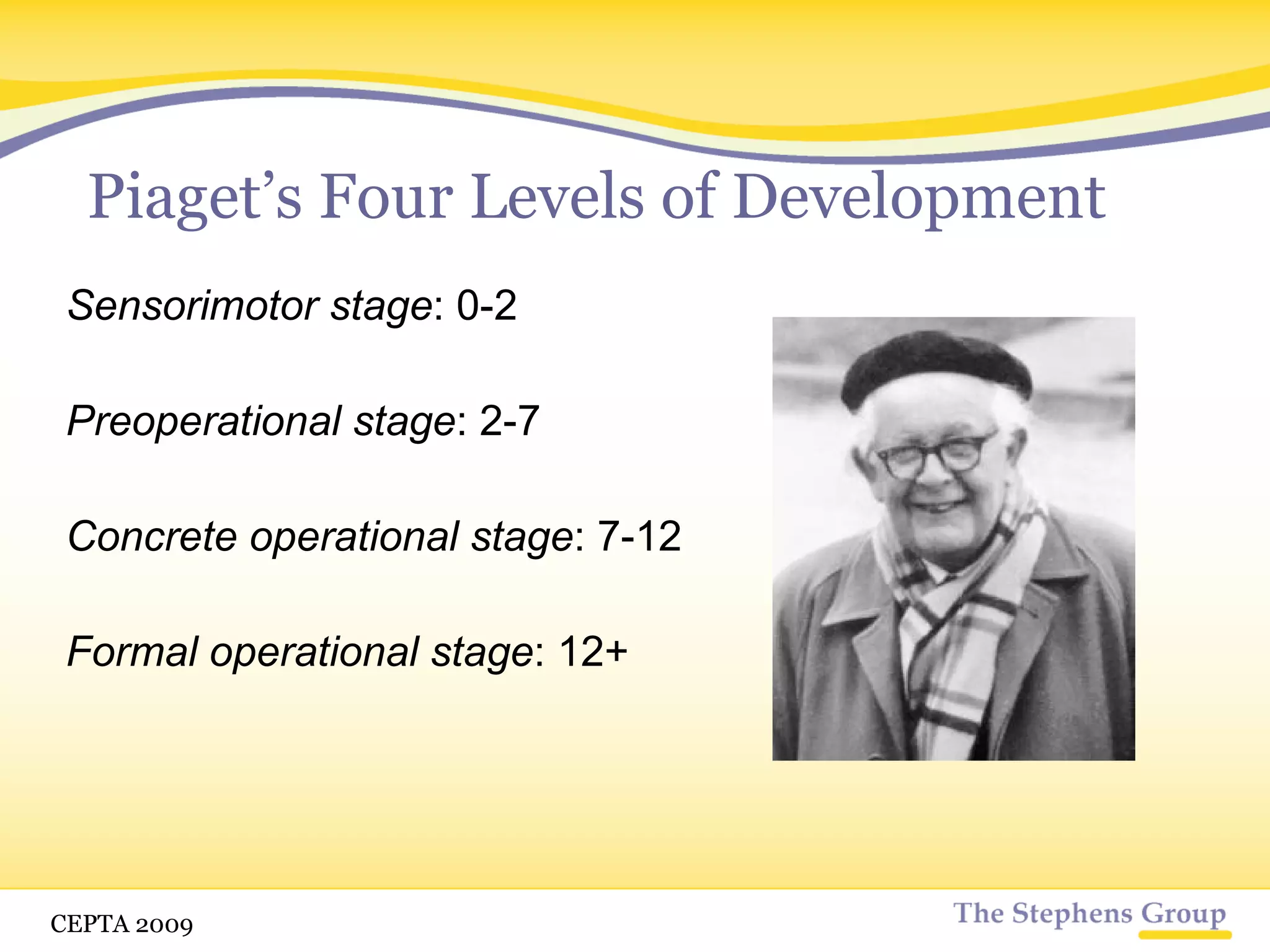
Piaget’s Four Levels of Development  Sensori-motor stage : 0-2 Pre-operational stage : 2-7 Concrete operational stage : 7-12 Formal operational stage : 12+ CETPA 2009
Sensori-motor Stage: 0-2 CETPA 2009
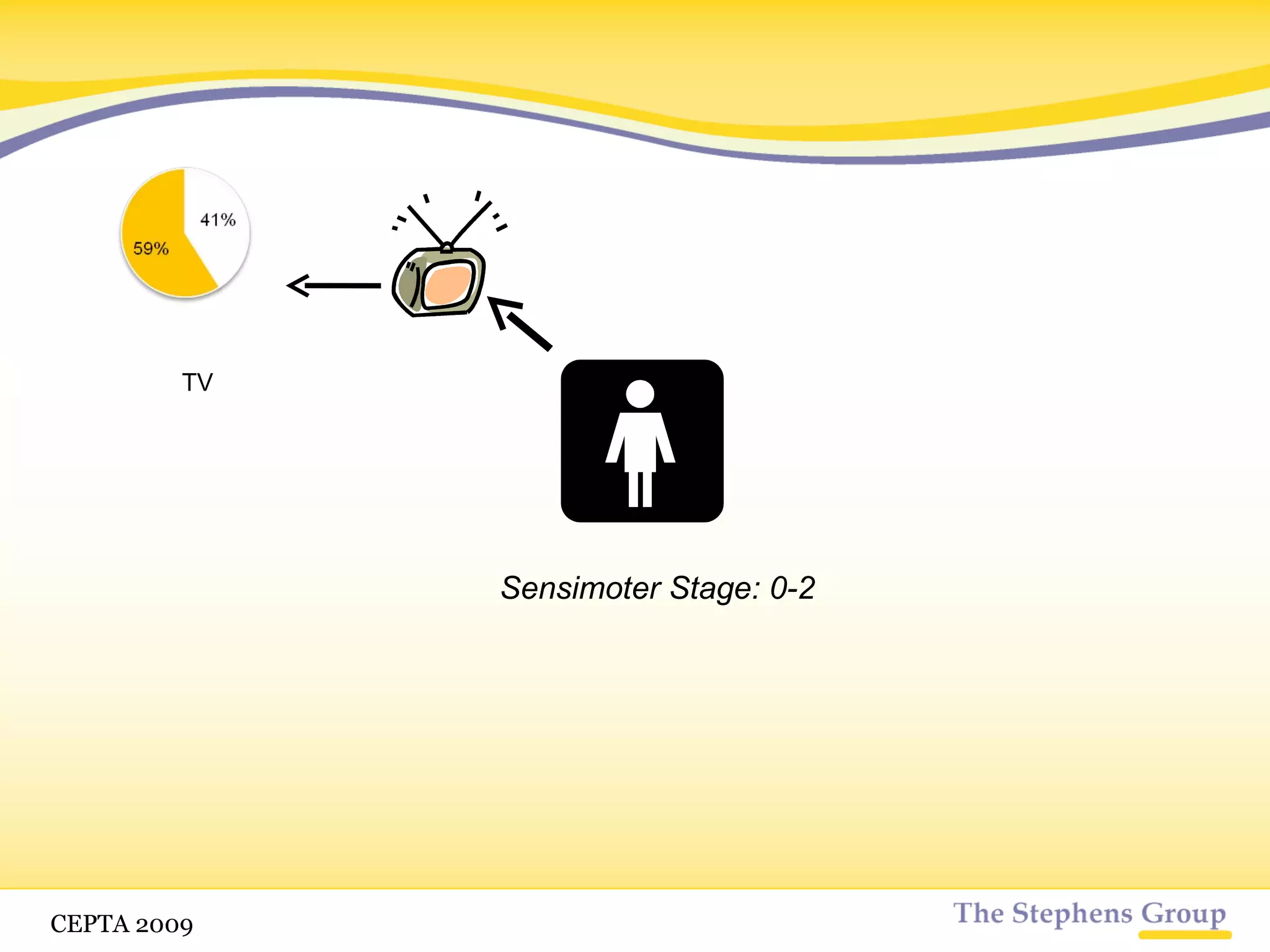
Sensori-motor Stage: 0-2 TV CETPA 2009
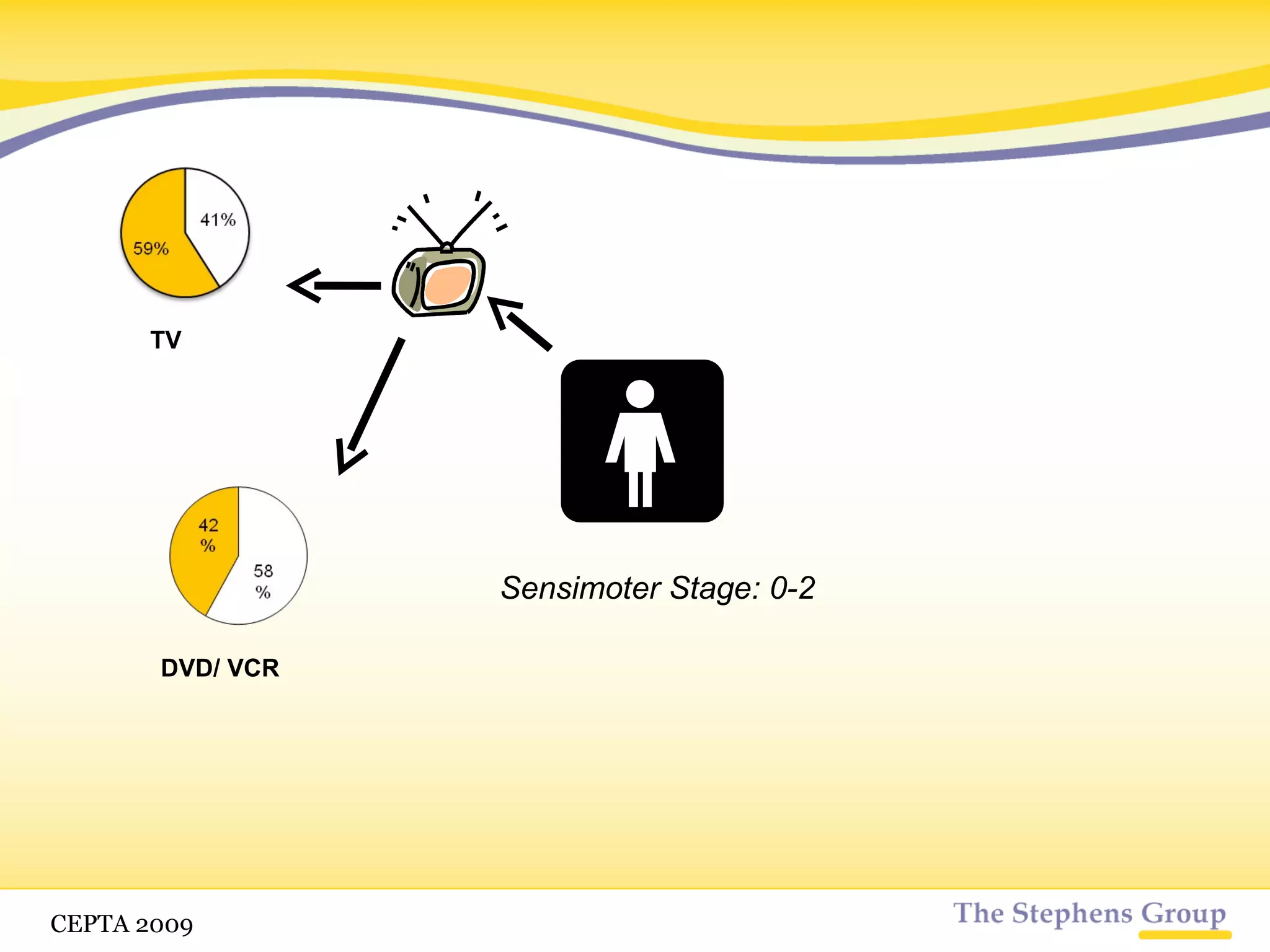
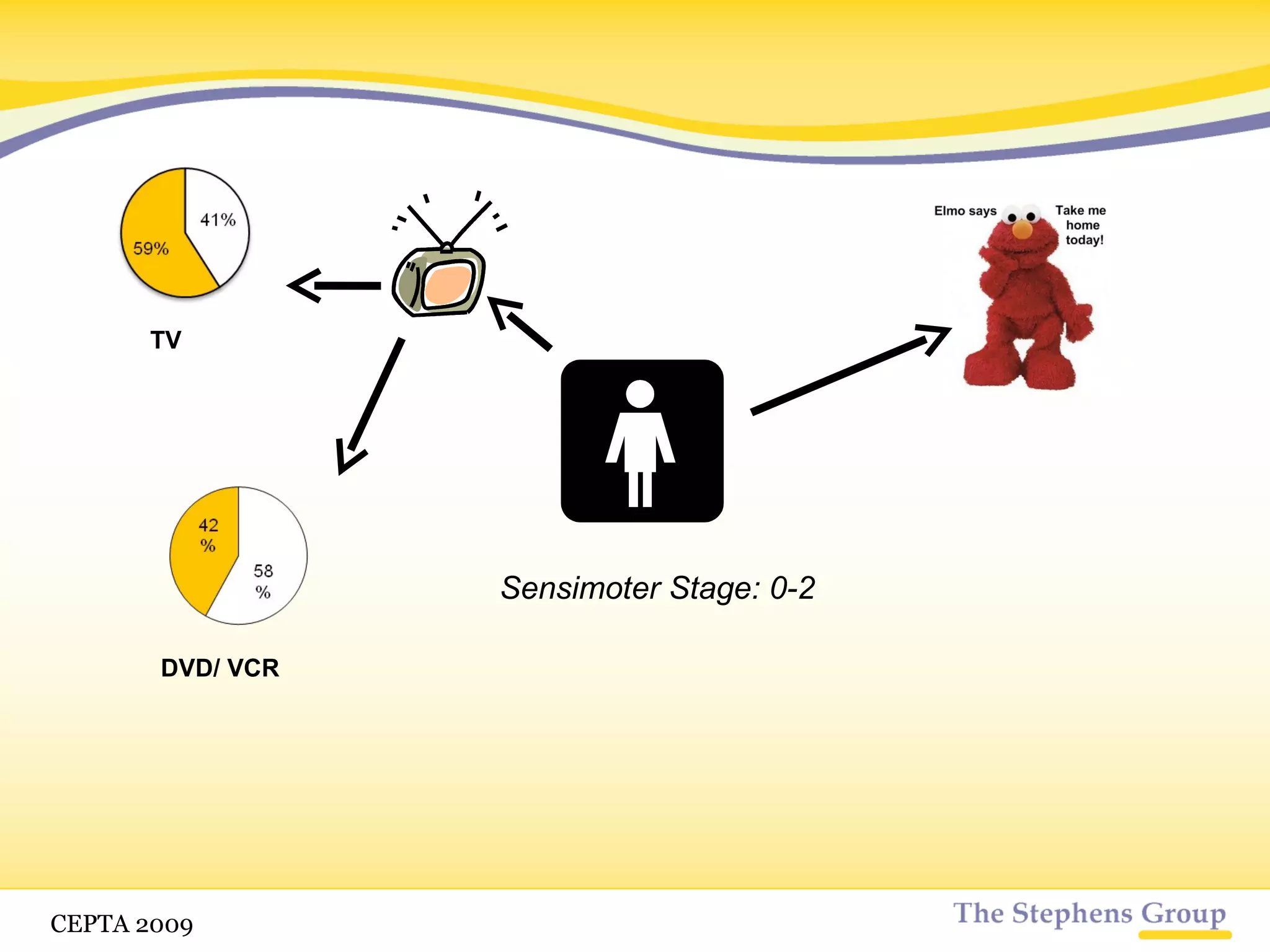
Sensori-motor Stage: 0-2 TV DVD/ VCR CETPA 2009
Preoperational stage : 2-7 CETPA 2009
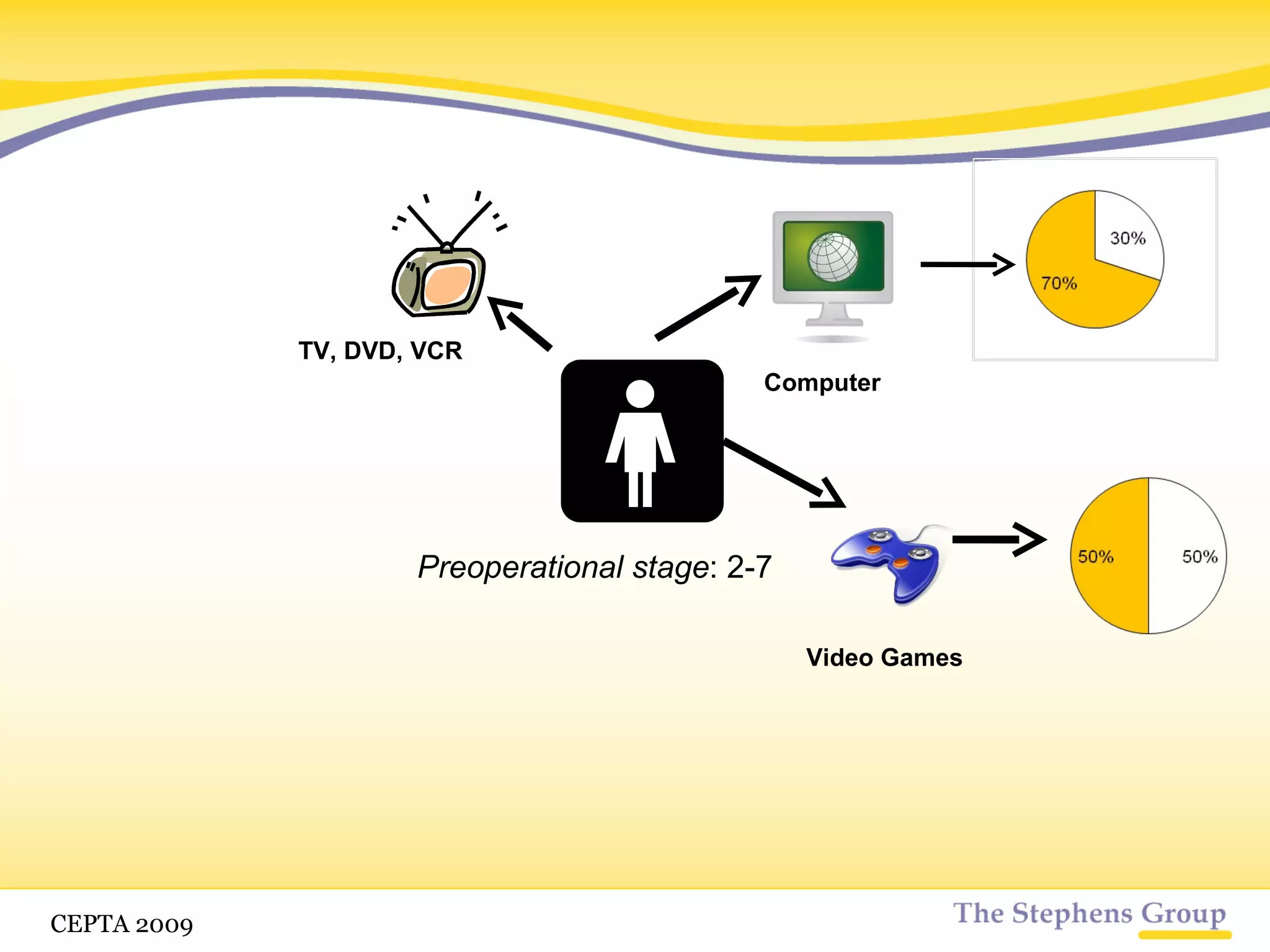
TV, DVD, VCR Preoperational stage : 2-7 Computer Video Games CETPA 2009
Concrete operational stage : 7-12 CETPA 2009
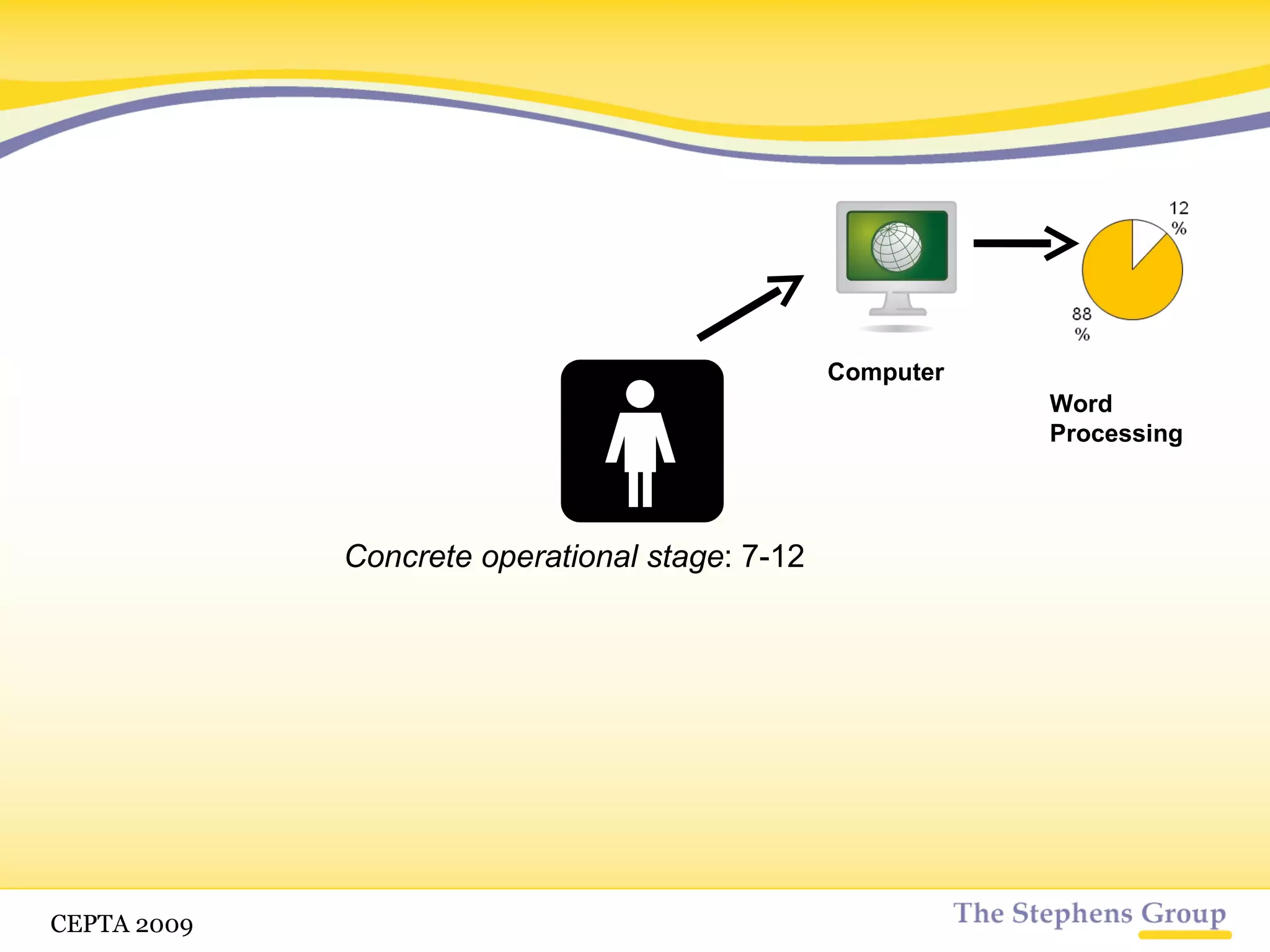
Concrete operational stage : 7-12 Computer Word Processing CETPA 2009
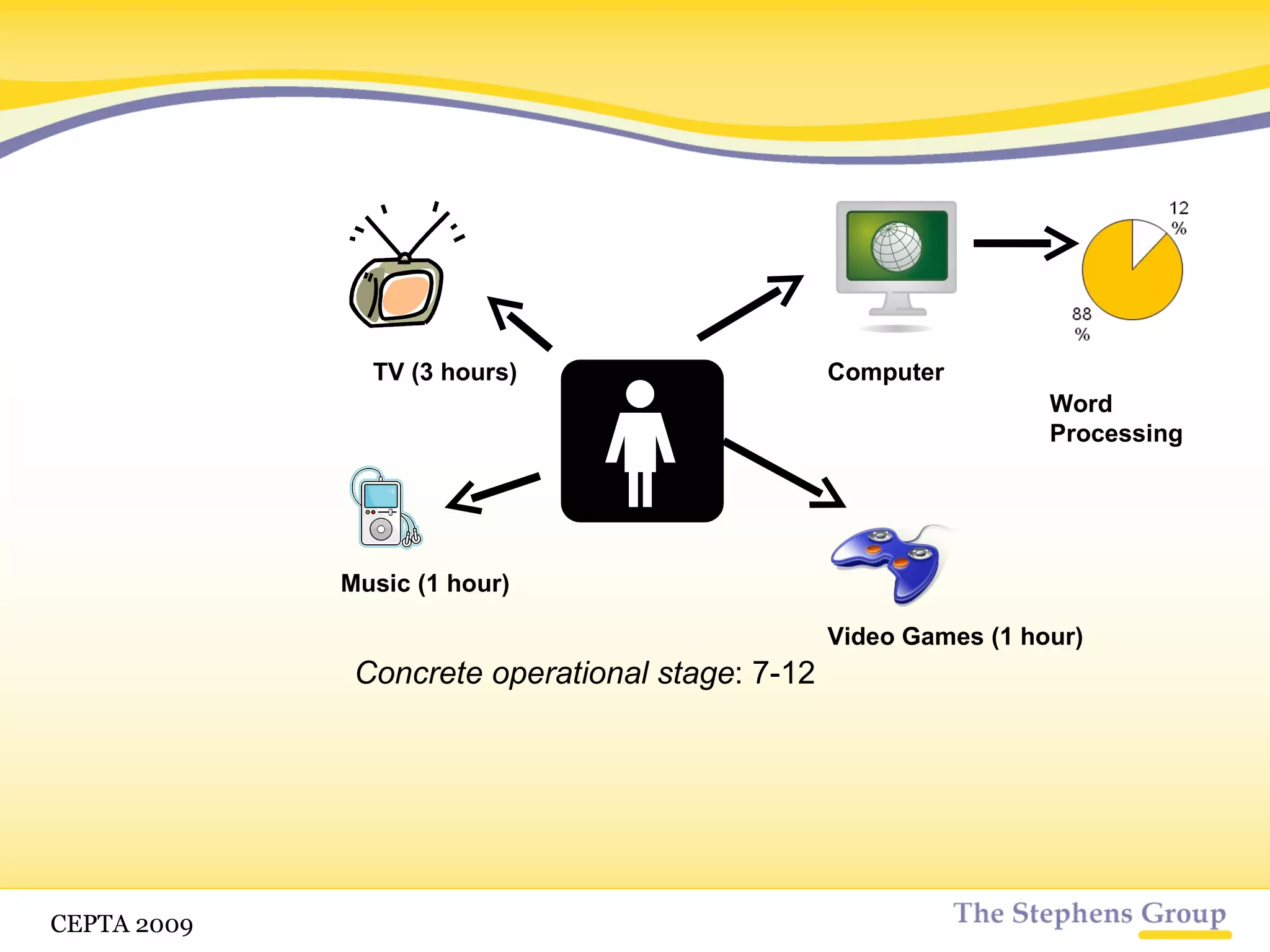
Concrete operational stage : 7-12 Computer Word Processing TV (3 hours) Music (1 hour) Video Games (1 hour) CETPA 2009
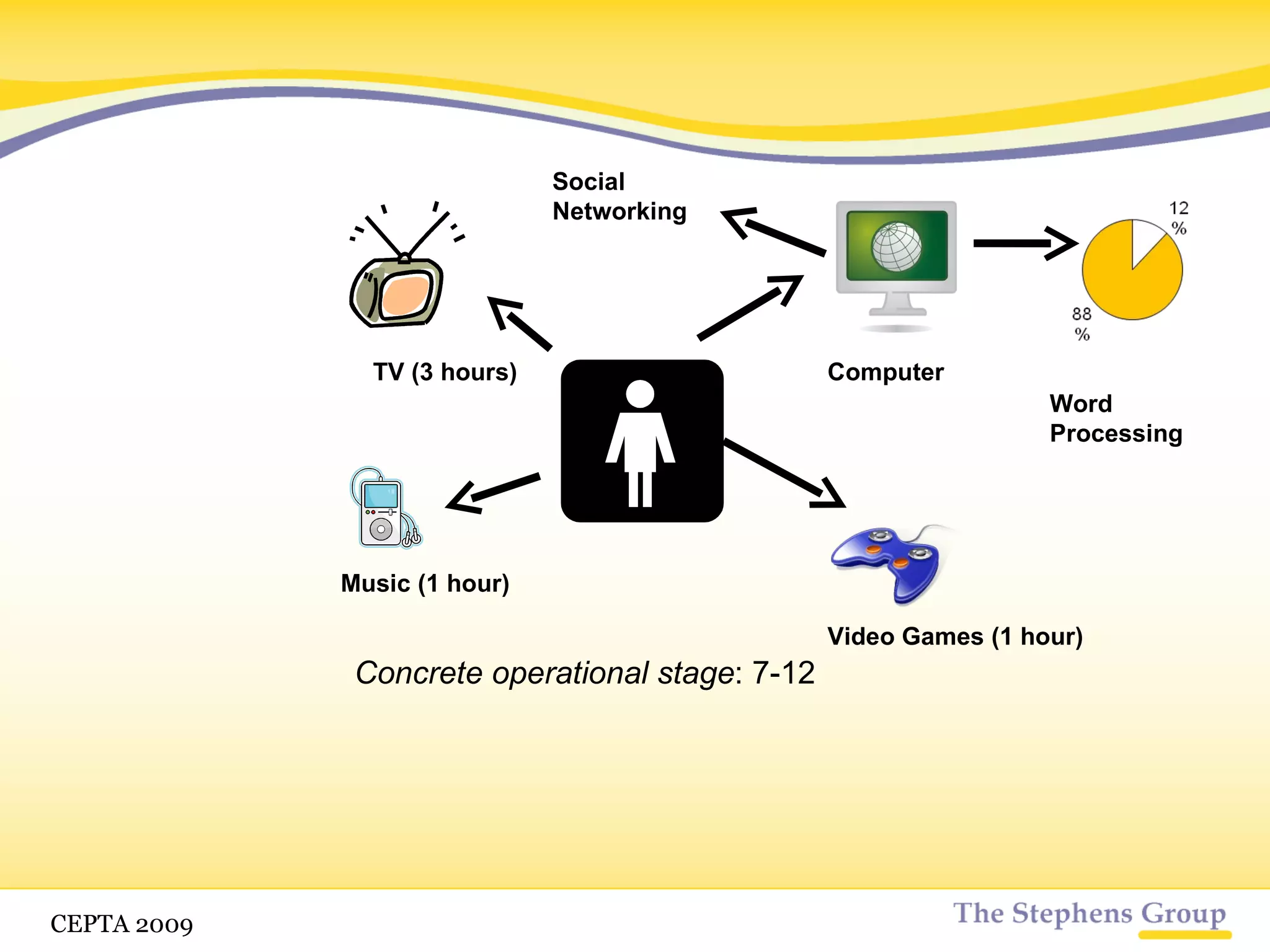
Concrete operational stage : 7-12 Computer Word Processing TV (3 hours) Music (1 hour) Video Games (1 hour) Social Networking CETPA 2009
Formal operational stage : 12+ CETPA 2009
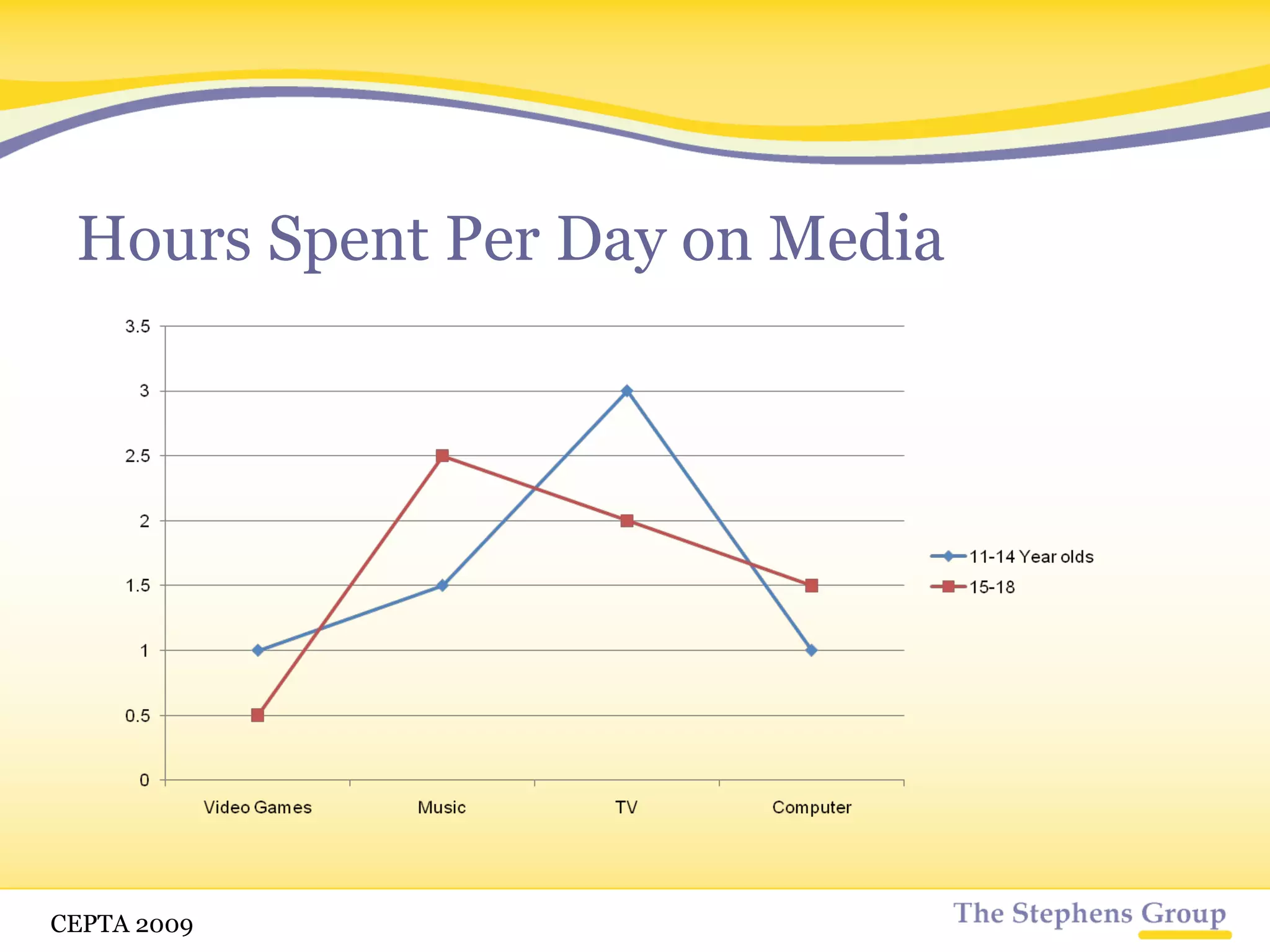
Hours Spent Per Day on Media CETPA 2009
What % of Teens: Social Network? Have their own blog? Instant Message (IM)? Create content and media to share on the web? CETPA 2009
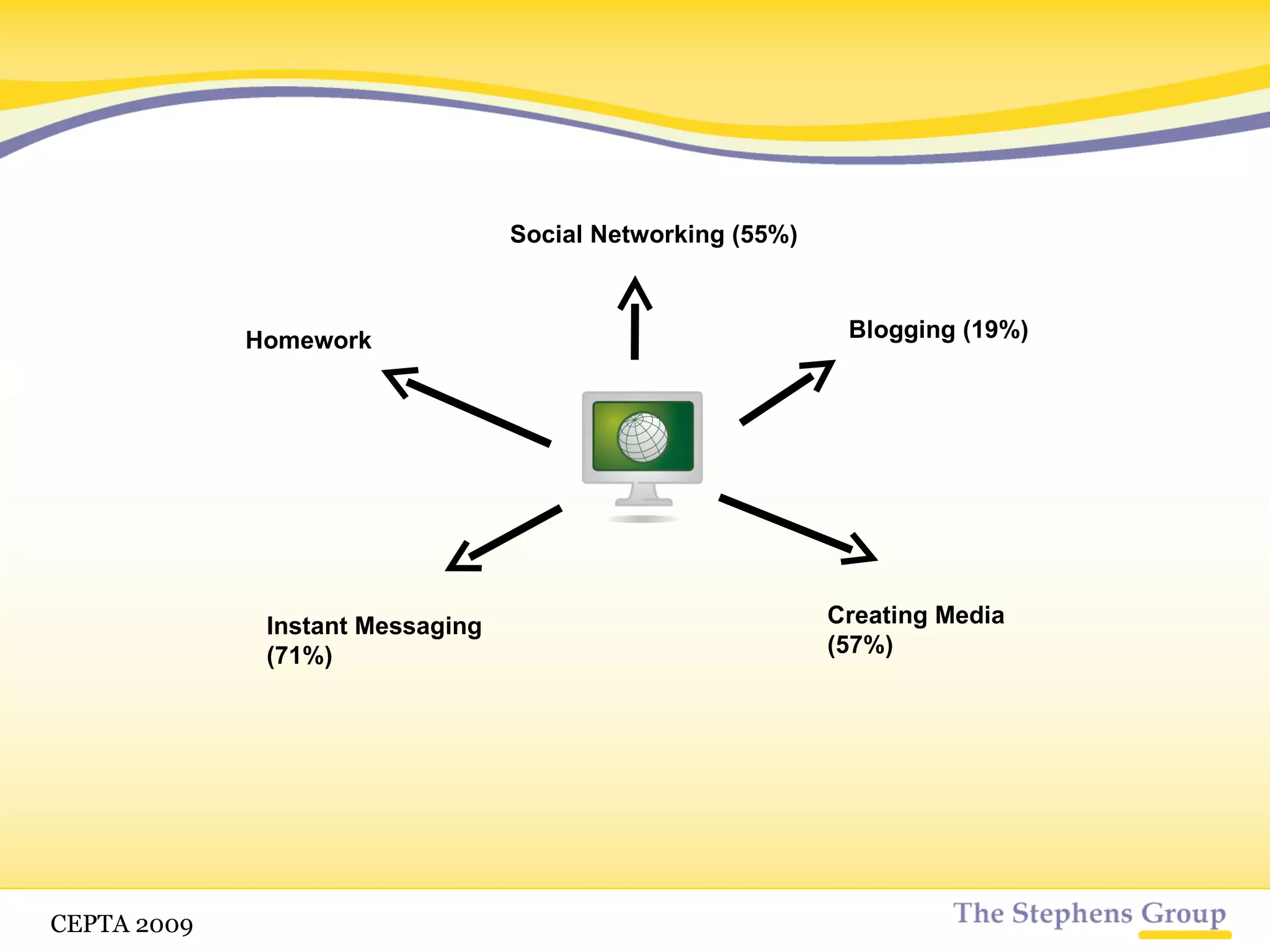
Homework Instant Messaging (71%) Blogging (19%) Creating Media (57%) Social Networking (55%) CETPA 2009
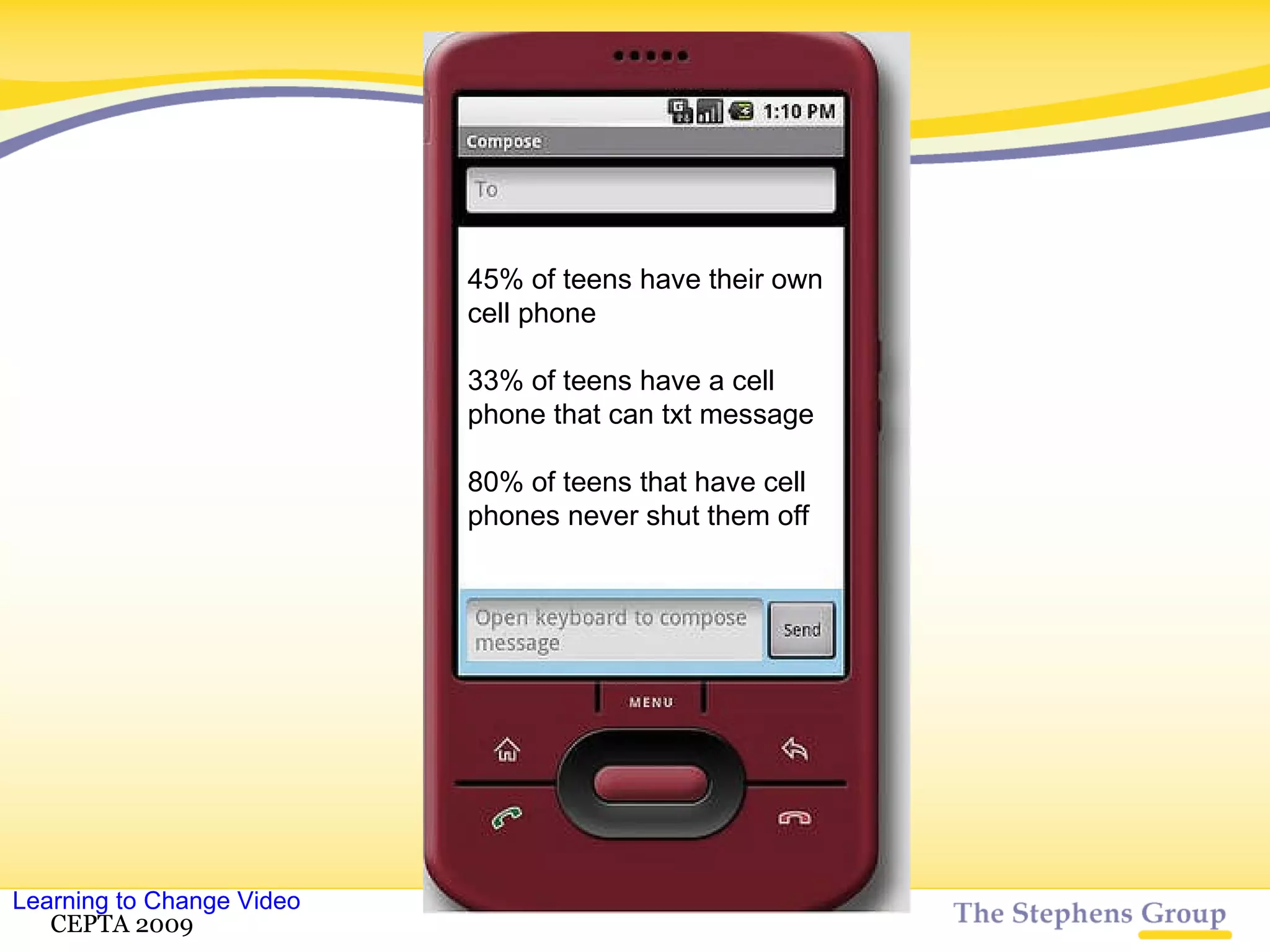
45% of teens have their own cell phone 33% of teens have a cell phone that can txt message 80% of teens that have cell phones never shut them off CETPA 2009
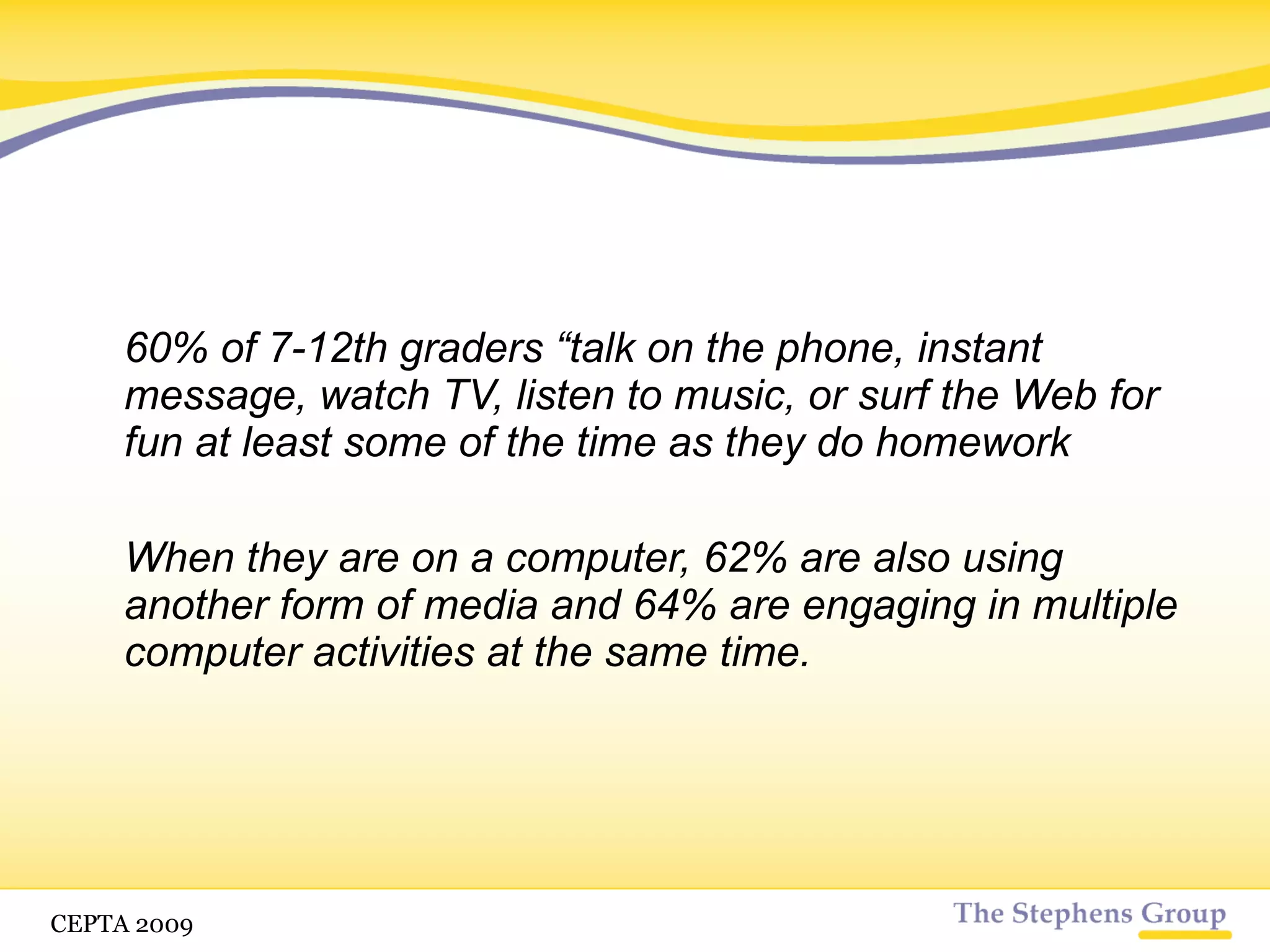
60% of 7-12th graders “talk on the phone, instant message, watch TV, listen to music, or surf the Web for fun at least some of the time as they do homework  When they are on a computer, 62% are also using another form of media and 64% are engaging in multiple computer activities at the same time. CETPA 2009
Part 2: Concerns about effects on New Media on Learning CETPA 2009
CETPA 2009
CETPA 2009
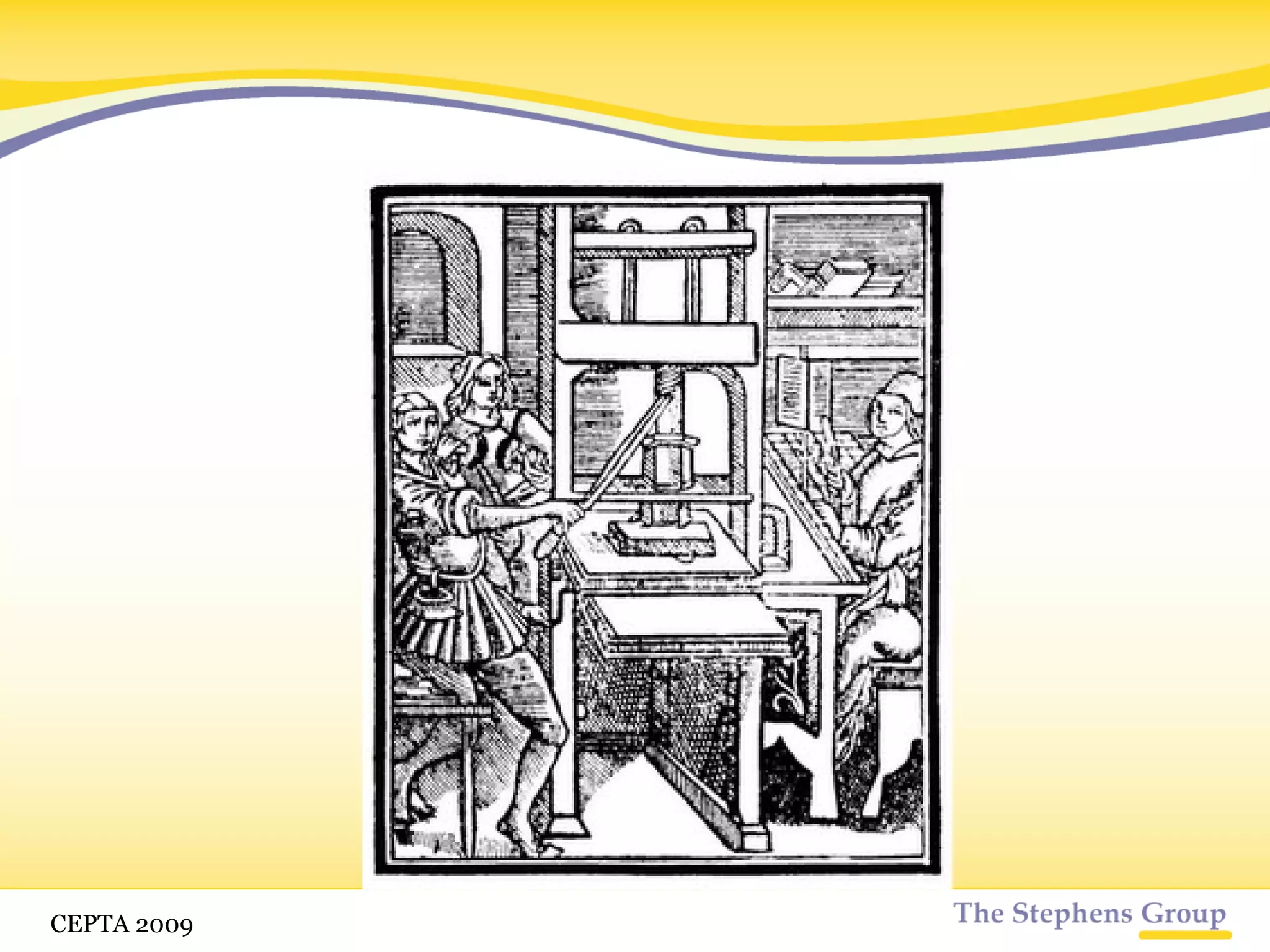
Part 3: The Gutenberg Revolution CETPA 2009
CETPA 2009
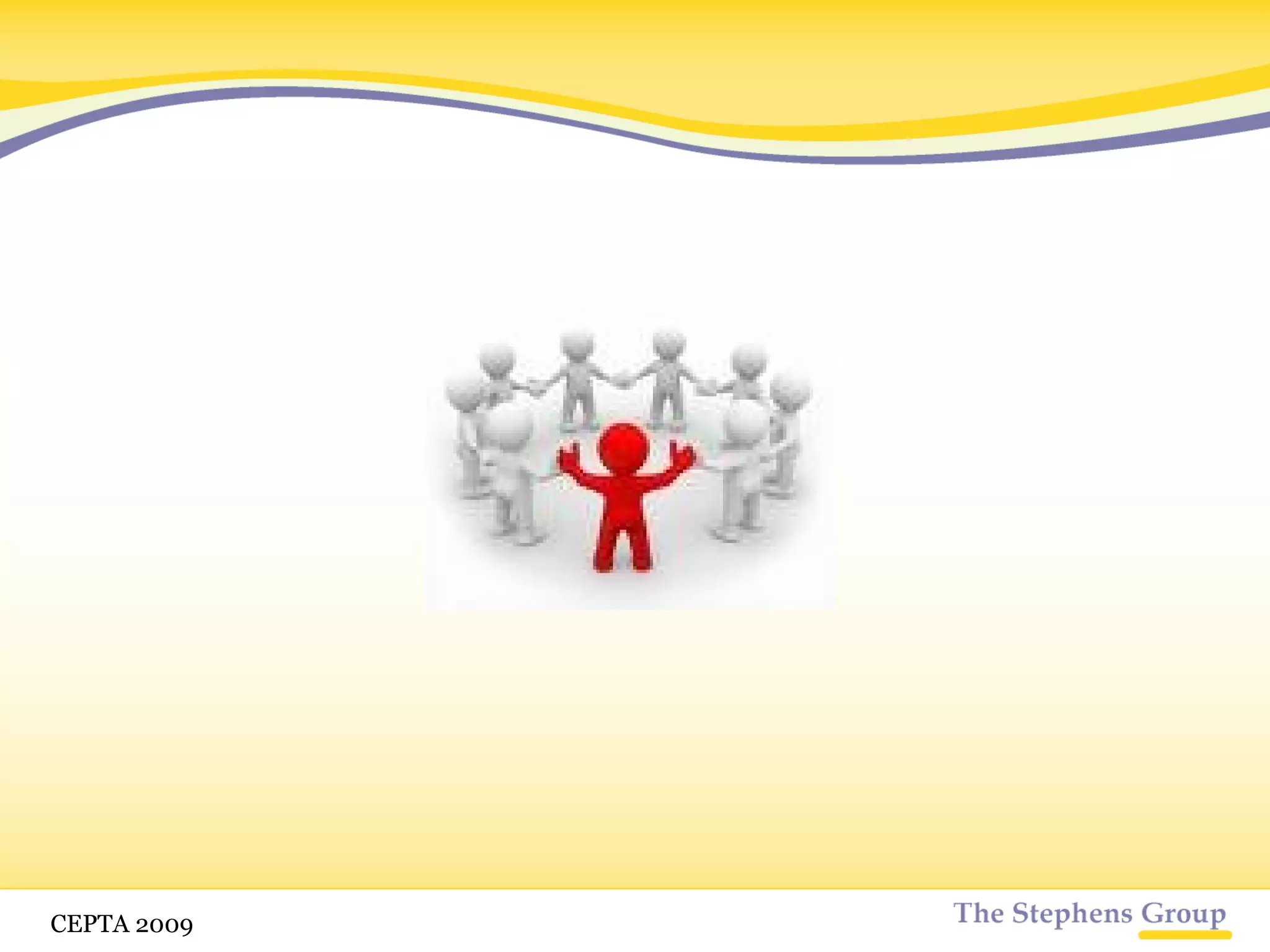
Part 4: What is learning? CETPA 2009
CETPA 2009
Part 5: How does instruction need to change to support the Post Gutenberg mind? CETPA 2009
Socio Technical Change Anything that we can Google  becomes less important for us to remember Implications for Education CETPA 2009
Socio Technical Change Anything that we can Google  becomes less important for us to remember Implications for Education How do we get students to make good use of all that knowledge? CETPA 2009
Socio Technical Change Anything that we can Google  becomes less important for us to remember Implications for Education How do we get students to make good use of all that knowledge? How will having that much and that kind of knowledge lead us to think differently? CETPA 2009
Socio Technical Change Anything that we can Google  becomes less important for us to remember Implications for Education How do we get students to make good use of all that knowledge? How will having that much and that kind of knowledge lead us to think differently? How are learning theories impacted when knowledge is no longer acquired in the linear manner? CETPA 2009
Socio Technical Change We live in a time of rampant change, increasing complexity, uncertainty, and change From chaos habits of knowledge and enrichment will begin to form Implications for Education CETPA 2009
Socio Technical Change We live in a time of rampant change, increasing complexity, uncertainty, and change From chaos habits of knowledge and enrichment will begin to form Implications for Education No more pre-packaged knowledge CETPA 2009
Socio Technical Change We live in a time of rampant change, increasing complexity, uncertainty, and change From chaos habits of knowledge and enrichment will begin to form Implications for Education No more pre-packaged knowledge Ability to self-organize CETPA 2009
Socio Technical Change We live in a time of rampant change, increasing complexity, uncertainty, and change From chaos habits of knowledge and enrichment will begin to form Implications for Education No more pre-packaged knowledge Ability to self-organize Promote more complex learning CETPA 2009
Socio Technical Change We live in a time of rampant change, increasing complexity, uncertainty, and change From chaos habits of knowledge and enrichment will begin to form Implications for Education No more pre-packaged knowledge Ability to self-organize Promote more complex learning Understand the context of media CETPA 2009
Socio Technical Change We live in a time of rampant change, increasing complexity, uncertainty, and change From chaos habits of knowledge and enrichment will begin to form Implications for Education No more pre-packaged knowledge Ability to self-organize Promote more complex learning Understand the context of media The ability to draw distinctions between important and unimportant information CETPA 2009
Socio Technical Change We live in a time of rampant change, increasing complexity, uncertainty, and change From chaos habits of knowledge and enrichment will begin to form Implications for Education No more pre-packaged knowledge Ability to self-organize Promote more complex learning Understand the context of media The ability to draw distinctions between important and unimportant information Shaping your environment and work style so you can better use your attitudinal networks CETPA 2009
Socio Technical Change Internet is creating new models of participation and sharing Implications for Education Challenges the design of learning environments CETPA 2009
Socio Technical Change Internet is creating new models of participation and sharing Implications for Education CETPA 2009
CETPA 2009
Socio Technical Change The organization and the individual are both learning organisms Implications for Education Web 2.0 applications can support this CETPA 2009
Clarkstown Central School DistrictK-12 "Constructing lesson plans and unit plans is no longer a solitary activity. It's a collaborative process that's happening not only with teachers on a building level team, but with teachers at a grade level from a variety of schools. Our teaching is made better as a result of this collective intelligence.” ~John Krouskoff, Director of Technology CETPA 2009
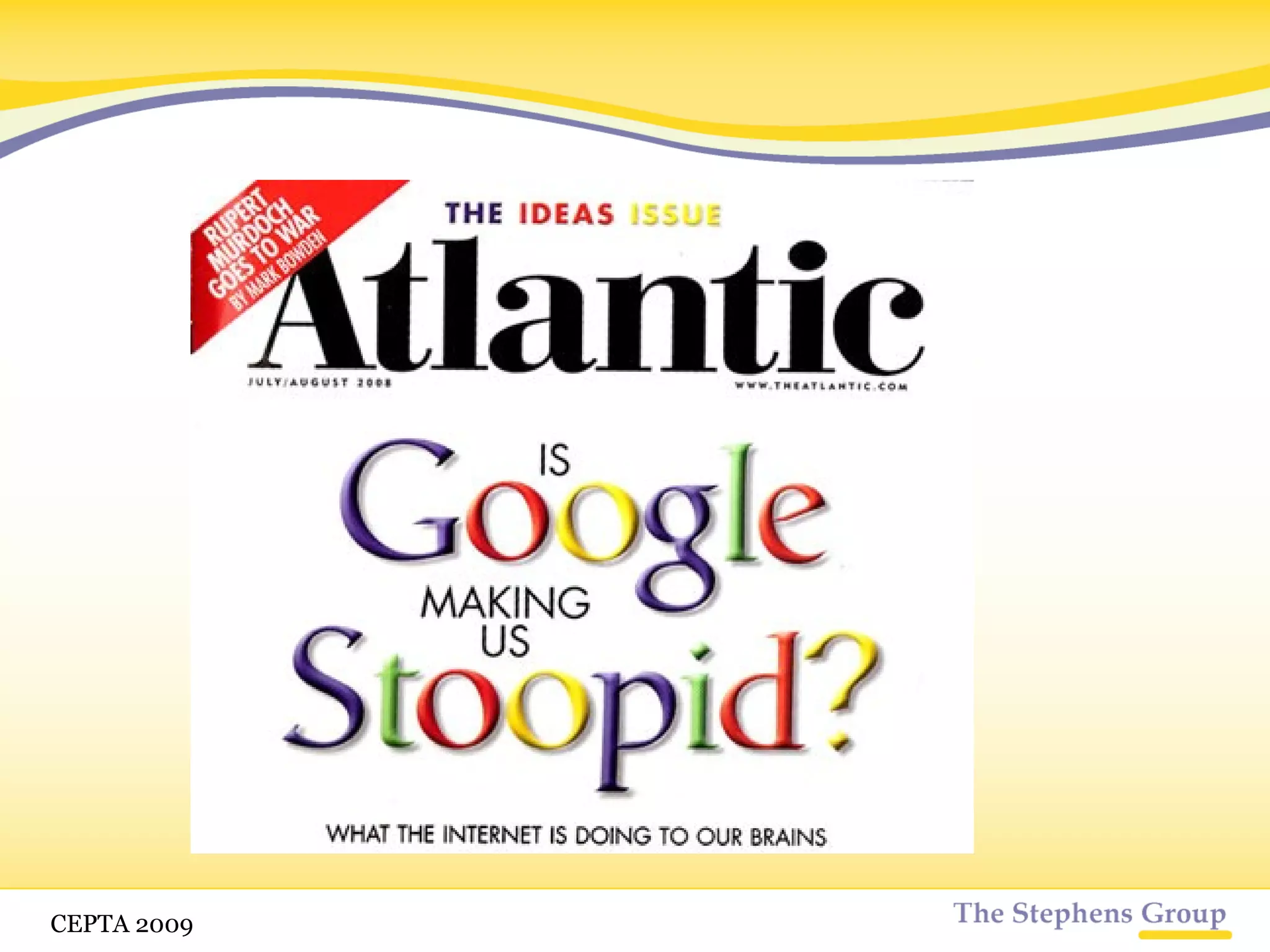
References: Jenkins, H., Clinton, K., Purushotma, R., Robison, A., & Weigel, M. (2006).  Confronting the Challenges of Participatory Culture: Media Education for the 21st Century : McArthur Foundation. Lenhart, A., Madden, M., & Hitlin, P. (2005).  Teens and technology, Youth are leading the transition to a fully wired and mobile nation : Pew Internet & American Life Project. Nicholas, C. (2008). Is Google making us stupid?  Atlantic Monthly, July/August 2008 . Rideout, V. J., Elizabeth A. Vandewater, and Ellen A. Wartella. (2003).  Zero to Six: Electronic Media in the Lives of Infants, Toddlers and Preschoolers : The Kaiser Family Foundation. Stephen, J. (2006).  Everything bad is Good for you: How today's popular culture is actually making us smarter : Penguin Publisher. Weigel, M., & Heikkinen, K. (2007).  Developing Minds with Digital Media: Habits of Mind in the YouTube Era : Harvard University. CETPA 2009
Contact Information The Stephens Group LLC 203 Prospect Ave. Long Beach, CA 90803 [email_address]   http://tstephens@thestephensgroup.com (800) 408.4935 CETPA 2009

How Media Is Changing The Way We Learn

  • 1.
    How Media isChanging the Way We Learn Tammy Stephens CEO, The Stephens Group LLC CETPA 2009
  • 2.
    Today’s Discussion Part1:Framing the conversation around child development and new digital media Part 2: Concerns about the effect of new media on learning Part 3: The Gutenberg Revolution Part 4: What is learning? Part 5: How does instruction need to change for the Post Gutenberg mind? CETPA 2009
  • 3.
    Part 1: Framingthe conversation around child development and new digital media CETPA 2009
  • 4.
    Piaget’s Four Levelsof Development Sensori-motor stage : 0-2 Pre-operational stage : 2-7 Concrete operational stage : 7-12 Formal operational stage : 12+ CETPA 2009
  • 5.
  • 6.
  • 7.
    Sensori-motor Stage: 0-2TV DVD/ VCR CETPA 2009
  • 8.
    Sensori-motor Stage: 0-2TV DVD/ VCR CETPA 2009
  • 9.
    Preoperational stage :2-7 CETPA 2009
  • 10.
    TV, DVD, VCRPreoperational stage : 2-7 Computer Video Games CETPA 2009
  • 11.
    Concrete operational stage: 7-12 CETPA 2009
  • 12.
    Concrete operational stage: 7-12 Computer Word Processing CETPA 2009
  • 13.
    Concrete operational stage: 7-12 Computer Word Processing TV (3 hours) Music (1 hour) Video Games (1 hour) CETPA 2009
  • 14.
    Concrete operational stage: 7-12 Computer Word Processing TV (3 hours) Music (1 hour) Video Games (1 hour) Social Networking CETPA 2009
  • 15.
    Formal operational stage: 12+ CETPA 2009
  • 16.
    Hours Spent PerDay on Media CETPA 2009
  • 17.
    What % ofTeens: Social Network? Have their own blog? Instant Message (IM)? Create content and media to share on the web? CETPA 2009
  • 18.
    Homework Instant Messaging(71%) Blogging (19%) Creating Media (57%) Social Networking (55%) CETPA 2009
  • 19.
    45% of teenshave their own cell phone 33% of teens have a cell phone that can txt message 80% of teens that have cell phones never shut them off CETPA 2009
  • 20.
    60% of 7-12thgraders “talk on the phone, instant message, watch TV, listen to music, or surf the Web for fun at least some of the time as they do homework When they are on a computer, 62% are also using another form of media and 64% are engaging in multiple computer activities at the same time. CETPA 2009
  • 21.
    Part 2: Concernsabout effects on New Media on Learning CETPA 2009
  • 22.
  • 23.
  • 24.
    Part 3: TheGutenberg Revolution CETPA 2009
  • 25.
  • 26.
    Part 4: Whatis learning? CETPA 2009
  • 27.
  • 28.
    Part 5: Howdoes instruction need to change to support the Post Gutenberg mind? CETPA 2009
  • 29.
    Socio Technical ChangeAnything that we can Google becomes less important for us to remember Implications for Education CETPA 2009
  • 30.
    Socio Technical ChangeAnything that we can Google becomes less important for us to remember Implications for Education How do we get students to make good use of all that knowledge? CETPA 2009
  • 31.
    Socio Technical ChangeAnything that we can Google becomes less important for us to remember Implications for Education How do we get students to make good use of all that knowledge? How will having that much and that kind of knowledge lead us to think differently? CETPA 2009
  • 32.
    Socio Technical ChangeAnything that we can Google becomes less important for us to remember Implications for Education How do we get students to make good use of all that knowledge? How will having that much and that kind of knowledge lead us to think differently? How are learning theories impacted when knowledge is no longer acquired in the linear manner? CETPA 2009
  • 33.
    Socio Technical ChangeWe live in a time of rampant change, increasing complexity, uncertainty, and change From chaos habits of knowledge and enrichment will begin to form Implications for Education CETPA 2009
  • 34.
    Socio Technical ChangeWe live in a time of rampant change, increasing complexity, uncertainty, and change From chaos habits of knowledge and enrichment will begin to form Implications for Education No more pre-packaged knowledge CETPA 2009
  • 35.
    Socio Technical ChangeWe live in a time of rampant change, increasing complexity, uncertainty, and change From chaos habits of knowledge and enrichment will begin to form Implications for Education No more pre-packaged knowledge Ability to self-organize CETPA 2009
  • 36.
    Socio Technical ChangeWe live in a time of rampant change, increasing complexity, uncertainty, and change From chaos habits of knowledge and enrichment will begin to form Implications for Education No more pre-packaged knowledge Ability to self-organize Promote more complex learning CETPA 2009
  • 37.
    Socio Technical ChangeWe live in a time of rampant change, increasing complexity, uncertainty, and change From chaos habits of knowledge and enrichment will begin to form Implications for Education No more pre-packaged knowledge Ability to self-organize Promote more complex learning Understand the context of media CETPA 2009
  • 38.
    Socio Technical ChangeWe live in a time of rampant change, increasing complexity, uncertainty, and change From chaos habits of knowledge and enrichment will begin to form Implications for Education No more pre-packaged knowledge Ability to self-organize Promote more complex learning Understand the context of media The ability to draw distinctions between important and unimportant information CETPA 2009
  • 39.
    Socio Technical ChangeWe live in a time of rampant change, increasing complexity, uncertainty, and change From chaos habits of knowledge and enrichment will begin to form Implications for Education No more pre-packaged knowledge Ability to self-organize Promote more complex learning Understand the context of media The ability to draw distinctions between important and unimportant information Shaping your environment and work style so you can better use your attitudinal networks CETPA 2009
  • 40.
    Socio Technical ChangeInternet is creating new models of participation and sharing Implications for Education Challenges the design of learning environments CETPA 2009
  • 41.
    Socio Technical ChangeInternet is creating new models of participation and sharing Implications for Education CETPA 2009
  • 42.
  • 43.
    Socio Technical ChangeThe organization and the individual are both learning organisms Implications for Education Web 2.0 applications can support this CETPA 2009
  • 44.
    Clarkstown Central SchoolDistrictK-12 "Constructing lesson plans and unit plans is no longer a solitary activity. It's a collaborative process that's happening not only with teachers on a building level team, but with teachers at a grade level from a variety of schools. Our teaching is made better as a result of this collective intelligence.” ~John Krouskoff, Director of Technology CETPA 2009
  • 45.
    References: Jenkins, H.,Clinton, K., Purushotma, R., Robison, A., & Weigel, M. (2006). Confronting the Challenges of Participatory Culture: Media Education for the 21st Century : McArthur Foundation. Lenhart, A., Madden, M., & Hitlin, P. (2005). Teens and technology, Youth are leading the transition to a fully wired and mobile nation : Pew Internet & American Life Project. Nicholas, C. (2008). Is Google making us stupid? Atlantic Monthly, July/August 2008 . Rideout, V. J., Elizabeth A. Vandewater, and Ellen A. Wartella. (2003). Zero to Six: Electronic Media in the Lives of Infants, Toddlers and Preschoolers : The Kaiser Family Foundation. Stephen, J. (2006). Everything bad is Good for you: How today's popular culture is actually making us smarter : Penguin Publisher. Weigel, M., & Heikkinen, K. (2007). Developing Minds with Digital Media: Habits of Mind in the YouTube Era : Harvard University. CETPA 2009
  • 46.
    Contact Information TheStephens Group LLC 203 Prospect Ave. Long Beach, CA 90803 [email_address] http://tstephens@thestephensgroup.com (800) 408.4935 CETPA 2009