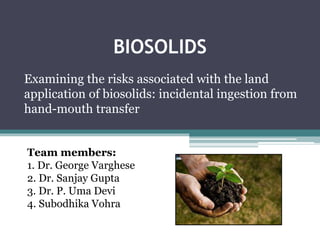
BIOSOLIDS
Examining the risks associated with the land
application of biosolids: incidental ingestion from
hand-mouth transfer
Team members:
1. Dr. George Varghese
2. Dr. Sanjay Gupta
3. Dr. P. Uma Devi
4. Subodhika Vohra
INTRODUCTION
• Biosolids are nutrient-rich organic materials obtained
from the treatment of domestic wastewater in a
wastewater treatment facility.
• Biosolids are rich source of organic matter, Nitrogen,
Potassium and Phosphorus, iron therefore assists in the
improvement of soil structure thus can be used as bio-
fertilizer.
• Biosolids usually are applied at rates designed to supply
crops with adequate nitrogen, phosphorus and micro-
nutrients; that reduce fertilizer requirements.
• Due to sewage sludge origin, biosolids contains a
number of human enteric pathogens, including
bacteria, viruses, and parasites.
• The levels of such pathogenic contaminations
depends on the pathogen burden in a particular
country, the volume of sewage produced, and the
type of treatment of the biosolids.
• Therefore the pathogens load in biosolids may
vary greatly in different geographical regions
and country to country.
• Due to high pathogenic potential, biosolids are getting
treated before use.
• The land application of biosolids that have not been treated
to remove all human pathogens poses serious threat to the
farmers and workers through direct human contact
contaminations, including hand contact.
• Hand contact with biosolid-amended soil followed by hand-
to-mouth contact and accidental ingestion creates a route
for enteric infection in people who come in close contact
with agricultural land.
• The most obvious risk group for this exposure is the
farmers and workers, either when applying them to land or
working on land where application has taken place.
PROBLEM FORMULATION
• The problem addressed in this study is
quantification of the risk posed to human health
by the practice of applying bio-solids to land.
• The pathogens present in the bio-solids can
infect the human being exposed to the practice
through various pathways.
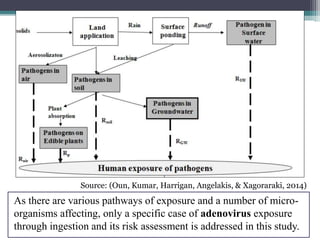
Source: (Oun, Kumar, Harrigan, Angelakis, & Xagoraraki, 2014)
As there are various pathways of exposure and a number of micro-
organisms affecting, only a specific case of adenovirus exposure
through ingestion and its risk assessment is addressed in this study.
SCOPE
• Previous studies have shown that adenovirus was the
pathogen that presented the greatest risk across the
different pathways (Gurian, et al. 2012). The study has
also reported that the incidental ingestion of soil was
found to present the highest risk among the various
pathways considered.
• Further, when class B bio-solid is applied to private land,
USEPA guidelines recommend that entry to this land be
restricted for 30 days.
Scope
Only one pathogen, i. e. adenovirus
The exposure to pathogens through inadvertent ingestion
of soil
Exposure time up to 31 days
• This study also addresses the effect of inactivation of
pathogens (decay rate) in the environment. Inactivation
of adenovirus under three different temperatures, 4oC,
20oC and 35oC is considered in the analysis.
DOSE RESPONSE
Risk of infection (Riskinf) depends on exposed dose
(Doseexp), pathogen type (Pathogen), and pathogen-
specific dose-response model (ModelD-R).
Different dose-response models exist for different
pathogen-exposure route pairs.
In general, two dose-response models:
“Exponential model” and “Beta-Poisson
model” have been extensively used to calculate the
risk of infection from microbial exposure
The exponential model has only one parameter (i.e., r :
fraction of the ingested microorganisms that survive to
initiate infections or host-microorganisms interaction
probability.
The Beta-Poisson model has two parameters (i.e., a and b),
which can be related to the median effective dose (Doseexp,
50%, i.e., a dose required to infect 50% of the population).
For adenovirus the exponential model has been
proved to be applicable. The equation is as follows.
𝑅𝑖𝑠𝑘𝑖𝑛𝑓,𝑒𝑥𝑝𝑡𝑙 = 1 − 𝑒(−𝑟𝑥𝐷𝑜𝑠𝑒 𝑒𝑥𝑝)
Adenovirus
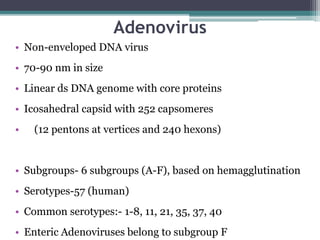
• Non-enveloped DNA virus
• 70-90 nm in size
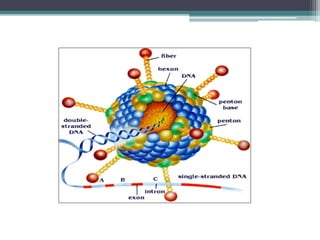
• Linear ds DNA genome with core proteins
• Icosahedral capsid with 252 capsomeres
• (12 pentons at vertices and 240 hexons)
• Subgroups- 6 subgroups (A-F), based on hemagglutination
• Serotypes-57 (human)
• Common serotypes:- 1-8, 11, 21, 35, 37, 40
• Enteric Adenoviruses belong to subgroup F
TRANSMISSION
• Droplets
• Fecal-oral route
• Direct and through poorly chlorinated water
• Fomites
• close personal contact, ( touching or shaking hands)
• coughing and sneezing
• touching an object or surface with adenoviruses on it then touching your mouth,
nose, or eyes before washing your hands
• Some adenoviruses can spread through an infected person’s stool, example,( during
diaper changing can also spread through the water, such as swimming pools),
• Incubation period- 2-14 days
• Infective period continues for weeks
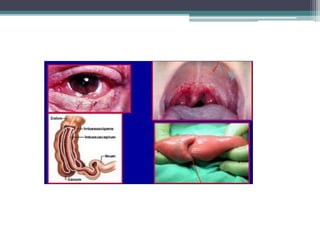
SIGNS AND SYMTOMS
• Sore throat (pharyngitis)
• Bronchitis
• Pneumonia
• Diarrhea
• Pink eye (conjunctivitis) Keratoconjunctivitis
• Fever
• Bladder inflammation or infection (cystitis)
• Inflammation of stomach and intestines (gastroenteritis)
• pharyngoconjunctival fever, often seen in small outbreaks among school-
age kids,
PATHOGENISIS
• replication in nucleus; very host dependent
• Viremia
• persistence in kidneys; reactivation with immune
compromise
• inapparent infection; hemorrhagic cystitis;
• Persistent infection occurs in the tonsils.
TREATMENT
• Most adenovirus infections are mild and typically require only
treatment of symptoms.
• There is no specific therapy for adenoviruses.
• Bed rest and isolation to prevent spread of infection.
• Drinking plenty of water and clear fluids. This prevents dehydration.
• Pracetamol/Acetaminophen or Ibuprofen is most commonly used.
• Humidifiers may be prescribed to ease a sore throat and blocked
nose.
• Lozenges and cough drops may be taken to ease the throat and
cough.
TREATMENT Contd..
• In those with conjunctivitis eye drops with antibiotics
and ointments are advised.
• Complications such as pneumonia need to be managed
in the hospital after admission.
• Those with meningitis also need to be admitted to the
hospital and managed with antibiotics, oxygen,
intravenous fluids etc
• Cidofovir is an antiviral agent that has been used to treat
severe adenovirus infections in people with suppressed
or low immune systems
VACCINE
• Oral live attenuated vaccine
• Strains 4, 7
• Used in military recruits
• Manufacture of vaccine was halted in 1996
PREVENTION
• washing your hands often with soap and water
• covering your mouth and nose when coughing or
sneezing
• not touching your eyes, nose, or mouth
• avoiding close contact with people who are sick
• staying home when you are sick
• Frequent hand washing is especially important in
childcare settings.
Exposure Assessment- Assumptions
Item/Parameter Details/Magnitude Remarks/Comment
s
Pathogen Adenovirus Rated significant by
Gurian, et al. 2012
Exposure route Direct, inadvertent ingestion of
soil
Rated significant by
Gurian, et al. 2012
Receptors 1. Adult conducting moderate
outdoor activity (Incidental
exposure)
2. Adult conducting rigorous
activity (Occupational
exposure)
USEPA 1997
Ingested quantity of soil 1. Incidental exposure- 0.05g
2. Occupational exposure- 0.48g
USEPA 1997
Number of adenovirus/g
of dry biosolid
3.7 to 22.6 with an arithmetic
mean value of 17.6
Pepper et al. 2010
Dilution of bio-solid in soil 1.75×10⁻³ Brooks, et al. 2012
Exposure Assessment- Assumptions
Item/Parameter Details/Magnitude Remarks/Comments
Exposure measured
on
Day 0, Day 1, Day 7, Day 14, Day 30
and Day 31 after biosolid application
30 days is the limit of
restriction recommended
by USEPA
Temperatures
considered
4oC, 20oC and 35o C
Soil inactivation rates of
adenovirus were available
for these temperatures
Log10 inactivation
rate of adenovirus
in soil (day-1)
For days 0 and 1: -0.0719 (4oC), -
0.1164 (20oC), -0.8880 (35oC)
For days 7, 14, 30 and 31: -0.0606
(4oC), -0.1220 (20oC), -0.7737 (35oC)
Davies, et al. 2006
At days 0 and 1,the soil
assumed wet and dry in
other days
Dose-response
parameter, r (day-1)
0.42 Crabtree et al.1997
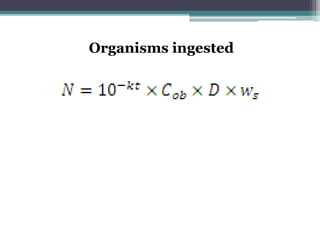
Organisms ingested
Risk Characterization
Incidental Exposure Occupational Exposure
Day Temp Average Lower Upper Average Lower Upper
0
4 6.4659E-04 1.3597E-04 8.3021E-04 6.1900E-03 1.3045E-03 7.9416E-03
20 6.4659E-04 1.3597E-04 8.3021E-04 6.1900E-03 1.3045E-03 7.9416E-03
35 6.4659E-04 1.3597E-04 8.3021E-04 6.1900E-03 1.3045E-03 7.9416E-03
1
4 5.4796E-04 1.1522E-04 7.0358E-04 5.2481E-03 1.1056E-03 6.7340E-03
20 4.9461E-04 1.0400E-04 6.3508E-04 4.7382E-03 9.9796E-04 6.0801E-03
35 8.3705E-05 1.7598E-05 1.0748E-04 8.0328E-04 1.6892E-04 1.0314E-03
7
4 2.4351E-04 5.1197E-05 3.1268E-04 2.3353E-03 4.9139E-04 2.9977E-03
20 9.0521E-05 1.9031E-05 1.1624E-04 8.6867E-04 1.8268E-04 1.1153E-03
35 2.4824E-09 5.2187E-10 3.1876E-09 2.3831E-08 5.0099E-09 3.0601E-08
14
4 9.1696E-05 1.9278E-05 1.1774E-04 8.7993E-04 1.8505E-04 1.1298E-03
20 1.2670E-05 2.6635E-06 1.6269E-05 1.2162E-04 2.5570E-05 1.5617E-04
35 9.5479E-15 1.9984E-15 1.2212E-14 9.1482E-14 1.9207E-14 1.1746E-13
30
4 9.8349E-06 2.0676E-06 1.2629E-05 9.4411E-05 1.9848E-05 1.2123E-04
20 1.4150E-07 2.9748E-08 1.8170E-07 1.3584E-06 2.8558E-07 1.7444E-06
35 0.0000E+00 0.0000E+00 0.0000E+00 0.0000E+00 0.0000E+00 0.0000E+00
31
4 8.5540E-06 1.7983E-06 1.0984E-05 8.2115E-05 1.7263E-05 1.0544E-04
20 1.0685E-07 2.2463E-08 1.3720E-07 1.0257E-06 2.1564E-07 1.3172E-06
35 0.0000E+00 0.0000E+00 0.0000E+00 0.0000E+00 0.0000E+00 0.0000E+00
• restriction recommended by USEPA regarding
the entry to land applied with biosolids is
reasonable in limiting the risk from adenovirus
infection
• Some of the earlier studies have not considered
the dilution of pathogens in soil
Risk Characterization
• Strictly follow the USEPA regulations regarding
entry
• In case inadvertent contact with soil is suspected
▫ washing hands with soap and water
▫ not touching the eyes, nose, or mouth
Risk Characterization
Thank You
Important References
• Brooks, J.P., M.R. McLaughlin, C.P. Gerba, and I.L. Pepper. " Land
application of manure and class B biosolids: An occupational and
public quantitative microbial risk assessment." J. Environental
Quality 41 (2012): 2009–2023.
• Crabtree, K.D., C.P. Gerba, J.B. Rose, and C.N. Haas. "Waterborne
adenovirus: A risk assessment." Water Sci. Technol. 35 (1997): 1–6.
• Davies, C.M., et al. "Soil inactivation of DNA viruses in septic
seepage." J. Appl. Microbiol. 100 (2006): 365–374.
• Enriquez, C. E., and C. J. Hurst. "Survival of the Enteric
Adenovirus-40 and Adenovirus-41 in Tap, Sea, and Waste-water."
Water Research 29, no. 11 (1995): 2548-2553.
• Gurian, P.L., et al. Site Specific Risk Assessment Tools for Land-
Applied Biosolids. Alexandria: Water Environment Research
Foundation, 2012.

Revised biosolids ppt

  • 1.
    BIOSOLIDS Examining the risksassociated with the land application of biosolids: incidental ingestion from hand-mouth transfer Team members: 1. Dr. George Varghese 2. Dr. Sanjay Gupta 3. Dr. P. Uma Devi 4. Subodhika Vohra
  • 2.
    INTRODUCTION • Biosolids arenutrient-rich organic materials obtained from the treatment of domestic wastewater in a wastewater treatment facility. • Biosolids are rich source of organic matter, Nitrogen, Potassium and Phosphorus, iron therefore assists in the improvement of soil structure thus can be used as bio- fertilizer. • Biosolids usually are applied at rates designed to supply crops with adequate nitrogen, phosphorus and micro- nutrients; that reduce fertilizer requirements.
  • 3.
    • Due tosewage sludge origin, biosolids contains a number of human enteric pathogens, including bacteria, viruses, and parasites. • The levels of such pathogenic contaminations depends on the pathogen burden in a particular country, the volume of sewage produced, and the type of treatment of the biosolids. • Therefore the pathogens load in biosolids may vary greatly in different geographical regions and country to country.
  • 4.
    • Due tohigh pathogenic potential, biosolids are getting treated before use. • The land application of biosolids that have not been treated to remove all human pathogens poses serious threat to the farmers and workers through direct human contact contaminations, including hand contact. • Hand contact with biosolid-amended soil followed by hand- to-mouth contact and accidental ingestion creates a route for enteric infection in people who come in close contact with agricultural land. • The most obvious risk group for this exposure is the farmers and workers, either when applying them to land or working on land where application has taken place.
  • 5.
    PROBLEM FORMULATION • Theproblem addressed in this study is quantification of the risk posed to human health by the practice of applying bio-solids to land. • The pathogens present in the bio-solids can infect the human being exposed to the practice through various pathways.
  • 6.
    Source: (Oun, Kumar,Harrigan, Angelakis, & Xagoraraki, 2014) As there are various pathways of exposure and a number of micro- organisms affecting, only a specific case of adenovirus exposure through ingestion and its risk assessment is addressed in this study.
  • 7.
    SCOPE • Previous studieshave shown that adenovirus was the pathogen that presented the greatest risk across the different pathways (Gurian, et al. 2012). The study has also reported that the incidental ingestion of soil was found to present the highest risk among the various pathways considered. • Further, when class B bio-solid is applied to private land, USEPA guidelines recommend that entry to this land be restricted for 30 days.
  • 8.
    Scope Only one pathogen,i. e. adenovirus The exposure to pathogens through inadvertent ingestion of soil Exposure time up to 31 days • This study also addresses the effect of inactivation of pathogens (decay rate) in the environment. Inactivation of adenovirus under three different temperatures, 4oC, 20oC and 35oC is considered in the analysis.
  • 9.
    DOSE RESPONSE Risk ofinfection (Riskinf) depends on exposed dose (Doseexp), pathogen type (Pathogen), and pathogen- specific dose-response model (ModelD-R). Different dose-response models exist for different pathogen-exposure route pairs. In general, two dose-response models: “Exponential model” and “Beta-Poisson model” have been extensively used to calculate the risk of infection from microbial exposure
  • 10.
    The exponential modelhas only one parameter (i.e., r : fraction of the ingested microorganisms that survive to initiate infections or host-microorganisms interaction probability. The Beta-Poisson model has two parameters (i.e., a and b), which can be related to the median effective dose (Doseexp, 50%, i.e., a dose required to infect 50% of the population). For adenovirus the exponential model has been proved to be applicable. The equation is as follows. 𝑅𝑖𝑠𝑘𝑖𝑛𝑓,𝑒𝑥𝑝𝑡𝑙 = 1 − 𝑒(−𝑟𝑥𝐷𝑜𝑠𝑒 𝑒𝑥𝑝)
  • 11.
    Adenovirus • Non-enveloped DNAvirus • 70-90 nm in size • Linear ds DNA genome with core proteins • Icosahedral capsid with 252 capsomeres • (12 pentons at vertices and 240 hexons) • Subgroups- 6 subgroups (A-F), based on hemagglutination • Serotypes-57 (human) • Common serotypes:- 1-8, 11, 21, 35, 37, 40 • Enteric Adenoviruses belong to subgroup F
  • 13.
    TRANSMISSION • Droplets • Fecal-oralroute • Direct and through poorly chlorinated water • Fomites • close personal contact, ( touching or shaking hands) • coughing and sneezing • touching an object or surface with adenoviruses on it then touching your mouth, nose, or eyes before washing your hands • Some adenoviruses can spread through an infected person’s stool, example,( during diaper changing can also spread through the water, such as swimming pools), • Incubation period- 2-14 days • Infective period continues for weeks
  • 14.
    SIGNS AND SYMTOMS •Sore throat (pharyngitis) • Bronchitis • Pneumonia • Diarrhea • Pink eye (conjunctivitis) Keratoconjunctivitis • Fever • Bladder inflammation or infection (cystitis) • Inflammation of stomach and intestines (gastroenteritis) • pharyngoconjunctival fever, often seen in small outbreaks among school- age kids,
  • 16.
    PATHOGENISIS • replication innucleus; very host dependent • Viremia • persistence in kidneys; reactivation with immune compromise • inapparent infection; hemorrhagic cystitis; • Persistent infection occurs in the tonsils.
  • 17.
    TREATMENT • Most adenovirusinfections are mild and typically require only treatment of symptoms. • There is no specific therapy for adenoviruses. • Bed rest and isolation to prevent spread of infection. • Drinking plenty of water and clear fluids. This prevents dehydration. • Pracetamol/Acetaminophen or Ibuprofen is most commonly used. • Humidifiers may be prescribed to ease a sore throat and blocked nose. • Lozenges and cough drops may be taken to ease the throat and cough.
  • 18.
    TREATMENT Contd.. • Inthose with conjunctivitis eye drops with antibiotics and ointments are advised. • Complications such as pneumonia need to be managed in the hospital after admission. • Those with meningitis also need to be admitted to the hospital and managed with antibiotics, oxygen, intravenous fluids etc • Cidofovir is an antiviral agent that has been used to treat severe adenovirus infections in people with suppressed or low immune systems
  • 19.
    VACCINE • Oral liveattenuated vaccine • Strains 4, 7 • Used in military recruits • Manufacture of vaccine was halted in 1996
  • 20.
    PREVENTION • washing yourhands often with soap and water • covering your mouth and nose when coughing or sneezing • not touching your eyes, nose, or mouth • avoiding close contact with people who are sick • staying home when you are sick • Frequent hand washing is especially important in childcare settings.
  • 21.
    Exposure Assessment- Assumptions Item/ParameterDetails/Magnitude Remarks/Comment s Pathogen Adenovirus Rated significant by Gurian, et al. 2012 Exposure route Direct, inadvertent ingestion of soil Rated significant by Gurian, et al. 2012 Receptors 1. Adult conducting moderate outdoor activity (Incidental exposure) 2. Adult conducting rigorous activity (Occupational exposure) USEPA 1997 Ingested quantity of soil 1. Incidental exposure- 0.05g 2. Occupational exposure- 0.48g USEPA 1997 Number of adenovirus/g of dry biosolid 3.7 to 22.6 with an arithmetic mean value of 17.6 Pepper et al. 2010 Dilution of bio-solid in soil 1.75×10⁻³ Brooks, et al. 2012
  • 22.
    Exposure Assessment- Assumptions Item/ParameterDetails/Magnitude Remarks/Comments Exposure measured on Day 0, Day 1, Day 7, Day 14, Day 30 and Day 31 after biosolid application 30 days is the limit of restriction recommended by USEPA Temperatures considered 4oC, 20oC and 35o C Soil inactivation rates of adenovirus were available for these temperatures Log10 inactivation rate of adenovirus in soil (day-1) For days 0 and 1: -0.0719 (4oC), - 0.1164 (20oC), -0.8880 (35oC) For days 7, 14, 30 and 31: -0.0606 (4oC), -0.1220 (20oC), -0.7737 (35oC) Davies, et al. 2006 At days 0 and 1,the soil assumed wet and dry in other days Dose-response parameter, r (day-1) 0.42 Crabtree et al.1997
  • 23.
  • 24.
    Risk Characterization Incidental ExposureOccupational Exposure Day Temp Average Lower Upper Average Lower Upper 0 4 6.4659E-04 1.3597E-04 8.3021E-04 6.1900E-03 1.3045E-03 7.9416E-03 20 6.4659E-04 1.3597E-04 8.3021E-04 6.1900E-03 1.3045E-03 7.9416E-03 35 6.4659E-04 1.3597E-04 8.3021E-04 6.1900E-03 1.3045E-03 7.9416E-03 1 4 5.4796E-04 1.1522E-04 7.0358E-04 5.2481E-03 1.1056E-03 6.7340E-03 20 4.9461E-04 1.0400E-04 6.3508E-04 4.7382E-03 9.9796E-04 6.0801E-03 35 8.3705E-05 1.7598E-05 1.0748E-04 8.0328E-04 1.6892E-04 1.0314E-03 7 4 2.4351E-04 5.1197E-05 3.1268E-04 2.3353E-03 4.9139E-04 2.9977E-03 20 9.0521E-05 1.9031E-05 1.1624E-04 8.6867E-04 1.8268E-04 1.1153E-03 35 2.4824E-09 5.2187E-10 3.1876E-09 2.3831E-08 5.0099E-09 3.0601E-08 14 4 9.1696E-05 1.9278E-05 1.1774E-04 8.7993E-04 1.8505E-04 1.1298E-03 20 1.2670E-05 2.6635E-06 1.6269E-05 1.2162E-04 2.5570E-05 1.5617E-04 35 9.5479E-15 1.9984E-15 1.2212E-14 9.1482E-14 1.9207E-14 1.1746E-13 30 4 9.8349E-06 2.0676E-06 1.2629E-05 9.4411E-05 1.9848E-05 1.2123E-04 20 1.4150E-07 2.9748E-08 1.8170E-07 1.3584E-06 2.8558E-07 1.7444E-06 35 0.0000E+00 0.0000E+00 0.0000E+00 0.0000E+00 0.0000E+00 0.0000E+00 31 4 8.5540E-06 1.7983E-06 1.0984E-05 8.2115E-05 1.7263E-05 1.0544E-04 20 1.0685E-07 2.2463E-08 1.3720E-07 1.0257E-06 2.1564E-07 1.3172E-06 35 0.0000E+00 0.0000E+00 0.0000E+00 0.0000E+00 0.0000E+00 0.0000E+00
  • 25.
    • restriction recommendedby USEPA regarding the entry to land applied with biosolids is reasonable in limiting the risk from adenovirus infection • Some of the earlier studies have not considered the dilution of pathogens in soil Risk Characterization
  • 26.
    • Strictly followthe USEPA regulations regarding entry • In case inadvertent contact with soil is suspected ▫ washing hands with soap and water ▫ not touching the eyes, nose, or mouth Risk Characterization
  • 27.
  • 28.
    Important References • Brooks,J.P., M.R. McLaughlin, C.P. Gerba, and I.L. Pepper. " Land application of manure and class B biosolids: An occupational and public quantitative microbial risk assessment." J. Environental Quality 41 (2012): 2009–2023. • Crabtree, K.D., C.P. Gerba, J.B. Rose, and C.N. Haas. "Waterborne adenovirus: A risk assessment." Water Sci. Technol. 35 (1997): 1–6. • Davies, C.M., et al. "Soil inactivation of DNA viruses in septic seepage." J. Appl. Microbiol. 100 (2006): 365–374. • Enriquez, C. E., and C. J. Hurst. "Survival of the Enteric Adenovirus-40 and Adenovirus-41 in Tap, Sea, and Waste-water." Water Research 29, no. 11 (1995): 2548-2553. • Gurian, P.L., et al. Site Specific Risk Assessment Tools for Land- Applied Biosolids. Alexandria: Water Environment Research Foundation, 2012.