⇌ pp


                     Rotoform® Pastillation in the
                     Fertilizer Finishing Process
                            K. SWAMY, U. NANZ, H. K. SCHROMM
                                    Sandvik Process Systems
                                             Fellbach, Germany


          In step with the radical developments of recent years in urea and urea finishing technology,
      Sandvik has been pursuing its own line of research and development and has explored and
      tested a number of possibilities. The outcome is a wide range of new applications in finishing
      pure and mixed nitrogen and nitrate fertilizers.
          There are several concerns in finishing technology over and above the actual formation of the
      solid particles which usually have to be addressed separately in a conventional large-scale air-
      cooled granulation or prilling operation. They include particle size management, dust handling
      and emissions control. The rapid indirect cooling and solidification achievable on a water-cooled
      steel belt, the basis of the Rotoform® pastillator technology, can substantially mitigate these
      problems, reducing the need for dedicated means for addressing them.
          Currently single Rotoform® units can handle 140-170 t/d of product, so the solidification
      requirements of a medium-sized plant can be handled by a manageable number of multiple units.
      Alternatively a pastillator or pastillators could be added to an existing plant to reduce emission
      loads or to allow capacity to be enlarged without increasing emissions.
          On account of the modular construction of Rotoform®, further development is in prospect.


BACKGROUND
The fertilizer industry is facing the challenge of having to satisfy ever increasing demand, not only in terms of
volume but also for new types of fertilizer capable of delivering optimum solutions for changing soil and user
needs.
Sandvik’s Rotoform® process was first introduced in early 1980s for the solidification of sulphur extracted in oil
refining and gas purification processes and has since been used for the cooling, crystallization and
solidification – direct from the melt – of several hundred different products.
In the early 1990s Sandvik began to investigate Rotoform-based solutions for the fertilizer industry and the
success of this development work has resulted in the Rotoform process now offering significant potential for
those involved in the pastillation of urea and nitrates.
This technical potential is backed up by Sandvik’s philosophy of focusing on customers’ specific production
needs and, wherever possible, adding value.

                                                     - 219 -
K. Swamy, U. Nanz, H. K. Schromm

ACHIEVEMENTS
The first major breakthrough came in 2005 at PCS Nitrogen, United States, with the installation of multiple
Rotoform systems for the production of technical-grade urea, a product used in the following applications:
         Selective catalytic reduction (SCR) to reduce emissions of nitrogen oxides (NOx)
         Adhesives used in the particle board industry
         Coatings for metal, paper, textile and leather finishing
         Nutritional nitrogen in animal feeds, production of yeast and in the fermentation process
         As a de-icer where the risk of corrosion precludes the use of other de-icers.
            (Source: http://www.yara.co.uk/industrial_solutions/chemicals/technical_urea/index.aspx)
Encouraging results here led to further system development and a partnership with Stamicarbon that resulted
in licensed urea pastillation. Confirmation of customer acceptance of this technology was a significant factor
behind two additional orders:
         Acron, Russia – start-up and test run completed in 2010
         Petrobras, Brazil – delivered end of 2010.
THE ROTOFORM® PROCESS
The Rotoformer consists of a heated, cylindrical stator and a perforated rotating shell that turns concentrically
around the stator, depositing droplets of urea melt across the full operating width of the steel belt (Fig. 1). The
circumferential speed of the Rotoform is synchronized with the speed of the belt, ensuring that the drops are
deposited accurately, consistently and without deformation.


                         Fig. 1:   Principle of pastillation
Water is sprayed against the underside of the solid steel belt and, as the urea is carried along by the steel belt,
the resulting transfer of heat converts the liquid droplets into solid pastilles.
This indirect approach ensures that there is no risk of contamination in either direction: the quality of the urea
is maintained as there is no contact with the cooling medium, while the water can be reused within the system
without any need for purification.
This also guarantees the purity of the urea. No formaldehyde is needed for the pastille forming process and
no chemicals are required for neutralization.
The inherent cleanliness of production ensures that this is an environmentally-friendly process, with low
emissions of ammonia and minimal dust, and no scrubbing is required for air purification. Energy consumption
levels are also low, further enhancing the Rotoform system’s environmental advantages.

220                                                 Nitrogen+Syngas 2011 International Conference (Düsseldorf, 21-24 February 2011)
Rotoform Pastillation in the Fertilizer Finishing Process


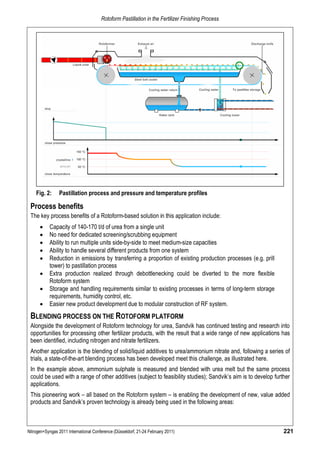
    Fig. 2:     Pastillation process and pressure and temperature profiles

 Process benefits
 The key process benefits of a Rotoform-based solution in this application include:
          Capacity of 140-170 t/d of urea from a single unit
          No need for dedicated screening/scrubbing equipment
          Ability to run multiple units side-by-side to meet medium-size capacities
          Ability to handle several different products from one system
          Reduction in emissions by transferring a proportion of existing production processes (e.g. prill
           tower) to pastillation process
          Extra production realized through debottlenecking could be diverted to the more flexible
           Rotoform system
          Storage and handling requirements similar to existing processes in terms of long-term storage
           requirements, humidity control, etc.
          Easier new product development due to modular construction of RF system.
 BLENDING PROCESS ON THE ROTOFORM PLATFORM
 Alongside the development of Rotoform technology for urea, Sandvik has continued testing and research into
 opportunities for processing other fertilizer products, with the result that a wide range of new applications has
 been identified, including nitrogen and nitrate fertilizers.
 Another application is the blending of solid/liquid additives to urea/ammonium nitrate and, following a series of
 trials, a state-of-the-art blending process has been developed meet this challenge, as illustrated here.
 In the example above, ammonium sulphate is measured and blended with urea melt but the same process
 could be used with a range of other additives (subject to feasibility studies); Sandvik’s aim is to develop further
 applications.
 This pioneering work – all based on the Rotoform system – is enabling the development of new, value added
 products and Sandvik’s proven technology is already being used in the following areas:


Nitrogen+Syngas 2011 International Conference (Düsseldorf, 21-24 February 2011)                                  221
222
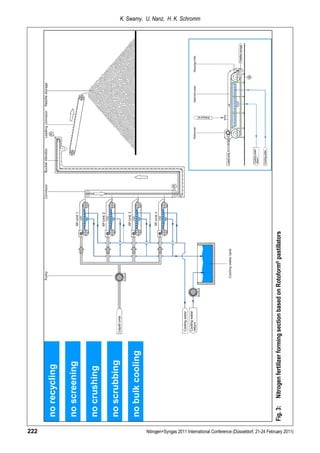
                                                                                   no recycling

                                                                                   no screening

                                                                                   no crushing

                                                                                   no scrubbing

                                                                                   no bulk cooling
                                                                                                                                                                  K. Swamy, U. Nanz, H. K. Schromm


                                                                                  Fig. 3:   Nitrogen fertilizer forming section based on Rotoform® pastillators


Nitrogen+Syngas 2011 International Conference (Düsseldorf, 21-24 February 2011)

Nitrogen syngas 2011

  • 1.
    ⇌ pp Rotoform® Pastillation in the Fertilizer Finishing Process K. SWAMY, U. NANZ, H. K. SCHROMM Sandvik Process Systems Fellbach, Germany In step with the radical developments of recent years in urea and urea finishing technology, Sandvik has been pursuing its own line of research and development and has explored and tested a number of possibilities. The outcome is a wide range of new applications in finishing pure and mixed nitrogen and nitrate fertilizers. There are several concerns in finishing technology over and above the actual formation of the solid particles which usually have to be addressed separately in a conventional large-scale air- cooled granulation or prilling operation. They include particle size management, dust handling and emissions control. The rapid indirect cooling and solidification achievable on a water-cooled steel belt, the basis of the Rotoform® pastillator technology, can substantially mitigate these problems, reducing the need for dedicated means for addressing them. Currently single Rotoform® units can handle 140-170 t/d of product, so the solidification requirements of a medium-sized plant can be handled by a manageable number of multiple units. Alternatively a pastillator or pastillators could be added to an existing plant to reduce emission loads or to allow capacity to be enlarged without increasing emissions. On account of the modular construction of Rotoform®, further development is in prospect. BACKGROUND The fertilizer industry is facing the challenge of having to satisfy ever increasing demand, not only in terms of volume but also for new types of fertilizer capable of delivering optimum solutions for changing soil and user needs. Sandvik’s Rotoform® process was first introduced in early 1980s for the solidification of sulphur extracted in oil refining and gas purification processes and has since been used for the cooling, crystallization and solidification – direct from the melt – of several hundred different products. In the early 1990s Sandvik began to investigate Rotoform-based solutions for the fertilizer industry and the success of this development work has resulted in the Rotoform process now offering significant potential for those involved in the pastillation of urea and nitrates. This technical potential is backed up by Sandvik’s philosophy of focusing on customers’ specific production needs and, wherever possible, adding value. - 219 -
  • 2.
    K. Swamy, U.Nanz, H. K. Schromm ACHIEVEMENTS The first major breakthrough came in 2005 at PCS Nitrogen, United States, with the installation of multiple Rotoform systems for the production of technical-grade urea, a product used in the following applications:  Selective catalytic reduction (SCR) to reduce emissions of nitrogen oxides (NOx)  Adhesives used in the particle board industry  Coatings for metal, paper, textile and leather finishing  Nutritional nitrogen in animal feeds, production of yeast and in the fermentation process  As a de-icer where the risk of corrosion precludes the use of other de-icers. (Source: http://www.yara.co.uk/industrial_solutions/chemicals/technical_urea/index.aspx) Encouraging results here led to further system development and a partnership with Stamicarbon that resulted in licensed urea pastillation. Confirmation of customer acceptance of this technology was a significant factor behind two additional orders:  Acron, Russia – start-up and test run completed in 2010  Petrobras, Brazil – delivered end of 2010. THE ROTOFORM® PROCESS The Rotoformer consists of a heated, cylindrical stator and a perforated rotating shell that turns concentrically around the stator, depositing droplets of urea melt across the full operating width of the steel belt (Fig. 1). The circumferential speed of the Rotoform is synchronized with the speed of the belt, ensuring that the drops are deposited accurately, consistently and without deformation. Fig. 1: Principle of pastillation Water is sprayed against the underside of the solid steel belt and, as the urea is carried along by the steel belt, the resulting transfer of heat converts the liquid droplets into solid pastilles. This indirect approach ensures that there is no risk of contamination in either direction: the quality of the urea is maintained as there is no contact with the cooling medium, while the water can be reused within the system without any need for purification. This also guarantees the purity of the urea. No formaldehyde is needed for the pastille forming process and no chemicals are required for neutralization. The inherent cleanliness of production ensures that this is an environmentally-friendly process, with low emissions of ammonia and minimal dust, and no scrubbing is required for air purification. Energy consumption levels are also low, further enhancing the Rotoform system’s environmental advantages. 220 Nitrogen+Syngas 2011 International Conference (Düsseldorf, 21-24 February 2011)
  • 3.
    Rotoform Pastillation inthe Fertilizer Finishing Process Fig. 2: Pastillation process and pressure and temperature profiles Process benefits The key process benefits of a Rotoform-based solution in this application include:  Capacity of 140-170 t/d of urea from a single unit  No need for dedicated screening/scrubbing equipment  Ability to run multiple units side-by-side to meet medium-size capacities  Ability to handle several different products from one system  Reduction in emissions by transferring a proportion of existing production processes (e.g. prill tower) to pastillation process  Extra production realized through debottlenecking could be diverted to the more flexible Rotoform system  Storage and handling requirements similar to existing processes in terms of long-term storage requirements, humidity control, etc.  Easier new product development due to modular construction of RF system. BLENDING PROCESS ON THE ROTOFORM PLATFORM Alongside the development of Rotoform technology for urea, Sandvik has continued testing and research into opportunities for processing other fertilizer products, with the result that a wide range of new applications has been identified, including nitrogen and nitrate fertilizers. Another application is the blending of solid/liquid additives to urea/ammonium nitrate and, following a series of trials, a state-of-the-art blending process has been developed meet this challenge, as illustrated here. In the example above, ammonium sulphate is measured and blended with urea melt but the same process could be used with a range of other additives (subject to feasibility studies); Sandvik’s aim is to develop further applications. This pioneering work – all based on the Rotoform system – is enabling the development of new, value added products and Sandvik’s proven technology is already being used in the following areas: Nitrogen+Syngas 2011 International Conference (Düsseldorf, 21-24 February 2011) 221
  • 4.
    222 no recycling no screening no crushing no scrubbing no bulk cooling K. Swamy, U. Nanz, H. K. Schromm Fig. 3: Nitrogen fertilizer forming section based on Rotoform® pastillators Nitrogen+Syngas 2011 International Conference (Düsseldorf, 21-24 February 2011)