Deakin University CRICOS Provider Code: 00113B
deakin.edu.au/cradle
How inclusive is the
“Openness” of Open
Education?
Sarah Lambert – 5/3/17
slambe@deakin.edu.au
Twitter @SarahLambertOz
CC-BY-SA
Deakin University CRICOS Provider Code: 00113B
Quick overview
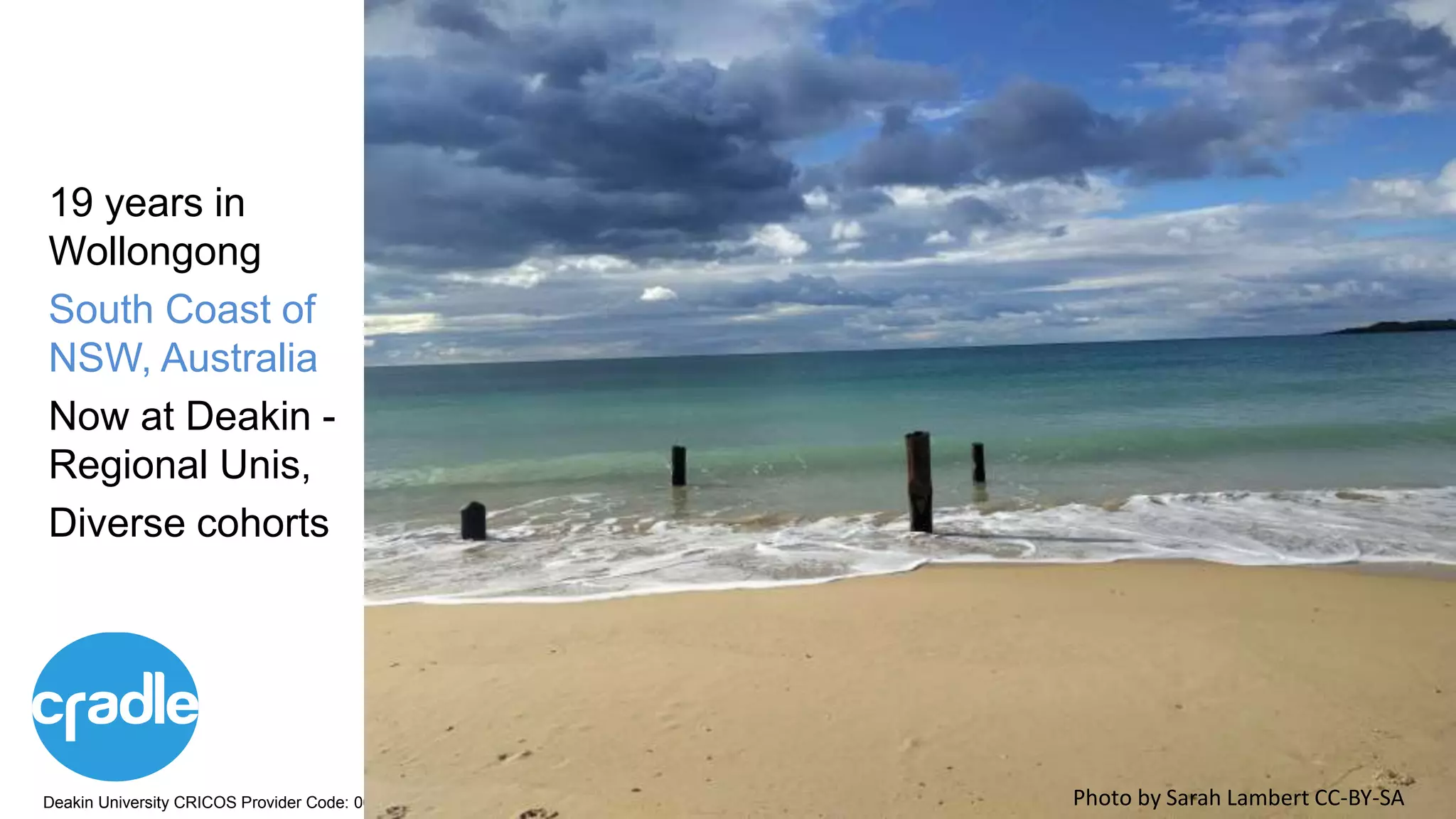
19 years in
Wollongong
South Coast of
NSW, Australia
Now at Deakin -
Regional Unis,
Diverse cohorts
Photo by Sarah Lambert CC-BY-SA
Deakin University CRICOS Provider Code: 00113B
• Full time on scholarship with Cradle
– Started, moved to Melbourne Feb 2016
• 1 year down, 2 to go
• Passed Colloquia Nov 2016 and now
collecting data
Quick PhD overview
Deakin University CRICOS Provider Code: 00113B
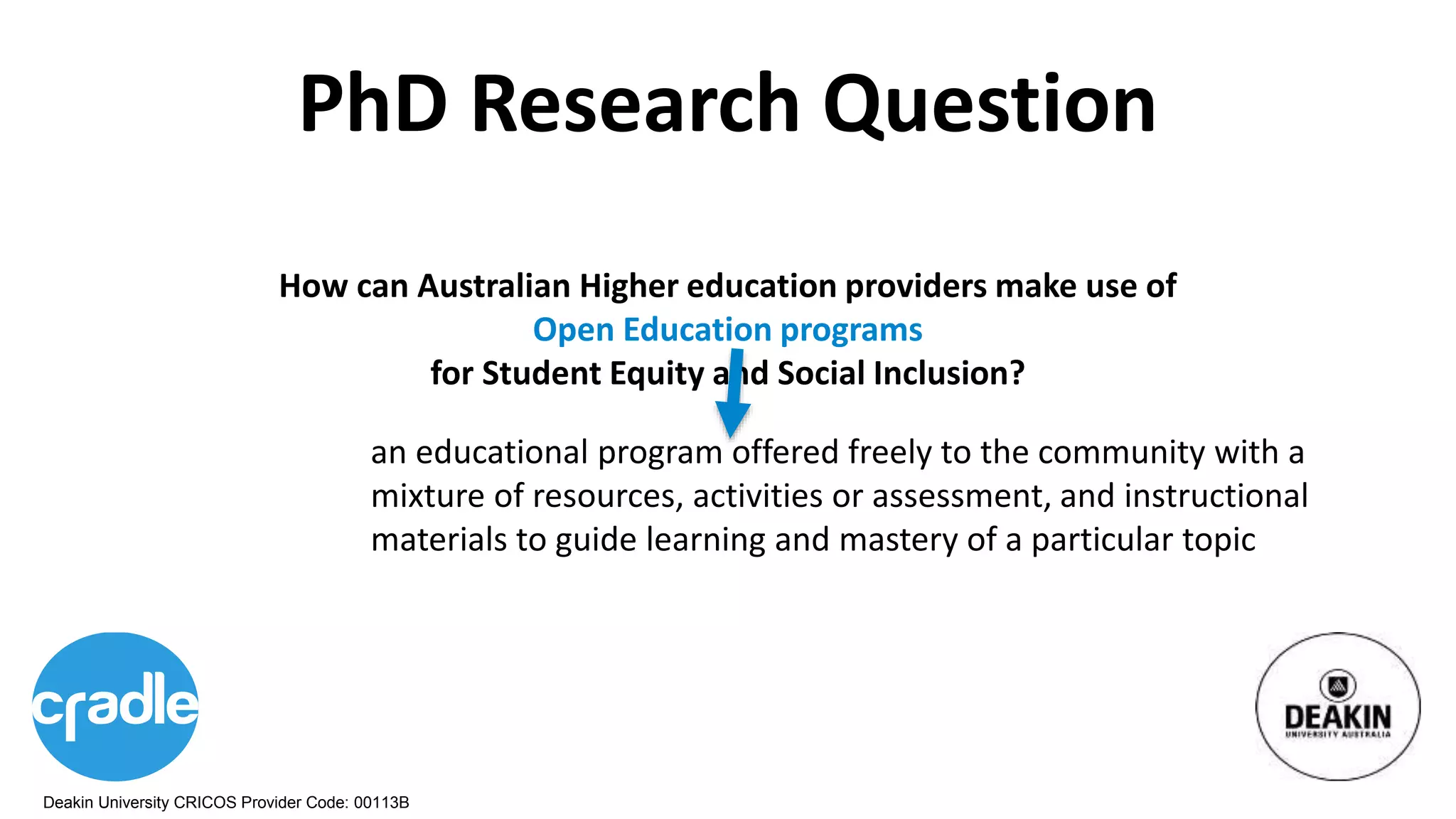
PhD Research Question
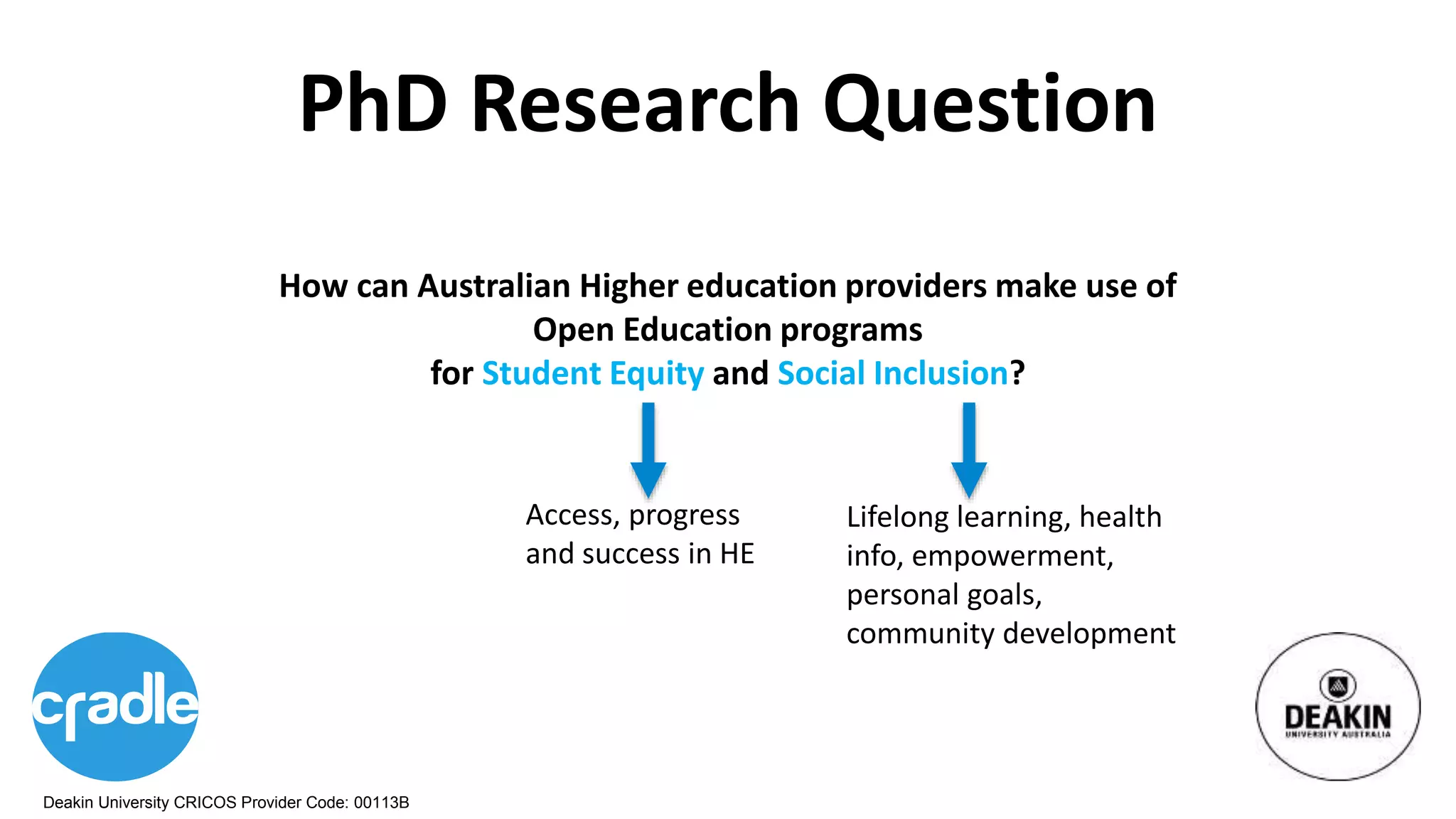
How can Australian Higher education providers make use of
Open Education programs
for Student Equity and Social Inclusion?
Access, progress
and success in HE
Lifelong learning, health
info, empowerment,
personal goals,
community development
Deakin University CRICOS Provider Code: 00113B
PhD Research Question
an educational program offered freely to the community with a
mixture of resources, activities or assessment, and instructional
materials to guide learning and mastery of a particular topic
How can Australian Higher education providers make use of
Open Education programs
for Student Equity and Social Inclusion?
Deakin University CRICOS Provider Code: 00113B
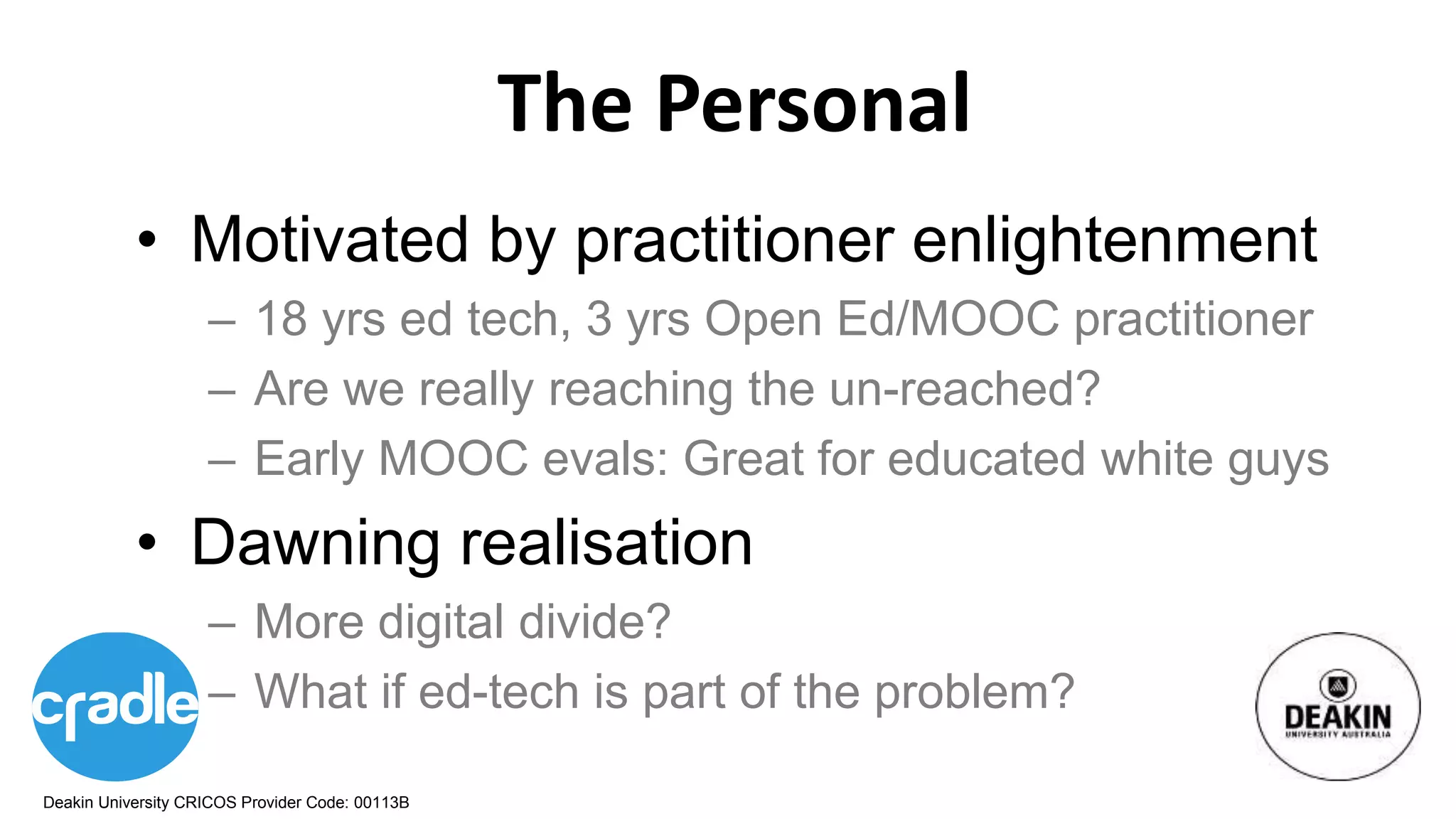
The Personal
• Motivated by practitioner enlightenment
– 18 yrs ed tech, 3 yrs Open Ed/MOOC practitioner
– Are we really reaching the un-reached?
– Early MOOC evals: Great for educated white guys
• Dawning realisation
– More digital divide?
– What if ed-tech is part of the problem?
Deakin University CRICOS Provider Code: 00113B
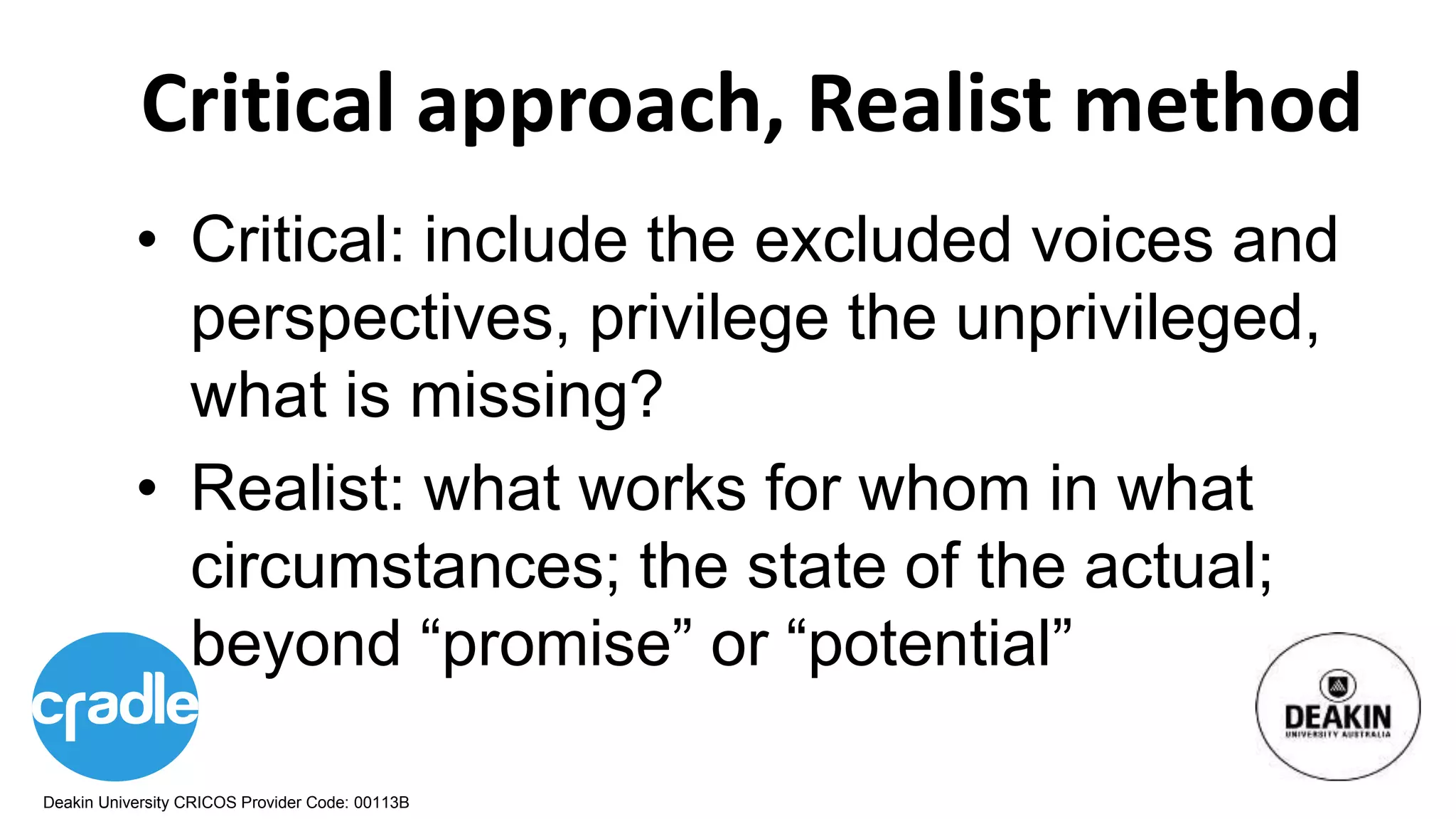
Critical approach, Realist method
• Critical: include the excluded voices and
perspectives, privilege the unprivileged,
what is missing?
• Realist: what works for whom in what
circumstances; the state of the actual;
beyond “promise” or “potential”
Deakin University CRICOS Provider Code: 00113B
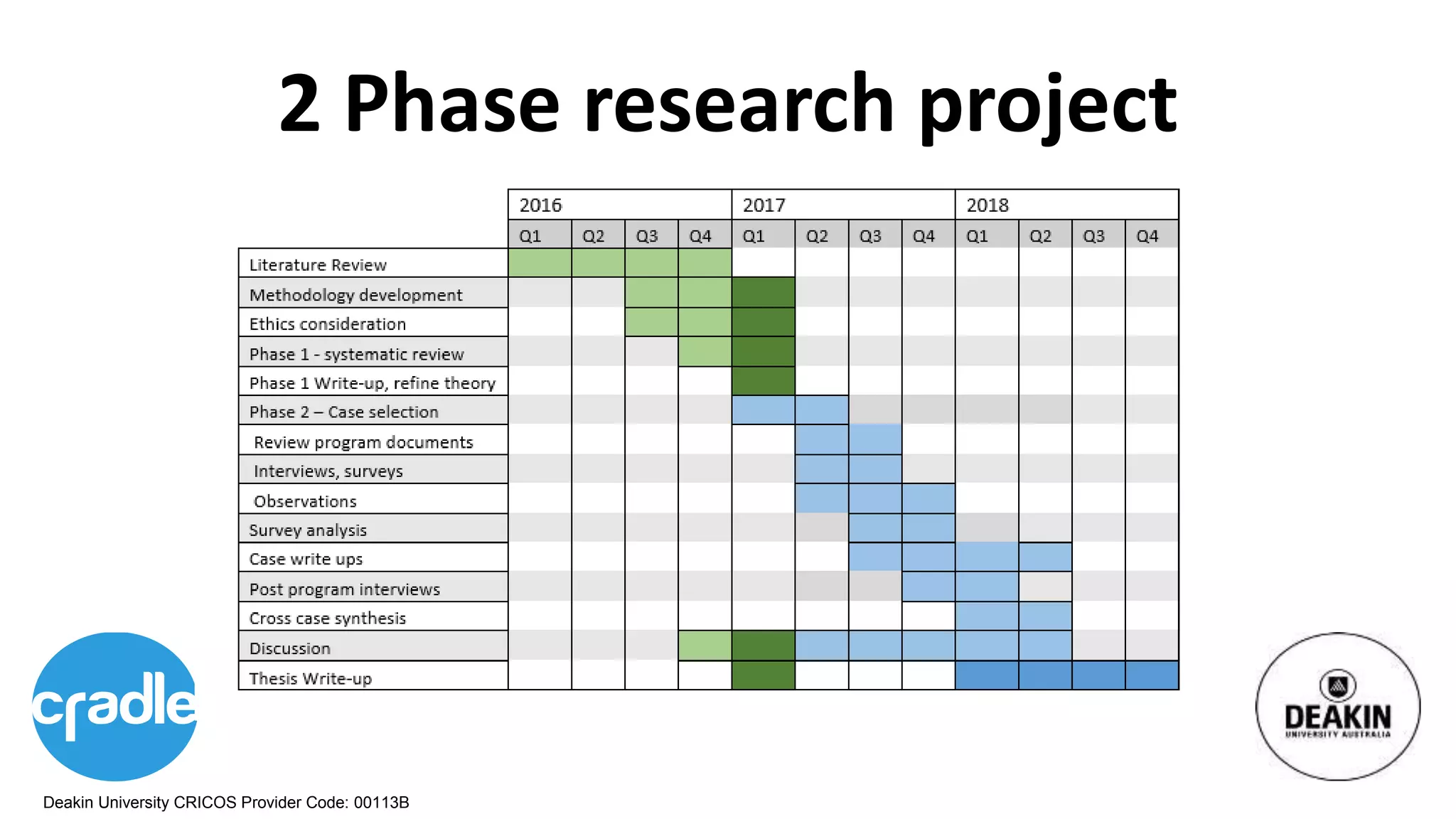
2 Phase research project
Deakin University CRICOS Provider Code: 00113B
Your input
• Help me find good cases for Phase 2 (in
depth case studies)
• Where OE is working for particular
underprivileged groups – for real, in
practice
Deakin University CRICOS Provider Code: 00113B
In theory: Free stuff. So what?
• Selwyn(2011): advantaged people tend to take-up and
take advantage of the new techs
• Rohs & Ganz (2015): MOOCs increasing the digital
divide
• Tinto (2008): access to education without support
does not lead to equal opportunity of education
Deakin University CRICOS Provider Code: 00113B
Free is not enough
• Warshauer’s major work “Technology for Social
Inclusion” (2003)
– providing technology for free on its own rarely
improves the lot of disadvantaged learners
– Also required: physical, digital, human and social
forms of support for learning and making meaning
of the new techs
– Irish “Information Town Competition” winner ($22M free stuff, failed)
vs 1.5M runner up (plan, partner, embed/engage, success)
Deakin University CRICOS Provider Code: 00113B
HEI student Equity lit
• Major Australian and English program
reviews of HEI interventions:
– Targetted: LSES schools, Indigenous mentoring
– Universal: FYE, transition, Inclusive pedagogy,
– High-touch, low-tech
– Community Partnerships are key, bring more
resources, acknowledge community strengths,
avoid colonial discourse and deficit discourse
Deakin University CRICOS Provider Code: 00113B
In practice: Inclusion Forum
• FiF Forum Nov 2016: revealed more interest in
online technologies (as compared to journals)
– Syncronous techs: keep F2F flavour
– Virtual techs: keep sense of place or campus
– Digital storytelling: privilege FiF/LSES/Indigenous
student experience in their own words
Deakin University CRICOS Provider Code: 00113B
Virtual student mentoring
Synchronous
+
Virtual sense
of place
Deakin University CRICOS Provider Code: 00113B
New thinking
• Universal and targeted
– Universal social inclusion programs for normalising
cohorts, sharing common ground?
– Targeted social inclusion programs for valuing
cultural difference and strengths?
• Both needed, complementary
– Will Open Education programs of both types also
exist and be mutually supportive and helpful?
Deakin University CRICOS Provider Code: 00113B
New thinking
• Many social inclusion projects run over
many years, build and enhance
relationships
– Part of the ‘How” question needs to look at “Where”
and “When” to locate/embed the digital
– If there is interest in synchronous techs, will Open
Education programs remain mostly asynchronous?
Deakin University CRICOS Provider Code: 00113B
Method: Systematic Review
Who is putting OE
to use for
inclusion?
What contexts?
What
interventions?
What supports and
resources?
Deakin University CRICOS Provider Code: 00113B
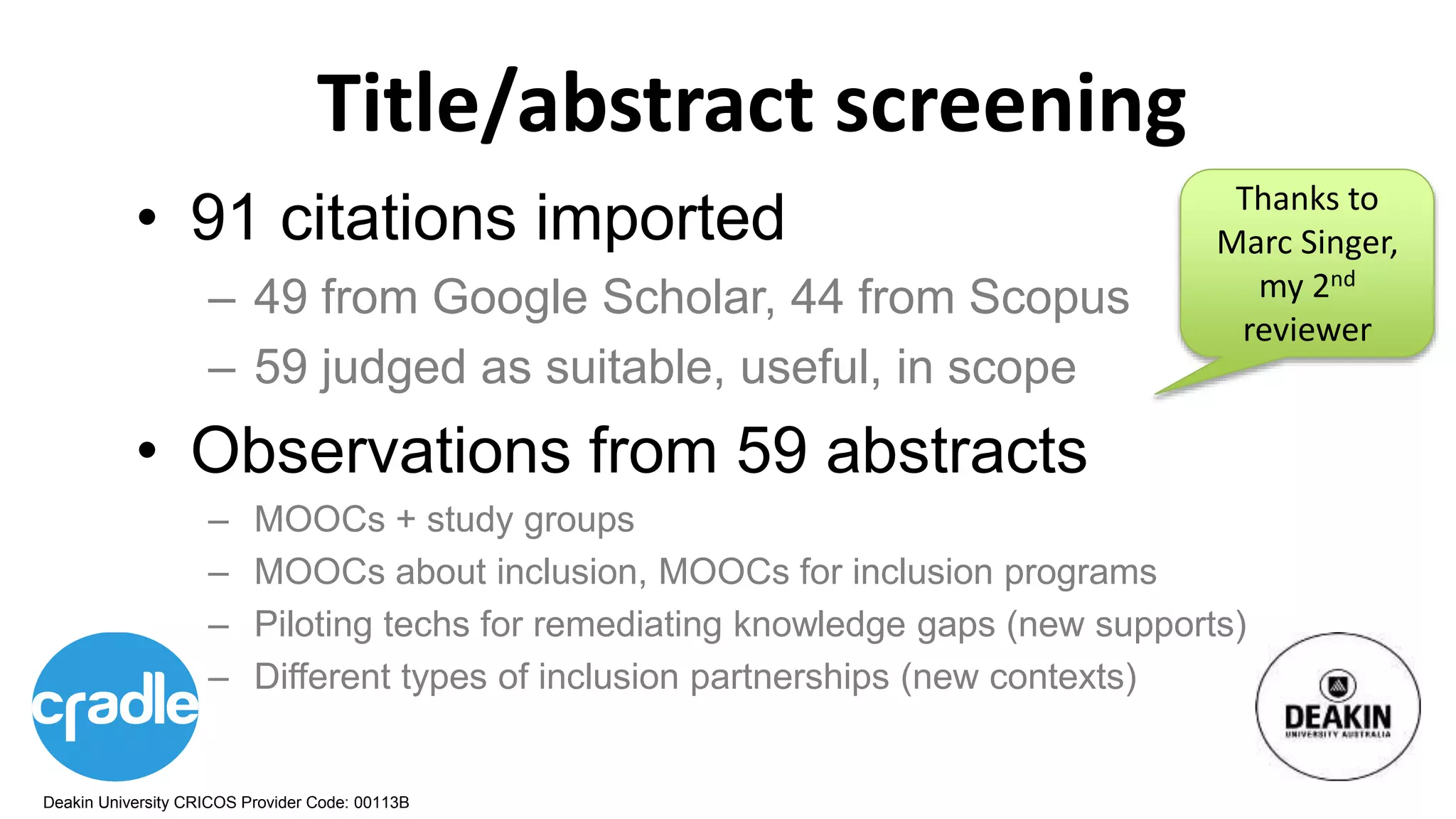
Title/abstract screening
• 91 citations imported
– 49 from Google Scholar, 44 from Scopus
– 59 judged as suitable, useful, in scope
• Observations from 59 abstracts
– MOOCs + study groups
– MOOCs about inclusion, MOOCs for inclusion programs
– Piloting techs for remediating knowledge gaps (new supports)
– Different types of inclusion partnerships (new contexts)
Thanks to
Marc Singer,
my 2nd
reviewer
Deakin University CRICOS Provider Code: 00113B
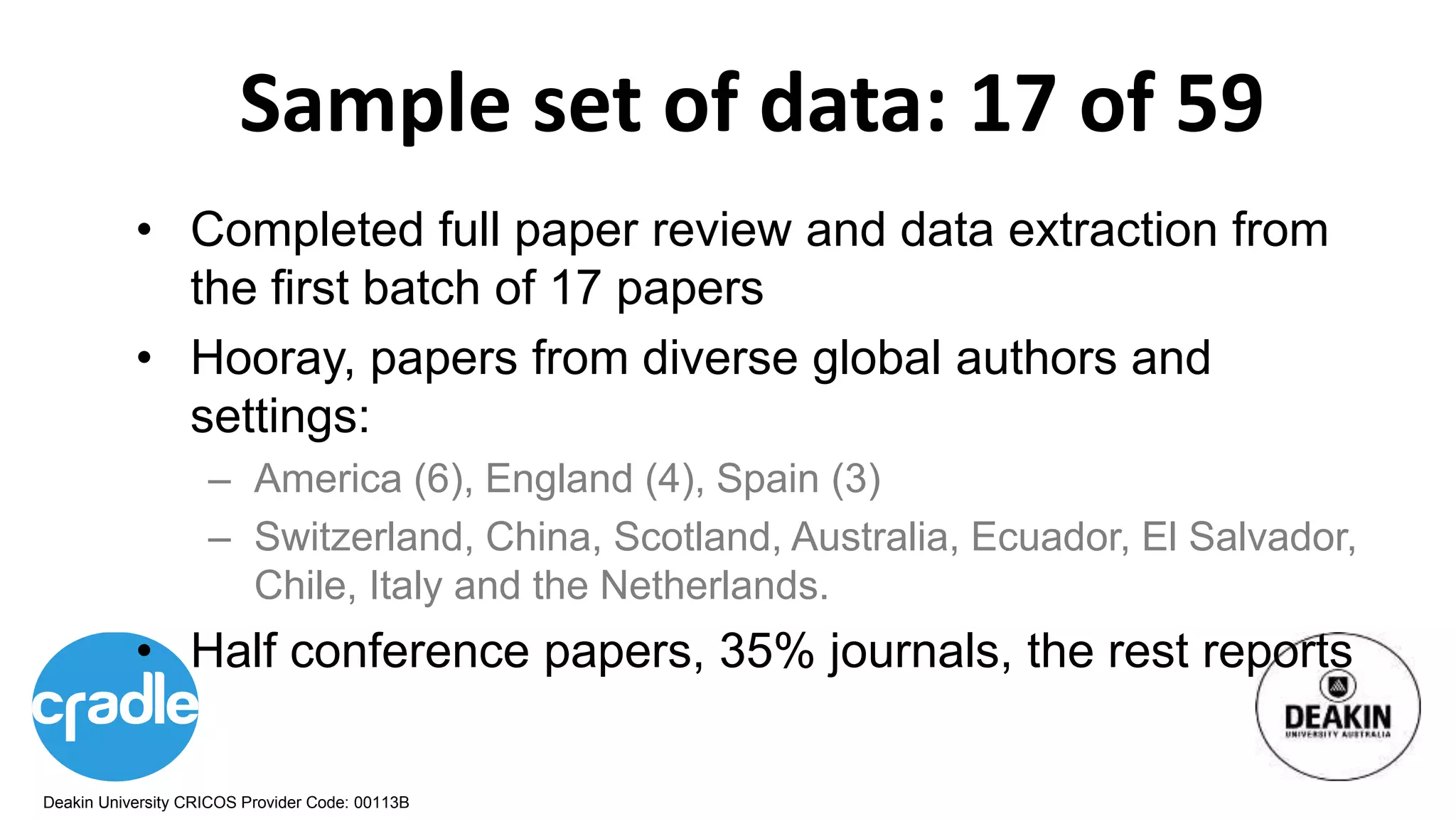
Sample set of data: 17 of 59
• Completed full paper review and data extraction from
the first batch of 17 papers
• Hooray, papers from diverse global authors and
settings:
– America (6), England (4), Spain (3)
– Switzerland, China, Scotland, Australia, Ecuador, El Salvador,
Chile, Italy and the Netherlands.
• Half conference papers, 35% journals, the rest reports
Deakin University CRICOS Provider Code: 00113B
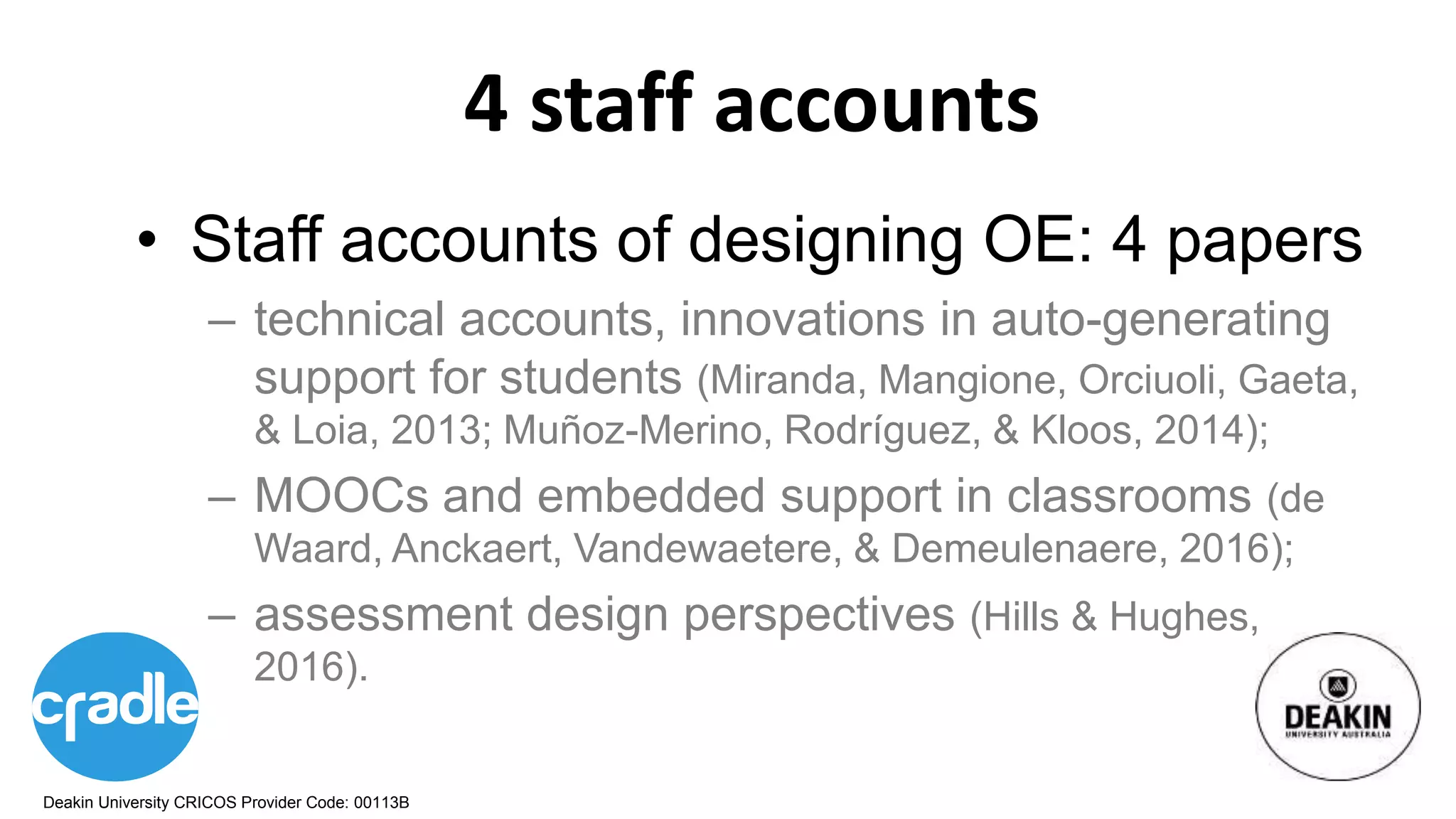
4 staff accounts
• Staff accounts of designing OE: 4 papers
– technical accounts, innovations in auto-generating
support for students (Miranda, Mangione, Orciuoli, Gaeta,
& Loia, 2013; Muñoz-Merino, Rodríguez, & Kloos, 2014);
– MOOCs and embedded support in classrooms (de
Waard, Anckaert, Vandewaetere, & Demeulenaere, 2016);
– assessment design perspectives (Hills & Hughes,
2016).
Deakin University CRICOS Provider Code: 00113B
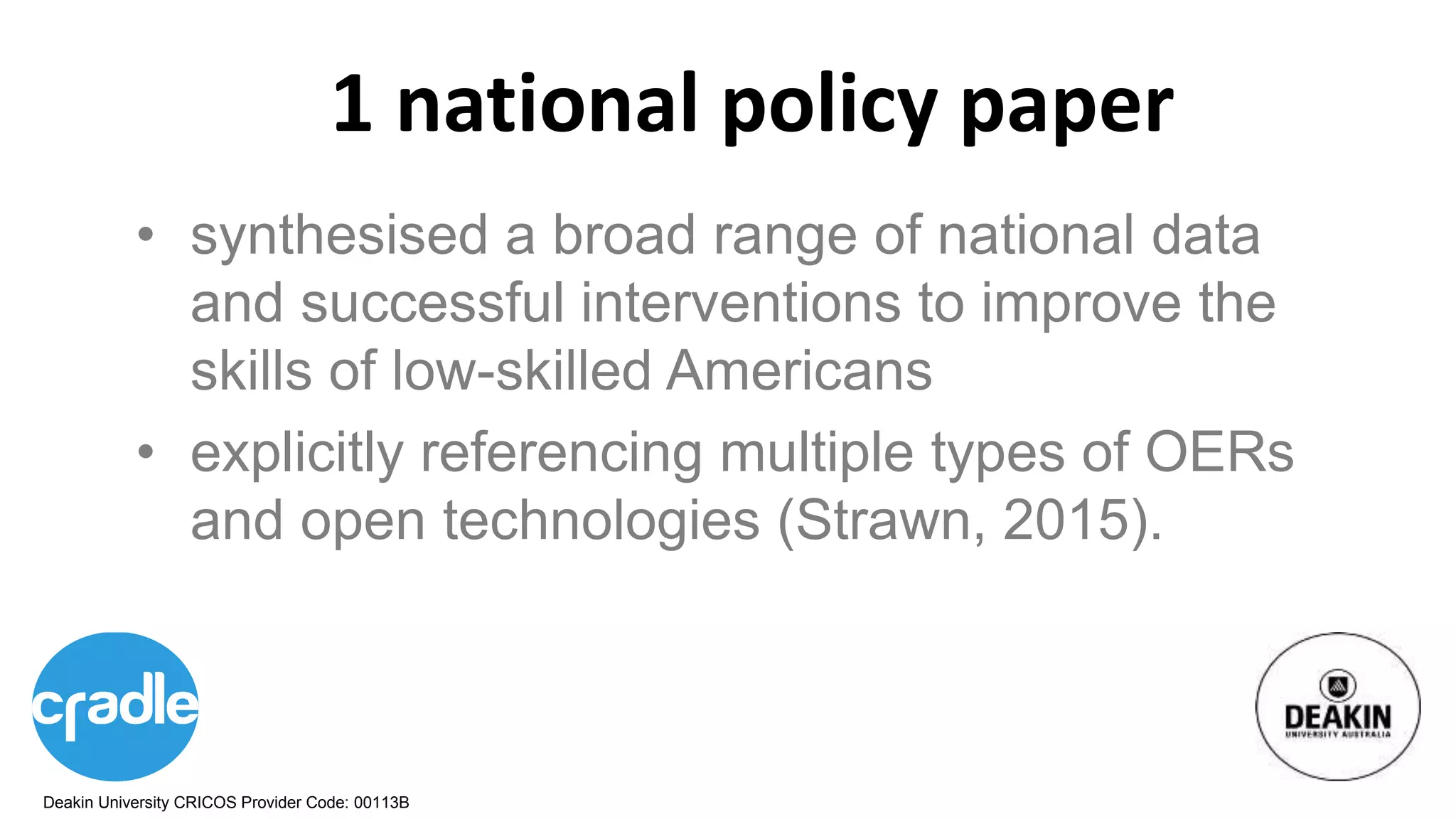
1 national policy paper
• synthesised a broad range of national data
and successful interventions to improve the
skills of low-skilled Americans
• explicitly referencing multiple types of OERs
and open technologies (Strawn, 2015).
Deakin University CRICOS Provider Code: 00113B
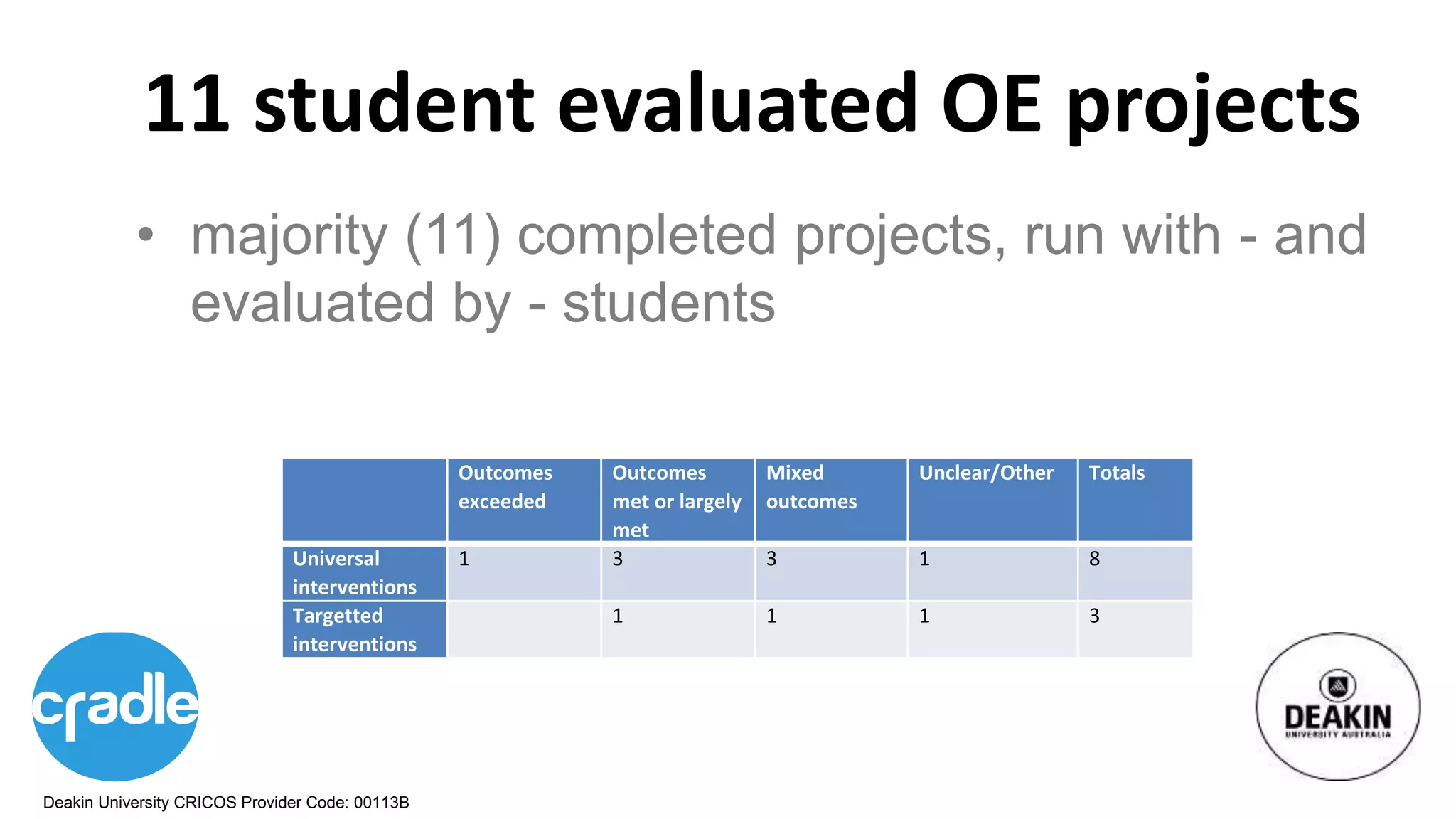
11 student evaluated OE projects
• majority (11) completed projects, run with - and
evaluated by - students
Outcomes
exceeded
Outcomes
met or largely
met
Mixed
outcomes
Unclear/Other Totals
Universal
interventions
1 3 3 1 8
Targetted
interventions
1 1 1 3
Deakin University CRICOS Provider Code: 00113B
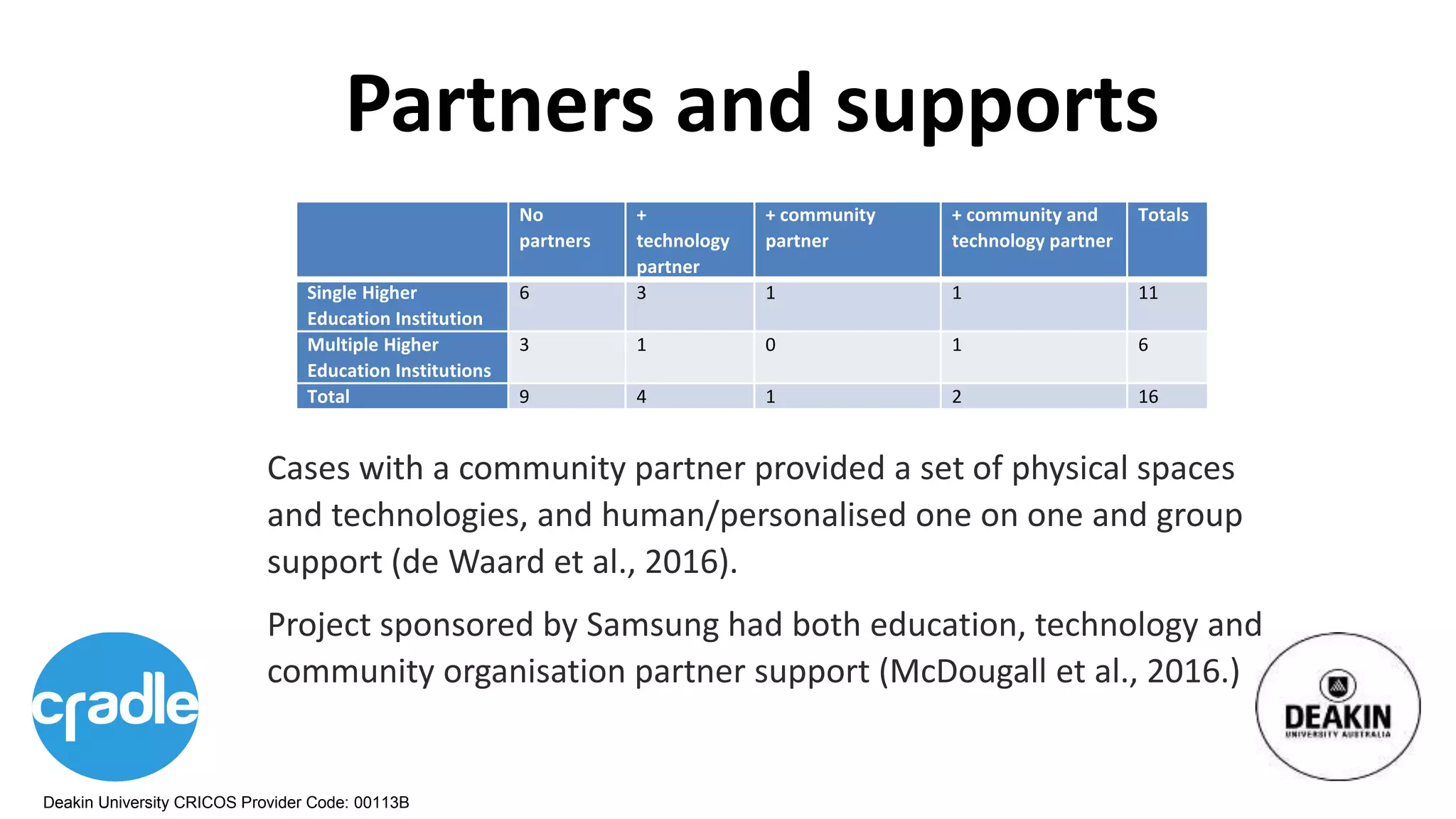
Partners and supports
No
partners
+
technology
partner
+ community
partner
+ community and
technology partner
Totals
Single Higher
Education Institution
6 3 1 1 11
Multiple Higher
Education Institutions
3 1 0 1 6
Total 9 4 1 2 16
Cases with a community partner provided a set of physical spaces
and technologies, and human/personalised one on one and group
support (de Waard et al., 2016).
Project sponsored by Samsung had both education, technology and
community organisation partner support (McDougall et al., 2016.)
Deakin University CRICOS Provider Code: 00113B
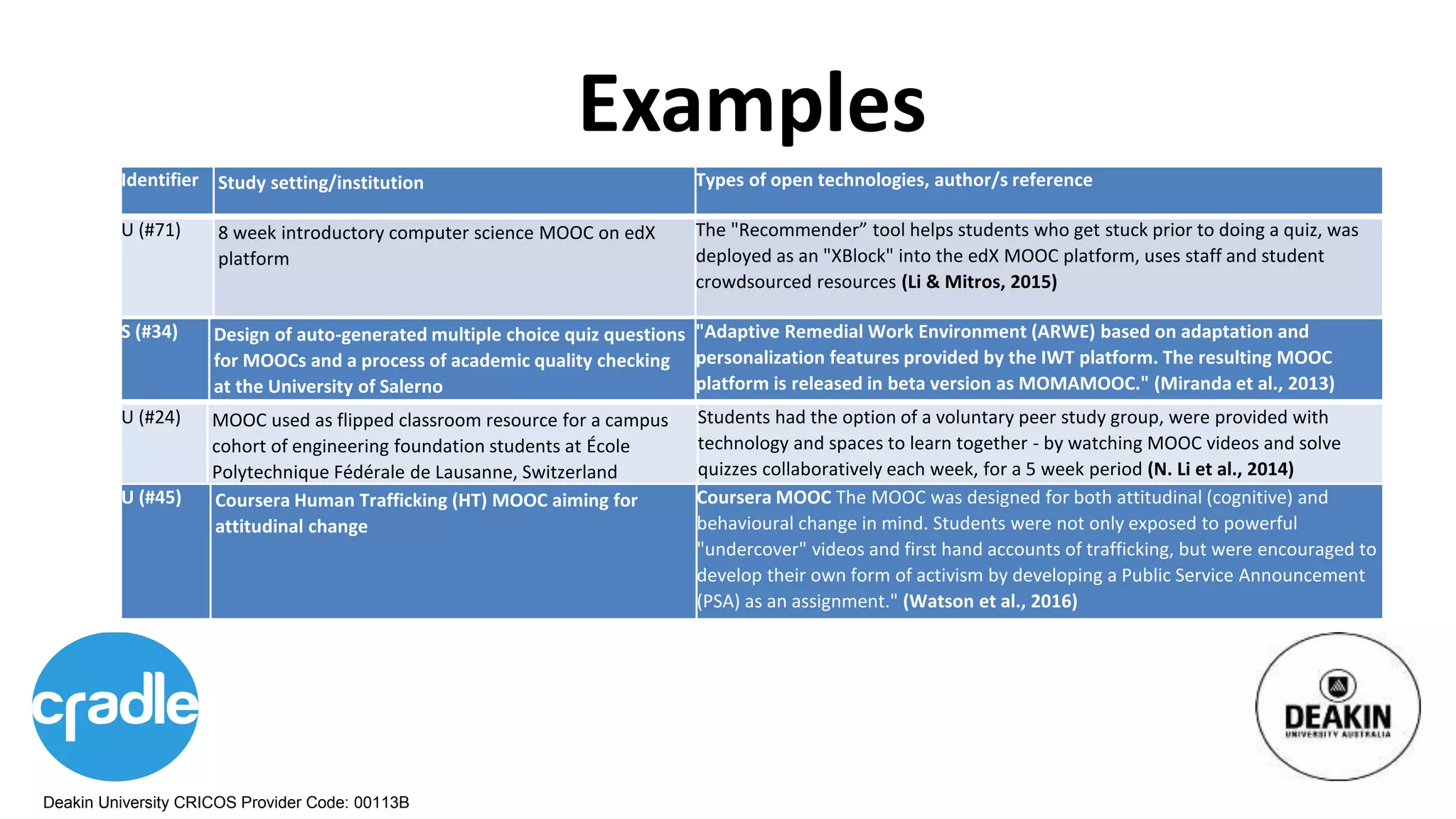
Examples
Identifier Study setting/institution Types of open technologies, author/s reference
U (#71) 8 week introductory computer science MOOC on edX
platform
The "Recommender” tool helps students who get stuck prior to doing a quiz, was
deployed as an "XBlock" into the edX MOOC platform, uses staff and student
crowdsourced resources (Li & Mitros, 2015)
S (#34) Design of auto-generated multiple choice quiz questions
for MOOCs and a process of academic quality checking
at the University of Salerno
"Adaptive Remedial Work Environment (ARWE) based on adaptation and
personalization features provided by the IWT platform. The resulting MOOC
platform is released in beta version as MOMAMOOC." (Miranda et al., 2013)
U (#24) MOOC used as flipped classroom resource for a campus
cohort of engineering foundation students at École
Polytechnique Fédérale de Lausanne, Switzerland
Students had the option of a voluntary peer study group, were provided with
technology and spaces to learn together - by watching MOOC videos and solve
quizzes collaboratively each week, for a 5 week period (N. Li et al., 2014)
U (#45) Coursera Human Trafficking (HT) MOOC aiming for
attitudinal change
Coursera MOOC The MOOC was designed for both attitudinal (cognitive) and
behavioural change in mind. Students were not only exposed to powerful
"undercover" videos and first hand accounts of trafficking, but were encouraged to
develop their own form of activism by developing a Public Service Announcement
(PSA) as an assignment." (Watson et al., 2016)
Deakin University CRICOS Provider Code: 00113B
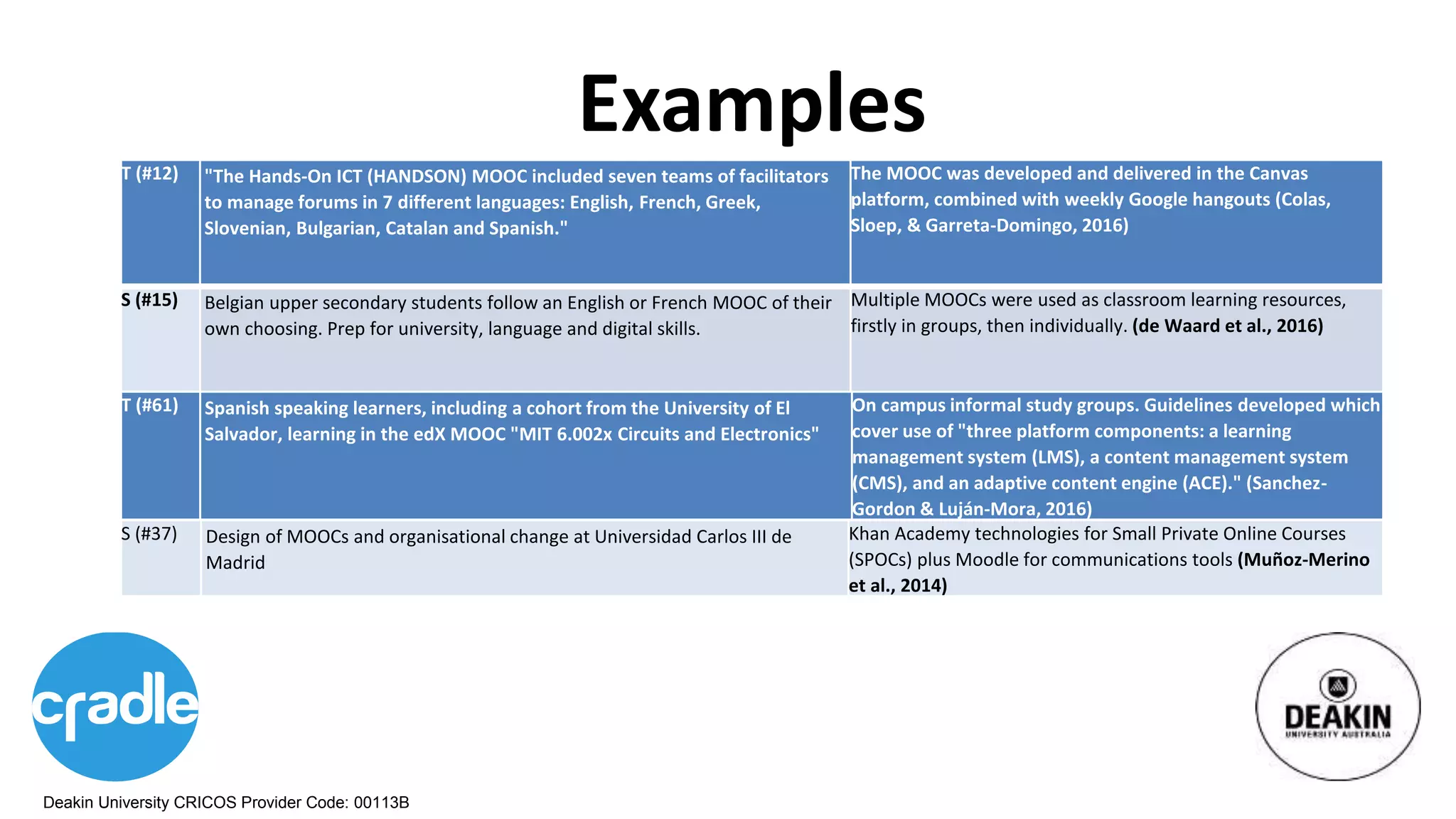
Examples
T (#12) "The Hands-On ICT (HANDSON) MOOC included seven teams of facilitators
to manage forums in 7 different languages: English, French, Greek,
Slovenian, Bulgarian, Catalan and Spanish."
The MOOC was developed and delivered in the Canvas
platform, combined with weekly Google hangouts (Colas,
Sloep, & Garreta-Domingo, 2016)
S (#15) Belgian upper secondary students follow an English or French MOOC of their
own choosing. Prep for university, language and digital skills.
Multiple MOOCs were used as classroom learning resources,
firstly in groups, then individually. (de Waard et al., 2016)
T (#61) Spanish speaking learners, including a cohort from the University of El
Salvador, learning in the edX MOOC "MIT 6.002x Circuits and Electronics"
On campus informal study groups. Guidelines developed which
cover use of "three platform components: a learning
management system (LMS), a content management system
(CMS), and an adaptive content engine (ACE)." (Sanchez-
Gordon & Luján-Mora, 2016)
S (#37) Design of MOOCs and organisational change at Universidad Carlos III de
Madrid
Khan Academy technologies for Small Private Online Courses
(SPOCs) plus Moodle for communications tools (Muñoz-Merino
et al., 2014)
Deakin University CRICOS Provider Code: 00113B
OpenEd programs: how inclusive?
• So far, not bad for STEM, NNS/ESL, college prep
equity cohorts
• Not yet seeing focus on other equity groups (but there
are 32 left to look at)
• A number of technical and pedagogical designs that
could be put to more targeted use for equity needs
Deakin University CRICOS Provider Code: 00113B
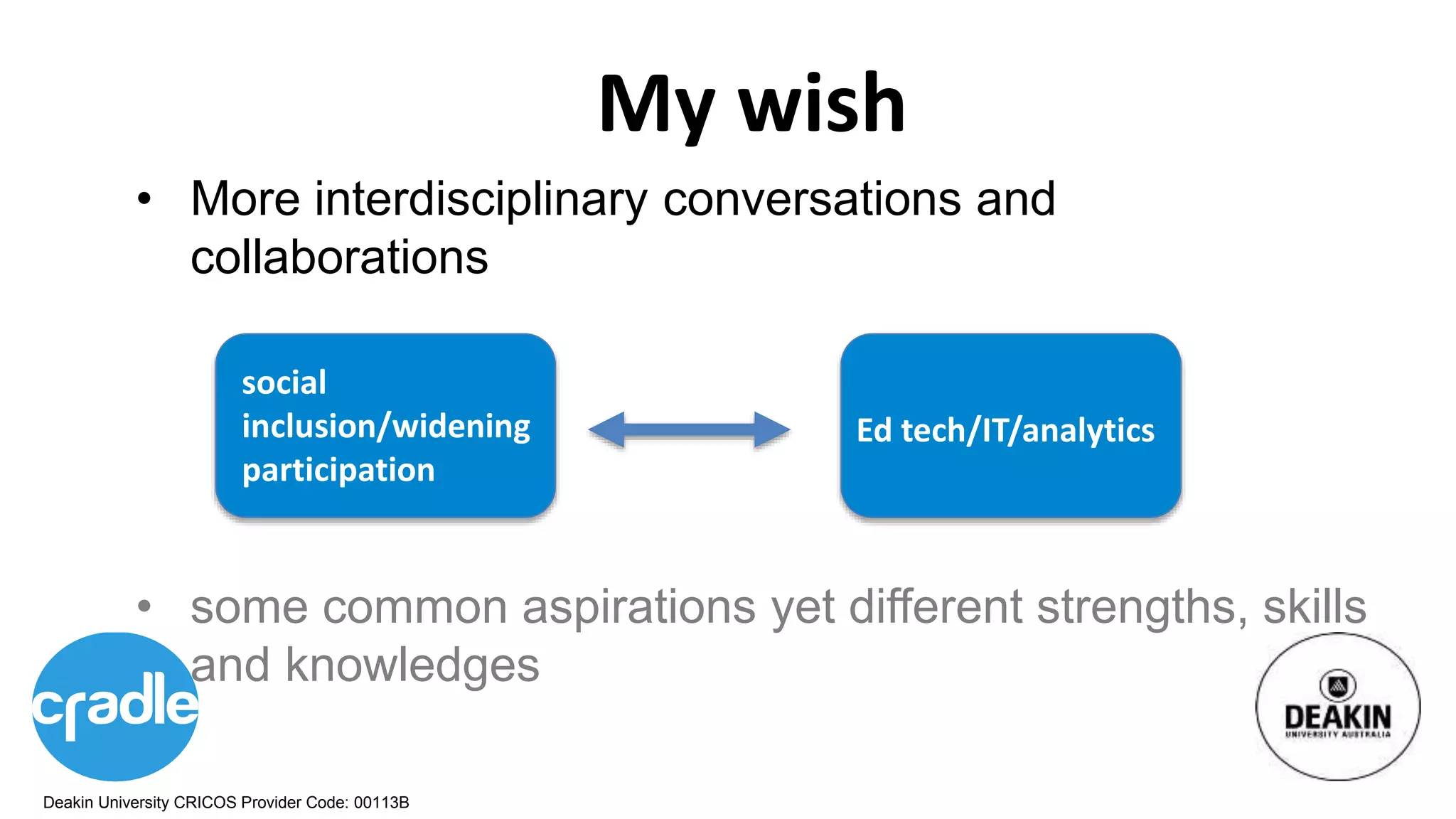
My wish
• More interdisciplinary conversations and
collaborations
• some common aspirations yet different strengths, skills
and knowledges
social
inclusion/widening
participation
Ed tech/IT/analytics
Deakin University CRICOS Provider Code: 00113B
Comments and questions
• Email slambe@deakin.edu.au
• Twitter @SarahLambertOz
With thanks to supervisors Prof. David Boud,
Assoc. Prof Phillip Dawson, and Dr Nadine Zacharias

How inclusive is the “Openness” of Open Education?

  • 1.
    Deakin University CRICOSProvider Code: 00113B deakin.edu.au/cradle How inclusive is the “Openness” of Open Education? Sarah Lambert – 5/3/17 slambe@deakin.edu.au Twitter @SarahLambertOz CC-BY-SA
  • 2.
    Deakin University CRICOSProvider Code: 00113B Quick overview 19 years in Wollongong South Coast of NSW, Australia Now at Deakin - Regional Unis, Diverse cohorts Photo by Sarah Lambert CC-BY-SA
  • 3.
    Deakin University CRICOSProvider Code: 00113B • Full time on scholarship with Cradle – Started, moved to Melbourne Feb 2016 • 1 year down, 2 to go • Passed Colloquia Nov 2016 and now collecting data Quick PhD overview
  • 4.
    Deakin University CRICOSProvider Code: 00113B PhD Research Question How can Australian Higher education providers make use of Open Education programs for Student Equity and Social Inclusion? Access, progress and success in HE Lifelong learning, health info, empowerment, personal goals, community development
  • 5.
    Deakin University CRICOSProvider Code: 00113B PhD Research Question an educational program offered freely to the community with a mixture of resources, activities or assessment, and instructional materials to guide learning and mastery of a particular topic How can Australian Higher education providers make use of Open Education programs for Student Equity and Social Inclusion?
  • 6.
    Deakin University CRICOSProvider Code: 00113B The Personal • Motivated by practitioner enlightenment – 18 yrs ed tech, 3 yrs Open Ed/MOOC practitioner – Are we really reaching the un-reached? – Early MOOC evals: Great for educated white guys • Dawning realisation – More digital divide? – What if ed-tech is part of the problem?
  • 7.
    Deakin University CRICOSProvider Code: 00113B Critical approach, Realist method • Critical: include the excluded voices and perspectives, privilege the unprivileged, what is missing? • Realist: what works for whom in what circumstances; the state of the actual; beyond “promise” or “potential”
  • 8.
    Deakin University CRICOSProvider Code: 00113B 2 Phase research project
  • 9.
    Deakin University CRICOSProvider Code: 00113B Your input • Help me find good cases for Phase 2 (in depth case studies) • Where OE is working for particular underprivileged groups – for real, in practice
  • 10.
    Deakin University CRICOSProvider Code: 00113B In theory: Free stuff. So what? • Selwyn(2011): advantaged people tend to take-up and take advantage of the new techs • Rohs & Ganz (2015): MOOCs increasing the digital divide • Tinto (2008): access to education without support does not lead to equal opportunity of education
  • 11.
    Deakin University CRICOSProvider Code: 00113B Free is not enough • Warshauer’s major work “Technology for Social Inclusion” (2003) – providing technology for free on its own rarely improves the lot of disadvantaged learners – Also required: physical, digital, human and social forms of support for learning and making meaning of the new techs – Irish “Information Town Competition” winner ($22M free stuff, failed) vs 1.5M runner up (plan, partner, embed/engage, success)
  • 12.
    Deakin University CRICOSProvider Code: 00113B HEI student Equity lit • Major Australian and English program reviews of HEI interventions: – Targetted: LSES schools, Indigenous mentoring – Universal: FYE, transition, Inclusive pedagogy, – High-touch, low-tech – Community Partnerships are key, bring more resources, acknowledge community strengths, avoid colonial discourse and deficit discourse
  • 13.
    Deakin University CRICOSProvider Code: 00113B In practice: Inclusion Forum • FiF Forum Nov 2016: revealed more interest in online technologies (as compared to journals) – Syncronous techs: keep F2F flavour – Virtual techs: keep sense of place or campus – Digital storytelling: privilege FiF/LSES/Indigenous student experience in their own words
  • 14.
    Deakin University CRICOSProvider Code: 00113B Virtual student mentoring Synchronous + Virtual sense of place
  • 15.
    Deakin University CRICOSProvider Code: 00113B New thinking • Universal and targeted – Universal social inclusion programs for normalising cohorts, sharing common ground? – Targeted social inclusion programs for valuing cultural difference and strengths? • Both needed, complementary – Will Open Education programs of both types also exist and be mutually supportive and helpful?
  • 16.
    Deakin University CRICOSProvider Code: 00113B New thinking • Many social inclusion projects run over many years, build and enhance relationships – Part of the ‘How” question needs to look at “Where” and “When” to locate/embed the digital – If there is interest in synchronous techs, will Open Education programs remain mostly asynchronous?
  • 17.
    Deakin University CRICOSProvider Code: 00113B Method: Systematic Review Who is putting OE to use for inclusion? What contexts? What interventions? What supports and resources?
  • 18.
    Deakin University CRICOSProvider Code: 00113B Title/abstract screening • 91 citations imported – 49 from Google Scholar, 44 from Scopus – 59 judged as suitable, useful, in scope • Observations from 59 abstracts – MOOCs + study groups – MOOCs about inclusion, MOOCs for inclusion programs – Piloting techs for remediating knowledge gaps (new supports) – Different types of inclusion partnerships (new contexts) Thanks to Marc Singer, my 2nd reviewer
  • 19.
    Deakin University CRICOSProvider Code: 00113B Sample set of data: 17 of 59 • Completed full paper review and data extraction from the first batch of 17 papers • Hooray, papers from diverse global authors and settings: – America (6), England (4), Spain (3) – Switzerland, China, Scotland, Australia, Ecuador, El Salvador, Chile, Italy and the Netherlands. • Half conference papers, 35% journals, the rest reports
  • 20.
    Deakin University CRICOSProvider Code: 00113B 4 staff accounts • Staff accounts of designing OE: 4 papers – technical accounts, innovations in auto-generating support for students (Miranda, Mangione, Orciuoli, Gaeta, & Loia, 2013; Muñoz-Merino, Rodríguez, & Kloos, 2014); – MOOCs and embedded support in classrooms (de Waard, Anckaert, Vandewaetere, & Demeulenaere, 2016); – assessment design perspectives (Hills & Hughes, 2016).
  • 21.
    Deakin University CRICOSProvider Code: 00113B 1 national policy paper • synthesised a broad range of national data and successful interventions to improve the skills of low-skilled Americans • explicitly referencing multiple types of OERs and open technologies (Strawn, 2015).
  • 22.
    Deakin University CRICOSProvider Code: 00113B 11 student evaluated OE projects • majority (11) completed projects, run with - and evaluated by - students Outcomes exceeded Outcomes met or largely met Mixed outcomes Unclear/Other Totals Universal interventions 1 3 3 1 8 Targetted interventions 1 1 1 3
  • 23.
    Deakin University CRICOSProvider Code: 00113B Partners and supports No partners + technology partner + community partner + community and technology partner Totals Single Higher Education Institution 6 3 1 1 11 Multiple Higher Education Institutions 3 1 0 1 6 Total 9 4 1 2 16 Cases with a community partner provided a set of physical spaces and technologies, and human/personalised one on one and group support (de Waard et al., 2016). Project sponsored by Samsung had both education, technology and community organisation partner support (McDougall et al., 2016.)
  • 24.
    Deakin University CRICOSProvider Code: 00113B Examples Identifier Study setting/institution Types of open technologies, author/s reference U (#71) 8 week introductory computer science MOOC on edX platform The "Recommender” tool helps students who get stuck prior to doing a quiz, was deployed as an "XBlock" into the edX MOOC platform, uses staff and student crowdsourced resources (Li & Mitros, 2015) S (#34) Design of auto-generated multiple choice quiz questions for MOOCs and a process of academic quality checking at the University of Salerno "Adaptive Remedial Work Environment (ARWE) based on adaptation and personalization features provided by the IWT platform. The resulting MOOC platform is released in beta version as MOMAMOOC." (Miranda et al., 2013) U (#24) MOOC used as flipped classroom resource for a campus cohort of engineering foundation students at École Polytechnique Fédérale de Lausanne, Switzerland Students had the option of a voluntary peer study group, were provided with technology and spaces to learn together - by watching MOOC videos and solve quizzes collaboratively each week, for a 5 week period (N. Li et al., 2014) U (#45) Coursera Human Trafficking (HT) MOOC aiming for attitudinal change Coursera MOOC The MOOC was designed for both attitudinal (cognitive) and behavioural change in mind. Students were not only exposed to powerful "undercover" videos and first hand accounts of trafficking, but were encouraged to develop their own form of activism by developing a Public Service Announcement (PSA) as an assignment." (Watson et al., 2016)
  • 25.
    Deakin University CRICOSProvider Code: 00113B Examples T (#12) "The Hands-On ICT (HANDSON) MOOC included seven teams of facilitators to manage forums in 7 different languages: English, French, Greek, Slovenian, Bulgarian, Catalan and Spanish." The MOOC was developed and delivered in the Canvas platform, combined with weekly Google hangouts (Colas, Sloep, & Garreta-Domingo, 2016) S (#15) Belgian upper secondary students follow an English or French MOOC of their own choosing. Prep for university, language and digital skills. Multiple MOOCs were used as classroom learning resources, firstly in groups, then individually. (de Waard et al., 2016) T (#61) Spanish speaking learners, including a cohort from the University of El Salvador, learning in the edX MOOC "MIT 6.002x Circuits and Electronics" On campus informal study groups. Guidelines developed which cover use of "three platform components: a learning management system (LMS), a content management system (CMS), and an adaptive content engine (ACE)." (Sanchez- Gordon & Luján-Mora, 2016) S (#37) Design of MOOCs and organisational change at Universidad Carlos III de Madrid Khan Academy technologies for Small Private Online Courses (SPOCs) plus Moodle for communications tools (Muñoz-Merino et al., 2014)
  • 26.
    Deakin University CRICOSProvider Code: 00113B OpenEd programs: how inclusive? • So far, not bad for STEM, NNS/ESL, college prep equity cohorts • Not yet seeing focus on other equity groups (but there are 32 left to look at) • A number of technical and pedagogical designs that could be put to more targeted use for equity needs
  • 27.
    Deakin University CRICOSProvider Code: 00113B My wish • More interdisciplinary conversations and collaborations • some common aspirations yet different strengths, skills and knowledges social inclusion/widening participation Ed tech/IT/analytics
  • 28.
    Deakin University CRICOSProvider Code: 00113B Comments and questions • Email slambe@deakin.edu.au • Twitter @SarahLambertOz With thanks to supervisors Prof. David Boud, Assoc. Prof Phillip Dawson, and Dr Nadine Zacharias

Editor's Notes

  • #5 Quick recap of working definition of OEPs
  • #6 Quick recap of working definition of OEPs
  • #9 Quick recap of the design, schedule
  • #18 Noting use of Covidence as workflow system for “blind” review by 2 reviewers, with system to resolve conflicts in judgements.
  • #19 Marc is Provost at Thomas Edison State University, a college designed for busy adults, specialises in assessment of prior learning, great OERu partner from the start.