How can we shape Open
Education programs to benefit
our Higher Education learners?
Sarah Lambert – July 2017
slambe@deakin.edu.au
Twitter @SarahLambertOz
Firstly:
Hello from Australia
Lucky me
19 years in
Wollongong
South Coast of
NSW, Australia
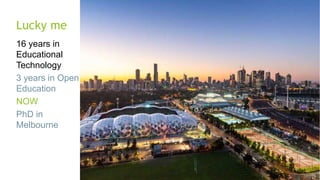
Lucky me
16 years in
Educational
Technology
3 years in Open
Education
NOW
PhD in
Melbourne
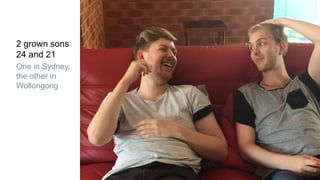
2 grown sons
24 and 21
One in Sydney,
the other in
Wollongong
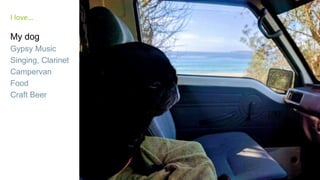
My dog
Gypsy Music
Singing, Clarinet
Campervan
Food
Craft Beer
I love…
But before all this
 Brought up by my hard-working mum
 Her mother was from the country
 her grandmother a Swedish immigrant
 Her father’s family were Russian exiles from Scotland
 Maybe originally from Slovenia (not 100% sure)
 My mum was smart and worked in business (property manager, accounts)
 But had no qualifications
 I am First In My Family to go to University
OER Pioneers in Kyrgyzstan
 You are not alone
 OER is a global movement
 In Western and European education systems, advanced Technology Enabled
Learning, blend digital resources with class work
 In Australia, advanced Distance Education, support regional development, all
online
 OER developed very rapidly into OEP “open educational practices”
 Sharing, digital resources, smaller chunks than whole textbook
 Not only Wikipedia and textbooks, but YouTube, social media,
MOOCs 1.0 to MOOCs 2.0
Big changes globally for OER
MOOCs: specific benefits to staff, students
and Universities
 increased digital literacies relevant to modern professions
 free quality resources on complex topics in your existing curriculum
 building capacity for staff to move from traditional to elearning or distance
learning
 reduced reliance on expensive text-book costs, and
 enhanced University reputation when quality learning materials are openly
published
Issues with
MOOCs 1.0
Pedagogy
Technical topics
Expensive (how
to sustain?)
Inequality
In English
MOOCs
2.0
Better quality
No longer free
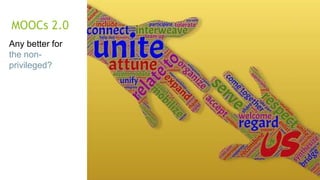
MOOCs 2.0
Any better for
the non-
privileged?
PhD Research Question
How can Australian Higher education providers make use of
Open Education programs
for Student Equity and Social Inclusion?
Access, progress
and success in HE
Lifelong learning, health
info, empowerment,
personal goals,
community development
Phase 1
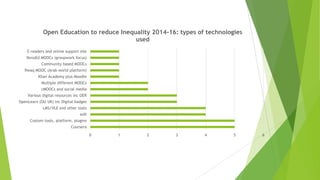
0 1 2 3 4 5 6
Coursera
Custom tools, platform, plugins
edX
LMS/VLE and other tools
OpenLearn (OU UK) inc Digital badges
Various digital resources inc OER
cMOOCs and social media
Multiple different MOOCs
Khan Academy plus Moodle
Rwaq MOOC (Arab world platform)
Community based MOOCs
NovoEd MOOCs (groupwork focus)
E-readers and online support site
Open Education to reduce Inequality 2014-16: types of technologies
used
0 1 2 3 4 5 6
Coursera
Custom tools, platform, plugins
edX
LMS/VLE and other tools
OpenLearn (OU UK) inc Digital badges
Various digital resources inc OER
cMOOCs and social media
Multiple different MOOCs
Khan Academy plus Moodle
Rwaq MOOC (Arab world platform)
Community based MOOCs
NovoEd MOOCs (groupwork focus)
E-readers and online support site
Open Education to reduce Inequality 2014-16: types of technologies
used
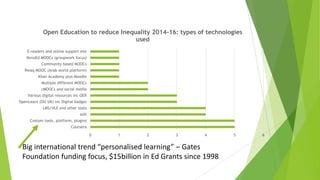
Big international trend “personalised learning” – Gates
Foundation funding focus, $15billion in Ed Grants since 1998
0 1 2 3 4 5 6
Coursera
Custom tools, platform, plugins
edX
LMS/VLE and other tools
OpenLearn (OU UK) inc Digital badges
Various digital resources inc OER
cMOOCs and social media
Multiple different MOOCs
Khan Academy plus Moodle
Rwaq MOOC (Arab world platform)
Community based MOOCs
NovoEd MOOCs (groupwork focus)
E-readers and online support site
Open Education to reduce Inequality 2014-16: types of technologies
used
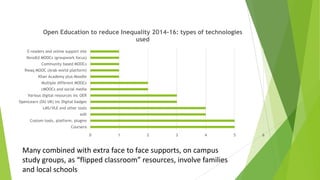
Many combined with extra face to face supports, on campus
study groups, as “flipped classroom” resources, involve families
and local schools
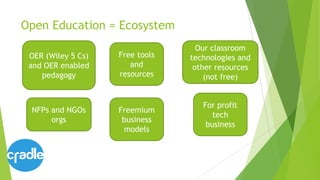
Open Education = Ecosystem
Free tools
and
resources
OER (Wiley 5 Cs)
and OER enabled
pedagogy
Our classroom
technologies and
other resources
(not free)
Freemium
business
models
NFPs and NGOs
orgs
For profit
tech
business
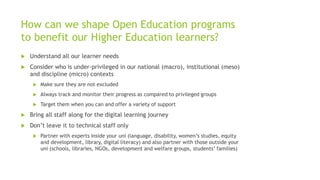
How can we shape Open Education programs
to benefit our Higher Education learners?
 Understand all our learner needs
 Consider who is under-privileged in our national (macro), institutional (meso)
and discipline (micro) contexts
 Make sure they are not excluded
 Always track and monitor their progress as compared to privileged groups
 Target them when you can and offer a variety of support
 Bring all staff along for the digital learning journey
 Don’t leave it to technical staff only
 Partner with experts inside your uni (language, disability, women’s studies, equity
and development, library, digital literacy) and also partner with those outside your
uni (schools, libraries, NGOs, development and welfare groups, students’ families)
Remember learning is social
 Proposed 6 Critical Dimensions of Open Education (PhD)
 Technology
 Learning Materials
 Skills
 Social Support
 Learner’s purpose (own goals in life and uni)
 Autonomy (the way we enable or constrain them in meeting their goals)
 Adapting and verifying these with Open Education
 Based on solid work: Technology for Social Inclusion (Warschauer)
Comments and questions
 Email slambe@deakin.edu.au
 Twitter @SarahLambertOz
With thanks to supervisors Prof. David Boud,
Assoc. Prof Phillip Dawson, and Dr Nadine Zacharias

ачык билим программаларын кантип студенттердин кызыкчылыгына өзгөртө алабыз. ачык университет (сара ламберт австралия)

  • 1.
    How can weshape Open Education programs to benefit our Higher Education learners? Sarah Lambert – July 2017 slambe@deakin.edu.au Twitter @SarahLambertOz
  • 2.
  • 3.
    Lucky me 19 yearsin Wollongong South Coast of NSW, Australia
  • 4.
    Lucky me 16 yearsin Educational Technology 3 years in Open Education NOW PhD in Melbourne
  • 5.
    2 grown sons 24and 21 One in Sydney, the other in Wollongong
  • 6.
    My dog Gypsy Music Singing,Clarinet Campervan Food Craft Beer I love…
  • 7.
    But before allthis  Brought up by my hard-working mum  Her mother was from the country  her grandmother a Swedish immigrant  Her father’s family were Russian exiles from Scotland  Maybe originally from Slovenia (not 100% sure)  My mum was smart and worked in business (property manager, accounts)  But had no qualifications  I am First In My Family to go to University
  • 8.
    OER Pioneers inKyrgyzstan  You are not alone  OER is a global movement  In Western and European education systems, advanced Technology Enabled Learning, blend digital resources with class work  In Australia, advanced Distance Education, support regional development, all online  OER developed very rapidly into OEP “open educational practices”  Sharing, digital resources, smaller chunks than whole textbook  Not only Wikipedia and textbooks, but YouTube, social media,
  • 9.
    MOOCs 1.0 toMOOCs 2.0 Big changes globally for OER
  • 10.
    MOOCs: specific benefitsto staff, students and Universities  increased digital literacies relevant to modern professions  free quality resources on complex topics in your existing curriculum  building capacity for staff to move from traditional to elearning or distance learning  reduced reliance on expensive text-book costs, and  enhanced University reputation when quality learning materials are openly published
  • 12.
    Issues with MOOCs 1.0 Pedagogy Technicaltopics Expensive (how to sustain?) Inequality In English
  • 13.
  • 14.
    MOOCs 2.0 Any betterfor the non- privileged?
  • 15.
    PhD Research Question Howcan Australian Higher education providers make use of Open Education programs for Student Equity and Social Inclusion? Access, progress and success in HE Lifelong learning, health info, empowerment, personal goals, community development
  • 16.
  • 19.
    0 1 23 4 5 6 Coursera Custom tools, platform, plugins edX LMS/VLE and other tools OpenLearn (OU UK) inc Digital badges Various digital resources inc OER cMOOCs and social media Multiple different MOOCs Khan Academy plus Moodle Rwaq MOOC (Arab world platform) Community based MOOCs NovoEd MOOCs (groupwork focus) E-readers and online support site Open Education to reduce Inequality 2014-16: types of technologies used
  • 20.
    0 1 23 4 5 6 Coursera Custom tools, platform, plugins edX LMS/VLE and other tools OpenLearn (OU UK) inc Digital badges Various digital resources inc OER cMOOCs and social media Multiple different MOOCs Khan Academy plus Moodle Rwaq MOOC (Arab world platform) Community based MOOCs NovoEd MOOCs (groupwork focus) E-readers and online support site Open Education to reduce Inequality 2014-16: types of technologies used Big international trend “personalised learning” – Gates Foundation funding focus, $15billion in Ed Grants since 1998
  • 21.
    0 1 23 4 5 6 Coursera Custom tools, platform, plugins edX LMS/VLE and other tools OpenLearn (OU UK) inc Digital badges Various digital resources inc OER cMOOCs and social media Multiple different MOOCs Khan Academy plus Moodle Rwaq MOOC (Arab world platform) Community based MOOCs NovoEd MOOCs (groupwork focus) E-readers and online support site Open Education to reduce Inequality 2014-16: types of technologies used Many combined with extra face to face supports, on campus study groups, as “flipped classroom” resources, involve families and local schools
  • 22.
    Open Education =Ecosystem Free tools and resources OER (Wiley 5 Cs) and OER enabled pedagogy Our classroom technologies and other resources (not free) Freemium business models NFPs and NGOs orgs For profit tech business
  • 25.
    How can weshape Open Education programs to benefit our Higher Education learners?  Understand all our learner needs  Consider who is under-privileged in our national (macro), institutional (meso) and discipline (micro) contexts  Make sure they are not excluded  Always track and monitor their progress as compared to privileged groups  Target them when you can and offer a variety of support  Bring all staff along for the digital learning journey  Don’t leave it to technical staff only  Partner with experts inside your uni (language, disability, women’s studies, equity and development, library, digital literacy) and also partner with those outside your uni (schools, libraries, NGOs, development and welfare groups, students’ families)
  • 26.
    Remember learning issocial  Proposed 6 Critical Dimensions of Open Education (PhD)  Technology  Learning Materials  Skills  Social Support  Learner’s purpose (own goals in life and uni)  Autonomy (the way we enable or constrain them in meeting their goals)  Adapting and verifying these with Open Education  Based on solid work: Technology for Social Inclusion (Warschauer)
  • 27.
    Comments and questions Email slambe@deakin.edu.au  Twitter @SarahLambertOz With thanks to supervisors Prof. David Boud, Assoc. Prof Phillip Dawson, and Dr Nadine Zacharias

Editor's Notes

  • #16 Quick recap of working definition of OEPs