TRANSFORMATIVE POTENTIALS
OF OPEN EDUCATION
IN THEORY, POLICY, AND
PRACTICE
JAMISON R. MILLER | THE COLLEGE OF WILLIAM AND MARY
@MILLERJAMISON | JRMILLER@WM.EDU
● BA & MA in urban and cultural geography
● Start PhD in educational policy + planning
in 2013
● Didn’t discover “open” until 2014 with
OpenVA
● GO-GN member since 2015
ABOUT ME:
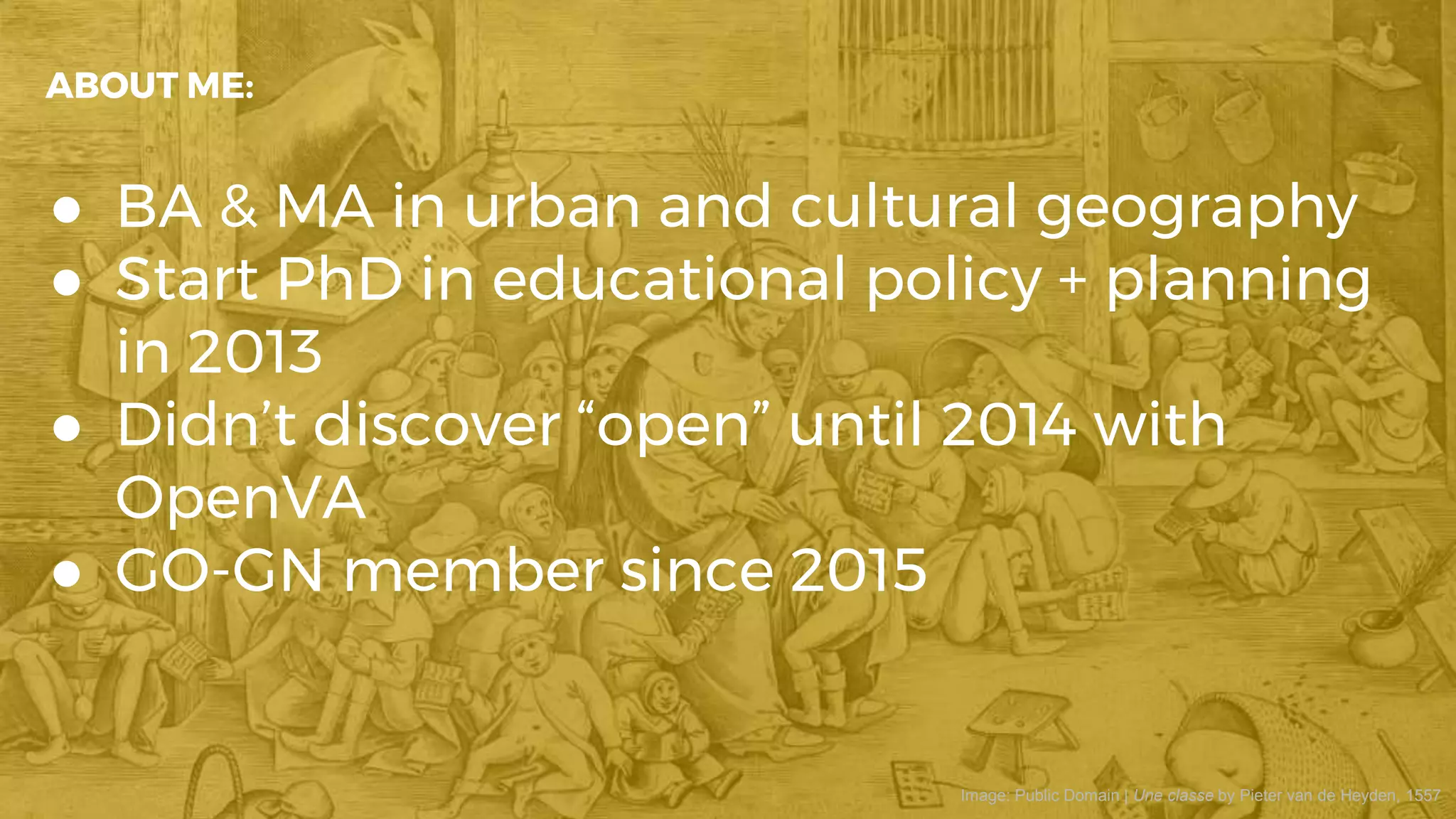
Image: Public Domain | Une classe by Pieter van de Heyden, 1557
● Introduction to the 3-paper approach and
overview of my dissertation
● The three projects
○ THEORY
○ POLICY
○ PRACTICE
● A synthesis
FORMAT:
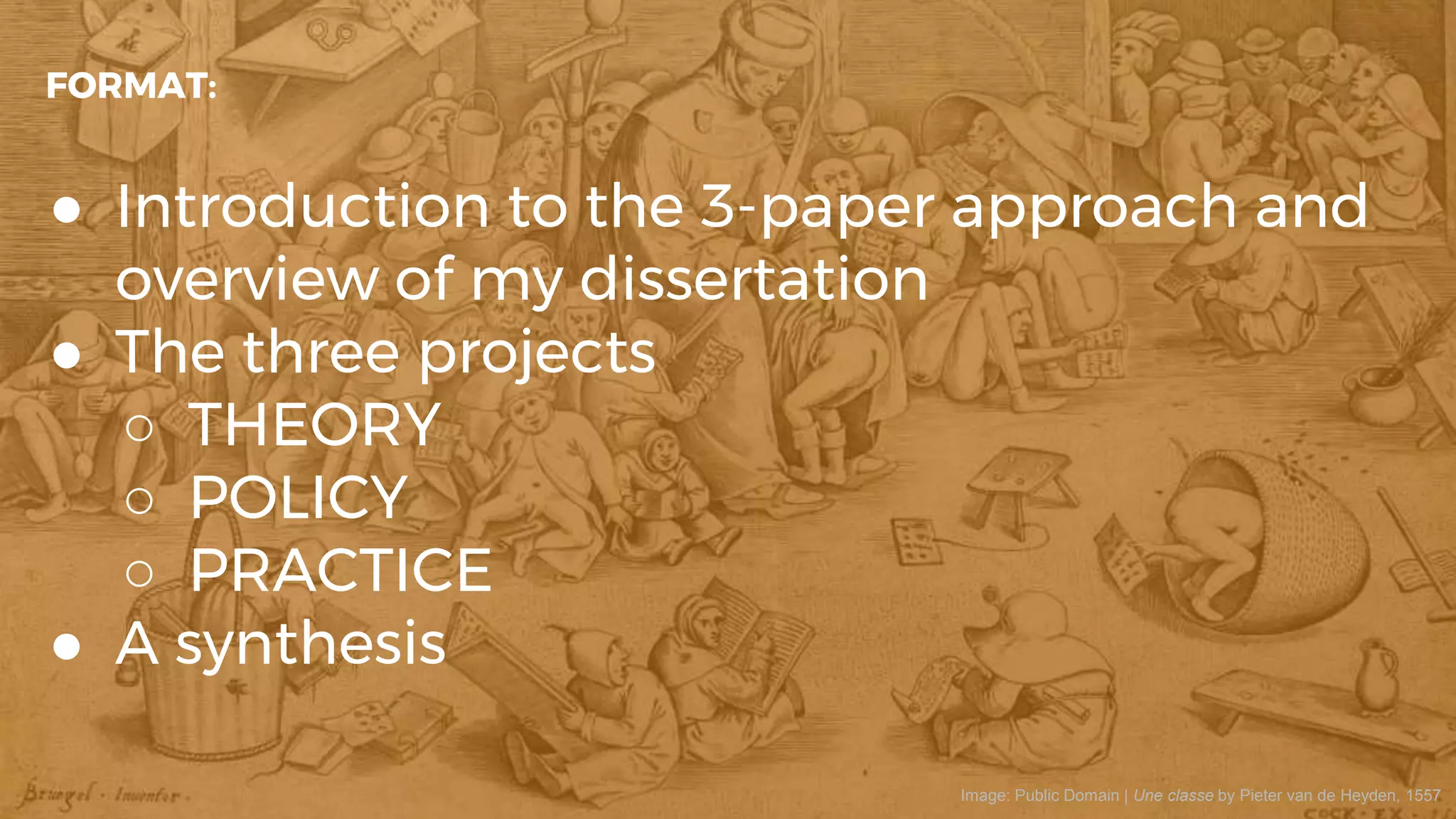
Image: Public Domain | Une classe by Pieter van de Heyden, 1557
Open education has the
potential to sustainably
transform existing
educational institutions
into more equitable and
democratic forms.
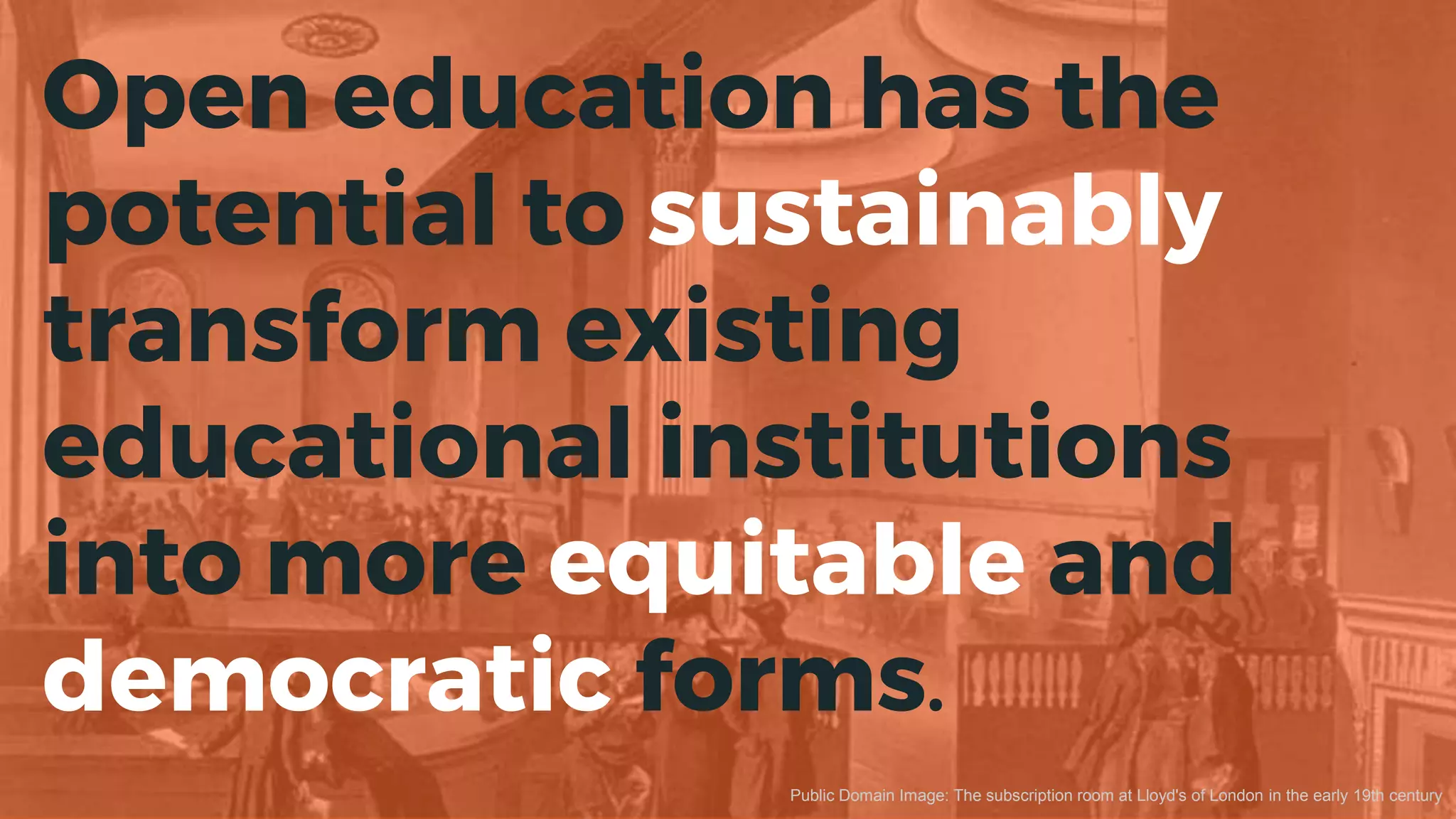
Public Domain Image: The subscription room at Lloyd's of London in the early 19th century
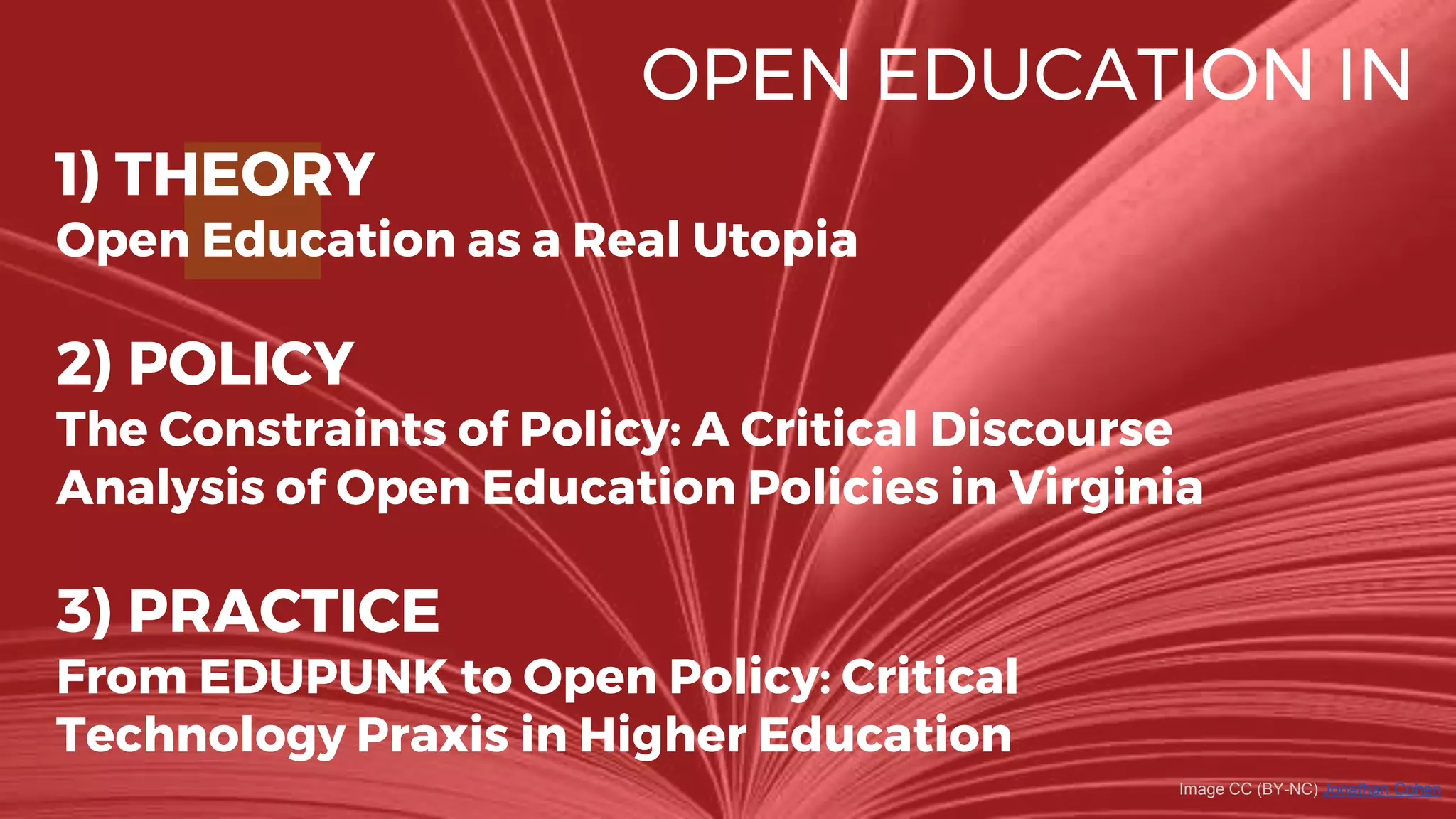
OPEN EDUCATION IN
1) THEORY
Open Education as a Real Utopia
2) POLICY
The Constraints of Policy: A Critical Discourse
Analysis of Open Education Policies in Virginia
3) PRACTICE
From EDUPUNK to Open Policy: Critical
Technology Praxis in Higher Education
Image CC (BY-NC) Jonathan Cohen
OPEN EDUCATION
AS A REAL UTOPIA
JAMISON R. MILLER | THE COLLEGE OF WILLIAM & MARY
JRMILLER@WM.EDU | @MILLERJAMISON
Public Domain Image: N°. 2 – Les utopies de la navigation aérienne au siècle dernier
OPEN EDUCATION IS
“UNDER-THEORIZED”
Bayne, Knox, & Ross, 2015
Deiman & Farrow, 2013
Edwards, 2015
Knox, 2013
Moe, 2015
Nyberg, 1975
Public Domain Image: N°. 2 – Les utopies de la navigation aérienne au siècle dernier
WHY THEORY?
● Without it, open education is vulnerable
to dilution and cooptation
● Not just a lens, but also as a keel
REAL UTOPIAS
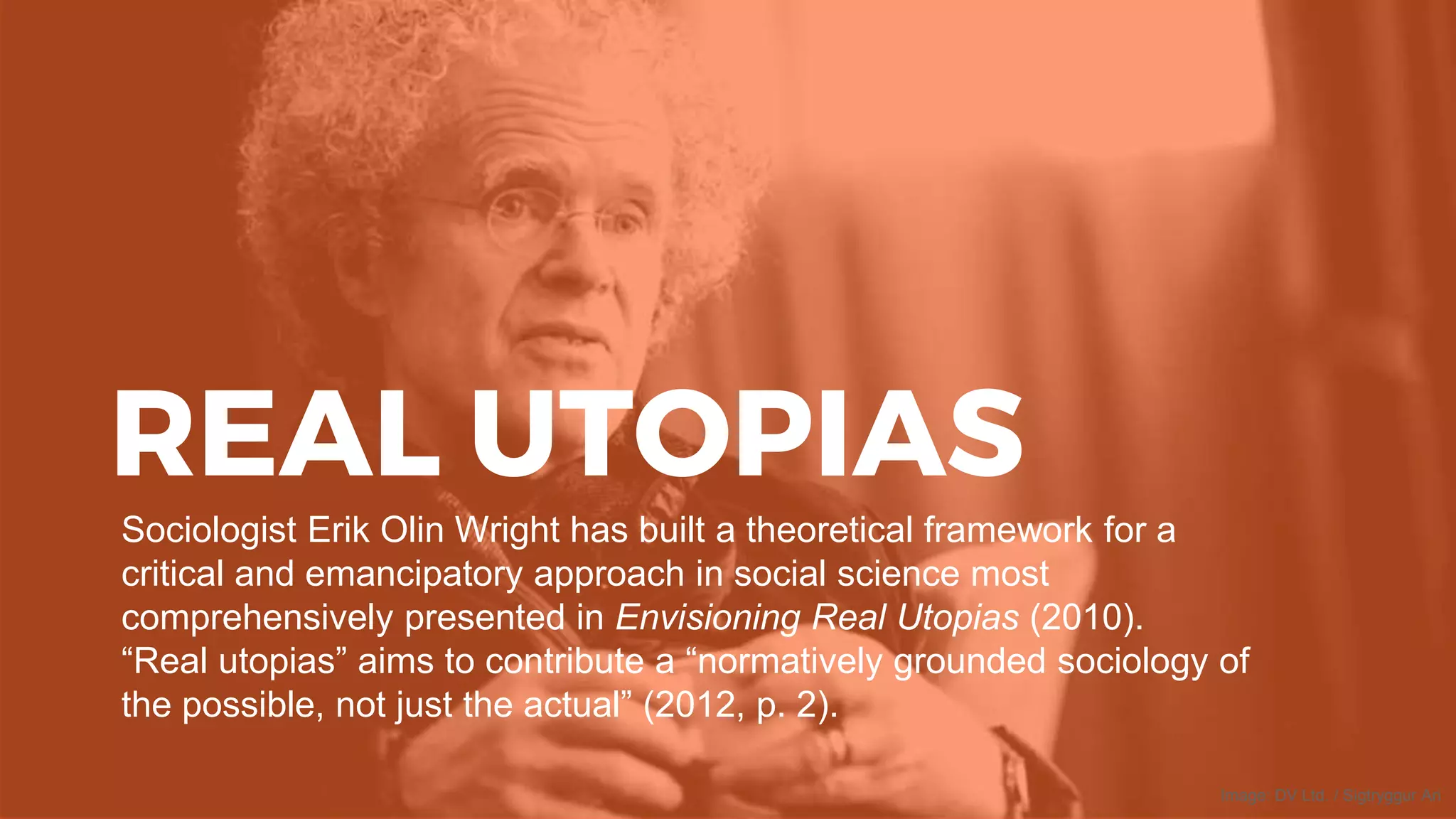
Sociologist Erik Olin Wright has built a theoretical framework for a
critical and emancipatory approach in social science most
comprehensively presented in Envisioning Real Utopias (2010).
“Real utopias” aims to contribute a “normatively grounded sociology of
the possible, not just the actual” (2012, p. 2).
Image: DV Ltd. / Sigtryggur Ari
REAL UTOPIAS
Image: DV Ltd. / Sigtryggur Ari
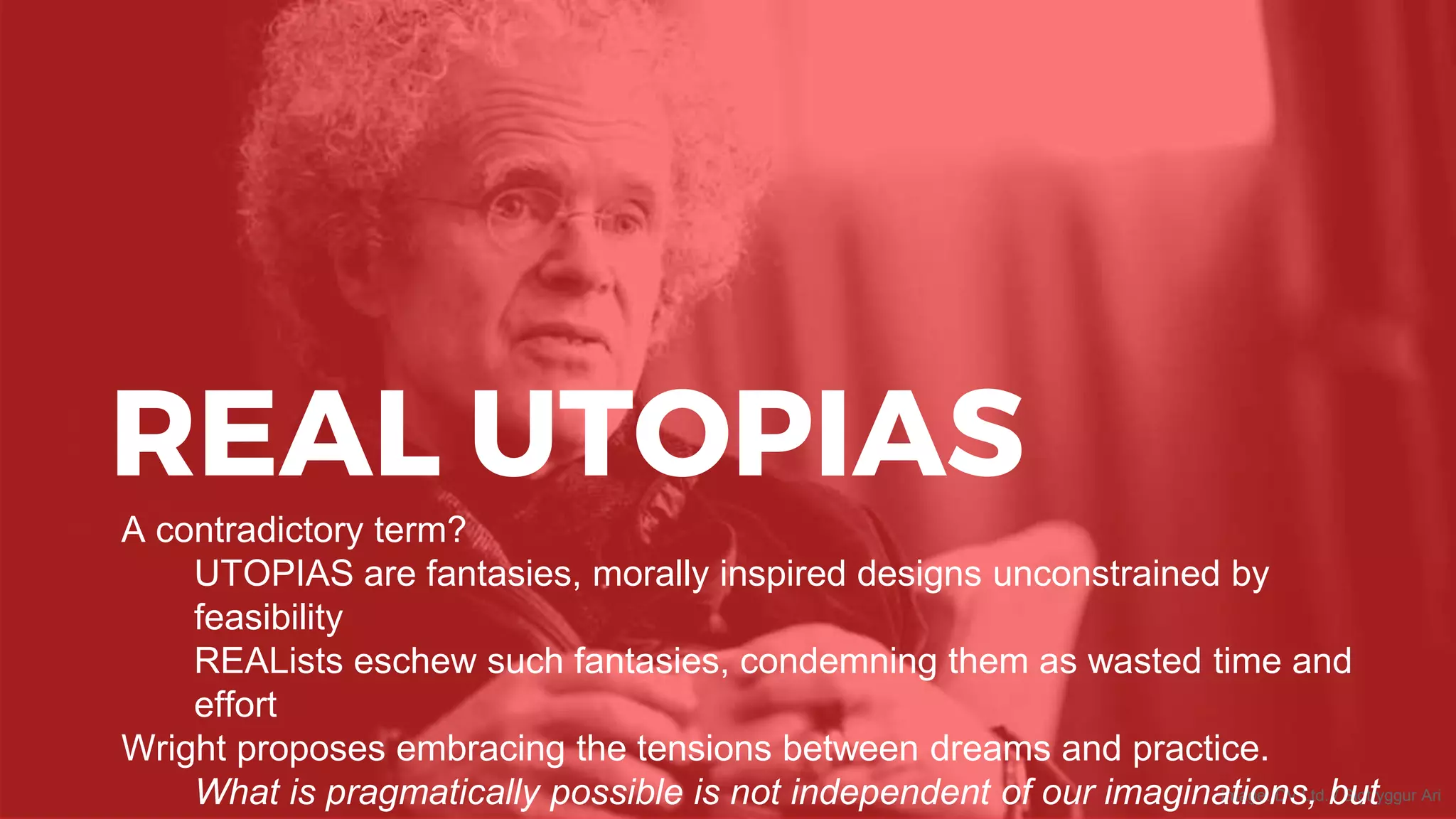
A contradictory term?
UTOPIAS are fantasies, morally inspired designs unconstrained by
feasibility
REALists eschew such fantasies, condemning them as wasted time and
effort
Wright proposes embracing the tensions between dreams and practice.
What is pragmatically possible is not independent of our imaginations, but
Public Domain Image: N°. 2 – Les utopies de la navigation aérienne au siècle dernier
FOUNDATIONS
1) Many forms of human suffering and many deficits in
human flourishing are the result of existing institutional
and social structures.
2) Transforming existing institutional and social structures
in the right way has the potential to substantially reduce
human suffering and expand the possibilities for human
flourishing.
(Wright, 2012, p. 2)
Public Domain Image: N°. 2 – Les utopies de la navigation aérienne au siècle dernier
FOUR TASKS
1) Specifying moral principles
2) Diagnosis and critique of existing institutions
3) Developing an account of viable alternatives
4) Proposing a theory of transformation
THE CONSTRAINTS
OF POLICY
A CRITICAL DISCOURSE ANALYSIS OF OPEN
EDUCATION POLICIES IN VIRGINIA
JAMISON R. MILLER | THE COLLEGE OF WILLIAM & MARY
JRMILLER@WM.EDU | @MILLERJAMISON
Public Domain Image: N°. 2 – Les utopies de la navigation aérienne au siècle dernier
Two research questions guide this analysis.
● First, how is open education discursively
framed within institutional policies?
● Second, do discursive framings in policies
support open education and OER as
transformational for education, and if so,
how?
Image CC (BY-SA) Véronique Debord-Lazaro
THEORETICAL
FRAMEWORK
∎ Tkacz (2015), Wikipedia and the Politics of Openness
∎ Critical Theory (Horkheimer, 1947;1972) and
∎ Critical Approaches to Open Education (Bayne, Knox, and
Ross, 2015; Deimann and Farrow, 2013; Hall, 2011; and
Knox, 2013)
Image: Warwick University
Fairclough (1993, 1995)
Texts present ideologies,
beliefs, messages, and
meanings.
CDA proposes to illuminate
these messages, how they
are framed, and how they can
be resisted and usurped.
Gee (1999)
Language is not merely a
means of communication, but
also orders social activity.
CDA is concerned with how
text presents discursive
practices- the ways in which
we are in the world.
Martínez-Alemán (2015)
Has been applying CDA in
higher education policy
analysis.
Identifies its primary
purposes as 1) to reveal
ideological foundations of
discourse, and 2) to provide
evidence (data) to support
corrective action
Critical Discourse Analysis (CDA)
Image CC (BY-SA) Pleuntje
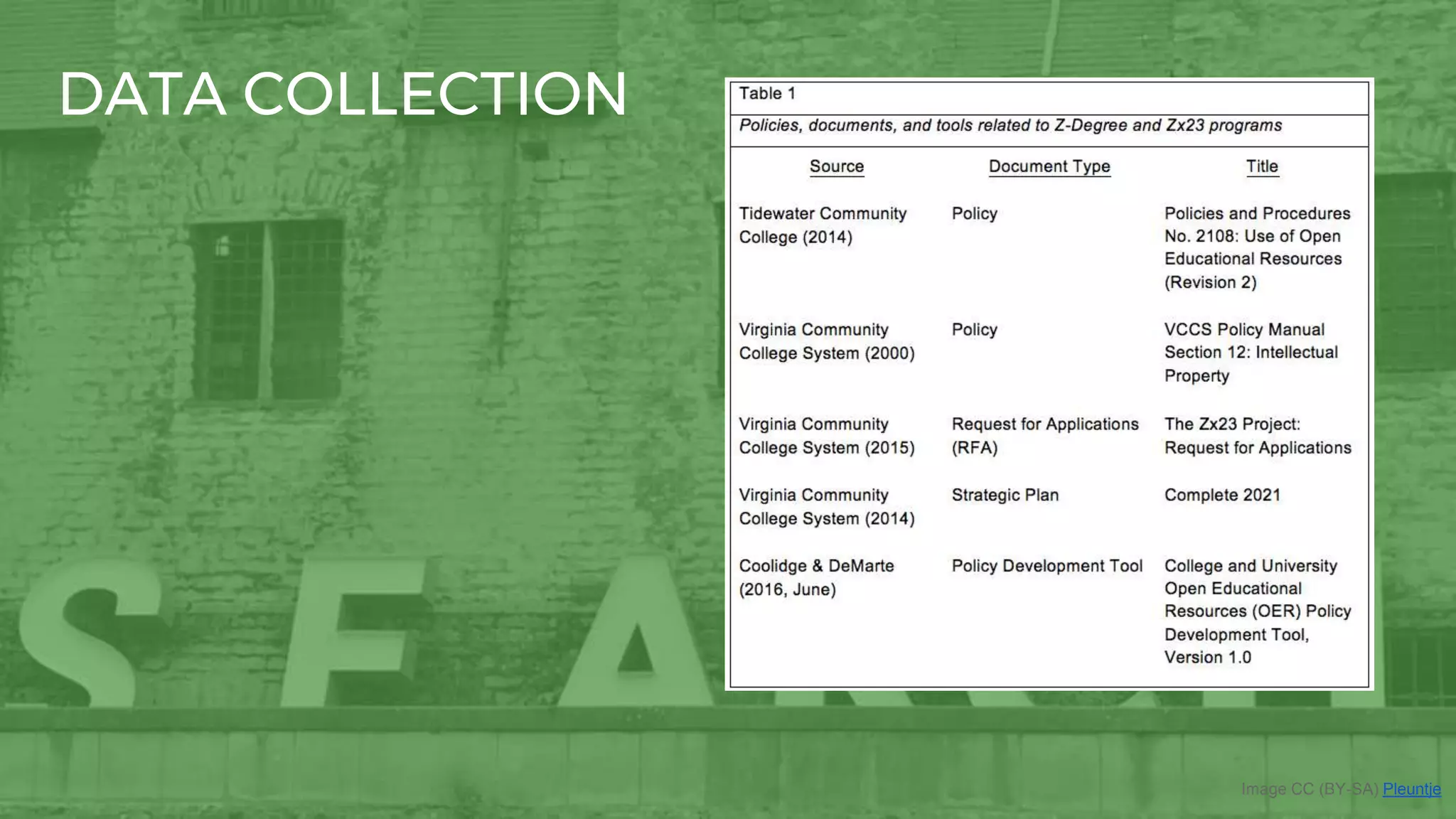
DATA COLLECTION
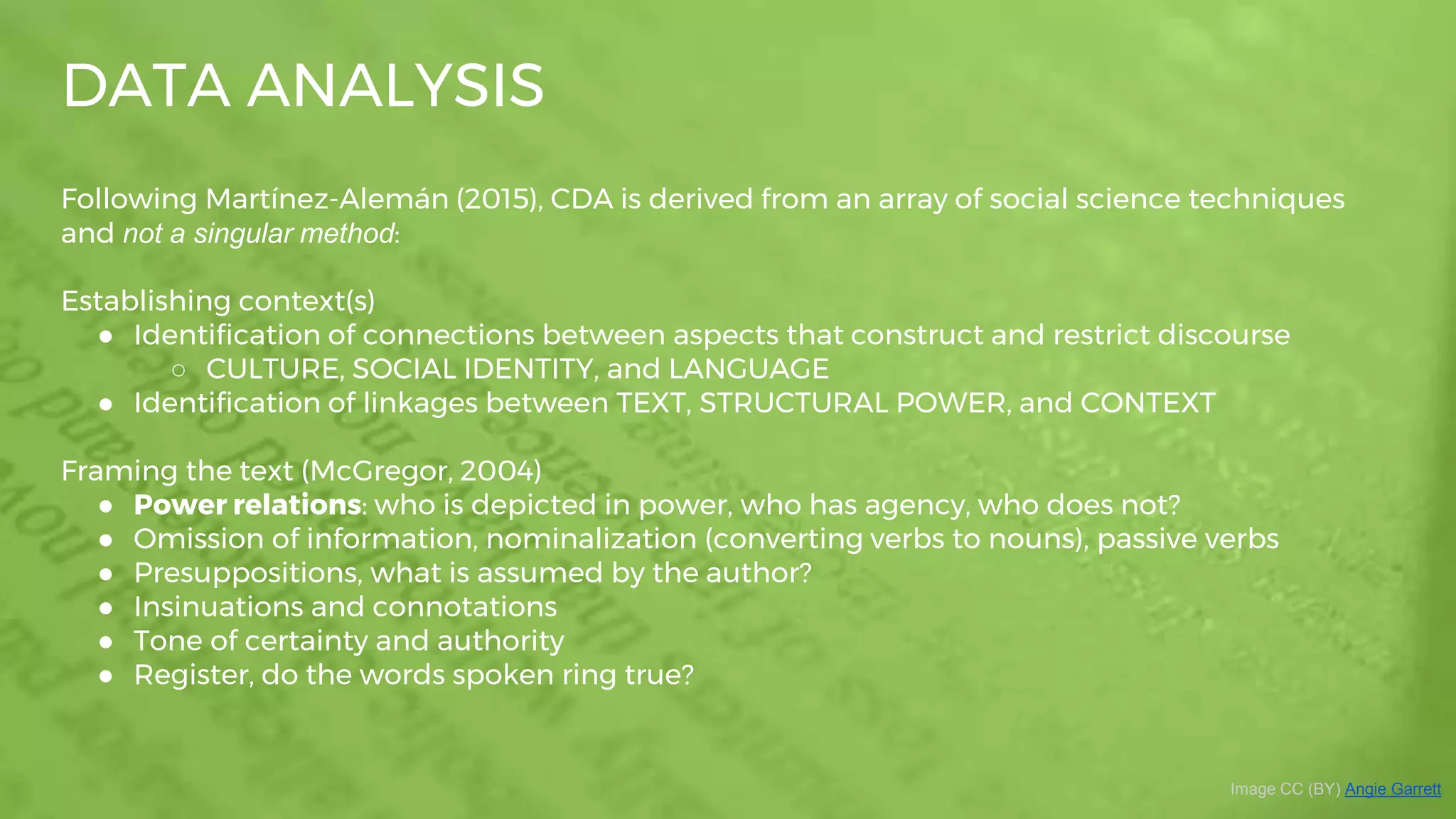
DATA ANALYSIS
Image CC (BY) Angie Garrett
Following Martínez-Alemán (2015), CDA is derived from an array of social science techniques
and not a singular method:
Establishing context(s)
● Identification of connections between aspects that construct and restrict discourse
○ CULTURE, SOCIAL IDENTITY, and LANGUAGE
● Identification of linkages between TEXT, STRUCTURAL POWER, and CONTEXT
Framing the text (McGregor, 2004)
● Power relations: who is depicted in power, who has agency, who does not?
● Omission of information, nominalization (converting verbs to nouns), passive verbs
● Presuppositions, what is assumed by the author?
● Insinuations and connotations
● Tone of certainty and authority
● Register, do the words spoken ring true?
DATA ANALYSIS
Image CC (BY) Angie Garrett
“improve student success through increased access and affordability, and
improve teaching efficiency and effectiveness through the ability to
focus, analyze, augment, and evolve course materials directly aligned to
course learning outcomes. Faculty will be supported in their use of OER to
achieve both of the stated outcomes.”
(TCC, 2014, p. 1-2)
DATA ANALYSIS
Image CC (BY) Angie Garrett
Faculty who incorporate OER materials into their courses shall assume all
responsibility for maintaining the integrity of the course content as
related to copyright and scholarly merit. In order for a course to carry a Z
designation within TCC’s Student Information System, faculty must
follow the procedures contained in this policy. (TCC, 2014, p. 2, emphasis
added)
DATA ANALYSIS
Image CC (BY) Angie Garrett
Faculty are to use only materials that are published under a Creative
Commons License or exist in the Public Domain. (TCC, 2014, p. 3, emphasis
added)
It is the faculty member’s responsibility to ensure that such content is
eligible for and meets the standards for a CC-BY license. As such, no
portion of such work may be claimed by others in whole, in part, or as a
derivative work. This requirement is mandatory for Z courses and
strongly encouraged for OER courses. (TCC, 2014, p. 3, emphasis added)
ASSUMPTIONS
● Built on the assumptions that language is more than the mechanics
of communication; it orders social practices and expresses ideology
and thus holds impact on actions
DELIMITATIONS
● Focused on institutional and state-level higher education policies
from Virginia from 2007-2016
LIMITATIONS
● As open education policies are only just emerging, there are relatively
few examples from which to draw
● This study will not be analyzing the impact of evident discourses
Image CC (BY-SA) Edith Soto
FROM EDUPUNK
TO OPEN POLICY
CRITICAL TECHNOLOGY PRAXIS
IN HIGHER EDUCATION
JAMISON R. MILLER | THE COLLEGE OF WILLIAM & MARY
JRMILLER@WM.EDU | @MILLERJAMISON
Public Domain Image: N°. 2 – Les utopies de la navigation aérienne au siècle dernier
BUILD A BRIDGE BETWEEN
CRITICAL PEDAGOGICAL
THEORY AND PRACTICES
AND
MY DISCIPLINARY HOME OF
HUMAN GEOGRAPHY.
Public Domain Image: N°. 2 – Les utopies de la navigation aérienne au siècle dernier
CONTEXT
The neoliberalizing university
(Giroux, 2014; Newfield 2010; 2016)
Public Domain Image: N°. 2 – Les utopies de la navigation aérienne au siècle dernier
THEORETICAL
FRAMEWORKS
● Dewey, Freire, hooks, Montessori
● Connected learning, Networked learning, and
open education
Public Domain Image: N°. 2 – Les utopies de la navigation aérienne au siècle dernier
1. EDUPUNK
a. DS106
b.A domain of one’s own
2.OER & Z-Degrees
3. OpenVA & Open Policy
EMPIRICS
Public Domain Image: N°. 2 – Les utopies de la navigation aérienne au siècle dernier
Implications for a critical
technology praxis in higher
education, geography in
particular
OPEN EDUCATION IN
1) THEORY
Open Education as a Real Utopia
2) POLICY
The Constraints of Policy: A Critical Discourse
Analysis of Open Education Policies in Virginia
3) PRACTICE
From EDUPUNK to Open Policy: Critical
Technology Praxis in Higher Education
Image CC (BY-NC) Jonathan Cohen
TRANSFORMATIVE POTENTIALS
OF OPEN EDUCATION
IN THEORY, POLICY, AND
PRACTICE
JAMISON R. MILLER | THE COLLEGE OF WILLIAM AND MARY
@MILLERJAMISON | JRMILLER@WM.EDU
Public Domain Image: N°. 2 – Les utopies de la navigation aérienne au siècle dernier
REFERENCES
Benkler, Y. (2006). The wealth of networks. New Haven, CT: Yale University Press.
Castells, M. (2010). The rise of the network society. In The information age: Economy,
society,
and culture (2nd ed., Vol 1). West Sussex, UK: Wiley-Blackwell.
Castells, M. (2013). Communication power. London, UK: Oxford University Press.
Dewey, J. (1916). Democracy and education: An introduction to the philosophy of education.
New York: Macmillan.
Floridi, L. (2011). The philosophy of information. Oxford, UK: Oxford University Press.
Freire, P. (2000 [1970]). Pedagogy of the oppressed. New York: Continuum.
Giroux, H. A. (2014). Neoliberalism's war on higher education. Chicago, IL: Haymarket Books.
Goldrick-Rab, S. (2016). Paying the price: College costs, financial aid, and the betrayal of the
American dream. Chicago, IL: University of Chicago Press.
Public Domain Image: N°. 2 – Les utopies de la navigation aérienne au siècle dernier
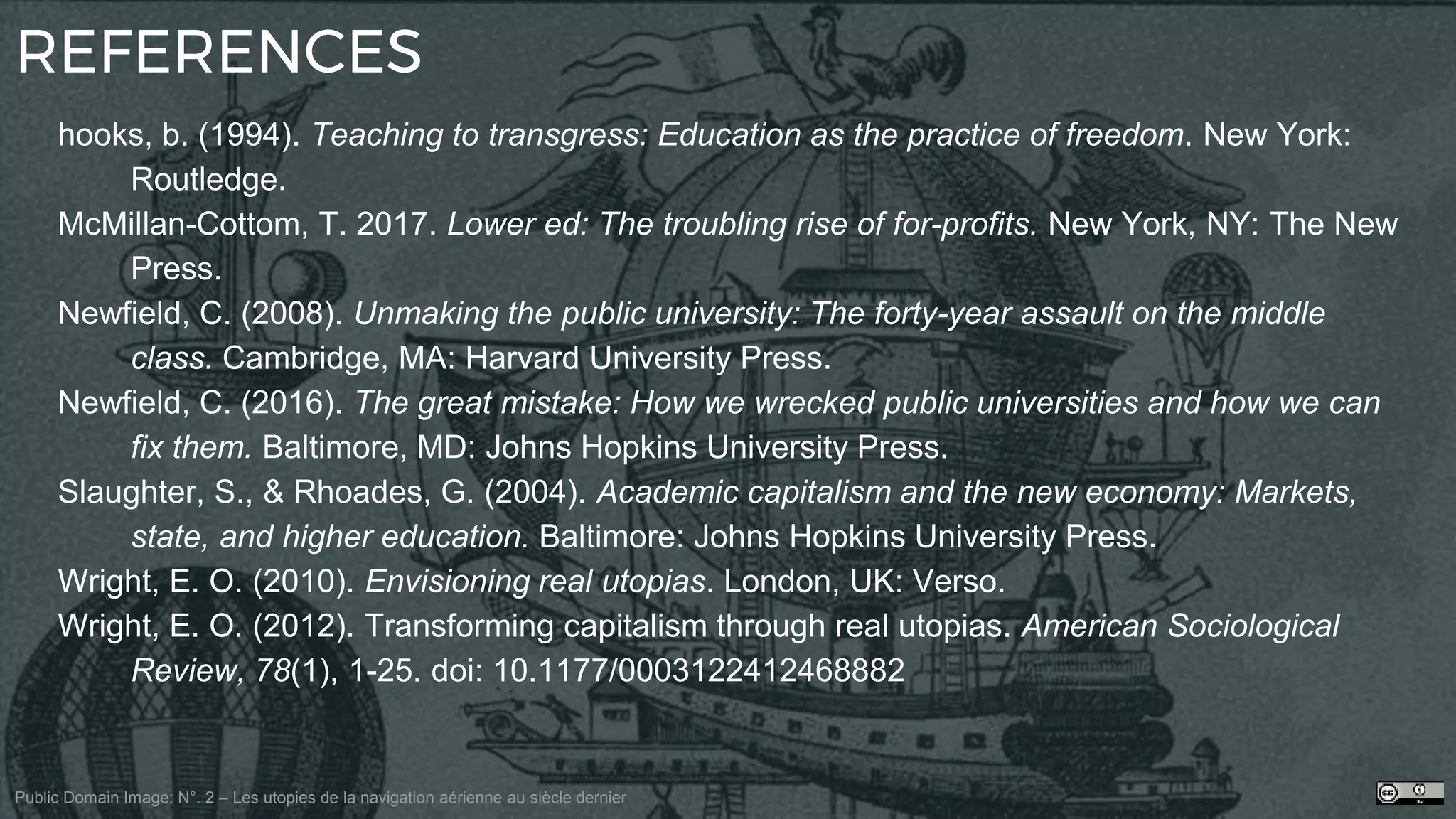
REFERENCES
hooks, b. (1994). Teaching to transgress: Education as the practice of freedom. New York:
Routledge.
McMillan-Cottom, T. 2017. Lower ed: The troubling rise of for-profits. New York, NY: The New
Press.
Newfield, C. (2008). Unmaking the public university: The forty-year assault on the middle
class. Cambridge, MA: Harvard University Press.
Newfield, C. (2016). The great mistake: How we wrecked public universities and how we can
fix them. Baltimore, MD: Johns Hopkins University Press.
Slaughter, S., & Rhoades, G. (2004). Academic capitalism and the new economy: Markets,
state, and higher education. Baltimore: Johns Hopkins University Press.
Wright, E. O. (2010). Envisioning real utopias. London, UK: Verso.
Wright, E. O. (2012). Transforming capitalism through real utopias. American Sociological
Review, 78(1), 1-25. doi: 10.1177/0003122412468882

TRANSFORMATIVE POTENTIALS OF OPEN EDUCATION IN THEORY, POLICY, AND PRACTICE

  • 1.
    TRANSFORMATIVE POTENTIALS OF OPENEDUCATION IN THEORY, POLICY, AND PRACTICE JAMISON R. MILLER | THE COLLEGE OF WILLIAM AND MARY @MILLERJAMISON | JRMILLER@WM.EDU
  • 2.
    ● BA &MA in urban and cultural geography ● Start PhD in educational policy + planning in 2013 ● Didn’t discover “open” until 2014 with OpenVA ● GO-GN member since 2015 ABOUT ME: Image: Public Domain | Une classe by Pieter van de Heyden, 1557
  • 3.
    ● Introduction tothe 3-paper approach and overview of my dissertation ● The three projects ○ THEORY ○ POLICY ○ PRACTICE ● A synthesis FORMAT: Image: Public Domain | Une classe by Pieter van de Heyden, 1557
  • 4.
    Open education hasthe potential to sustainably transform existing educational institutions into more equitable and democratic forms. Public Domain Image: The subscription room at Lloyd's of London in the early 19th century
  • 5.
    OPEN EDUCATION IN 1)THEORY Open Education as a Real Utopia 2) POLICY The Constraints of Policy: A Critical Discourse Analysis of Open Education Policies in Virginia 3) PRACTICE From EDUPUNK to Open Policy: Critical Technology Praxis in Higher Education Image CC (BY-NC) Jonathan Cohen
  • 6.
    OPEN EDUCATION AS AREAL UTOPIA JAMISON R. MILLER | THE COLLEGE OF WILLIAM & MARY JRMILLER@WM.EDU | @MILLERJAMISON Public Domain Image: N°. 2 – Les utopies de la navigation aérienne au siècle dernier
  • 7.
    Public Domain Image:N°. 2 – Les utopies de la navigation aérienne au siècle dernier OPEN EDUCATION IS “UNDER-THEORIZED” Bayne, Knox, & Ross, 2015 Deiman & Farrow, 2013 Edwards, 2015 Knox, 2013 Moe, 2015 Nyberg, 1975
  • 8.
    Public Domain Image:N°. 2 – Les utopies de la navigation aérienne au siècle dernier WHY THEORY? ● Without it, open education is vulnerable to dilution and cooptation ● Not just a lens, but also as a keel
  • 9.
    REAL UTOPIAS Sociologist ErikOlin Wright has built a theoretical framework for a critical and emancipatory approach in social science most comprehensively presented in Envisioning Real Utopias (2010). “Real utopias” aims to contribute a “normatively grounded sociology of the possible, not just the actual” (2012, p. 2). Image: DV Ltd. / Sigtryggur Ari
  • 10.
    REAL UTOPIAS Image: DVLtd. / Sigtryggur Ari A contradictory term? UTOPIAS are fantasies, morally inspired designs unconstrained by feasibility REALists eschew such fantasies, condemning them as wasted time and effort Wright proposes embracing the tensions between dreams and practice. What is pragmatically possible is not independent of our imaginations, but
  • 11.
    Public Domain Image:N°. 2 – Les utopies de la navigation aérienne au siècle dernier FOUNDATIONS 1) Many forms of human suffering and many deficits in human flourishing are the result of existing institutional and social structures. 2) Transforming existing institutional and social structures in the right way has the potential to substantially reduce human suffering and expand the possibilities for human flourishing. (Wright, 2012, p. 2)
  • 12.
    Public Domain Image:N°. 2 – Les utopies de la navigation aérienne au siècle dernier FOUR TASKS 1) Specifying moral principles 2) Diagnosis and critique of existing institutions 3) Developing an account of viable alternatives 4) Proposing a theory of transformation
  • 13.
    THE CONSTRAINTS OF POLICY ACRITICAL DISCOURSE ANALYSIS OF OPEN EDUCATION POLICIES IN VIRGINIA JAMISON R. MILLER | THE COLLEGE OF WILLIAM & MARY JRMILLER@WM.EDU | @MILLERJAMISON Public Domain Image: N°. 2 – Les utopies de la navigation aérienne au siècle dernier
  • 14.
    Two research questionsguide this analysis. ● First, how is open education discursively framed within institutional policies? ● Second, do discursive framings in policies support open education and OER as transformational for education, and if so, how? Image CC (BY-SA) Véronique Debord-Lazaro
  • 15.
    THEORETICAL FRAMEWORK ∎ Tkacz (2015),Wikipedia and the Politics of Openness ∎ Critical Theory (Horkheimer, 1947;1972) and ∎ Critical Approaches to Open Education (Bayne, Knox, and Ross, 2015; Deimann and Farrow, 2013; Hall, 2011; and Knox, 2013) Image: Warwick University
  • 16.
    Fairclough (1993, 1995) Textspresent ideologies, beliefs, messages, and meanings. CDA proposes to illuminate these messages, how they are framed, and how they can be resisted and usurped. Gee (1999) Language is not merely a means of communication, but also orders social activity. CDA is concerned with how text presents discursive practices- the ways in which we are in the world. Martínez-Alemán (2015) Has been applying CDA in higher education policy analysis. Identifies its primary purposes as 1) to reveal ideological foundations of discourse, and 2) to provide evidence (data) to support corrective action Critical Discourse Analysis (CDA)
  • 17.
    Image CC (BY-SA)Pleuntje DATA COLLECTION
  • 18.
    DATA ANALYSIS Image CC(BY) Angie Garrett Following Martínez-Alemán (2015), CDA is derived from an array of social science techniques and not a singular method: Establishing context(s) ● Identification of connections between aspects that construct and restrict discourse ○ CULTURE, SOCIAL IDENTITY, and LANGUAGE ● Identification of linkages between TEXT, STRUCTURAL POWER, and CONTEXT Framing the text (McGregor, 2004) ● Power relations: who is depicted in power, who has agency, who does not? ● Omission of information, nominalization (converting verbs to nouns), passive verbs ● Presuppositions, what is assumed by the author? ● Insinuations and connotations ● Tone of certainty and authority ● Register, do the words spoken ring true?
  • 19.
    DATA ANALYSIS Image CC(BY) Angie Garrett “improve student success through increased access and affordability, and improve teaching efficiency and effectiveness through the ability to focus, analyze, augment, and evolve course materials directly aligned to course learning outcomes. Faculty will be supported in their use of OER to achieve both of the stated outcomes.” (TCC, 2014, p. 1-2)
  • 20.
    DATA ANALYSIS Image CC(BY) Angie Garrett Faculty who incorporate OER materials into their courses shall assume all responsibility for maintaining the integrity of the course content as related to copyright and scholarly merit. In order for a course to carry a Z designation within TCC’s Student Information System, faculty must follow the procedures contained in this policy. (TCC, 2014, p. 2, emphasis added)
  • 21.
    DATA ANALYSIS Image CC(BY) Angie Garrett Faculty are to use only materials that are published under a Creative Commons License or exist in the Public Domain. (TCC, 2014, p. 3, emphasis added) It is the faculty member’s responsibility to ensure that such content is eligible for and meets the standards for a CC-BY license. As such, no portion of such work may be claimed by others in whole, in part, or as a derivative work. This requirement is mandatory for Z courses and strongly encouraged for OER courses. (TCC, 2014, p. 3, emphasis added)
  • 22.
    ASSUMPTIONS ● Built onthe assumptions that language is more than the mechanics of communication; it orders social practices and expresses ideology and thus holds impact on actions DELIMITATIONS ● Focused on institutional and state-level higher education policies from Virginia from 2007-2016 LIMITATIONS ● As open education policies are only just emerging, there are relatively few examples from which to draw ● This study will not be analyzing the impact of evident discourses Image CC (BY-SA) Edith Soto
  • 23.
    FROM EDUPUNK TO OPENPOLICY CRITICAL TECHNOLOGY PRAXIS IN HIGHER EDUCATION JAMISON R. MILLER | THE COLLEGE OF WILLIAM & MARY JRMILLER@WM.EDU | @MILLERJAMISON Public Domain Image: N°. 2 – Les utopies de la navigation aérienne au siècle dernier
  • 24.
    Public Domain Image:N°. 2 – Les utopies de la navigation aérienne au siècle dernier BUILD A BRIDGE BETWEEN CRITICAL PEDAGOGICAL THEORY AND PRACTICES AND MY DISCIPLINARY HOME OF HUMAN GEOGRAPHY.
  • 25.
    Public Domain Image:N°. 2 – Les utopies de la navigation aérienne au siècle dernier CONTEXT The neoliberalizing university (Giroux, 2014; Newfield 2010; 2016)
  • 26.
    Public Domain Image:N°. 2 – Les utopies de la navigation aérienne au siècle dernier THEORETICAL FRAMEWORKS ● Dewey, Freire, hooks, Montessori ● Connected learning, Networked learning, and open education
  • 27.
    Public Domain Image:N°. 2 – Les utopies de la navigation aérienne au siècle dernier 1. EDUPUNK a. DS106 b.A domain of one’s own 2.OER & Z-Degrees 3. OpenVA & Open Policy EMPIRICS
  • 28.
    Public Domain Image:N°. 2 – Les utopies de la navigation aérienne au siècle dernier Implications for a critical technology praxis in higher education, geography in particular
  • 29.
    OPEN EDUCATION IN 1)THEORY Open Education as a Real Utopia 2) POLICY The Constraints of Policy: A Critical Discourse Analysis of Open Education Policies in Virginia 3) PRACTICE From EDUPUNK to Open Policy: Critical Technology Praxis in Higher Education Image CC (BY-NC) Jonathan Cohen
  • 30.
    TRANSFORMATIVE POTENTIALS OF OPENEDUCATION IN THEORY, POLICY, AND PRACTICE JAMISON R. MILLER | THE COLLEGE OF WILLIAM AND MARY @MILLERJAMISON | JRMILLER@WM.EDU
  • 31.
    Public Domain Image:N°. 2 – Les utopies de la navigation aérienne au siècle dernier REFERENCES Benkler, Y. (2006). The wealth of networks. New Haven, CT: Yale University Press. Castells, M. (2010). The rise of the network society. In The information age: Economy, society, and culture (2nd ed., Vol 1). West Sussex, UK: Wiley-Blackwell. Castells, M. (2013). Communication power. London, UK: Oxford University Press. Dewey, J. (1916). Democracy and education: An introduction to the philosophy of education. New York: Macmillan. Floridi, L. (2011). The philosophy of information. Oxford, UK: Oxford University Press. Freire, P. (2000 [1970]). Pedagogy of the oppressed. New York: Continuum. Giroux, H. A. (2014). Neoliberalism's war on higher education. Chicago, IL: Haymarket Books. Goldrick-Rab, S. (2016). Paying the price: College costs, financial aid, and the betrayal of the American dream. Chicago, IL: University of Chicago Press.
  • 32.
    Public Domain Image:N°. 2 – Les utopies de la navigation aérienne au siècle dernier REFERENCES hooks, b. (1994). Teaching to transgress: Education as the practice of freedom. New York: Routledge. McMillan-Cottom, T. 2017. Lower ed: The troubling rise of for-profits. New York, NY: The New Press. Newfield, C. (2008). Unmaking the public university: The forty-year assault on the middle class. Cambridge, MA: Harvard University Press. Newfield, C. (2016). The great mistake: How we wrecked public universities and how we can fix them. Baltimore, MD: Johns Hopkins University Press. Slaughter, S., & Rhoades, G. (2004). Academic capitalism and the new economy: Markets, state, and higher education. Baltimore: Johns Hopkins University Press. Wright, E. O. (2010). Envisioning real utopias. London, UK: Verso. Wright, E. O. (2012). Transforming capitalism through real utopias. American Sociological Review, 78(1), 1-25. doi: 10.1177/0003122412468882

Editor's Notes

  • #29 Clarify equal access versus equal opportunity.