HOW HEAT
TRANSFER?
• Direction: Read the statement carefully and choose the best
answer.
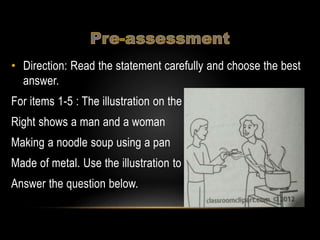
For items 1-5 : The illustration on the
Right shows a man and a woman
Making a noodle soup using a pan
Made of metal. Use the illustration to
Answer the question below.
1. How does heat travel through the pan?
Heat travels through the pan by _____________.
a. Radiation c. Convection
b. Dispersion d. Conduction
2. How does heat travel through the soup? Heat travels through
the soup by ______________.
a. Radiation c. Convection
b. Dispersion d. Conduction
3. In what direction does heat travel through the soup?
a. from top to bottom c. both A and B
b. from bottom to top d. neither A nor B
4. Which of the following explains why the lady is able to hold the handle of the pan
with her bare hands?
I. The handle is made of good insulator of heat
II. The handle has low thermal conductivity
III. The handle has high thermal expansion
a. I and II only c. II and III only
b. I and III only d. I,II and III
5. Which of the following methods of heat transfer is NOT taking place in the given
situation?
a. Conduction c. Radiation
b. Convection d. None of them
ACTIVITY: WARM ME UP, COOL ME DOWN
• Heat always moves from a warmer place
to a cooler place.
• Hot objects in a cooler room will cool to
room temperature.
• Cold objects in a warmer room will heat
up to room temperature
• Heat (thermal) energy is created by the
movement of particles (atoms) that
produces heat.
• Heat (thermal) energy increases as
temperature increases because as
temperature increases, atoms move
faster (have more kinetic energy)
• Heat (thermal energy) is transferred from one
object to another when the objects are at
different temperatures.
• The amount of heat (thermal energy) that is
transferred when two objects are brought into
contact depends on the difference in
temperature between the objects.
• Heat is transferred only when two objects are at
different temperatures
• Thermal energy always moves from warmer to
cooler objects
• The warmer object loses thermal energy and
becomes cooler as the cooler object gains thermal
energy and becomes warmer.
• Energy will continue to move from a warmer object
to a cooler object until both have the same
temperature.
How heat transfer
How heat transfer
How heat transfer
How heat transfer
How heat transfer

How heat transfer

  • 1.
  • 2.
    • Direction: Readthe statement carefully and choose the best answer. For items 1-5 : The illustration on the Right shows a man and a woman Making a noodle soup using a pan Made of metal. Use the illustration to Answer the question below.
  • 3.
    1. How doesheat travel through the pan? Heat travels through the pan by _____________. a. Radiation c. Convection b. Dispersion d. Conduction 2. How does heat travel through the soup? Heat travels through the soup by ______________. a. Radiation c. Convection b. Dispersion d. Conduction 3. In what direction does heat travel through the soup? a. from top to bottom c. both A and B b. from bottom to top d. neither A nor B
  • 4.
    4. Which ofthe following explains why the lady is able to hold the handle of the pan with her bare hands? I. The handle is made of good insulator of heat II. The handle has low thermal conductivity III. The handle has high thermal expansion a. I and II only c. II and III only b. I and III only d. I,II and III 5. Which of the following methods of heat transfer is NOT taking place in the given situation? a. Conduction c. Radiation b. Convection d. None of them
  • 6.
    ACTIVITY: WARM MEUP, COOL ME DOWN
  • 7.
    • Heat alwaysmoves from a warmer place to a cooler place. • Hot objects in a cooler room will cool to room temperature. • Cold objects in a warmer room will heat up to room temperature
  • 8.
    • Heat (thermal)energy is created by the movement of particles (atoms) that produces heat. • Heat (thermal) energy increases as temperature increases because as temperature increases, atoms move faster (have more kinetic energy)
  • 9.
    • Heat (thermalenergy) is transferred from one object to another when the objects are at different temperatures. • The amount of heat (thermal energy) that is transferred when two objects are brought into contact depends on the difference in temperature between the objects.
  • 10.
    • Heat istransferred only when two objects are at different temperatures • Thermal energy always moves from warmer to cooler objects • The warmer object loses thermal energy and becomes cooler as the cooler object gains thermal energy and becomes warmer. • Energy will continue to move from a warmer object to a cooler object until both have the same temperature.