Focus and
Epicenter
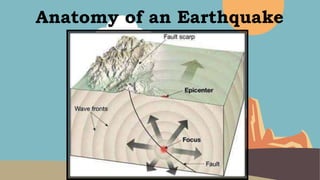
The area inside the
Earth where an
earthquake starts is
known as the focal
point of the quake
or the focus
(hypocenter)
The point at the
Earth's surface
directly above the
focus is known as
the epicenter of
the quake.
Seismic waves from a deep-
focus earthquake lose more of
their energy as they travel
farther up to surface.
Anatomy of an Earthquake
INTENSITY and
MAGNITUDE
Philippine Institute of Volcanology and
Seismology (PHIVOLCS) – is the
service institute to mitigate disasters that
may arise from volcanic eruptions,
earthquakes, tsunamis and other related
geotectonic phenomena.
It can be
measured using
a Mercalli Scale
It is the measure of
the damage released
by the earthquake to
its surroundings.
What is Intensity?
Mercalli Scale
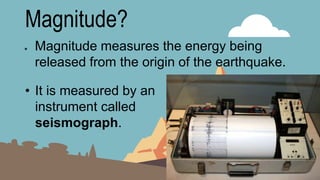
Magnitude?
● Magnitude measures the energy being
released from the origin of the earthquake.
• It is measured by an
instrument called
seismograph.
● The Richter
Magnitude
Scale measures
the quantity of
seismic energy
released by an
earthquake.
Difference between
INTENSITY and MAGNITUDE
INTENSITY
1. Can be determined by
observing the effects in
different places.
2. Can be measured
using Mercalli Scale.
3. Expressed in Roman
Numerals.
MAGNITUDE
1. Measures the energy
released by the
earthquake.
2. Can be measured
using Richter Scale.
3. Expressed in Hindu-
Arabic Numerals.
ACTIVITY
Make a 2-3 minute role
playing act showing
what to do before,
during and after an
earthquake starts.
FAULT TYPES
Two kinds of Faults
1. Active Fault
2. Inactive Fault
1. ACTIVE FAULTS
• These are structures along which we
expect displacement to occur.
• The process that produces
displacement across a fault
continuously.
• All shallow earthquakes occur on active
faults.
1. ACTIVE FAULTS
• Faults are commonly considered to be
active if there has been movement
observed or evidence of seismic activity
during the last 10,000 years.
2. inACTIVE FAULTS
• These are structures that we can
identify, but which do no have
earthquakes.
• If a fault has been inactive for millions of
years, it’s certainly safe to call it
inactive.
five active fault lines in the country
1. Western Philippine Fault
2. Eastern Philippine Fault
3. South of Mindanao Fault
4. Central Philippine Fault
5. Marikina/Valley Fault System
Bring the following materials for the next
activity
Flat basin (batya)
Water
Rectangular piece of plastic or plywood
Rock
EARTHQUAKES
AND
TSUNAMIS
Video of
Tsunami
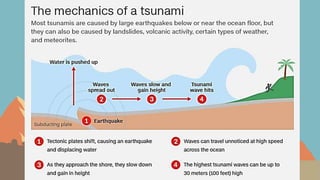
• Tsunami is caused by an earthquake
and other movements on the ocean
floor.
It travels at speeds up to 600 miles
per hour.
Awesome
Words
Awesome
Words
Earthquake
Preparedness
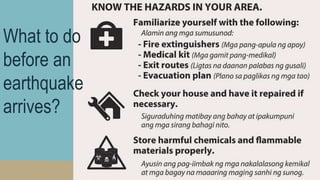
What to do
before an
earthquake
arrives?
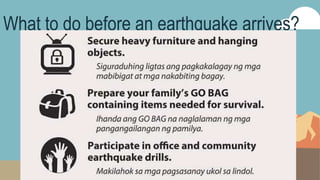
What to do before an earthquake arrives?
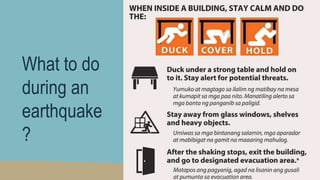
What to do
during an
earthquake
?
What to do during an earthquake?
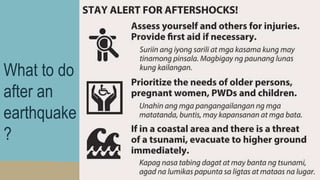
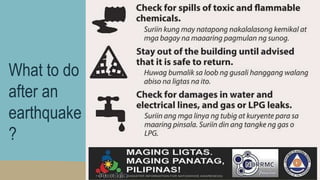
What to do
after an
earthquake
?
What to do
after an
earthquake
?
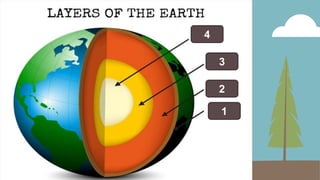
Layers of
the Earth
4
3
2
1
CRUST
• The outermost and thinnest layer.
• It is made of loose material, like rocks,
soil, and seabed.
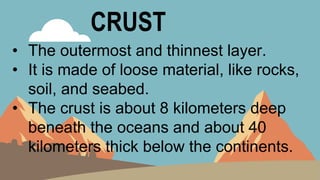
• The crust is about 8 kilometers deep
beneath the oceans and about 40
kilometers thick below the continents.
CRUST
• Crust is mainly made of different
elements like oxygen, silicon,
aluminum, calcium, sodium, and
potassium.
• It makes up about 1% of the Earth’s
total volume
MANTLE
● It extends approximately 2900 kilometers
deep into the Earth. It makes up about
84% of the Earth’s total volume.
● The temperature in the mantle is about
1000 º C - 3000 º C, the high temperature
and pressure in the mantle allows the
solid rock to flow slowly.
MANTLE
● Mantle is mainly made of silicate rocks in
the upper part making it solid layer and
mostly iron in the lower part making it
denser than the upper part of the mantle.
Outer core
● This is about 2200 kilometers beneath the
Earth’s surface.
● The outer core consists of super-heated
liquid molten lava about 2000 º C – 4000
º C.
Outer core
● The lava is mostly made up of iron and
nickel, which is why some geologist call it
molten metal instead of molten rock.
inner core
● This layer is about 1278 kilometers thick,
has the temperature of 5000º C to 6000 º
C that’s up to 6000 times hotter than our
atmosphere.
● Outer core and inner core are about 15%
of the Earth’s total volume.
inner core
● Inner core is also made of iron and nickel
but stays solid because of the incredible
pressure surrounding it.
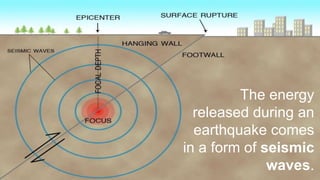
The energy
released during an
earthquake comes
in a form of seismic
waves.
TYPES OF SEISMIC
WAVES
1. Primary wave (P-wave)
2. Secondary wave (S-wave)
Primary Wave (P-Wave)
• Primary wave or P – wave is the fastest
kind of seismic wave and the first to
arrive' at a seismic station.
• The P – wave can move in all kind of
medium such as solid rock and fluids,
water or the liquid layers of the earth
and gas.
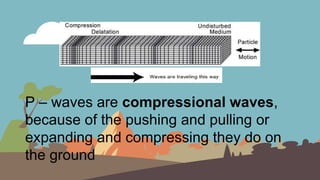
P – waves are compressional waves,
because of the pushing and pulling or
expanding and compressing they do on
the ground
Secondary wave or S –
wave
• the second wave you feel in an earthquake.
• An S – wave is slower than a P – wave and
can only move through solid rock, not
through any liquid medium.
• It is this property of S waves that led
seismologists to conclude that the Earth's
outer core is a liquid.
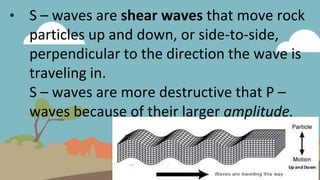
• S – waves are shear waves that move rock
particles up and down, or side-to-side,
perpendicular to the direction the wave is
traveling in.
S – waves are more destructive that P –
waves because of their larger amplitude.
Others
You can enter a subtitle
here in case you need it
04
A picture is
worth a
thousand
words
1,870
Big numbers catch your
audience’s attention
earths is the Sun’s mass
333,000.000
is Jupiter’s rotation period
9h 55m 23s
is a very long distance
386,000 km
The slide titles goes here!
Do you know what helps you make your point
clear? Lists like this one:
● They’re simple
● You can organize your ideas
● You’ll never forget to buy milk!
And the audience won’t miss the point
of your presentation
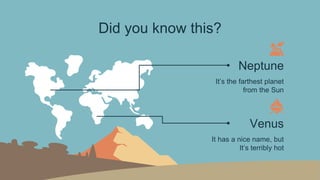
Did you know this?
Neptune
It’s the farthest planet
from the Sun
Venus
It has a nice name, but
It’s terribly hot
A picture always
reinforces the
concept
Images reveal large amounts of data, so
remember: use an image instead of long
texts
Mineral classification
Hardness Brightness
Mercury is the
closest planet to the
Sun
Venus is the second
planet from the Sun
Color Shape
Neptune is far away
from Earth
Jupiter is the biggest
planet in our System
Need more columns?
Mercury Venus
It’s the smallest
planet in the Solar
System
Venus is the second
planet from the Sun
Saturn Neptune
Saturn is a gas giant
and has several rings
It’s the farthest
planet from the Sun
Mars
Despite being red,
Mars is a cold place
Jupiter
It’s the biggest planet
in the Solar System
Process
Neptune
It’s the farthest planet
from the Sun
Mars
Despite being red, Mars
is a cold place
Venus
Venus is the second
planet from the Sun
Step 1 Step 2 Step3
1 2 3
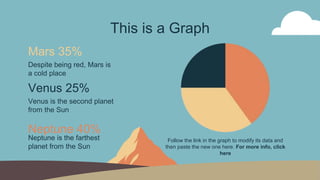
This is a Graph
Mars 35%
Despite being red, Mars is
a cold place
Venus 25%
Venus is the second planet
from the Sun
Neptune 40%
Neptune is the farthest
planet from the Sun
Follow the link in the graph to modify its data and
then paste the new one here. For more info, click
here
Overview Diagram
Mercury is the closest
planet to the Sun
Jupiter is the biggest
planet in our System
Venus has a beautiful
name, but it’s hot
1
2
3
Sun
Weathering
Chemical
Weathering
Despite being red,
Mars is a cold place
Saturn is a gas giant
and it has several rings
Temperature
Changes
Mercury is the closest
planet to the Sun
Jupiter is the biggest
planet in our System
Problems vs. Solution
Solution
Problems
Neptune is the farthest
planet from the Sun
Mercury is the closest
planet to the Sun
CREDITS: This presentation template was created
by Slidesgo, including icons by Flaticon,
infographics & images by Freepik
Thanks!
Do you have any questions?
youremail@freepik.com | +91 620 421
838 | yourcompany.com
Please, keep this slide for attribution
Alternative Resources
Vectors:
● Hand drawn spring landscape with
lake mountains
● Artistic gradient mountains
landscape
● Spring landscape scene
Photos:
● Mountain landscape against sky
with clouds
● Slopes mountains are covered with
abundant rainforest
● Scenics view idyllic lake with
mountain
● Aerial scenery view mountains
● Aerial scenery view waterfall
● Aerial scenery view
Vectors:
● Earth structure infographic with
layers
● Mars landscape background
● Flat natural background with
landscape
● Natural background with desert
landscape
● Waterfalls collection cartoon style
● Illustrated blue gradient mountains
landscape
● Orange landscape with mountains
Photos:
● People holding earth their hands
● Reflection rocky mountains sky
beautiful lake
Resources
Instructions for use
In order to use this template, you must credit Slidesgo by keeping the Thanks slide.
You are allowed to:
- Modify this template.
- Use it for both personal and commercial projects.
You are not allowed to:
- Sublicense, sell or rent any of Slidesgo Content (or a modified version of Slidesgo Content).
- Distribute Slidesgo Content unless it has been expressly authorized by Slidesgo.
- Include Slidesgo Content in an online or offline database or file.
- Offer Slidesgo templates (or modified versions of Slidesgo templates) for download.
- Acquire the copyright of Slidesgo Content.
For more information about editing slides, please read our FAQs or visit Slidesgo School:
https://slidesgo.com/faqs and https://slidesgo.com/slidesgo-school
Instructions for use (premium users)
In order to use this template, you must be a Premium user on Slidesgo.
You are allowed to:
● Modify this template.
● Use it for both personal and commercial purposes.
● Hide or delete the “Thanks” slide and the mention to Slidesgo in the credits.
● Share this template in an editable format with people who are not part of your team.
You are not allowed to:
● Sublicense, sell or rent this Slidesgo Template (or a modified version of this Slidesgo Template).
● Distribute this Slidesgo Template (or a modified version of this Slidesgo Template) or include it in a database or in
any other product or service that offers downloadable images, icons or presentations that may be subject to
distribution or resale.
● Use any of the elements that are part of this Slidesgo Template in an isolated and separated way from this
Template.
● Register any of the elements that are part of this template as a trademark or logo, or register it as a work in an
intellectual property registry or similar.
For more information about editing slides, please read our FAQs or visit Slidesgo School:
https://slidesgo.com/faqs and https://slidesgo.com/slidesgo-school
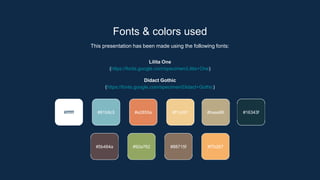
Fonts & colors used
This presentation has been made using the following fonts:
Lilita One
(https://fonts.google.com/specimen/Lilita+One)
Didact Gothic
(https://fonts.google.com/specimen/Didact+Gothic)
#81b9c3 #e2855a #f1cd91
#ffffff #baaa86 #16343f
#5b484a #92a762 #88715f #f7b267
Storyset
Create your Story with our illustrated concepts. Choose the style you like the most, edit its colors, pick the
background and layers you want to show and bring them to life with the animator panel! It will boost your
presentation. Check out How it Works.
Pana Amico Bro Rafiki Cuate
You can easily resize these resources without losing quality. To change the color, just ungroup the resource
and click on the object you want to change. Then, click on the paint bucket and select the color you want.
Group the resource again when you’re done. You can also look for more infographics on Slidesgo.
Use our editable graphic resources...
JANUARY FEBRUARY MARCH APRIL MAY JUNE
PHASE 1
PHASE 2
Task 1
Task 2
Task 1
Task 2
JANUARY FEBRUARY MARCH APRIL
PHASE 1
Task 1
Task 2
...and our sets of editable icons
You can resize these icons without losing quality.
You can change the stroke and fill color; just select the icon and click on the paint bucket/pen.
In Google Slides, you can also use Flaticon’s extension, allowing you to customize and add even more icons.
Educational Icons Medical Icons
Business Icons Teamwork Icons
Help & Support Icons Avatar Icons
Creative Process Icons Performing Arts Icons
Nature Icons
SEO & Marketing Icons
Premium infographics...
Add the Title here
Text 1 Text 2 Text 3
Text 4 Text 5 Text 6
2016 2017 2018 2019 2020
“Despite being red,
Mars is a cold place
full of iron oxide”
“Mercury is closest
planet to the Sun
and the smallest”
“Neptune is the
farthest-known
planet from the Sun”
“Saturn is a gas
giant and has
several rings”
“Venus has a
beautiful name and
is the second planet”
“Mercury is closest
planet to the Sun
and the smallest”
“Mercury is closest
planet to the Sun
and the smallest”
“Mercury is closest
planet to the Sun
and the smallest”
Premium infographics...
“Mercury is closest
planet to the Sun
and the smallest”
TITLE 1
75%
75%
Premium Icons
Digital Marketing
Premium Icons
Online Learning
Premium Icons
Laboratory
Premium Icons
Goals and Results
Premium Icons
Infographics Elements
focus and epicenter.pptx

focus and epicenter.pptx

  • 1.
  • 2.
    The area insidethe Earth where an earthquake starts is known as the focal point of the quake or the focus (hypocenter)
  • 3.
    The point atthe Earth's surface directly above the focus is known as the epicenter of the quake.
  • 4.
    Seismic waves froma deep- focus earthquake lose more of their energy as they travel farther up to surface.
  • 5.
    Anatomy of anEarthquake
  • 7.
  • 8.
    Philippine Institute ofVolcanology and Seismology (PHIVOLCS) – is the service institute to mitigate disasters that may arise from volcanic eruptions, earthquakes, tsunamis and other related geotectonic phenomena.
  • 9.
    It can be measuredusing a Mercalli Scale It is the measure of the damage released by the earthquake to its surroundings. What is Intensity?
  • 10.
  • 11.
    Magnitude? ● Magnitude measuresthe energy being released from the origin of the earthquake. • It is measured by an instrument called seismograph.
  • 12.
    ● The Richter Magnitude Scalemeasures the quantity of seismic energy released by an earthquake.
  • 13.
    Difference between INTENSITY andMAGNITUDE INTENSITY 1. Can be determined by observing the effects in different places. 2. Can be measured using Mercalli Scale. 3. Expressed in Roman Numerals. MAGNITUDE 1. Measures the energy released by the earthquake. 2. Can be measured using Richter Scale. 3. Expressed in Hindu- Arabic Numerals.
  • 14.
    ACTIVITY Make a 2-3minute role playing act showing what to do before, during and after an earthquake starts.
  • 15.
  • 16.
    Two kinds ofFaults 1. Active Fault 2. Inactive Fault
  • 17.
    1. ACTIVE FAULTS •These are structures along which we expect displacement to occur. • The process that produces displacement across a fault continuously. • All shallow earthquakes occur on active faults.
  • 18.
    1. ACTIVE FAULTS •Faults are commonly considered to be active if there has been movement observed or evidence of seismic activity during the last 10,000 years.
  • 19.
    2. inACTIVE FAULTS •These are structures that we can identify, but which do no have earthquakes. • If a fault has been inactive for millions of years, it’s certainly safe to call it inactive.
  • 20.
    five active faultlines in the country 1. Western Philippine Fault 2. Eastern Philippine Fault 3. South of Mindanao Fault 4. Central Philippine Fault 5. Marikina/Valley Fault System
  • 21.
    Bring the followingmaterials for the next activity Flat basin (batya) Water Rectangular piece of plastic or plywood Rock
  • 22.
  • 23.
  • 24.
    • Tsunami iscaused by an earthquake and other movements on the ocean floor. It travels at speeds up to 600 miles per hour.
  • 25.
  • 26.
  • 28.
  • 29.
    What to do beforean earthquake arrives?
  • 30.
    What to dobefore an earthquake arrives?
  • 31.
    What to do duringan earthquake ?
  • 32.
    What to doduring an earthquake?
  • 33.
    What to do afteran earthquake ?
  • 34.
    What to do afteran earthquake ?
  • 35.
  • 36.
  • 37.
    CRUST • The outermostand thinnest layer. • It is made of loose material, like rocks, soil, and seabed. • The crust is about 8 kilometers deep beneath the oceans and about 40 kilometers thick below the continents.
  • 38.
    CRUST • Crust ismainly made of different elements like oxygen, silicon, aluminum, calcium, sodium, and potassium. • It makes up about 1% of the Earth’s total volume
  • 39.
    MANTLE ● It extendsapproximately 2900 kilometers deep into the Earth. It makes up about 84% of the Earth’s total volume. ● The temperature in the mantle is about 1000 º C - 3000 º C, the high temperature and pressure in the mantle allows the solid rock to flow slowly.
  • 40.
    MANTLE ● Mantle ismainly made of silicate rocks in the upper part making it solid layer and mostly iron in the lower part making it denser than the upper part of the mantle.
  • 41.
    Outer core ● Thisis about 2200 kilometers beneath the Earth’s surface. ● The outer core consists of super-heated liquid molten lava about 2000 º C – 4000 º C.
  • 42.
    Outer core ● Thelava is mostly made up of iron and nickel, which is why some geologist call it molten metal instead of molten rock.
  • 43.
    inner core ● Thislayer is about 1278 kilometers thick, has the temperature of 5000º C to 6000 º C that’s up to 6000 times hotter than our atmosphere. ● Outer core and inner core are about 15% of the Earth’s total volume.
  • 44.
    inner core ● Innercore is also made of iron and nickel but stays solid because of the incredible pressure surrounding it.
  • 45.
    The energy released duringan earthquake comes in a form of seismic waves.
  • 46.
    TYPES OF SEISMIC WAVES 1.Primary wave (P-wave) 2. Secondary wave (S-wave)
  • 47.
    Primary Wave (P-Wave) •Primary wave or P – wave is the fastest kind of seismic wave and the first to arrive' at a seismic station. • The P – wave can move in all kind of medium such as solid rock and fluids, water or the liquid layers of the earth and gas.
  • 48.
    P – wavesare compressional waves, because of the pushing and pulling or expanding and compressing they do on the ground
  • 49.
    Secondary wave orS – wave • the second wave you feel in an earthquake. • An S – wave is slower than a P – wave and can only move through solid rock, not through any liquid medium. • It is this property of S waves that led seismologists to conclude that the Earth's outer core is a liquid.
  • 50.
    • S –waves are shear waves that move rock particles up and down, or side-to-side, perpendicular to the direction the wave is traveling in. S – waves are more destructive that P – waves because of their larger amplitude.
  • 52.
    Others You can entera subtitle here in case you need it 04
  • 53.
    A picture is wortha thousand words
  • 54.
    1,870 Big numbers catchyour audience’s attention
  • 55.
    earths is theSun’s mass 333,000.000 is Jupiter’s rotation period 9h 55m 23s is a very long distance 386,000 km
  • 56.
    The slide titlesgoes here! Do you know what helps you make your point clear? Lists like this one: ● They’re simple ● You can organize your ideas ● You’ll never forget to buy milk! And the audience won’t miss the point of your presentation
  • 57.
    Did you knowthis? Neptune It’s the farthest planet from the Sun Venus It has a nice name, but It’s terribly hot
  • 58.
    A picture always reinforcesthe concept Images reveal large amounts of data, so remember: use an image instead of long texts
  • 59.
    Mineral classification Hardness Brightness Mercuryis the closest planet to the Sun Venus is the second planet from the Sun Color Shape Neptune is far away from Earth Jupiter is the biggest planet in our System
  • 60.
    Need more columns? MercuryVenus It’s the smallest planet in the Solar System Venus is the second planet from the Sun Saturn Neptune Saturn is a gas giant and has several rings It’s the farthest planet from the Sun Mars Despite being red, Mars is a cold place Jupiter It’s the biggest planet in the Solar System
  • 61.
    Process Neptune It’s the farthestplanet from the Sun Mars Despite being red, Mars is a cold place Venus Venus is the second planet from the Sun Step 1 Step 2 Step3 1 2 3
  • 62.
    This is aGraph Mars 35% Despite being red, Mars is a cold place Venus 25% Venus is the second planet from the Sun Neptune 40% Neptune is the farthest planet from the Sun Follow the link in the graph to modify its data and then paste the new one here. For more info, click here
  • 63.
    Overview Diagram Mercury isthe closest planet to the Sun Jupiter is the biggest planet in our System Venus has a beautiful name, but it’s hot 1 2 3 Sun
  • 64.
    Weathering Chemical Weathering Despite being red, Marsis a cold place Saturn is a gas giant and it has several rings Temperature Changes Mercury is the closest planet to the Sun Jupiter is the biggest planet in our System
  • 65.
    Problems vs. Solution Solution Problems Neptuneis the farthest planet from the Sun Mercury is the closest planet to the Sun
  • 66.
    CREDITS: This presentationtemplate was created by Slidesgo, including icons by Flaticon, infographics & images by Freepik Thanks! Do you have any questions? youremail@freepik.com | +91 620 421 838 | yourcompany.com Please, keep this slide for attribution
  • 67.
  • 68.
    Alternative Resources Vectors: ● Handdrawn spring landscape with lake mountains ● Artistic gradient mountains landscape ● Spring landscape scene Photos: ● Mountain landscape against sky with clouds ● Slopes mountains are covered with abundant rainforest ● Scenics view idyllic lake with mountain ● Aerial scenery view mountains ● Aerial scenery view waterfall ● Aerial scenery view
  • 69.
    Vectors: ● Earth structureinfographic with layers ● Mars landscape background ● Flat natural background with landscape ● Natural background with desert landscape ● Waterfalls collection cartoon style ● Illustrated blue gradient mountains landscape ● Orange landscape with mountains Photos: ● People holding earth their hands ● Reflection rocky mountains sky beautiful lake Resources
  • 70.
    Instructions for use Inorder to use this template, you must credit Slidesgo by keeping the Thanks slide. You are allowed to: - Modify this template. - Use it for both personal and commercial projects. You are not allowed to: - Sublicense, sell or rent any of Slidesgo Content (or a modified version of Slidesgo Content). - Distribute Slidesgo Content unless it has been expressly authorized by Slidesgo. - Include Slidesgo Content in an online or offline database or file. - Offer Slidesgo templates (or modified versions of Slidesgo templates) for download. - Acquire the copyright of Slidesgo Content. For more information about editing slides, please read our FAQs or visit Slidesgo School: https://slidesgo.com/faqs and https://slidesgo.com/slidesgo-school
  • 71.
    Instructions for use(premium users) In order to use this template, you must be a Premium user on Slidesgo. You are allowed to: ● Modify this template. ● Use it for both personal and commercial purposes. ● Hide or delete the “Thanks” slide and the mention to Slidesgo in the credits. ● Share this template in an editable format with people who are not part of your team. You are not allowed to: ● Sublicense, sell or rent this Slidesgo Template (or a modified version of this Slidesgo Template). ● Distribute this Slidesgo Template (or a modified version of this Slidesgo Template) or include it in a database or in any other product or service that offers downloadable images, icons or presentations that may be subject to distribution or resale. ● Use any of the elements that are part of this Slidesgo Template in an isolated and separated way from this Template. ● Register any of the elements that are part of this template as a trademark or logo, or register it as a work in an intellectual property registry or similar. For more information about editing slides, please read our FAQs or visit Slidesgo School: https://slidesgo.com/faqs and https://slidesgo.com/slidesgo-school
  • 72.
    Fonts & colorsused This presentation has been made using the following fonts: Lilita One (https://fonts.google.com/specimen/Lilita+One) Didact Gothic (https://fonts.google.com/specimen/Didact+Gothic) #81b9c3 #e2855a #f1cd91 #ffffff #baaa86 #16343f #5b484a #92a762 #88715f #f7b267
  • 73.
    Storyset Create your Storywith our illustrated concepts. Choose the style you like the most, edit its colors, pick the background and layers you want to show and bring them to life with the animator panel! It will boost your presentation. Check out How it Works. Pana Amico Bro Rafiki Cuate
  • 74.
    You can easilyresize these resources without losing quality. To change the color, just ungroup the resource and click on the object you want to change. Then, click on the paint bucket and select the color you want. Group the resource again when you’re done. You can also look for more infographics on Slidesgo. Use our editable graphic resources...
  • 77.
    JANUARY FEBRUARY MARCHAPRIL MAY JUNE PHASE 1 PHASE 2 Task 1 Task 2 Task 1 Task 2 JANUARY FEBRUARY MARCH APRIL PHASE 1 Task 1 Task 2
  • 80.
    ...and our setsof editable icons You can resize these icons without losing quality. You can change the stroke and fill color; just select the icon and click on the paint bucket/pen. In Google Slides, you can also use Flaticon’s extension, allowing you to customize and add even more icons.
  • 81.
  • 82.
  • 83.
    Help & SupportIcons Avatar Icons
  • 84.
    Creative Process IconsPerforming Arts Icons
  • 85.
  • 86.
  • 87.
    Premium infographics... Add theTitle here Text 1 Text 2 Text 3 Text 4 Text 5 Text 6 2016 2017 2018 2019 2020 “Despite being red, Mars is a cold place full of iron oxide” “Mercury is closest planet to the Sun and the smallest” “Neptune is the farthest-known planet from the Sun” “Saturn is a gas giant and has several rings” “Venus has a beautiful name and is the second planet”
  • 88.
    “Mercury is closest planetto the Sun and the smallest” “Mercury is closest planet to the Sun and the smallest” “Mercury is closest planet to the Sun and the smallest” Premium infographics... “Mercury is closest planet to the Sun and the smallest” TITLE 1 75% 75%
  • 89.
  • 90.
  • 91.
  • 92.
  • 93.

Editor's Notes

  • #4 During an earthquake, the strongest shaking occurs at the epicenter.
  • #17 five active fault lines in the country namely the Western Philippine Fault, the Eastern Philippine Fault, the South of Mindanao Fault, Central Philippine Fault and the Marikina/Valley Fault System.a
  • #18 five active fault lines in the country namely the Western Philippine Fault, the Eastern Philippine Fault, the South of Mindanao Fault, Central Philippine Fault and the Marikina/Valley Fault System.a
  • #19 five active fault lines in the country namely the Western Philippine Fault, the Eastern Philippine Fault, the South of Mindanao Fault, Central Philippine Fault and the Marikina/Valley Fault System.a
  • #37 How did the scientists know all about this information about the earth? Simply because of having earthquakes.
  • #54 five active fault lines in the country namely the Western Philippine Fault, the Eastern Philippine Fault, the South of Mindanao Fault, Central Philippine Fault and the Marikina/Valley Fault System.