All About
Heat Transfer
Q3-LC8
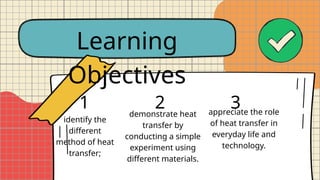
Learning
Competency
The learners identify advantageous
and disadvantageous examples of
conduction, convection, and
radiation;
Learning
Objectives
demonstrate heat
transfer by
conducting a simple
experiment using
different materials.
identify the
different
method of heat
transfer;
appreciate the role
of heat transfer in
everyday life and
technology.
1 2 3
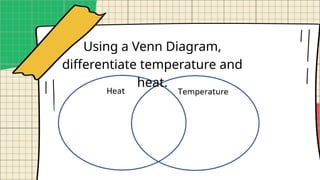
Using a Venn Diagram,
differentiate temperature and
heat.
Methods
of
Heat Transfer
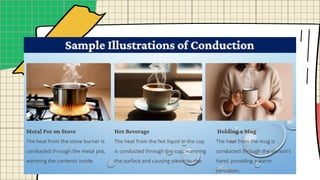
What is conduction?
is one of the fundamental
mechanisms of heat transfer,
where thermal energy is
transmitted through direct
contact between materials
without the involvement of any
bulk motion of the medium.
• Thermal Conductors are the
materials that allow heat to
transfer easily (iron, aluminum,
copper)
• Thermal Insulators are materials
that are considered poor conductors
Conduction in
Everyday Life
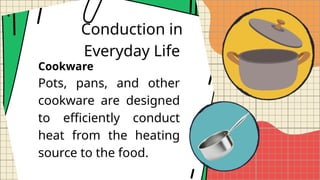
Cookware
Pots, pans, and other
cookware are designed
to efficiently conduct
heat from the heating
source to the food.
Conduction in
Everyday Life
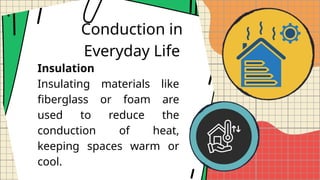
Insulation
Insulating materials like
fiberglass or foam are
used to reduce the
conduction of heat,
keeping spaces warm or
cool.
Conduction in
Everyday Life
Heating Systems
Radiators and other
heating elements rely on
conduction to transfer
heat from the source to
the surrounding air.
What is
convection?
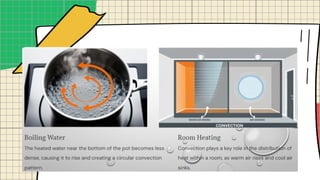
It describes the transfer
of heat through the
movement of a fluid, such
as air or water.
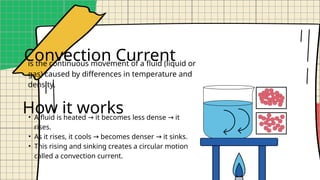
Convection Current
is the continuous movement of a fluid (liquid or
gas) caused by differences in temperature and
density.
• A fluid is heated it becomes less dense it
→ →
rises.
• As it rises, it cools becomes denser it sinks.
→ →
• This rising and sinking creates a circular motion
called a convection current.
How it works
What is
radiation?
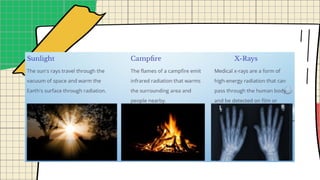
Radiation - is the transfer
of heat energy through
space by electromagnetic
radiation.
- Does not require a
medium.
Learning
Task #1
Individual
Learning
Task #2
Group
Reflection on
Learning
Directions: Answer the following questions in complete
sentences.
1.Why is it important to understand how heat is
transferred in daily life?
2.How can understanding heat transfer help you stay
safe when cooking or handling hot objects?
3.Can you give an example of when you observed
conduction, convection, or radiation at home or in
school?
1.What happens when you place a
metal spoon in hot soup?
A. Convection
B. Radiation
C. Conduction
D. Insulation
2. Through what process does heat
from the Sun reach the Earth?
A. Conduction
B. Convection
C. Radiation
D. Insulation
3. How does heat move through
conduction?
A. Through direct contact between
materials
B. By movement of fluids
C. Through electromagnetic waves
4. Which observation shows that heat transfer
has occurred during the experiment?
A. The material floats
B. The material changes color
C. The material produces sound
D. The material becomes warmer
after contact with hot water
5. Maria is helping her family cook dinner. She
notices that the pot has a metal body but plastic
handles. While cooking, the pot becomes very
hot, but the handles stay cool enough to hold. At
the same time, steam rises from the boiling
water inside the pot.
5. Why is the pot designed with different
materials for the body and the handles?
A. Plastic makes the pot lighter
B. Plastic absorbs more heat than metal
C. Metal changes color faster than plastic
D. Metal allows heat to transfer quickly while
plastic reduces heat transfer to protect hands
Let’s
Check!
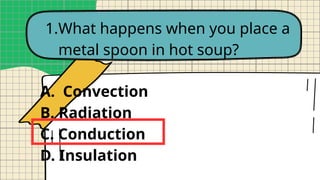
1.What happens when you place a
metal spoon in hot soup?
A. Convection
B. Radiation
C. Conduction
D. Insulation
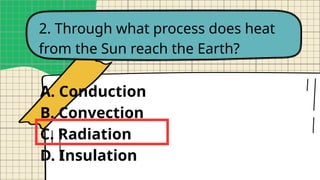
2. Through what process does heat
from the Sun reach the Earth?
A. Conduction
B. Convection
C. Radiation
D. Insulation
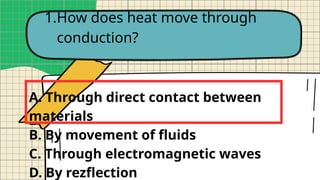
1.How does heat move through
conduction?
A. Through direct contact between
materials
B. By movement of fluids
C. Through electromagnetic waves
D. By rezflection
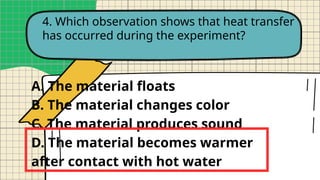
4. Which observation shows that heat transfer
has occurred during the experiment?
A. The material floats
B. The material changes color
C. The material produces sound
D. The material becomes warmer
after contact with hot water
5. Maria is helping her family cook dinner. She
notices that the pot has a metal body but plastic
handles. While cooking, the pot becomes very
hot, but the handles stay cool enough to hold. At
the same time, steam rises from the boiling
water inside the pot.
5. Why is the pot designed with different
materials for the body and the handles?
A. Plastic makes the pot lighter
B. Plastic absorbs more heat than metal
C. Metal changes color faster than plastic
D. Metal allows heat to transfer quickly
while plastic reduces heat transfer to
protect hands
Thanks
for
listening!
Well Done

Grade scien7LC8_All about _Heat Transfer

  • 1.
  • 2.
    Learning Competency The learners identifyadvantageous and disadvantageous examples of conduction, convection, and radiation;
  • 3.
    Learning Objectives demonstrate heat transfer by conductinga simple experiment using different materials. identify the different method of heat transfer; appreciate the role of heat transfer in everyday life and technology. 1 2 3
  • 4.
    Using a VennDiagram, differentiate temperature and heat.
  • 6.
  • 7.
    What is conduction? isone of the fundamental mechanisms of heat transfer, where thermal energy is transmitted through direct contact between materials without the involvement of any bulk motion of the medium.
  • 8.
    • Thermal Conductorsare the materials that allow heat to transfer easily (iron, aluminum, copper) • Thermal Insulators are materials that are considered poor conductors
  • 10.
    Conduction in Everyday Life Cookware Pots,pans, and other cookware are designed to efficiently conduct heat from the heating source to the food.
  • 11.
    Conduction in Everyday Life Insulation Insulatingmaterials like fiberglass or foam are used to reduce the conduction of heat, keeping spaces warm or cool.
  • 12.
    Conduction in Everyday Life HeatingSystems Radiators and other heating elements rely on conduction to transfer heat from the source to the surrounding air.
  • 13.
    What is convection? It describesthe transfer of heat through the movement of a fluid, such as air or water.
  • 14.
    Convection Current is thecontinuous movement of a fluid (liquid or gas) caused by differences in temperature and density. • A fluid is heated it becomes less dense it → → rises. • As it rises, it cools becomes denser it sinks. → → • This rising and sinking creates a circular motion called a convection current. How it works
  • 16.
    What is radiation? Radiation -is the transfer of heat energy through space by electromagnetic radiation. - Does not require a medium.
  • 18.
  • 19.
  • 20.
    Reflection on Learning Directions: Answerthe following questions in complete sentences. 1.Why is it important to understand how heat is transferred in daily life? 2.How can understanding heat transfer help you stay safe when cooking or handling hot objects? 3.Can you give an example of when you observed conduction, convection, or radiation at home or in school?
  • 22.
    1.What happens whenyou place a metal spoon in hot soup? A. Convection B. Radiation C. Conduction D. Insulation
  • 23.
    2. Through whatprocess does heat from the Sun reach the Earth? A. Conduction B. Convection C. Radiation D. Insulation
  • 24.
    3. How doesheat move through conduction? A. Through direct contact between materials B. By movement of fluids C. Through electromagnetic waves
  • 25.
    4. Which observationshows that heat transfer has occurred during the experiment? A. The material floats B. The material changes color C. The material produces sound D. The material becomes warmer after contact with hot water
  • 26.
    5. Maria ishelping her family cook dinner. She notices that the pot has a metal body but plastic handles. While cooking, the pot becomes very hot, but the handles stay cool enough to hold. At the same time, steam rises from the boiling water inside the pot.
  • 27.
    5. Why isthe pot designed with different materials for the body and the handles? A. Plastic makes the pot lighter B. Plastic absorbs more heat than metal C. Metal changes color faster than plastic D. Metal allows heat to transfer quickly while plastic reduces heat transfer to protect hands
  • 28.
  • 29.
    1.What happens whenyou place a metal spoon in hot soup? A. Convection B. Radiation C. Conduction D. Insulation
  • 30.
    2. Through whatprocess does heat from the Sun reach the Earth? A. Conduction B. Convection C. Radiation D. Insulation
  • 31.
    1.How does heatmove through conduction? A. Through direct contact between materials B. By movement of fluids C. Through electromagnetic waves D. By rezflection
  • 32.
    4. Which observationshows that heat transfer has occurred during the experiment? A. The material floats B. The material changes color C. The material produces sound D. The material becomes warmer after contact with hot water
  • 33.
    5. Maria ishelping her family cook dinner. She notices that the pot has a metal body but plastic handles. While cooking, the pot becomes very hot, but the handles stay cool enough to hold. At the same time, steam rises from the boiling water inside the pot.
  • 34.
    5. Why isthe pot designed with different materials for the body and the handles? A. Plastic makes the pot lighter B. Plastic absorbs more heat than metal C. Metal changes color faster than plastic D. Metal allows heat to transfer quickly while plastic reduces heat transfer to protect hands
  • 35.