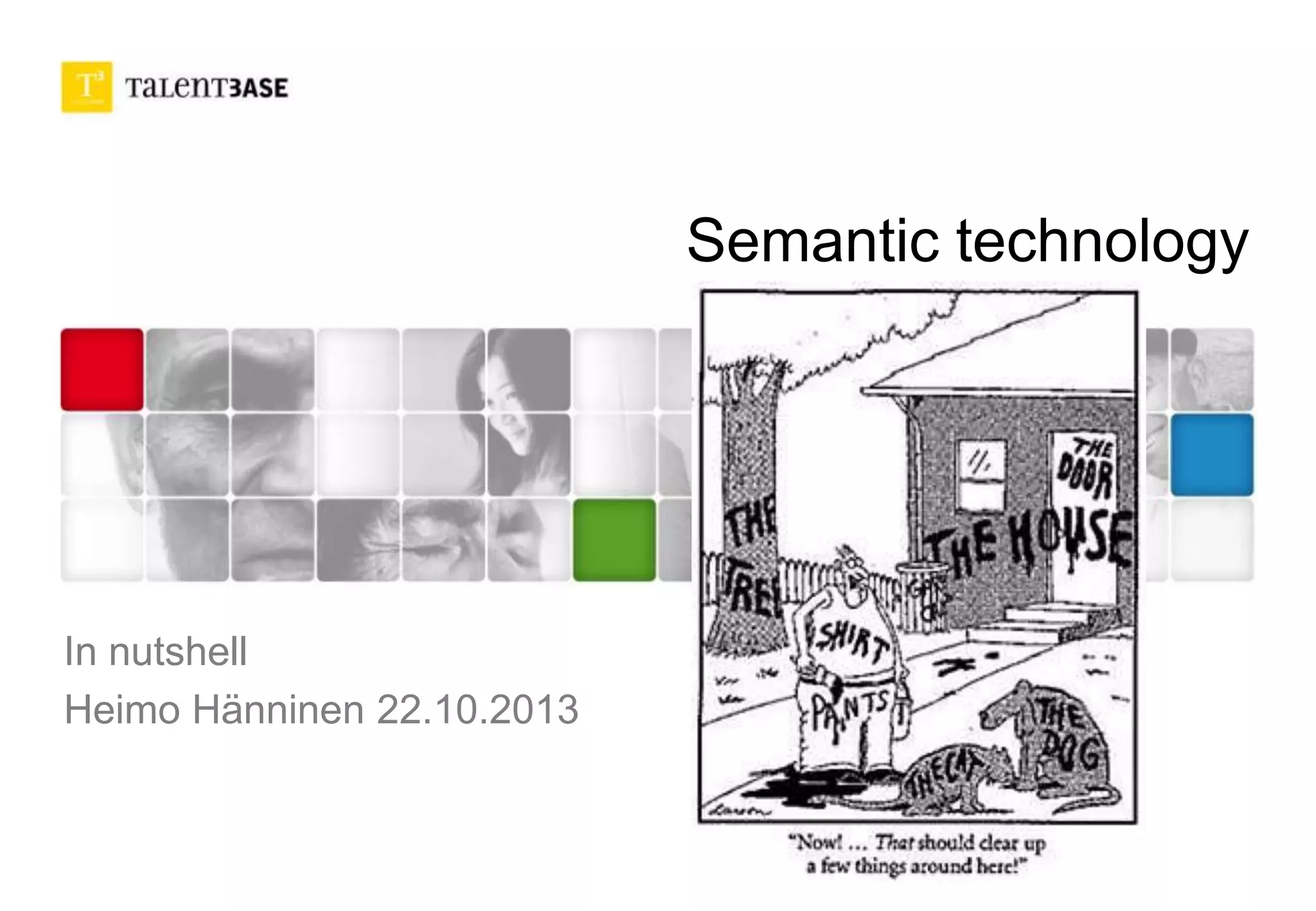
Semantic technology
In nutshell
Heimo Hänninen 22.10.2013
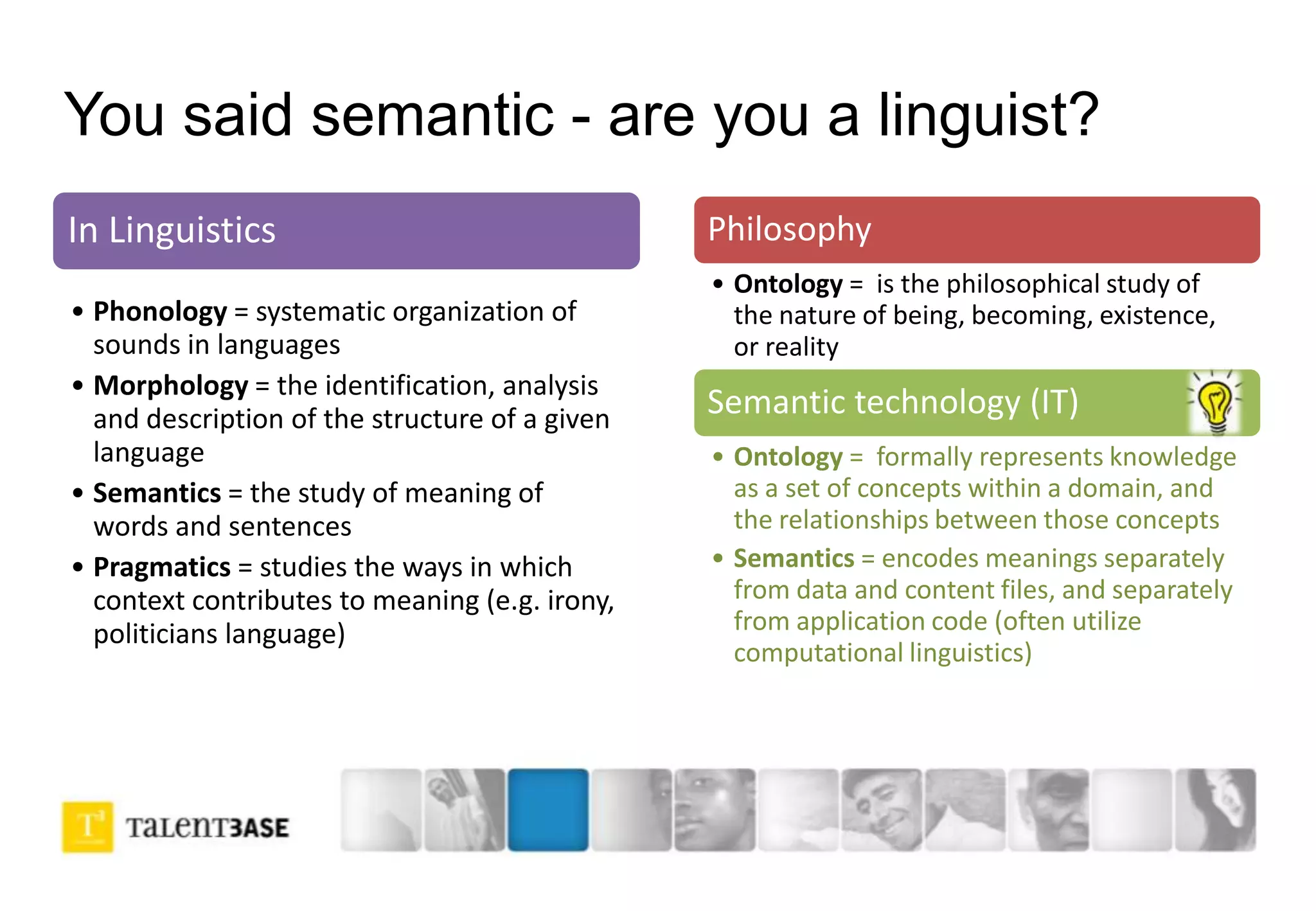
You said semantic - are you a linguist?
In Linguistics
• Phonology = systematic organization of
sounds in languages
• Morphology = the identification, analysis
and description of the structure of a given
language
• Semantics = the study of meaning of
words and sentences
• Pragmatics = studies the ways in which
context contributes to meaning (e.g. irony,
politicians language)
Philosophy
• Ontology = is the philosophical study of
the nature of being, becoming, existence,
or reality
Semantic technology (IT)
• Ontology = formally represents knowledge
as a set of concepts within a domain, and
the relationships between those concepts
• Semantics = encodes meanings separately
from data and content files, and separately
from application code (often utilize
computational linguistics)
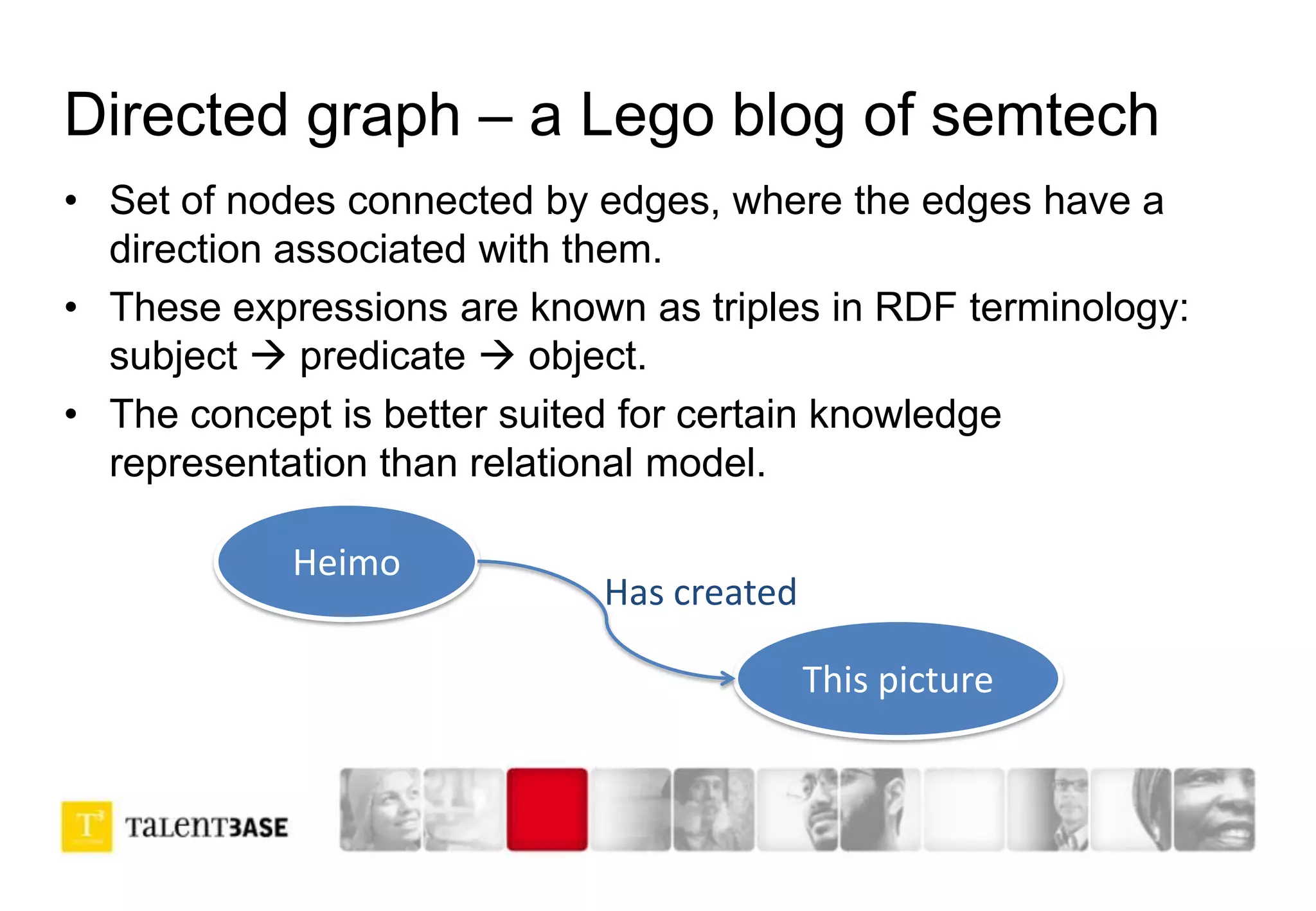
Directed graph – a Lego blog of semtech
• Set of nodes connected by edges, where the edges have a
direction associated with them.
• These expressions are known as triples in RDF terminology:
subject  predicate  object.
• The concept is better suited for certain knowledge
representation than relational model.
Heimo
This picture
Has created
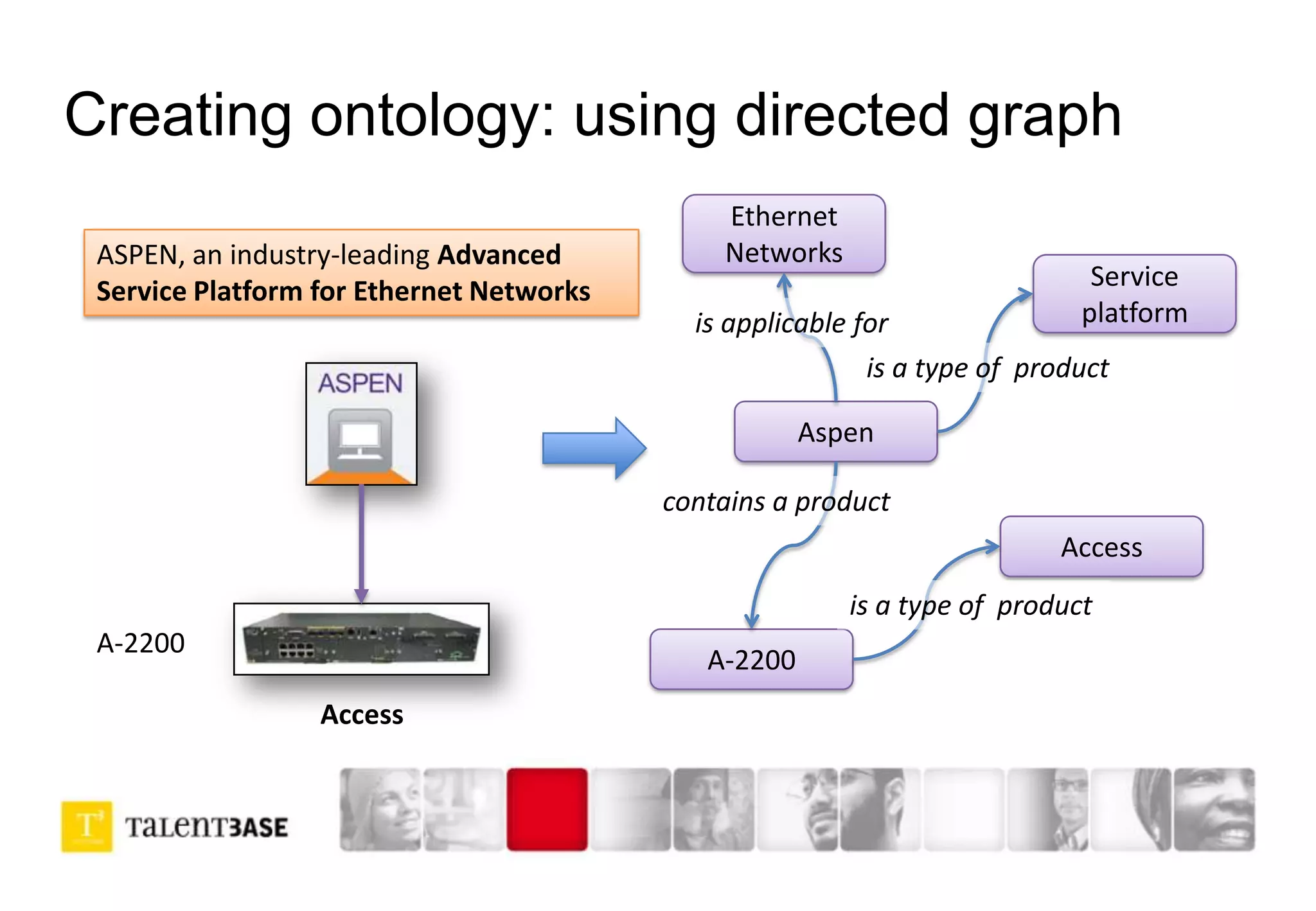
Creating ontology: using directed graph
ASPEN, an industry-leading Advanced
Service Platform for Ethernet Networks
A-2200
Access
Aspen
A-2200
Service
platform
Access
is a type of product
contains a product
is a type of product
Ethernet
Networks
is applicable for
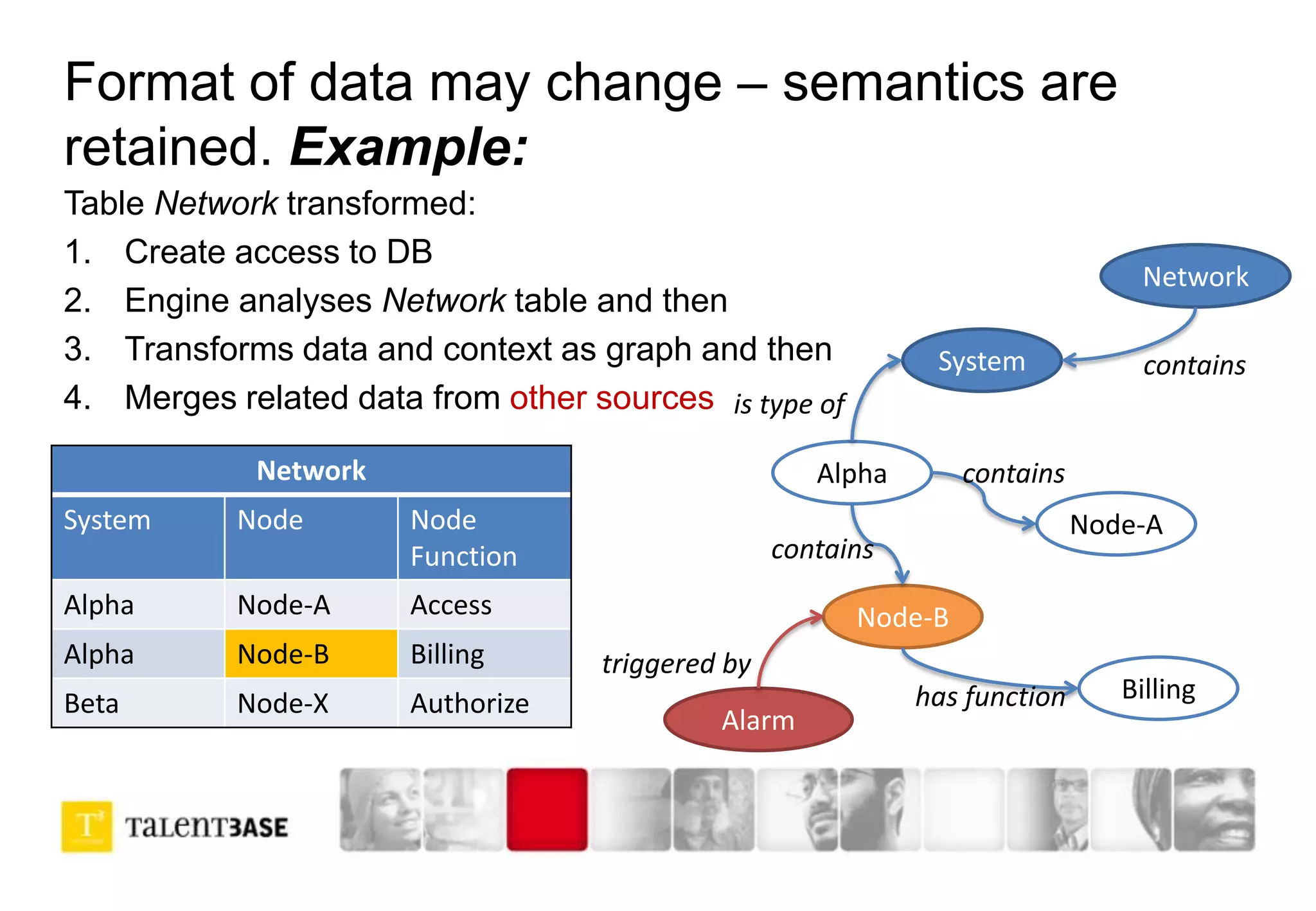
Format of data may change – semantics are
retained. Example:
Table Network transformed:
1. Create access to DB
2. Engine analyses Network table and then
3. Transforms data and context as graph and then
4. Merges related data from other sources
Network
System Node Node
Function
Alpha Node-A Access
Alpha Node-B Billing
Beta Node-X Authorize
Alpha
System
Node-B
Node-A
Billing
Network
contains
is type of
contains
contains
has function
Alarm
triggered by
Search on ontology – instead of system
integarations
With semantic technology the integration of information is easier
and a lot cheaper to do since:
• harmonized model across systems, organizations and data
processes can be created “above the system space” without
complex data integrations
• semantic engine comes with content analysis capabilities
• semantic engine comes with query capabilities, which enables
fast and effective search style data integration
• semantic engine often provides an inferring tool for reasoning
(what if –analysis etc.)
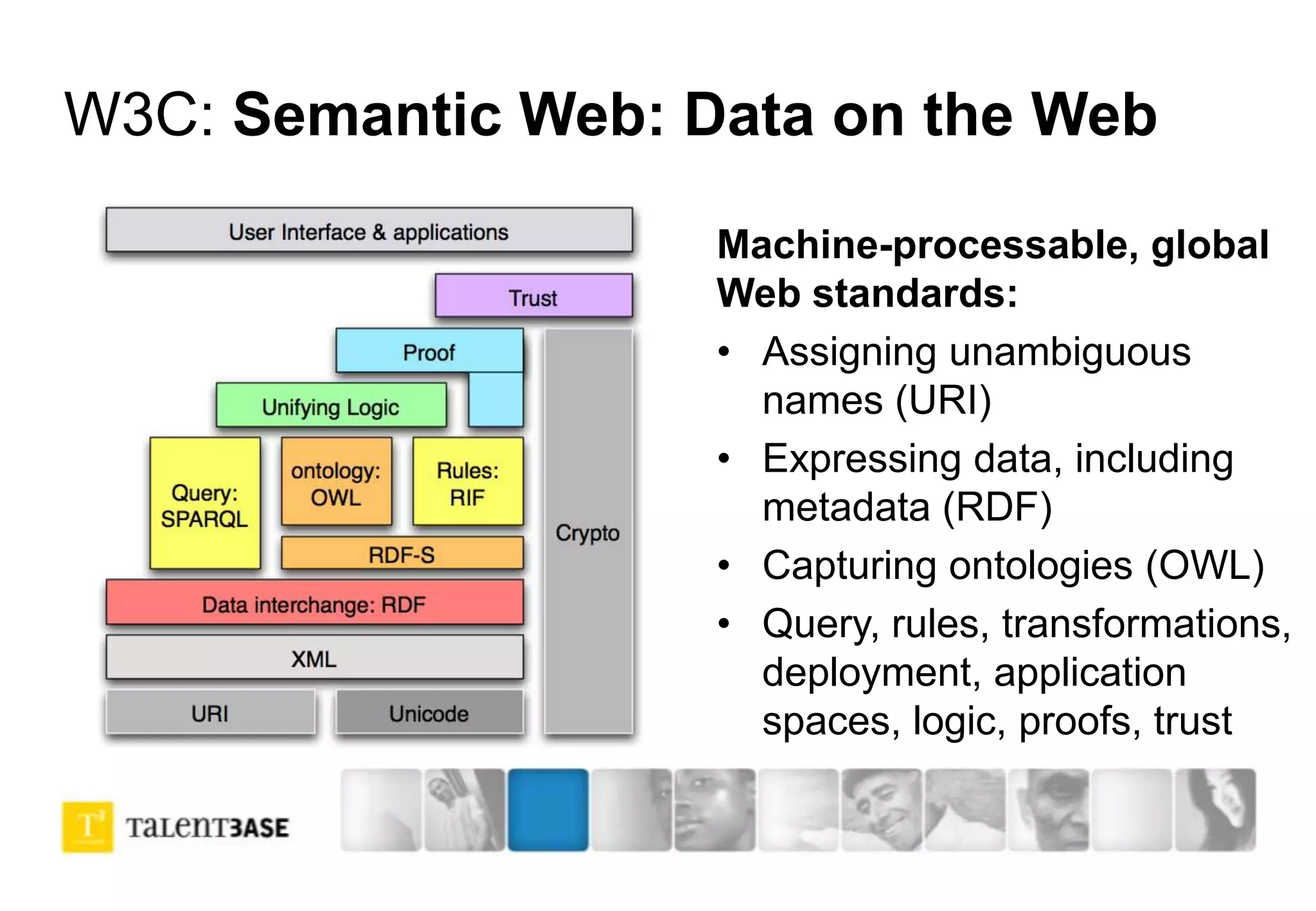
W3C: Semantic Web: Data on the Web
Machine-processable, global
Web standards:
• Assigning unambiguous
names (URI)
• Expressing data, including
metadata (RDF)
• Capturing ontologies (OWL)
• Query, rules, transformations,
deployment, application
spaces, logic, proofs, trust
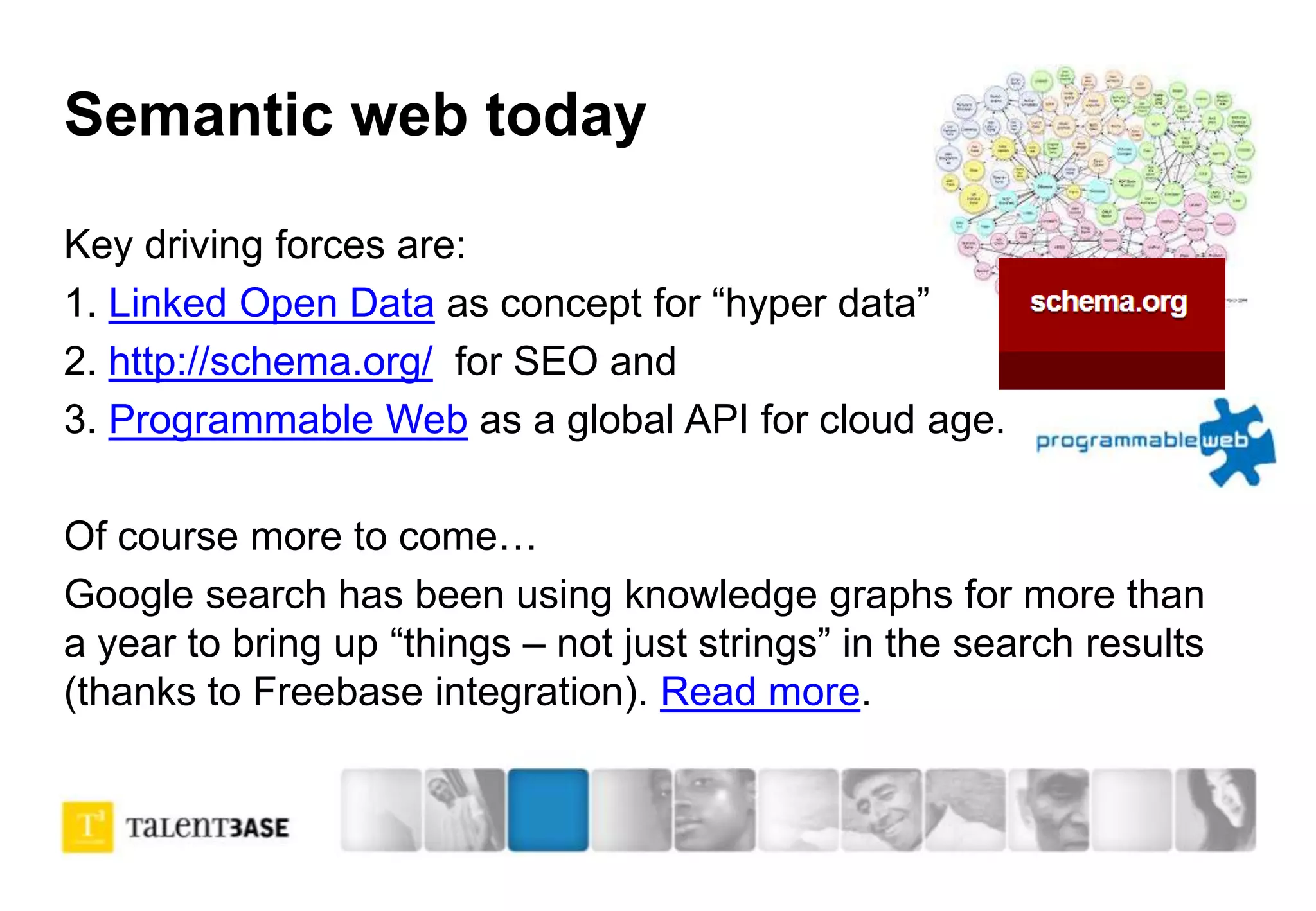
Semantic web today
Key driving forces are:
1. Linked Open Data as concept for “hyper data”
2. http://schema.org/ for SEO and
3. Programmable Web as a global API for cloud age.
Of course more to come…
Google search has been using knowledge graphs for more than
a year to bring up “things – not just strings” in the search results
(thanks to Freebase integration). Read more.

Semantic technology in nutshell 2013. Semantic! are you a linguist?

  • 1.
  • 2.
    You said semantic- are you a linguist? In Linguistics • Phonology = systematic organization of sounds in languages • Morphology = the identification, analysis and description of the structure of a given language • Semantics = the study of meaning of words and sentences • Pragmatics = studies the ways in which context contributes to meaning (e.g. irony, politicians language) Philosophy • Ontology = is the philosophical study of the nature of being, becoming, existence, or reality Semantic technology (IT) • Ontology = formally represents knowledge as a set of concepts within a domain, and the relationships between those concepts • Semantics = encodes meanings separately from data and content files, and separately from application code (often utilize computational linguistics)
  • 3.
    Directed graph –a Lego blog of semtech • Set of nodes connected by edges, where the edges have a direction associated with them. • These expressions are known as triples in RDF terminology: subject  predicate  object. • The concept is better suited for certain knowledge representation than relational model. Heimo This picture Has created
  • 4.
    Creating ontology: usingdirected graph ASPEN, an industry-leading Advanced Service Platform for Ethernet Networks A-2200 Access Aspen A-2200 Service platform Access is a type of product contains a product is a type of product Ethernet Networks is applicable for
  • 5.
    Format of datamay change – semantics are retained. Example: Table Network transformed: 1. Create access to DB 2. Engine analyses Network table and then 3. Transforms data and context as graph and then 4. Merges related data from other sources Network System Node Node Function Alpha Node-A Access Alpha Node-B Billing Beta Node-X Authorize Alpha System Node-B Node-A Billing Network contains is type of contains contains has function Alarm triggered by
  • 6.
    Search on ontology– instead of system integarations With semantic technology the integration of information is easier and a lot cheaper to do since: • harmonized model across systems, organizations and data processes can be created “above the system space” without complex data integrations • semantic engine comes with content analysis capabilities • semantic engine comes with query capabilities, which enables fast and effective search style data integration • semantic engine often provides an inferring tool for reasoning (what if –analysis etc.)
  • 7.
    W3C: Semantic Web:Data on the Web Machine-processable, global Web standards: • Assigning unambiguous names (URI) • Expressing data, including metadata (RDF) • Capturing ontologies (OWL) • Query, rules, transformations, deployment, application spaces, logic, proofs, trust
  • 8.
    Semantic web today Keydriving forces are: 1. Linked Open Data as concept for “hyper data” 2. http://schema.org/ for SEO and 3. Programmable Web as a global API for cloud age. Of course more to come… Google search has been using knowledge graphs for more than a year to bring up “things – not just strings” in the search results (thanks to Freebase integration). Read more.