CLEANING AGENTS
Natural or synthetic substances that are used to assist
the cleaning process – that is, removal of dirt and grit
and the maintenance of a clean appearance on the
surface
WATER
• Universal solvent
• Prime agent in cleaning process
• Though an excellent solvent, water alone is not a sufficiently effective cleanser
• Must be used in conjunction with other cleaning agents such as detergents,
soaps and so on
• Soft water is ideal for cleaning purposes and also to make up the proper
dilutions of other cleaning agents
Sources of water
• Surface water-obtained from streams, rivers, and lakes, it may contain both
organic and inorganic impurities in large amounts
• Sub-soil water-coming from shallow wells and springs, not likely to be
contaminated with suspended matter and organic impurities
• Deep-soil water-pumped up from deep wells, has a very high content of minerals
such as calcium, magnesium, iron, sulphur, phosphates, and silica as well as
dissolved gases such as nitrogen, carbon dioxide, and oxygen
Hard and Soft water
• More than 60 ppm (parts
per million) of calcium and
magnesium- hard water
• 61-120 ppm- moderately
hard water
• More than 180 ppm- very
hard water
• Below 60 ppm-soft water
2.DETERGENTS
• When used in conjunction with water, loosen and remove dirt
• Two types of detergents are-
1. Soapy detergent
2. Synthetic detergent
Three basic properties of detergent are-
• Good wetting power- to lower the surface tension of water and
enable the surface of the article to be thoroughly wet
• Good emulsifying power-to break up the grease and enable the
dirt to be loosened
• Good suspending power-to suspend the dirt in solution, thus
preventing its deposition
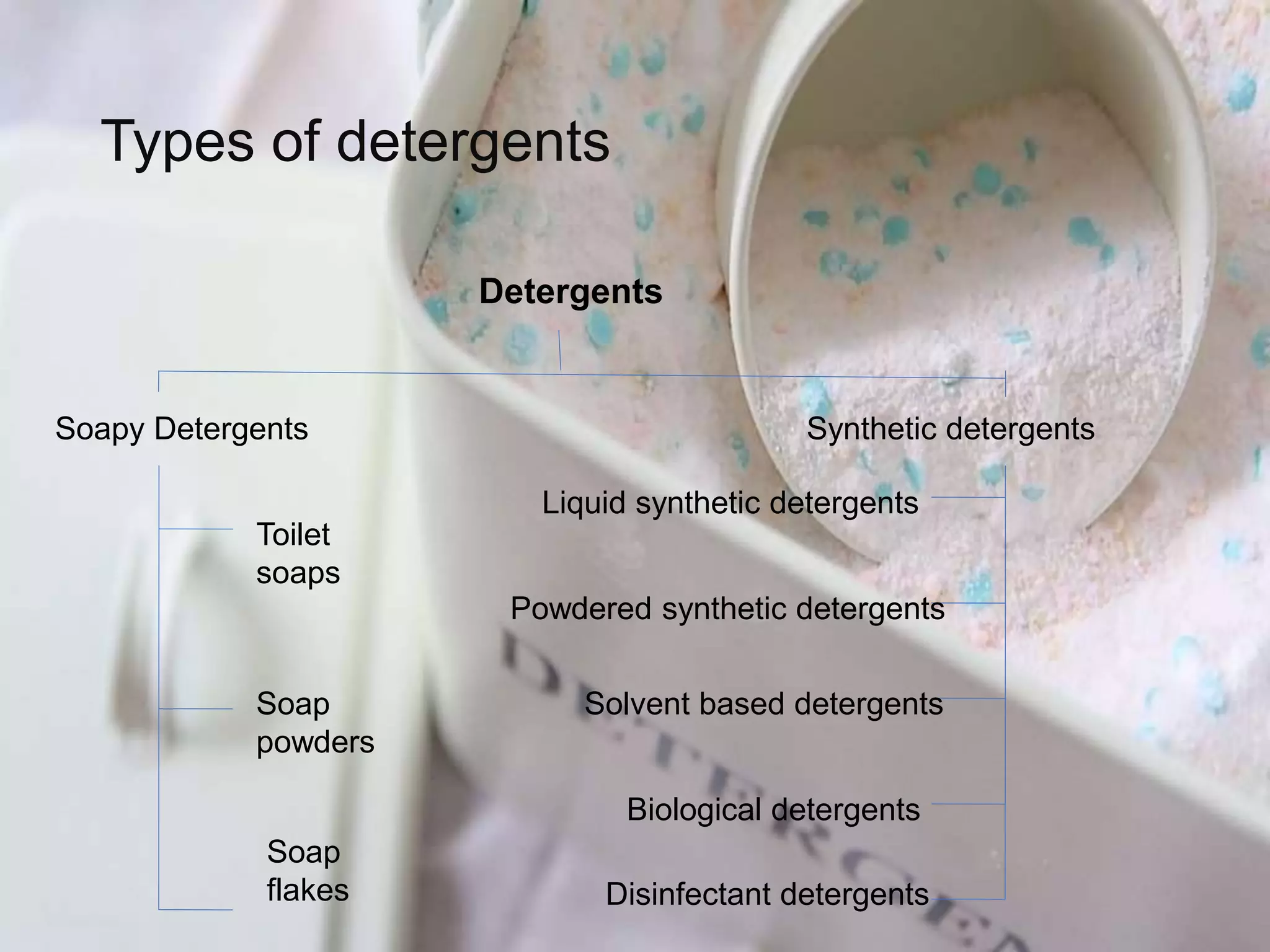
Types of detergents
Soapy Detergents
Toilet
soaps
Soap
powders
Soap
flakes
Synthetic detergents
Liquid synthetic detergents
Powdered synthetic detergents
Solvent based detergents
Biological detergents
Disinfectant detergents
Detergents
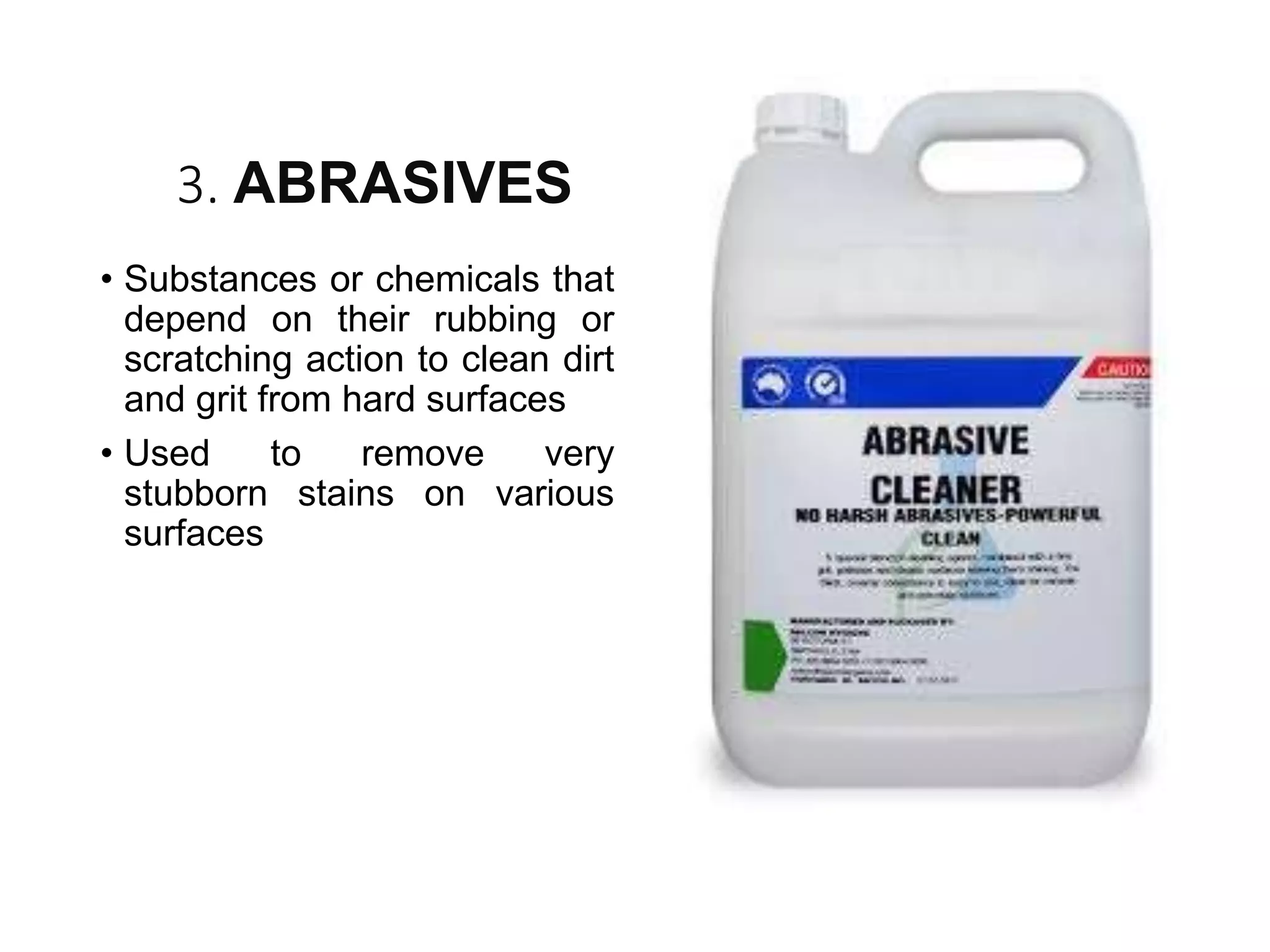
3. ABRASIVES
• Substances or chemicals that
depend on their rubbing or
scratching action to clean dirt
and grit from hard surfaces
• Used to remove very
stubborn stains on various
surfaces
TYPES OF ABRASIVES
• Fine abrasives-These include precipitated whiting and jeweller’s
rouge used for shinning silver
• Medium abrasives-These include rotten stone, salt, scouring
paste.
• Hard/coarse abrasives-These include bath bricks, sandpaper,
pumice, steel wool, and emery paper
4. REAGENTS
• Cleaning by a chemical reaction requiring a
distinctly low or high pH.
• Includes acids and alkalis that aid in the cleaning
process
5. ORGANIC SOLVENTS
• Grease is soluble in organic solvents such as carbon
tetrachloride,acetone,turpentine, and methylated spirit.
• Used for removal of grease, dry-cleaning of fabrics, and stain removal
• As evaporate rapidly ,useful for cleaning glass surfaces such as
mirrors and windows
6.DISINFECTANTS AND BLEACHES
• Phenols- used to disinfectant
surfaces.
• Halogens-used to disinfectant
surfaces made up of chlorine
and iodine
• Quaternary ammonium
compounds-these are
cationic surfactants useful as
bactericides
• Natural pine oils- Pine oils
are obtained from pine trees,
are mainly added to cleaning
formulations for their pleasant
smell
7. GLASS CLEANERS
• Composed of an organic, water
miscible solvent such as
isopropyl alcohol and alkaline
detergent.
• Sprayed directly onto windows,
mirrors, and other glass surfaces
or applied with a soft cloth and
rubbed off using a soft, lint-free
duster
8.POLISHES
• They do not necessarily clean
but produce a shine by
providing a smooth surface from
which light is reflected evenly.
• Metal polishes – these remove
the tarnish resulting from the
attack on the metal by certain
compounds and some
foodstuffs. They are of two basic
types, one for hard metal and
other for soft.
• Floor polishes –They are of two
basic types – Spirit based, Water
based.
• Spirit based polishes contain a blend of mainly natural waxes, dispersed
in a spirit solvent. They may be in paste or liquid form and contains
silicon, but too high a silicon content makes the floor slippery.
• Water-based polished are emulsions in which fine particles of natural
and synthetic waxes are dispersed in water. They are suitable for use on
thermoplastic, rubber, PVC, asphalt and combination floors as spirits can
affect them. and linoleum.
• Floor polishes are floor waxes and have to be subjected to rough traffic.
A more lasting surface can be obtained by use of a floor seal, with or
without water based polish applied on it.
Furniture polishes
• Furniture polishes are intended for
wooden furniture and fittings. It
consists of waxes dissolved in
varying amount of spirits. They are
of four types –
• Paste wax polish – high proportion
of wax plus silicon
• Cream polish – greater amounts of
spirit to give a cleaning action.
• Liquid polish – have great
proportion of spirit requiring no
buffing.
• Spray polish – also has high
proportion of spirit.
9.FLOOR SEALERS
• These are applied to flooring
surfaces as a semi- permanent
finish that acts as a protective
barrier by preventing the entry
of dirt, gems and liquid, grease,
stains and bacteria. They
prevent scratching and provide
an easily maintainable surface.
Types of floor sealers
• Oleo-resinous sealers: they are used for imparting an attractive surface
gloss penetrating the floor darkening the color and highlighting the grain
of wood floors.
• One-pot plastic sealers: they are used on wood, wood- composition,
cork and magnesite floors.
• Two-pot plastic sealers: they are also used on wood, wood-
composition, cork and magnesite floors.
• Pigmented sealers: these may be used on concrete, wood, wood-
composition, magnesite, asphalt, and stone floors.
water-based seals: these may used on marble , terrazzo, magnesite,
linoleum, rubber, thermoplastic tiles, PVCs, asphalt, concrete, stone-,
and quarry tiles.
Different chemicals used for cleaning in
hotels
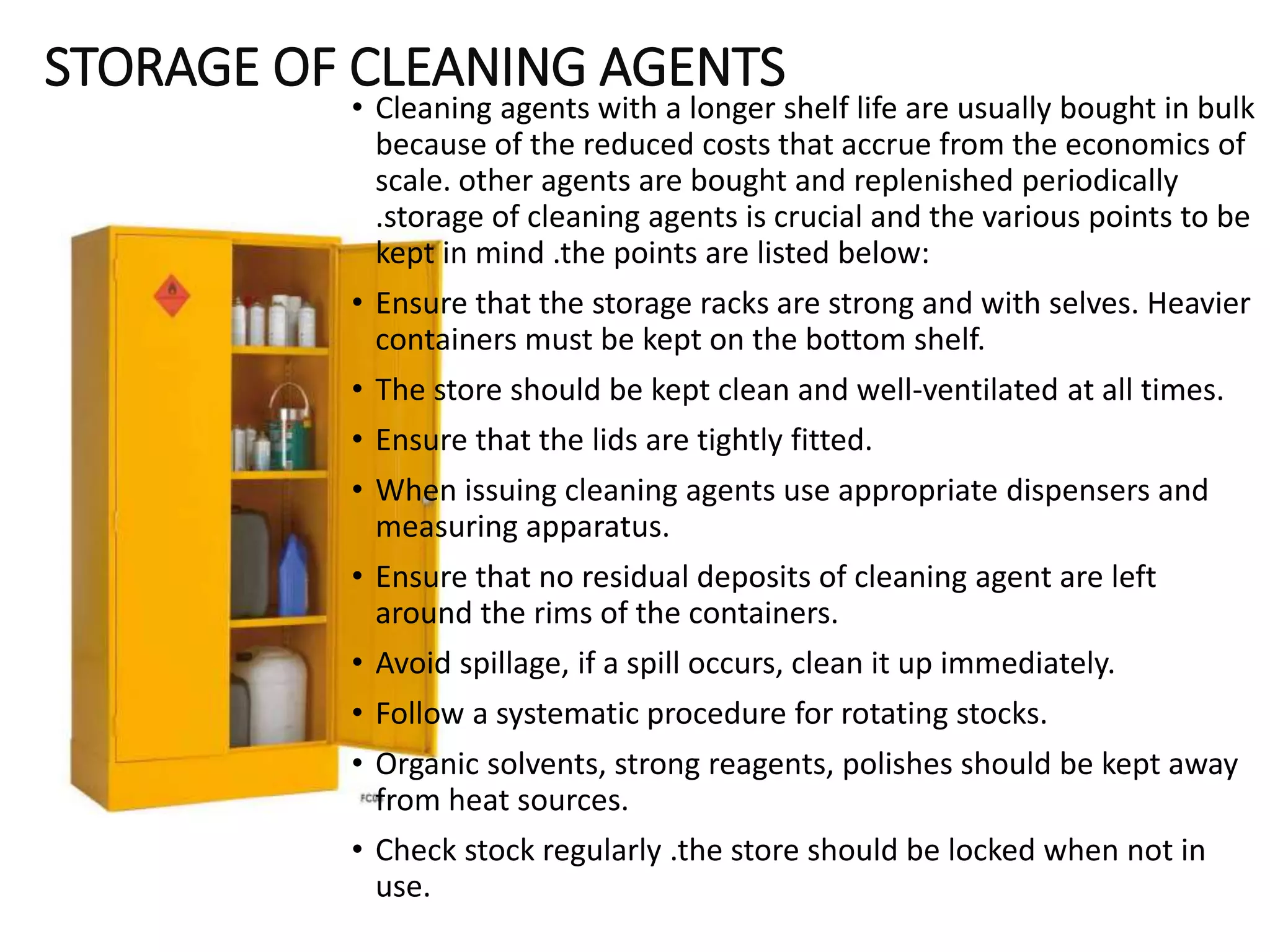
STORAGE OF CLEANING AGENTS
• Cleaning agents with a longer shelf life are usually bought in bulk
because of the reduced costs that accrue from the economics of
scale. other agents are bought and replenished periodically
.storage of cleaning agents is crucial and the various points to be
kept in mind .the points are listed below:
• Ensure that the storage racks are strong and with selves. Heavier
containers must be kept on the bottom shelf.
• The store should be kept clean and well-ventilated at all times.
• Ensure that the lids are tightly fitted.
• When issuing cleaning agents use appropriate dispensers and
measuring apparatus.
• Ensure that no residual deposits of cleaning agent are left
around the rims of the containers.
• Avoid spillage, if a spill occurs, clean it up immediately.
• Follow a systematic procedure for rotating stocks.
• Organic solvents, strong reagents, polishes should be kept away
from heat sources.
• Check stock regularly .the store should be locked when not in
use.
• 1. What are the different types of cleaning agents?
• 2. Discuss the process for storage of cleaning agents
CLEANING AGENTS- HOUSEKEEPING.pptx

CLEANING AGENTS- HOUSEKEEPING.pptx

  • 2.
  • 3.
    Natural or syntheticsubstances that are used to assist the cleaning process – that is, removal of dirt and grit and the maintenance of a clean appearance on the surface
  • 4.
    WATER • Universal solvent •Prime agent in cleaning process • Though an excellent solvent, water alone is not a sufficiently effective cleanser • Must be used in conjunction with other cleaning agents such as detergents, soaps and so on • Soft water is ideal for cleaning purposes and also to make up the proper dilutions of other cleaning agents
  • 5.
    Sources of water •Surface water-obtained from streams, rivers, and lakes, it may contain both organic and inorganic impurities in large amounts • Sub-soil water-coming from shallow wells and springs, not likely to be contaminated with suspended matter and organic impurities • Deep-soil water-pumped up from deep wells, has a very high content of minerals such as calcium, magnesium, iron, sulphur, phosphates, and silica as well as dissolved gases such as nitrogen, carbon dioxide, and oxygen
  • 6.
    Hard and Softwater • More than 60 ppm (parts per million) of calcium and magnesium- hard water • 61-120 ppm- moderately hard water • More than 180 ppm- very hard water • Below 60 ppm-soft water
  • 7.
    2.DETERGENTS • When usedin conjunction with water, loosen and remove dirt • Two types of detergents are- 1. Soapy detergent 2. Synthetic detergent
  • 8.
    Three basic propertiesof detergent are- • Good wetting power- to lower the surface tension of water and enable the surface of the article to be thoroughly wet • Good emulsifying power-to break up the grease and enable the dirt to be loosened • Good suspending power-to suspend the dirt in solution, thus preventing its deposition
  • 9.
    Types of detergents SoapyDetergents Toilet soaps Soap powders Soap flakes Synthetic detergents Liquid synthetic detergents Powdered synthetic detergents Solvent based detergents Biological detergents Disinfectant detergents Detergents
  • 10.
    3. ABRASIVES • Substancesor chemicals that depend on their rubbing or scratching action to clean dirt and grit from hard surfaces • Used to remove very stubborn stains on various surfaces
  • 11.
    TYPES OF ABRASIVES •Fine abrasives-These include precipitated whiting and jeweller’s rouge used for shinning silver • Medium abrasives-These include rotten stone, salt, scouring paste. • Hard/coarse abrasives-These include bath bricks, sandpaper, pumice, steel wool, and emery paper
  • 12.
    4. REAGENTS • Cleaningby a chemical reaction requiring a distinctly low or high pH. • Includes acids and alkalis that aid in the cleaning process
  • 13.
    5. ORGANIC SOLVENTS •Grease is soluble in organic solvents such as carbon tetrachloride,acetone,turpentine, and methylated spirit. • Used for removal of grease, dry-cleaning of fabrics, and stain removal • As evaporate rapidly ,useful for cleaning glass surfaces such as mirrors and windows
  • 14.
    6.DISINFECTANTS AND BLEACHES •Phenols- used to disinfectant surfaces. • Halogens-used to disinfectant surfaces made up of chlorine and iodine • Quaternary ammonium compounds-these are cationic surfactants useful as bactericides • Natural pine oils- Pine oils are obtained from pine trees, are mainly added to cleaning formulations for their pleasant smell
  • 15.
    7. GLASS CLEANERS •Composed of an organic, water miscible solvent such as isopropyl alcohol and alkaline detergent. • Sprayed directly onto windows, mirrors, and other glass surfaces or applied with a soft cloth and rubbed off using a soft, lint-free duster
  • 16.
    8.POLISHES • They donot necessarily clean but produce a shine by providing a smooth surface from which light is reflected evenly. • Metal polishes – these remove the tarnish resulting from the attack on the metal by certain compounds and some foodstuffs. They are of two basic types, one for hard metal and other for soft. • Floor polishes –They are of two basic types – Spirit based, Water based.
  • 17.
    • Spirit basedpolishes contain a blend of mainly natural waxes, dispersed in a spirit solvent. They may be in paste or liquid form and contains silicon, but too high a silicon content makes the floor slippery. • Water-based polished are emulsions in which fine particles of natural and synthetic waxes are dispersed in water. They are suitable for use on thermoplastic, rubber, PVC, asphalt and combination floors as spirits can affect them. and linoleum. • Floor polishes are floor waxes and have to be subjected to rough traffic. A more lasting surface can be obtained by use of a floor seal, with or without water based polish applied on it.
  • 18.
    Furniture polishes • Furniturepolishes are intended for wooden furniture and fittings. It consists of waxes dissolved in varying amount of spirits. They are of four types – • Paste wax polish – high proportion of wax plus silicon • Cream polish – greater amounts of spirit to give a cleaning action. • Liquid polish – have great proportion of spirit requiring no buffing. • Spray polish – also has high proportion of spirit.
  • 19.
    9.FLOOR SEALERS • Theseare applied to flooring surfaces as a semi- permanent finish that acts as a protective barrier by preventing the entry of dirt, gems and liquid, grease, stains and bacteria. They prevent scratching and provide an easily maintainable surface.
  • 20.
    Types of floorsealers • Oleo-resinous sealers: they are used for imparting an attractive surface gloss penetrating the floor darkening the color and highlighting the grain of wood floors. • One-pot plastic sealers: they are used on wood, wood- composition, cork and magnesite floors. • Two-pot plastic sealers: they are also used on wood, wood- composition, cork and magnesite floors. • Pigmented sealers: these may be used on concrete, wood, wood- composition, magnesite, asphalt, and stone floors. water-based seals: these may used on marble , terrazzo, magnesite, linoleum, rubber, thermoplastic tiles, PVCs, asphalt, concrete, stone-, and quarry tiles.
  • 21.
    Different chemicals usedfor cleaning in hotels
  • 23.
    STORAGE OF CLEANINGAGENTS • Cleaning agents with a longer shelf life are usually bought in bulk because of the reduced costs that accrue from the economics of scale. other agents are bought and replenished periodically .storage of cleaning agents is crucial and the various points to be kept in mind .the points are listed below: • Ensure that the storage racks are strong and with selves. Heavier containers must be kept on the bottom shelf. • The store should be kept clean and well-ventilated at all times. • Ensure that the lids are tightly fitted. • When issuing cleaning agents use appropriate dispensers and measuring apparatus. • Ensure that no residual deposits of cleaning agent are left around the rims of the containers. • Avoid spillage, if a spill occurs, clean it up immediately. • Follow a systematic procedure for rotating stocks. • Organic solvents, strong reagents, polishes should be kept away from heat sources. • Check stock regularly .the store should be locked when not in use.
  • 25.
    • 1. Whatare the different types of cleaning agents? • 2. Discuss the process for storage of cleaning agents