Page 1
CHAPTER 3
HOUSEKEEPING
INVENTORIES
By: Mumtazul Ilyani
Page 2
INTRODUCTION
 Housekeeping inventories refer to the stoks of
purchased operating supplies, equipment and
other items held for future use in housekeeping
operations.
 There are two types of housekeeping inventories:
1. Recycled inventories are for those items and
pieces of equipment that have relatively limited
useful lives but are used over and over again.
Example: Cleaning equipment and other
machines, linen, uniforms and guest loan items.
2. Non-recycled inventories include items that are
used up during the course of routine
housekeeping operations. Example: Cleaning
supplies, cleaning agents and small piece of
equipment.
Page 3
CLEANING EQUIPMENT (BRUSHES)
 Brushes are meant to remove dirt dry or
wet from hard or soft surfaces. They may
have bristles of animal, vegetable or man
made origin.
 It is of following types:
 HARD BRUSHES: They have hard
bristles used for removing heavy soil
& litter from carpets and for cleaning
hard and rough surfaces such as hard
floor.
 SOFT BRUSHES: They have soft and
flexible bristles meant for removing
loose soil from hard/smooth surfaces
such as carpets and furnitures.
Page 4
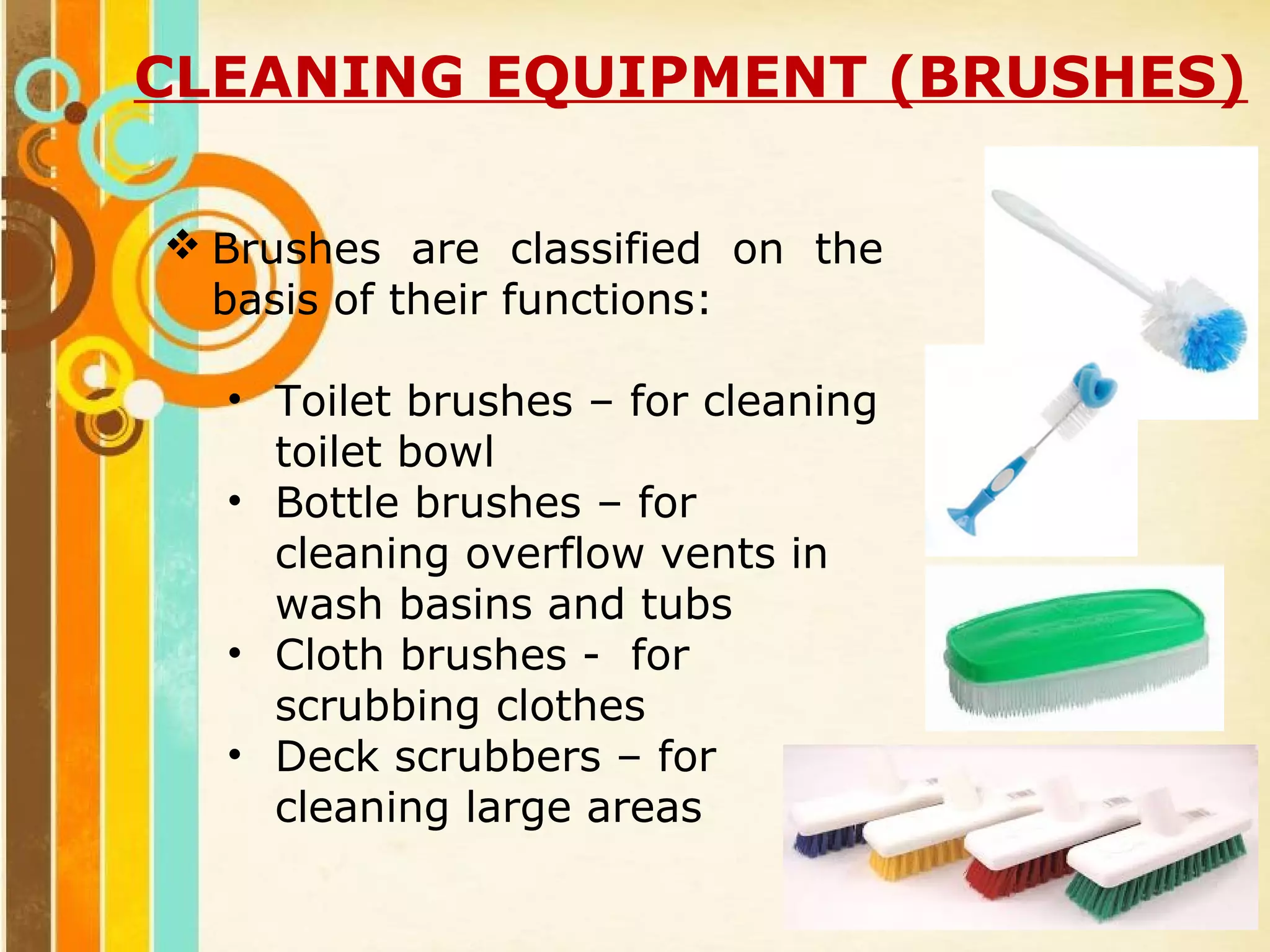
 Brushes are classified on the
basis of their functions:
• Toilet brushes – for cleaning
toilet bowl
• Bottle brushes – for
cleaning overflow vents in
wash basins and tubs
• Cloth brushes - for
scrubbing clothes
• Deck scrubbers – for
cleaning large areas
CLEANING EQUIPMENT (BRUSHES)
Page 5
• Carpet brushes – for
brushing carpets
• Upholstery brushes – to
loosen out dust between
the fabric fibres in
upholstered chairs and
sofas
• Feather brushes – for light
dusting
• Hearth brush – for
cleaning heavy soiling
• Flue brush – for cleaning
chimneys
CLEANING EQUIPMENT (BRUSHES)
Page 6
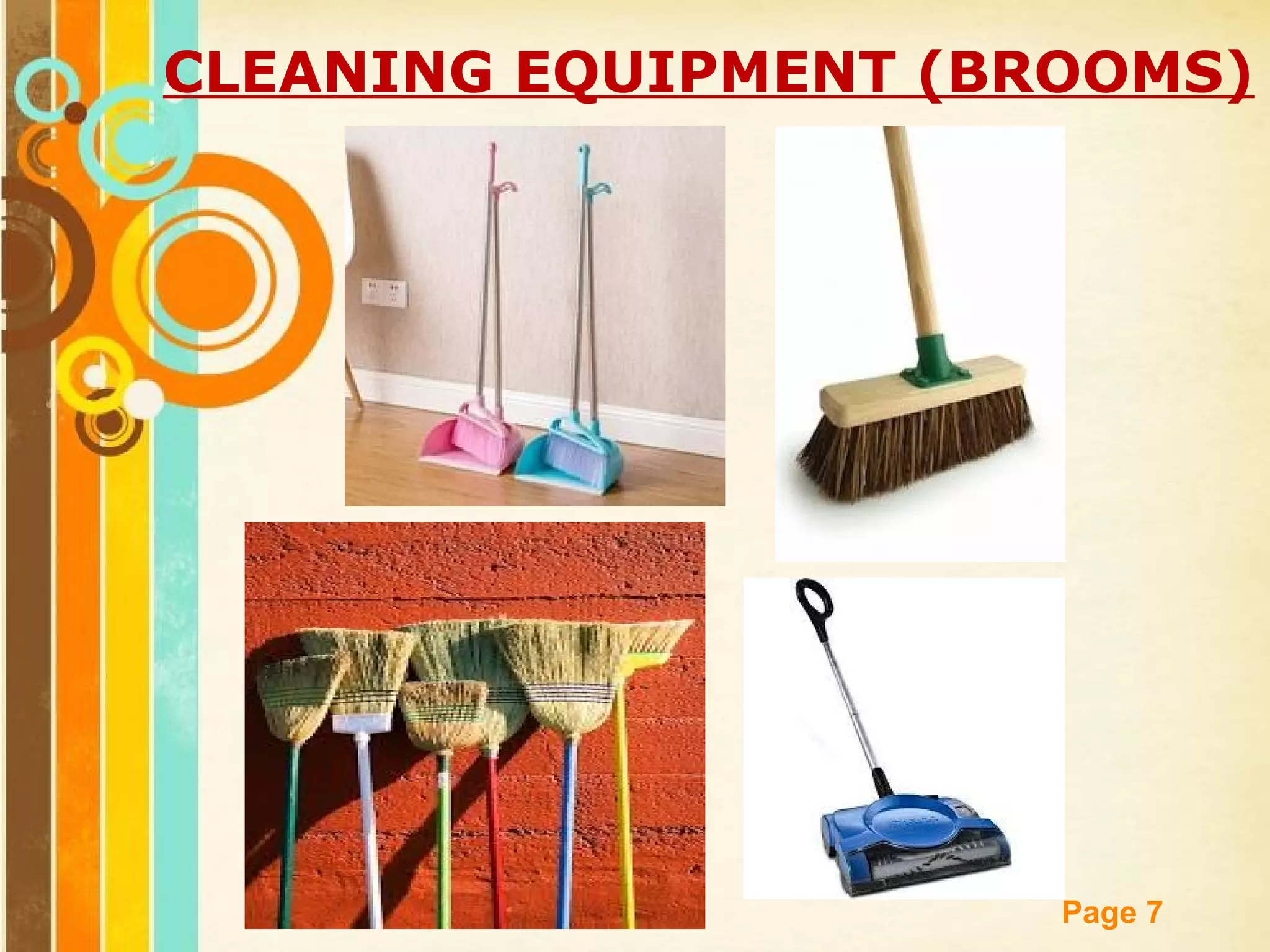
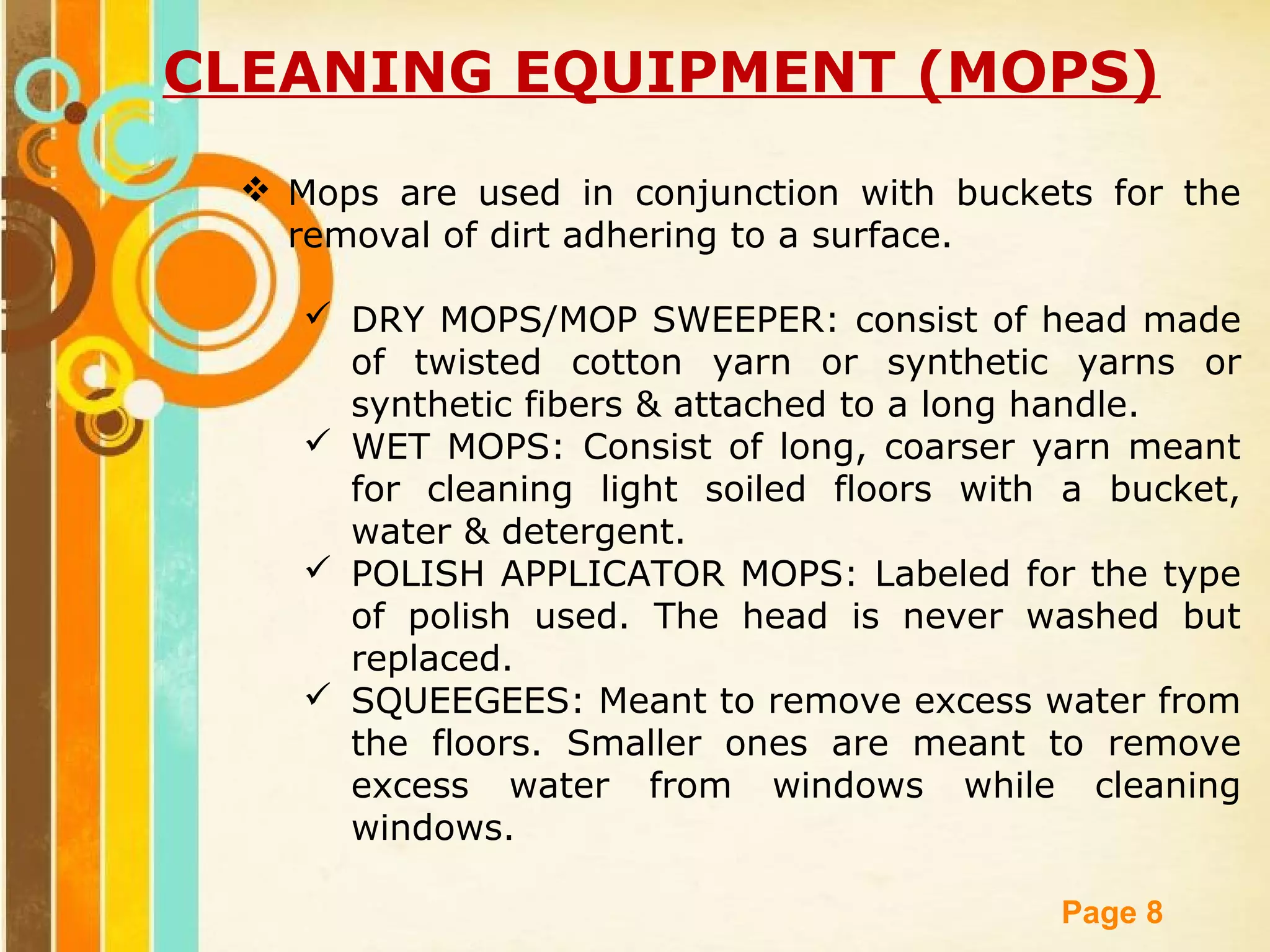
CLEANING EQUIPMENT (BROOMS)
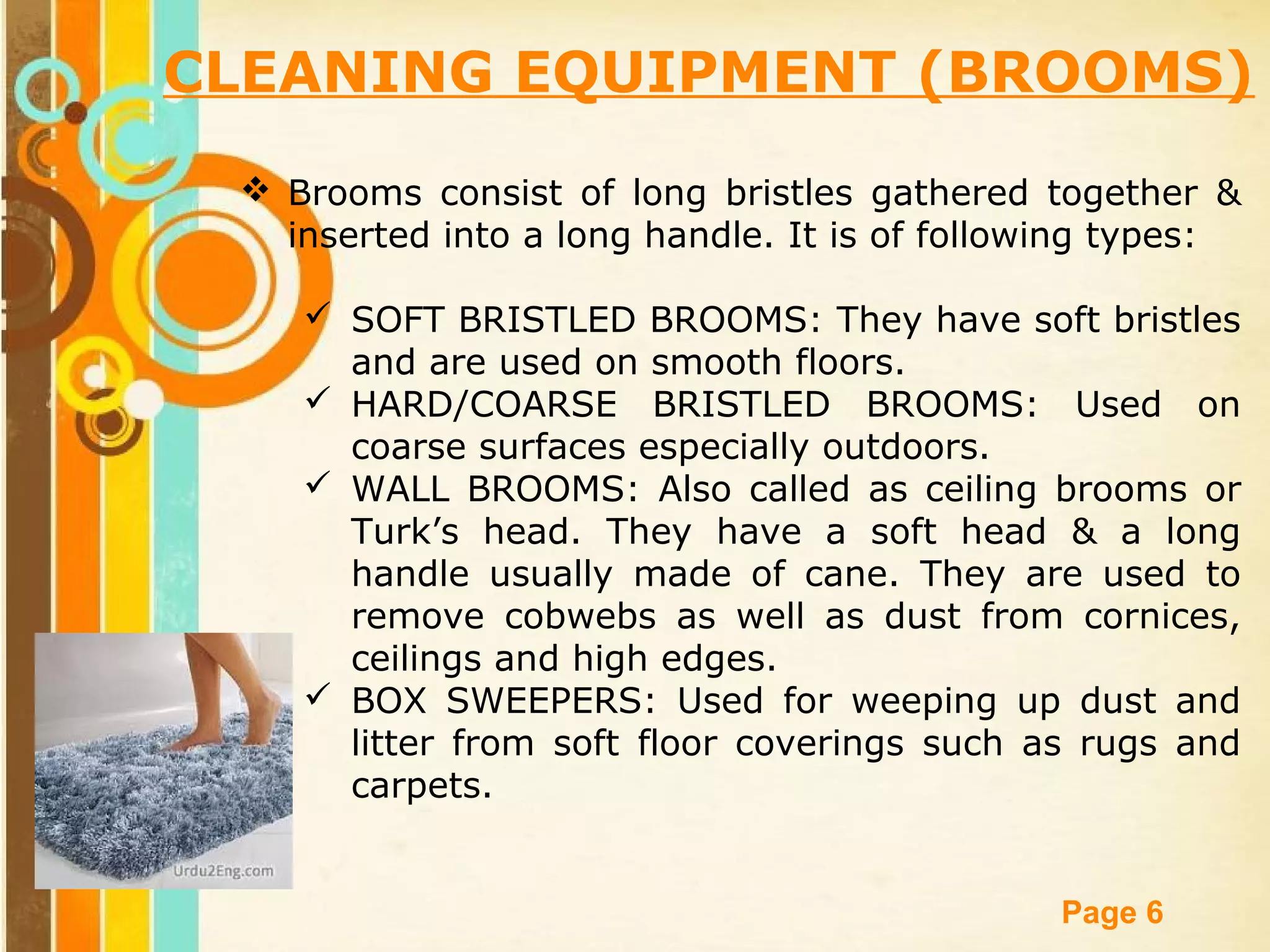
 Brooms consist of long bristles gathered together &
inserted into a long handle. It is of following types:
 SOFT BRISTLED BROOMS: They have soft bristles
and are used on smooth floors.
 HARD/COARSE BRISTLED BROOMS: Used on
coarse surfaces especially outdoors.
 WALL BROOMS: Also called as ceiling brooms or
Turk’s head. They have a soft head & a long
handle usually made of cane. They are used to
remove cobwebs as well as dust from cornices,
ceilings and high edges.
 BOX SWEEPERS: Used for weeping up dust and
litter from soft floor coverings such as rugs and
carpets.
Page 7
CLEANING EQUIPMENT (BROOMS)
Page 8
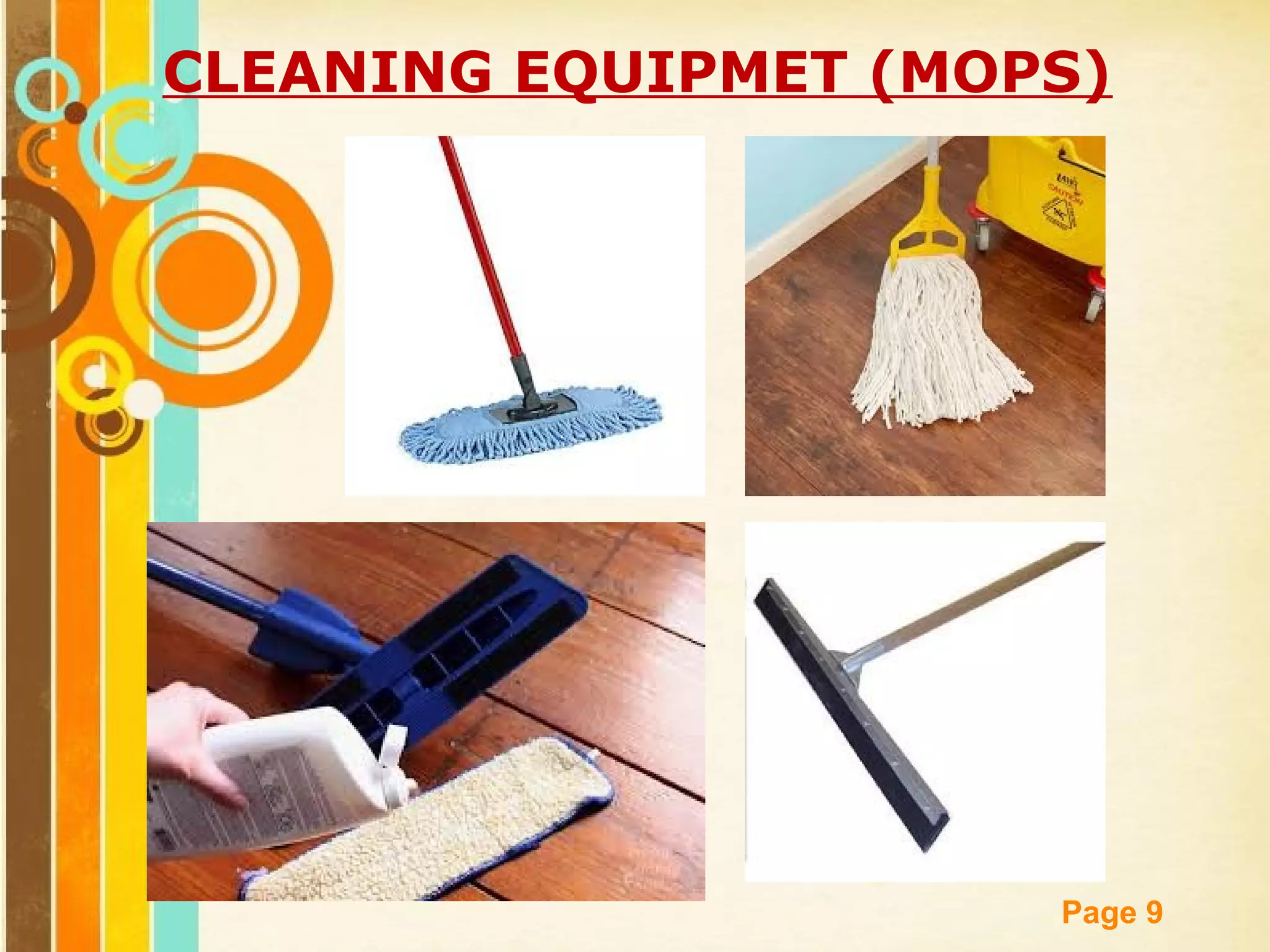
CLEANING EQUIPMENT (MOPS)
 Mops are used in conjunction with buckets for the
removal of dirt adhering to a surface.
 DRY MOPS/MOP SWEEPER: consist of head made
of twisted cotton yarn or synthetic yarns or
synthetic fibers & attached to a long handle.
 WET MOPS: Consist of long, coarser yarn meant
for cleaning light soiled floors with a bucket,
water & detergent.
 POLISH APPLICATOR MOPS: Labeled for the type
of polish used. The head is never washed but
replaced.
 SQUEEGEES: Meant to remove excess water from
the floors. Smaller ones are meant to remove
excess water from windows while cleaning
windows.
Page 9
CLEANING EQUIPMET (MOPS)
Page 10
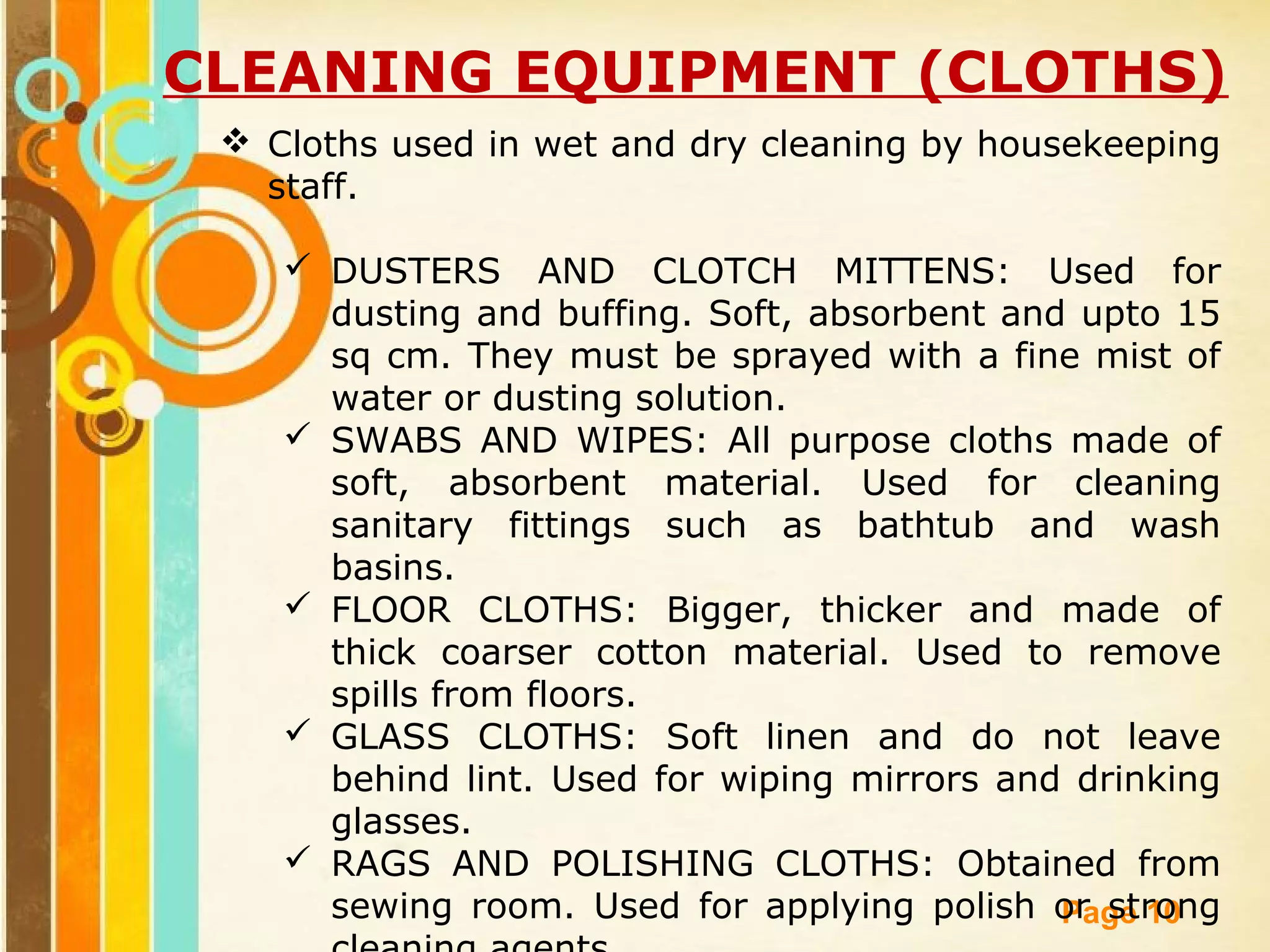
CLEANING EQUIPMENT (CLOTHS)
 Cloths used in wet and dry cleaning by housekeeping
staff.
 DUSTERS AND CLOTCH MITTENS: Used for
dusting and buffing. Soft, absorbent and upto 15
sq cm. They must be sprayed with a fine mist of
water or dusting solution.
 SWABS AND WIPES: All purpose cloths made of
soft, absorbent material. Used for cleaning
sanitary fittings such as bathtub and wash
basins.
 FLOOR CLOTHS: Bigger, thicker and made of
thick coarser cotton material. Used to remove
spills from floors.
 GLASS CLOTHS: Soft linen and do not leave
behind lint. Used for wiping mirrors and drinking
glasses.
 RAGS AND POLISHING CLOTHS: Obtained from
sewing room. Used for applying polish or strong
Page 11
CLEANING EQUIPMENT (CLOTHS)
Page 12
CLEANING EQUIPMENT (CONTAINER)
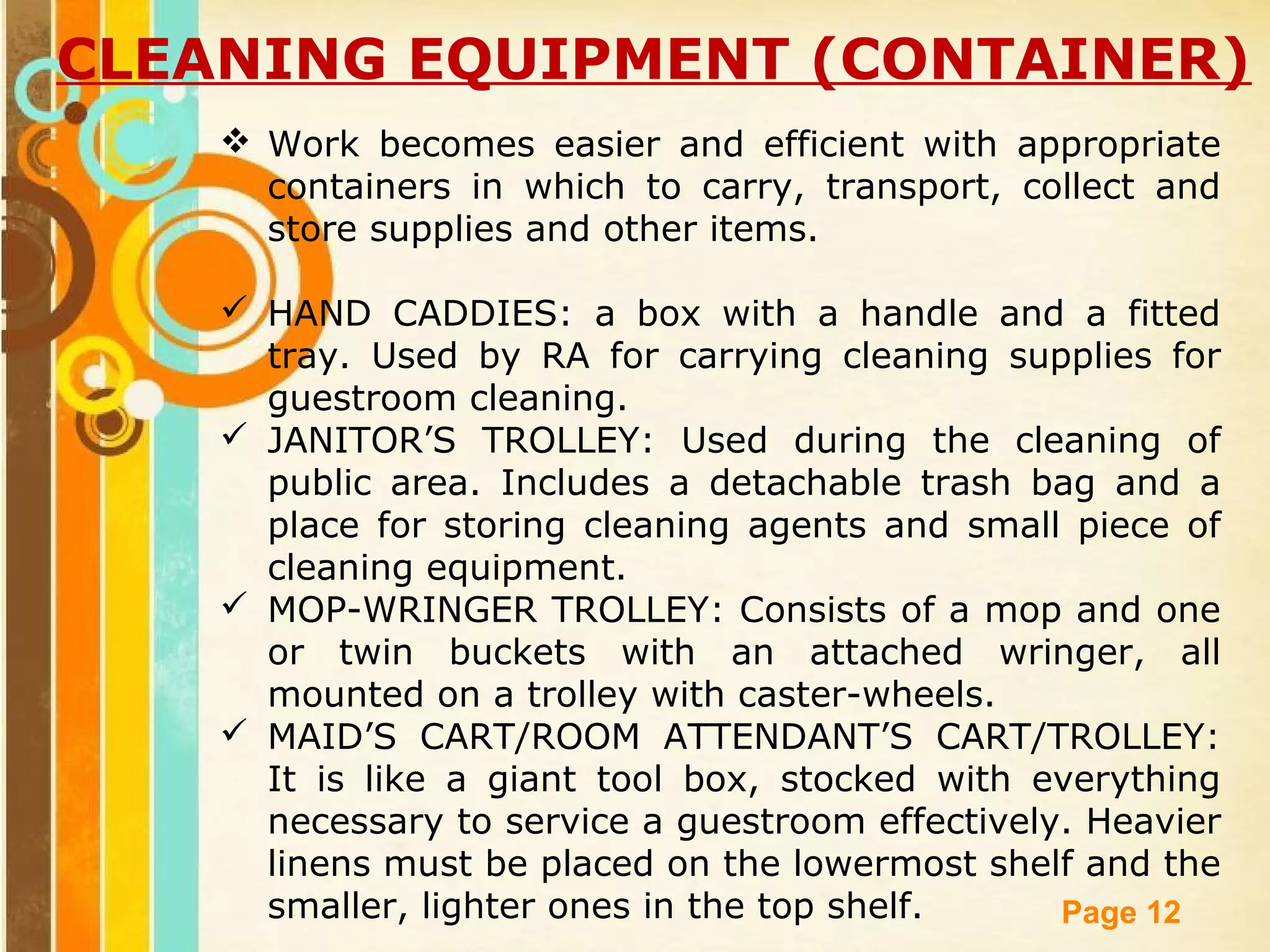
 Work becomes easier and efficient with appropriate
containers in which to carry, transport, collect and
store supplies and other items.
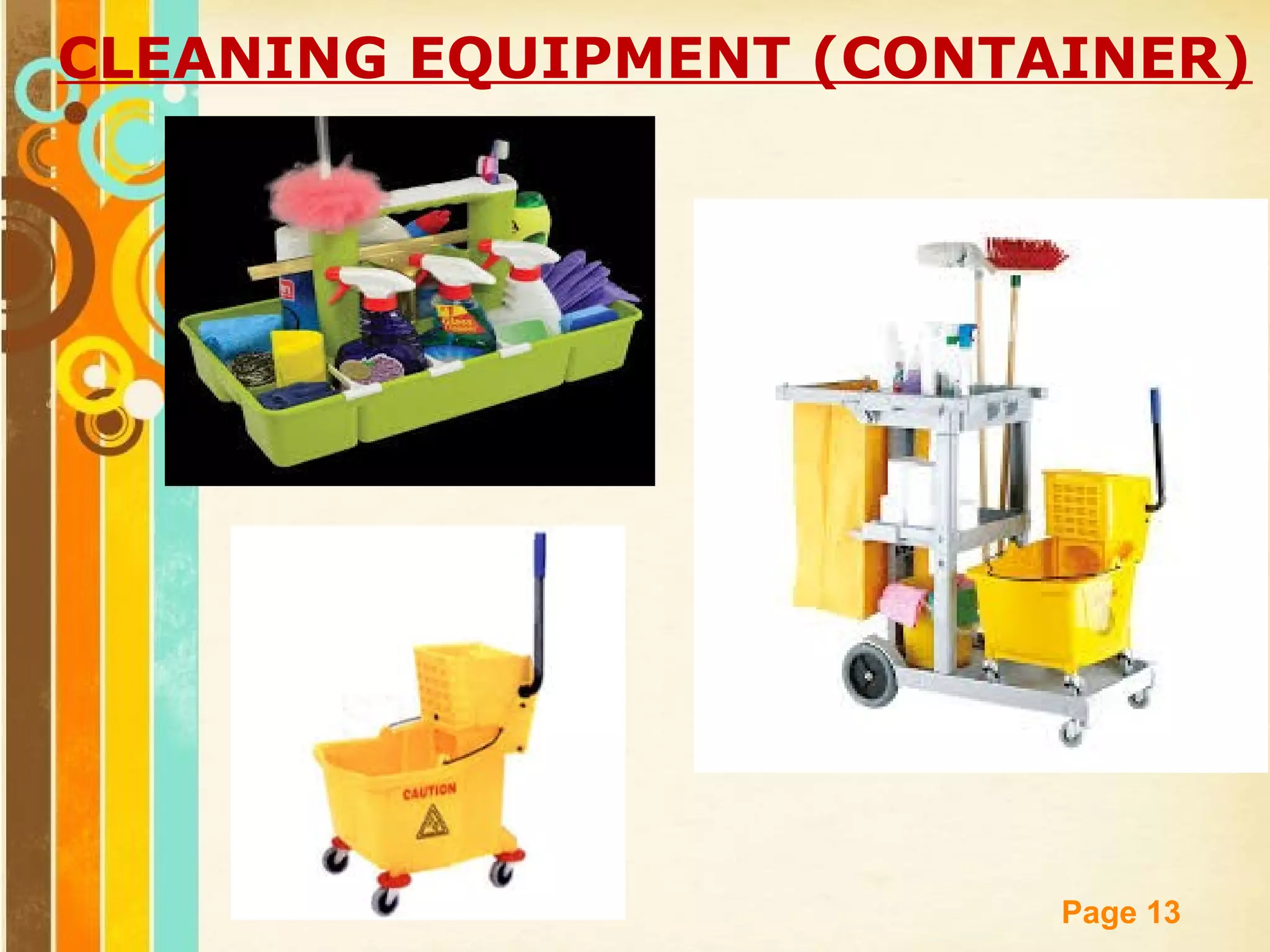
 HAND CADDIES: a box with a handle and a fitted
tray. Used by RA for carrying cleaning supplies for
guestroom cleaning.
 JANITOR’S TROLLEY: Used during the cleaning of
public area. Includes a detachable trash bag and a
place for storing cleaning agents and small piece of
cleaning equipment.
 MOP-WRINGER TROLLEY: Consists of a mop and one
or twin buckets with an attached wringer, all
mounted on a trolley with caster-wheels.
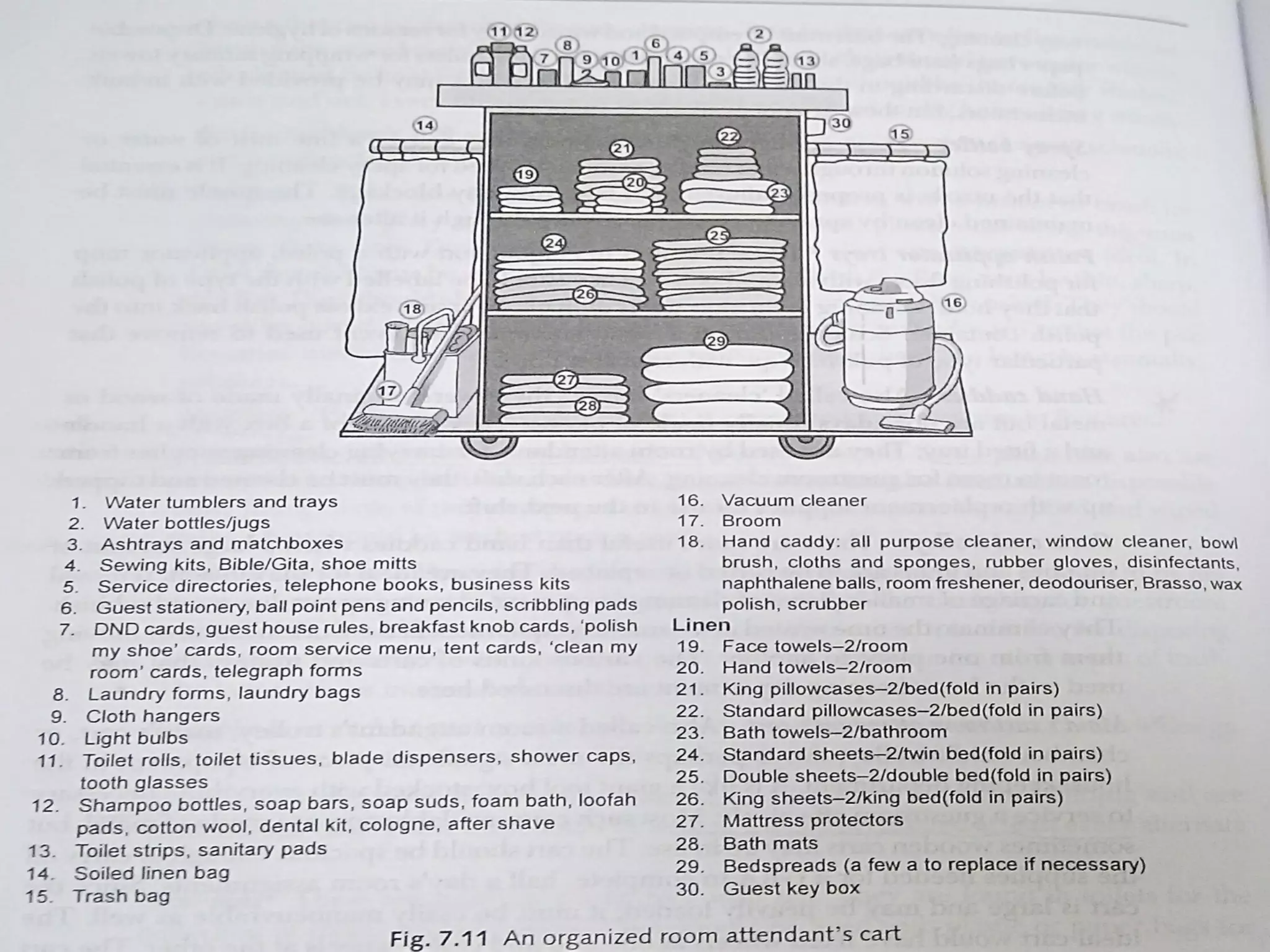
 MAID’S CART/ROOM ATTENDANT’S CART/TROLLEY:
It is like a giant tool box, stocked with everything
necessary to service a guestroom effectively. Heavier
linens must be placed on the lowermost shelf and the
smaller, lighter ones in the top shelf.
Page 13
CLEANING EQUIPMENT (CONTAINER)
Page 14
Page 15
CLEANING MECHANICAL EQUIPMENT
(VACUUM)
 Vacuum cleaners remove debris, soil and water from a surface
by suction.
 BACKPACK VACUUM: For cleaning high, hard to reach areas
such as curtains, ceiling corners and also used for cleaning
staircase too. This vacuum can be easily strapped to the back
of the operator.
 UPRIGHT VACUUM: The main body lies horizontal on the floor,
used rotating brushes and is driven by a single motor. Most
suitable for use on a large carpeted areas.
 CYLINDRICAL VACCUM: Have no rotating brushes and work
by suction only. A flexible hose along with different
attachments is used to clean a variety of surface.
 CENTRALIZED VACUUM CLEANER: Suction is generated at one
point in the building. Soiling can be removed at vacuum
points elsewhere in the building by suitable nozzles linked to
detachable flexible hoses. The collected dirt is then conveyed
by a network pipes to a central container.
 WET AND DRY VACUUM: Can pick up spills and water excess
when on the wet mode. Help in removal of dust and debris on
the dry mode.
Page 16
CLEANING MECHANICAL EQUIPMET
(VACUUM)
Page 17
CLEANING MECHANICAL
EQUIPMENT (SCRUBBER)
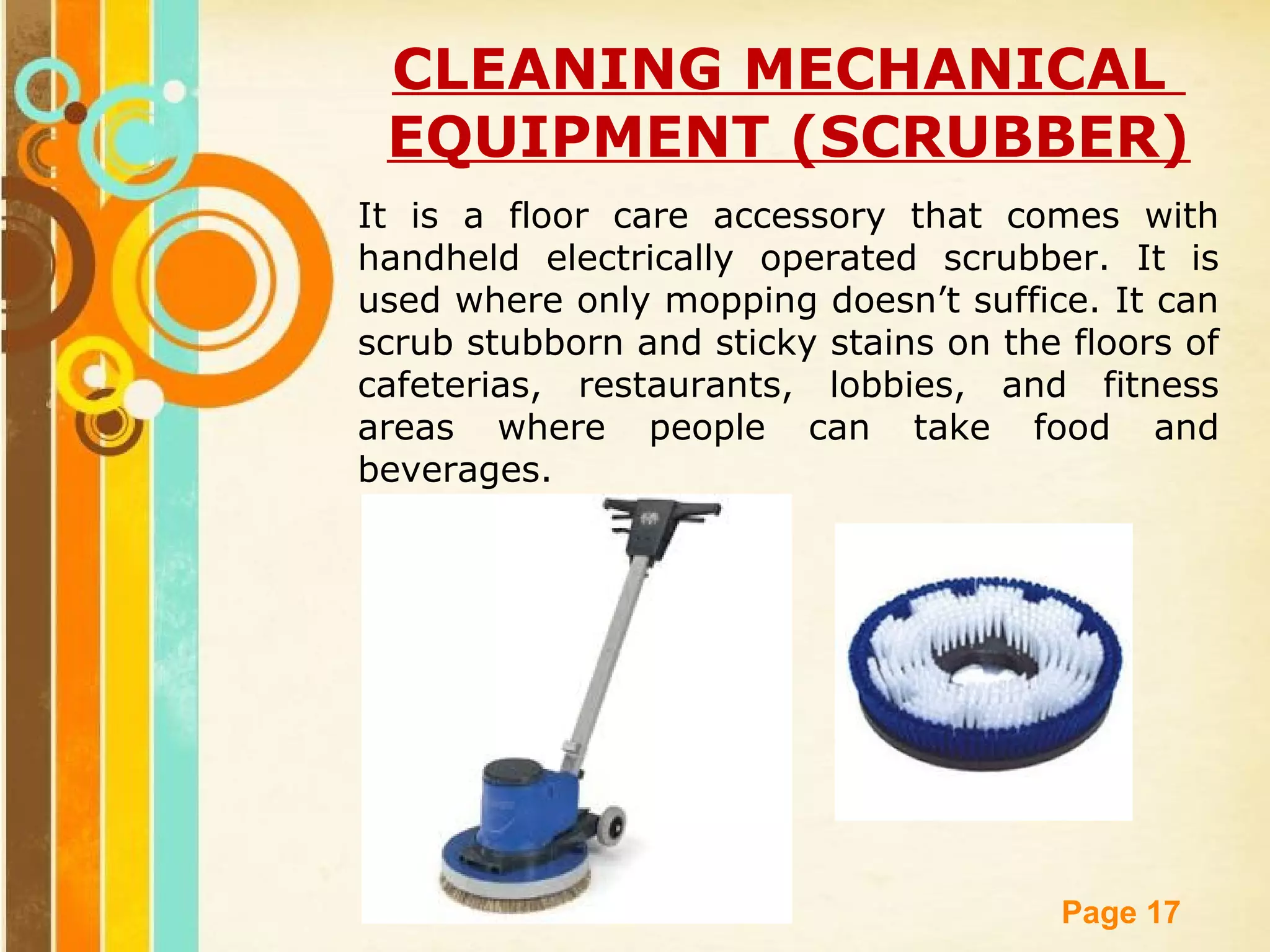
It is a floor care accessory that comes with
handheld electrically operated scrubber. It is
used where only mopping doesn’t suffice. It can
scrub stubborn and sticky stains on the floors of
cafeterias, restaurants, lobbies, and fitness
areas where people can take food and
beverages.
Page 18
CLEANING MECHANICAL
EQUIPMENT (POLISHER)
They are used to add a shine to the floors of
most frequented areas of the hotel.
Page 19
CLEANING MECHANICAL EQUIPMENT
(HIGH PRESSURE WASHERS)
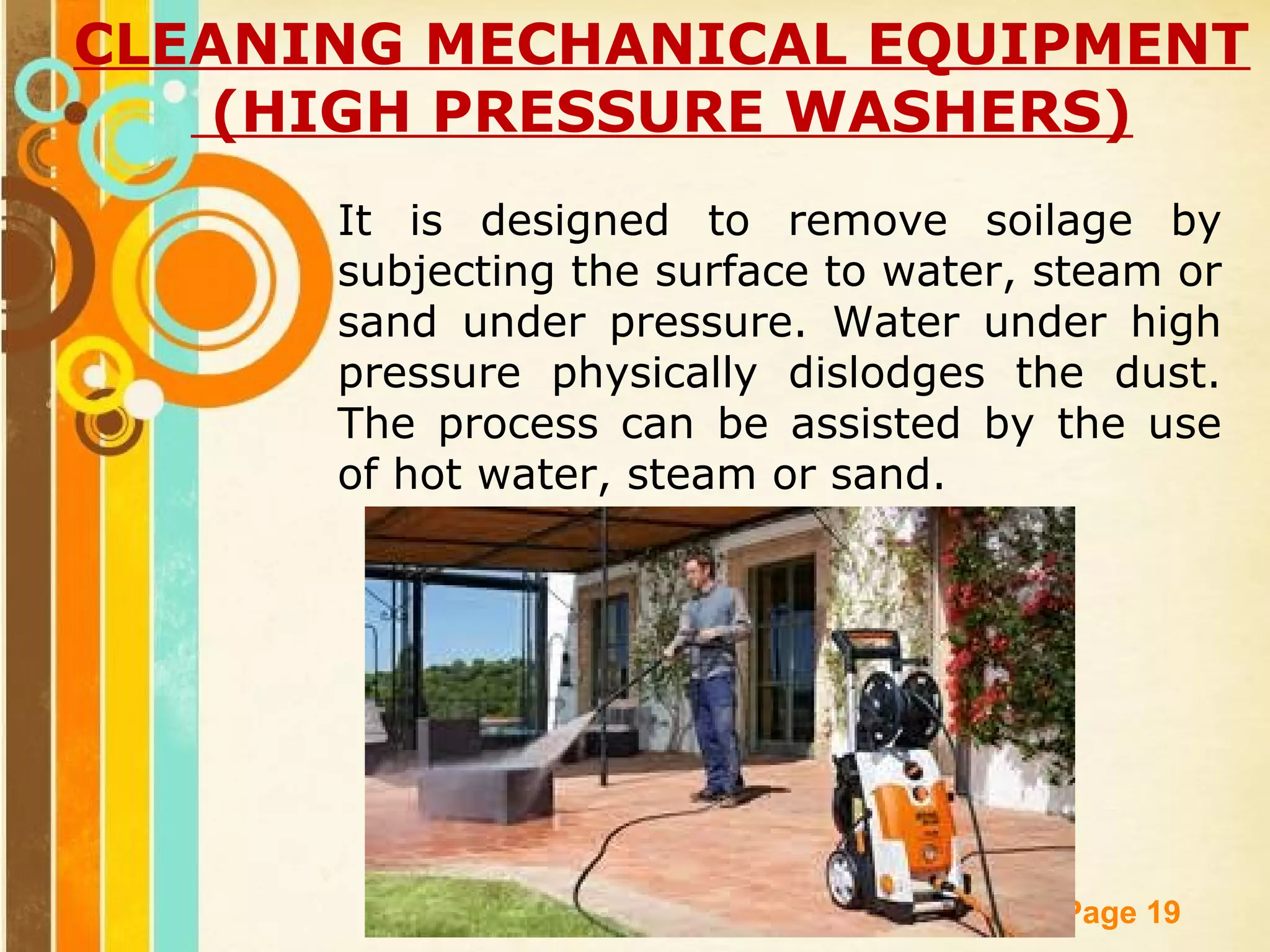
It is designed to remove soilage by
subjecting the surface to water, steam or
sand under pressure. Water under high
pressure physically dislodges the dust.
The process can be assisted by the use
of hot water, steam or sand.
Page 20
CLEANING MECHANICAL EQUIPMENT
(SCARIFYING MACHINES)
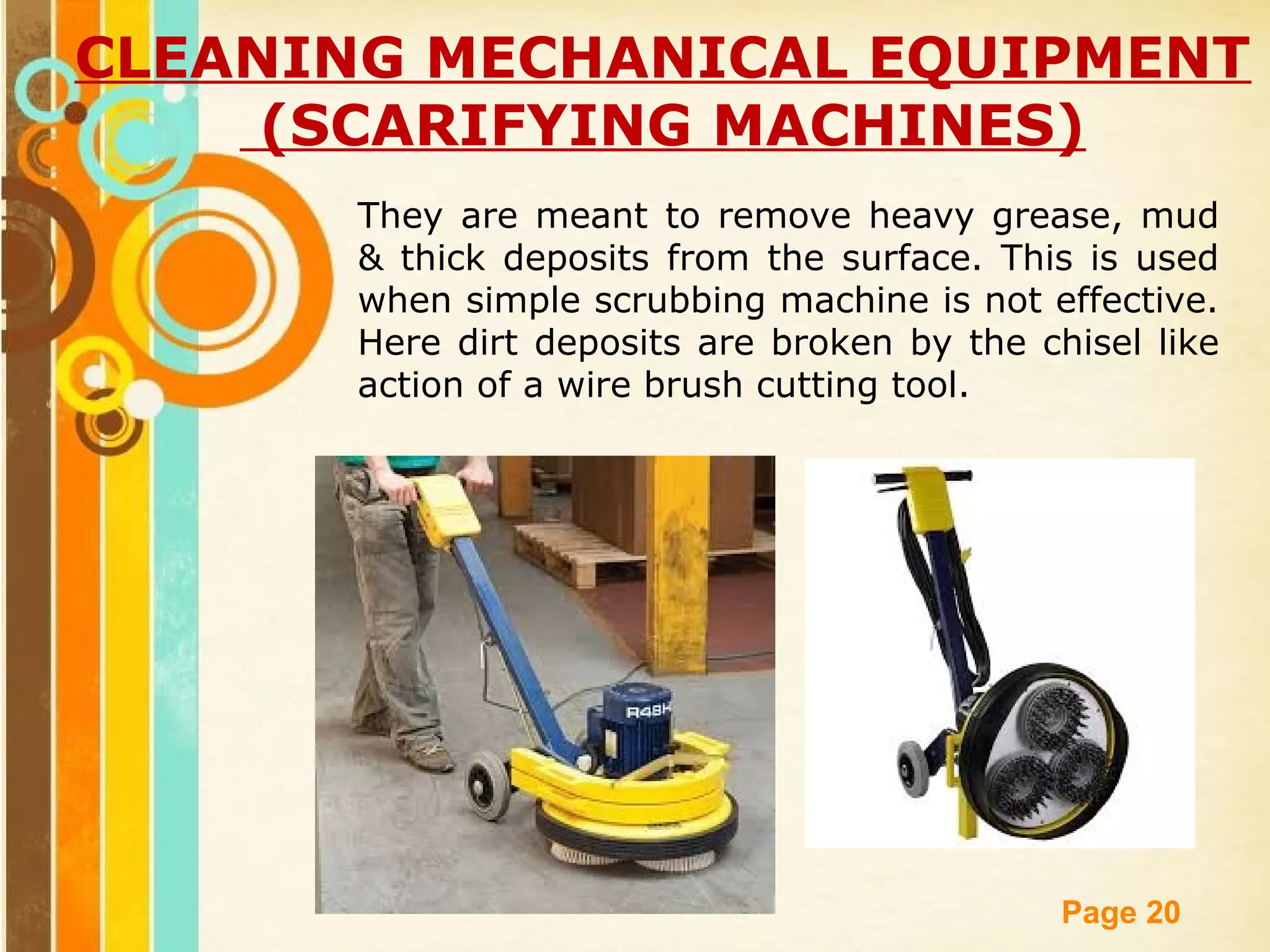
They are meant to remove heavy grease, mud
& thick deposits from the surface. This is used
when simple scrubbing machine is not effective.
Here dirt deposits are broken by the chisel like
action of a wire brush cutting tool.
Page 21
Factors to consider in selecting
cleaning equipment
• Safety in operation
• Suitability to the type of area,
surface, work, amount of obstruction
• Versatility to undertake various types
of cleaning
• Work performance in terms of
capacity of machine
• Ease of handling in terms of size,
weight & height of the machine
Page 22
Factors to consider in selecting
cleaning equipment
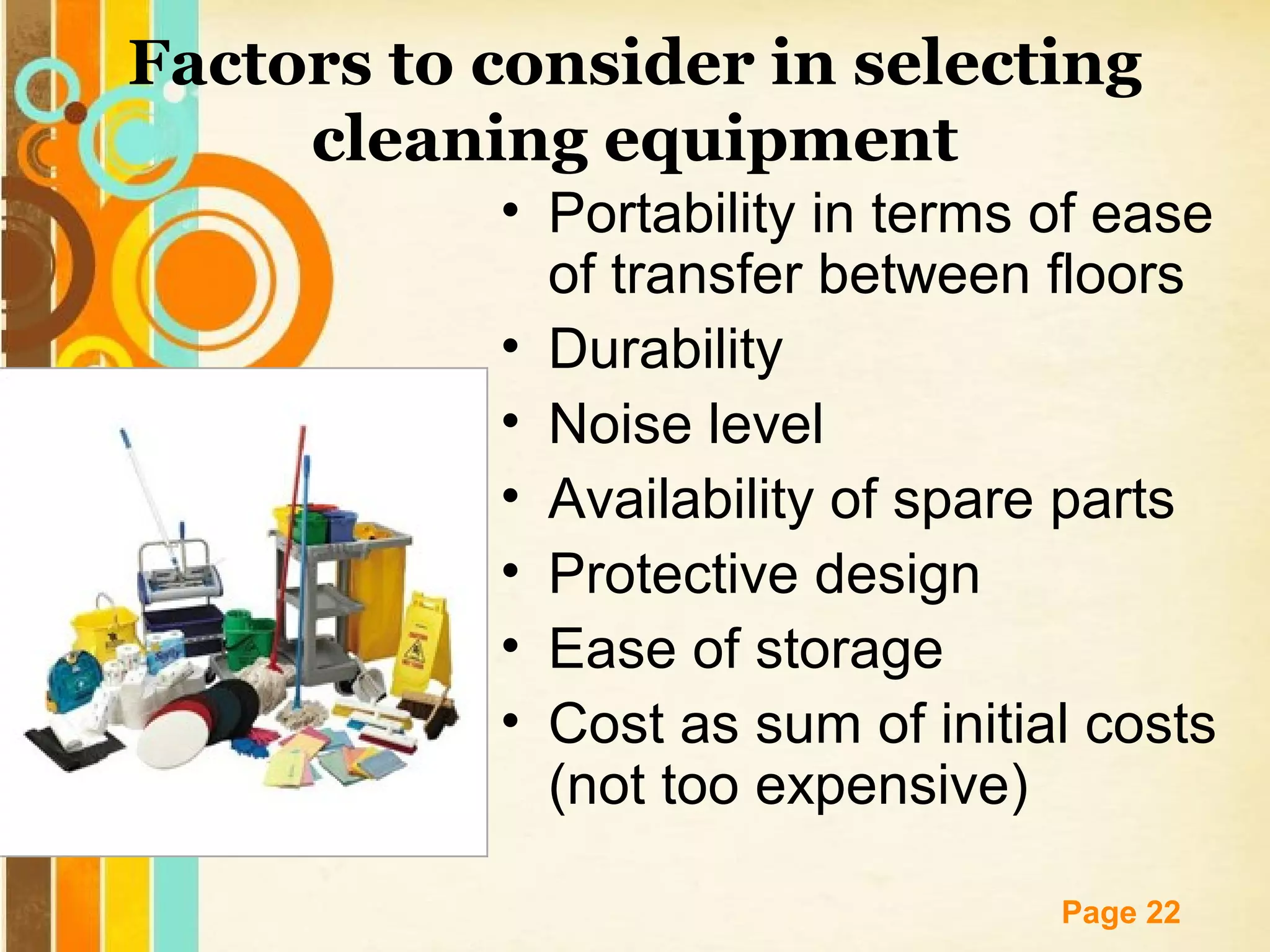
• Portability in terms of ease
of transfer between floors
• Durability
• Noise level
• Availability of spare parts
• Protective design
• Ease of storage
• Cost as sum of initial costs
(not too expensive)
Page 23
General care of electrical cleaning
equipment
• Machine using water has a float valve
which automatically cuts off the motor
• Have equipment serviced regularly by
qualified electricians
• Use only with dry hand
• Report damage immediately
• Always use the nearest socket
• Switch off wall socket when not being used
• Use extension leads only in an emergency
• Replace broken plugs
• Use correct size fuses
• Never overload the socket
Page 24
MAINTENANCE
• When to use equipment
• How to use equipment
• How to clean each item
• Where to clean
equipment
• How often to attend to
equipment
• How to obtain assistance
if required
• Where to obtain supplies
of spare parts
Page 25
SUPERVISION
• Adequate training of all staff
• Effective supervision of all staff
• Use work method & instruction
charts for all staff, to ensure safe
working practice
• Check plug regularly
• Never allow appliances to come into
direct contact with water
• Ensure that all equipment is cleaned
& properly stored after use.
Page 26
EQUIPMENT STORAGE
• Storeroom should:
– Clean & have adequate space
– Near to working area
– Equipment should be coded
– Must have store keeper
– Adequate shelving & hooks
– Store should be well ventilated
Page 27
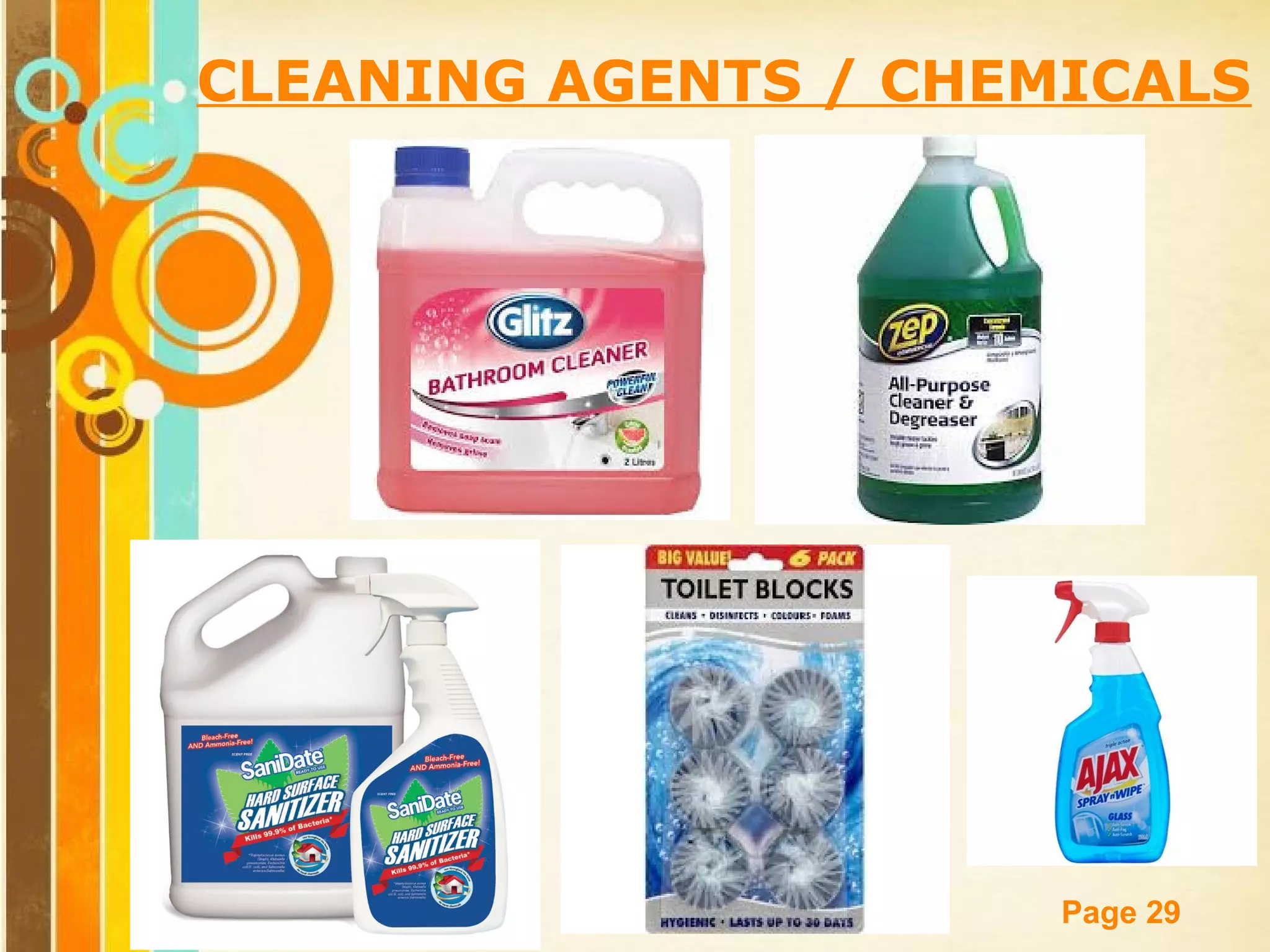
CLEANING AGENTS / CHEMICALS
 Apart from water and regular detergents, the housekeeping
staff also uses cleaning chemicals, which are often available in
the form of liquids, blocks, and powders.
 Water − It is the most commonly used medium for
cleaning and rinsing. Non-oily and non-greasy stains such
as ink stains can be removed using water.
 Bathroom Cleaners − They come in liquid form for easy
cleaning. They clean, descale, and disinfect the bathroom
walls, bathtubs, bathroom flooring, sinks, and showers.
They often contain phosphoric acid.
 Degreaser − This is mainly used in bars to remove the
marks of grease and lipstick that cannot be removed by
traditional washing of glasses and cups. Degreaser
restores the surface shine and transparency of the glasses
and bowls.
 Floor cleaner - Some areas in the hotel are busy and bear
heavy traffic such as lobby, corridors, parking areas,
restaurants, and dining halls. Their floorings loses
smoothness and shine. The floor cleaners and sealers are
used for restoring their look and shine.
Page 28
CLEANING AGENTS / CHEMICALS
 Surface Sanitizers − They often come in the form of
liquid concentrate. They are water-based and
sanitize the surfaces without damaging their
appearance. The sanitizers reduce the presence of
bacteria to a great extent.
 Toilet Blocks − They deodorize the toilets and leave
them with a fresh smell.
 Toilet Cleaners − They are available in liquid form
containing strong hydrochloric acid. They remove
stains and plumbing scales easily, and restore the
shine of their surface.
 Carpet cleaning chemicals are often low-moisture,
fast-drying cleaners that take care of the carpets.
 Glass cleaner – to clean mirror, glass window or
glass door.
Page 29
CLEANING AGENTS / CHEMICALS
Page 30
GUEST SUPPLIES
 Guest supplies include all items that are conducive
to the guest’s material comfort and convenience.
1. Guest amenities: all the luxury items that a
hotel provides to its guests at no extra cost.
2. Guest expendables: guest supplies that are
expected to be used up or taken away by guest
on leaving the property.
3. Guest essentials: items that are essential to the
guestroom but are not used up or expected to
be taken away by guests.
4. Guest loan items: Supplies that are not
normally found in the guestroom, but are
available to the guest on request.
Page 31
Page 32
Page 33
GUESTROOM LINEN
 Consists of bed and bath linen.
1.BED LINEN: includes all the launderable articles on
the bed.
• Pillowcases - a cloth cover for a pillow.
• Blankets - a large piece of material that keeps
the body warm.
• Duvet covers – made of cotton or blended
fabrics. Referred as comforters.
• Mattress protectors – to protect mattress from
stains and spills.
• Bedspreads - a decorative cloth used to cover a
bed.
• Dust ruffles – fabric skirting that extend around
the sides and foot of a bed.
• Bed sheets - rectangular piece of cloth, laid above the
mattress
Page 34
Page 35
GUESTROOM LINEN
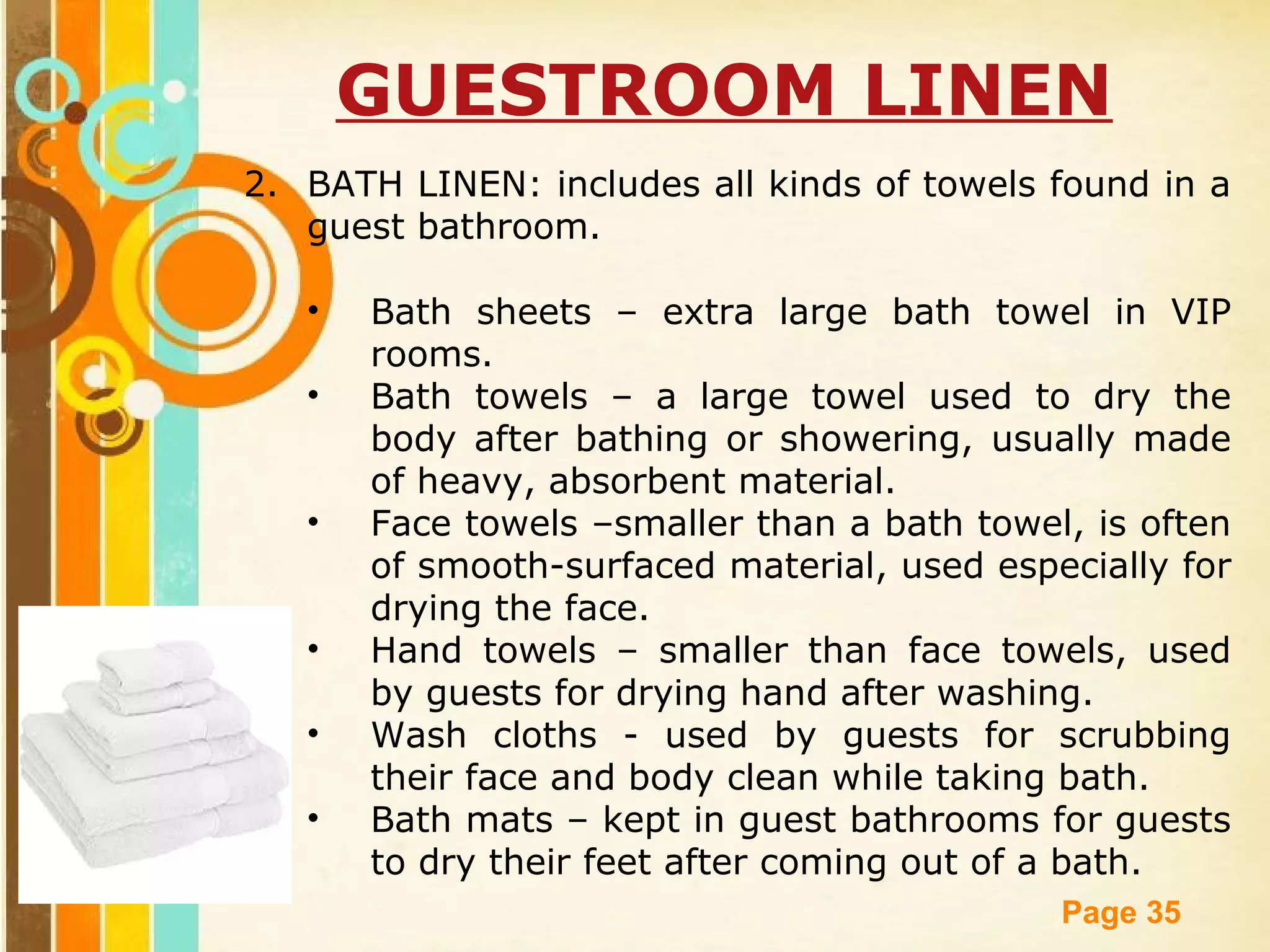
2. BATH LINEN: includes all kinds of towels found in a
guest bathroom.
• Bath sheets – extra large bath towel in VIP
rooms.
• Bath towels – a large towel used to dry the
body after bathing or showering, usually made
of heavy, absorbent material.
• Face towels –smaller than a bath towel, is often
of smooth-surfaced material, used especially for
drying the face.
• Hand towels – smaller than face towels, used
by guests for drying hand after washing.
• Wash cloths - used by guests for scrubbing
their face and body clean while taking bath.
• Bath mats – kept in guest bathrooms for guests
to dry their feet after coming out of a bath.
Page 36
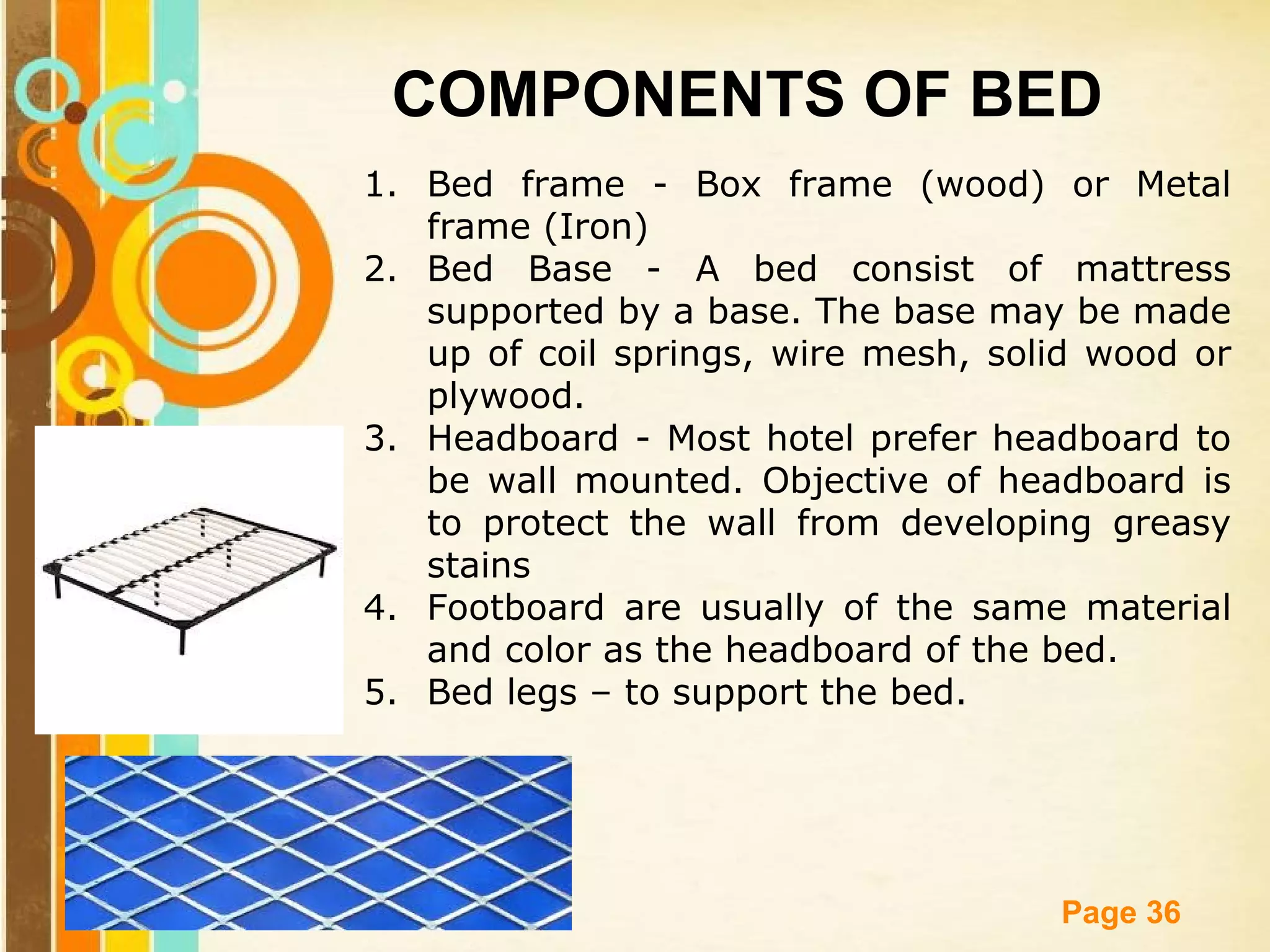
COMPONENTS OF BED
1. Bed frame - Box frame (wood) or Metal
frame (Iron)
2. Bed Base - A bed consist of mattress
supported by a base. The base may be made
up of coil springs, wire mesh, solid wood or
plywood.
3. Headboard - Most hotel prefer headboard to
be wall mounted. Objective of headboard is
to protect the wall from developing greasy
stains
4. Footboard are usually of the same material
and color as the headboard of the bed.
5. Bed legs – to support the bed.
Page 37
Page 38

HOUSEKEEPING OPERATION: HOUSEKEEPING INVENTORIES

  • 1.
  • 2.
    Page 2 INTRODUCTION  Housekeepinginventories refer to the stoks of purchased operating supplies, equipment and other items held for future use in housekeeping operations.  There are two types of housekeeping inventories: 1. Recycled inventories are for those items and pieces of equipment that have relatively limited useful lives but are used over and over again. Example: Cleaning equipment and other machines, linen, uniforms and guest loan items. 2. Non-recycled inventories include items that are used up during the course of routine housekeeping operations. Example: Cleaning supplies, cleaning agents and small piece of equipment.
  • 3.
    Page 3 CLEANING EQUIPMENT(BRUSHES)  Brushes are meant to remove dirt dry or wet from hard or soft surfaces. They may have bristles of animal, vegetable or man made origin.  It is of following types:  HARD BRUSHES: They have hard bristles used for removing heavy soil & litter from carpets and for cleaning hard and rough surfaces such as hard floor.  SOFT BRUSHES: They have soft and flexible bristles meant for removing loose soil from hard/smooth surfaces such as carpets and furnitures.
  • 4.
    Page 4  Brushesare classified on the basis of their functions: • Toilet brushes – for cleaning toilet bowl • Bottle brushes – for cleaning overflow vents in wash basins and tubs • Cloth brushes - for scrubbing clothes • Deck scrubbers – for cleaning large areas CLEANING EQUIPMENT (BRUSHES)
  • 5.
    Page 5 • Carpetbrushes – for brushing carpets • Upholstery brushes – to loosen out dust between the fabric fibres in upholstered chairs and sofas • Feather brushes – for light dusting • Hearth brush – for cleaning heavy soiling • Flue brush – for cleaning chimneys CLEANING EQUIPMENT (BRUSHES)
  • 6.
    Page 6 CLEANING EQUIPMENT(BROOMS)  Brooms consist of long bristles gathered together & inserted into a long handle. It is of following types:  SOFT BRISTLED BROOMS: They have soft bristles and are used on smooth floors.  HARD/COARSE BRISTLED BROOMS: Used on coarse surfaces especially outdoors.  WALL BROOMS: Also called as ceiling brooms or Turk’s head. They have a soft head & a long handle usually made of cane. They are used to remove cobwebs as well as dust from cornices, ceilings and high edges.  BOX SWEEPERS: Used for weeping up dust and litter from soft floor coverings such as rugs and carpets.
  • 7.
  • 8.
    Page 8 CLEANING EQUIPMENT(MOPS)  Mops are used in conjunction with buckets for the removal of dirt adhering to a surface.  DRY MOPS/MOP SWEEPER: consist of head made of twisted cotton yarn or synthetic yarns or synthetic fibers & attached to a long handle.  WET MOPS: Consist of long, coarser yarn meant for cleaning light soiled floors with a bucket, water & detergent.  POLISH APPLICATOR MOPS: Labeled for the type of polish used. The head is never washed but replaced.  SQUEEGEES: Meant to remove excess water from the floors. Smaller ones are meant to remove excess water from windows while cleaning windows.
  • 9.
  • 10.
    Page 10 CLEANING EQUIPMENT(CLOTHS)  Cloths used in wet and dry cleaning by housekeeping staff.  DUSTERS AND CLOTCH MITTENS: Used for dusting and buffing. Soft, absorbent and upto 15 sq cm. They must be sprayed with a fine mist of water or dusting solution.  SWABS AND WIPES: All purpose cloths made of soft, absorbent material. Used for cleaning sanitary fittings such as bathtub and wash basins.  FLOOR CLOTHS: Bigger, thicker and made of thick coarser cotton material. Used to remove spills from floors.  GLASS CLOTHS: Soft linen and do not leave behind lint. Used for wiping mirrors and drinking glasses.  RAGS AND POLISHING CLOTHS: Obtained from sewing room. Used for applying polish or strong
  • 11.
  • 12.
    Page 12 CLEANING EQUIPMENT(CONTAINER)  Work becomes easier and efficient with appropriate containers in which to carry, transport, collect and store supplies and other items.  HAND CADDIES: a box with a handle and a fitted tray. Used by RA for carrying cleaning supplies for guestroom cleaning.  JANITOR’S TROLLEY: Used during the cleaning of public area. Includes a detachable trash bag and a place for storing cleaning agents and small piece of cleaning equipment.  MOP-WRINGER TROLLEY: Consists of a mop and one or twin buckets with an attached wringer, all mounted on a trolley with caster-wheels.  MAID’S CART/ROOM ATTENDANT’S CART/TROLLEY: It is like a giant tool box, stocked with everything necessary to service a guestroom effectively. Heavier linens must be placed on the lowermost shelf and the smaller, lighter ones in the top shelf.
  • 13.
  • 14.
  • 15.
    Page 15 CLEANING MECHANICALEQUIPMENT (VACUUM)  Vacuum cleaners remove debris, soil and water from a surface by suction.  BACKPACK VACUUM: For cleaning high, hard to reach areas such as curtains, ceiling corners and also used for cleaning staircase too. This vacuum can be easily strapped to the back of the operator.  UPRIGHT VACUUM: The main body lies horizontal on the floor, used rotating brushes and is driven by a single motor. Most suitable for use on a large carpeted areas.  CYLINDRICAL VACCUM: Have no rotating brushes and work by suction only. A flexible hose along with different attachments is used to clean a variety of surface.  CENTRALIZED VACUUM CLEANER: Suction is generated at one point in the building. Soiling can be removed at vacuum points elsewhere in the building by suitable nozzles linked to detachable flexible hoses. The collected dirt is then conveyed by a network pipes to a central container.  WET AND DRY VACUUM: Can pick up spills and water excess when on the wet mode. Help in removal of dust and debris on the dry mode.
  • 16.
    Page 16 CLEANING MECHANICALEQUIPMET (VACUUM)
  • 17.
    Page 17 CLEANING MECHANICAL EQUIPMENT(SCRUBBER) It is a floor care accessory that comes with handheld electrically operated scrubber. It is used where only mopping doesn’t suffice. It can scrub stubborn and sticky stains on the floors of cafeterias, restaurants, lobbies, and fitness areas where people can take food and beverages.
  • 18.
    Page 18 CLEANING MECHANICAL EQUIPMENT(POLISHER) They are used to add a shine to the floors of most frequented areas of the hotel.
  • 19.
    Page 19 CLEANING MECHANICALEQUIPMENT (HIGH PRESSURE WASHERS) It is designed to remove soilage by subjecting the surface to water, steam or sand under pressure. Water under high pressure physically dislodges the dust. The process can be assisted by the use of hot water, steam or sand.
  • 20.
    Page 20 CLEANING MECHANICALEQUIPMENT (SCARIFYING MACHINES) They are meant to remove heavy grease, mud & thick deposits from the surface. This is used when simple scrubbing machine is not effective. Here dirt deposits are broken by the chisel like action of a wire brush cutting tool.
  • 21.
    Page 21 Factors toconsider in selecting cleaning equipment • Safety in operation • Suitability to the type of area, surface, work, amount of obstruction • Versatility to undertake various types of cleaning • Work performance in terms of capacity of machine • Ease of handling in terms of size, weight & height of the machine
  • 22.
    Page 22 Factors toconsider in selecting cleaning equipment • Portability in terms of ease of transfer between floors • Durability • Noise level • Availability of spare parts • Protective design • Ease of storage • Cost as sum of initial costs (not too expensive)
  • 23.
    Page 23 General careof electrical cleaning equipment • Machine using water has a float valve which automatically cuts off the motor • Have equipment serviced regularly by qualified electricians • Use only with dry hand • Report damage immediately • Always use the nearest socket • Switch off wall socket when not being used • Use extension leads only in an emergency • Replace broken plugs • Use correct size fuses • Never overload the socket
  • 24.
    Page 24 MAINTENANCE • Whento use equipment • How to use equipment • How to clean each item • Where to clean equipment • How often to attend to equipment • How to obtain assistance if required • Where to obtain supplies of spare parts
  • 25.
    Page 25 SUPERVISION • Adequatetraining of all staff • Effective supervision of all staff • Use work method & instruction charts for all staff, to ensure safe working practice • Check plug regularly • Never allow appliances to come into direct contact with water • Ensure that all equipment is cleaned & properly stored after use.
  • 26.
    Page 26 EQUIPMENT STORAGE •Storeroom should: – Clean & have adequate space – Near to working area – Equipment should be coded – Must have store keeper – Adequate shelving & hooks – Store should be well ventilated
  • 27.
    Page 27 CLEANING AGENTS/ CHEMICALS  Apart from water and regular detergents, the housekeeping staff also uses cleaning chemicals, which are often available in the form of liquids, blocks, and powders.  Water − It is the most commonly used medium for cleaning and rinsing. Non-oily and non-greasy stains such as ink stains can be removed using water.  Bathroom Cleaners − They come in liquid form for easy cleaning. They clean, descale, and disinfect the bathroom walls, bathtubs, bathroom flooring, sinks, and showers. They often contain phosphoric acid.  Degreaser − This is mainly used in bars to remove the marks of grease and lipstick that cannot be removed by traditional washing of glasses and cups. Degreaser restores the surface shine and transparency of the glasses and bowls.  Floor cleaner - Some areas in the hotel are busy and bear heavy traffic such as lobby, corridors, parking areas, restaurants, and dining halls. Their floorings loses smoothness and shine. The floor cleaners and sealers are used for restoring their look and shine.
  • 28.
    Page 28 CLEANING AGENTS/ CHEMICALS  Surface Sanitizers − They often come in the form of liquid concentrate. They are water-based and sanitize the surfaces without damaging their appearance. The sanitizers reduce the presence of bacteria to a great extent.  Toilet Blocks − They deodorize the toilets and leave them with a fresh smell.  Toilet Cleaners − They are available in liquid form containing strong hydrochloric acid. They remove stains and plumbing scales easily, and restore the shine of their surface.  Carpet cleaning chemicals are often low-moisture, fast-drying cleaners that take care of the carpets.  Glass cleaner – to clean mirror, glass window or glass door.
  • 29.
  • 30.
    Page 30 GUEST SUPPLIES Guest supplies include all items that are conducive to the guest’s material comfort and convenience. 1. Guest amenities: all the luxury items that a hotel provides to its guests at no extra cost. 2. Guest expendables: guest supplies that are expected to be used up or taken away by guest on leaving the property. 3. Guest essentials: items that are essential to the guestroom but are not used up or expected to be taken away by guests. 4. Guest loan items: Supplies that are not normally found in the guestroom, but are available to the guest on request.
  • 31.
  • 32.
  • 33.
    Page 33 GUESTROOM LINEN Consists of bed and bath linen. 1.BED LINEN: includes all the launderable articles on the bed. • Pillowcases - a cloth cover for a pillow. • Blankets - a large piece of material that keeps the body warm. • Duvet covers – made of cotton or blended fabrics. Referred as comforters. • Mattress protectors – to protect mattress from stains and spills. • Bedspreads - a decorative cloth used to cover a bed. • Dust ruffles – fabric skirting that extend around the sides and foot of a bed. • Bed sheets - rectangular piece of cloth, laid above the mattress
  • 34.
  • 35.
    Page 35 GUESTROOM LINEN 2.BATH LINEN: includes all kinds of towels found in a guest bathroom. • Bath sheets – extra large bath towel in VIP rooms. • Bath towels – a large towel used to dry the body after bathing or showering, usually made of heavy, absorbent material. • Face towels –smaller than a bath towel, is often of smooth-surfaced material, used especially for drying the face. • Hand towels – smaller than face towels, used by guests for drying hand after washing. • Wash cloths - used by guests for scrubbing their face and body clean while taking bath. • Bath mats – kept in guest bathrooms for guests to dry their feet after coming out of a bath.
  • 36.
    Page 36 COMPONENTS OFBED 1. Bed frame - Box frame (wood) or Metal frame (Iron) 2. Bed Base - A bed consist of mattress supported by a base. The base may be made up of coil springs, wire mesh, solid wood or plywood. 3. Headboard - Most hotel prefer headboard to be wall mounted. Objective of headboard is to protect the wall from developing greasy stains 4. Footboard are usually of the same material and color as the headboard of the bed. 5. Bed legs – to support the bed.
  • 37.
  • 38.

Editor's Notes

  • #4 Chimneys - pipe which conducts smoke and combustion gases up from a fire or furnace and typically through the roof of a building (cerobong asap)
  • #6 Red brush – upholstery soft brush for sofea Black brush – flue brush Chimneys - pipe which conducts smoke and combustion gases up from a fire or furnace and typically through the roof of a building (cerobong asap)
  • #7 Rugs - a floor covering of thick woven material or animal skin Cane - the hollow jointed stem of a tall grass, especially bamboo or sugar cane
  • #9 Adhering – stick (melekat) SQUEEGEES – functioning like wiper