Hospital
Statistics
Dr Htin Zaw Soe
MBBS, DFT, MMedSc
(P&TM), PhD, DipMedEd
Associate Professor, Biostatistics
Dept, University of Public Health,
Yangon
Hospital
 An institution providing medical and surgical
treatment and nursing care for sick or injured people
(Oxford Dictionary)
 An institution that provides medical, surgical, or
psychiatric care and treatment for the sick or the
injured
(Online Dictionary)
Statistics
 A field of study concerned with (1) the collection,
organization, summarization and analysis of data; and
(2) drawing of inferences about a body of data when only
a part of the data is observed.
 The science of collecting, organizing, presenting,
analyzing, and interpreting data to assist in making more
effective decisions.
Etymology of statistics
 New Latin: Statisticum collegium (Council of State)
 Italy : Statista (Stateman or Politician)
 German : Statistik (Analysis of data about the State/
State Science)
 English : Political arithmetic (‘Statistical Account of
Scotland’ published in 1791)
Statistics is the systematic collection of demographic
and economic data by the states.
Hospital Statistics
 are derived from numerical data collected in the context
of hospital system
 also called health service utilization rates
 as important as vital registrations and notifications of
infectious diseases
 constitute a basic and primary source of information
about diseases prevalent in community
 necessary to plan and control efficient patient
care and efficiently manage the hospital
 also an integral and basic part of the national statistical
program
Provides information on:
 Geographic sources of patients
 Age and sex distribution of different diseases
 Duration of hospital stay
 Distribution of diagnosis
 Association between different diseases
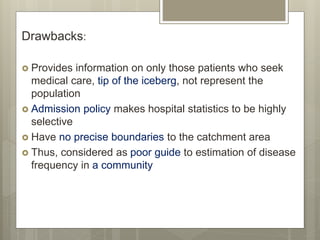
Drawbacks:
 Provides information on only those patients who seek
medical care, tip of the iceberg, not represent the
population
 Admission policy makes hospital statistics to be highly
selective
 Have no precise boundaries to the catchment area
 Thus, considered as poor guide to estimation of disease
frequency in a community
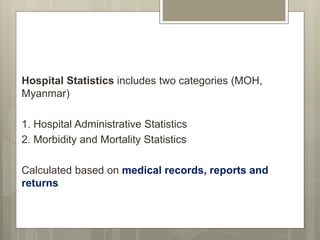
Hospital Statistics includes two categories (MOH,
Myanmar)
1. Hospital Administrative Statistics
2. Morbidity and Mortality Statistics
Calculated based on medical records, reports and
returns
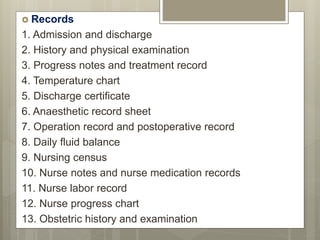
 Records
1. Admission and discharge
2. History and physical examination
3. Progress notes and treatment record
4. Temperature chart
5. Discharge certificate
6. Anaesthetic record sheet
7. Operation record and postoperative record
8. Daily fluid balance
9. Nursing census
10. Nurse notes and nurse medication records
11. Nurse labor record
12. Nurse progress chart
13. Obstetric history and examination
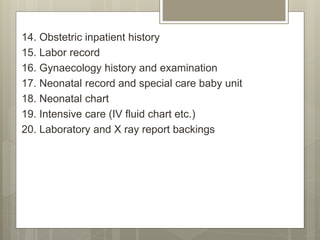
14. Obstetric inpatient history
15. Labor record
16. Gynaecology history and examination
17. Neonatal record and special care baby unit
18. Neonatal chart
19. Intensive care (IV fluid chart etc.)
20. Laboratory and X ray report backings
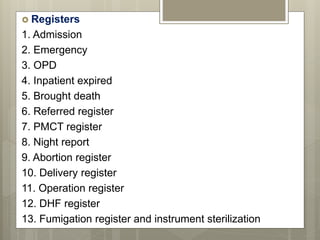
 Registers
1. Admission
2. Emergency
3. OPD
4. Inpatient expired
5. Brought death
6. Referred register
7. PMCT register
8. Night report
9. Abortion register
10. Delivery register
11. Operation register
12. DHF register
13. Fumigation register and instrument sterilization
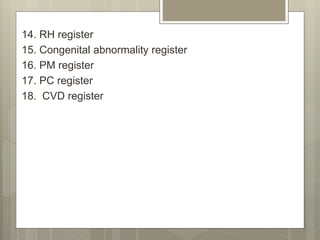
14. RH register
15. Congenital abnormality register
16. PM register
17. PC register
18. CVD register
 Hospital report forms
1. Form I [Monthly hospital return (administrative)]
2. Form II (Monthly general inpatient summary)
3. Form III [Hospital daily record (inpatient)]
4. Outpatient report form
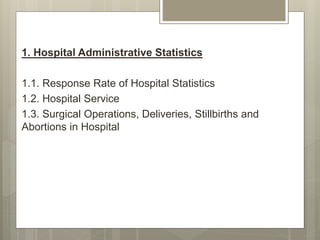
1. Hospital Administrative Statistics
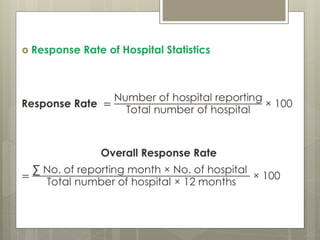
1.1. Response Rate of Hospital Statistics
1.2. Hospital Service
1.3. Surgical Operations, Deliveries, Stillbirths and
Abortions in Hospital
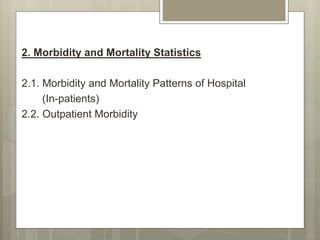
2. Morbidity and Mortality Statistics
2.1. Morbidity and Mortality Patterns of Hospital
(In-patients)
2.2. Outpatient Morbidity
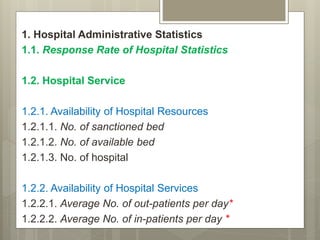
1. Hospital Administrative Statistics
1.1. Response Rate of Hospital Statistics
1.2. Hospital Service
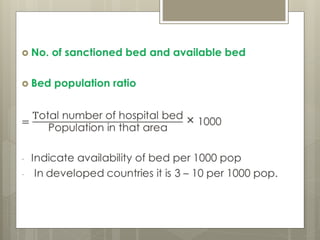
1.2.1. Availability of Hospital Resources
1.2.1.1. No. of sanctioned bed
1.2.1.2. No. of available bed
1.2.1.3. No. of hospital
1.2.2. Availability of Hospital Services
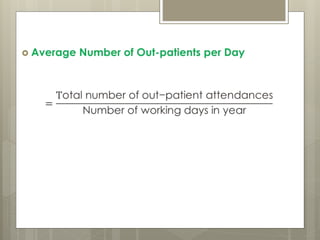
1.2.2.1. Average No. of out-patients per day*
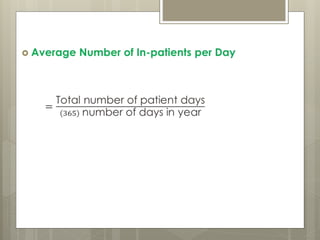
1.2.2.2. Average No. of in-patients per day *
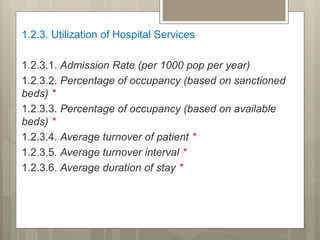
1.2.3. Utilization of Hospital Services
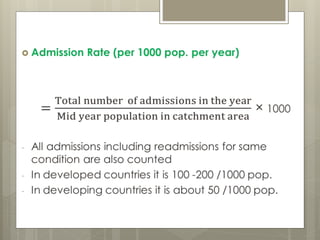
1.2.3.1. Admission Rate (per 1000 pop per year)
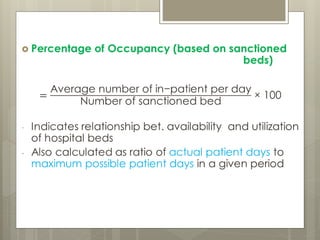
1.2.3.2. Percentage of occupancy (based on sanctioned
beds) *
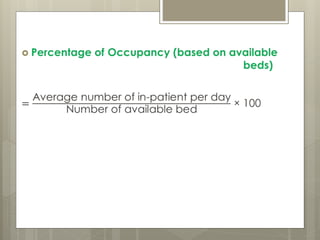
1.2.3.3. Percentage of occupancy (based on available
beds) *
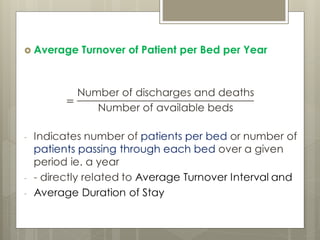
1.2.3.4. Average turnover of patient *
1.2.3.5. Average turnover interval *
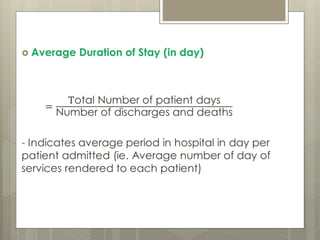
1.2.3.6. Average duration of stay *
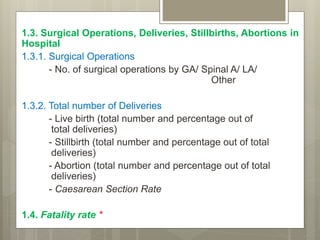
1.3. Surgical Operations, Deliveries, Stillbirths, Abortions in
Hospital
1.3.1. Surgical Operations
- No. of surgical operations by GA/ Spinal A/ LA/
Other
1.3.2. Total number of Deliveries
- Live birth (total number and percentage out of
total deliveries)
- Stillbirth (total number and percentage out of total
deliveries)
- Abortion (total number and percentage out of total
deliveries)
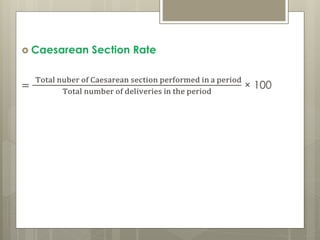
- Caesarean Section Rate
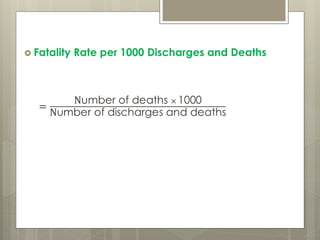
1.4. Fatality rate *
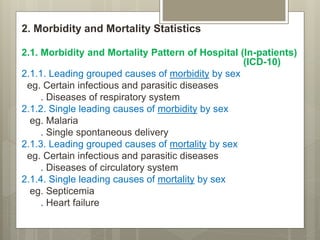
2. Morbidity and Mortality Statistics
2.1. Morbidity and Mortality Pattern of Hospital (In-patients)
(ICD-10)
2.1.1. Leading grouped causes of morbidity by sex
eg. Certain infectious and parasitic diseases
. Diseases of respiratory system
2.1.2. Single leading causes of morbidity by sex
eg. Malaria
. Single spontaneous delivery
2.1.3. Leading grouped causes of mortality by sex
eg. Certain infectious and parasitic diseases
. Diseases of circulatory system
2.1.4. Single leading causes of mortality by sex
eg. Septicemia
. Heart failure
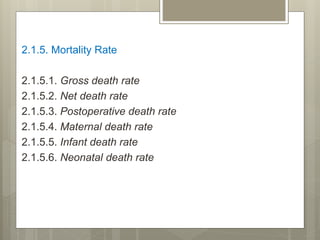
2.1.5. Mortality Rate
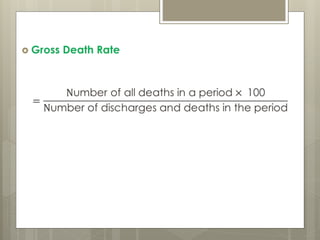
2.1.5.1. Gross death rate
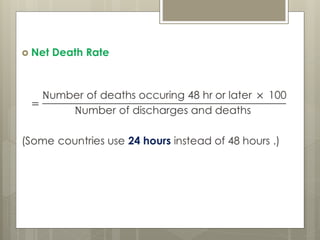
2.1.5.2. Net death rate
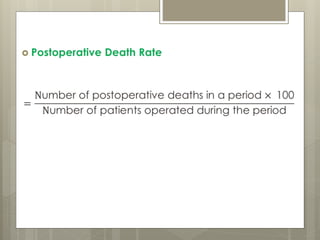
2.1.5.3. Postoperative death rate
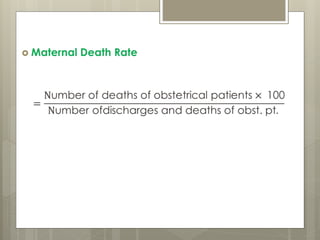
2.1.5.4. Maternal death rate
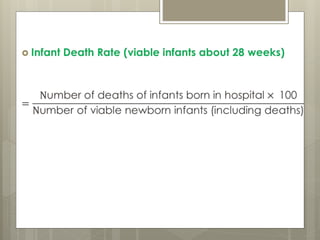
2.1.5.5. Infant death rate
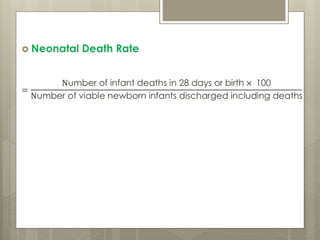
2.1.5.6. Neonatal death rate
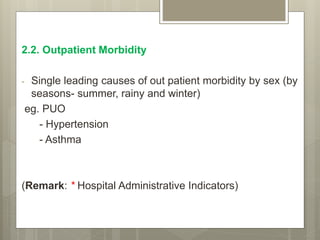
2.2. Outpatient Morbidity
- Single leading causes of out patient morbidity by sex (by
seasons- summer, rainy and winter)
eg. PUO
- Hypertension
- Asthma
(Remark: * Hospital Administrative Indicators)
Some required data to calculate Hospital Statistics
1. Population (in catchment area)
2. Total No. of hospital
3. Sanctioned bed
4. Available bed
5. Out patient attendance
6. Admission
7. Discharge
8. Death
9. Patient day [The unit of measure which denotes
in days the service given to in-patient(s)]
(ie. Patient × day)
 Example:
- In a 300 bedded hospital, potential hospitalization days in
a year are 300 × 365 = 109,500
- If actual totaled-up hospitalization days are 98,200 and
number of discharges including deaths in that year are
5,680
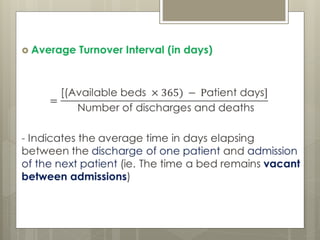
 Average Turnover Interval
=
[(Available beds × 365) − Patient days]
Number of discharges and deaths
=
109500 − 98200
5680
= 1.989 days
It means each bed remained vacant for 2 days in that year
bet. one discharge and next admission.
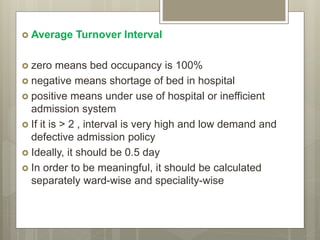
 Average Turnover Interval
 zero means bed occupancy is 100%
 negative means shortage of bed in hospital
 positive means under use of hospital or inefficient
admission system
 If it is > 2 , interval is very high and low demand and
defective admission policy
 Ideally, it should be 0.5 day
 In order to be meaningful, it should be calculated
separately ward-wise and speciality-wise
References cited
 Daniel WW 2005, Biostatistics. Foundation for analysis
in the health sciences
 DHP(MOH) 2007, Annual Hospital Statistics Report
 Getu Degu, Fasil Tessema 2005, Lecture notes on
biostatistics, University of Gondar.
 K. Park 2009, Park’s textbook of preventive and social
medicine, Jabalpur, India.
 Richard A .Johnson 2006, Statistics principles and
methods 6th edition, United States of America.
THE END

Hosp stat

  • 1.
    Hospital Statistics Dr Htin ZawSoe MBBS, DFT, MMedSc (P&TM), PhD, DipMedEd Associate Professor, Biostatistics Dept, University of Public Health, Yangon
  • 2.
    Hospital  An institutionproviding medical and surgical treatment and nursing care for sick or injured people (Oxford Dictionary)  An institution that provides medical, surgical, or psychiatric care and treatment for the sick or the injured (Online Dictionary)
  • 3.
    Statistics  A fieldof study concerned with (1) the collection, organization, summarization and analysis of data; and (2) drawing of inferences about a body of data when only a part of the data is observed.  The science of collecting, organizing, presenting, analyzing, and interpreting data to assist in making more effective decisions.
  • 4.
    Etymology of statistics New Latin: Statisticum collegium (Council of State)  Italy : Statista (Stateman or Politician)  German : Statistik (Analysis of data about the State/ State Science)  English : Political arithmetic (‘Statistical Account of Scotland’ published in 1791) Statistics is the systematic collection of demographic and economic data by the states.
  • 5.
    Hospital Statistics  arederived from numerical data collected in the context of hospital system  also called health service utilization rates  as important as vital registrations and notifications of infectious diseases
  • 6.
     constitute abasic and primary source of information about diseases prevalent in community  necessary to plan and control efficient patient care and efficiently manage the hospital  also an integral and basic part of the national statistical program
  • 7.
    Provides information on: Geographic sources of patients  Age and sex distribution of different diseases  Duration of hospital stay  Distribution of diagnosis  Association between different diseases
  • 8.
    Drawbacks:  Provides informationon only those patients who seek medical care, tip of the iceberg, not represent the population  Admission policy makes hospital statistics to be highly selective  Have no precise boundaries to the catchment area  Thus, considered as poor guide to estimation of disease frequency in a community
  • 9.
    Hospital Statistics includestwo categories (MOH, Myanmar) 1. Hospital Administrative Statistics 2. Morbidity and Mortality Statistics Calculated based on medical records, reports and returns
  • 10.
     Records 1. Admissionand discharge 2. History and physical examination 3. Progress notes and treatment record 4. Temperature chart 5. Discharge certificate 6. Anaesthetic record sheet 7. Operation record and postoperative record 8. Daily fluid balance 9. Nursing census 10. Nurse notes and nurse medication records 11. Nurse labor record 12. Nurse progress chart 13. Obstetric history and examination
  • 11.
    14. Obstetric inpatienthistory 15. Labor record 16. Gynaecology history and examination 17. Neonatal record and special care baby unit 18. Neonatal chart 19. Intensive care (IV fluid chart etc.) 20. Laboratory and X ray report backings
  • 12.
     Registers 1. Admission 2.Emergency 3. OPD 4. Inpatient expired 5. Brought death 6. Referred register 7. PMCT register 8. Night report 9. Abortion register 10. Delivery register 11. Operation register 12. DHF register 13. Fumigation register and instrument sterilization
  • 13.
    14. RH register 15.Congenital abnormality register 16. PM register 17. PC register 18. CVD register
  • 14.
     Hospital reportforms 1. Form I [Monthly hospital return (administrative)] 2. Form II (Monthly general inpatient summary) 3. Form III [Hospital daily record (inpatient)] 4. Outpatient report form
  • 15.
    1. Hospital AdministrativeStatistics 1.1. Response Rate of Hospital Statistics 1.2. Hospital Service 1.3. Surgical Operations, Deliveries, Stillbirths and Abortions in Hospital
  • 16.
    2. Morbidity andMortality Statistics 2.1. Morbidity and Mortality Patterns of Hospital (In-patients) 2.2. Outpatient Morbidity
  • 17.
    1. Hospital AdministrativeStatistics 1.1. Response Rate of Hospital Statistics 1.2. Hospital Service 1.2.1. Availability of Hospital Resources 1.2.1.1. No. of sanctioned bed 1.2.1.2. No. of available bed 1.2.1.3. No. of hospital 1.2.2. Availability of Hospital Services 1.2.2.1. Average No. of out-patients per day* 1.2.2.2. Average No. of in-patients per day *
  • 18.
    1.2.3. Utilization ofHospital Services 1.2.3.1. Admission Rate (per 1000 pop per year) 1.2.3.2. Percentage of occupancy (based on sanctioned beds) * 1.2.3.3. Percentage of occupancy (based on available beds) * 1.2.3.4. Average turnover of patient * 1.2.3.5. Average turnover interval * 1.2.3.6. Average duration of stay *
  • 19.
    1.3. Surgical Operations,Deliveries, Stillbirths, Abortions in Hospital 1.3.1. Surgical Operations - No. of surgical operations by GA/ Spinal A/ LA/ Other 1.3.2. Total number of Deliveries - Live birth (total number and percentage out of total deliveries) - Stillbirth (total number and percentage out of total deliveries) - Abortion (total number and percentage out of total deliveries) - Caesarean Section Rate 1.4. Fatality rate *
  • 20.
    2. Morbidity andMortality Statistics 2.1. Morbidity and Mortality Pattern of Hospital (In-patients) (ICD-10) 2.1.1. Leading grouped causes of morbidity by sex eg. Certain infectious and parasitic diseases . Diseases of respiratory system 2.1.2. Single leading causes of morbidity by sex eg. Malaria . Single spontaneous delivery 2.1.3. Leading grouped causes of mortality by sex eg. Certain infectious and parasitic diseases . Diseases of circulatory system 2.1.4. Single leading causes of mortality by sex eg. Septicemia . Heart failure
  • 21.
    2.1.5. Mortality Rate 2.1.5.1.Gross death rate 2.1.5.2. Net death rate 2.1.5.3. Postoperative death rate 2.1.5.4. Maternal death rate 2.1.5.5. Infant death rate 2.1.5.6. Neonatal death rate
  • 22.
    2.2. Outpatient Morbidity -Single leading causes of out patient morbidity by sex (by seasons- summer, rainy and winter) eg. PUO - Hypertension - Asthma (Remark: * Hospital Administrative Indicators)
  • 23.
    Some required datato calculate Hospital Statistics 1. Population (in catchment area) 2. Total No. of hospital 3. Sanctioned bed 4. Available bed 5. Out patient attendance 6. Admission 7. Discharge 8. Death 9. Patient day [The unit of measure which denotes in days the service given to in-patient(s)] (ie. Patient × day)
  • 33.
     Example: - Ina 300 bedded hospital, potential hospitalization days in a year are 300 × 365 = 109,500 - If actual totaled-up hospitalization days are 98,200 and number of discharges including deaths in that year are 5,680  Average Turnover Interval = [(Available beds × 365) − Patient days] Number of discharges and deaths = 109500 − 98200 5680 = 1.989 days It means each bed remained vacant for 2 days in that year bet. one discharge and next admission.
  • 34.
     Average TurnoverInterval  zero means bed occupancy is 100%  negative means shortage of bed in hospital  positive means under use of hospital or inefficient admission system  If it is > 2 , interval is very high and low demand and defective admission policy  Ideally, it should be 0.5 day  In order to be meaningful, it should be calculated separately ward-wise and speciality-wise
  • 44.
    References cited  DanielWW 2005, Biostatistics. Foundation for analysis in the health sciences  DHP(MOH) 2007, Annual Hospital Statistics Report  Getu Degu, Fasil Tessema 2005, Lecture notes on biostatistics, University of Gondar.  K. Park 2009, Park’s textbook of preventive and social medicine, Jabalpur, India.  Richard A .Johnson 2006, Statistics principles and methods 6th edition, United States of America.
  • 45.