





MEDICAL RECORDS
Professor S. A. Tabish
Definition
• An orderly written document
encompassing the patient’s
identification data, health history,
physical examination findings, the
surgical procedures, and hospital
course.
• When complete it should contain
sufficient data to justify the
investigation, diagnosis, treatment,
length of hospital stay, result of care,
future course of action.
Benefits to Patient
• Document the story of patient
• Avoids repetition of diagnosis &
treatment
• Assists in the continuity of care in
the event of future illness
• Serves an evidence to support or
to refute the legal questions that
arise
Benefits to Hospital
• Provides the management with
statistical information necessary for
decision making regarding the
utilization of resources
• Furnishes documentary evidence for
purposes of evaluation of hospital care
in terms of quantity, quality and
adequacy (medical audit)
• Protects the hospital in the event of
legal action
Benefits to Pub Health Authorities
• Gives morbidity & mortality
statistics
• Helps PH Authorities to plan
the prevention and social
measures to meet the needs of
the community
Medical Education & Research
• Since recorded observations and
case-studies are the basis of all
clinical research, medical records
become invaluable in all research
and teaching programs
Characteristics of Good MR
• Complete: sufficient data to
identify the patient, justify
diagnosis and warrant treatment
and outcome
• Adequate: all necessary forms
and all relevant clinical information
• Accurate: capable of quantitative
analysis
Functions
•Outpatient
•Inpatient (MR Library)
•Accident & Emergency
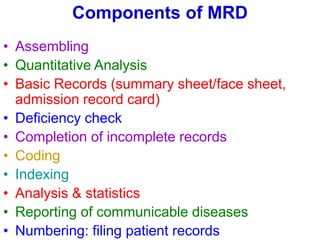
Components of MRD
• Assembling
• Quantitative Analysis
• Basic Records (summary sheet/face sheet,
admission record card)
• Deficiency check
• Completion of incomplete records
• Coding
• Indexing
• Analysis & statistics
• Reporting of communicable diseases
• Numbering: filing patient records
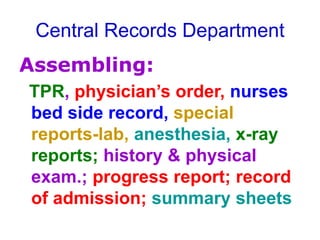
Central Records Department
Assembling:
TPR, physician’s order, nurses
bed side record, special
reports-lab, anesthesia, x-ray
reports; history & physical
exam.; progress report; record
of admission; summary sheets
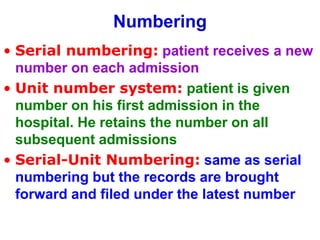
Numbering
• Serial numbering: patient receives a new
number on each admission
• Unit number system: patient is given
number on his first admission in the
hospital. He retains the number on all
subsequent admissions
• Serial-Unit Numbering: same as serial
numbering but the records are brought
forward and filed under the latest number
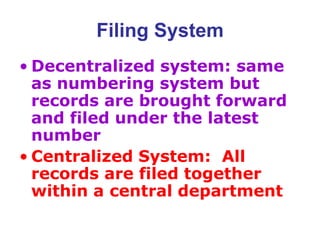
Filing System
• Decentralized system: same
as numbering system but
records are brought forward
and filed under the latest
number
• Centralized System: All
records are filed together
within a central department
Methods of filing
• Horizontal: papers are inserted in
the files or folders and the
folders are kept in horizontal
position, one upon the other
• Vertical filing: files are placed
vertically or in a standing upright
position. It facilitates ready
reference, economical, scope for
expansion
Storage
How long MR will be preserved:
Inpatient: upto 10 years
Outpatient: upto 5 years
Medicolegal: upto 10 years
Ownership of MR
•MR is the property of the
hospital and not of the
patient, the clinical
department or the
attending doctor
Electronic MR
• Decreased paper work
• Save time and effort
• Reduce costs
• Increase accuracy and
completeness
• Improve quality
• Improve management of care
• Disadvantage: security & privacy
problems
Electronic MR
• Stored in digital format
• Can be seen and used in more
than one locations at a time
• Can be replicated
• Can be processed
automatically
Smart Cards
• With features like smart cards and
hot-disking, appliances allow
Hospital employees to work in new
ways.
• Users insert credit card-size smart
cards into the Appliances' built-in
card readers to log in to the system,
providing strong security without the
need to memorize passwords.
Smart Card
• Doctors and nurses use smart
cards to obtain information from
thin clients located by patients'
bedsides
• Smart cards can also be used as
ID badges, or with barcode
technology for purchasing.
T H A N K Y O U
V e r y m u c h

MEDICAL RECORDS.ppt

  • 1.
  • 2.
    Definition • An orderlywritten document encompassing the patient’s identification data, health history, physical examination findings, the surgical procedures, and hospital course. • When complete it should contain sufficient data to justify the investigation, diagnosis, treatment, length of hospital stay, result of care, future course of action.
  • 3.
    Benefits to Patient •Document the story of patient • Avoids repetition of diagnosis & treatment • Assists in the continuity of care in the event of future illness • Serves an evidence to support or to refute the legal questions that arise
  • 4.
    Benefits to Hospital •Provides the management with statistical information necessary for decision making regarding the utilization of resources • Furnishes documentary evidence for purposes of evaluation of hospital care in terms of quantity, quality and adequacy (medical audit) • Protects the hospital in the event of legal action
  • 5.
    Benefits to PubHealth Authorities • Gives morbidity & mortality statistics • Helps PH Authorities to plan the prevention and social measures to meet the needs of the community
  • 6.
    Medical Education &Research • Since recorded observations and case-studies are the basis of all clinical research, medical records become invaluable in all research and teaching programs
  • 7.
    Characteristics of GoodMR • Complete: sufficient data to identify the patient, justify diagnosis and warrant treatment and outcome • Adequate: all necessary forms and all relevant clinical information • Accurate: capable of quantitative analysis
  • 8.
  • 9.
    Components of MRD •Assembling • Quantitative Analysis • Basic Records (summary sheet/face sheet, admission record card) • Deficiency check • Completion of incomplete records • Coding • Indexing • Analysis & statistics • Reporting of communicable diseases • Numbering: filing patient records
  • 10.
    Central Records Department Assembling: TPR,physician’s order, nurses bed side record, special reports-lab, anesthesia, x-ray reports; history & physical exam.; progress report; record of admission; summary sheets
  • 11.
    Numbering • Serial numbering:patient receives a new number on each admission • Unit number system: patient is given number on his first admission in the hospital. He retains the number on all subsequent admissions • Serial-Unit Numbering: same as serial numbering but the records are brought forward and filed under the latest number
  • 12.
    Filing System • Decentralizedsystem: same as numbering system but records are brought forward and filed under the latest number • Centralized System: All records are filed together within a central department
  • 13.
    Methods of filing •Horizontal: papers are inserted in the files or folders and the folders are kept in horizontal position, one upon the other • Vertical filing: files are placed vertically or in a standing upright position. It facilitates ready reference, economical, scope for expansion
  • 14.
    Storage How long MRwill be preserved: Inpatient: upto 10 years Outpatient: upto 5 years Medicolegal: upto 10 years
  • 15.
    Ownership of MR •MRis the property of the hospital and not of the patient, the clinical department or the attending doctor
  • 16.
    Electronic MR • Decreasedpaper work • Save time and effort • Reduce costs • Increase accuracy and completeness • Improve quality • Improve management of care • Disadvantage: security & privacy problems
  • 17.
    Electronic MR • Storedin digital format • Can be seen and used in more than one locations at a time • Can be replicated • Can be processed automatically
  • 18.
    Smart Cards • Withfeatures like smart cards and hot-disking, appliances allow Hospital employees to work in new ways. • Users insert credit card-size smart cards into the Appliances' built-in card readers to log in to the system, providing strong security without the need to memorize passwords.
  • 19.
    Smart Card • Doctorsand nurses use smart cards to obtain information from thin clients located by patients' bedsides • Smart cards can also be used as ID badges, or with barcode technology for purchasing.
  • 20.
    T H AN K Y O U V e r y m u c h