General information of Horse and its
Management
Presented by
Dr. Ravikant Nirala
Assistant Professor
Livestock Production Management
Bihar Veterinary College, Patna - 14
Kingdom: Animalia
Phylum: Chordata
Class: Mammalia
Order: Perissodactyla
Family: Equidae
Genus: Equus
Species: Equus caballus (Horse)
Equus asinus (Ass)
 The horse has evolved over the past 45 to 55 million years
from a small multi-toed creature, Eohippus, into the large,
single-toed animal of today.
 It is an odd toed ungulate mammals.
Position of horse in Animal kingdom
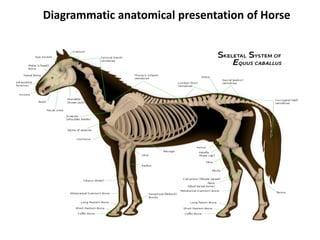
Diagrammatic anatomical presentation of Horse
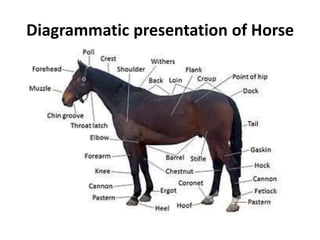
Diagrammatic presentation of Horse
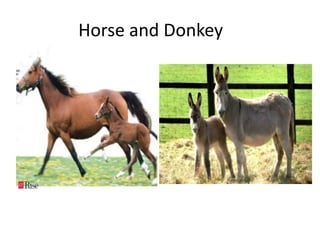
Horse and Donkey
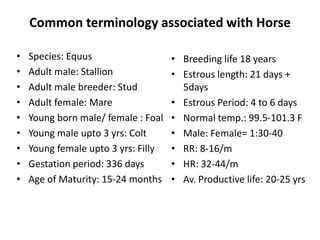
Common terminology associated with Horse
• Species: Equus
• Adult male: Stallion
• Adult male breeder: Stud
• Adult female: Mare
• Young born male/ female : Foal
• Young male upto 3 yrs: Colt
• Young female upto 3 yrs: Filly
• Gestation period: 336 days
• Age of Maturity: 15-24 months
• Breeding life 18 years
• Estrous length: 21 days +
5days
• Estrous Period: 4 to 6 days
• Normal temp.: 99.5-101.3 F
• Male: Female= 1:30-40
• RR: 8-16/m
• HR: 32-44/m
• Av. Productive life: 20-25 yrs
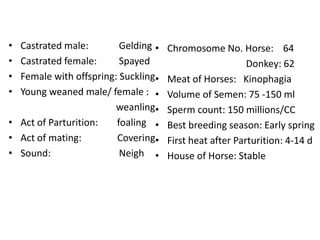
• Castrated male: Gelding
• Castrated female: Spayed
• Female with offspring: Suckling
• Young weaned male/ female :
weanling
• Act of Parturition: foaling
• Act of mating: Covering
• Sound: Neigh
• Chromosome No. Horse: 64
Donkey: 62
• Meat of Horses: Kinophagia
• Volume of Semen: 75 -150 ml
• Sperm count: 150 millions/CC
• Best breeding season: Early spring
• First heat after Parturition: 4-14 d
• House of Horse: Stable
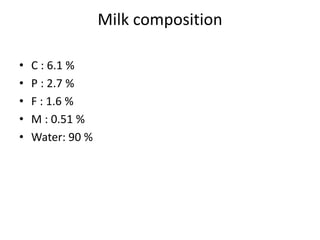
Milk composition
• C : 6.1 %
• P : 2.7 %
• F : 1.6 %
• M : 0.51 %
• Water: 90 %
Introduction
• The equine comprises Horses, donkeys (Ass) and their crosses like Mule
and Hinny.
• They are used for cart/ draught, pack, transport, meat and riding
purposes.
• It used every where from plain, desert to hill.
• The riding horses have use in carrying urgent messages and win the
battles in warfare.
• It is symbol of royalty.
• There is sharp decline in its number due mechanization.
• The population of horses and donkeys are more in western parts of India
in which wild asses are found in Rann of Kutchh.
• Horses are mainly used for riding, but asses and mules are used for
transport.
• Indian asses are donkeys, wild asses and kiang in Sikkim and laddakh.
• Horses are adapted to run, allowing them to quickly escape
predators, possessing an excellent sense of balance and a
strong fight-or-flight response.
• Related to this need to flee from predators in the wild is an
unusual trait.
• horses are able to sleep both standing up and lying down,
with younger horses tending to sleep significantly more
than adults.
• Female horses, called mares, carry their young for
11 months and foal, can stand and run shortly following
birth.
• Training under a saddle or in a harness between the ages of
two and four.
• Horse breeds are loosely divided into three categories based on general
temperament: spirited
• Hot bloods" with speed and endurance;
• Cold bloods", such as draft horses and Ponies, suitable for slow, heavy
work; and
• Warmbloods", developed from crosses between hot bloods and cold
bloods, often focusing on creating breeds for specific riding purposes,
particularly in Europe.
• There are more than 300 breeds of horse in the world today, developed
for many different uses.
• Horses and humans interact in a wide variety of sport competitions and
non-competitive recreational pursuits, as well as in working activities such
as police work, agriculture, entertainment and therapy.
• Many products are derived from horses, including meat, milk, hide, hair,
bone, and pharmaceuticals extracted from the urine of pregnant mares.
• Humans provide domesticated horses with food, water, and shelter, as
well as attention from specialists such as veterinarians and farriers.
• The height of horses is measured at the highest point of the withers, where the neck
meets the back.
• In English-speaking countries, the height of horses is often stated in units of hands and
inches:
• One hand is equal to 4 inches (101.6 mm). The height is expressed as the number of full
hands, followed by a point, then the number of additional inches, and ending with the
abbreviation "h" or "hh" (for "hands high").
• Thus, a horse described as "15.2 h" is 15 hands plus 2 inches, for a total of 62 inches
(157.5 cm) in height.
• The size of horses varies by breed, but also is influenced by nutrition.
• Light riding horses usually range in height from 14 to 16 hands (56 to 64 inches, 142 to
163 cm) and can weigh from 380 to 550 kilograms.
• Larger riding horses usually start at about 15.2 hands (62 inches, 157 cm) and often are as
tall as 17 hands (68 inches, 173 cm), weighing from 500 to 600 kilograms.
• Heavy or draft horses are usually at least 16 hands (64 inches, 163 cm) high and can be as
tall as 18 hands (72 inches, 183 cm) high. They can weigh from about 700 to 1,000
kilograms.
• The largest horse in recorded history was probably a Shire horse named Mammoth, who
was born in 1848. He stood 21.2 1⁄4 hands (86.25 inches, 219 cm) high and his peak
weight was estimated at 1,524 kilograms.
• The current record holder for the world's smallest horse is Thumbelina, a fully
mature miniature horse affected by dwarfism. She is 17 in (43 cm) tall and weighs 57 lb
(26 kg)
• Ponies are taxonomically the same animals as horses.
The distinction between a horse and pony is
commonly drawn on the basis of height, especially
for competition purposes.
• However, height alone is not dispositive; the
difference between horses and ponies may also
include aspects of phenotype, including
conformation and temperament.
• The traditional standard for height of a horse or a
pony at maturity is 14.2 hands (58 inches, 147 cm).
• An animal 14.2 h or over is usually considered to be a
horse and one less than 14.2 h a pony.
• Horses exhibit a diverse array of coat colors and
distinctive markings, described by a specialized
vocabulary.
• They have the largest eyes of any land mammal.
• They have lateral-eyed, meaning that their eyes are positioned on
the sides of their heads.
• This means that horses have a range of vision of more than 350°,
with approximately 65° of this being binocular vision and the
remaining 285° monocular vision.
• Horses have excellent day and night vision, but they have two-color,
or dichromatic vision; their color vision is somewhat like red-green
color blindness in humans, where certain colors, especially red and
related colors, appear as a shade of green.
• Their sense of smell is much better than that of humans, is not
quite as good as that of a dog.
• It is believed to play a key role in the social interactions of horses as
well as detecting other key scents in the environment.
• Horses have two olfactory centers.
• Horses have a great sense of balance, due partly to their ability to
feel their footing and partly to highly developed.
Terminology in Equine
Production
Mare: A mature female horse of four years of age and given birth of a
foal.
Stallion: A mature uncastrated male horse of four years of age.
Gelding: A castrated male horse of all ages.
Colt: A young uncastrated male horse.
Filly: A young female horse under 3-4 years of age. After
foaling………. mare.
Foal: A young horse of either sex under the age of
one year such as Colt foal and Filly foal.
Foaling: The act of giving birth by mare.
Foal at foot: A suckling foal running with its
dam/mare.
Covering: Mating in horses.
Broodmare: A mare that is used for horse breeding.
Stud: An establishment where pedigreed stallion being kept
for breeding.
Stud Book: A list of horses of a particular breed whose parents
are known.
Hand: A measurement of the height of a horse. One hand is
equal to 4 inches. The measurement is usually taken from the
ground to the withers.
Pony: A horse breed that typically measures shorter than
14.2 hands (58 inches, 147 cm). it is used in sport of polo.
Horses: Individual animals of breeds that typically measure
over 14.2 hands (148 cm, 58.27 in) of height without shoes
and over 14.2½ h (149 cm, 58.66 in) (just) with shoes. Cut off
height: 14 hands
Jack: An uncastrated male donkey or ass.
Jennet/Jenny: A female donkey.
Jockey: The rider of a horse in horse racing.
Mule: Hybrid offspring of a male donkey and a horse mare.
Almost always sterile. Mules are noted for their sure-
footedness.
Hinny: The sterile hybrid offsprings of horse stallion and
female donkey.
Zebroid: Hybrid offspring of a zebra crossed on another
equine.
Neigh: A sound made by a horse.
Stable: A building in which horses are kept.
Grooming: Cleaning horses for hygienic, practical
or esthetic reasons.
Doping: Illegal use of medicines to improve a
horse's performance in racing/showing or to harm an
animal to perform poorly by an opponent.
Farrier: A professional hoof care specialist who
does hoof trimming and horse shoeing.
Horses
• Family: Equidae Scientific name: Equus
caballus
• Odd-toed ungulate mammal.
• Important role in transportation, agriculture, sports and warfare.
• Light riding horses: 14.0-16.0 hands weighing 386-540 kg. Ex.
Arabians, Morgans, Quarter Horses.
•
• Larger riding horses: 15.2-17 hands weighing 540-680 kg. Ex.
Thoroughbreds, American Saddlebreds, Warmbloods.
• Heavy/draft horses: 16.0-18.0 hands weighing 680-900 kg. Ex.
Clydesdale, Belgian, Percheron and Shire.
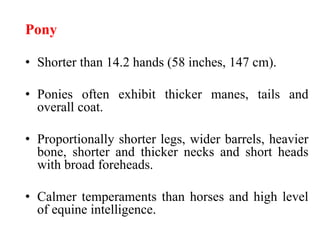
Pony
• Shorter than 14.2 hands (58 inches, 147 cm).
• Ponies often exhibit thicker manes, tails and
overall coat.
• Proportionally shorter legs, wider barrels, heavier
bone, shorter and thicker necks and short heads
with broad foreheads.
• Calmer temperaments than horses and high level
of equine intelligence.
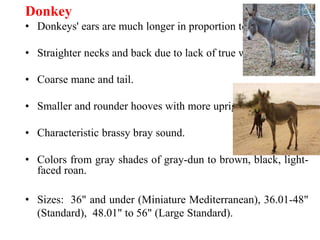
Donkey
• Donkeys' ears are much longer in proportion to their size.
• Straighter necks and back due to lack of true wither.
• Coarse mane and tail.
• Smaller and rounder hooves with more upright pasterns.
• Characteristic brassy bray sound.
• Colors from gray shades of gray-dun to brown, black, light-
faced roan.
• Sizes: 36" and under (Miniature Mediterranean), 36.01-48"
(Standard), 48.01" to 56" (Large Standard).
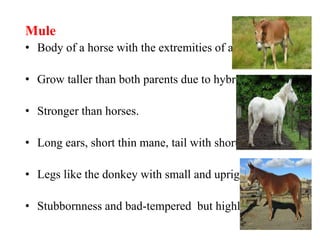
Mule
• Body of a horse with the extremities of a donkey.
• Grow taller than both parents due to hybrid vigour.
• Stronger than horses.
• Long ears, short thin mane, tail with shorter hairs.
• Legs like the donkey with small and upright hooves.
• Stubbornness and bad-tempered but highly intelligent.
Thanks

horse_1.pptx

  • 1.
    General information ofHorse and its Management Presented by Dr. Ravikant Nirala Assistant Professor Livestock Production Management Bihar Veterinary College, Patna - 14
  • 2.
    Kingdom: Animalia Phylum: Chordata Class:Mammalia Order: Perissodactyla Family: Equidae Genus: Equus Species: Equus caballus (Horse) Equus asinus (Ass)  The horse has evolved over the past 45 to 55 million years from a small multi-toed creature, Eohippus, into the large, single-toed animal of today.  It is an odd toed ungulate mammals. Position of horse in Animal kingdom
  • 3.
  • 4.
  • 5.
  • 6.
    Common terminology associatedwith Horse • Species: Equus • Adult male: Stallion • Adult male breeder: Stud • Adult female: Mare • Young born male/ female : Foal • Young male upto 3 yrs: Colt • Young female upto 3 yrs: Filly • Gestation period: 336 days • Age of Maturity: 15-24 months • Breeding life 18 years • Estrous length: 21 days + 5days • Estrous Period: 4 to 6 days • Normal temp.: 99.5-101.3 F • Male: Female= 1:30-40 • RR: 8-16/m • HR: 32-44/m • Av. Productive life: 20-25 yrs
  • 7.
    • Castrated male:Gelding • Castrated female: Spayed • Female with offspring: Suckling • Young weaned male/ female : weanling • Act of Parturition: foaling • Act of mating: Covering • Sound: Neigh • Chromosome No. Horse: 64 Donkey: 62 • Meat of Horses: Kinophagia • Volume of Semen: 75 -150 ml • Sperm count: 150 millions/CC • Best breeding season: Early spring • First heat after Parturition: 4-14 d • House of Horse: Stable
  • 8.
    Milk composition • C: 6.1 % • P : 2.7 % • F : 1.6 % • M : 0.51 % • Water: 90 %
  • 9.
    Introduction • The equinecomprises Horses, donkeys (Ass) and their crosses like Mule and Hinny. • They are used for cart/ draught, pack, transport, meat and riding purposes. • It used every where from plain, desert to hill. • The riding horses have use in carrying urgent messages and win the battles in warfare. • It is symbol of royalty. • There is sharp decline in its number due mechanization. • The population of horses and donkeys are more in western parts of India in which wild asses are found in Rann of Kutchh. • Horses are mainly used for riding, but asses and mules are used for transport. • Indian asses are donkeys, wild asses and kiang in Sikkim and laddakh.
  • 10.
    • Horses areadapted to run, allowing them to quickly escape predators, possessing an excellent sense of balance and a strong fight-or-flight response. • Related to this need to flee from predators in the wild is an unusual trait. • horses are able to sleep both standing up and lying down, with younger horses tending to sleep significantly more than adults. • Female horses, called mares, carry their young for 11 months and foal, can stand and run shortly following birth. • Training under a saddle or in a harness between the ages of two and four.
  • 11.
    • Horse breedsare loosely divided into three categories based on general temperament: spirited • Hot bloods" with speed and endurance; • Cold bloods", such as draft horses and Ponies, suitable for slow, heavy work; and • Warmbloods", developed from crosses between hot bloods and cold bloods, often focusing on creating breeds for specific riding purposes, particularly in Europe. • There are more than 300 breeds of horse in the world today, developed for many different uses. • Horses and humans interact in a wide variety of sport competitions and non-competitive recreational pursuits, as well as in working activities such as police work, agriculture, entertainment and therapy. • Many products are derived from horses, including meat, milk, hide, hair, bone, and pharmaceuticals extracted from the urine of pregnant mares. • Humans provide domesticated horses with food, water, and shelter, as well as attention from specialists such as veterinarians and farriers.
  • 12.
    • The heightof horses is measured at the highest point of the withers, where the neck meets the back. • In English-speaking countries, the height of horses is often stated in units of hands and inches: • One hand is equal to 4 inches (101.6 mm). The height is expressed as the number of full hands, followed by a point, then the number of additional inches, and ending with the abbreviation "h" or "hh" (for "hands high"). • Thus, a horse described as "15.2 h" is 15 hands plus 2 inches, for a total of 62 inches (157.5 cm) in height. • The size of horses varies by breed, but also is influenced by nutrition. • Light riding horses usually range in height from 14 to 16 hands (56 to 64 inches, 142 to 163 cm) and can weigh from 380 to 550 kilograms. • Larger riding horses usually start at about 15.2 hands (62 inches, 157 cm) and often are as tall as 17 hands (68 inches, 173 cm), weighing from 500 to 600 kilograms. • Heavy or draft horses are usually at least 16 hands (64 inches, 163 cm) high and can be as tall as 18 hands (72 inches, 183 cm) high. They can weigh from about 700 to 1,000 kilograms. • The largest horse in recorded history was probably a Shire horse named Mammoth, who was born in 1848. He stood 21.2 1⁄4 hands (86.25 inches, 219 cm) high and his peak weight was estimated at 1,524 kilograms. • The current record holder for the world's smallest horse is Thumbelina, a fully mature miniature horse affected by dwarfism. She is 17 in (43 cm) tall and weighs 57 lb (26 kg)
  • 13.
    • Ponies aretaxonomically the same animals as horses. The distinction between a horse and pony is commonly drawn on the basis of height, especially for competition purposes. • However, height alone is not dispositive; the difference between horses and ponies may also include aspects of phenotype, including conformation and temperament. • The traditional standard for height of a horse or a pony at maturity is 14.2 hands (58 inches, 147 cm). • An animal 14.2 h or over is usually considered to be a horse and one less than 14.2 h a pony. • Horses exhibit a diverse array of coat colors and distinctive markings, described by a specialized vocabulary.
  • 14.
    • They havethe largest eyes of any land mammal. • They have lateral-eyed, meaning that their eyes are positioned on the sides of their heads. • This means that horses have a range of vision of more than 350°, with approximately 65° of this being binocular vision and the remaining 285° monocular vision. • Horses have excellent day and night vision, but they have two-color, or dichromatic vision; their color vision is somewhat like red-green color blindness in humans, where certain colors, especially red and related colors, appear as a shade of green. • Their sense of smell is much better than that of humans, is not quite as good as that of a dog. • It is believed to play a key role in the social interactions of horses as well as detecting other key scents in the environment. • Horses have two olfactory centers. • Horses have a great sense of balance, due partly to their ability to feel their footing and partly to highly developed.
  • 15.
    Terminology in Equine Production Mare:A mature female horse of four years of age and given birth of a foal. Stallion: A mature uncastrated male horse of four years of age. Gelding: A castrated male horse of all ages. Colt: A young uncastrated male horse. Filly: A young female horse under 3-4 years of age. After foaling………. mare.
  • 16.
    Foal: A younghorse of either sex under the age of one year such as Colt foal and Filly foal. Foaling: The act of giving birth by mare. Foal at foot: A suckling foal running with its dam/mare. Covering: Mating in horses. Broodmare: A mare that is used for horse breeding.
  • 17.
    Stud: An establishmentwhere pedigreed stallion being kept for breeding. Stud Book: A list of horses of a particular breed whose parents are known. Hand: A measurement of the height of a horse. One hand is equal to 4 inches. The measurement is usually taken from the ground to the withers. Pony: A horse breed that typically measures shorter than 14.2 hands (58 inches, 147 cm). it is used in sport of polo. Horses: Individual animals of breeds that typically measure over 14.2 hands (148 cm, 58.27 in) of height without shoes and over 14.2½ h (149 cm, 58.66 in) (just) with shoes. Cut off height: 14 hands
  • 18.
    Jack: An uncastratedmale donkey or ass. Jennet/Jenny: A female donkey. Jockey: The rider of a horse in horse racing. Mule: Hybrid offspring of a male donkey and a horse mare. Almost always sterile. Mules are noted for their sure- footedness. Hinny: The sterile hybrid offsprings of horse stallion and female donkey. Zebroid: Hybrid offspring of a zebra crossed on another equine.
  • 19.
    Neigh: A soundmade by a horse. Stable: A building in which horses are kept. Grooming: Cleaning horses for hygienic, practical or esthetic reasons. Doping: Illegal use of medicines to improve a horse's performance in racing/showing or to harm an animal to perform poorly by an opponent. Farrier: A professional hoof care specialist who does hoof trimming and horse shoeing.
  • 20.
    Horses • Family: EquidaeScientific name: Equus caballus • Odd-toed ungulate mammal. • Important role in transportation, agriculture, sports and warfare. • Light riding horses: 14.0-16.0 hands weighing 386-540 kg. Ex. Arabians, Morgans, Quarter Horses. • • Larger riding horses: 15.2-17 hands weighing 540-680 kg. Ex. Thoroughbreds, American Saddlebreds, Warmbloods. • Heavy/draft horses: 16.0-18.0 hands weighing 680-900 kg. Ex. Clydesdale, Belgian, Percheron and Shire.
  • 21.
    Pony • Shorter than14.2 hands (58 inches, 147 cm). • Ponies often exhibit thicker manes, tails and overall coat. • Proportionally shorter legs, wider barrels, heavier bone, shorter and thicker necks and short heads with broad foreheads. • Calmer temperaments than horses and high level of equine intelligence.
  • 22.
    Donkey • Donkeys' earsare much longer in proportion to their size. • Straighter necks and back due to lack of true wither. • Coarse mane and tail. • Smaller and rounder hooves with more upright pasterns. • Characteristic brassy bray sound. • Colors from gray shades of gray-dun to brown, black, light- faced roan. • Sizes: 36" and under (Miniature Mediterranean), 36.01-48" (Standard), 48.01" to 56" (Large Standard).
  • 23.
    Mule • Body ofa horse with the extremities of a donkey. • Grow taller than both parents due to hybrid vigour. • Stronger than horses. • Long ears, short thin mane, tail with shorter hairs. • Legs like the donkey with small and upright hooves. • Stubbornness and bad-tempered but highly intelligent.
  • 24.