Interesting Facts…
about Horses
1 Horse Evolution:
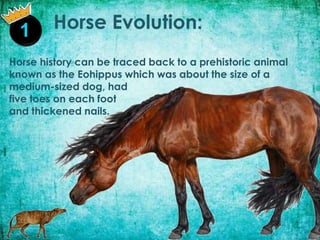
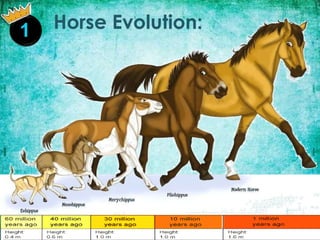
Horse history can be traced back to a prehistoric animal
known as the Eohippus which was about the size of a
medium-sized dog, had
five toes on each foot
and thickened nails.
1 Horse Evolution:
The Horse belongs to the
Equus Family.
Equus comes from the
ancient Greek word meaning
"QUICKNESS”.
Horses and human history:
France 32,000-24,000 BC
Chauvet-Pont-d'Arc Cave
South of France
contains the earliest known
and best preserved
figurative cave paintings in
he world as evidence of
Upper Paleolithic life.
The first human hunted
horses for their meat and
especially for their skins, to
make into leather hides for
clothes and for tents and tools.
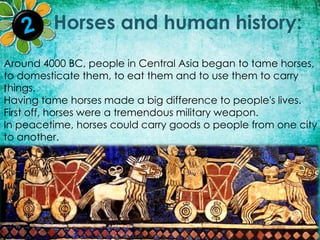
Around 4000 BC, people in Central Asia began to tame horses,
to domesticate them, to eat them and to use them to carry
things.
Having tame horses made a big difference to people's lives.
First off, horses were a tremendous military weapon.
In peacetime, horses could carry goods o people from one city
to another.
Horses and human history:
Until the medieval period, people generally did not really fight
on horseback. They rode their horses to the battle and then
dismounted to fight.
The horse has been used as main transportation until the car invention
Horses and human history:
•Foal - Male or female horse
less than 1 year old.
•Yearling - Male or female horse
between 1 and 2 years old.
•Colt- Male horse
between 2 and 4 years old
•Filly- Female horse
between 2 and 4 years old.
•Mare - A female horse
older than 4 years.
•Gelding- A castrated male horse
older than 4 years
•Stallion- A non-castrated male horse
older than 4 years.
Horse Gender Definitions
Horses Classes & Breeds:
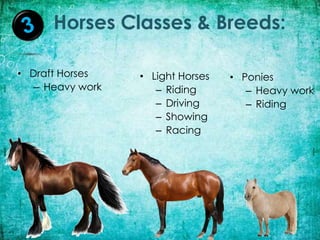
• Light Horses
– Riding
– Driving
– Showing
– Racing
• Draft Horses
– Heavy work
• Ponies
– Heavy work
– Riding
Shire HorseTinker
Pinto
HanoverianKnabstrupperClydesdaleTennessee WalkerLipizzanerTrakehnen BreedCamargue
Appaloosa
Andalucian
Horses Classes & Breeds:
Colors:
Horses Classes & Breeds:
Marking:
Horses & Sports:
Doma
(Saddle bronc riding)
Vaulting
Horses & Sports:
Rodeo
Horses & Sports:
Polo
Horses & Sports:
Racing
Horses & Sports:
Harness Racing
Horses & Sports:
Dressage
Horses & Sports:
Horses & Sports:
Show Jumping
Horses & Sports:
Horses & Sports:
Cross Country
Horses & Sports:
Horses & Sports:
Equipment:
Ear Net
Saddle pad
Saddle
Girth
Snaffle
Bridle
Lead
Blanket
Comb
Brush
Stirrup
Protection
boots
Horseshoes
Hoof
pick
Equipment:
Equipment:
Gloves:
Boots:
Security
vest and
glasses:
Horse’s Body:Skeleton
Horses have about 205 bones in their body that
provide structure, give rise to joints to allow for
movement, and offer protection
to vital organs.
Horse’s Body: Muscles
Horses have over 700 individual muscles in the body
which equates to approximately 60% of an
individual's body weight.
The horse has binocular
vision, but can also see
different things in each
eye. This is why you
need to show your
horse the spooky
things in both eyes so
the brain can get the
message that it's not
spooky.
Horse’s Body: Vision
Horse’s Body What Do Horses Eat? :
Being herbivorous
nature, these animals
predominantly rely on
grasses, vegetation,
and other plant
material.
A horse con consume
7 – 11 kg of food daily.
Besides, they take in
38 litres to 45 litres of
water.
Horse’s Body What Do Horses Eat? :
Horses in the move:
Horses in the move:
Horses in the move:
Horses in the move:
Horses in the move:
Horses in the move:
Horses in the move:
Horses in the move:
http://horses.animal-world.com/information/horse-history.php
http://environmentalresearchweb.org/cws/article/yournews/48799
http://pookyhorse.deviantart.com/art/Horse-evolution-293639818
https://kidskonnect.com/animals/horse/
http://en.wikipedia.org/wiki/Chauvet_Cave
http://www.historyforkids.org/learn/environment/horses.htm#!
http://www.equine-world.co.uk/about_horses/equine_gender.asp
www.schleich-s.com/
http://reveraine.deviantart.com/art/Horse-Colors-Poster-449508760
http://www.thenewforestguide.co.uk/biodiversity/ponies/
http://www.telegraph.co.uk/sport/olympics/7904559/London-2012-
Olympics-equestrian-guide.html
http://www.lovehorsebackriding.com/equine-skeletal-anatomy.html
http://www.horseswithamie.com/horsefacts/horsefacts.htm
Bibliography:

Horses School Project