SCIENCE
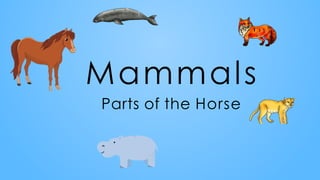
Mammals
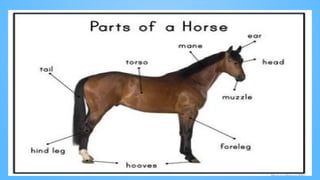
Parts of the Horse
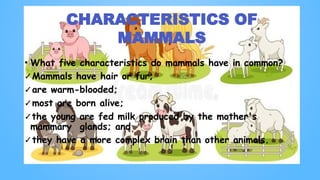
CHARACTERISTICS OF
MAMMALS
• What five characteristics do mammals have in common?
✓Mammals have hair or fur;
✓are warm-blooded;
✓most are born alive;
✓the young are fed milk produced by the mother's
mammary glands; and
✓they have a more complex brain than other animals.
The Horse
The Horse
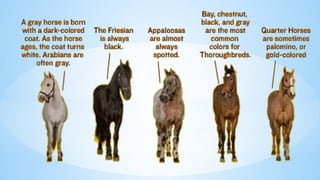
*Horses come in a wide range of colors
and patterns. For some horse breeds ,
only a particular color or color
combination is allowed. In others,
individual horses may be virtually any
color.
Horses Come in 3 Basic Body
Types
Light Breeds
• Light horses are bred for riding,
racing, jumping, and herding.
Their long, thin legs are
designed for speed. Long,
flexible necks help them stay
balanced while running and
maneuvering. Well-defined
withers allow light horses to be
easily fitted with a saddle.
• Light breeds generally weigh
from 800 to 1,500 pounds (363
to 680 kilograms).
•
Ponies
• Ponies are usually small in size
and stocky looking. They have
been developed for use in
specific environments. The depth
of their body is usually equal to
the length of their legs. In many
equestrian competitions, any
horse under 14.2 hands high (58
inches, or 147 centimeters) is
considered a pony.
Ponies weigh from 200 to 1,500
pounds (91 to 680 kilograms).
Heavy breeds
–also called draft horses–
are big, massive horses.
They are built to pull plows
and wagons, and to carry
hefty loads. Their relatively
short, sturdy legs give them
better leverage when
pulling. Short, muscular
backs and powerful
hindquarters allow them to
tow substantial weights.
Heavy breeds weigh from
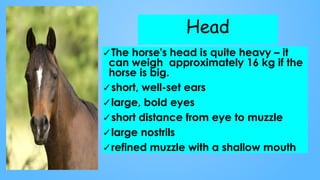
Head
✓The horse's head is quite heavy – it
can weigh approximately 16 kg if the
horse is big.
✓short, well-set ears
✓large, bold eyes
✓short distance from eye to muzzle
✓large nostrils
✓refined muzzle with a shallow mouth
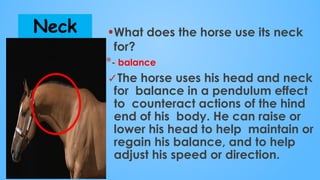
Neck •What does the horse use its neck
for?
*- balance
✓The horse uses his head and neck
for balance in a pendulum effect
to counteract actions of the hind
end of his body. He can raise or
lower his head to help maintain or
regain his balance, and to help
adjust his speed or direction.
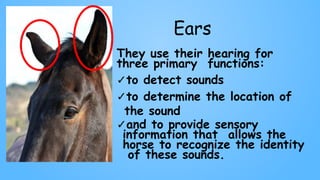
Ears
They use their hearing for
three primary functions:
✓to detect sounds
✓to determine the location of
the sound
✓and to provide sensory
information that allows the
horse to recognize the identity
of these sounds.
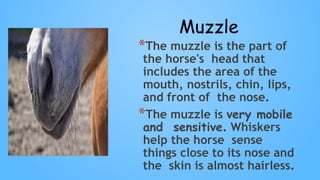
Muzzle
*The muzzle is the part of
the horse's head that
includes the area of the
mouth, nostrils, chin, lips,
and front of the nose.
*The muzzle is very mobile
and sensitive. Whiskers
help the horse sense
things close to its nose and
the skin is almost hairless.
Nostrils
*Large, thin-walled nostrils
allow for great expansion
when exercising extensively
and there is a requirement for
lots of air. Horses breed for
slower types of work have
smaller, thicker- walled
nostrils.
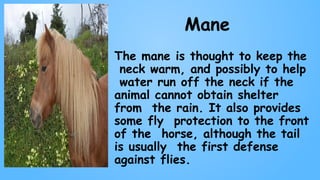
Mane
The mane is thought to keep the
neck warm, and possibly to help
water run off the neck if the
animal cannot obtain shelter
from the rain. It also provides
some fly protection to the front
of the horse, although the tail
is usually the first defense
against flies.
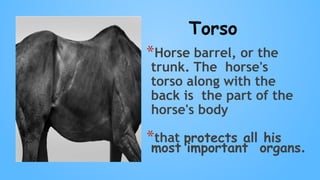
Torso
*Horse barrel, or the
trunk. The horse's
torso along with the
back is the part of the
horse's body
*that protects all his
most important organs.
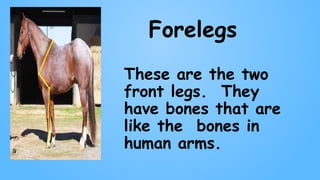
Forelegs
These are the two
front legs. They
have bones that are
like the bones in
human arms.
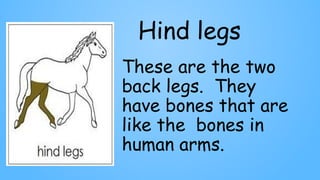
Hind legs
These are the two
back legs. They
have bones that are
like the bones in
human arms.
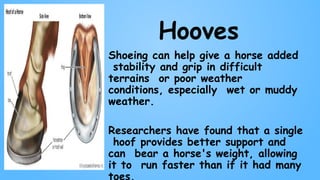
Hooves
Shoeing can help give a horse added
stability and grip in difficult
terrains or poor weather
conditions, especially wet or muddy
weather.
Researchers have found that a single
hoof provides better support and
can bear a horse's weight, allowing
it to run faster than if it had many
Tail
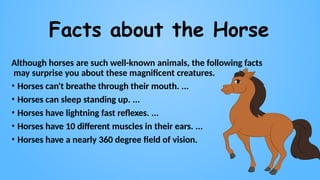
The tail is used by the horse and
other to keep away biting insects,
and the position and movement of
the tail may provide clues to the
animal's physical or emotional
state.
Why do horses run with their tail up?
A raised tail is often a sign of high excitement or just feeling
great.
Young horses, or horses with excess energy, galloping
freely in a field often hoist their tails high to show their
exuberance.
Facts about the Horse
Although horses are such well-known animals, the following facts
may surprise you about these magnificent creatures.
• Horses can't breathe through their mouth. ...
• Horses can sleep standing up. ...
• Horses have lightning fast reflexes. ...
• Horses have 10 different muscles in their ears. ...
• Horses have a nearly 360 degree field of vision.
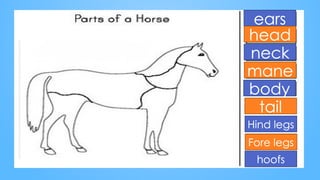
ears
head
neck
mane
body
tail
Hind legs
hoofs
Fore legs

elementarydepartmentscience123MAMMALS.pptx

  • 1.
  • 2.
  • 3.
    CHARACTERISTICS OF MAMMALS • Whatfive characteristics do mammals have in common? ✓Mammals have hair or fur; ✓are warm-blooded; ✓most are born alive; ✓the young are fed milk produced by the mother's mammary glands; and ✓they have a more complex brain than other animals.
  • 4.
  • 5.
    The Horse *Horses comein a wide range of colors and patterns. For some horse breeds , only a particular color or color combination is allowed. In others, individual horses may be virtually any color.
  • 7.
    Horses Come in3 Basic Body Types Light Breeds • Light horses are bred for riding, racing, jumping, and herding. Their long, thin legs are designed for speed. Long, flexible necks help them stay balanced while running and maneuvering. Well-defined withers allow light horses to be easily fitted with a saddle. • Light breeds generally weigh from 800 to 1,500 pounds (363 to 680 kilograms). • Ponies • Ponies are usually small in size and stocky looking. They have been developed for use in specific environments. The depth of their body is usually equal to the length of their legs. In many equestrian competitions, any horse under 14.2 hands high (58 inches, or 147 centimeters) is considered a pony. Ponies weigh from 200 to 1,500 pounds (91 to 680 kilograms). Heavy breeds –also called draft horses– are big, massive horses. They are built to pull plows and wagons, and to carry hefty loads. Their relatively short, sturdy legs give them better leverage when pulling. Short, muscular backs and powerful hindquarters allow them to tow substantial weights. Heavy breeds weigh from
  • 10.
    Head ✓The horse's headis quite heavy – it can weigh approximately 16 kg if the horse is big. ✓short, well-set ears ✓large, bold eyes ✓short distance from eye to muzzle ✓large nostrils ✓refined muzzle with a shallow mouth
  • 11.
    Neck •What doesthe horse use its neck for? *- balance ✓The horse uses his head and neck for balance in a pendulum effect to counteract actions of the hind end of his body. He can raise or lower his head to help maintain or regain his balance, and to help adjust his speed or direction.
  • 12.
    Ears They use theirhearing for three primary functions: ✓to detect sounds ✓to determine the location of the sound ✓and to provide sensory information that allows the horse to recognize the identity of these sounds.
  • 13.
    Muzzle *The muzzle isthe part of the horse's head that includes the area of the mouth, nostrils, chin, lips, and front of the nose. *The muzzle is very mobile and sensitive. Whiskers help the horse sense things close to its nose and the skin is almost hairless.
  • 14.
    Nostrils *Large, thin-walled nostrils allowfor great expansion when exercising extensively and there is a requirement for lots of air. Horses breed for slower types of work have smaller, thicker- walled nostrils.
  • 15.
    Mane The mane isthought to keep the neck warm, and possibly to help water run off the neck if the animal cannot obtain shelter from the rain. It also provides some fly protection to the front of the horse, although the tail is usually the first defense against flies.
  • 16.
    Torso *Horse barrel, orthe trunk. The horse's torso along with the back is the part of the horse's body *that protects all his most important organs.
  • 17.
    Forelegs These are thetwo front legs. They have bones that are like the bones in human arms.
  • 18.
    Hind legs These arethe two back legs. They have bones that are like the bones in human arms.
  • 19.
    Hooves Shoeing can helpgive a horse added stability and grip in difficult terrains or poor weather conditions, especially wet or muddy weather. Researchers have found that a single hoof provides better support and can bear a horse's weight, allowing it to run faster than if it had many
  • 20.
    Tail The tail isused by the horse and other to keep away biting insects, and the position and movement of the tail may provide clues to the animal's physical or emotional state. Why do horses run with their tail up? A raised tail is often a sign of high excitement or just feeling great. Young horses, or horses with excess energy, galloping freely in a field often hoist their tails high to show their exuberance.
  • 22.
    Facts about theHorse Although horses are such well-known animals, the following facts may surprise you about these magnificent creatures. • Horses can't breathe through their mouth. ... • Horses can sleep standing up. ... • Horses have lightning fast reflexes. ... • Horses have 10 different muscles in their ears. ... • Horses have a nearly 360 degree field of vision.
  • 23.