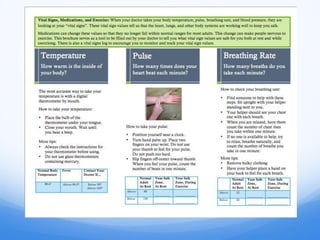
Vital Signs
A guide to safe exercise while taking medications
University of Washington
Department of Rehabilitation
Sam Bennett, SPT
Megan Hillman, SPT
Mary Thurtle, SPT
Meg Whitney, SPT
Anne Ziegltrum, SPT
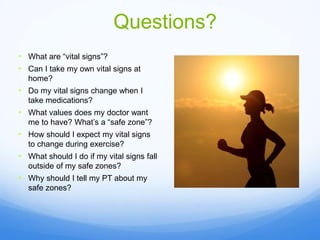
Questions?
• What are “vital signs”?
• Can I take my own vital signs at
home?
• Do my vital signs change when I
take medications?
• What values does my doctor want
me to have? What’s a “safe zone”?
• How should I expect my vital signs
to change during exercise?
• What should I do if my vital signs fall
outside of my safe zones?
• Why should I tell my PT about my
safe zones?
What is Body Temperature?1
 Body temperature tells us how warm your body is on
the inside
 Normal temperature for adults: 97.8-99°F
 What can change your temperature?
 Activity
 Food or fluid
 Time of day
 Some drugs and medications
Drugs and Medications…
 …that can lower your temperature:2
 Antidepressants
 Antipsychotics
 Narcotic pain medications
 Sedatives
 …that can raise your temperature:3
 Beta blockers
 Diuretics
 Antihistamines
 Tranquilizers
 Illegal drugs:
 Cocaine
 Amphetamines
When To Take Your
Temperature
 Take your temperature at the same time each day and
before exercising
 Avoid hot or cold food or drink immediately before
taking your temperature
How To Take Your
Temperature1
 Can be done in many ways:
 By mouth
 Rectally
 Underarm
 By ear
 By skin on forehead
 Using different tools:
 Glass thermometer
 Digital thermometer
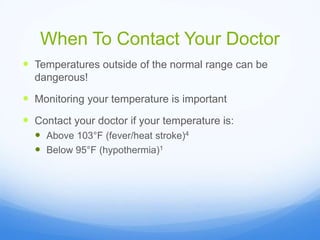
Demonstration
 The most accurate way to take temperature is by mouth
or rectally, using a digital thermometer5
 Always read the instructions on your thermometer
 DO NOT use mercury thermometers1
http://www.clipartpanda.com/categories/cold-thermometer-clip-art-black-and-white
When To Contact Your Doctor
 Temperatures outside of the normal range can be
dangerous!
 Monitoring your temperature is important
 Contact your doctor if your temperature is:
 Above 103°F (fever/heat stroke)4
 Below 95°F (hypothermia)1
What is a Pulse?
 Heart Rate (or pulse) tells us how many times our
heart beats each minute
 Feel your heart beat:
 In blood vessels known as arteries:
 Arteries carry blood from your heart to your
body
 Every time your heart beats your arteries pulse
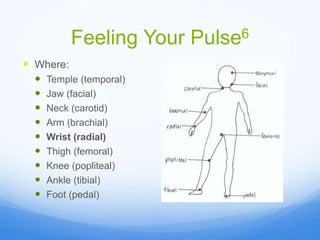
Feeling Your Pulse6
 Where:
 Temple (temporal)
 Jaw (facial)
 Neck (carotid)
 Arm (brachial)
 Wrist (radial)
 Thigh (femoral)
 Knee (popliteal)
 Ankle (tibial)
 Foot (pedal)
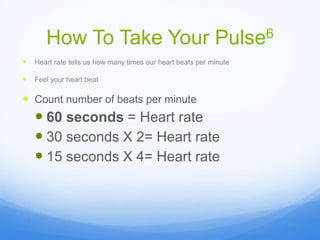
How To Take Your Pulse6
 Heart rate tells us how many times our heart beats per minute
 Feel your heart beat
 Count number of beats per minute
 60 seconds = Heart rate
 30 seconds X 2= Heart rate
 15 seconds X 4= Heart rate
What is “Normal”
 Normal varies
 “Normal” resting heart rate for adults: 60-100
beats/minute6
What Do The Numbers Mean?7
 High or low heart rate may indicate a problem
 Lower heart rate= healthy heart, greater fitness
 Higher heart rate= heart does not work as well, has
to beat more to do same job
What Can Change Your
Pulse?7
 These can lower your heart
rate:
 Medications: Adrenaline
(beta blockers)
 Regular moderate
exercise
 Resting
 These can raise your heart
rate:
 Medications: thyroid
medication (too much)
 Poor heart health, obesity
 Standing, activity
 Strong emotions
 Heat and humidity
When to Take Your Pulse6
 Before exercise
 Sit for a couple of minutes first
 During exercise
 Stop moving
Demonstration
 How to check your own heart rate6:
 Position yourself near a clock
 Place your hand palm-up
 Use artery at wrist (radial)
 Place two fingers on your wrist (Do not push too hard)
 Slip your fingers off-center toward your thumb
 Count the number of beats in one minute
 Write it down
When to Contact Your Doctor6
 Outside of safe zone
 Resting and active are different
 Important:
 Feeling faint
 heart does not beat in a steady rhythm
What is Breathing Rate?6
 How many breaths you take each minute
What is Happening When You
Breathe?6
 Your brain controls breathing!
 Brain signals travel down your spine to your muscles.
 This happens automatically without you needing to be aware.
 Why is this important to know?
 Noting any changes in your breathing is important to catching any
concerns early
 What is the normal range?
 12-20 breaths per minute
What Can Change Breathing
Rate?6
 You can control it
 Emotions
 Activity level
 Condition of
air/environment
 Medications/drugs
How To Check Your Breathing
Rate8
 What you will need to check your breathing rate at
home:
 Someone to help
 A clock
 Find someone to help with these steps:
1. Sit comfortably and have your helper stand next to you.
2. Instruct them to count each time they see your chest rise in a
minute.
 If no one is available to help, try these steps on your
own.
Demonstration8
 Additional Tips
 Remove bulky clothing
 Have your helper place their hand on your back
and feel for each breath
When To Contact Your
Doctor8
 If breathing rate falls outside of your safe zone (See
brochure)
 You or your helper notices you make noises when breathing
like grunting or wheezing
 You feel dizzy or light headed
 Call 911 if:
 You or your helper notices that you are experiencing difficulty
breathing or are unable to breathe
What Is Blood
Pressure?9
 Blood Pressure = Systolic / Diastolic
 Systolic: the pressure in your arteries when
your heart is contracting
 Diastolic: the pressure in your arteries between
heart beats (relaxed)
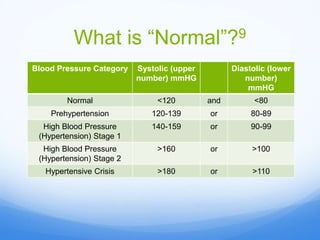
What is “Normal”?9
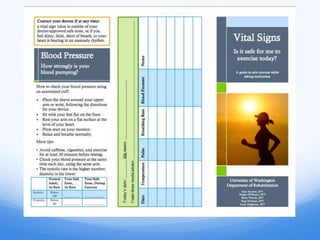
Blood Pressure Category Systolic (upper
number) mmHG
Diastolic (lower
number)
mmHG
Normal <120 and <80
Prehypertension 120-139 or 80-89
High Blood Pressure
(Hypertension) Stage 1
140-159 or 90-99
High Blood Pressure
(Hypertension) Stage 2
>160 or >100
Hypertensive Crisis >180 or >110
Why do I need to take my
blood pressure?12
 High blood pressure often causes no symptoms
 High blood pressure increase your risk for heart
disease and stroke
 The best way to monitor blood pressure is by checking
it often.
Types of Monitors
 There are many different types of home monitors but
the most commonly used are:
 Upper arm monitor
 Wrist monitor
 Make sure you buy the right size monitor11
 Have your doctor check your monitor to make sure it is
working properly
 Check the tubing frequently to make sure the cuff is in
good condition
Demonstration
 Make sure:
 your monitor is placed in the appropriate position
 you are sitting down with feet flat on the floor
 your arm is supported on a table or other flat surface
at the level of the heart
 Additional tips
 Avoid caffeine, cigarettes, and exercise for at least 30
minutes prior to the test10
 Monitor your blood pressure at the same time every
day on the same arm
 Keep a journal to monitor your results
When To Contact Your Doctor
 If, while monitoring your blood pressure, you get13:
 A systolic reading of 180 mmHg or higher OR
 A diastolic reading of 110 mmHg or higher…
 …wait a couple of minutes and take it again
 If the reading is still at or above that level, you should
seek immediate emergency medical treatment.
 Also, seek medical attention if you feel faint, dizzy, or
lose consciousness.
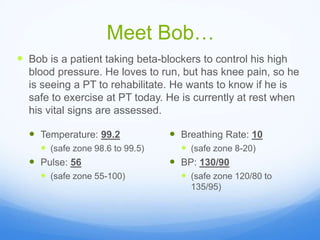
Meet Bob…
 Bob is a patient taking beta-blockers to control his high
blood pressure. He loves to run, but has knee pain, so he
is seeing a PT to rehabilitate. He wants to know if he is
safe to exercise at PT today. He is currently at rest when
his vital signs are assessed.
 Temperature: 99.2
 (safe zone 98.6 to 99.5)
 Pulse: 56
 (safe zone 55-100)
 Breathing Rate: 10
 (safe zone 8-20)
 BP: 130/90
 (safe zone 120/80 to
135/95)
More about Bob…
 What do we need to consider if Bob had taken
these vital signs while on the treadmill at PT?
 What if Bob was feeling dizzy? Is that a worry?
?

Vital signs group ppt_FINAL

  • 1.
    Vital Signs A guideto safe exercise while taking medications University of Washington Department of Rehabilitation Sam Bennett, SPT Megan Hillman, SPT Mary Thurtle, SPT Meg Whitney, SPT Anne Ziegltrum, SPT
  • 2.
    Questions? • What are“vital signs”? • Can I take my own vital signs at home? • Do my vital signs change when I take medications? • What values does my doctor want me to have? What’s a “safe zone”? • How should I expect my vital signs to change during exercise? • What should I do if my vital signs fall outside of my safe zones? • Why should I tell my PT about my safe zones?
  • 5.
    What is BodyTemperature?1  Body temperature tells us how warm your body is on the inside  Normal temperature for adults: 97.8-99°F  What can change your temperature?  Activity  Food or fluid  Time of day  Some drugs and medications
  • 6.
    Drugs and Medications… …that can lower your temperature:2  Antidepressants  Antipsychotics  Narcotic pain medications  Sedatives  …that can raise your temperature:3  Beta blockers  Diuretics  Antihistamines  Tranquilizers  Illegal drugs:  Cocaine  Amphetamines
  • 7.
    When To TakeYour Temperature  Take your temperature at the same time each day and before exercising  Avoid hot or cold food or drink immediately before taking your temperature
  • 8.
    How To TakeYour Temperature1  Can be done in many ways:  By mouth  Rectally  Underarm  By ear  By skin on forehead  Using different tools:  Glass thermometer  Digital thermometer
  • 9.
    Demonstration  The mostaccurate way to take temperature is by mouth or rectally, using a digital thermometer5  Always read the instructions on your thermometer  DO NOT use mercury thermometers1 http://www.clipartpanda.com/categories/cold-thermometer-clip-art-black-and-white
  • 10.
    When To ContactYour Doctor  Temperatures outside of the normal range can be dangerous!  Monitoring your temperature is important  Contact your doctor if your temperature is:  Above 103°F (fever/heat stroke)4  Below 95°F (hypothermia)1
  • 11.
    What is aPulse?  Heart Rate (or pulse) tells us how many times our heart beats each minute  Feel your heart beat:  In blood vessels known as arteries:  Arteries carry blood from your heart to your body  Every time your heart beats your arteries pulse
  • 12.
    Feeling Your Pulse6 Where:  Temple (temporal)  Jaw (facial)  Neck (carotid)  Arm (brachial)  Wrist (radial)  Thigh (femoral)  Knee (popliteal)  Ankle (tibial)  Foot (pedal)
  • 13.
    How To TakeYour Pulse6  Heart rate tells us how many times our heart beats per minute  Feel your heart beat  Count number of beats per minute  60 seconds = Heart rate  30 seconds X 2= Heart rate  15 seconds X 4= Heart rate
  • 14.
    What is “Normal” Normal varies  “Normal” resting heart rate for adults: 60-100 beats/minute6
  • 15.
    What Do TheNumbers Mean?7  High or low heart rate may indicate a problem  Lower heart rate= healthy heart, greater fitness  Higher heart rate= heart does not work as well, has to beat more to do same job
  • 16.
    What Can ChangeYour Pulse?7  These can lower your heart rate:  Medications: Adrenaline (beta blockers)  Regular moderate exercise  Resting  These can raise your heart rate:  Medications: thyroid medication (too much)  Poor heart health, obesity  Standing, activity  Strong emotions  Heat and humidity
  • 17.
    When to TakeYour Pulse6  Before exercise  Sit for a couple of minutes first  During exercise  Stop moving
  • 18.
    Demonstration  How tocheck your own heart rate6:  Position yourself near a clock  Place your hand palm-up  Use artery at wrist (radial)  Place two fingers on your wrist (Do not push too hard)  Slip your fingers off-center toward your thumb  Count the number of beats in one minute  Write it down
  • 19.
    When to ContactYour Doctor6  Outside of safe zone  Resting and active are different  Important:  Feeling faint  heart does not beat in a steady rhythm
  • 20.
    What is BreathingRate?6  How many breaths you take each minute
  • 21.
    What is HappeningWhen You Breathe?6  Your brain controls breathing!  Brain signals travel down your spine to your muscles.  This happens automatically without you needing to be aware.  Why is this important to know?  Noting any changes in your breathing is important to catching any concerns early  What is the normal range?  12-20 breaths per minute
  • 22.
    What Can ChangeBreathing Rate?6  You can control it  Emotions  Activity level  Condition of air/environment  Medications/drugs
  • 23.
    How To CheckYour Breathing Rate8  What you will need to check your breathing rate at home:  Someone to help  A clock  Find someone to help with these steps: 1. Sit comfortably and have your helper stand next to you. 2. Instruct them to count each time they see your chest rise in a minute.  If no one is available to help, try these steps on your own.
  • 24.
    Demonstration8  Additional Tips Remove bulky clothing  Have your helper place their hand on your back and feel for each breath
  • 25.
    When To ContactYour Doctor8  If breathing rate falls outside of your safe zone (See brochure)  You or your helper notices you make noises when breathing like grunting or wheezing  You feel dizzy or light headed  Call 911 if:  You or your helper notices that you are experiencing difficulty breathing or are unable to breathe
  • 26.
    What Is Blood Pressure?9 Blood Pressure = Systolic / Diastolic  Systolic: the pressure in your arteries when your heart is contracting  Diastolic: the pressure in your arteries between heart beats (relaxed)
  • 27.
    What is “Normal”?9 BloodPressure Category Systolic (upper number) mmHG Diastolic (lower number) mmHG Normal <120 and <80 Prehypertension 120-139 or 80-89 High Blood Pressure (Hypertension) Stage 1 140-159 or 90-99 High Blood Pressure (Hypertension) Stage 2 >160 or >100 Hypertensive Crisis >180 or >110
  • 28.
    Why do Ineed to take my blood pressure?12  High blood pressure often causes no symptoms  High blood pressure increase your risk for heart disease and stroke  The best way to monitor blood pressure is by checking it often.
  • 29.
    Types of Monitors There are many different types of home monitors but the most commonly used are:  Upper arm monitor  Wrist monitor  Make sure you buy the right size monitor11  Have your doctor check your monitor to make sure it is working properly  Check the tubing frequently to make sure the cuff is in good condition
  • 30.
    Demonstration  Make sure: your monitor is placed in the appropriate position  you are sitting down with feet flat on the floor  your arm is supported on a table or other flat surface at the level of the heart  Additional tips  Avoid caffeine, cigarettes, and exercise for at least 30 minutes prior to the test10  Monitor your blood pressure at the same time every day on the same arm  Keep a journal to monitor your results
  • 31.
    When To ContactYour Doctor  If, while monitoring your blood pressure, you get13:  A systolic reading of 180 mmHg or higher OR  A diastolic reading of 110 mmHg or higher…  …wait a couple of minutes and take it again  If the reading is still at or above that level, you should seek immediate emergency medical treatment.  Also, seek medical attention if you feel faint, dizzy, or lose consciousness.
  • 32.
    Meet Bob…  Bobis a patient taking beta-blockers to control his high blood pressure. He loves to run, but has knee pain, so he is seeing a PT to rehabilitate. He wants to know if he is safe to exercise at PT today. He is currently at rest when his vital signs are assessed.  Temperature: 99.2  (safe zone 98.6 to 99.5)  Pulse: 56  (safe zone 55-100)  Breathing Rate: 10  (safe zone 8-20)  BP: 130/90  (safe zone 120/80 to 135/95)
  • 33.
    More about Bob… What do we need to consider if Bob had taken these vital signs while on the treadmill at PT?  What if Bob was feeling dizzy? Is that a worry?
  • 34.

Editor's Notes

  • #3 These are some questions you may have. Our goal is to answer these questions for you.
  • #6 1. University of Rochester Medical Center. Health Encyclopedia. Vital Signs (Body Temperature, Pulse Rate, Respiration Rate, Blood Pressure). 2015. Available at http://www.urmc.rochester.edu/encyclopedia/content.aspx?ContentTypeID=85&ContentID=P00866. Accessed January 30, 2015.
  • #7 2. Mayo Clinic. Diseases and Conditions. Hypothermia: Risk Factors. http://www.mayoclinic.org/diseases-conditions/hypothermia/basics/risk-factors/con-20020453. Accessed February 2, 2015. 3. Mayo Clinic. Diseases and Conditions. Heat Exhaustion: Risk Factors. http://www.mayoclinic.org/diseases-conditions/heat-exhaustion/basics/risk-factors/con-20033366. Accessed February 2, 2015.
  • #10 5. Mayo Clinic. Diseases and Conditions. Thermometers: Understand the Options. http://www.mayoclinic.org/diseases-conditions/fever/in-depth/thermometers/art-20046737. Accessed January 30, 2015.
  • #11 4. Mayo Clinic. Diseases and Conditions. Fever. Available at http://www.mayoclinic.org/first-aid/first-aid-fever/basics/art-20056685. Accessed January 30, 2015.
  • #12 1. University of Rochester Medical Center. Health Encyclopedia. Vital Signs (Body Temperature, Pulse Rate, Respiration Rate, Blood Pressure). 2015. Available at http://www.urmc.rochester.edu/encyclopedia/content.aspx?ContentTypeID=85&ContentID=P00866. Accessed January 30, 2015.
  • #13 http://www.abpischools.org.uk/page/modules/heartandcirculation/heart5.cfm
  • #16 http://www.heart.org/HEARTORG/Conditions/More/MyHeartandStrokeNews/All-About-Heart-Rate-Pulse_UCM_438850_Article.jsp
  • #17 http://www.heart.org/HEARTORG/Conditions/More/MyHeartandStrokeNews/All-About-Heart-Rate-Pulse_UCM_438850_Article.jsp
  • #21 6. Johansson, C, Chinworth, SA. Mobility in Context Principles of Patient Care. Philadelpha, PA: F.A. Davis Company; 2012.
  • #22 6. Johansson, C, Chinworth, SA. Mobility in Context Principles of Patient Care. Philadelpha, PA: F.A. Davis Company; 2012.
  • #23 6. Johansson, C, Chinworth, SA. Mobility in Context Principles of Patient Care. Philadelpha, PA: F.A. Davis Company; 2012.
  • #24 8. How to Count Respirations. Drugs.com. http://www.drugs.com/cg/how-to-count-respirations.html. Published 2000. Updated February 4, 2015. Accessed February 15, 2015.
  • #25 8. How to Count Respirations. Drugs.com. http://www.drugs.com/cg/how-to-count-respirations.html. Published 2000. Updated February 4, 2015. Accessed February 15, 2015.
  • #26 8. How to Count Respirations. Drugs.com. http://www.drugs.com/cg/how-to-count-respirations.html. Published 2000. Updated February 4, 2015. Accessed February 15, 2015.
  • #28 Citation for table