POST CABG LV ASSESSMENT
CABG
• Coronary artery bypass grafting is known to be associated with better
outcome in ischemic heart disease patients with low ejection fraction.We aim
to demonstrate the effect of coronary artery bypass grafting (CABG) on left
ventricle (LV) systolic function and to identify the predictors that adversely
lead to postoperative poor outcome.
• Echo is Performed both peri operative and with in 7 days post operative
period after surgery and 4 months after surgery before follow up.
• In echo goal is to assess Lv function and r/o Possible complications.
PURPOSES
Restore blood flow to the heart
Relieves chest pain and ischemia
Improves the patient’s quality of life
Enable the patient to resume a normal lifestyle
• Lower the risk of a heart attack
CHEST PAIN AFTER CARDIAC
SURGERY?
• It is helpful to consider the 3 “I”s (infectious, inflammatory and ischemic) when
considering important causes of chest pain after cardiac surgery. Pain is often
related to mechanical trauma from the sternotomy, in which case it is localized
and exacerbated by movement.
• Pain may be related to wound infection, which also leads to localized pain,
along with characteristic signs of infection
PERICARDITIS
• Patients with pericarditis often report vague anterior chest pain.Theremay be
an associated audible pericardial rub on physical examination.
• Postpericardiotomy syndrome is an immune pericarditis that develop weeks
to months after cardiac surgery.its clinical features include unexplained fever,
pericardial or pleural rubs, new or worsening pleural or pericardial effusion
(although this is not present in all), and pericarditic or pleuritic chest pain.
• Postoperative cardiac tamponade is a rare complication of postpericardiotomy
syndrome that most commonly presents early (< 7 d after surgery), but can
also occur late (> 7 d) in 1%–12.6% of patients.
MYOCARDIAL INFARCTION AFTER
CABG
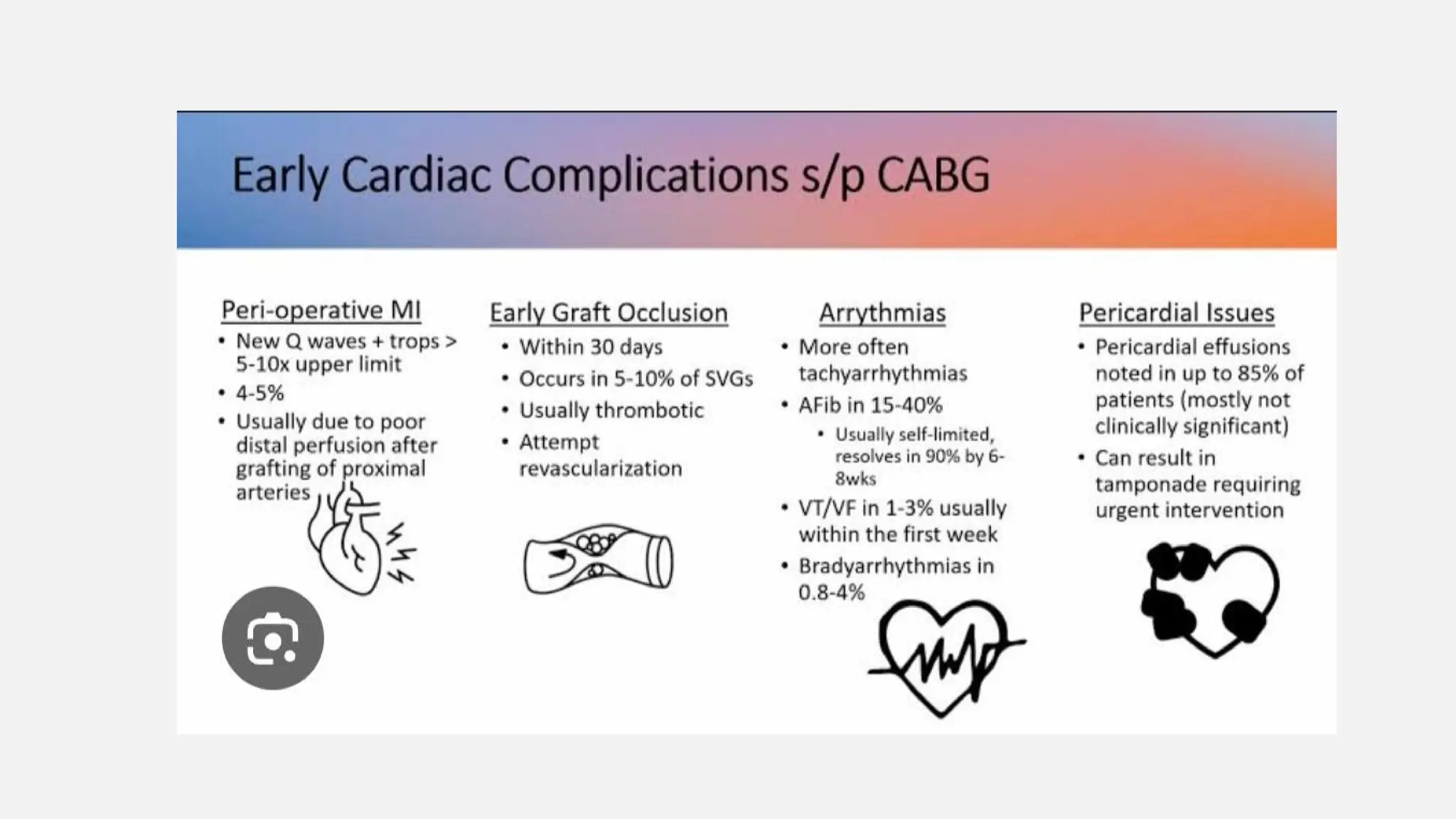
• Occlusion or stenosis of bypass grafts or nonbypassed artery can lead to ischemic chest
pain after CABG surgery.This chest pain can be typical or atypical. Ischemia can also be
painless which is commonly seen preoperatively in patients with diabetes.
• Early perioperative myocardial infarction occurs in 0.6% to 19% of cases after CABG.The
graft occlusion rate after CABG is about 2%–5% per year.
WHAT CAUSES SHORTNESS OF BREATH
AFTER CARDIAC SURGERY?
• In the immediate postoperative period, most patients have dyspnea, with or
without hypoxia, owing to pain-induced by breathing and managed by analgesia
Mobilization, incentive spirometry and physiotherapy.
• Important causes that should be excluded before discharge are (from most to
least likely) pleural effusion, atelectasis, congestive heart failure, pneumonia and
pulmonary embolism.
CONGESTIVE HEART FAILURE
• According to large retrospective studies, about 13% of readmissions to
hospital after CABG are a result of heart failure, with higher rates seen in
patients with low ejection fraction before surgery.
• Peri operative Irreversible myocardial damage, intraoperative myocardial injury,
residual lesions in coronary arteries leading to ongoing ischemia, diastolic
dysfunction or hibernating myocardium after CABG are possible causes.
Patients should be referred to cardiology services
PULMONARY EMBOLISM
• Pulmonary embolism is uncommon after cardiac surgery, owing to routine
aggressive thromboprophylaxis, dual antiplatelet therapy and early
postoperative mobilization in hospital. Continued physical mobilization at
home is also preventive. Pulmonary embolism is usually a sudden emergent
event and patients present with substantial hypoxia
• In patients with severe dyspnea, physicians should investigate for common
causes while maintaining a high index of suspicion for pulmonary embolism.
FOLLOW-UP AFTER CABG
• A follow-up appointment with your doctor is recommended about six to eight
weeks after coronary artery bypass graft (CABG) surgery . It is essential to
keep these appointments to ensure you receive the best possible care for your
individual needs .You may be advised to return for regular follow-up visits at
least once a year
Post CABG Left Ventricle evaluation pptx

Post CABG Left Ventricle evaluation pptx

  • 1.
    POST CABG LVASSESSMENT
  • 2.
    CABG • Coronary arterybypass grafting is known to be associated with better outcome in ischemic heart disease patients with low ejection fraction.We aim to demonstrate the effect of coronary artery bypass grafting (CABG) on left ventricle (LV) systolic function and to identify the predictors that adversely lead to postoperative poor outcome. • Echo is Performed both peri operative and with in 7 days post operative period after surgery and 4 months after surgery before follow up. • In echo goal is to assess Lv function and r/o Possible complications.
  • 3.
    PURPOSES Restore blood flowto the heart Relieves chest pain and ischemia Improves the patient’s quality of life Enable the patient to resume a normal lifestyle • Lower the risk of a heart attack
  • 5.
    CHEST PAIN AFTERCARDIAC SURGERY? • It is helpful to consider the 3 “I”s (infectious, inflammatory and ischemic) when considering important causes of chest pain after cardiac surgery. Pain is often related to mechanical trauma from the sternotomy, in which case it is localized and exacerbated by movement. • Pain may be related to wound infection, which also leads to localized pain, along with characteristic signs of infection
  • 6.
    PERICARDITIS • Patients withpericarditis often report vague anterior chest pain.Theremay be an associated audible pericardial rub on physical examination. • Postpericardiotomy syndrome is an immune pericarditis that develop weeks to months after cardiac surgery.its clinical features include unexplained fever, pericardial or pleural rubs, new or worsening pleural or pericardial effusion (although this is not present in all), and pericarditic or pleuritic chest pain. • Postoperative cardiac tamponade is a rare complication of postpericardiotomy syndrome that most commonly presents early (< 7 d after surgery), but can also occur late (> 7 d) in 1%–12.6% of patients.
  • 7.
    MYOCARDIAL INFARCTION AFTER CABG •Occlusion or stenosis of bypass grafts or nonbypassed artery can lead to ischemic chest pain after CABG surgery.This chest pain can be typical or atypical. Ischemia can also be painless which is commonly seen preoperatively in patients with diabetes. • Early perioperative myocardial infarction occurs in 0.6% to 19% of cases after CABG.The graft occlusion rate after CABG is about 2%–5% per year.
  • 8.
    WHAT CAUSES SHORTNESSOF BREATH AFTER CARDIAC SURGERY? • In the immediate postoperative period, most patients have dyspnea, with or without hypoxia, owing to pain-induced by breathing and managed by analgesia Mobilization, incentive spirometry and physiotherapy. • Important causes that should be excluded before discharge are (from most to least likely) pleural effusion, atelectasis, congestive heart failure, pneumonia and pulmonary embolism.
  • 9.
    CONGESTIVE HEART FAILURE •According to large retrospective studies, about 13% of readmissions to hospital after CABG are a result of heart failure, with higher rates seen in patients with low ejection fraction before surgery. • Peri operative Irreversible myocardial damage, intraoperative myocardial injury, residual lesions in coronary arteries leading to ongoing ischemia, diastolic dysfunction or hibernating myocardium after CABG are possible causes. Patients should be referred to cardiology services
  • 10.
    PULMONARY EMBOLISM • Pulmonaryembolism is uncommon after cardiac surgery, owing to routine aggressive thromboprophylaxis, dual antiplatelet therapy and early postoperative mobilization in hospital. Continued physical mobilization at home is also preventive. Pulmonary embolism is usually a sudden emergent event and patients present with substantial hypoxia • In patients with severe dyspnea, physicians should investigate for common causes while maintaining a high index of suspicion for pulmonary embolism.
  • 11.
    FOLLOW-UP AFTER CABG •A follow-up appointment with your doctor is recommended about six to eight weeks after coronary artery bypass graft (CABG) surgery . It is essential to keep these appointments to ensure you receive the best possible care for your individual needs .You may be advised to return for regular follow-up visits at least once a year