INTRODUCTION TO
BIOSTATISTICS
Lecture 01
This Lecture covers:
 Origin and development of Biostatistics
 Definition of Statistics and Biostatistics
 Reasons to know about Biostatistics
• “Statistics is the science which
deals with collection,
classification and tabulation of
numerical facts as the basis for
explanation, description and
comparison of phenomenon”.
------ Lovitt
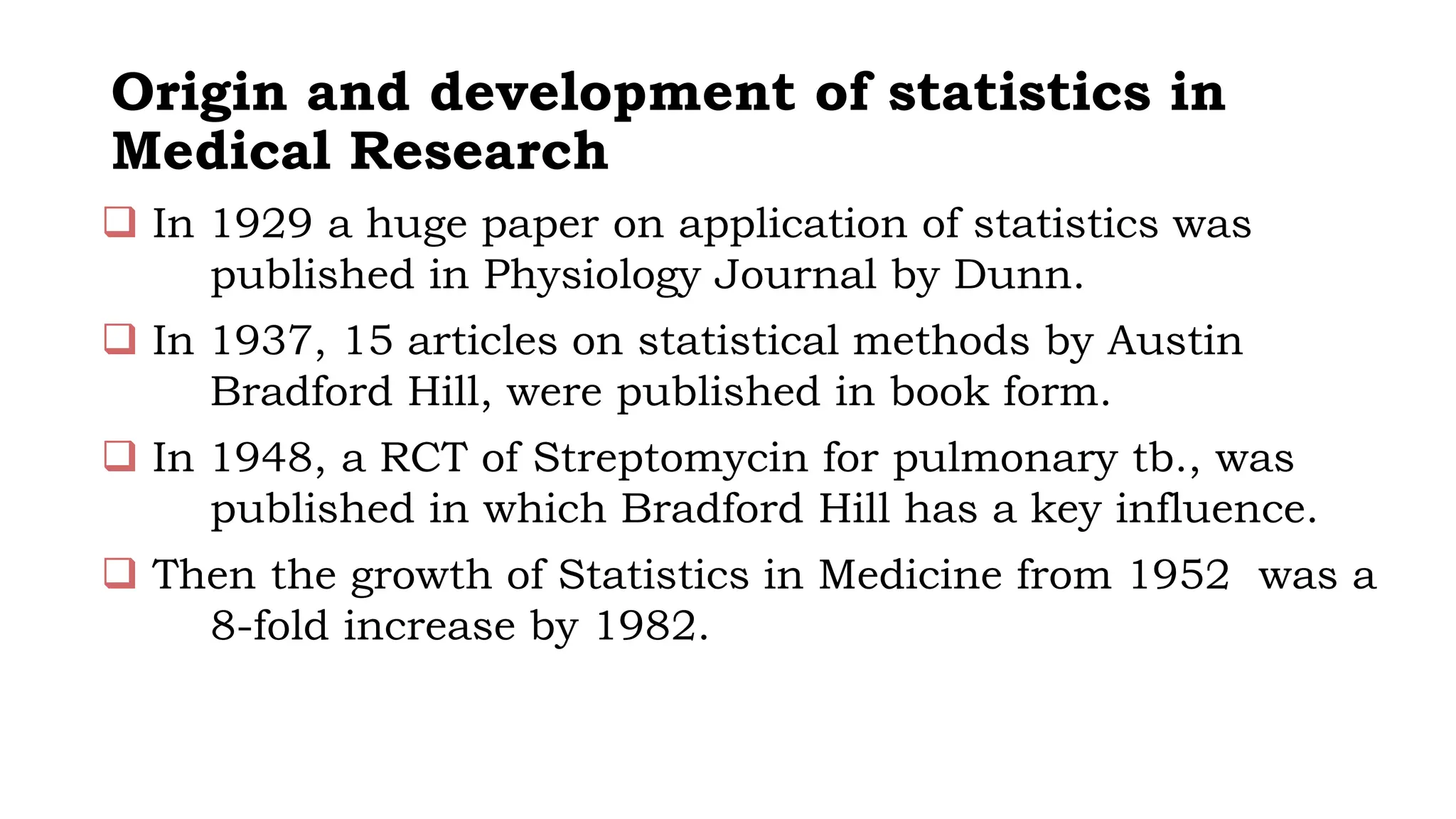
Origin and development of statistics in
Medical Research
 In 1929 a huge paper on application of statistics was
published in Physiology Journal by Dunn.
 In 1937, 15 articles on statistical methods by Austin
Bradford Hill, were published in book form.
 In 1948, a RCT of Streptomycin for pulmonary tb., was
published in which Bradford Hill has a key influence.
 Then the growth of Statistics in Medicine from 1952 was a
8-fold increase by 1982.
Douglas Altman Ronald Fisher Karl Pearson
C.R. Rao
Carl Friedrich Gauss
“BIOSTATISICS”
1. Statistics arising out of biological sciences, particularly
from the fields of Medicine and public health.
2. The methods used in dealing with statistics in the fields
of medicine, biology and public health for planning,
conducting and analyzing data which arise in
investigations of these branches.
Reasons to know about
biostatistics:
 Medicine is becoming increasingly quantitative.
 The planning, conduct and interpretation of much of medical
research are becoming increasingly reliant on the
statistical methodology.
 Statistics pervades the medical literature.
Example: Evaluation of treatment A vs treatment B for treating
bacterial pneumonia in children< 2 yrs.
 What is the sample size needed to demonstrate the significance of one group against other ?
 Is treatment A is better than treatment B or vice versa ?
 If so, how much better ?
 What is the normal variation in clinical measurement ? (mild, moderate & severe) ?
 How reliable and valid is the measurement ? (clinical & radiological) ?
 What is the magnitude and effect of laboratory and technical error ?
 How does one interpret abnormal values ?
CLINICAL MEDICINE
 Documentation of medical history of diseases.
 Planning and conduct of clinical studies.
 Evaluating the merits of different procedures.
 In providing methods for definition of “normal” and “abnormal”.
PREVENTIVE MEDICINE
 To provide the magnitude of any health problem in the
community.
 To find out the basic factors underlying the ill-health.
 To evaluate the health programs which was introduced in
the community (success/failure).
 To introduce and promote health legislation.
WHAT DOES STAISTICS COVER ?
 Planning
 Design
 Execution (Data collection)
 Data Processing
 Data analysis
 Presentation
 Interpretation
 Publication
HOW A “BIOSTATISTICIAN” CAN HELP ?
 Design of study
 Sample size & power calculations
 Selection of sample and controls
 Designing a questionnaire
 Data Management
 Choice of descriptive statistics & graphs
 Application of univariate and multivariate
 Statistical analysis techniques
INVESTIGATION
Data Collection
Data Presentation
Tabulation
Diagrams
Graphs
Descriptive Statistics
Measures of Location
Measures of Dispersion
Measures of Skewness &
Kurtosis
Inferential Statistics
Estimation
Point estimate
Interval estimate
Hypothesis Testing
Univariate analysis
Multivariate analysis

Biostatistics Introduction Lecture 01.pptx

  • 1.
  • 2.
    This Lecture covers: Origin and development of Biostatistics  Definition of Statistics and Biostatistics  Reasons to know about Biostatistics
  • 3.
    • “Statistics isthe science which deals with collection, classification and tabulation of numerical facts as the basis for explanation, description and comparison of phenomenon”. ------ Lovitt
  • 4.
    Origin and developmentof statistics in Medical Research  In 1929 a huge paper on application of statistics was published in Physiology Journal by Dunn.  In 1937, 15 articles on statistical methods by Austin Bradford Hill, were published in book form.  In 1948, a RCT of Streptomycin for pulmonary tb., was published in which Bradford Hill has a key influence.  Then the growth of Statistics in Medicine from 1952 was a 8-fold increase by 1982.
  • 5.
    Douglas Altman RonaldFisher Karl Pearson C.R. Rao Carl Friedrich Gauss
  • 6.
    “BIOSTATISICS” 1. Statistics arisingout of biological sciences, particularly from the fields of Medicine and public health. 2. The methods used in dealing with statistics in the fields of medicine, biology and public health for planning, conducting and analyzing data which arise in investigations of these branches.
  • 7.
    Reasons to knowabout biostatistics:  Medicine is becoming increasingly quantitative.  The planning, conduct and interpretation of much of medical research are becoming increasingly reliant on the statistical methodology.  Statistics pervades the medical literature.
  • 8.
    Example: Evaluation oftreatment A vs treatment B for treating bacterial pneumonia in children< 2 yrs.  What is the sample size needed to demonstrate the significance of one group against other ?  Is treatment A is better than treatment B or vice versa ?  If so, how much better ?  What is the normal variation in clinical measurement ? (mild, moderate & severe) ?  How reliable and valid is the measurement ? (clinical & radiological) ?  What is the magnitude and effect of laboratory and technical error ?  How does one interpret abnormal values ?
  • 9.
    CLINICAL MEDICINE  Documentationof medical history of diseases.  Planning and conduct of clinical studies.  Evaluating the merits of different procedures.  In providing methods for definition of “normal” and “abnormal”.
  • 10.
    PREVENTIVE MEDICINE  Toprovide the magnitude of any health problem in the community.  To find out the basic factors underlying the ill-health.  To evaluate the health programs which was introduced in the community (success/failure).  To introduce and promote health legislation.
  • 11.
    WHAT DOES STAISTICSCOVER ?  Planning  Design  Execution (Data collection)  Data Processing  Data analysis  Presentation  Interpretation  Publication
  • 12.
    HOW A “BIOSTATISTICIAN”CAN HELP ?  Design of study  Sample size & power calculations  Selection of sample and controls  Designing a questionnaire  Data Management  Choice of descriptive statistics & graphs  Application of univariate and multivariate  Statistical analysis techniques
  • 13.
    INVESTIGATION Data Collection Data Presentation Tabulation Diagrams Graphs DescriptiveStatistics Measures of Location Measures of Dispersion Measures of Skewness & Kurtosis Inferential Statistics Estimation Point estimate Interval estimate Hypothesis Testing Univariate analysis Multivariate analysis