M M I P R
Assignment of comp
uter
TOPIC : Hospital Manageme
nt system
Submitted To. Submitted By.
Abhay Bindal sir. Suryakant
1819067
BPT 3rd year
Content
. Introduction
. Features
. Objectives
. Goals
. Advantages
. Modules
Introduction
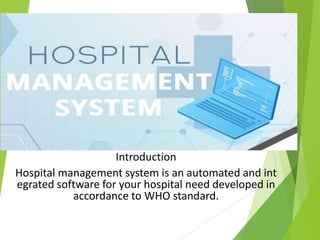
Hospital management system is an automated and int
egrated software for your hospital need developed in
accordance to WHO standard.
• It is aimed to record each and every transac
tion of your hospital and preserve securely.
• It established the paper less office and trans
mitt the data within the d department and
provide graphical presentation of data for t
he top management for analysis .
• Lesser dependence on middle and lower m
anagement
• Better Patient care with efficacy
Features
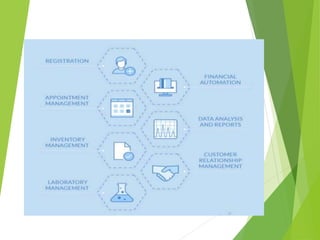
• Appointment and scheduling
• Electronic health record
• Accounting management
• Doctor information
• Laboratory management
• Inventory management
• Telemedicine
Objectives of Hospital Man
agement System
• The hospital management system software i
s user friendly software. The main objective
of the system is which shows and help you t
o collect the most information about hospit
ality and medical serserserserservices.Other
objectives are as follows :
• Patients are easily allocated to doctor
• Docrores search is possible
• Today's patients list help doctor to search th
eir patients
• To have the possibility to access informati
on from any location at anytime.
• To provide tools for evaluating health care
cost and quality
• To have common registration of total patie
nt information at the point of each transac
tion .
• To recognise the health care provider as m
ajor user thus ease of use.
• To recognise that technology must meet t
he users application and needs.
Goals :
• To make the hospital / office paperless
• To enable the executives to make decisi
ons on a click of mouse.
• To improve decision making
• To build the hospital capacity for effectiv
e and efficient response .
• To enhance patients care
• To make technology add to the buttom -
line of the company
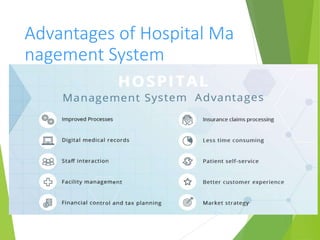
Advantages of Hospital Ma
nagement System
Hospital management system
Submitted By:
Suryakant
1819067
BPT 3rd Yr.
Submitted To:
Mr. Abhay Bindal
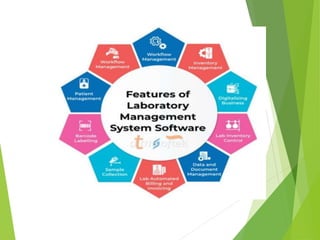
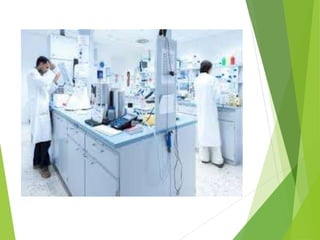
Laboratory module
 This aimed at viewing the prescribed test to the patients
by the doctor and to insert the details of the test reports .
It has the following functions:
 Examination details
 Viewpoint details
 Enter examination details
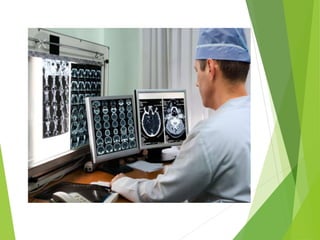
2) Radiology system:
It is most secured Radiology Systems Compatible for integration with a Web portal and mobile access. It
can be used for managing medical imagery, associated data, manage image archives, record-keeping, and
billing. It will help you to generate all kinds of reports such as C&S for microbiology, pathology,
biochemistry, etc.
3) Quality control laboratory management system :
Computer laboratory management also can incorporate internal control oversight over documents and
procedures in your lab. The software package can assist you to get in compliance with state laws and
keep that method with alerts once it's time to update very important procedures. You will run mock
audits to work out what areas of your workplace won't work and are in risk of failing state scrutiny.
Internal control software package will assist you to prepare your state-mandated documents within the
correct format thus you will print them for your files and state regulators.
4) laboratory data management system:
Computer workplace management extends on the far side provides inventory and staff. The specimens that
enter your workplace for analysis should even be tracked through your system, their results analyzed and
recorded, and therefore the reports distributed. This method will all be machine-controlled with a lab
management system. A system like this will increase potency, reduces risk of human error, and makes it
doable to instantly find a personal specimen throughout any step of the progress. A laboratory data
management system gets to take a look at results to a physician abundant faster and so is thought-about
important to patient health and recovery.
ASSIGNMENT ON
PHARMACY MODULE
INTRODUCTION
Pharmacy module
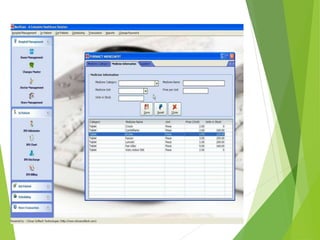
 Pharmacy module deals with the automation of general
workflow and administration management process of the
pharmacy. The pharmacy module is equipped with bar
coding facility, which makes the delivery of medical items
to the patient more efficient.
 This system involve information technology and
database as a repository of information that is useful in
managing the hospital, various tools needed to build a
reliable system.
 Pharmacy Modules deals with the activities such as :
 Enquiry
 Quotation
 Purchase order
 Online approval
 Pharmacy drug configuration
 Pharmacy stores configuration
 Drug issue to patient and billing
 Unit doses facility
 Supplier information
 Maintenance of drug inventory
 Automatic recorder level setting
 Purchase requisition
 Purchase order
 Online request for stock from various substores
 Online stock transfer
 Maintenance of stock at different substores
 Return of items nearing expiry
 Destruction of expired items
 Goods receipt
 Stock adjustment
 Stock in hand reports
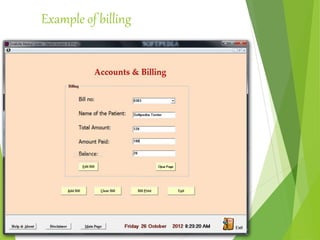
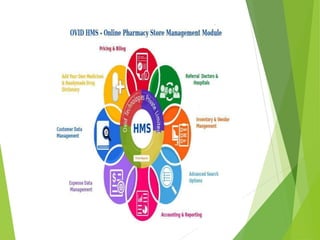
Billing in hospital management system
 Billing modules provides an efficient and error free
process to capture all the billable services rendered for a
patient, without any data loss thus ensuring that no
revenue is ever lost. It involves patient registration, test
conducted, doctor fee, ambulance and other charges.
 Before a patient is discharged they need to pay the entire
bill and management software provide error free and
speedy process. This system also provide automated
billing.
Types of billing in HMS
1. Registration and consulting billing
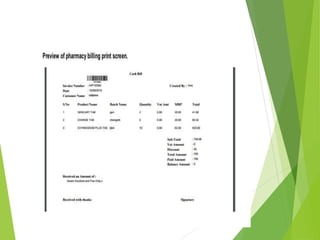
2. Pharmacy billing
3. Laboratory billing
4. In patient billing
Example of billing
Key features of billing
 Items levels or complete cancellation of bills generated.
 Patient level ledger for each patient.
 Clinical actions auto trigger charges
 No discretion on deciding billing amount or discount at billing counter.
 Handles complete management.
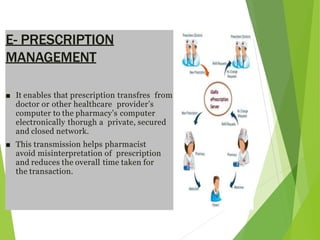
E- PRESCRIPTION
MANAGEMENT
■ It enables that prescription transfres from
doctor or other healthcare provider’s
computer to the pharmacy’s computer
electronically thorugh a private, secured
and closed network.
■ This transmission helps pharmacist
avoid misinterpretation of prescription
and reduces the overall time taken for
the transaction.
BILLING IN HMS
■ It is the most essential
module in hospital
management system.
■ It helps to manage both
insurance needs as well as
patient payment reliably
whuch not included in
other software.
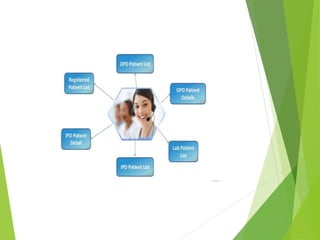
Help desk module
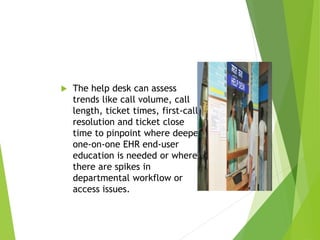
 The help desk can assess
trends like call volume, call
length, ticket times, first-call
resolution and ticket close
time to pinpoint where deeper
one-on-one EHR end-user
education is needed or where
there are spikes in
departmental workflow or
access issues.
Nurse module
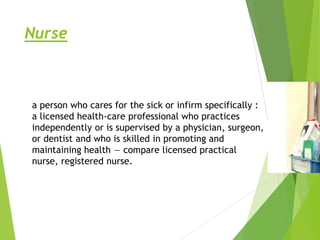
Nurse
a person who cares for the sick or infirm specifically :
a licensed health-care professional who practices
independently or is supervised by a physician, surgeon,
or dentist and who is skilled in promoting and
maintaining health — compare licensed practical
nurse, registered nurse.
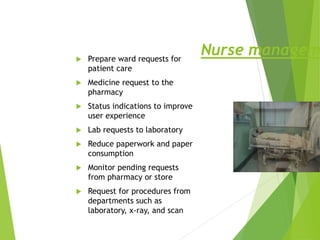
Nurse managem
 Prepare ward requests for
patient care
 Medicine request to the
pharmacy
 Status indications to improve
user experience
 Lab requests to laboratory
 Reduce paperwork and paper
consumption
 Monitor pending requests
from pharmacy or store
 Request for procedures from
departments such as
laboratory, x-ray, and scan
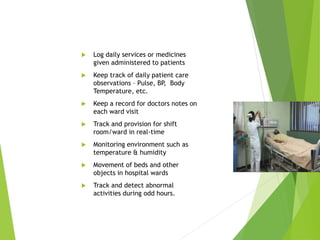
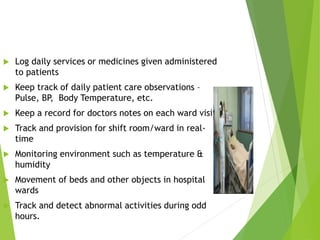
 Log daily services or medicines
given administered to patients
 Keep track of daily patient care
observations – Pulse, BP, Body
Temperature, etc.
 Keep a record for doctors notes on
each ward visit
 Track and provision for shift
room/ward in real-time
 Monitoring environment such as
temperature & humidity
 Movement of beds and other
objects in hospital wards
 Track and detect abnormal
activities during odd hours.
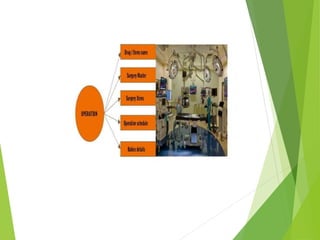
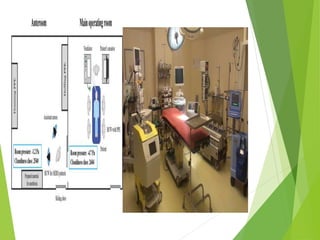
Operation
theatre
module
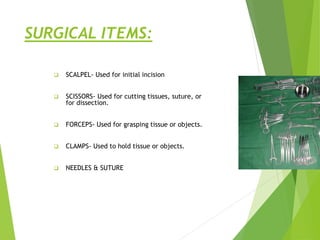
SURGICAL ITEMS:
 SCALPEL- Used for initial incision
 SCISSORS- Used for cutting tissues, suture, or
for dissection.
 FORCEPS- Used for grasping tissue or objects.
 CLAMPS- Used to hold tissue or objects.
 NEEDLES & SUTURE
 Log daily services or medicines given administered
to patients
 Keep track of daily patient care observations –
Pulse, BP, Body Temperature, etc.
 Keep a record for doctors notes on each ward visit
 Track and provision for shift room/ward in real-
time
 Monitoring environment such as temperature &
humidity
 Movement of beds and other objects in hospital
wards
 Track and detect abnormal activities during odd
hours.
5. Vehicle module
Ambulance
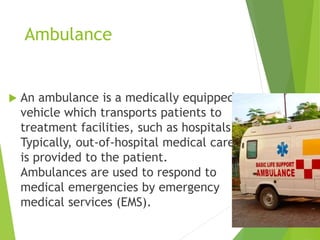
 An ambulance is a medically equipped
vehicle which transports patients to
treatment facilities, such as hospitals.
Typically, out-of-hospital medical care
is provided to the patient.
Ambulances are used to respond to
medical emergencies by emergency
medical services (EMS).
Types
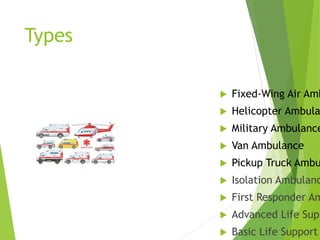
 Fixed-Wing Air Amb
 Helicopter Ambula
 Military Ambulance
 Van Ambulance
 Pickup Truck Ambu
 Isolation Ambulanc
 First Responder Am
 Advanced Life Supp
 Basic Life Support
setup
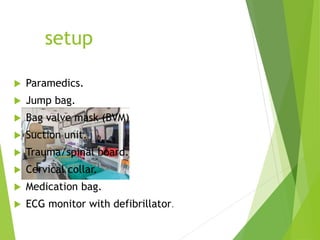
 Paramedics.
 Jump bag.
 Bag valve mask (BVM)
 Suction unit.
 Trauma/spinal board.
 Cervical collar.
 Medication bag.
 ECG monitor with defibrillator.
Thank you

HMS Suryakant 1819067.pptx

  • 1.
    M M IP R
  • 2.
    Assignment of comp uter TOPIC: Hospital Manageme nt system Submitted To. Submitted By. Abhay Bindal sir. Suryakant 1819067 BPT 3rd year
  • 3.
    Content . Introduction . Features .Objectives . Goals . Advantages . Modules
  • 4.
    Introduction Hospital management systemis an automated and int egrated software for your hospital need developed in accordance to WHO standard.
  • 5.
    • It isaimed to record each and every transac tion of your hospital and preserve securely. • It established the paper less office and trans mitt the data within the d department and provide graphical presentation of data for t he top management for analysis . • Lesser dependence on middle and lower m anagement • Better Patient care with efficacy
  • 7.
    Features • Appointment andscheduling • Electronic health record • Accounting management • Doctor information • Laboratory management • Inventory management • Telemedicine
  • 8.
    Objectives of HospitalMan agement System • The hospital management system software i s user friendly software. The main objective of the system is which shows and help you t o collect the most information about hospit ality and medical serserserserservices.Other objectives are as follows : • Patients are easily allocated to doctor • Docrores search is possible • Today's patients list help doctor to search th eir patients
  • 9.
    • To havethe possibility to access informati on from any location at anytime. • To provide tools for evaluating health care cost and quality • To have common registration of total patie nt information at the point of each transac tion . • To recognise the health care provider as m ajor user thus ease of use. • To recognise that technology must meet t he users application and needs.
  • 10.
    Goals : • Tomake the hospital / office paperless • To enable the executives to make decisi ons on a click of mouse. • To improve decision making • To build the hospital capacity for effectiv e and efficient response . • To enhance patients care • To make technology add to the buttom - line of the company
  • 11.
    Advantages of HospitalMa nagement System
  • 12.
    Hospital management system SubmittedBy: Suryakant 1819067 BPT 3rd Yr. Submitted To: Mr. Abhay Bindal
  • 13.
    Laboratory module  Thisaimed at viewing the prescribed test to the patients by the doctor and to insert the details of the test reports . It has the following functions:  Examination details  Viewpoint details  Enter examination details
  • 17.
    2) Radiology system: Itis most secured Radiology Systems Compatible for integration with a Web portal and mobile access. It can be used for managing medical imagery, associated data, manage image archives, record-keeping, and billing. It will help you to generate all kinds of reports such as C&S for microbiology, pathology, biochemistry, etc.
  • 19.
    3) Quality controllaboratory management system : Computer laboratory management also can incorporate internal control oversight over documents and procedures in your lab. The software package can assist you to get in compliance with state laws and keep that method with alerts once it's time to update very important procedures. You will run mock audits to work out what areas of your workplace won't work and are in risk of failing state scrutiny. Internal control software package will assist you to prepare your state-mandated documents within the correct format thus you will print them for your files and state regulators.
  • 21.
    4) laboratory datamanagement system: Computer workplace management extends on the far side provides inventory and staff. The specimens that enter your workplace for analysis should even be tracked through your system, their results analyzed and recorded, and therefore the reports distributed. This method will all be machine-controlled with a lab management system. A system like this will increase potency, reduces risk of human error, and makes it doable to instantly find a personal specimen throughout any step of the progress. A laboratory data management system gets to take a look at results to a physician abundant faster and so is thought-about important to patient health and recovery.
  • 23.
  • 24.
    INTRODUCTION Pharmacy module  Pharmacymodule deals with the automation of general workflow and administration management process of the pharmacy. The pharmacy module is equipped with bar coding facility, which makes the delivery of medical items to the patient more efficient.  This system involve information technology and database as a repository of information that is useful in managing the hospital, various tools needed to build a reliable system.
  • 26.
     Pharmacy Modulesdeals with the activities such as :  Enquiry  Quotation  Purchase order  Online approval  Pharmacy drug configuration  Pharmacy stores configuration  Drug issue to patient and billing
  • 27.
     Unit dosesfacility  Supplier information  Maintenance of drug inventory  Automatic recorder level setting  Purchase requisition  Purchase order  Online request for stock from various substores  Online stock transfer
  • 28.
     Maintenance ofstock at different substores  Return of items nearing expiry  Destruction of expired items  Goods receipt  Stock adjustment  Stock in hand reports
  • 29.
    Billing in hospitalmanagement system  Billing modules provides an efficient and error free process to capture all the billable services rendered for a patient, without any data loss thus ensuring that no revenue is ever lost. It involves patient registration, test conducted, doctor fee, ambulance and other charges.  Before a patient is discharged they need to pay the entire bill and management software provide error free and speedy process. This system also provide automated billing.
  • 30.
    Types of billingin HMS 1. Registration and consulting billing 2. Pharmacy billing 3. Laboratory billing 4. In patient billing
  • 31.
  • 32.
    Key features ofbilling  Items levels or complete cancellation of bills generated.  Patient level ledger for each patient.  Clinical actions auto trigger charges  No discretion on deciding billing amount or discount at billing counter.  Handles complete management.
  • 35.
    E- PRESCRIPTION MANAGEMENT ■ Itenables that prescription transfres from doctor or other healthcare provider’s computer to the pharmacy’s computer electronically thorugh a private, secured and closed network. ■ This transmission helps pharmacist avoid misinterpretation of prescription and reduces the overall time taken for the transaction.
  • 36.
    BILLING IN HMS ■It is the most essential module in hospital management system. ■ It helps to manage both insurance needs as well as patient payment reliably whuch not included in other software.
  • 37.
  • 38.
     The helpdesk can assess trends like call volume, call length, ticket times, first-call resolution and ticket close time to pinpoint where deeper one-on-one EHR end-user education is needed or where there are spikes in departmental workflow or access issues.
  • 40.
  • 41.
    Nurse a person whocares for the sick or infirm specifically : a licensed health-care professional who practices independently or is supervised by a physician, surgeon, or dentist and who is skilled in promoting and maintaining health — compare licensed practical nurse, registered nurse.
  • 42.
    Nurse managem  Prepareward requests for patient care  Medicine request to the pharmacy  Status indications to improve user experience  Lab requests to laboratory  Reduce paperwork and paper consumption  Monitor pending requests from pharmacy or store  Request for procedures from departments such as laboratory, x-ray, and scan
  • 43.
     Log dailyservices or medicines given administered to patients  Keep track of daily patient care observations – Pulse, BP, Body Temperature, etc.  Keep a record for doctors notes on each ward visit  Track and provision for shift room/ward in real-time  Monitoring environment such as temperature & humidity  Movement of beds and other objects in hospital wards  Track and detect abnormal activities during odd hours.
  • 44.
  • 46.
    SURGICAL ITEMS:  SCALPEL-Used for initial incision  SCISSORS- Used for cutting tissues, suture, or for dissection.  FORCEPS- Used for grasping tissue or objects.  CLAMPS- Used to hold tissue or objects.  NEEDLES & SUTURE
  • 48.
     Log dailyservices or medicines given administered to patients  Keep track of daily patient care observations – Pulse, BP, Body Temperature, etc.  Keep a record for doctors notes on each ward visit  Track and provision for shift room/ward in real- time  Monitoring environment such as temperature & humidity  Movement of beds and other objects in hospital wards  Track and detect abnormal activities during odd hours.
  • 49.
  • 50.
    Ambulance  An ambulanceis a medically equipped vehicle which transports patients to treatment facilities, such as hospitals. Typically, out-of-hospital medical care is provided to the patient. Ambulances are used to respond to medical emergencies by emergency medical services (EMS).
  • 51.
    Types  Fixed-Wing AirAmb  Helicopter Ambula  Military Ambulance  Van Ambulance  Pickup Truck Ambu  Isolation Ambulanc  First Responder Am  Advanced Life Supp  Basic Life Support
  • 52.
    setup  Paramedics.  Jumpbag.  Bag valve mask (BVM)  Suction unit.  Trauma/spinal board.  Cervical collar.  Medication bag.  ECG monitor with defibrillator.
  • 54.