Hive User Group Meeting August 2009
Hive Overview
Why Another Data Warehousing System? Data, data and more data 200GB per day in March 2008  5+TB(compressed) raw data per day today
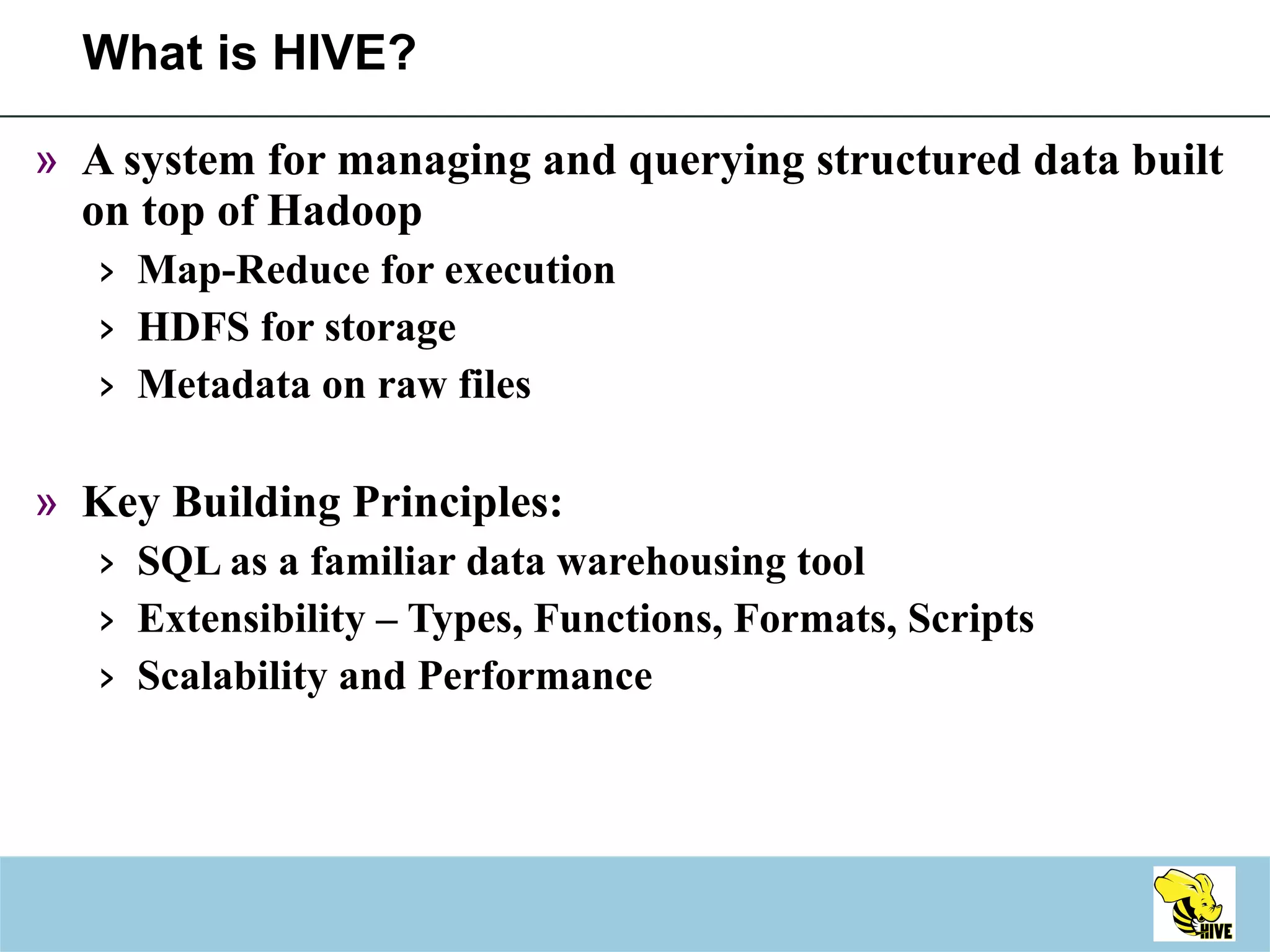
What is HIVE? A system for managing and querying structured data built on top of Hadoop Map-Reduce for execution HDFS for storage Metadata on raw files Key Building Principles: SQL as a familiar data warehousing tool Extensibility – Types, Functions, Formats, Scripts Scalability and Performance
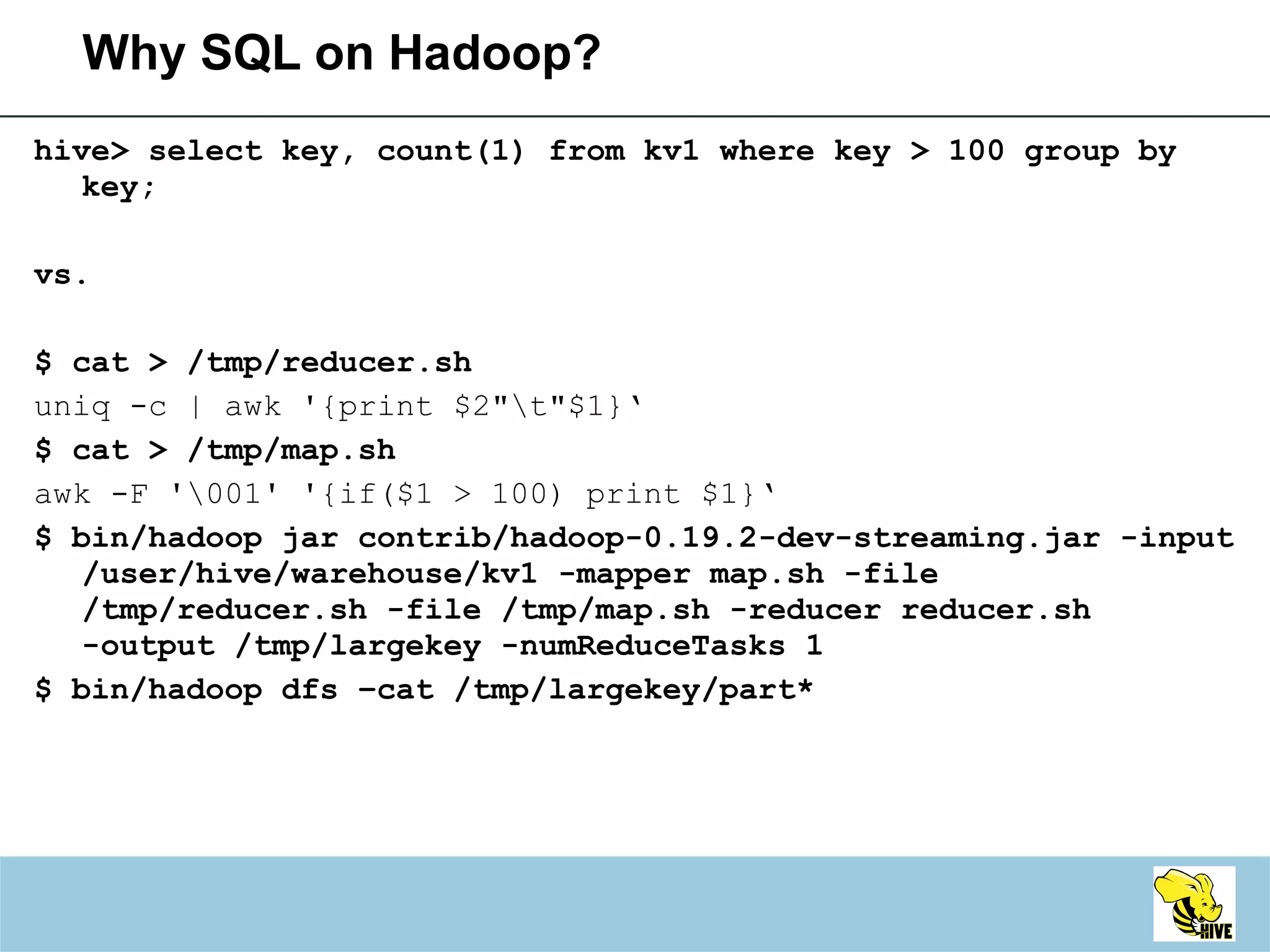
Why SQL on Hadoop? hive> select key, count(1) from kv1 where key > 100 group by key; vs. $ cat > /tmp/reducer.sh uniq -c | awk '{print $2"\t"$1}‘ $ cat > /tmp/map.sh awk -F '\001' '{if($1 > 100) print $1}‘ $ bin/hadoop jar contrib/hadoop-0.19.2-dev-streaming.jar -input /user/hive/warehouse/kv1 -mapper map.sh -file /tmp/reducer.sh -file /tmp/map.sh -reducer reducer.sh -output /tmp/largekey -numReduceTasks 1  $ bin/hadoop dfs –cat /tmp/largekey/part*
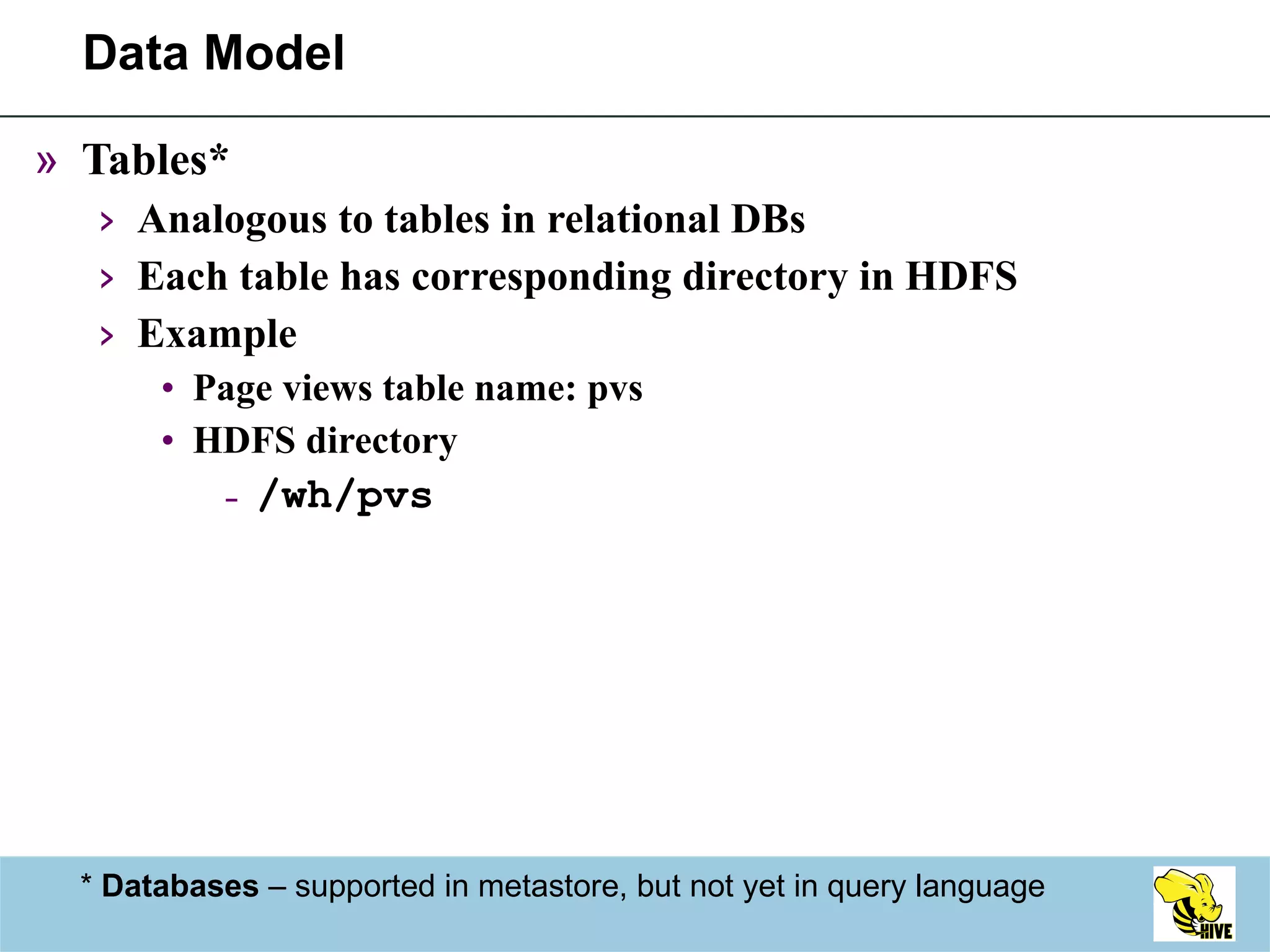
Data Model Tables*  Analogous to tables in relational DBs Each table has corresponding directory in HDFS Example Page views table name: pvs HDFS directory /wh/pvs *  Databases  – supported in metastore, but not yet in query language
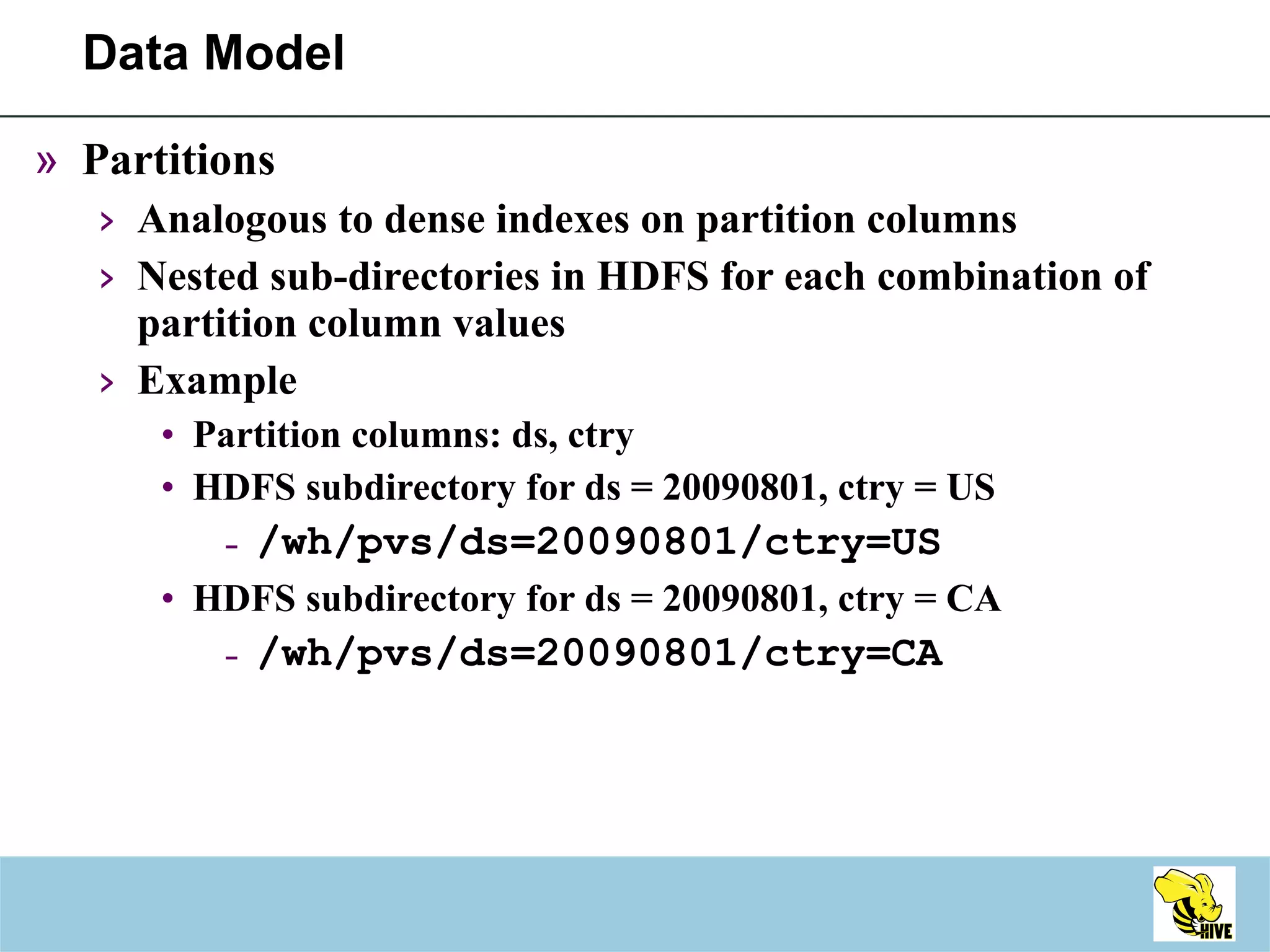
Data Model Partitions  Analogous to dense indexes on partition columns Nested sub-directories in HDFS for each combination of partition column values Example Partition columns: ds, ctry HDFS subdirectory for ds = 20090801, ctry = US /wh/pvs/ds=20090801/ctry=US HDFS subdirectory for ds = 20090801, ctry = CA /wh/pvs/ds=20090801/ctry=CA
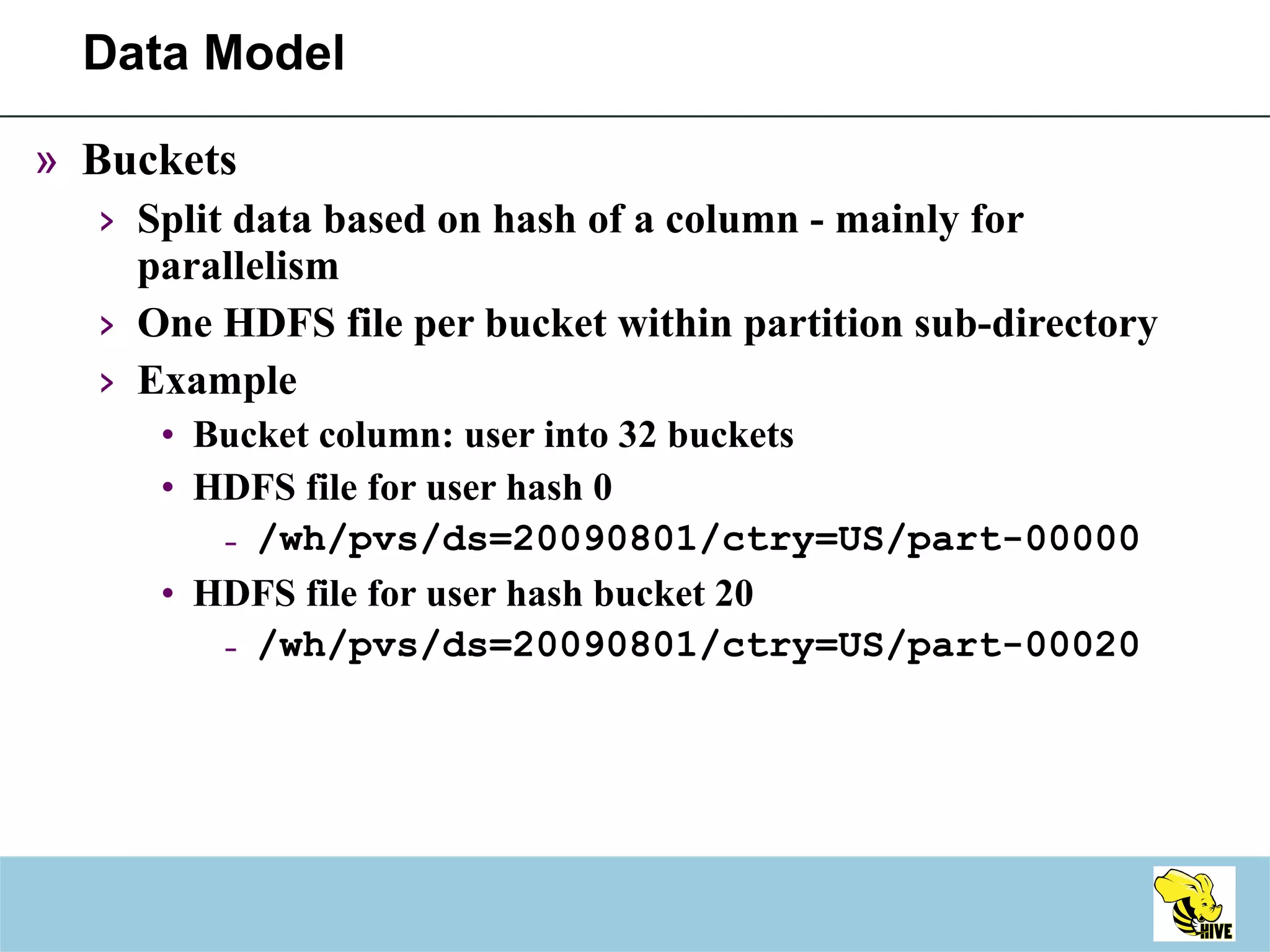
Data Model Buckets  Split data based on hash of a column - mainly for parallelism One HDFS file per bucket within partition sub-directory Example Bucket column: user into 32 buckets HDFS file for user hash 0 /wh/pvs/ds=20090801/ctry=US/part-00000 HDFS file for user hash bucket 20 /wh/pvs/ds=20090801/ctry=US/part-00020
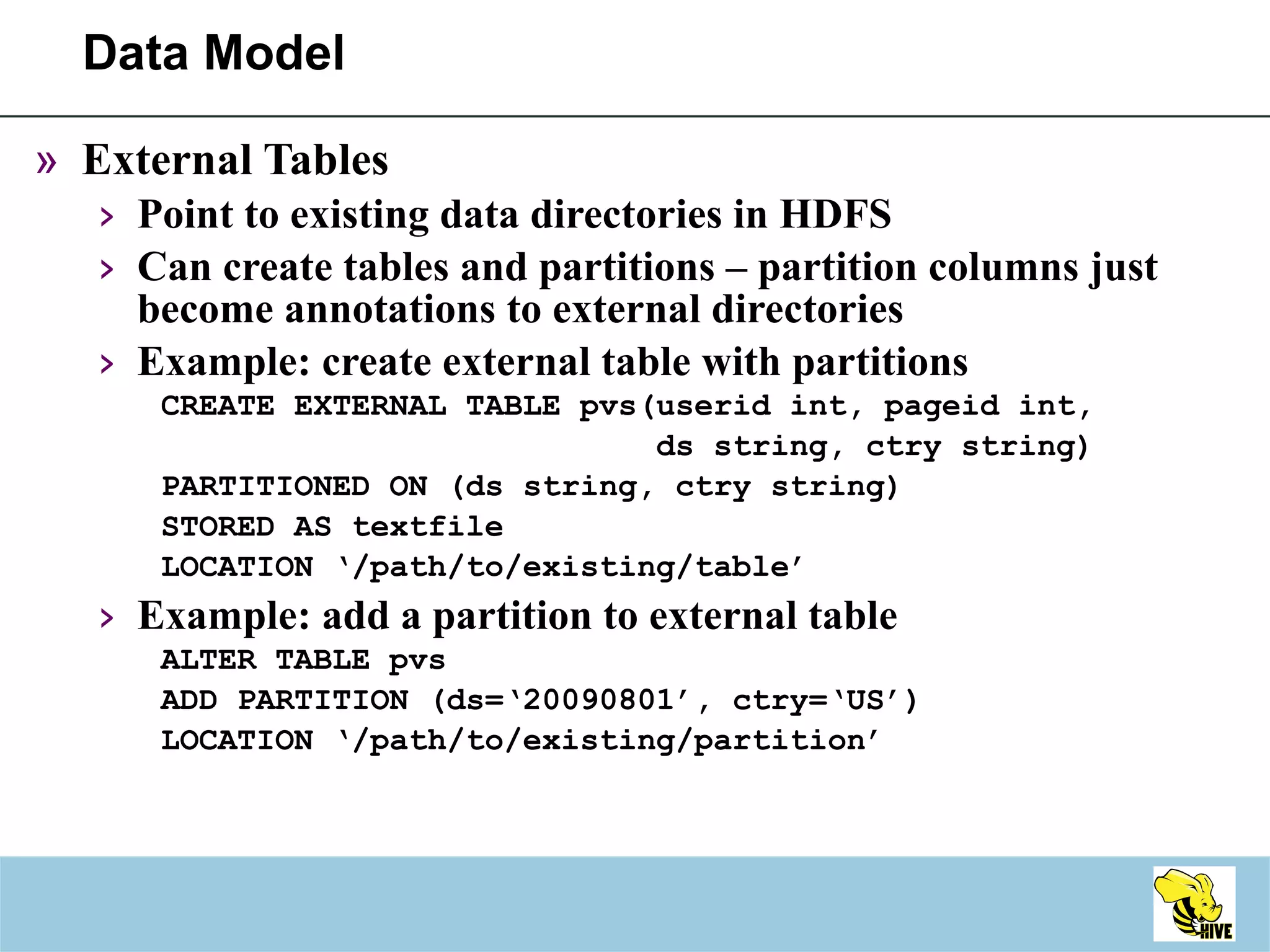
Data Model External Tables Point to existing data directories in HDFS Can create tables and partitions – partition columns just become annotations to external directories Example: create external table with partitions CREATE EXTERNAL TABLE pvs(userid int, pageid int,  ds string, ctry string)  PARTITIONED ON (ds string, ctry string) STORED AS textfile LOCATION ‘/path/to/existing/table’ Example: add a partition to external table ALTER TABLE pvs  ADD PARTITION (ds=‘20090801’, ctry=‘US’) LOCATION ‘/path/to/existing/partition’
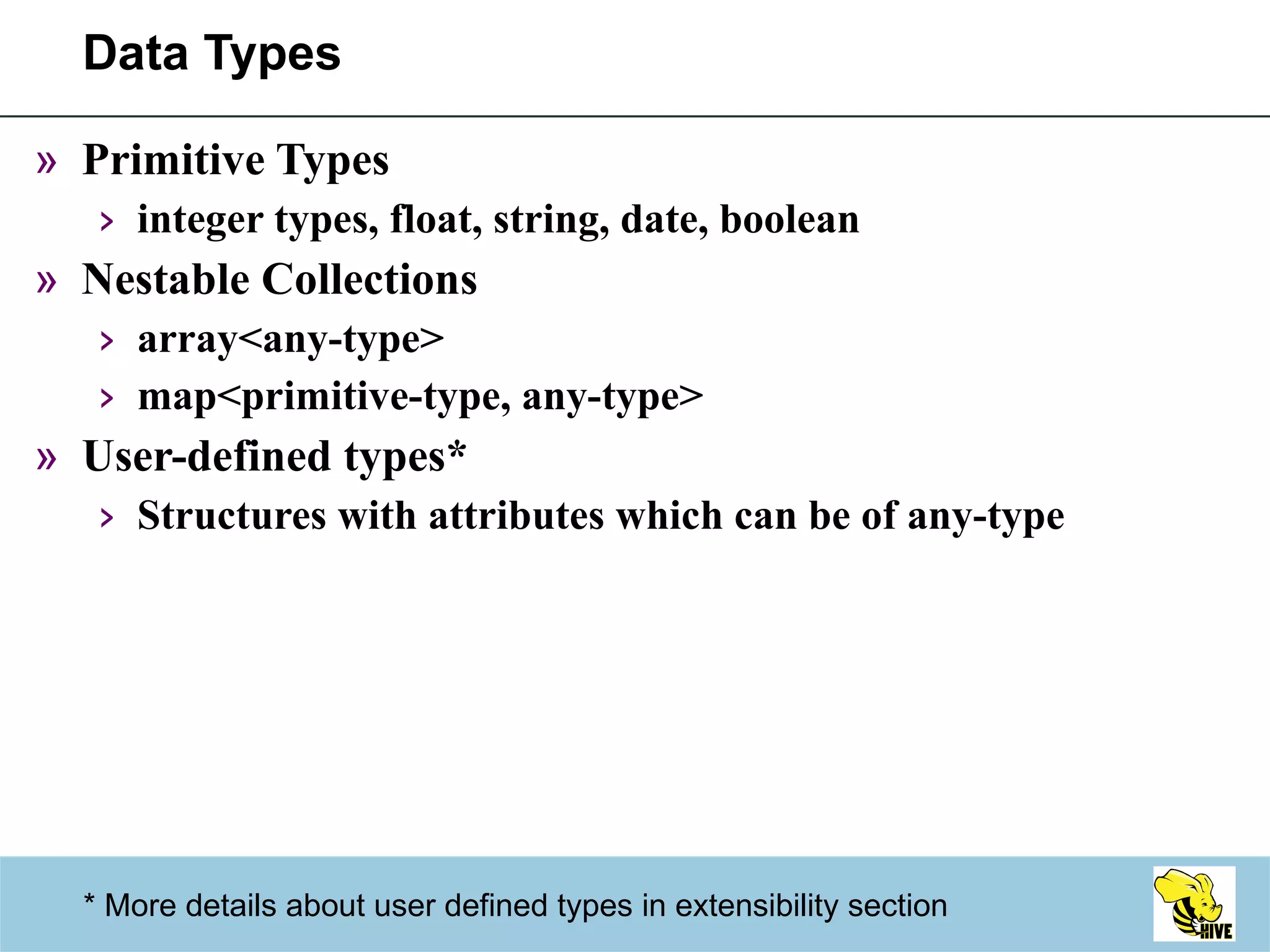
Data Types Primitive Types integer types, float, string, date, boolean Nestable Collections array<any-type> map<primitive-type, any-type> User-defined types* Structures with attributes which can be of any-type * More details about user defined types in extensibility section
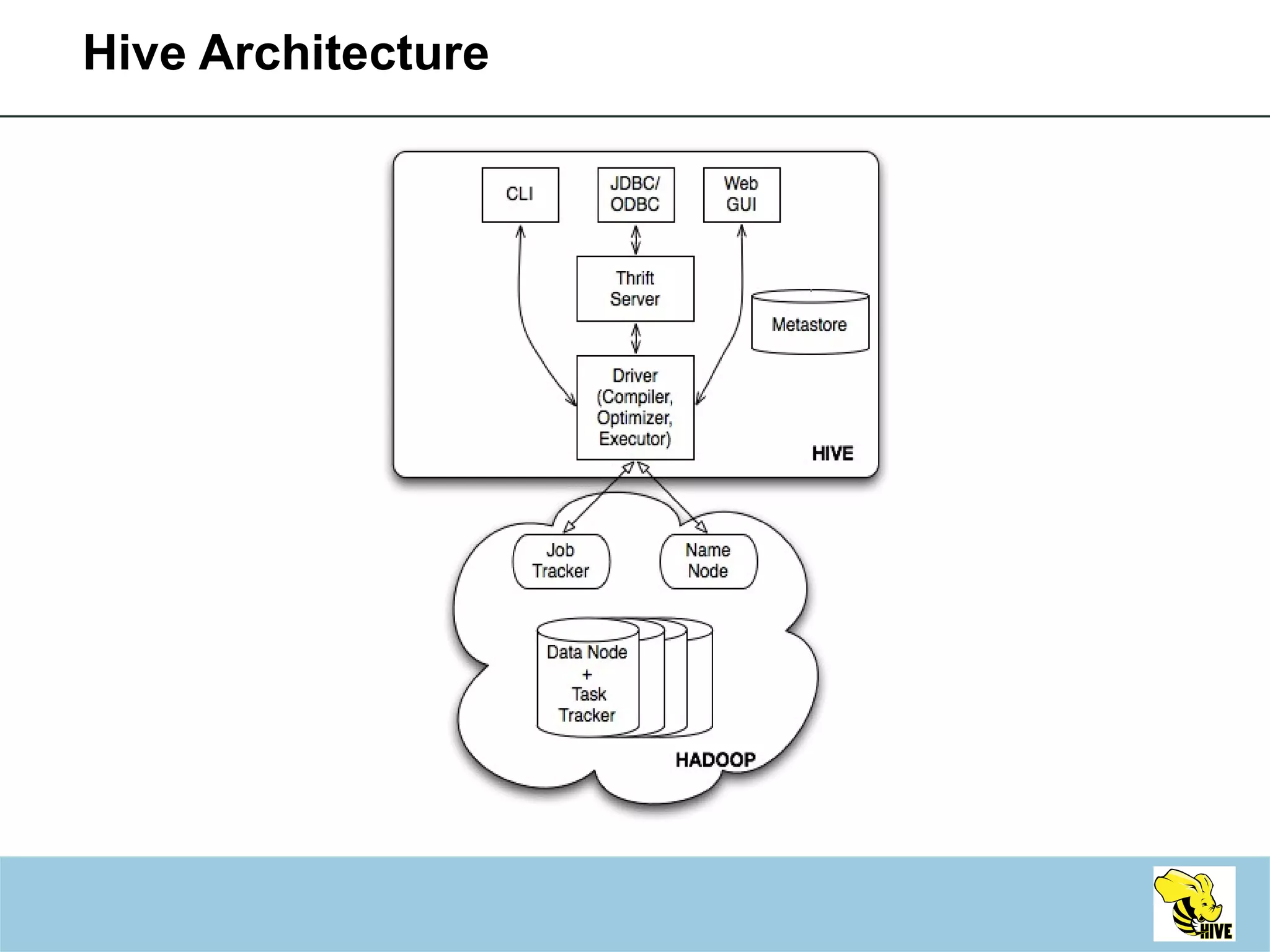
Hive Architecture
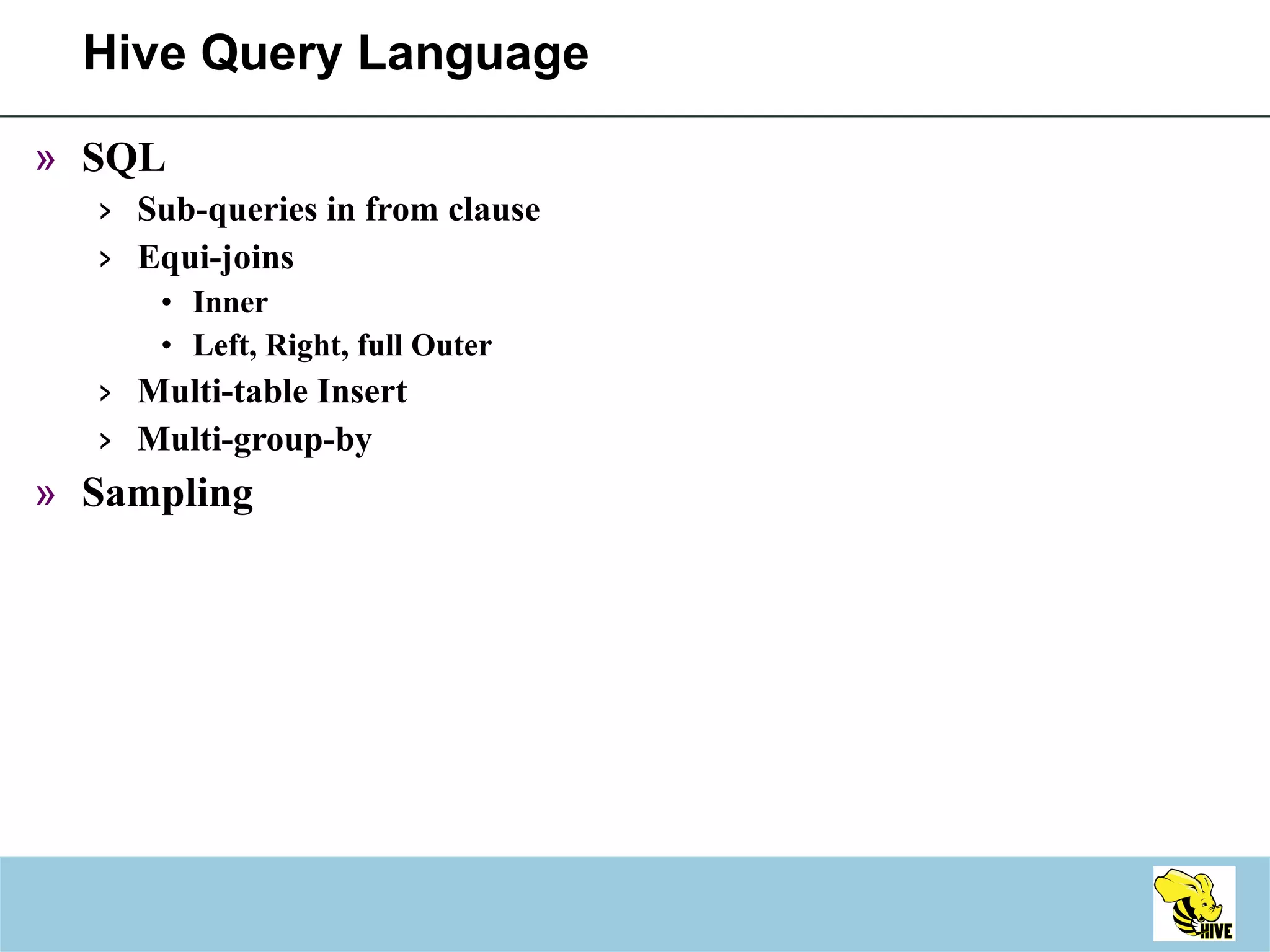
Hive Query Language SQL Sub-queries in from clause Equi-joins Inner Left, Right, full Outer Multi-table Insert Multi-group-by Sampling
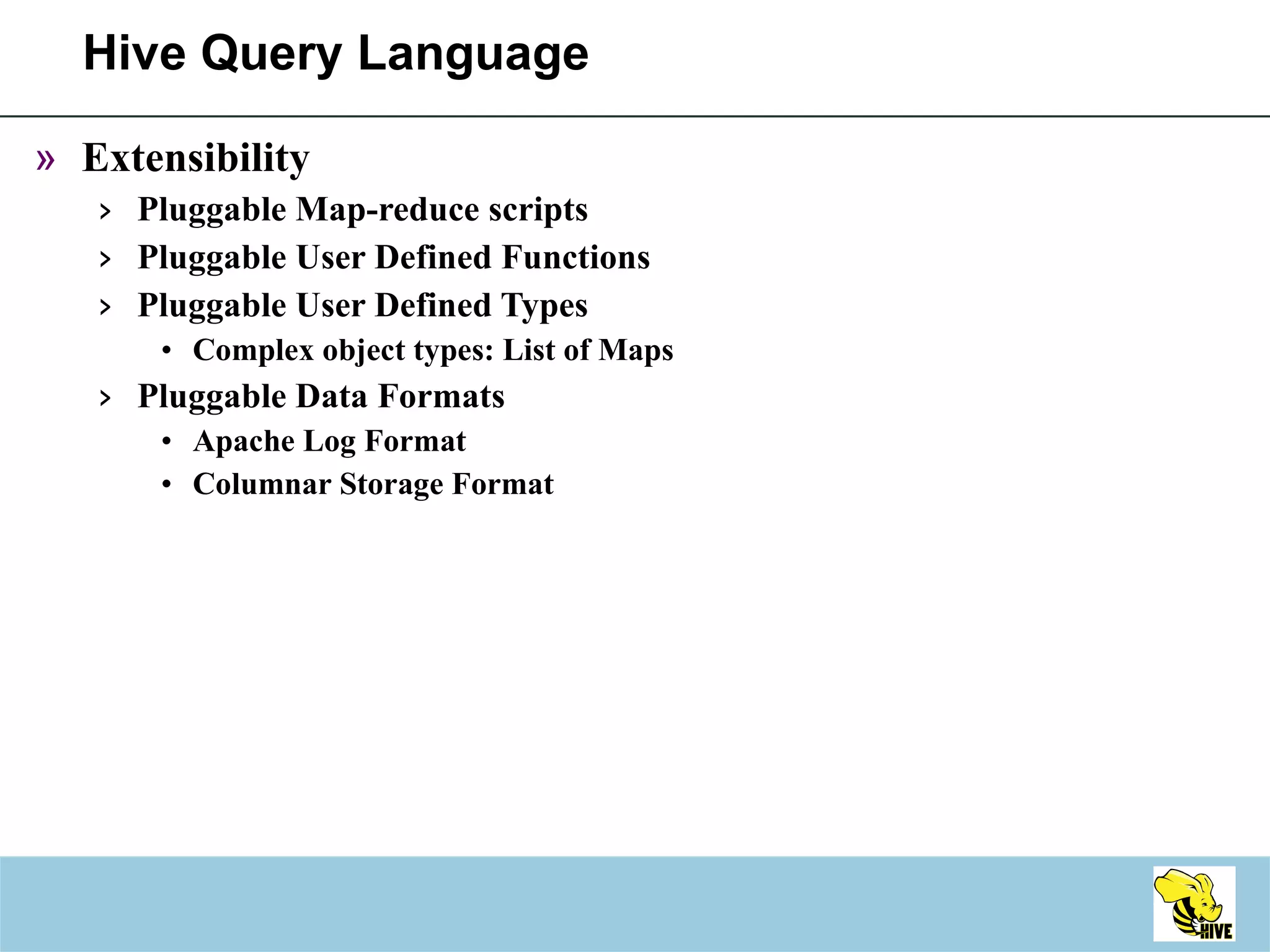
Hive Query Language Extensibility Pluggable Map-reduce scripts Pluggable User Defined Functions Pluggable User Defined Types Complex object types: List of Maps Pluggable Data Formats Apache Log Format Columnar Storage Format
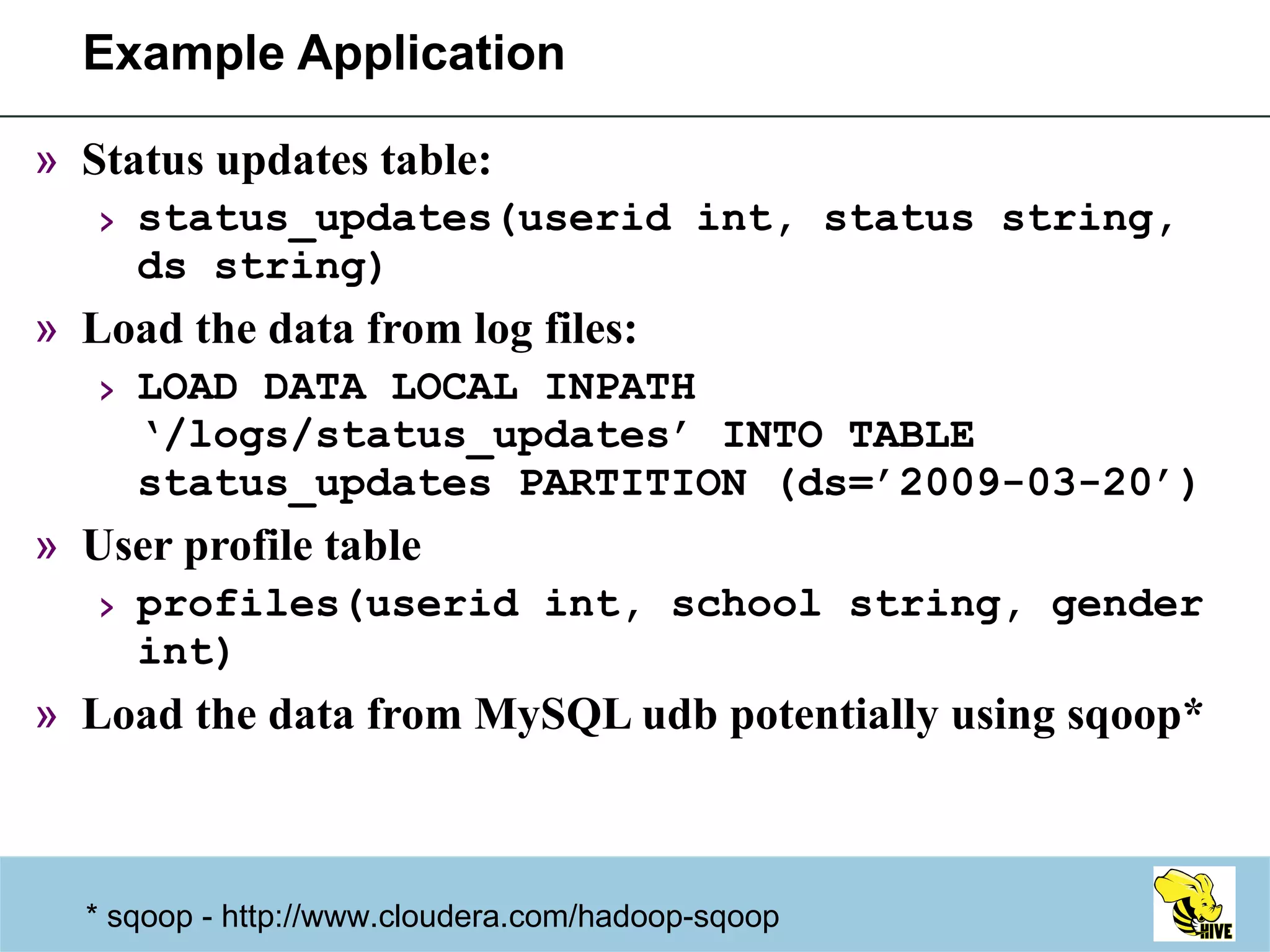
Example Application Status updates table: status_updates(userid int, status string, ds string) Load the data from log files: LOAD DATA LOCAL INPATH ‘/logs/status_updates’ INTO TABLE status_updates PARTITION (ds=’2009-03-20’) User profile table profiles(userid int, school string, gender int) Load the data from MySQL udb potentially using sqoop* * sqoop - http://www.cloudera.com/hadoop-sqoop
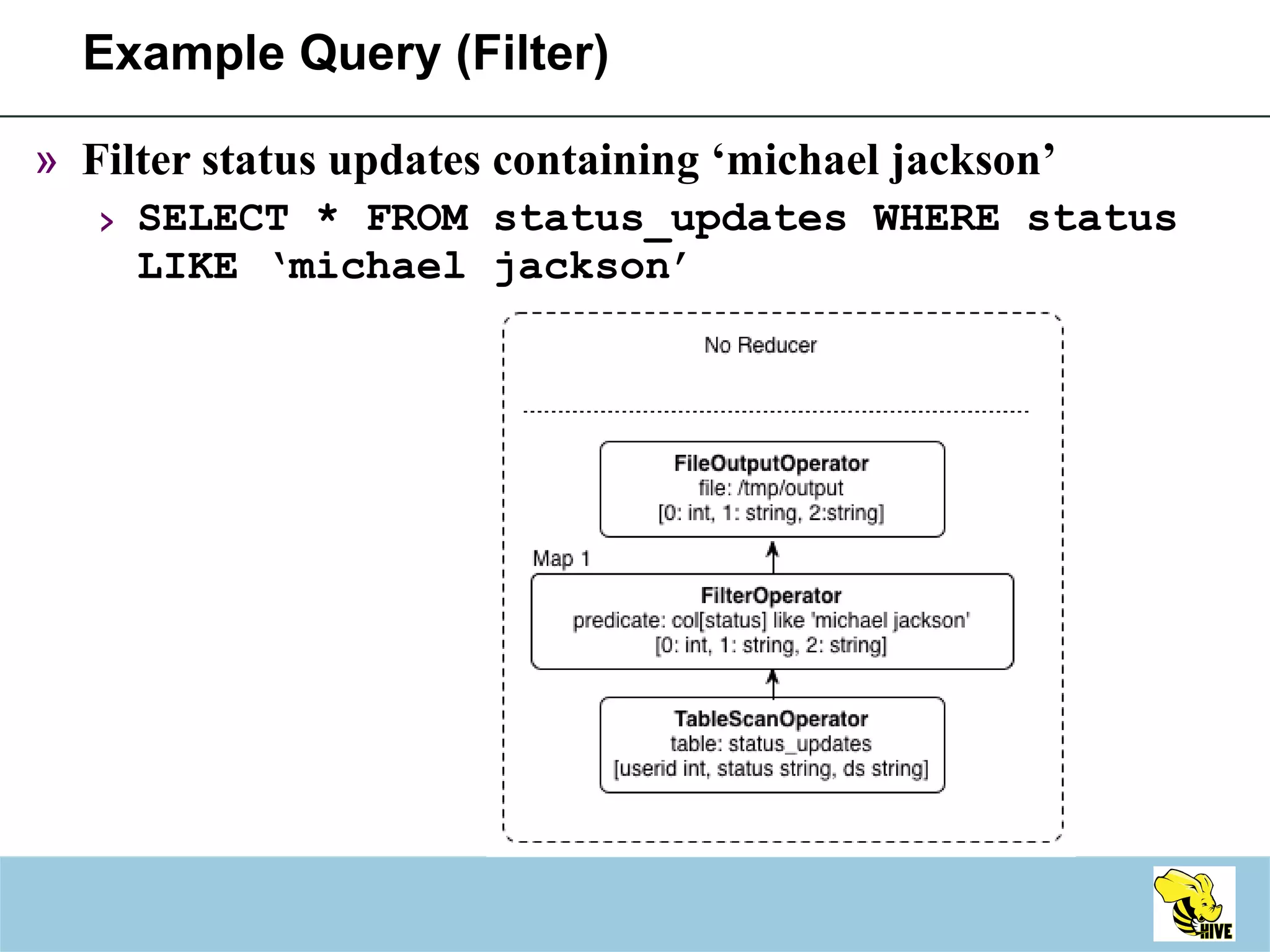
Example Query (Filter) Filter status updates containing ‘michael jackson’ SELECT * FROM status_updates WHERE status LIKE ‘michael jackson’
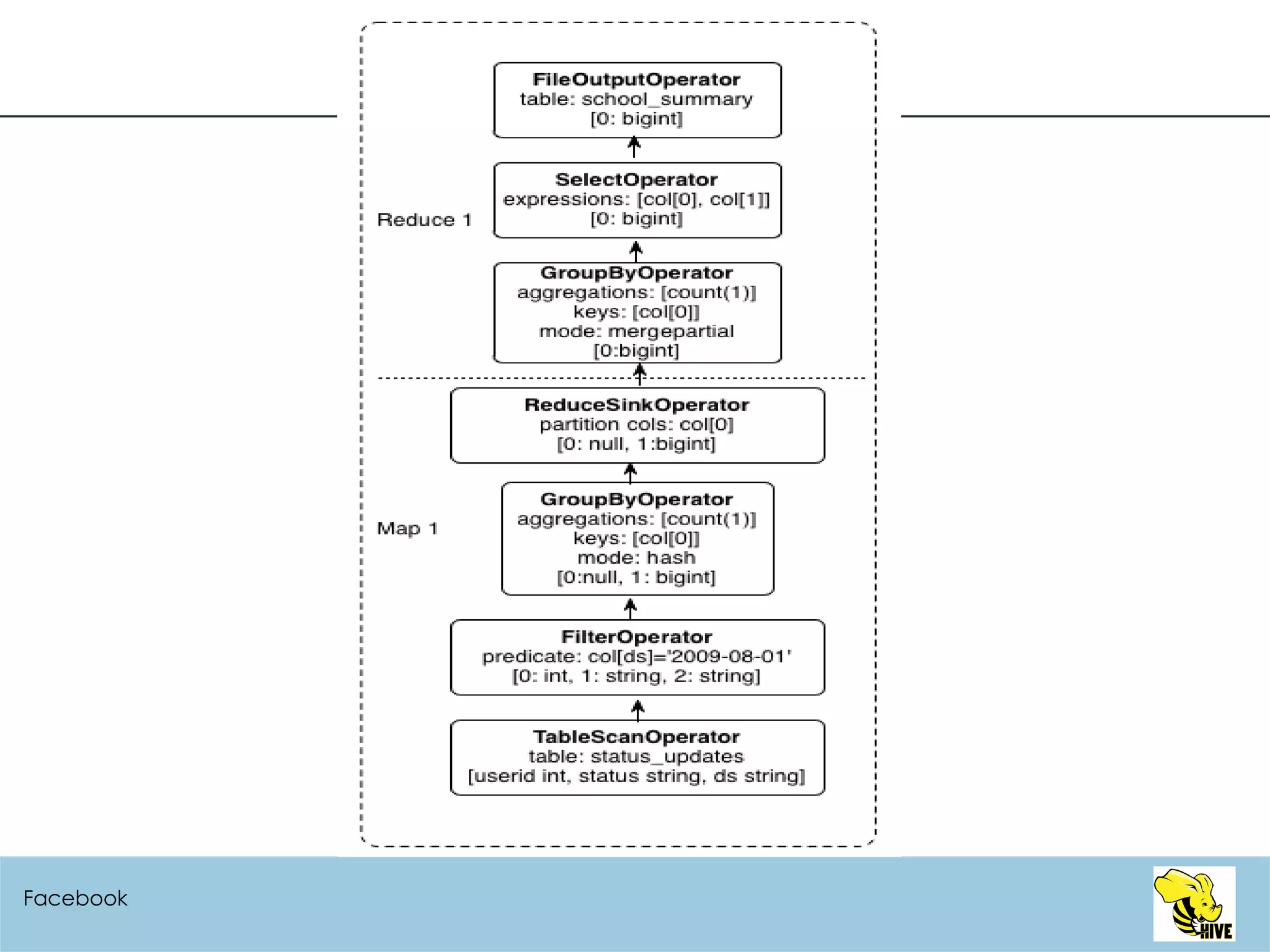
Example Query (Aggregation) Figure out total number of status_updates in a given day SELECT COUNT(1) FROM status_updates WHERE ds = ’2009-08-01’
Facebook
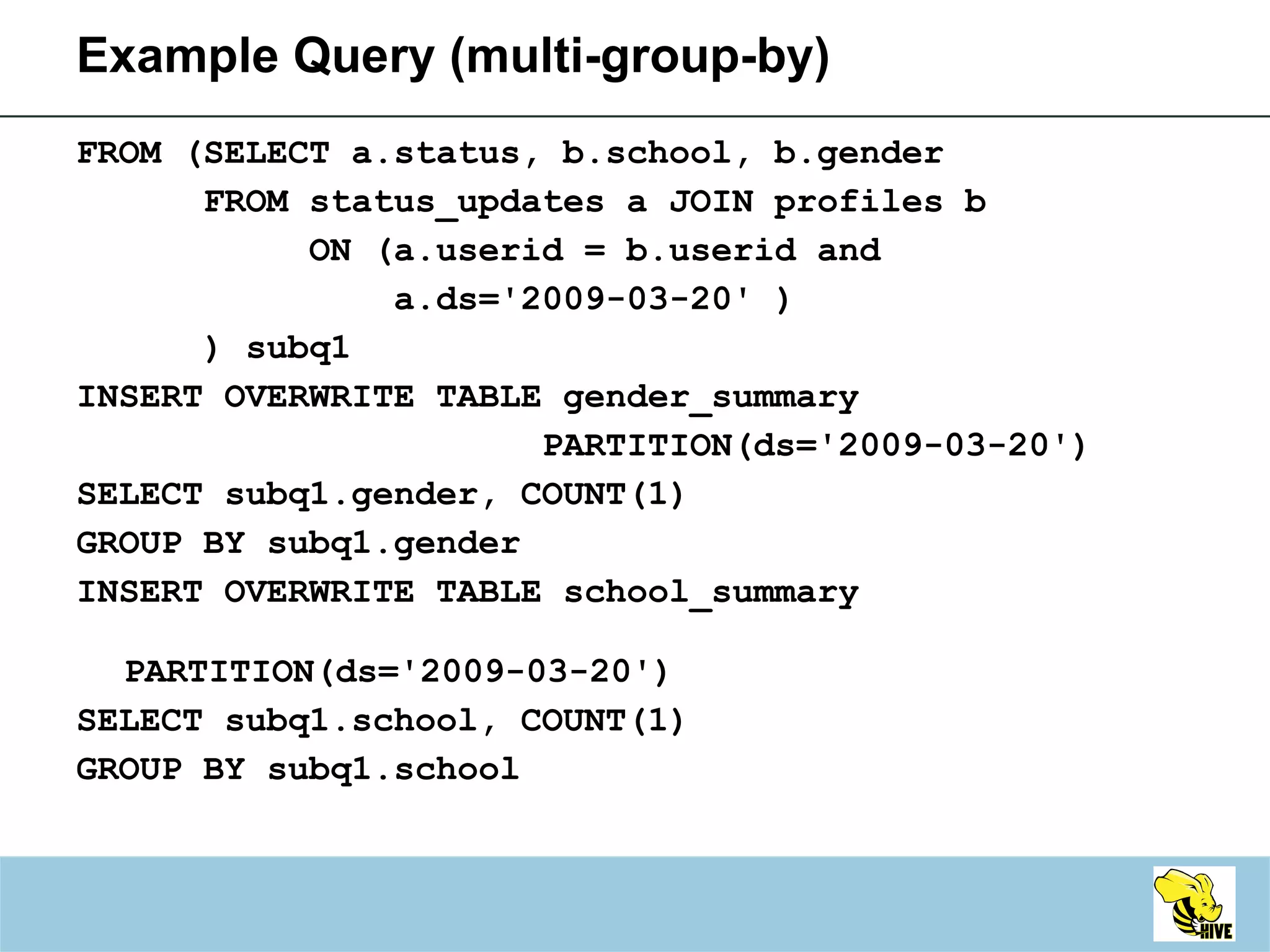
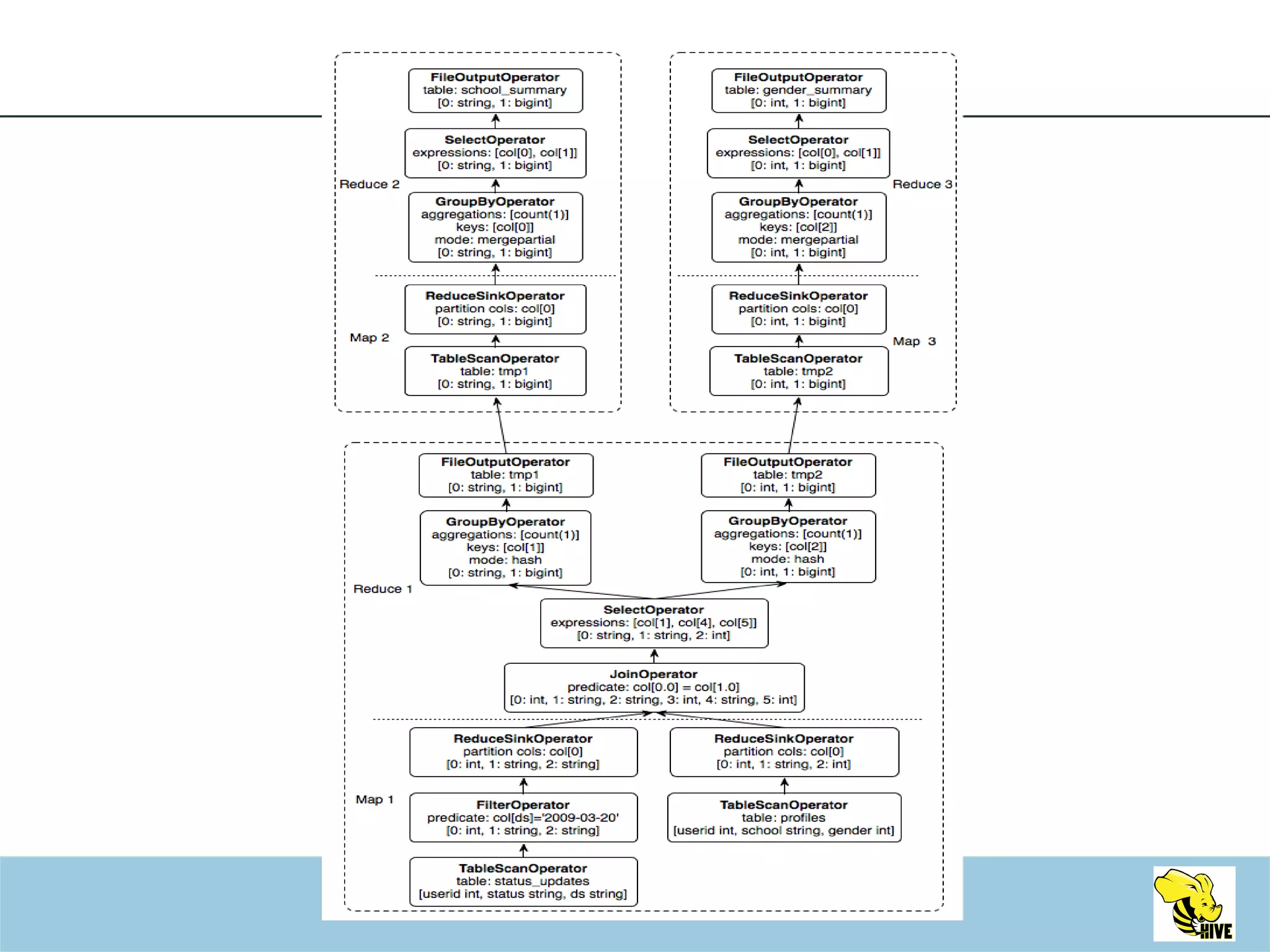
Next example query combines group-by, joins and multi-table inserts. Facebook
FROM (SELECT a.status, b.school, b.gender  FROM status_updates a JOIN profiles b  ON (a.userid = b.userid and  a.ds='2009-03-20' ) ) subq1 INSERT OVERWRITE TABLE gender_summary PARTITION(ds='2009-03-20') SELECT subq1.gender, COUNT(1)  GROUP BY subq1.gender INSERT OVERWRITE TABLE school_summary   PARTITION(ds='2009-03-20') SELECT subq1.school, COUNT(1) GROUP BY subq1.school Example Query (multi-group-by)
 
Hive Metastore
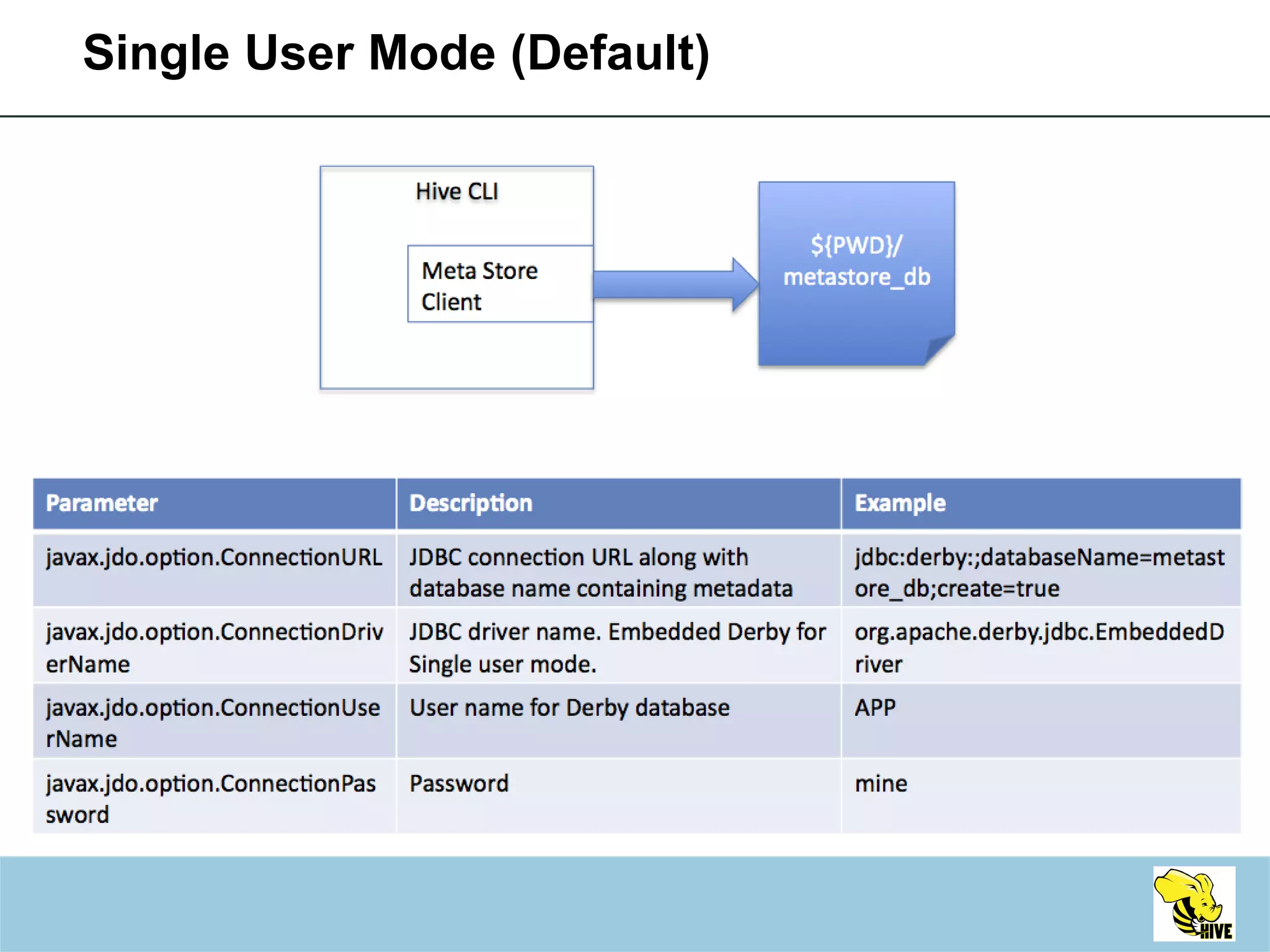
Single User Mode (Default)
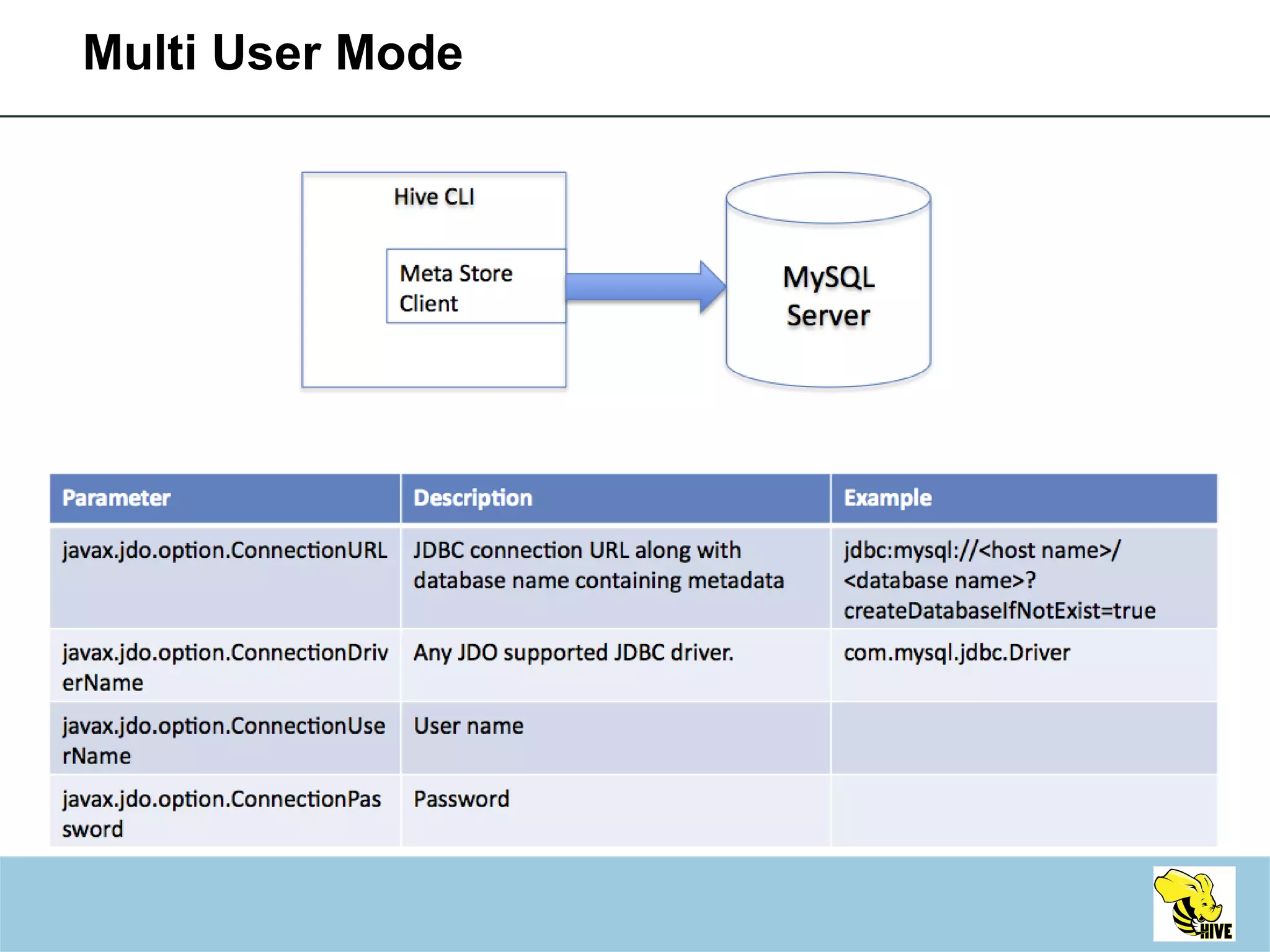
Multi User Mode
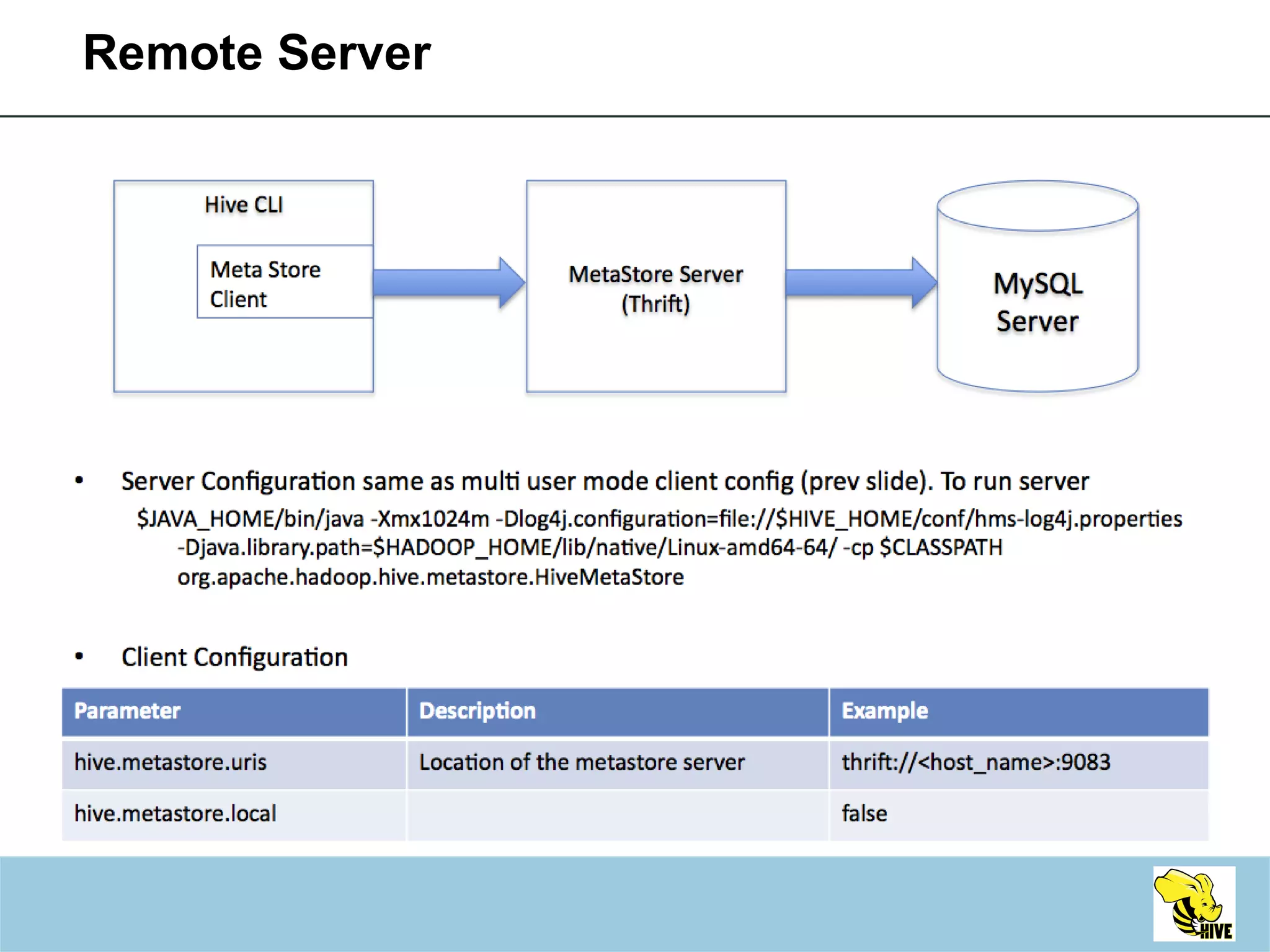
Remote Server
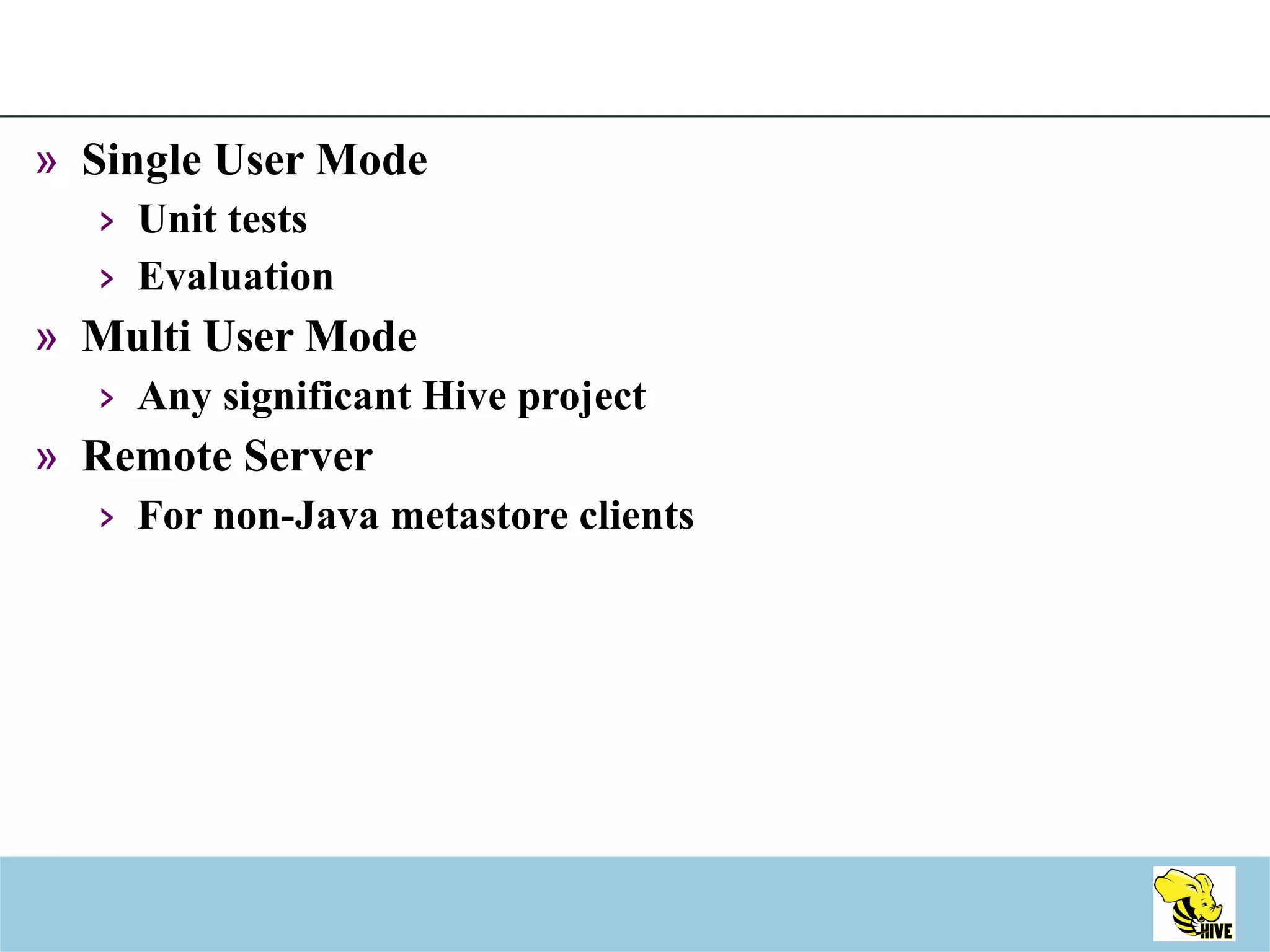
Single User Mode Unit tests Evaluation Multi User Mode Any significant Hive project Remote Server For non-Java metastore clients
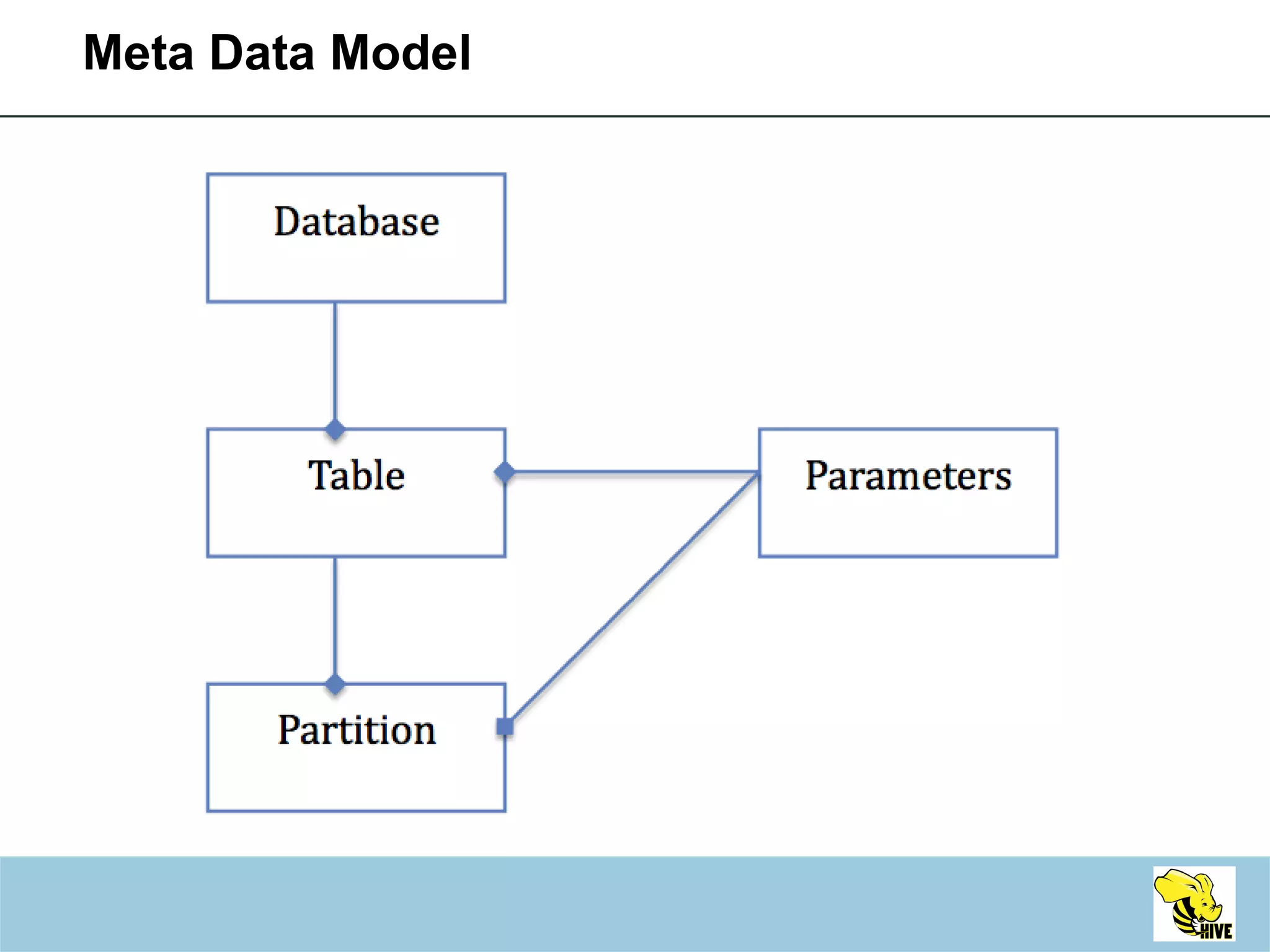
Meta Data Model
Hive Optimizations
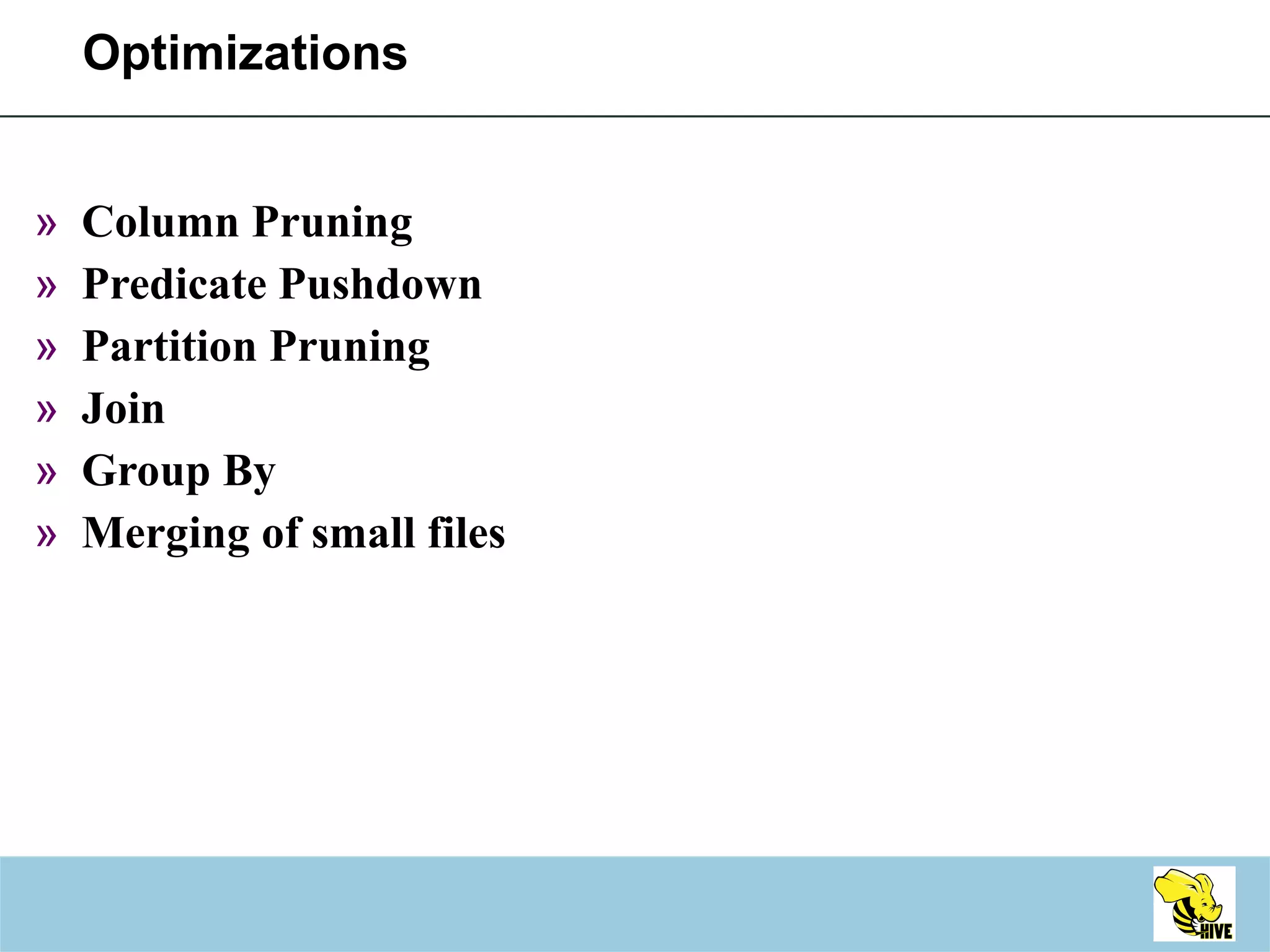
Optimizations Column Pruning Predicate Pushdown Partition Pruning Join Group By Merging of small files
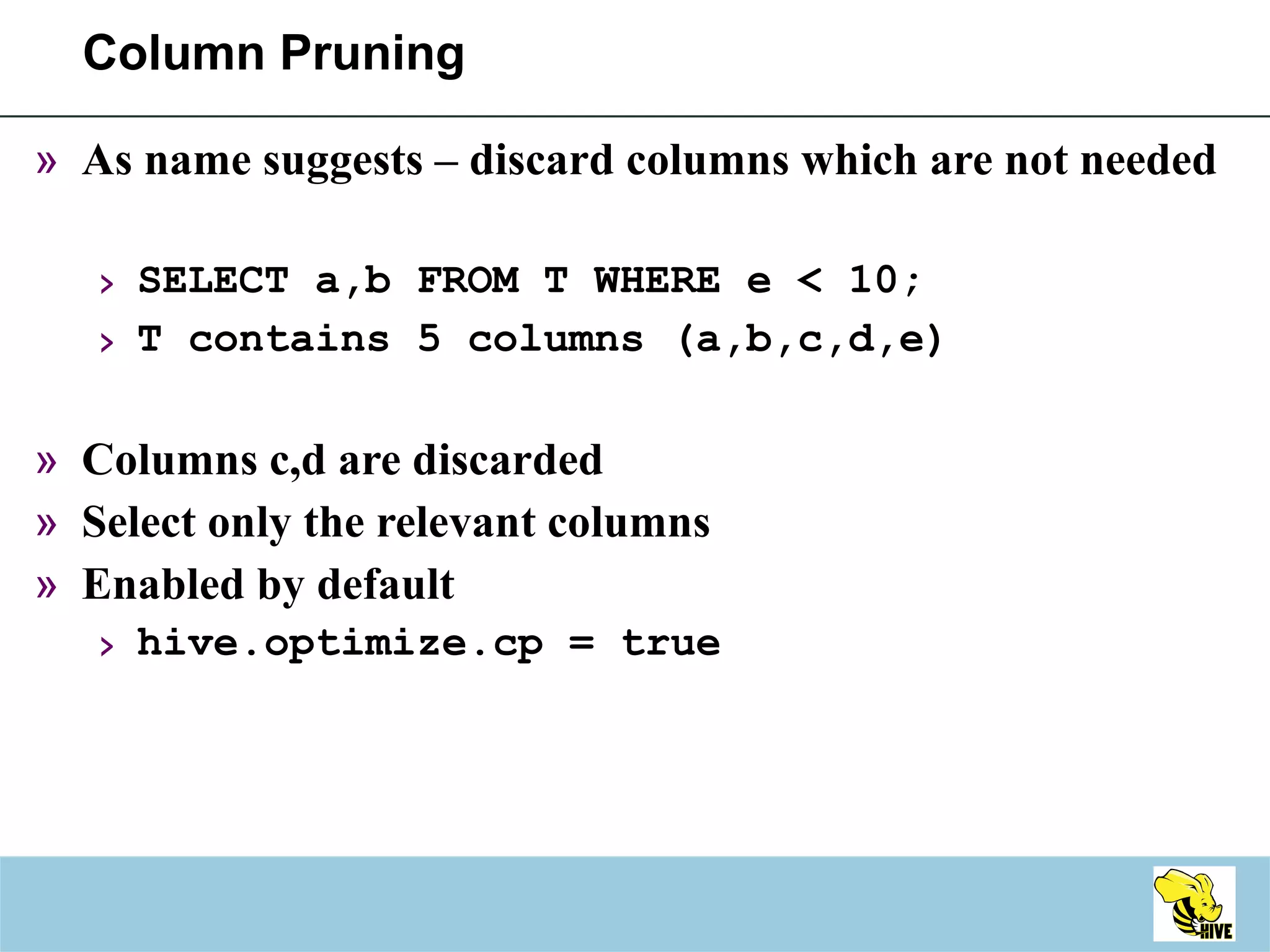
Column Pruning As name suggests – discard columns which are not needed SELECT a,b FROM T WHERE e < 10; T contains 5 columns (a,b,c,d,e) Columns c,d are discarded Select only the relevant columns Enabled by default hive.optimize.cp = true
Predicate Pushdown Move predicate closer to the table scan only. Enabled by default: hive.optimize.ppd = true
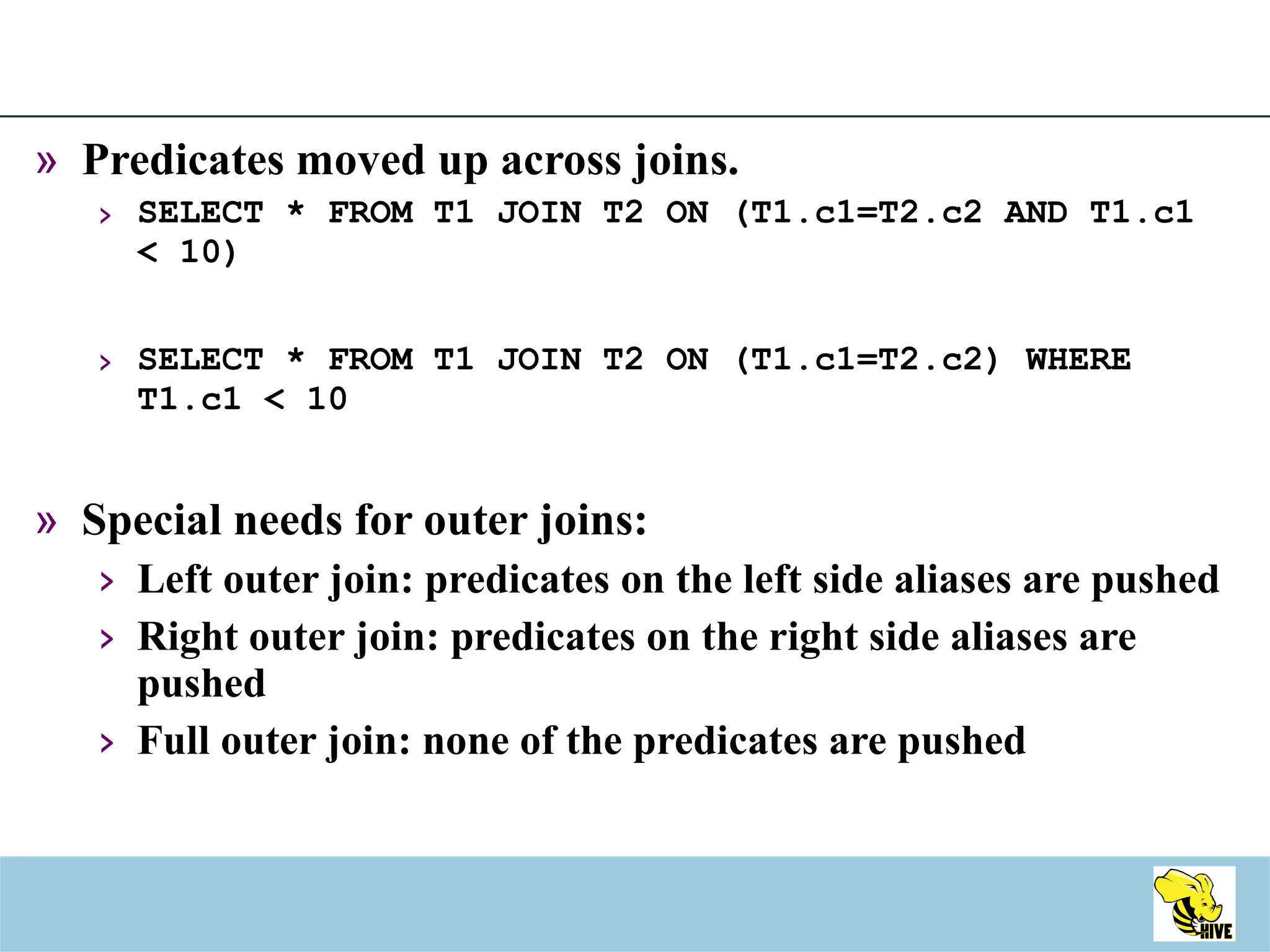
Predicates moved up across joins. SELECT * FROM T1 JOIN T2 ON (T1.c1=T2.c2 AND T1.c1 < 10) SELECT * FROM T1 JOIN T2 ON (T1.c1=T2.c2) WHERE T1.c1 < 10 Special needs for outer joins: Left outer join: predicates on the left side aliases are pushed Right outer join: predicates on the right side aliases are pushed Full outer join: none of the predicates are pushed
Non-deterministic functions (eg. rand()) not pushed. Use annotation:  @UDFType(deterministic=false) The entire expression containing non-deterministic function is not pushed up C1 > 10 and c2 < rand()
Partition Pruning Reduce list of partitions to be scanned Works on parse tree currently – some known bugs
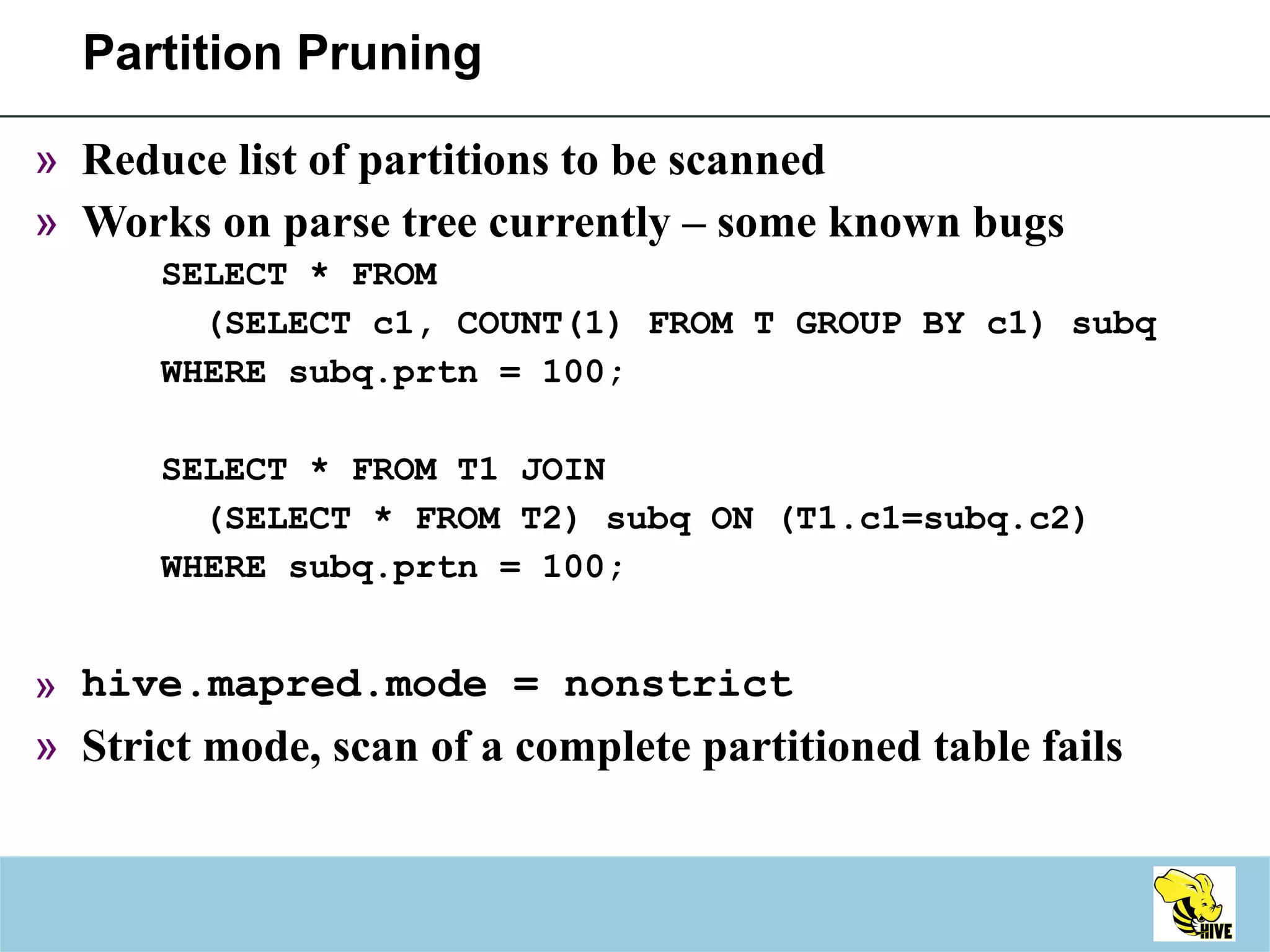
Partition Pruning Reduce list of partitions to be scanned Works on parse tree currently – some known bugs SELECT * FROM  (SELECT c1, COUNT(1) FROM T GROUP BY c1) subq  WHERE subq.prtn = 100; SELECT * FROM T1 JOIN  (SELECT * FROM T2) subq ON (T1.c1=subq.c2)  WHERE subq.prtn = 100; hive.mapred.mode = nonstrict Strict mode, scan of a complete partitioned table fails
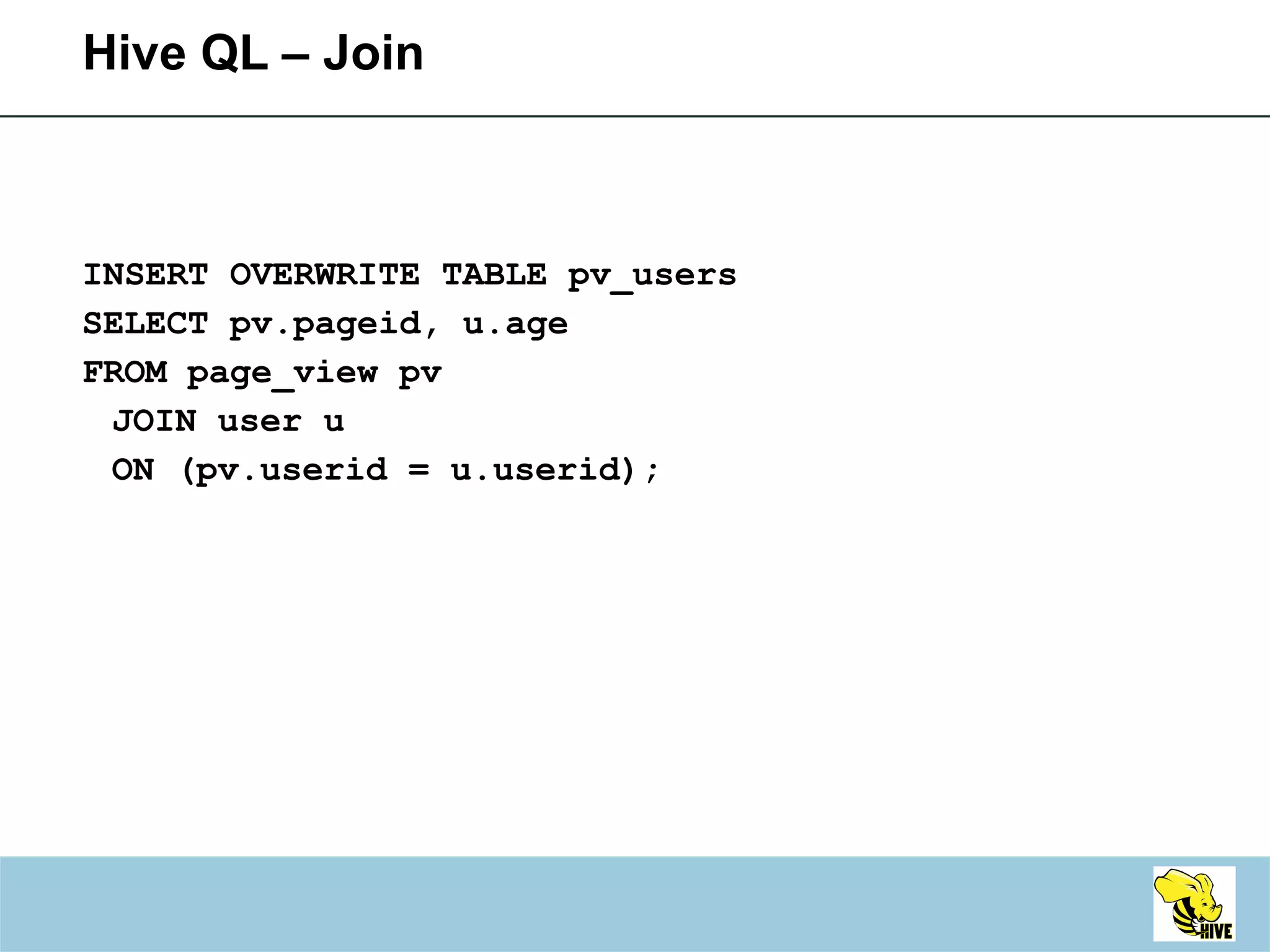
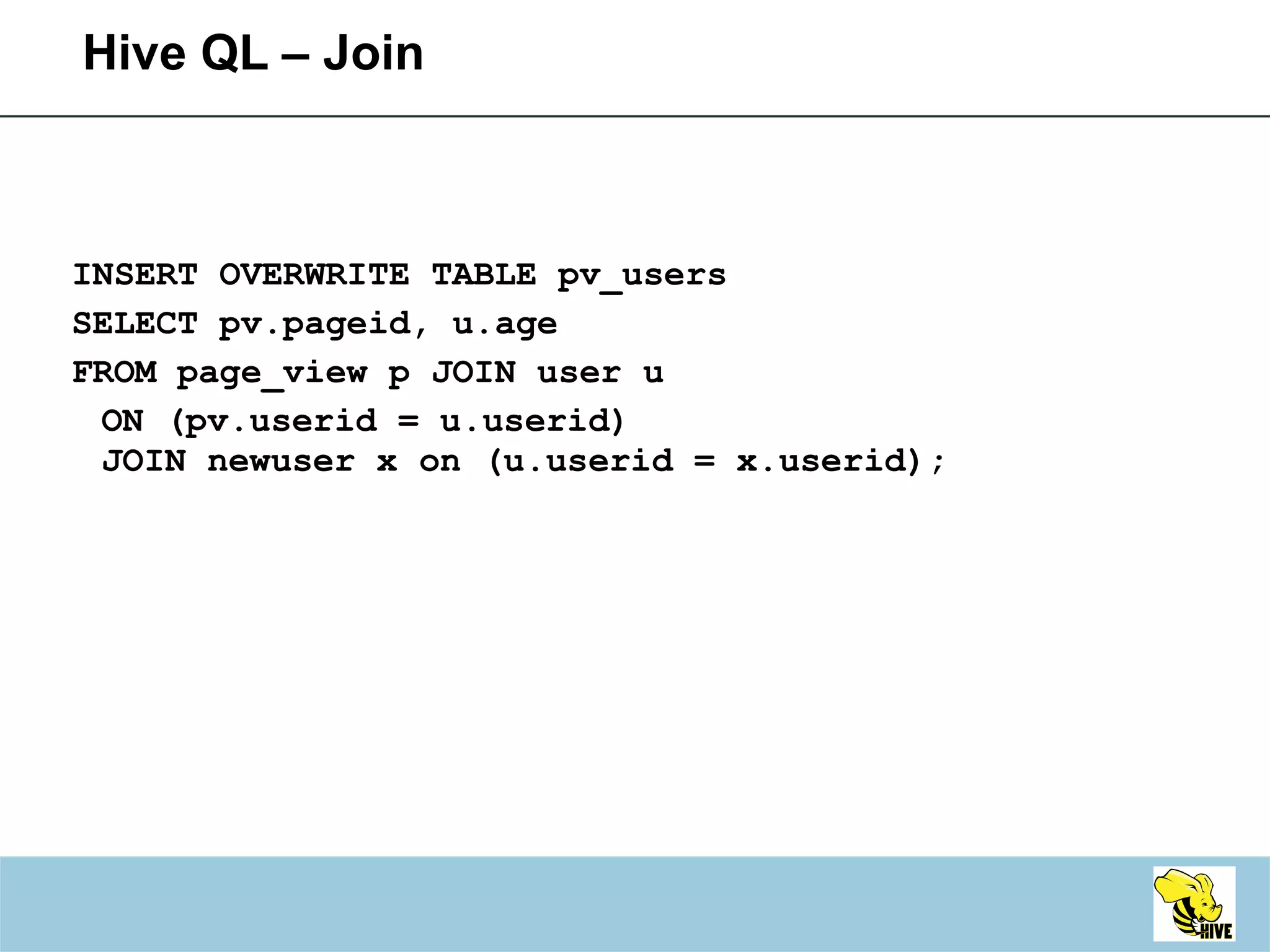
Hive QL – Join INSERT OVERWRITE TABLE pv_users SELECT pv.pageid, u.age FROM page_view pv JOIN user u ON (pv.userid = u.userid);
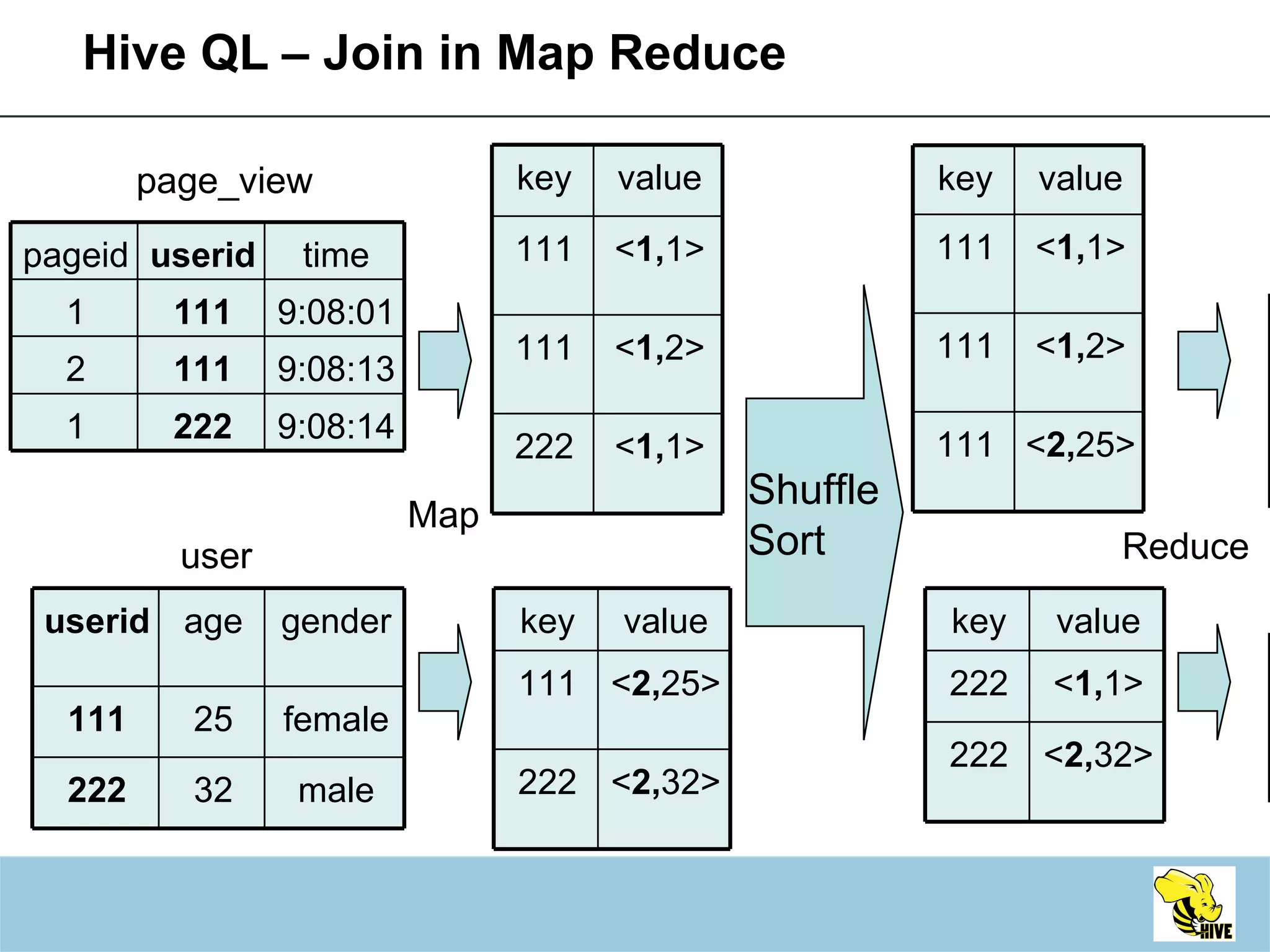
Hive QL – Join in Map Reduce page_view user pv_users Map Reduce key value 111 < 1, 1> 111 < 1, 2> 222 < 1, 1> pageid userid time 1 111 9:08:01 2 111 9:08:13 1 222 9:08:14 userid age gender 111 25 female 222 32 male key value 111 < 2, 25> 222 < 2, 32> key value 111 < 1, 1> 111 < 1, 2> 111 < 2, 25> key value 222 < 1, 1> 222 < 2, 32> Shuffle Sort Pageid age 1 25 2 25 pageid age 1 32
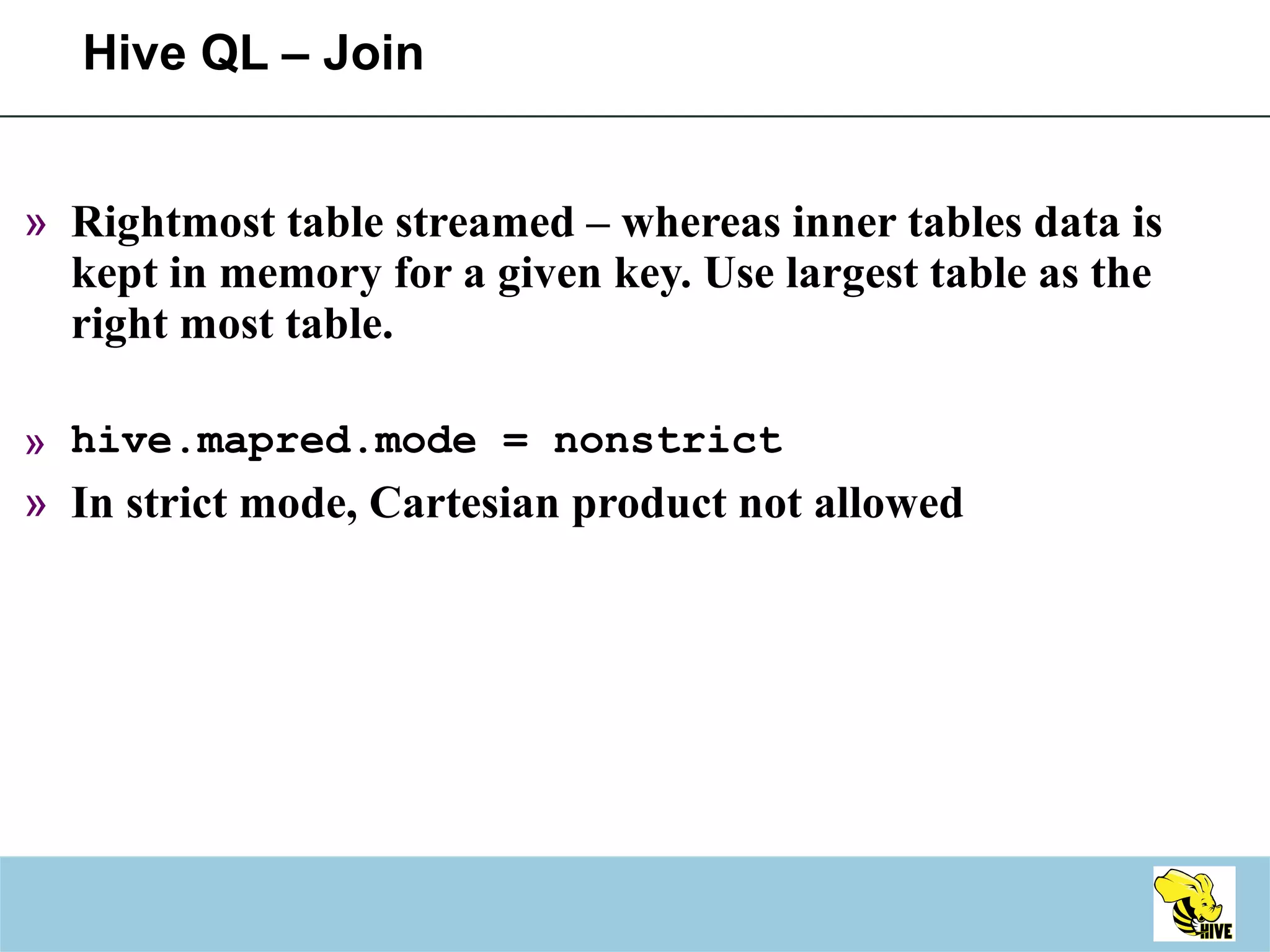
Hive QL – Join Rightmost table streamed – whereas inner tables data is kept in memory for a given key. Use largest table as the right most table. hive.mapred.mode = nonstrict In strict mode, Cartesian product not allowed
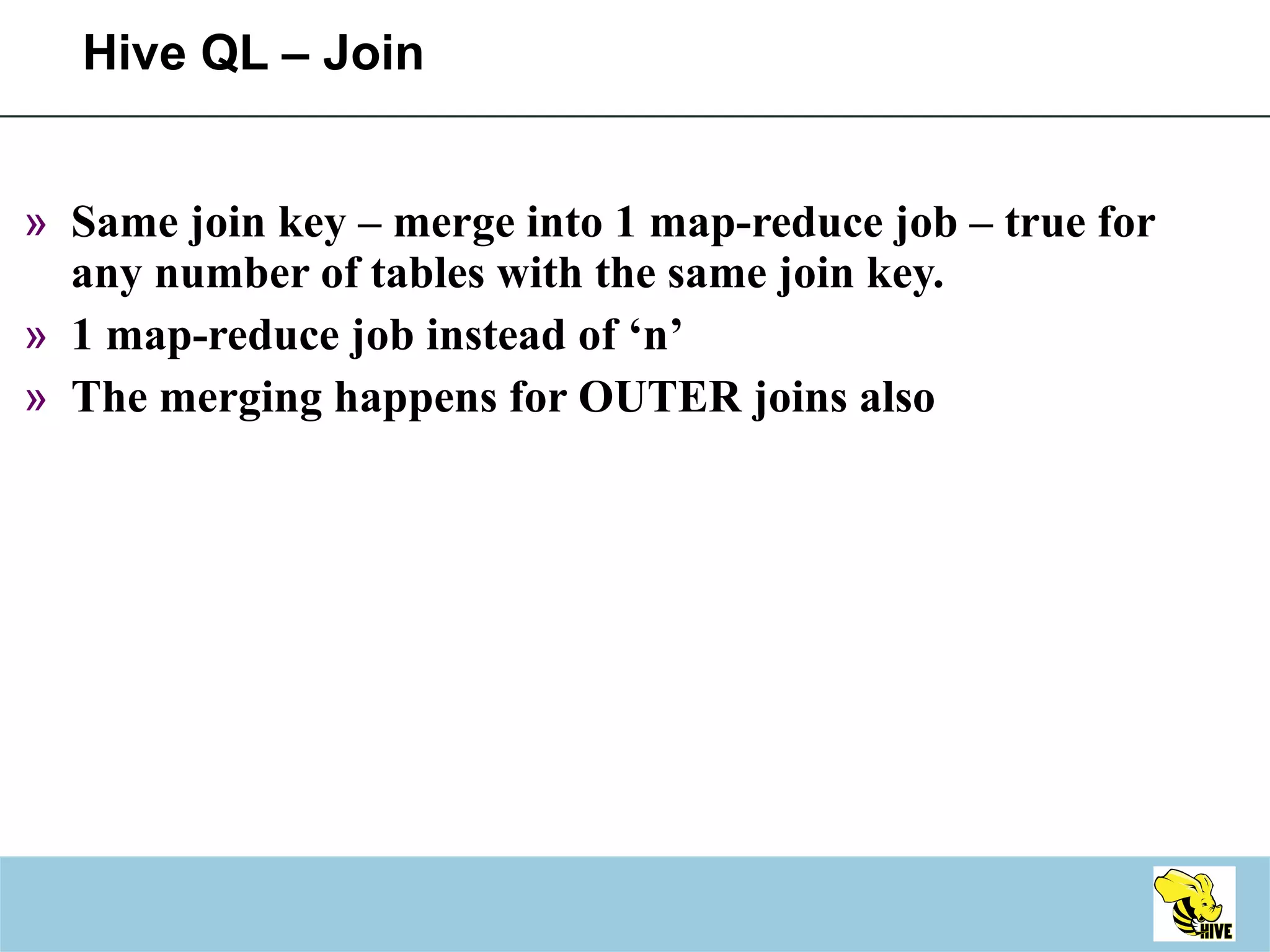
Hive QL – Join INSERT OVERWRITE TABLE pv_users SELECT pv.pageid, u.age FROM page_view p JOIN user u ON (pv.userid = u.userid) JOIN newuser x on (u.userid = x.userid);
Hive QL – Join Same join key – merge into 1 map-reduce job – true for any number of tables with the same join key. 1 map-reduce job instead of ‘n’ The merging happens for OUTER joins also
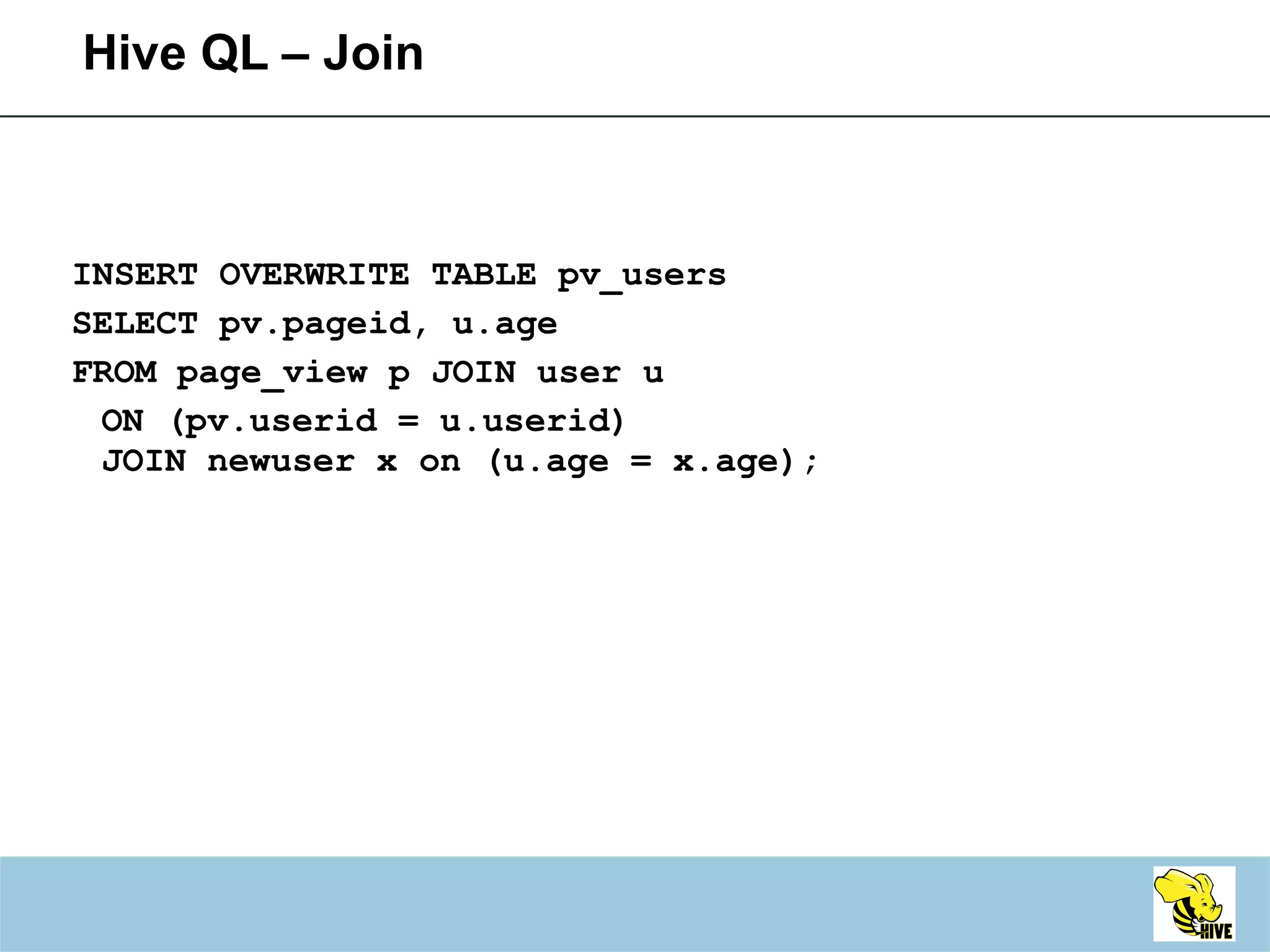
Hive QL – Join INSERT OVERWRITE TABLE pv_users SELECT pv.pageid, u.age FROM page_view p JOIN user u ON (pv.userid = u.userid) JOIN newuser x on (u.age = x.age);
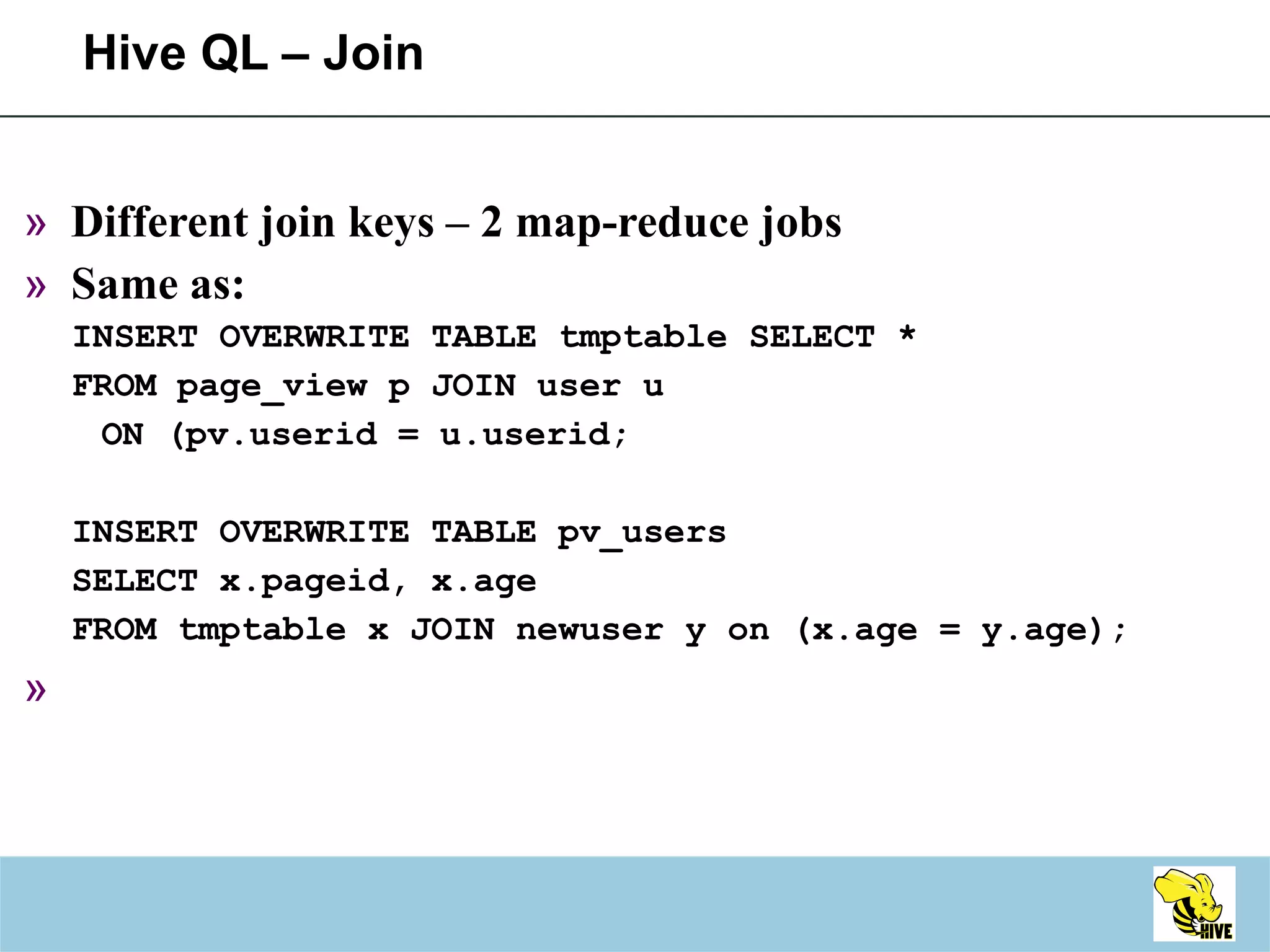
Hive QL – Join Different join keys – 2 map-reduce jobs Same as: INSERT OVERWRITE TABLE tmptable SELECT * FROM page_view p JOIN user u ON (pv.userid = u.userid; INSERT OVERWRITE TABLE pv_users SELECT x.pageid, x.age FROM tmptable x JOIN newuser y on (x.age = y.age);
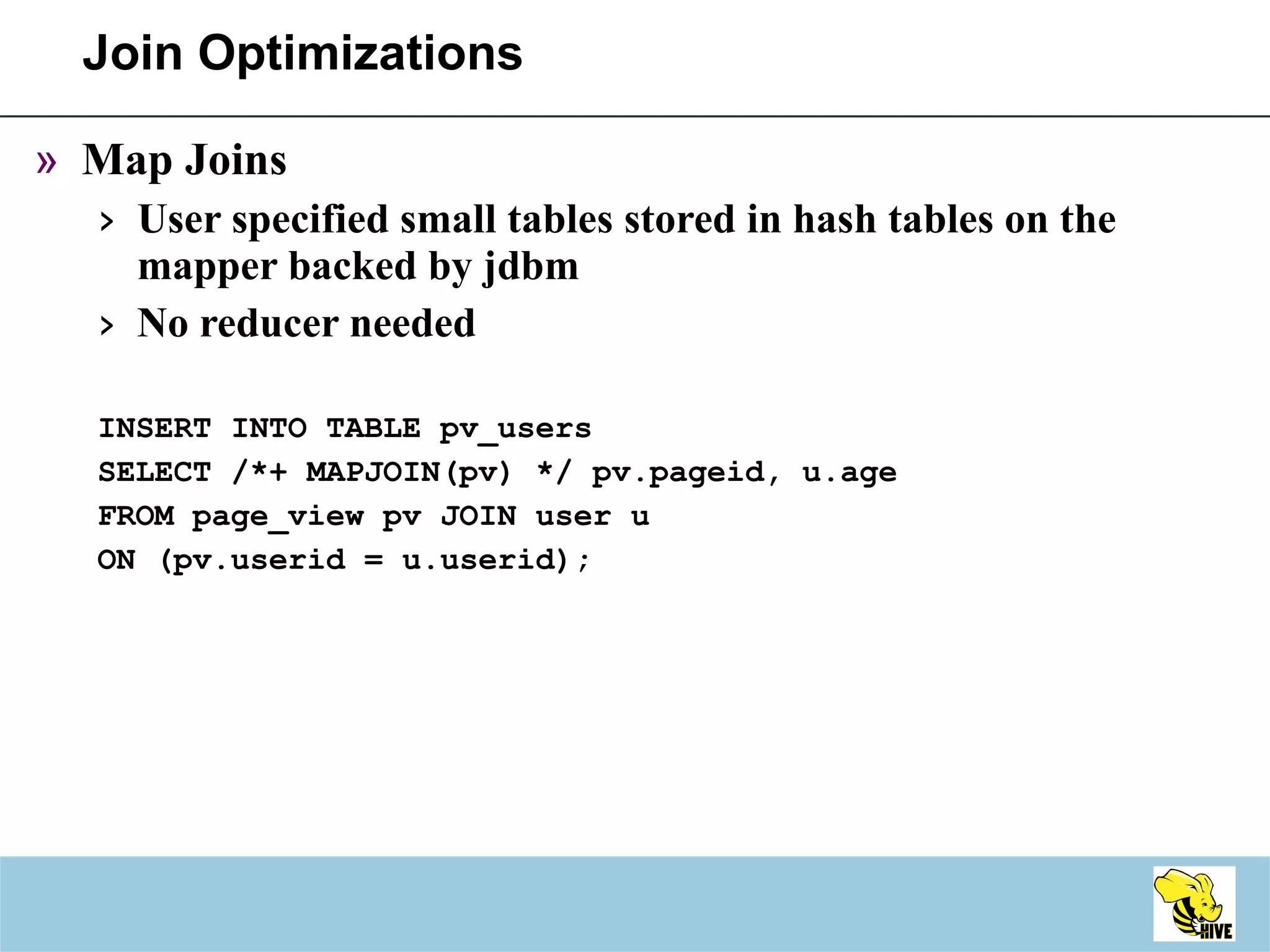
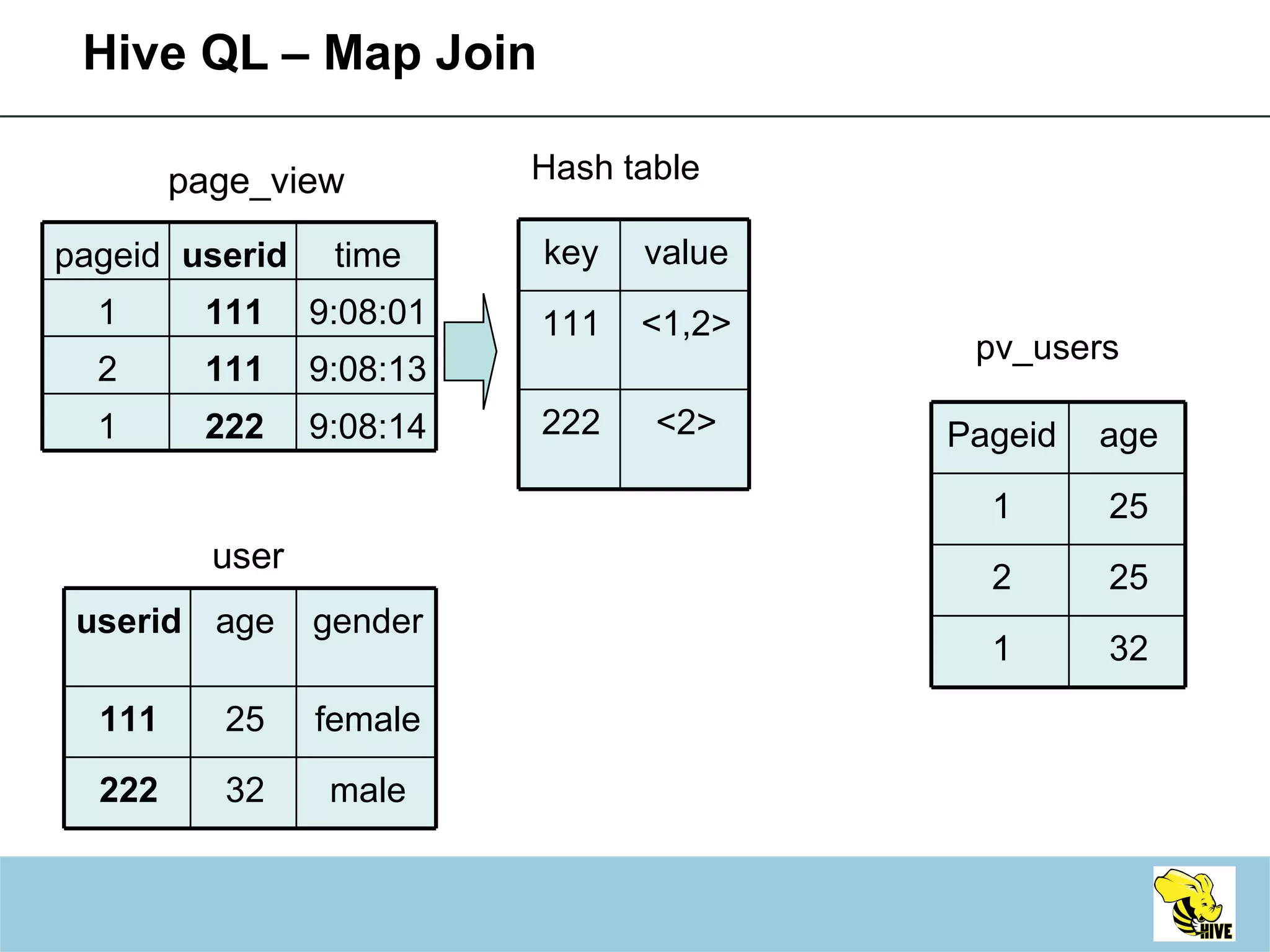
Join Optimizations Map Joins User specified small tables stored in hash tables on the mapper backed by jdbm No reducer needed INSERT INTO TABLE pv_users SELECT /*+ MAPJOIN(pv) */ pv.pageid, u.age FROM page_view pv JOIN user u ON (pv.userid = u.userid);
Hive QL – Map Join page_view user Hash table pv_users key value 111 <1,2> 222 <2> pageid userid time 1 111 9:08:01 2 111 9:08:13 1 222 9:08:14 userid age gender 111 25 female 222 32 male Pageid age 1 25 2 25 1 32
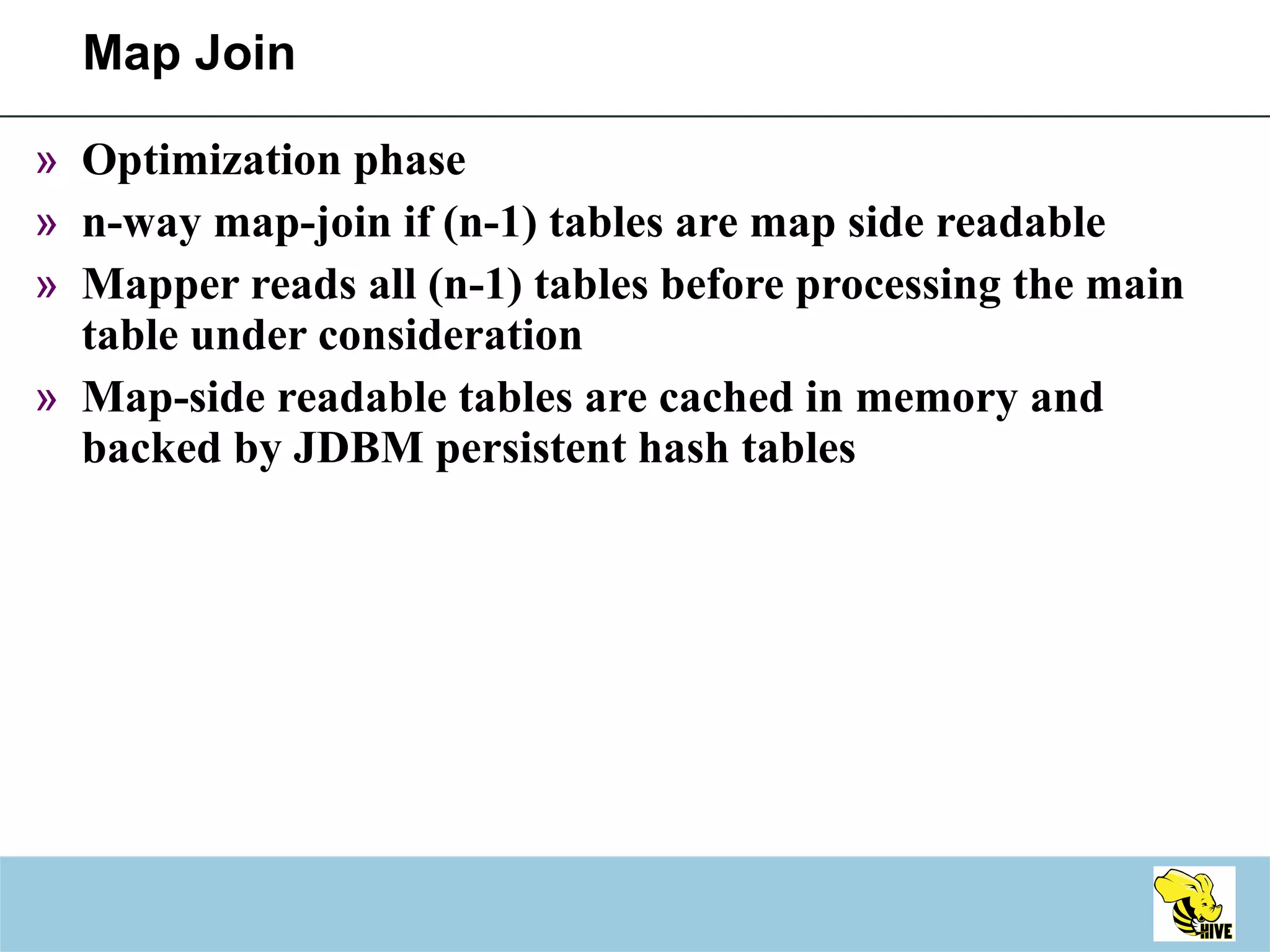
Map Join Optimization phase n-way map-join if (n-1) tables are map side readable Mapper reads all (n-1) tables before processing the main table under consideration Map-side readable tables are cached in memory and backed by JDBM persistent hash tables
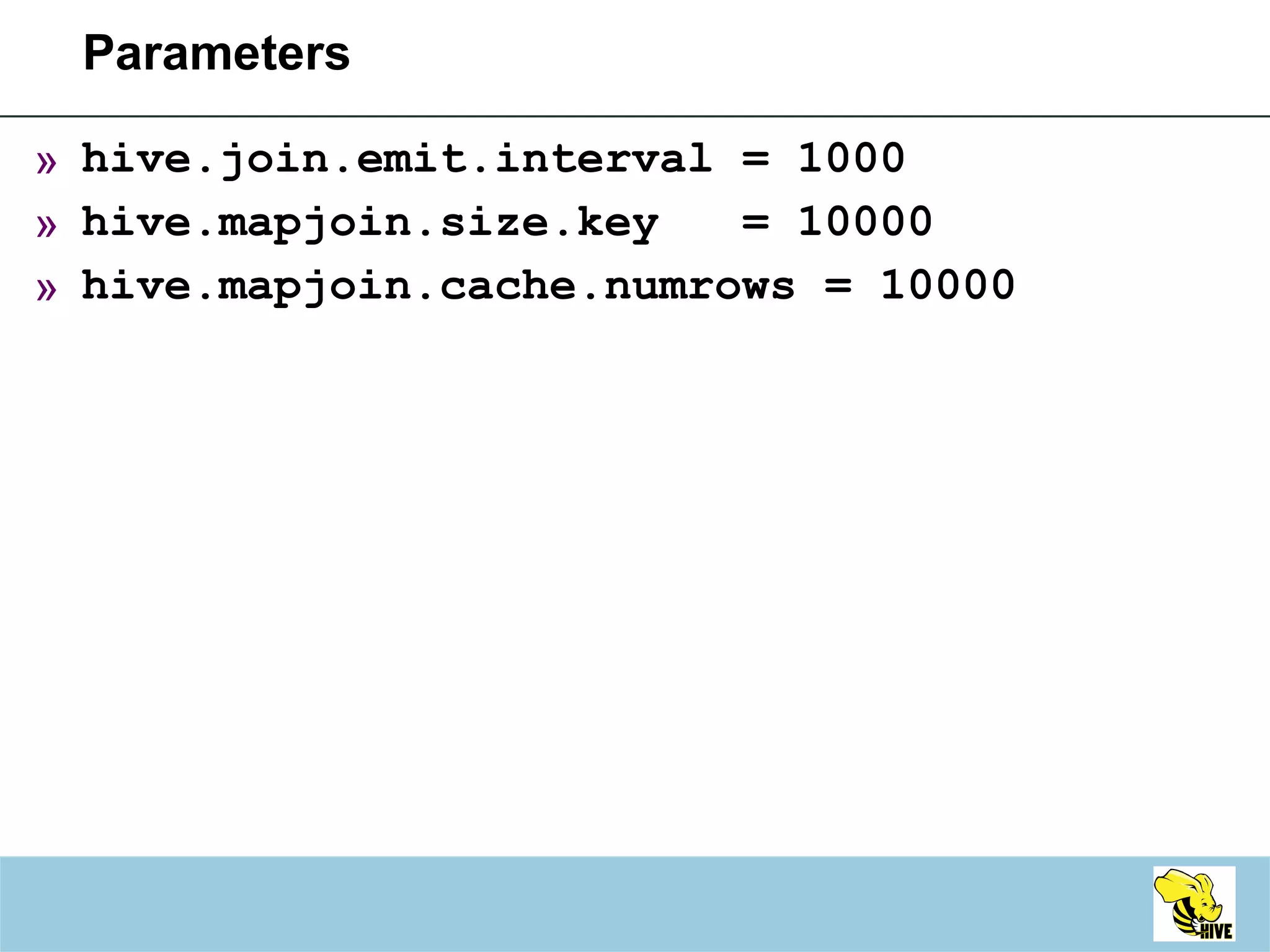
Parameters hive.join.emit.interval = 1000 hive.mapjoin.size.key  = 10000 hive.mapjoin.cache.numrows = 10000
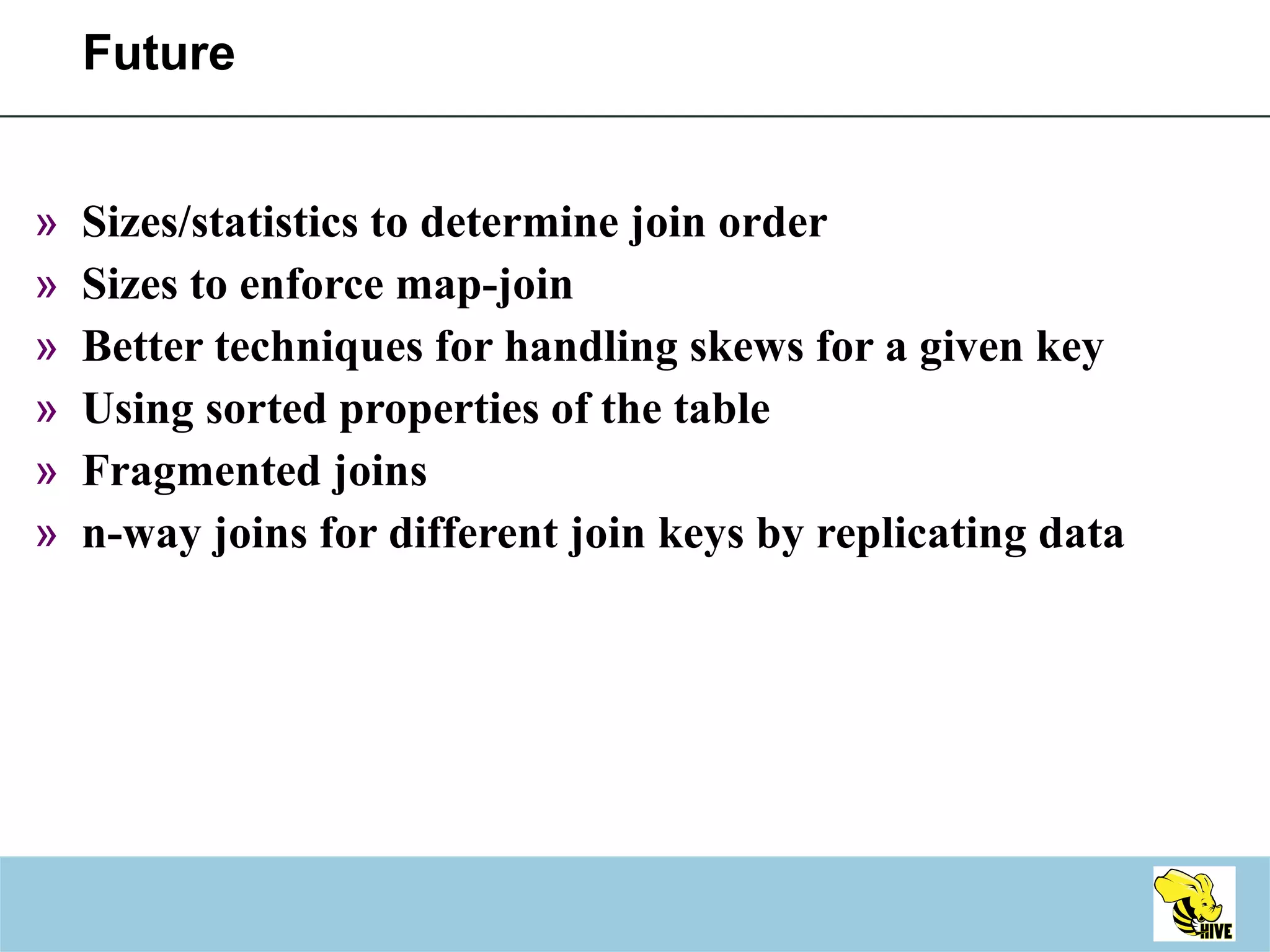
Future Sizes/statistics to determine join order Sizes to enforce map-join Better techniques for handling skews for a given key Using sorted properties of the table Fragmented joins n-way joins for different join keys by replicating data
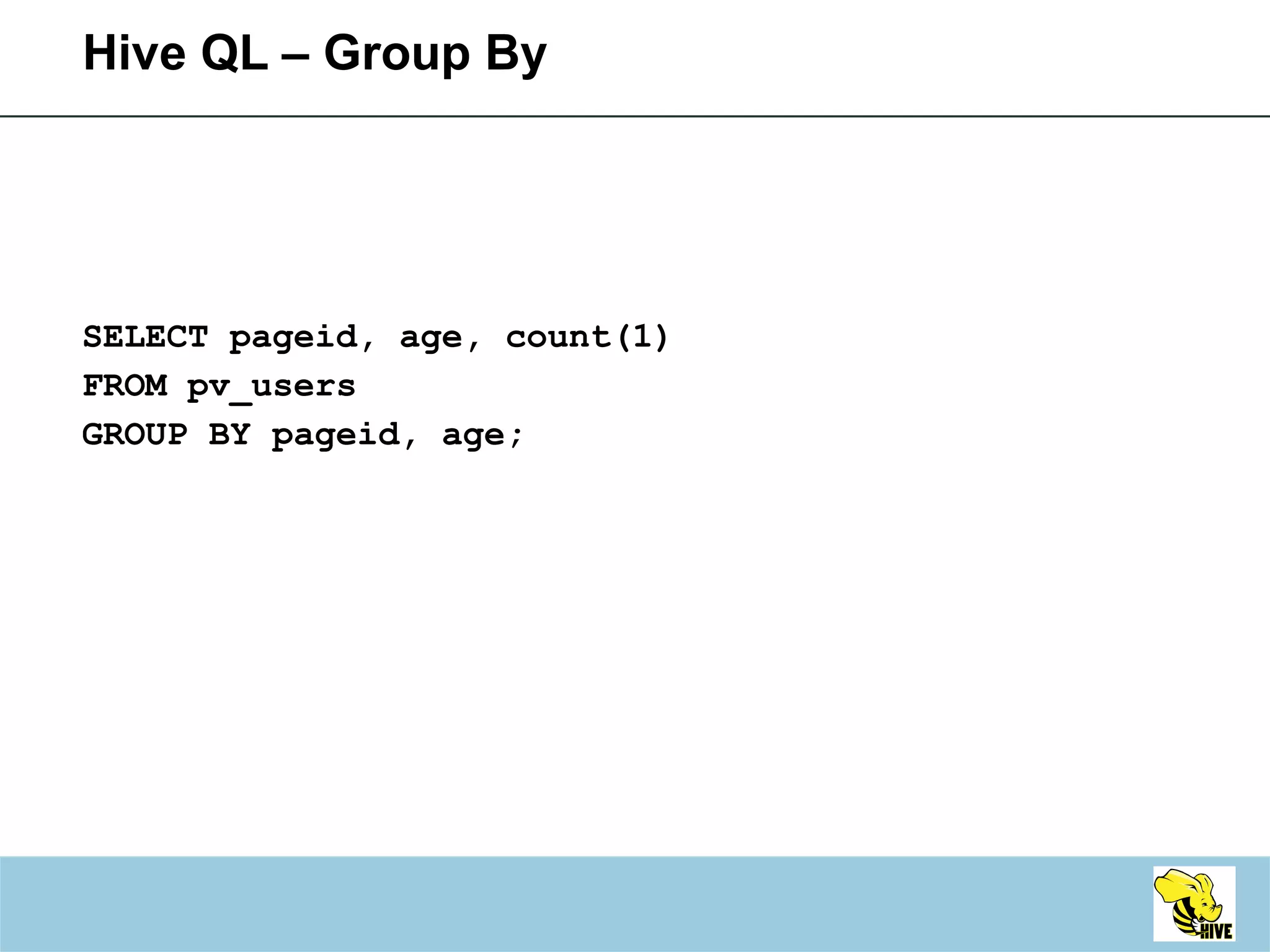
Hive QL – Group By SELECT pageid, age, count(1) FROM pv_users GROUP BY pageid, age;
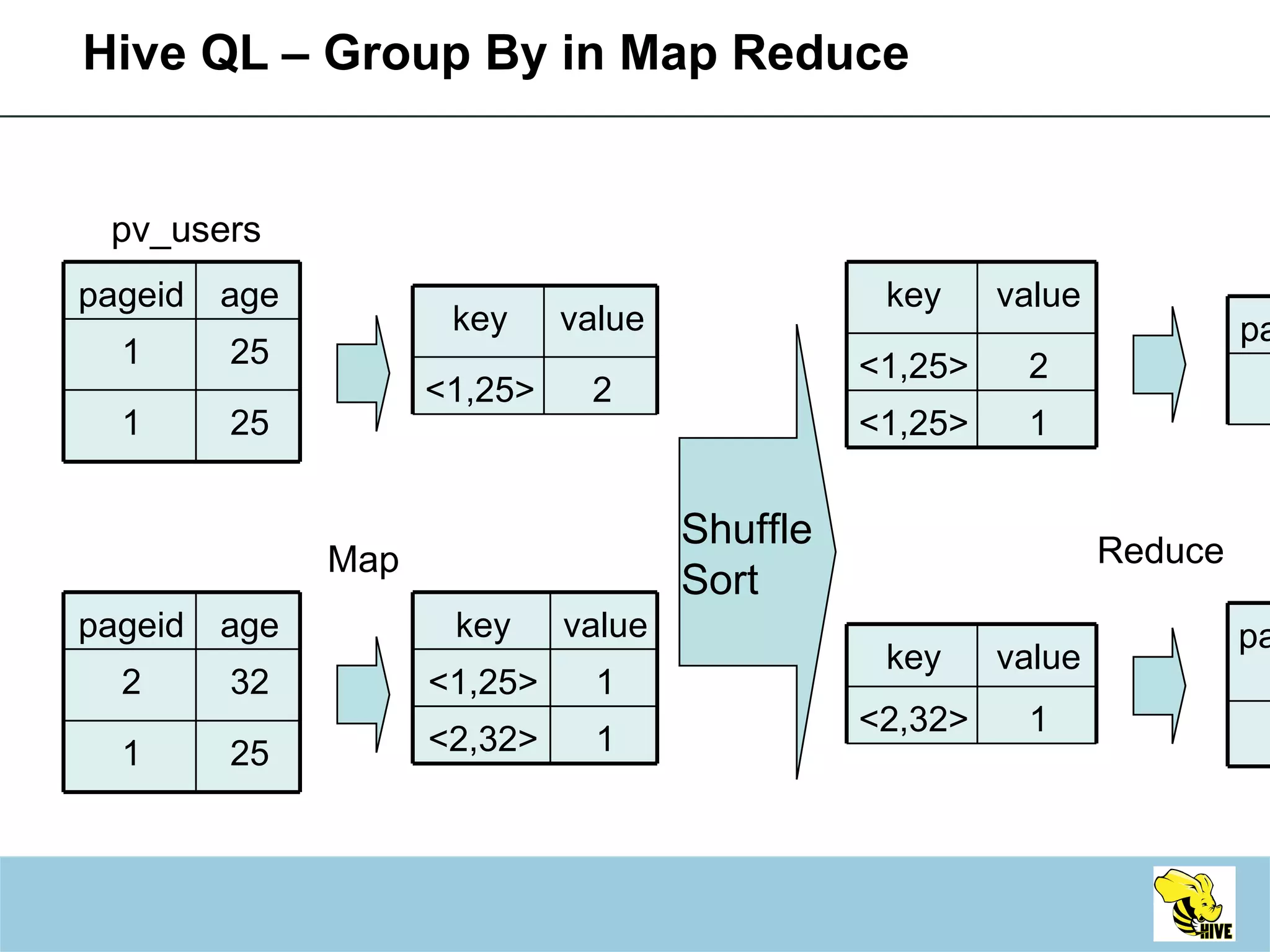
Hive QL – Group By in Map Reduce pv_users Map Reduce pageid age 1 25 1 25 pageid age count 1 25 3 pageid age 2 32 1 25 key value <1,25> 2 key value <1,25> 1 <2,32> 1 key value <1,25> 2 <1,25> 1 key value <2,32> 1 Shuffle Sort pageid age count 2 32 1
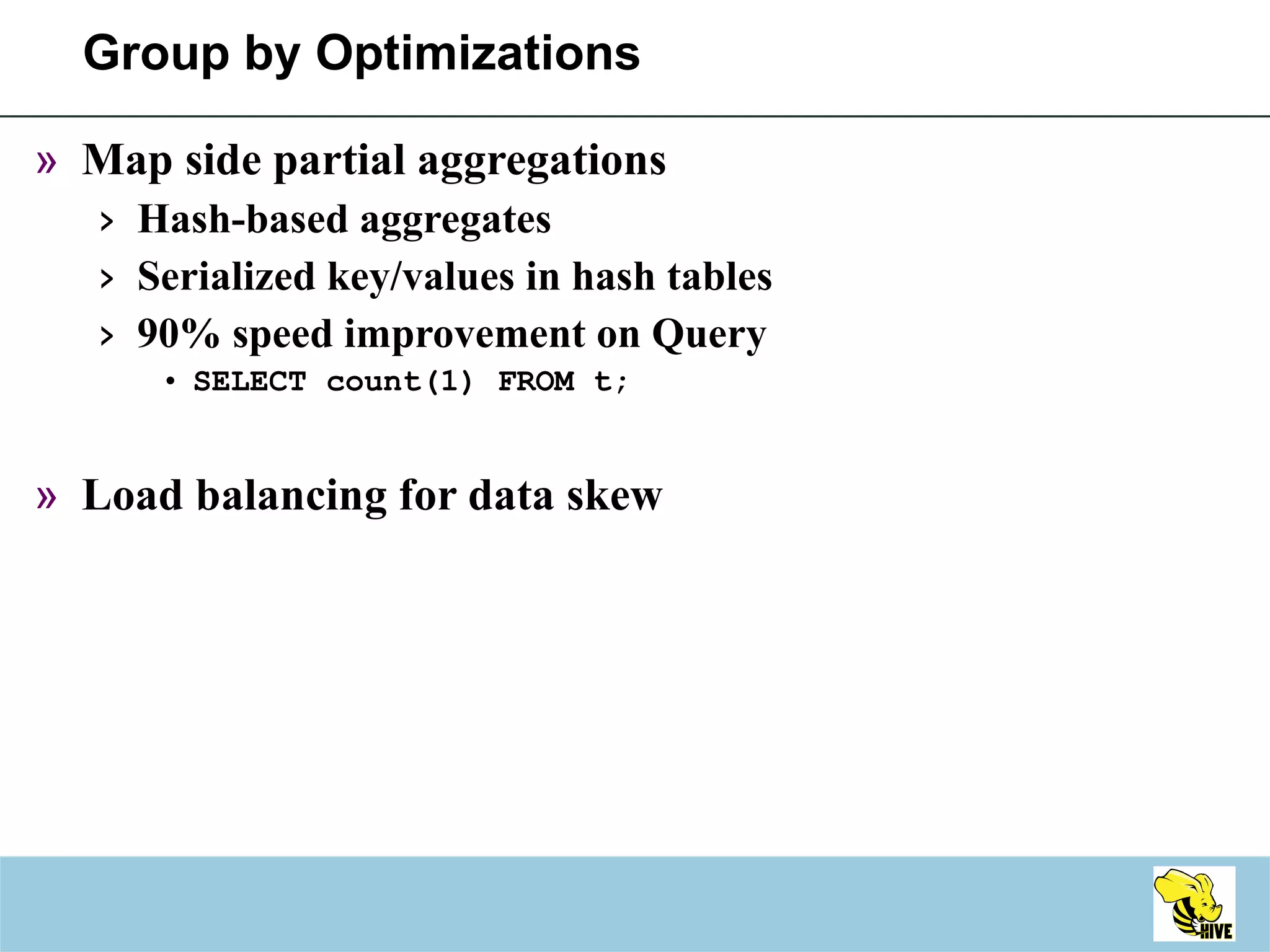
Group by Optimizations Map side partial aggregations Hash-based aggregates Serialized key/values in hash tables 90% speed improvement on Query SELECT count(1) FROM t; Load balancing for data skew
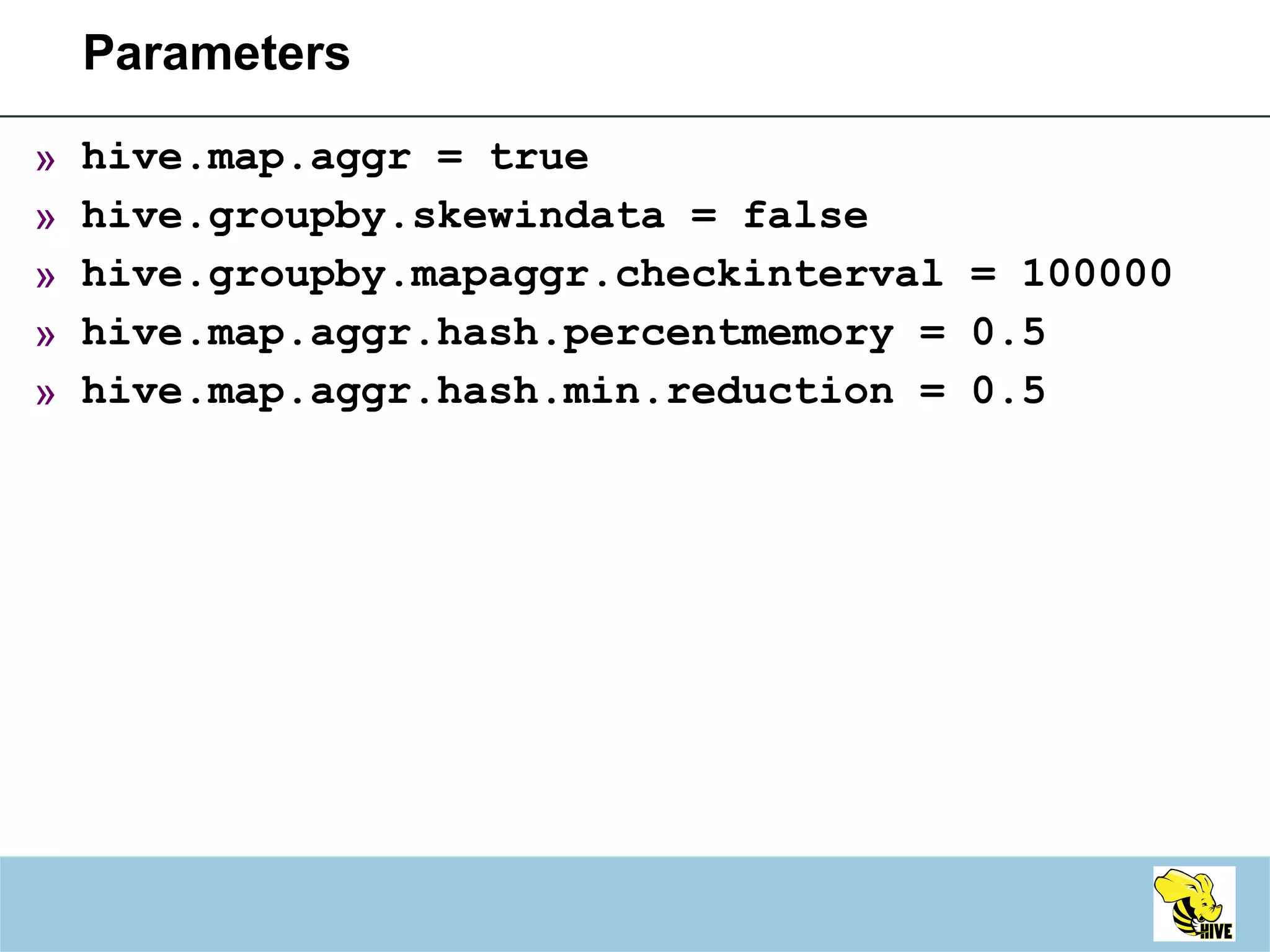
Parameters hive.map.aggr = true hive.groupby.skewindata = false hive.groupby.mapaggr.checkinterval = 100000 hive.map.aggr.hash.percentmemory = 0.5 hive.map.aggr.hash.min.reduction = 0.5
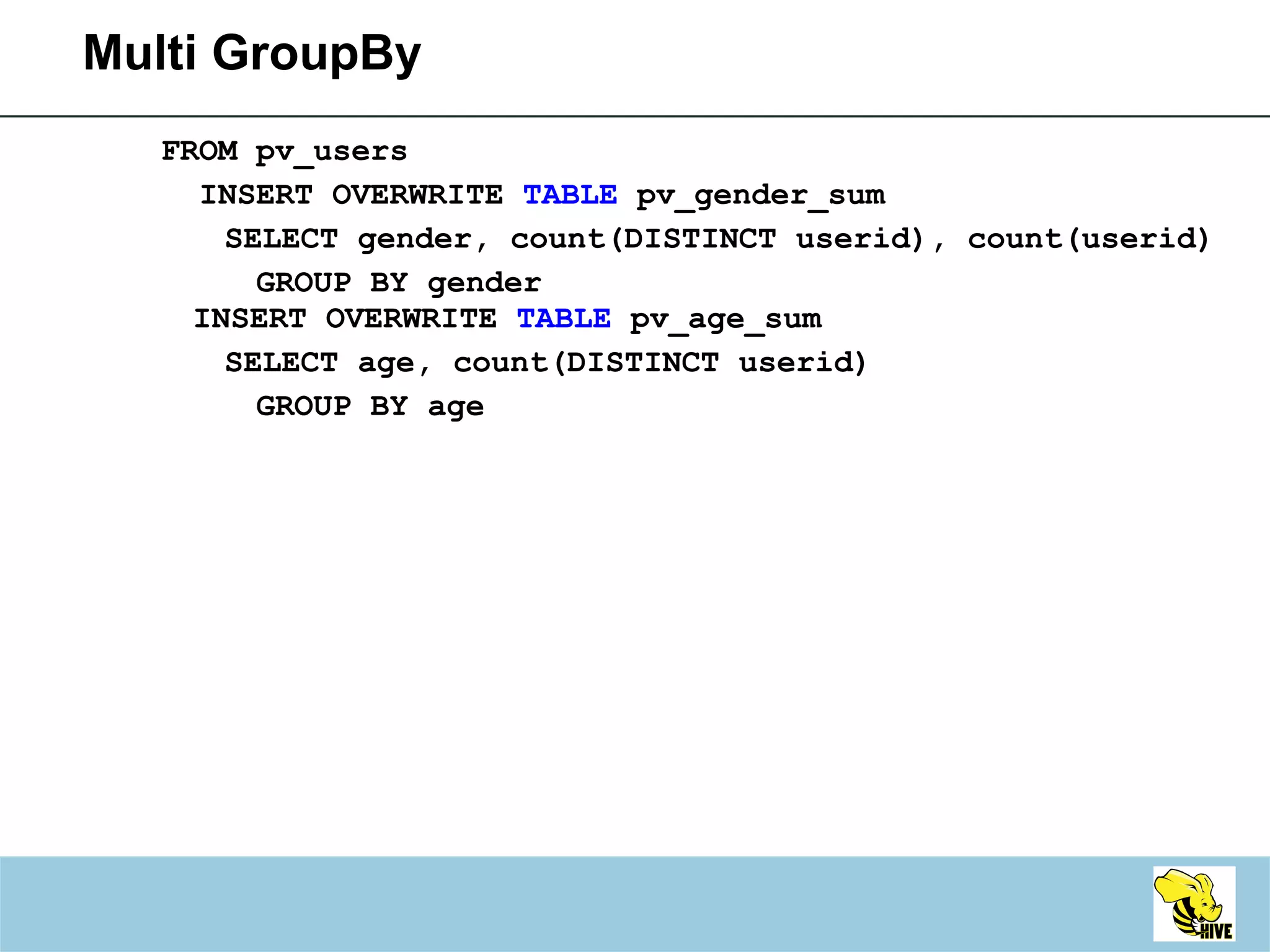
Multi GroupBy FROM pv_users  INSERT OVERWRITE  TABLE  pv_gender_sum  SELECT gender, count(DISTINCT userid), count(userid)  GROUP BY gender INSERT OVERWRITE  TABLE  pv_age_sum  SELECT age, count(DISTINCT userid)  GROUP BY age
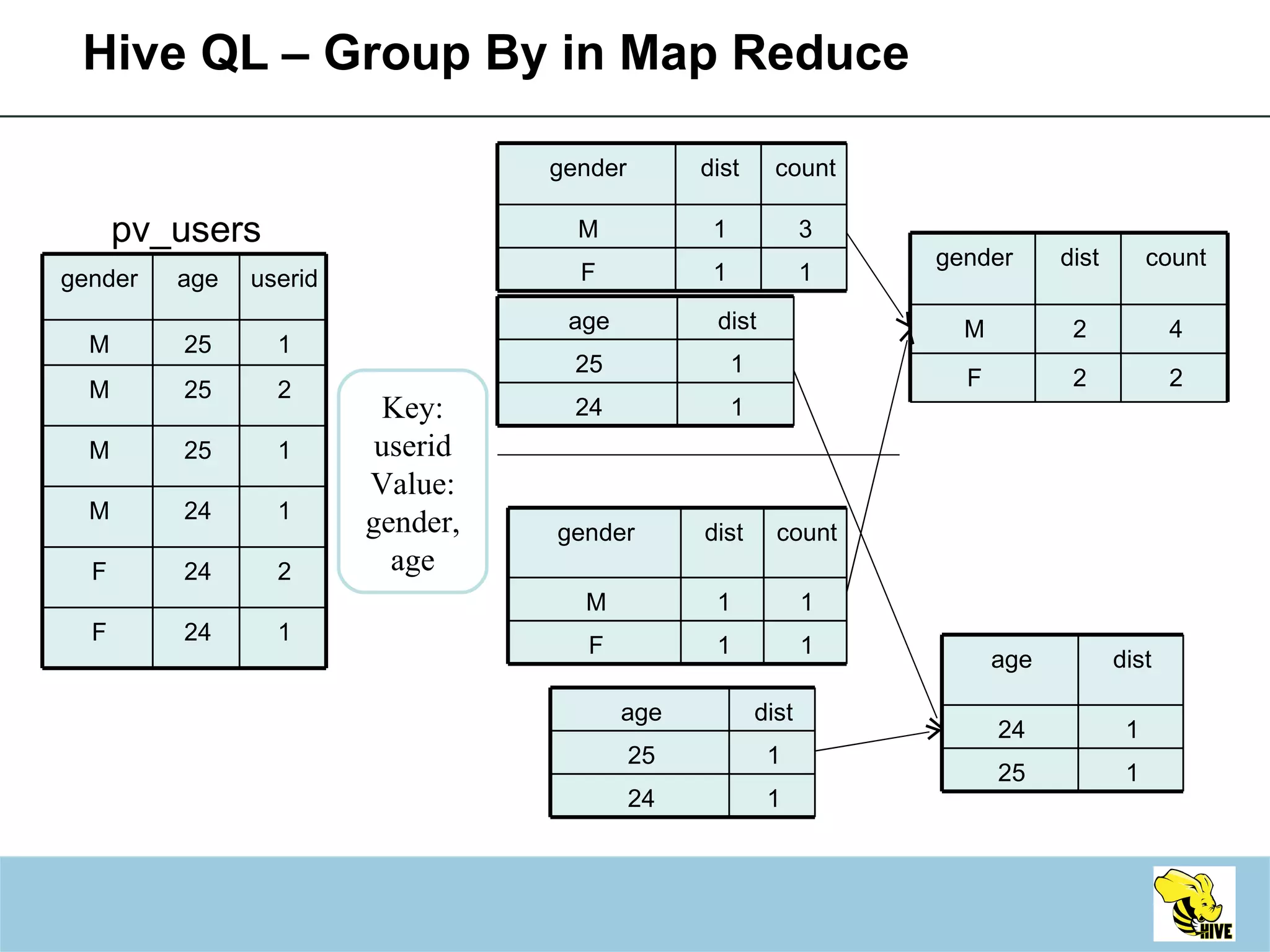
Hive QL – Group By in Map Reduce pv_users Key: userid Value: gender, age gender age userid M 25 1 M 25 2 M 25 1 M 24 1 F 24 2 F 24 1 gender dist count M 2 4 F 2 2 gender dist count M 1 3 F 1 1 age dist 24 1 25 1 gender dist count M 1 1 F 1 1 age dist 25 1 24 1 age dist 25 1 24 1
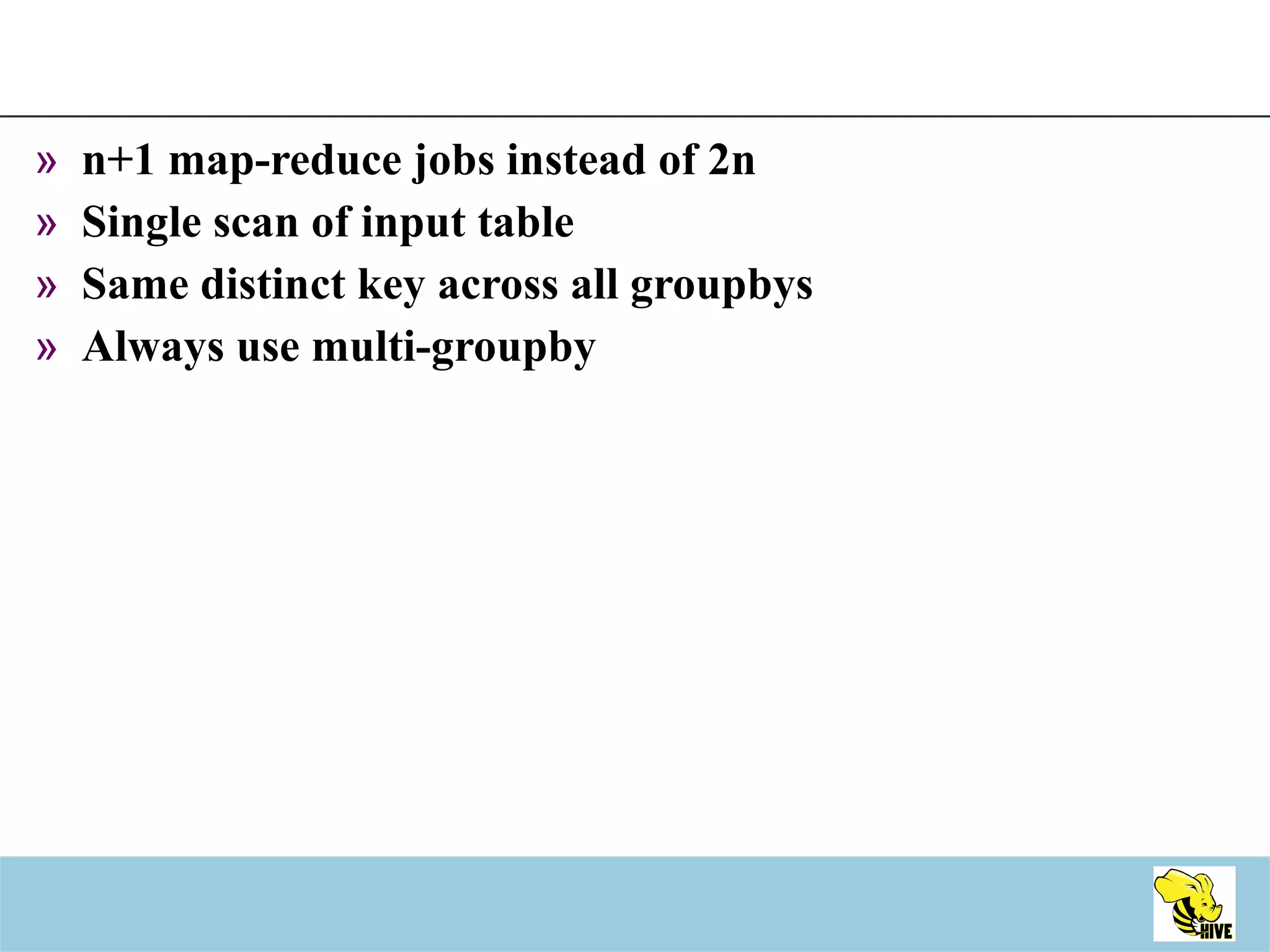
n+1 map-reduce jobs instead of 2n Single scan of input table Same distinct key across all groupbys Always use multi-groupby
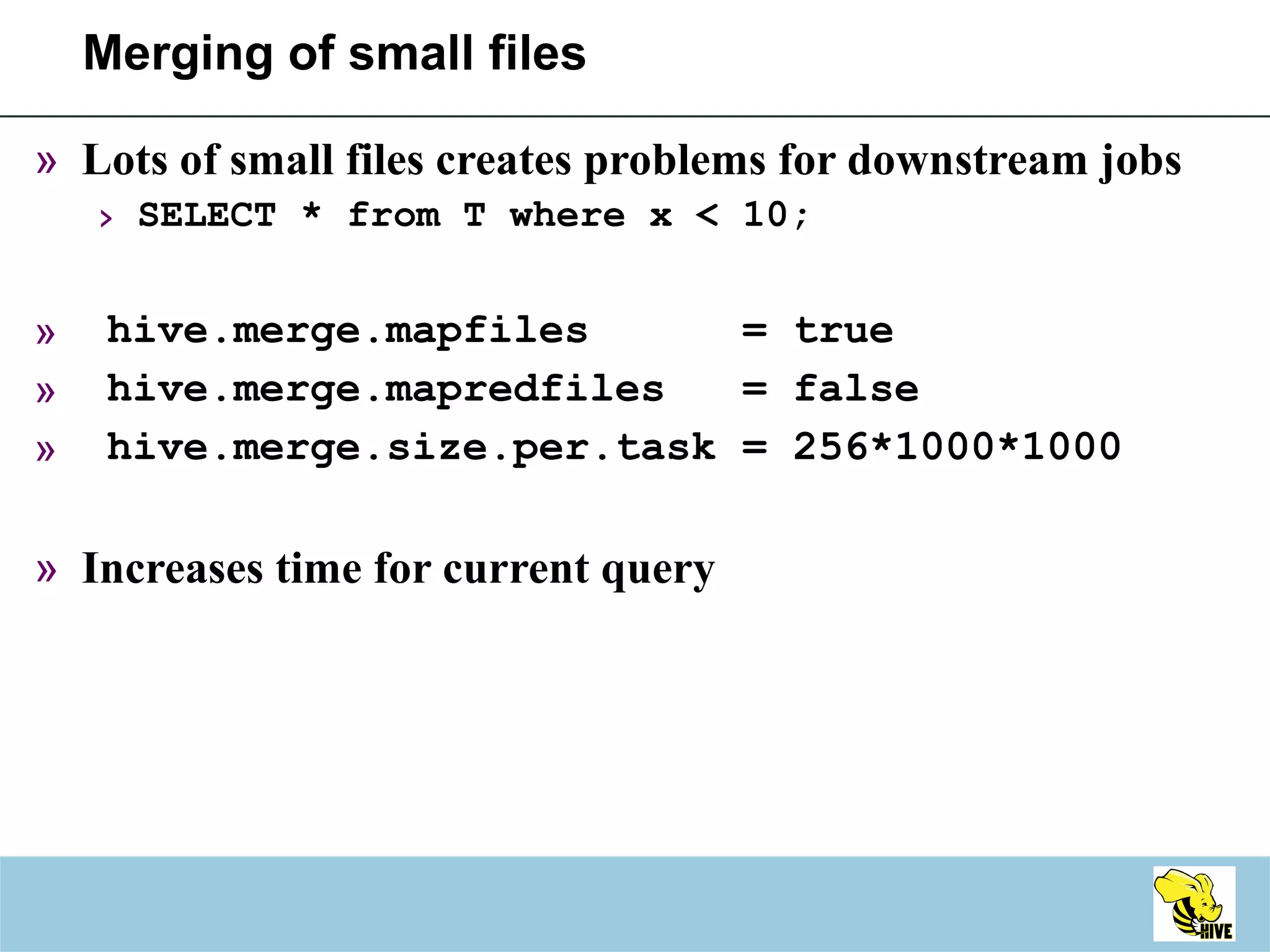
Merging of small files Lots of small files creates problems for downstream jobs SELECT * from T where x < 10; hive.merge.mapfiles  = true hive.merge.mapredfiles  = false hive.merge.size.per.task = 256*1000*1000 Increases time for current query
Hive Extensibility Features
Agenda Introduction File Format SerDe Map/Reduce Scripts (Transform) UDF UDAF How to contribute the work Facebook
Introduction Facebook
Hive is an open system Different on-disk data formats Text File, Sequence File, … Different in-memory data formats Java Integer/String, Hadoop IntWritable/Text … User-provided map/reduce scripts In any language, use stdin/stdout to transfer data … User-defined Functions Substr, Trim, From_unixtime … User-defined Aggregation Functions Sum, Average … Facebook
File Format Facebook
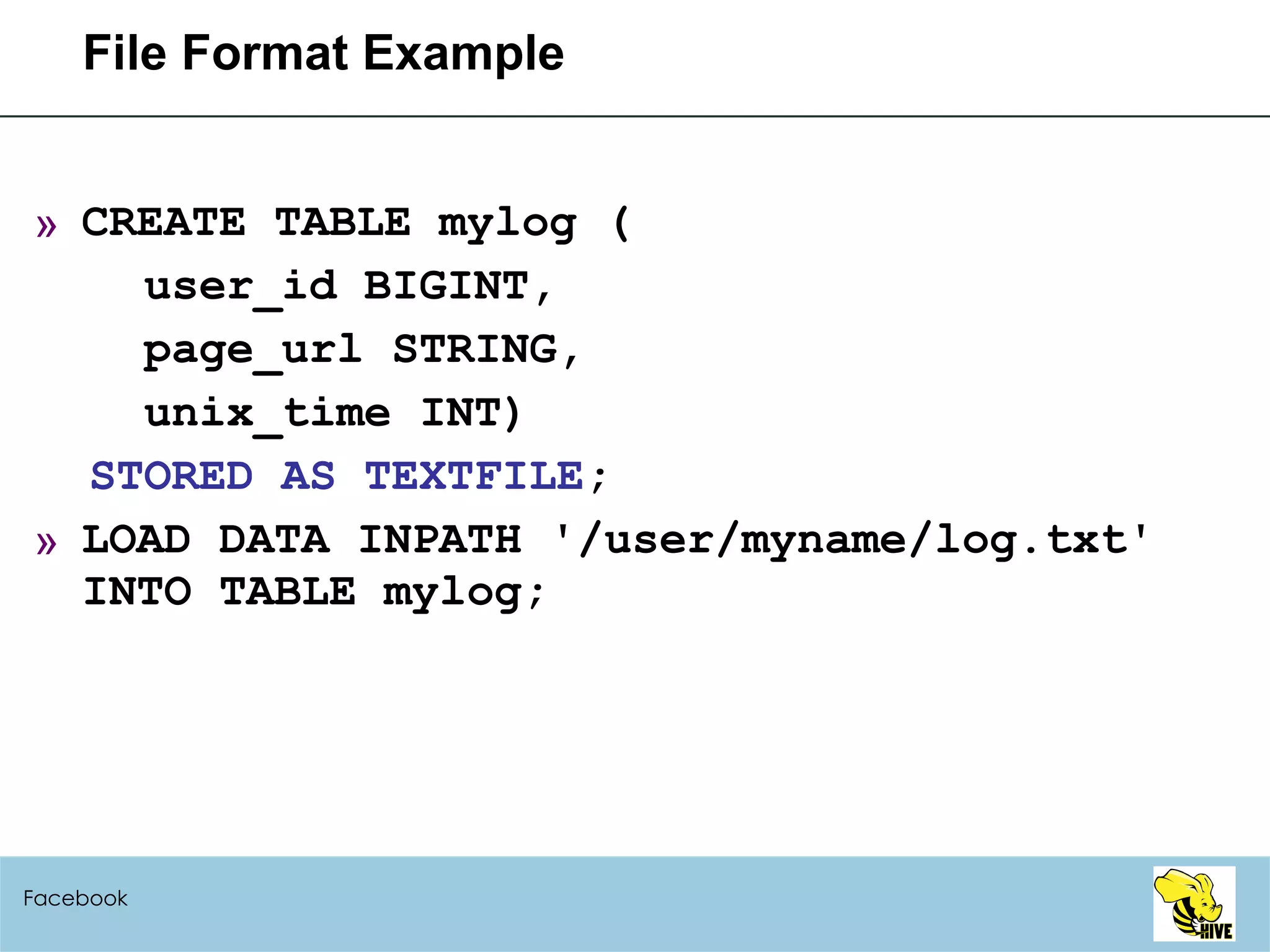
File Format Example CREATE TABLE mylog ( user_id BIGINT, page_url STRING, unix_time INT) STORED AS TEXTFILE ; LOAD DATA INPATH '/user/myname/log.txt' INTO TABLE mylog; Facebook
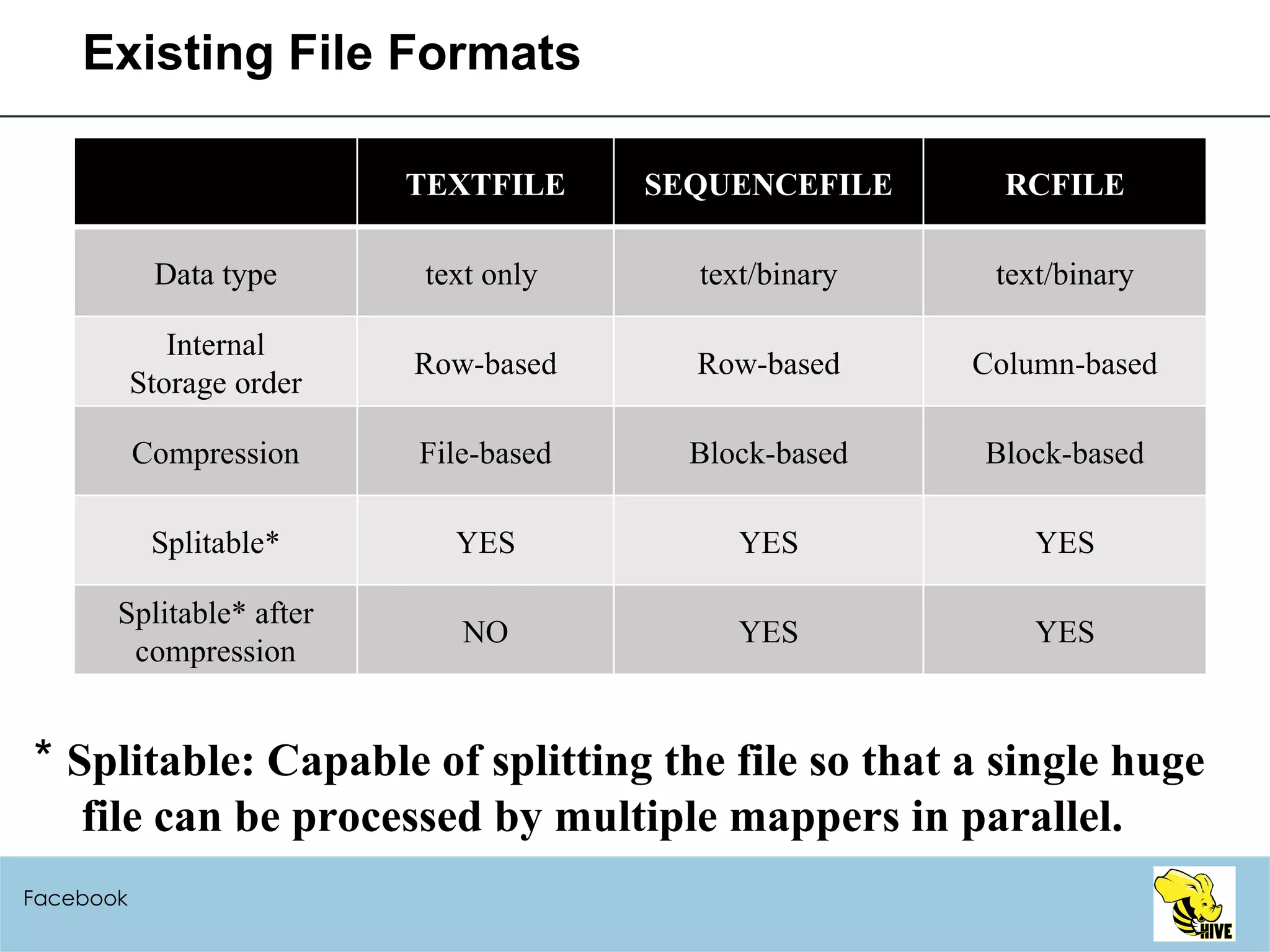
Existing File Formats Facebook *  Splitable: Capable of splitting the file so that a single huge file can be processed by multiple mappers in parallel. TEXTFILE SEQUENCEFILE RCFILE Data type text only  text/binary text/binary Internal Storage order Row-based Row-based Column-based Compression File-based Block-based Block-based Splitable* YES YES YES Splitable* after compression NO YES YES
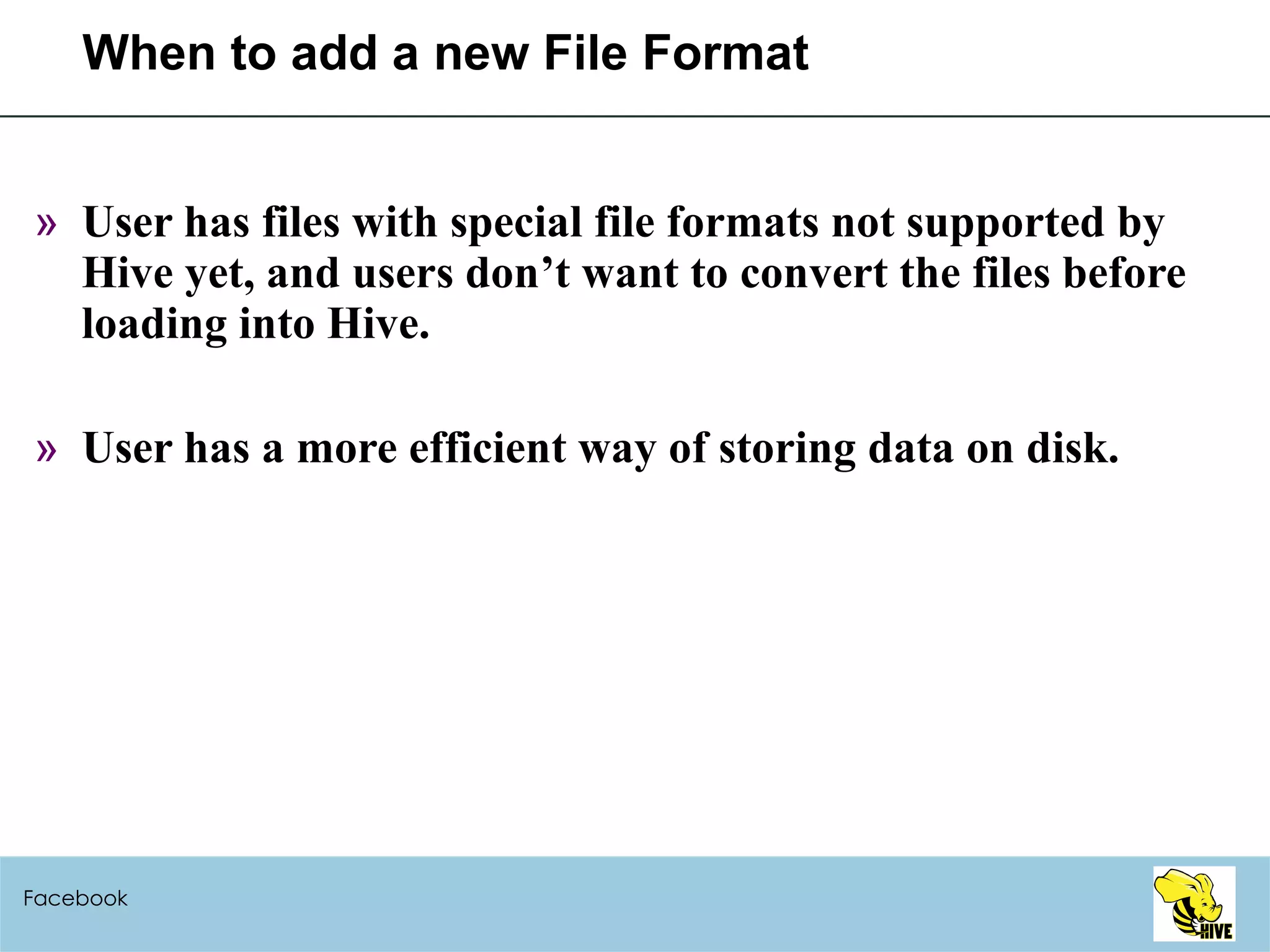
When to add a new File Format User has files with special file formats not supported by Hive yet, and users don’t want to convert the files before loading into Hive. User has a more efficient way of storing data on disk. Facebook
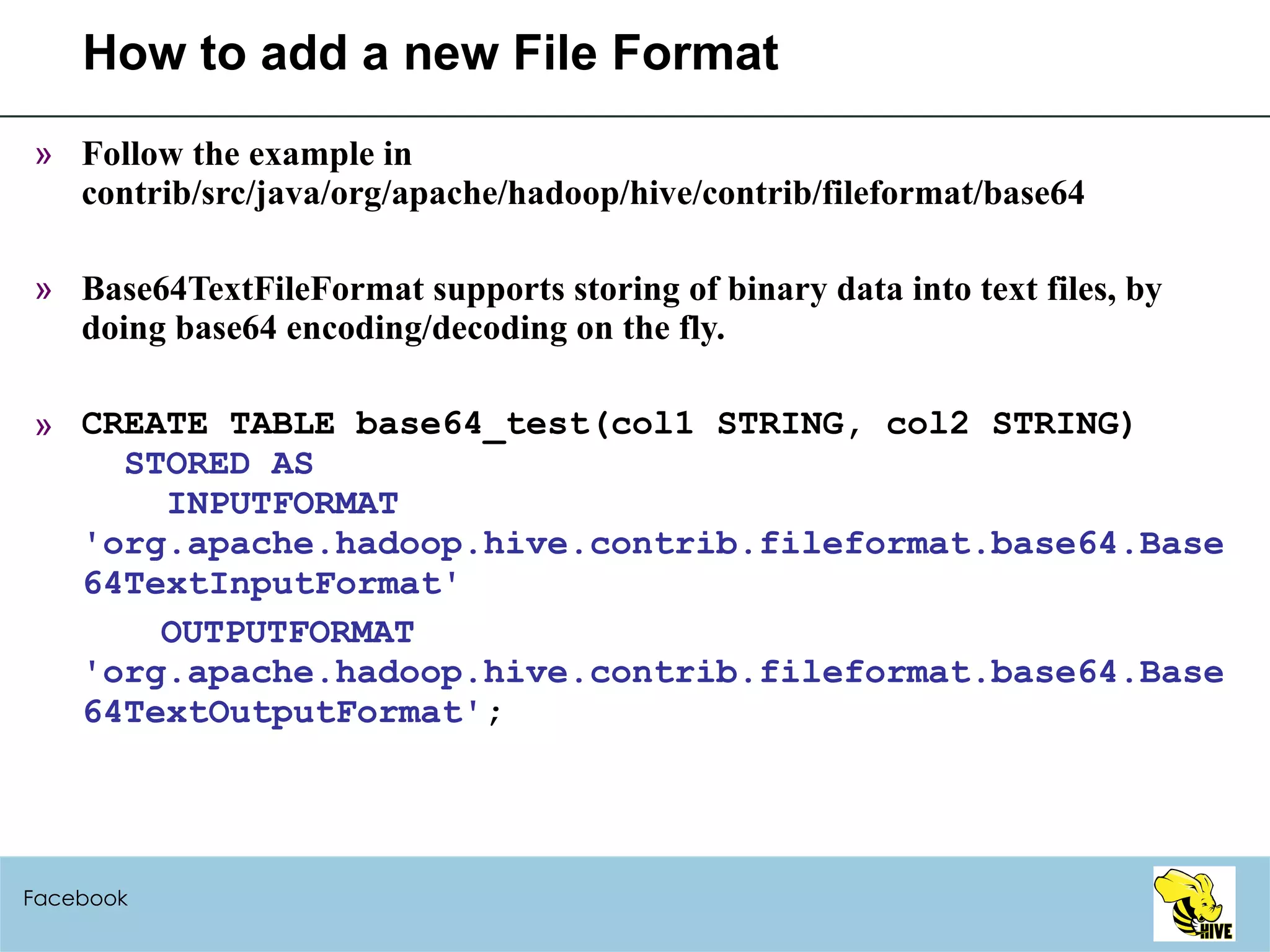
How to add a new File Format Follow the example in contrib/src/java/org/apache/hadoop/hive/contrib/fileformat/base64 Base64TextFileFormat supports storing of binary data into text files, by doing base64 encoding/decoding on the fly. CREATE TABLE base64_test(col1 STRING, col2 STRING)   STORED AS    INPUTFORMAT 'org.apache.hadoop.hive.contrib.fileformat.base64.Base64TextInputFormat' OUTPUTFORMAT 'org.apache.hadoop.hive.contrib.fileformat.base64.Base64TextOutputFormat' ; Facebook
SerDe Facebook
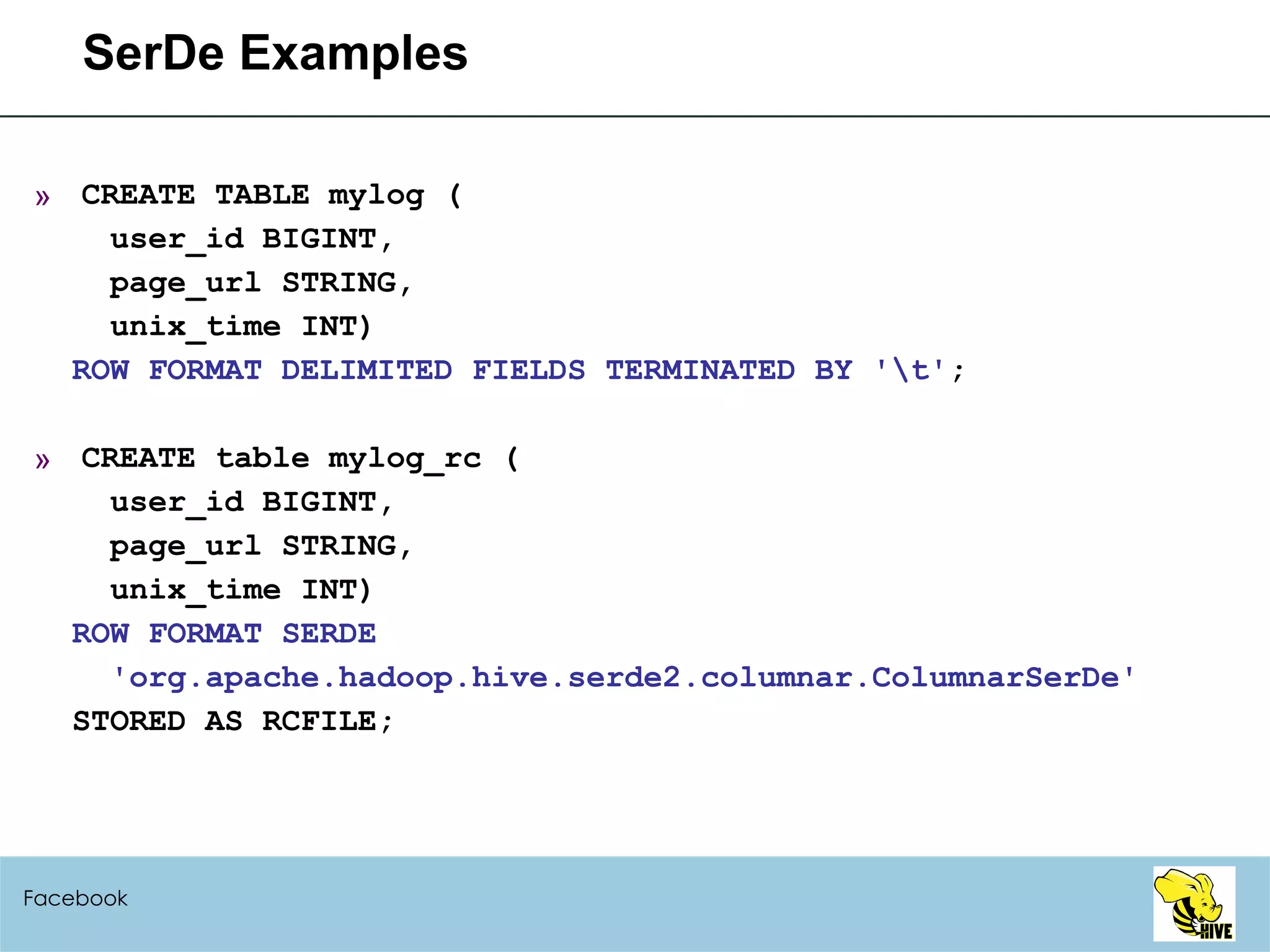
SerDe Examples CREATE TABLE mylog ( user_id BIGINT, page_url STRING, unix_time INT) ROW FORMAT DELIMITED FIELDS TERMINATED BY '\t' ; CREATE table mylog_rc ( user_id BIGINT, page_url STRING, unix_time INT) ROW FORMAT SERDE 'org.apache.hadoop.hive.serde2.columnar.ColumnarSerDe' STORED AS RCFILE; Facebook
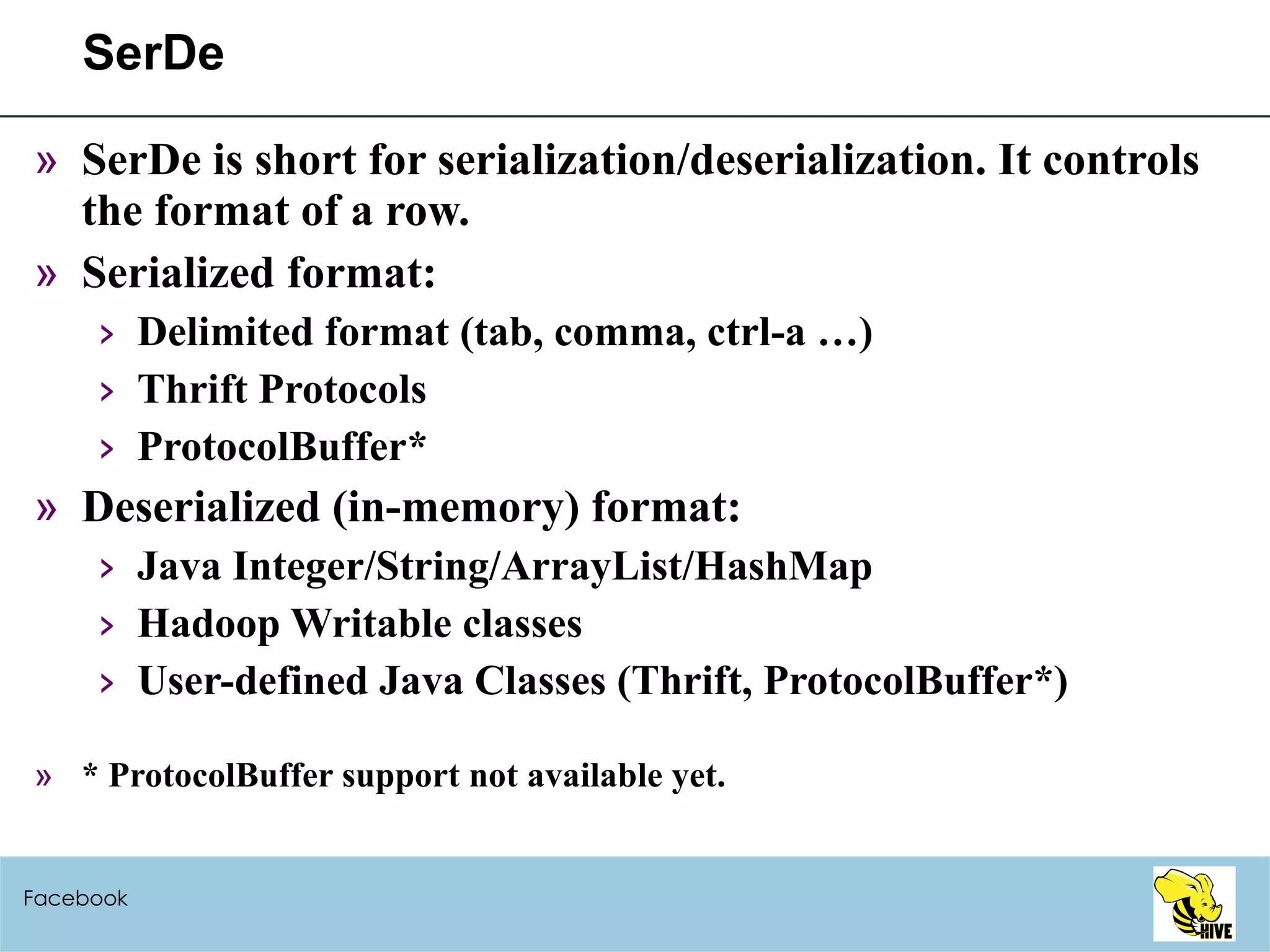
SerDe SerDe is short for serialization/deserialization. It controls the format of a row. Serialized format: Delimited format (tab, comma, ctrl-a …) Thrift Protocols ProtocolBuffer* Deserialized (in-memory) format: Java Integer/String/ArrayList/HashMap Hadoop Writable classes User-defined Java Classes (Thrift, ProtocolBuffer*) * ProtocolBuffer support not available yet. Facebook
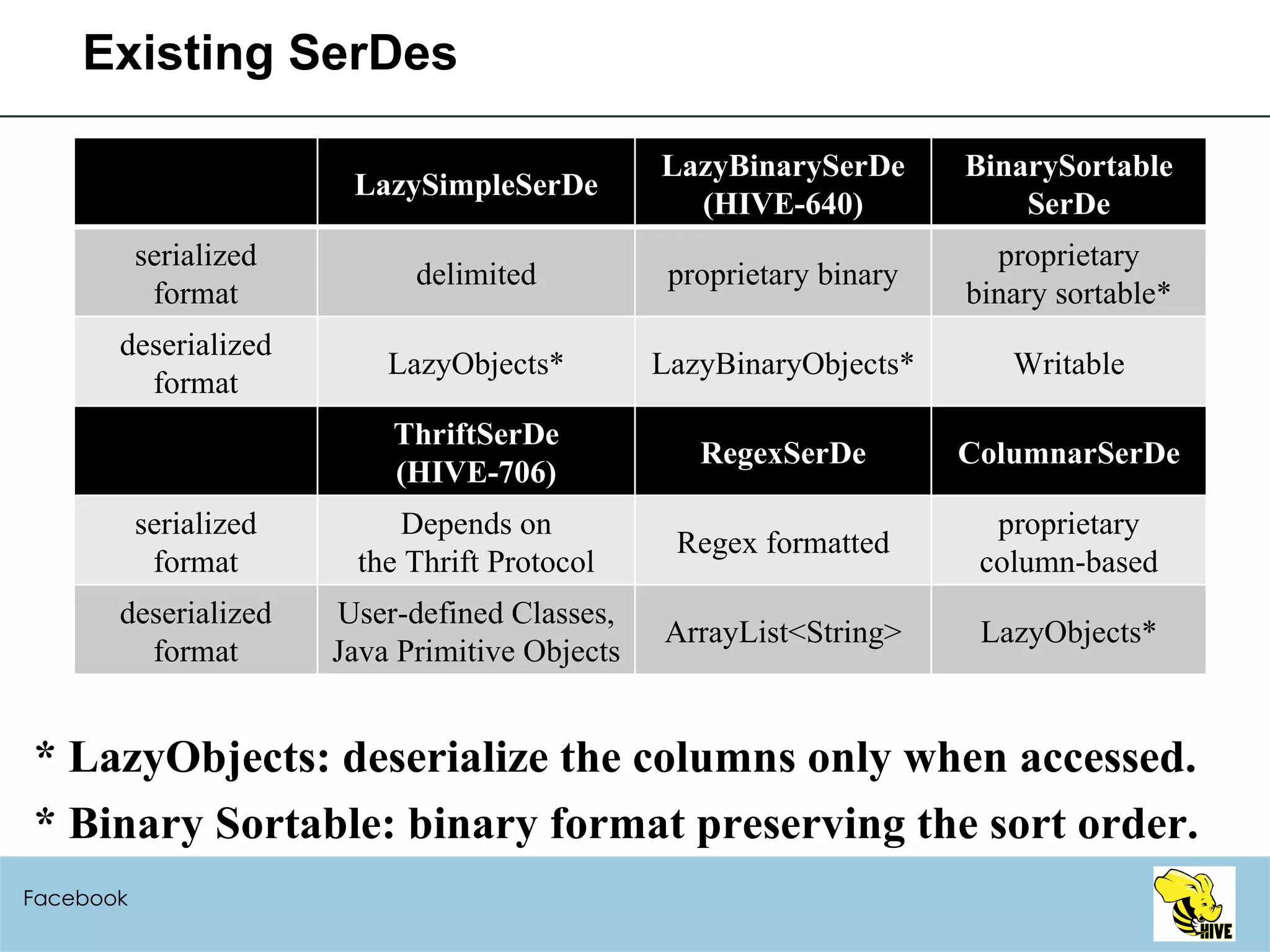
Existing SerDes Facebook * LazyObjects: deserialize the columns only when accessed. * Binary Sortable: binary format preserving the sort order. LazySimpleSerDe LazyBinarySerDe (HIVE-640) BinarySortable SerDe serialized format delimited proprietary binary proprietary binary sortable* deserialized format LazyObjects* LazyBinaryObjects* Writable ThriftSerDe (HIVE-706) RegexSerDe ColumnarSerDe serialized format Depends on the Thrift Protocol Regex formatted proprietary column-based deserialized format User-defined Classes, Java Primitive Objects ArrayList<String> LazyObjects*
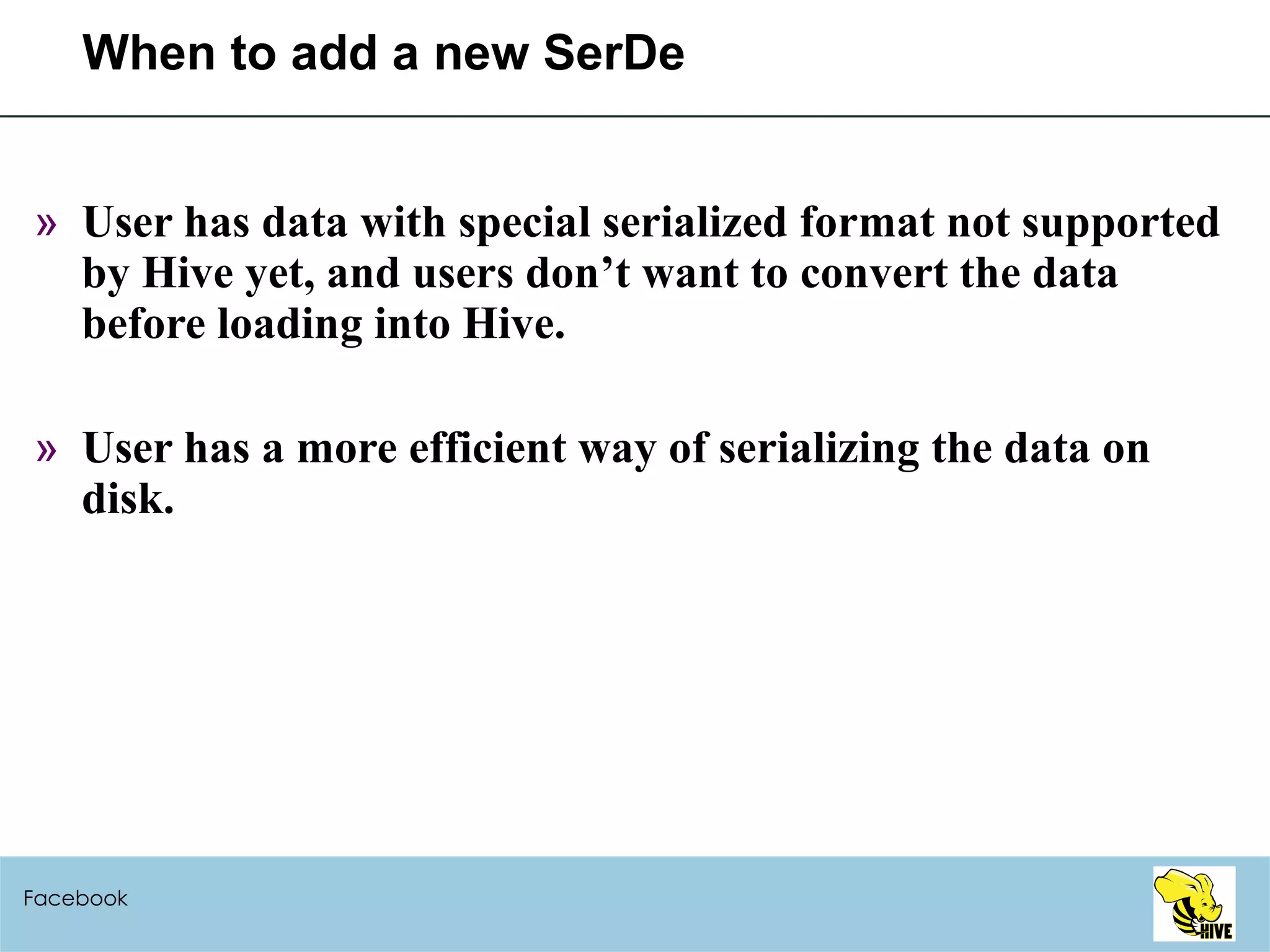
When to add a new SerDe User has data with special serialized format not supported by Hive yet, and users don’t want to convert the data before loading into Hive. User has a more efficient way of serializing the data on disk. Facebook
How to add a new SerDe for text data Follow the example in contrib/src/java/org/apache/hadoop/hive/contrib/serde2/RegexSerDe.java RegexSerDe uses a user-provided regular expression to deserialize data. CREATE TABLE apache_log(host STRING,  identity STRING, user STRING, time STRING, request STRING,  status STRING, size STRING, referer STRING, agent STRING) ROW FORMAT SERDE 'org.apache.hadoop.hive.contrib.serde2.RegexSerDe' WITH SERDEPROPERTIES ( &quot;input.regex&quot; = &quot;([^ ]*) ([^ ]*) ([^ ]*) (-|\\[[^\\]]*\\]) ([^ \&quot;]*|\&quot;[^\&quot;]*\&quot;) (-|[0-9]*) (-|[0-9]*)(?: ([^ \&quot;]*|\&quot;[^\&quot;]*\&quot;) ([^ \&quot;]*|\&quot;[^\&quot;]*\&quot;))?&quot;, &quot;output.format.string&quot; = &quot;%1$s %2$s %3$s %4$s %5$s %6$s %7$s %8$s %9$s”) STORED AS TEXTFILE; Facebook
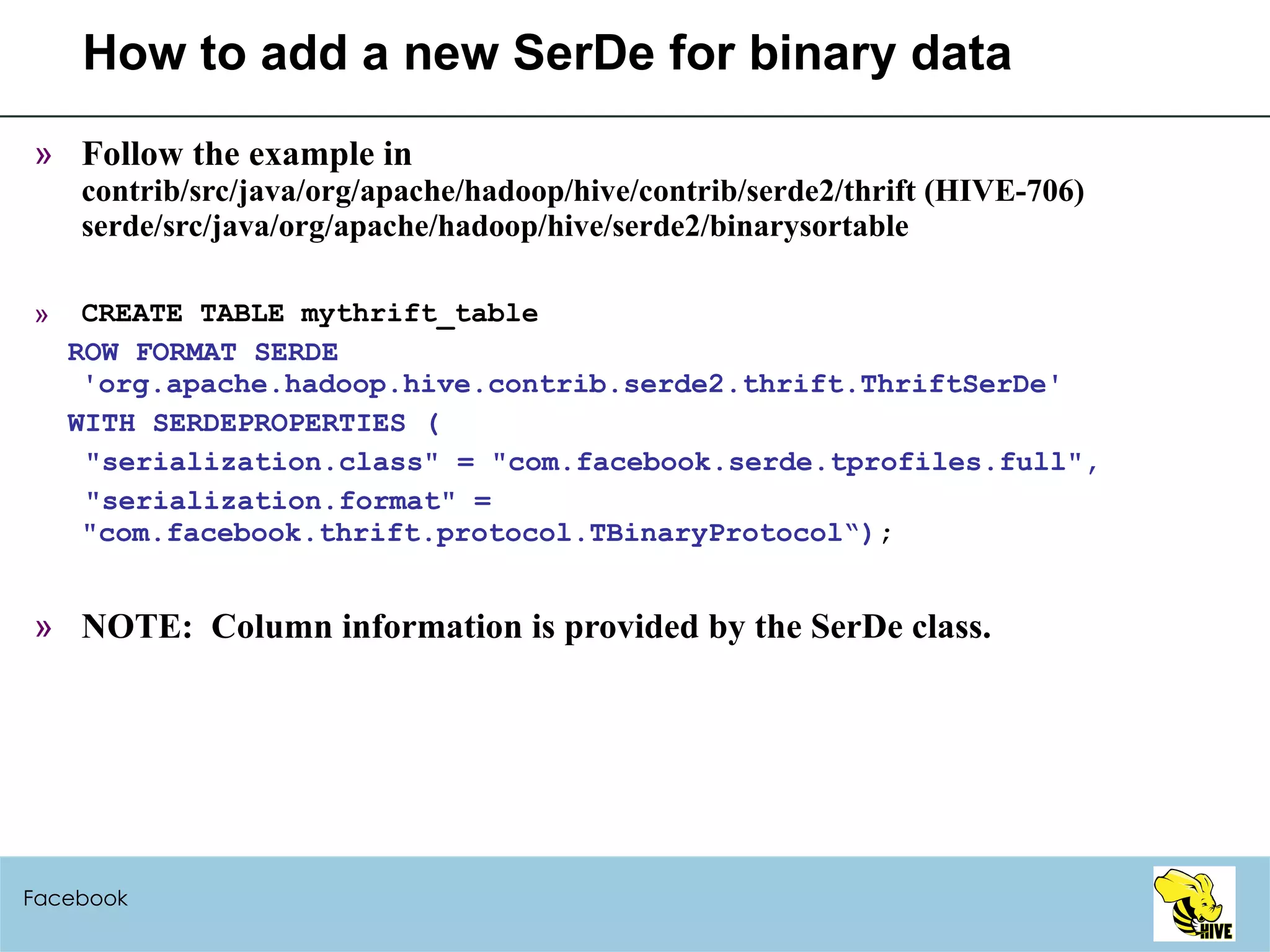
How to add a new SerDe for binary data Follow the example in contrib/src/java/org/apache/hadoop/hive/contrib/serde2/thrift (HIVE-706) serde/src/java/org/apache/hadoop/hive/serde2/binarysortable CREATE TABLE mythrift_table ROW FORMAT SERDE 'org.apache.hadoop.hive.contrib.serde2.thrift.ThriftSerDe' WITH SERDEPROPERTIES ( &quot;serialization.class&quot; = &quot;com.facebook.serde.tprofiles.full&quot;, &quot;serialization.format&quot; = &quot;com.facebook.thrift.protocol.TBinaryProtocol“) ; NOTE:  Column information is provided by the SerDe class. Facebook
Map/Reduce Scripts (Transform) Facebook
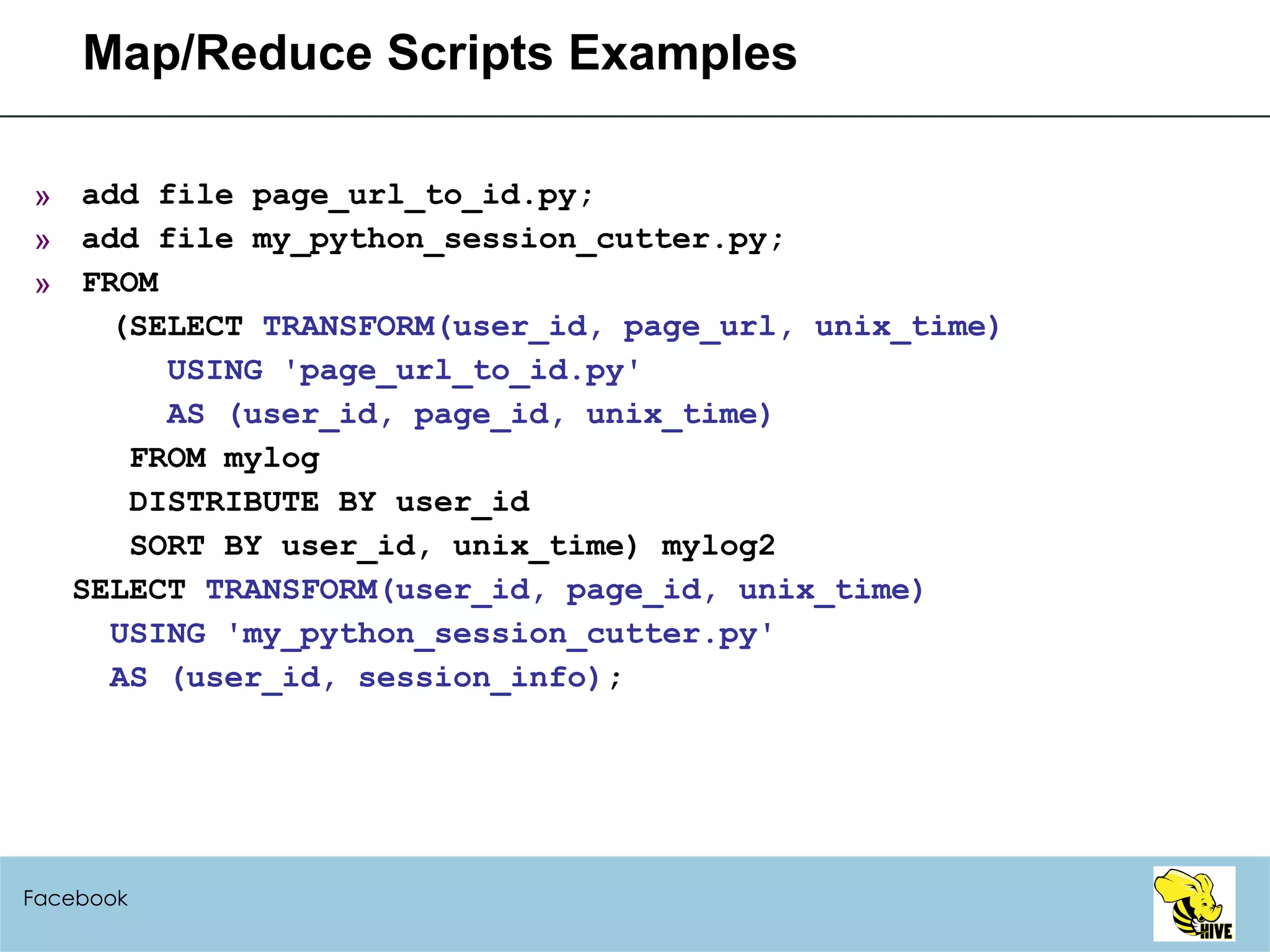
Map/Reduce Scripts Examples add file page_url_to_id.py; add file my_python_session_cutter.py; FROM (SELECT  TRANSFORM(user_id, page_url, unix_time) USING 'page_url_to_id.py' AS (user_id, page_id, unix_time) FROM mylog DISTRIBUTE BY user_id SORT BY user_id, unix_time) mylog2 SELECT  TRANSFORM(user_id, page_id, unix_time) USING 'my_python_session_cutter.py' AS (user_id, session_info) ; Facebook
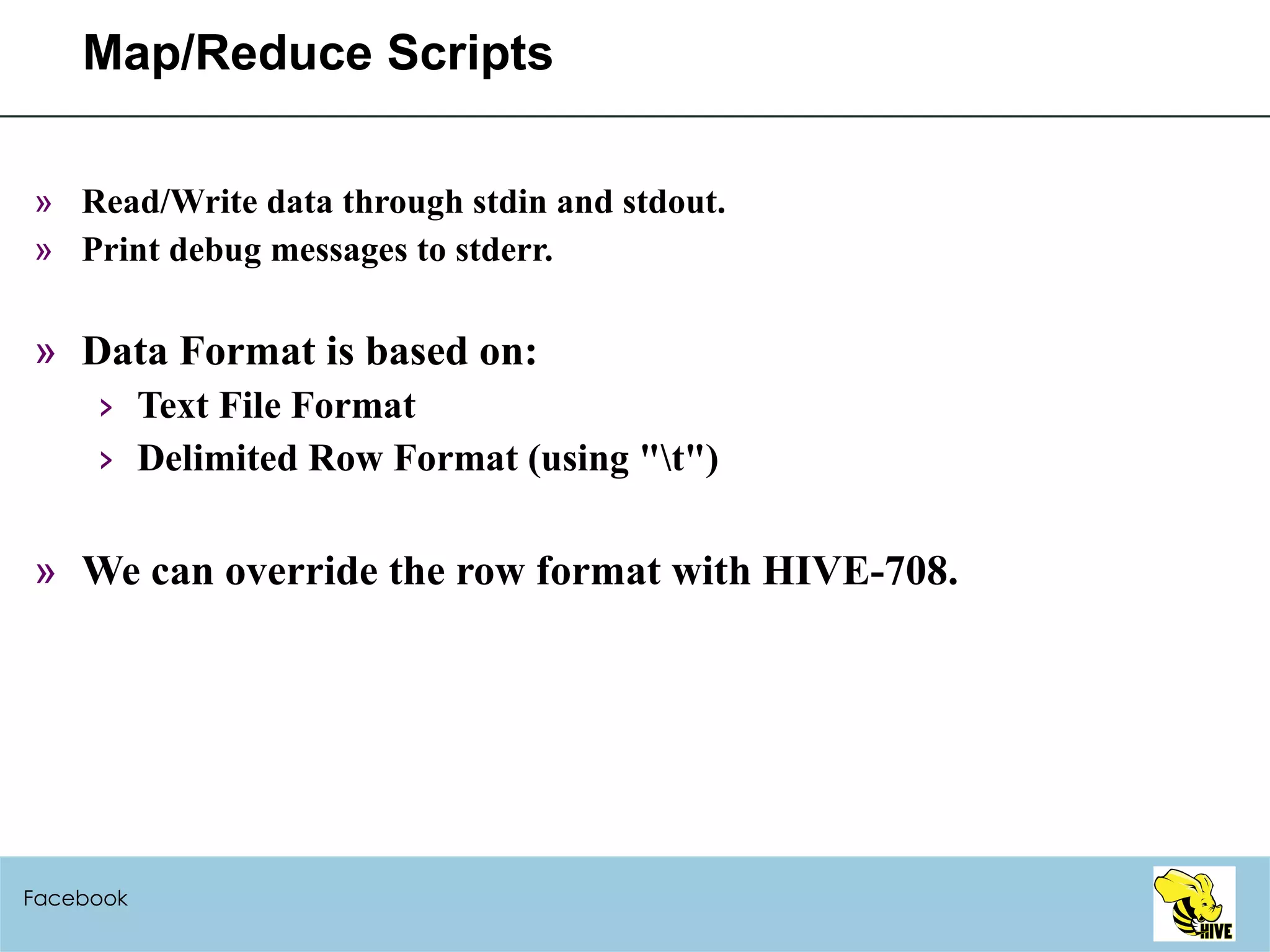
Map/Reduce Scripts Read/Write data through stdin and stdout. Print debug messages to stderr. Data Format is based on: Text File Format Delimited Row Format (using &quot;\t&quot;) We can override the row format with HIVE-708. Facebook
UDF (User-defined Functions) Facebook
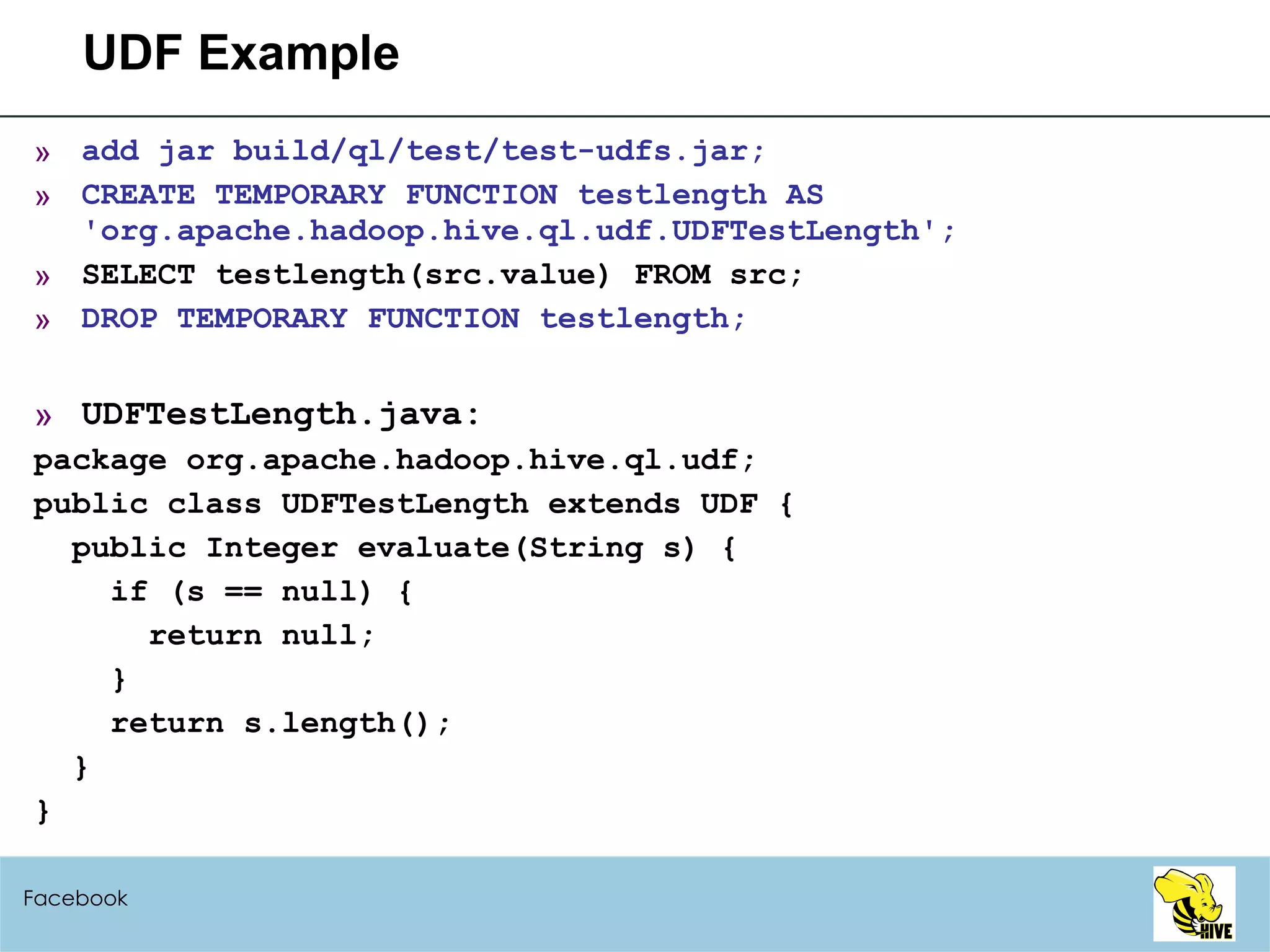
UDF Example add jar build/ql/test/test-udfs.jar; CREATE TEMPORARY FUNCTION testlength AS 'org.apache.hadoop.hive.ql.udf.UDFTestLength'; SELECT testlength(src.value) FROM src; DROP TEMPORARY FUNCTION testlength; UDFTestLength.java: package org.apache.hadoop.hive.ql.udf;  public class UDFTestLength extends UDF { public Integer evaluate(String s) { if (s == null) { return null; } return s.length(); } } Facebook
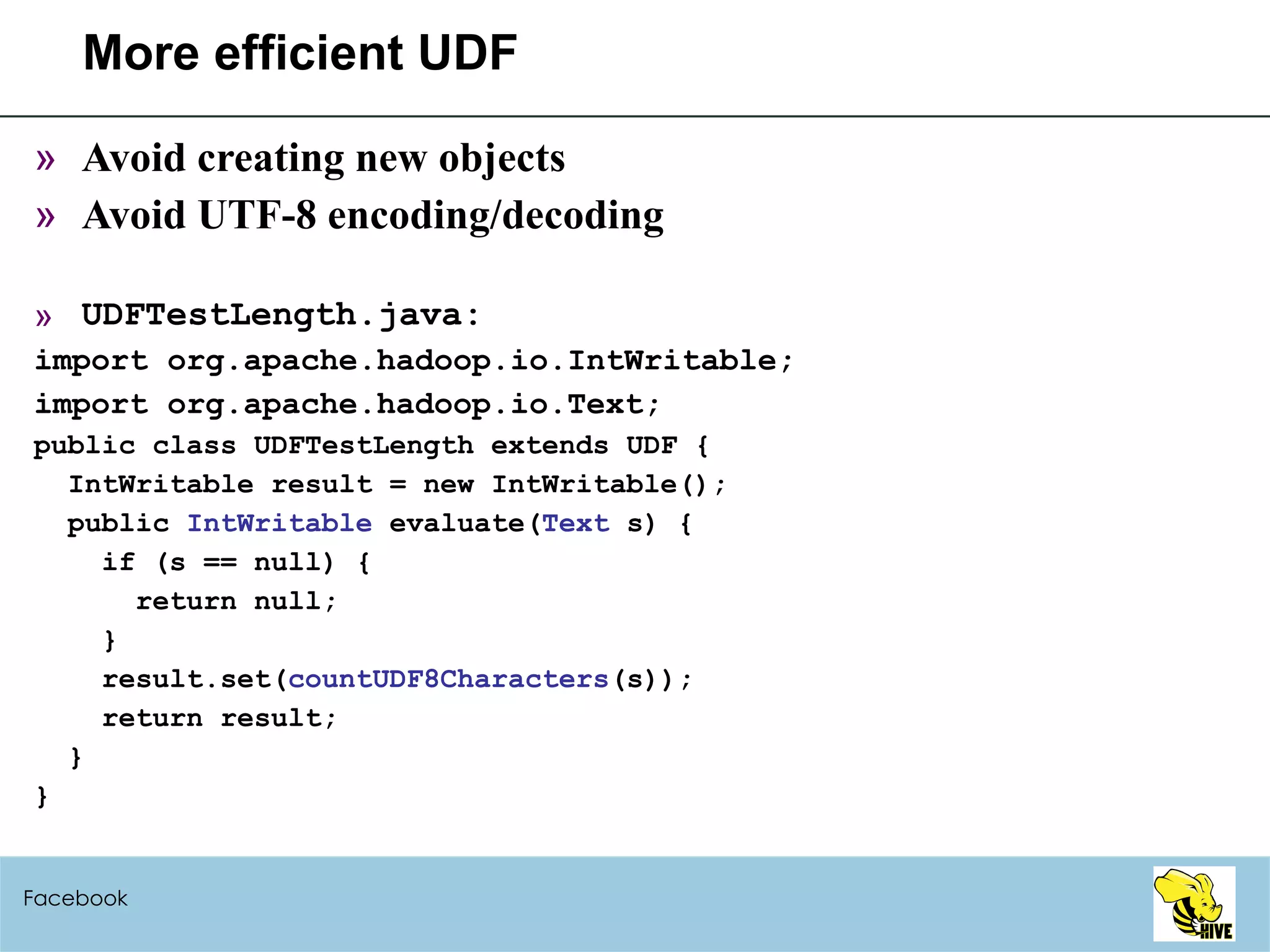
More efficient UDF Avoid creating new objects Avoid UTF-8 encoding/decoding UDFTestLength.java: import org.apache.hadoop.io.IntWritable; import org.apache.hadoop.io.Text; public class UDFTestLength extends UDF { IntWritable result = new IntWritable(); public  IntWritable  evaluate( Text  s) { if (s == null) { return null; } result.set( countUDF8Characters (s)); return result; } } Facebook
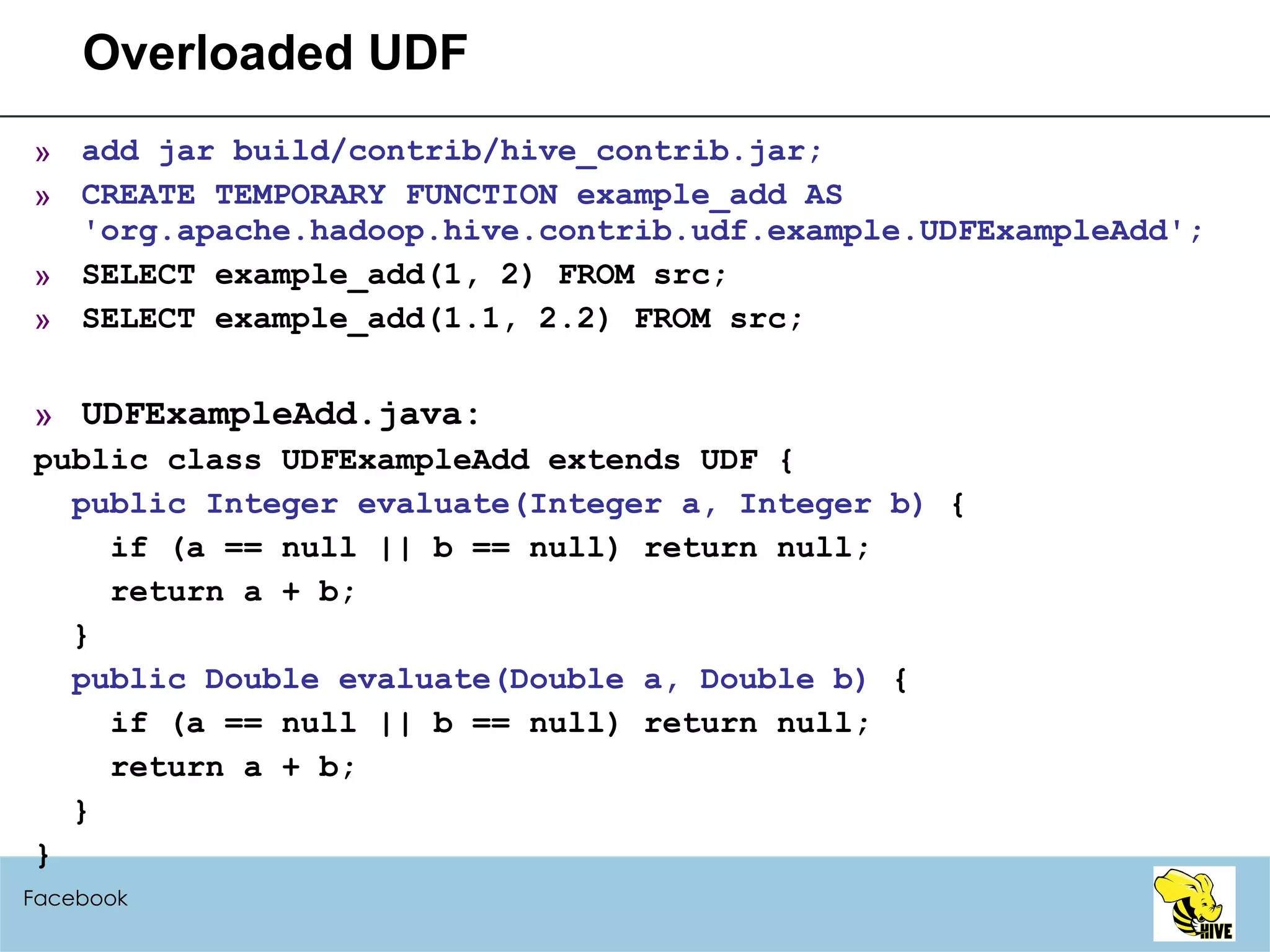
Overloaded UDF add jar build/contrib/hive_contrib.jar; CREATE TEMPORARY FUNCTION example_add AS 'org.apache.hadoop.hive.contrib.udf.example.UDFExampleAdd'; SELECT example_add(1, 2) FROM src; SELECT example_add(1.1, 2.2) FROM src; UDFExampleAdd.java: public class UDFExampleAdd extends UDF { public Integer evaluate(Integer a, Integer b)  { if (a == null || b == null) return null; return a + b; } public Double evaluate(Double a, Double b)  { if (a == null || b == null) return null; return a + b; } } Facebook
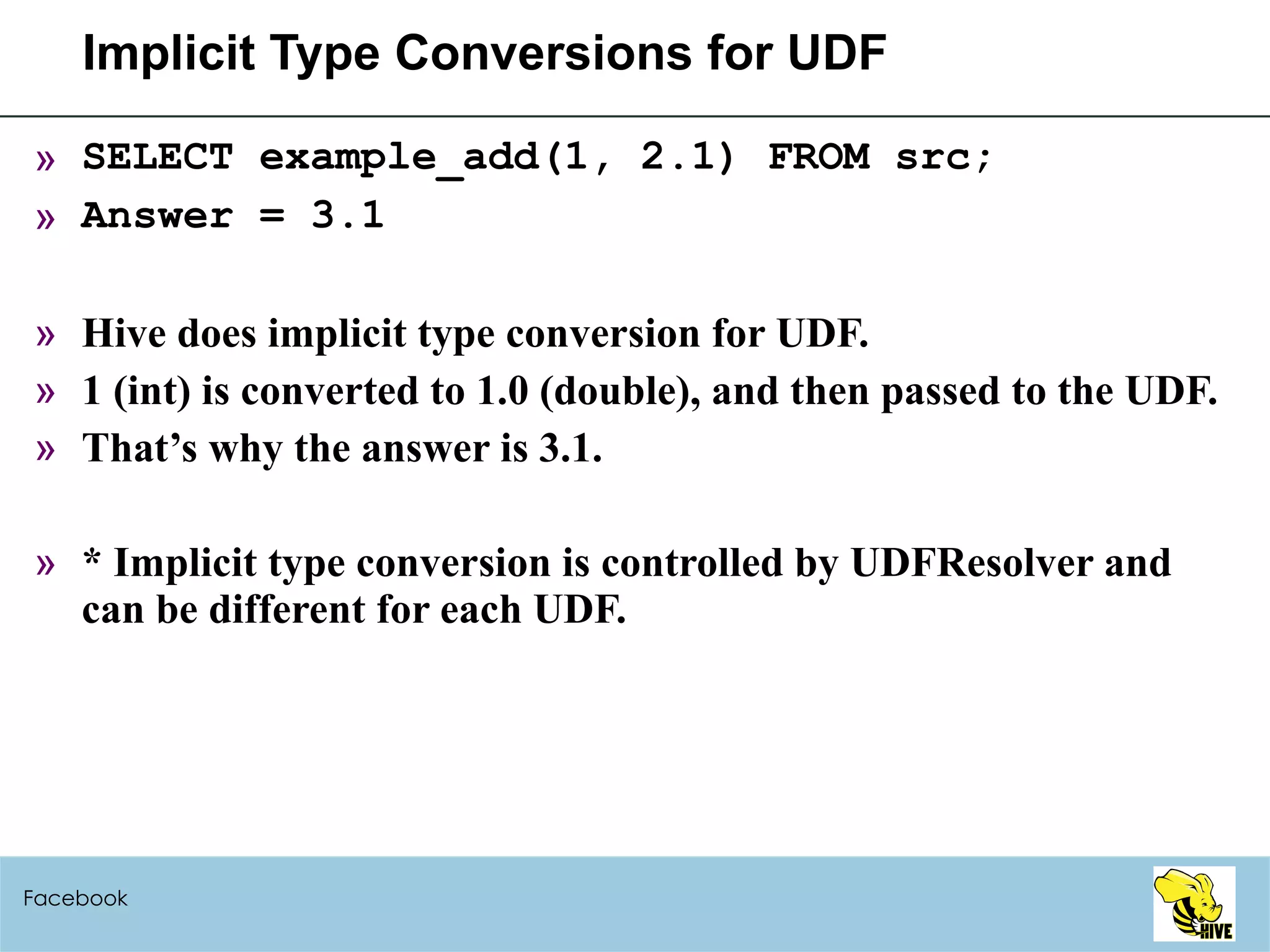
Implicit Type Conversions for UDF SELECT example_add(1, 2.1) FROM src; Answer = 3.1 Hive does implicit type conversion for UDF. 1 (int) is converted to 1.0 (double), and then passed to the UDF. That’s why the answer is 3.1. * Implicit type conversion is controlled by UDFResolver and can be different for each UDF. Facebook
Variable-length Arguments (HIVE-699) SELECT example_add(1, 2) FROM src; SELECT example_add(1, 2, 3) FROM src; SELECT example_add(1, 2, 3, 4.1) FROM src; UDFExampleAdd.java: public class UDFExampleAdd extends UDF { public Integer evaluate(Integer... a) { int total = 0; for (int i=0; i<a.length; i++) if (a[i] != null) total += a[i]; return total; } // the same for Double public Double evaluate(Double... a)  } Facebook
Summary for UDFs Writing UDF in Java is simple. Hadoop Writables/Text provides better efficiency. UDF can be overloaded. Hive supports implicit type conversions. UDF can take variable-length arguments, just as in Java. *GenericUDF provides the best performance (avoiding Java reflection, allows short-circuit evaluation, etc).  Facebook
UDAF (User-defined Aggregation Functions) Facebook
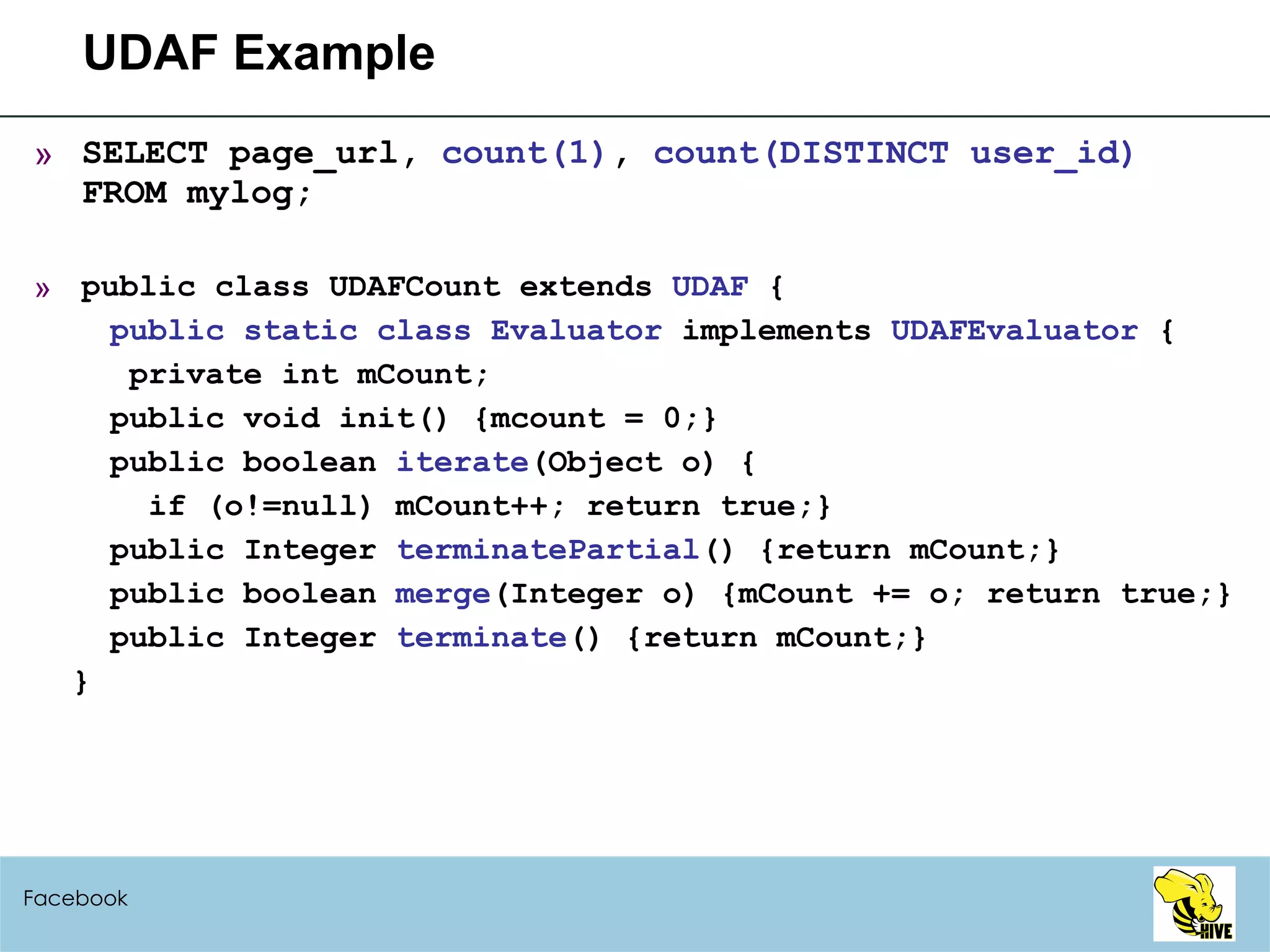
UDAF Example SELECT page_url,  count(1) ,  count(DISTINCT user_id) FROM mylog; public class UDAFCount extends  UDAF  { public static class Evaluator  implements  UDAFEvaluator  { private int mCount; public void init() {mcount = 0;} public boolean  iterate (Object o) { if (o!=null) mCount++; return true;} public Integer  terminatePartial () {return mCount;} public boolean  merge (Integer o) {mCount += o; return true;} public Integer  terminate () {return mCount;} } Facebook
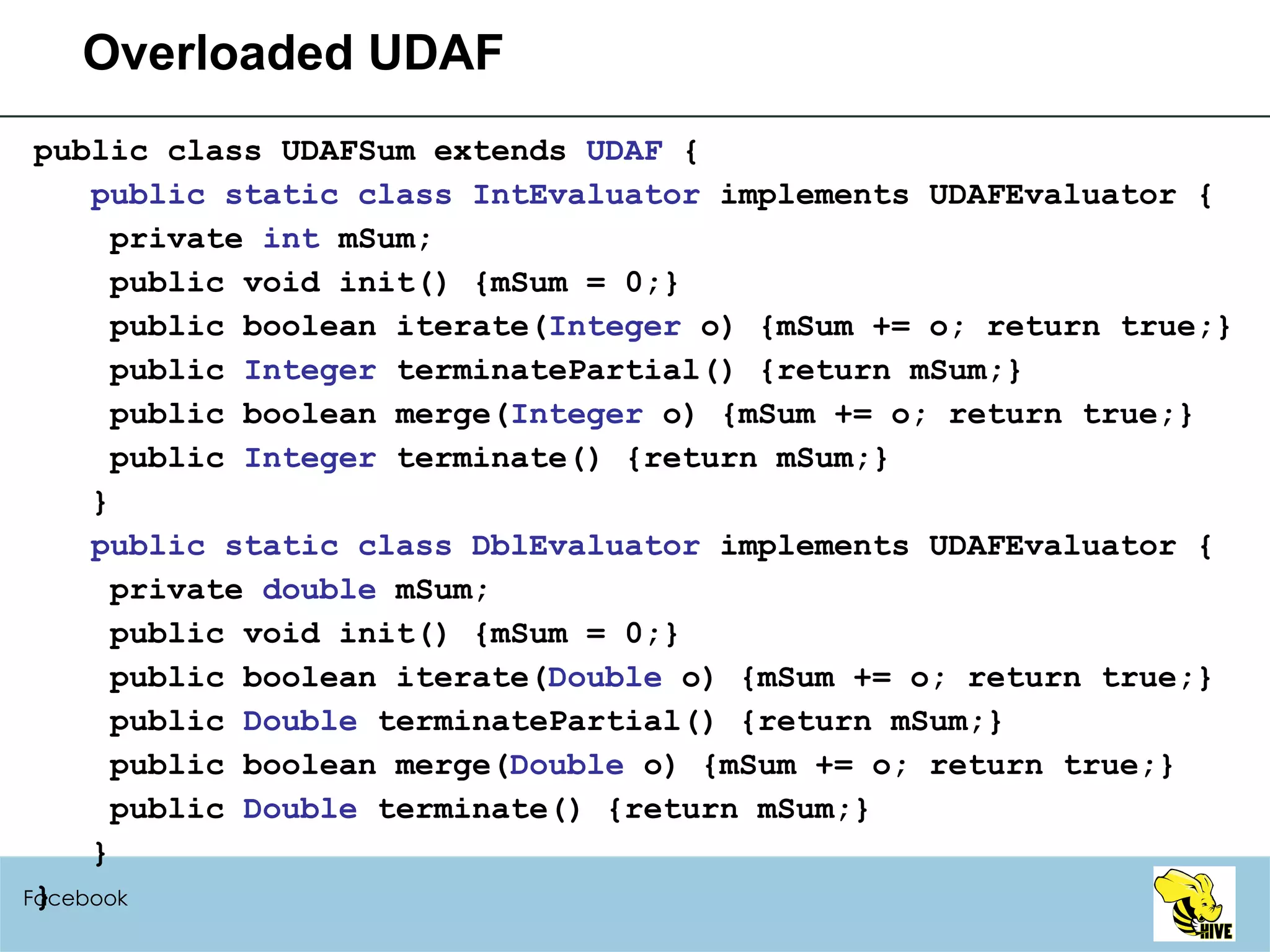
Overloaded UDAF public class UDAFSum extends  UDAF  { public static class IntEvaluator  implements UDAFEvaluator { private  int  mSum; public void init() {mSum = 0;} public boolean iterate( Integer  o) {mSum += o; return true;} public  Integer  terminatePartial() {return mSum;} public boolean merge( Integer  o) {mSum += o; return true;} public  Integer  terminate() {return mSum;} } public static class DblEvaluator  implements UDAFEvaluator { private  double  mSum; public void init() {mSum = 0;} public boolean iterate( Double  o) {mSum += o; return true;} public  Double  terminatePartial() {return mSum;} public boolean merge( Double  o) {mSum += o; return true;} public  Double  terminate() {return mSum;} } } Facebook
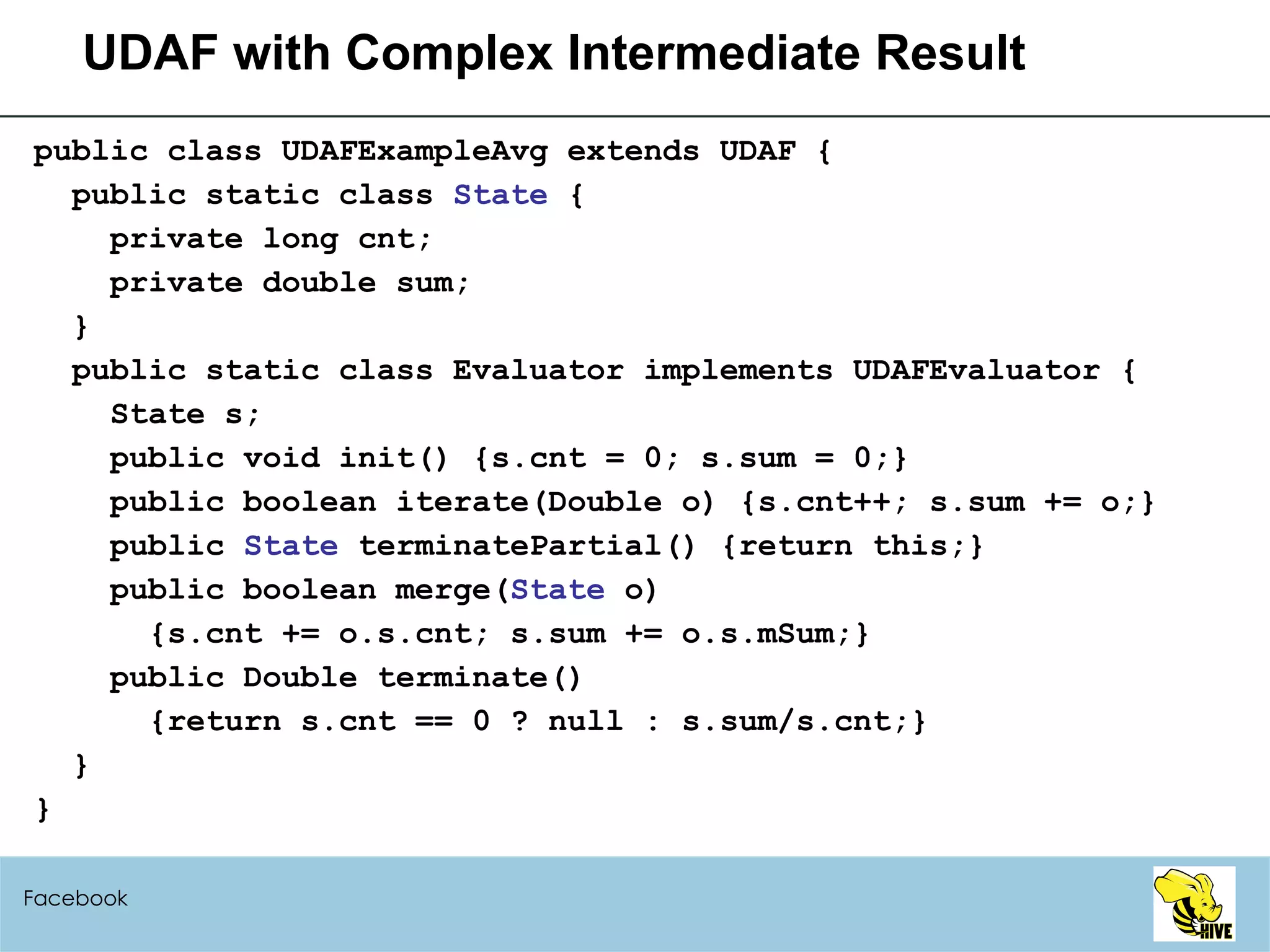
UDAF with Complex Intermediate Result public class UDAFExampleAvg extends UDAF { public static class  State  { private long cnt; private double sum; } public static class Evaluator implements UDAFEvaluator { State s; public void init() {s.cnt = 0; s.sum = 0;} public boolean iterate(Double o) {s.cnt++; s.sum += o;} public  State  terminatePartial() {return this;} public boolean merge( State  o) {s.cnt += o.s.cnt; s.sum += o.s.mSum;} public Double terminate() {return s.cnt == 0 ? null : s.sum/s.cnt;} } } Facebook
UDAF without Partial Aggregations Implement dummy  terminatePartial   and  merge  functions that throw a RunTimeException. Do the following before running the query: set hive.map.aggr=false; set hive.groupby.skewindata=false; Facebook
Summary for UDAFs Writing UDAF is similar to writing UDF. UDAFs are overloaded via multiple static inner classes. UDAFs (as well as UDF) can return complex objects. We can disable partial aggregations for UDAFs. *GenericUDAF provides the best performance (avoiding Java reflection, etc).  Facebook
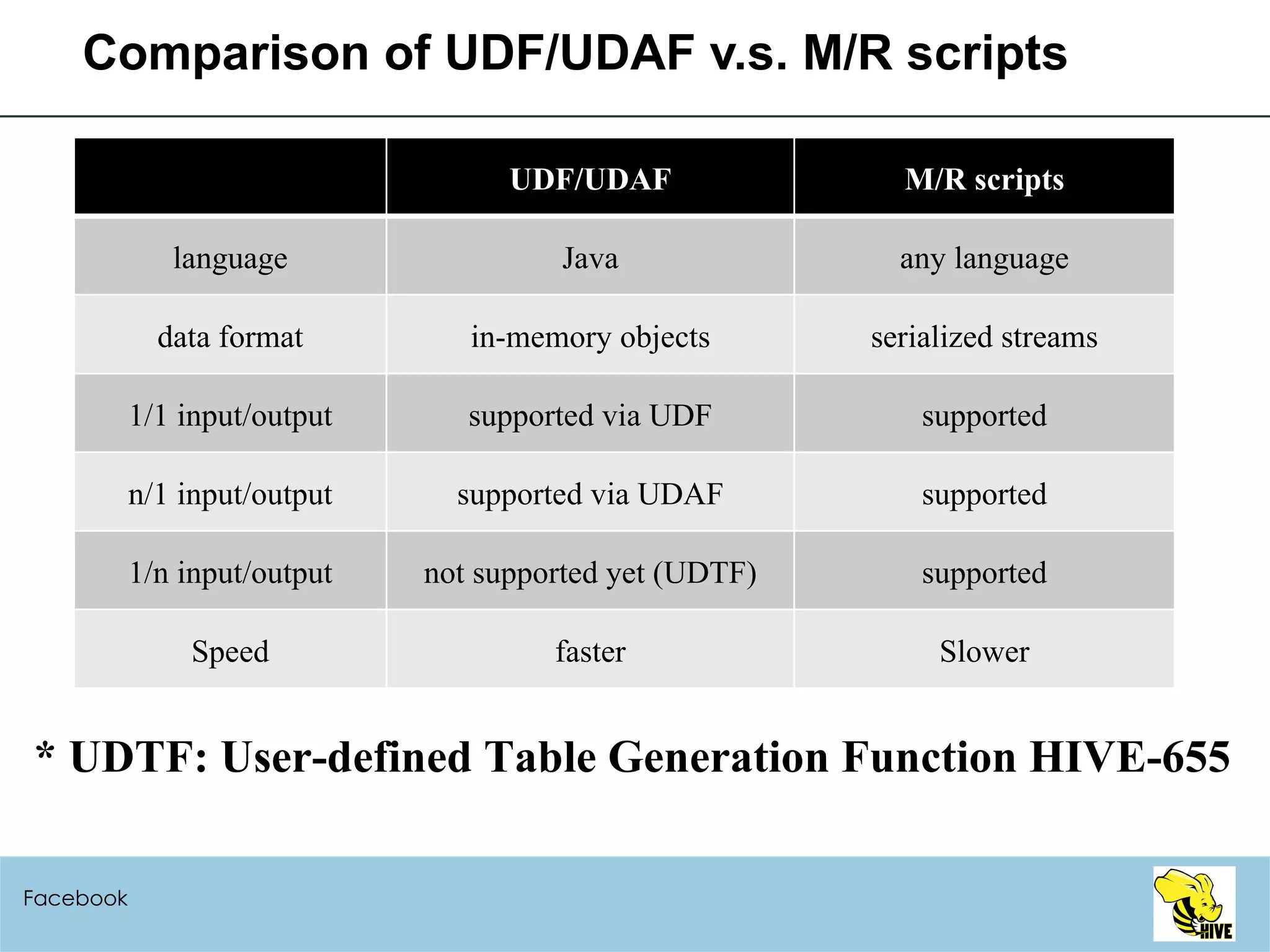
Comparison of UDF/UDAF v.s. M/R scripts Facebook * UDTF: User-defined Table Generation Function HIVE-655 UDF/UDAF M/R scripts language Java any language data format in-memory objects serialized streams 1/1 input/output supported via UDF supported n/1 input/output supported via UDAF supported 1/n input/output not supported yet (UDTF) supported Speed faster Slower
How to Contribute the Work Facebook
How to contribute the work contrib is the directory for contribution of general-purpose file format / serde / udf / udaf. Write the code. Add a test case (a .q file). Verify the code works. &quot;svn add&quot; the new files. Create a JIRA and a patch. Reference:  http://wiki.apache.org/hadoop/Hive/HowToContribute Facebook
Q & A File Format SerDe Map/Reduce Scripts (Transform) UDF UDAF Facebook
Hive – Roadmap
Branches and Releases Branch out Hive-0.4 by end of the week (8/7/2009) Release Hive-0.4 and Hive-0.3.1 by (8/29/2009) Drop support for Hadoop-0.17 in trunk? Facebook
Features available in 0.4 ODBC driver Performance Optimizations Map side joins Columnar Storage Lazy SerDe Predicate pushdown Features Multi group by New UDFs and UDAFs Facebook
Future stuff Views and data variables Dumbo integration Create table as select Indexes Inserts without listing partitions Use sort properties to optimize query Insert appends IN, exists and correlated subqueries Types – timestamp, enums HAVING clause Better error reporting Facebook
More Future stuff Statistics More join optimizations Persistent UDFs and UDAFs Help on the CLI Facebook

Hive User Meeting 2009 8 Facebook

  • 1.
    Hive User GroupMeeting August 2009
  • 2.
  • 3.
    Why Another DataWarehousing System? Data, data and more data 200GB per day in March 2008 5+TB(compressed) raw data per day today
  • 4.
    What is HIVE?A system for managing and querying structured data built on top of Hadoop Map-Reduce for execution HDFS for storage Metadata on raw files Key Building Principles: SQL as a familiar data warehousing tool Extensibility – Types, Functions, Formats, Scripts Scalability and Performance
  • 5.
    Why SQL onHadoop? hive> select key, count(1) from kv1 where key > 100 group by key; vs. $ cat > /tmp/reducer.sh uniq -c | awk '{print $2&quot;\t&quot;$1}‘ $ cat > /tmp/map.sh awk -F '\001' '{if($1 > 100) print $1}‘ $ bin/hadoop jar contrib/hadoop-0.19.2-dev-streaming.jar -input /user/hive/warehouse/kv1 -mapper map.sh -file /tmp/reducer.sh -file /tmp/map.sh -reducer reducer.sh -output /tmp/largekey -numReduceTasks 1 $ bin/hadoop dfs –cat /tmp/largekey/part*
  • 6.
    Data Model Tables* Analogous to tables in relational DBs Each table has corresponding directory in HDFS Example Page views table name: pvs HDFS directory /wh/pvs * Databases – supported in metastore, but not yet in query language
  • 7.
    Data Model Partitions Analogous to dense indexes on partition columns Nested sub-directories in HDFS for each combination of partition column values Example Partition columns: ds, ctry HDFS subdirectory for ds = 20090801, ctry = US /wh/pvs/ds=20090801/ctry=US HDFS subdirectory for ds = 20090801, ctry = CA /wh/pvs/ds=20090801/ctry=CA
  • 8.
    Data Model Buckets Split data based on hash of a column - mainly for parallelism One HDFS file per bucket within partition sub-directory Example Bucket column: user into 32 buckets HDFS file for user hash 0 /wh/pvs/ds=20090801/ctry=US/part-00000 HDFS file for user hash bucket 20 /wh/pvs/ds=20090801/ctry=US/part-00020
  • 9.
    Data Model ExternalTables Point to existing data directories in HDFS Can create tables and partitions – partition columns just become annotations to external directories Example: create external table with partitions CREATE EXTERNAL TABLE pvs(userid int, pageid int, ds string, ctry string) PARTITIONED ON (ds string, ctry string) STORED AS textfile LOCATION ‘/path/to/existing/table’ Example: add a partition to external table ALTER TABLE pvs ADD PARTITION (ds=‘20090801’, ctry=‘US’) LOCATION ‘/path/to/existing/partition’
  • 10.
    Data Types PrimitiveTypes integer types, float, string, date, boolean Nestable Collections array<any-type> map<primitive-type, any-type> User-defined types* Structures with attributes which can be of any-type * More details about user defined types in extensibility section
  • 11.
  • 12.
    Hive Query LanguageSQL Sub-queries in from clause Equi-joins Inner Left, Right, full Outer Multi-table Insert Multi-group-by Sampling
  • 13.
    Hive Query LanguageExtensibility Pluggable Map-reduce scripts Pluggable User Defined Functions Pluggable User Defined Types Complex object types: List of Maps Pluggable Data Formats Apache Log Format Columnar Storage Format
  • 14.
    Example Application Statusupdates table: status_updates(userid int, status string, ds string) Load the data from log files: LOAD DATA LOCAL INPATH ‘/logs/status_updates’ INTO TABLE status_updates PARTITION (ds=’2009-03-20’) User profile table profiles(userid int, school string, gender int) Load the data from MySQL udb potentially using sqoop* * sqoop - http://www.cloudera.com/hadoop-sqoop
  • 15.
    Example Query (Filter)Filter status updates containing ‘michael jackson’ SELECT * FROM status_updates WHERE status LIKE ‘michael jackson’
  • 16.
    Example Query (Aggregation)Figure out total number of status_updates in a given day SELECT COUNT(1) FROM status_updates WHERE ds = ’2009-08-01’
  • 17.
  • 18.
    Next example querycombines group-by, joins and multi-table inserts. Facebook
  • 19.
    FROM (SELECT a.status,b.school, b.gender FROM status_updates a JOIN profiles b ON (a.userid = b.userid and a.ds='2009-03-20' ) ) subq1 INSERT OVERWRITE TABLE gender_summary PARTITION(ds='2009-03-20') SELECT subq1.gender, COUNT(1) GROUP BY subq1.gender INSERT OVERWRITE TABLE school_summary PARTITION(ds='2009-03-20') SELECT subq1.school, COUNT(1) GROUP BY subq1.school Example Query (multi-group-by)
  • 20.
  • 21.
  • 22.
  • 23.
  • 24.
  • 25.
    Single User ModeUnit tests Evaluation Multi User Mode Any significant Hive project Remote Server For non-Java metastore clients
  • 26.
  • 27.
  • 28.
    Optimizations Column PruningPredicate Pushdown Partition Pruning Join Group By Merging of small files
  • 29.
    Column Pruning Asname suggests – discard columns which are not needed SELECT a,b FROM T WHERE e < 10; T contains 5 columns (a,b,c,d,e) Columns c,d are discarded Select only the relevant columns Enabled by default hive.optimize.cp = true
  • 30.
    Predicate Pushdown Movepredicate closer to the table scan only. Enabled by default: hive.optimize.ppd = true
  • 31.
    Predicates moved upacross joins. SELECT * FROM T1 JOIN T2 ON (T1.c1=T2.c2 AND T1.c1 < 10) SELECT * FROM T1 JOIN T2 ON (T1.c1=T2.c2) WHERE T1.c1 < 10 Special needs for outer joins: Left outer join: predicates on the left side aliases are pushed Right outer join: predicates on the right side aliases are pushed Full outer join: none of the predicates are pushed
  • 32.
    Non-deterministic functions (eg.rand()) not pushed. Use annotation: @UDFType(deterministic=false) The entire expression containing non-deterministic function is not pushed up C1 > 10 and c2 < rand()
  • 33.
    Partition Pruning Reducelist of partitions to be scanned Works on parse tree currently – some known bugs
  • 34.
    Partition Pruning Reducelist of partitions to be scanned Works on parse tree currently – some known bugs SELECT * FROM (SELECT c1, COUNT(1) FROM T GROUP BY c1) subq WHERE subq.prtn = 100; SELECT * FROM T1 JOIN (SELECT * FROM T2) subq ON (T1.c1=subq.c2) WHERE subq.prtn = 100; hive.mapred.mode = nonstrict Strict mode, scan of a complete partitioned table fails
  • 35.
    Hive QL –Join INSERT OVERWRITE TABLE pv_users SELECT pv.pageid, u.age FROM page_view pv JOIN user u ON (pv.userid = u.userid);
  • 36.
    Hive QL –Join in Map Reduce page_view user pv_users Map Reduce key value 111 < 1, 1> 111 < 1, 2> 222 < 1, 1> pageid userid time 1 111 9:08:01 2 111 9:08:13 1 222 9:08:14 userid age gender 111 25 female 222 32 male key value 111 < 2, 25> 222 < 2, 32> key value 111 < 1, 1> 111 < 1, 2> 111 < 2, 25> key value 222 < 1, 1> 222 < 2, 32> Shuffle Sort Pageid age 1 25 2 25 pageid age 1 32
  • 37.
    Hive QL –Join Rightmost table streamed – whereas inner tables data is kept in memory for a given key. Use largest table as the right most table. hive.mapred.mode = nonstrict In strict mode, Cartesian product not allowed
  • 38.
    Hive QL –Join INSERT OVERWRITE TABLE pv_users SELECT pv.pageid, u.age FROM page_view p JOIN user u ON (pv.userid = u.userid) JOIN newuser x on (u.userid = x.userid);
  • 39.
    Hive QL –Join Same join key – merge into 1 map-reduce job – true for any number of tables with the same join key. 1 map-reduce job instead of ‘n’ The merging happens for OUTER joins also
  • 40.
    Hive QL –Join INSERT OVERWRITE TABLE pv_users SELECT pv.pageid, u.age FROM page_view p JOIN user u ON (pv.userid = u.userid) JOIN newuser x on (u.age = x.age);
  • 41.
    Hive QL –Join Different join keys – 2 map-reduce jobs Same as: INSERT OVERWRITE TABLE tmptable SELECT * FROM page_view p JOIN user u ON (pv.userid = u.userid; INSERT OVERWRITE TABLE pv_users SELECT x.pageid, x.age FROM tmptable x JOIN newuser y on (x.age = y.age);
  • 42.
    Join Optimizations MapJoins User specified small tables stored in hash tables on the mapper backed by jdbm No reducer needed INSERT INTO TABLE pv_users SELECT /*+ MAPJOIN(pv) */ pv.pageid, u.age FROM page_view pv JOIN user u ON (pv.userid = u.userid);
  • 43.
    Hive QL –Map Join page_view user Hash table pv_users key value 111 <1,2> 222 <2> pageid userid time 1 111 9:08:01 2 111 9:08:13 1 222 9:08:14 userid age gender 111 25 female 222 32 male Pageid age 1 25 2 25 1 32
  • 44.
    Map Join Optimizationphase n-way map-join if (n-1) tables are map side readable Mapper reads all (n-1) tables before processing the main table under consideration Map-side readable tables are cached in memory and backed by JDBM persistent hash tables
  • 45.
    Parameters hive.join.emit.interval =1000 hive.mapjoin.size.key = 10000 hive.mapjoin.cache.numrows = 10000
  • 46.
    Future Sizes/statistics todetermine join order Sizes to enforce map-join Better techniques for handling skews for a given key Using sorted properties of the table Fragmented joins n-way joins for different join keys by replicating data
  • 47.
    Hive QL –Group By SELECT pageid, age, count(1) FROM pv_users GROUP BY pageid, age;
  • 48.
    Hive QL –Group By in Map Reduce pv_users Map Reduce pageid age 1 25 1 25 pageid age count 1 25 3 pageid age 2 32 1 25 key value <1,25> 2 key value <1,25> 1 <2,32> 1 key value <1,25> 2 <1,25> 1 key value <2,32> 1 Shuffle Sort pageid age count 2 32 1
  • 49.
    Group by OptimizationsMap side partial aggregations Hash-based aggregates Serialized key/values in hash tables 90% speed improvement on Query SELECT count(1) FROM t; Load balancing for data skew
  • 50.
    Parameters hive.map.aggr =true hive.groupby.skewindata = false hive.groupby.mapaggr.checkinterval = 100000 hive.map.aggr.hash.percentmemory = 0.5 hive.map.aggr.hash.min.reduction = 0.5
  • 51.
    Multi GroupBy FROMpv_users INSERT OVERWRITE TABLE pv_gender_sum SELECT gender, count(DISTINCT userid), count(userid) GROUP BY gender INSERT OVERWRITE TABLE pv_age_sum SELECT age, count(DISTINCT userid) GROUP BY age
  • 52.
    Hive QL –Group By in Map Reduce pv_users Key: userid Value: gender, age gender age userid M 25 1 M 25 2 M 25 1 M 24 1 F 24 2 F 24 1 gender dist count M 2 4 F 2 2 gender dist count M 1 3 F 1 1 age dist 24 1 25 1 gender dist count M 1 1 F 1 1 age dist 25 1 24 1 age dist 25 1 24 1
  • 53.
    n+1 map-reduce jobsinstead of 2n Single scan of input table Same distinct key across all groupbys Always use multi-groupby
  • 54.
    Merging of smallfiles Lots of small files creates problems for downstream jobs SELECT * from T where x < 10; hive.merge.mapfiles = true hive.merge.mapredfiles = false hive.merge.size.per.task = 256*1000*1000 Increases time for current query
  • 55.
  • 56.
    Agenda Introduction FileFormat SerDe Map/Reduce Scripts (Transform) UDF UDAF How to contribute the work Facebook
  • 57.
  • 58.
    Hive is anopen system Different on-disk data formats Text File, Sequence File, … Different in-memory data formats Java Integer/String, Hadoop IntWritable/Text … User-provided map/reduce scripts In any language, use stdin/stdout to transfer data … User-defined Functions Substr, Trim, From_unixtime … User-defined Aggregation Functions Sum, Average … Facebook
  • 59.
  • 60.
    File Format ExampleCREATE TABLE mylog ( user_id BIGINT, page_url STRING, unix_time INT) STORED AS TEXTFILE ; LOAD DATA INPATH '/user/myname/log.txt' INTO TABLE mylog; Facebook
  • 61.
    Existing File FormatsFacebook * Splitable: Capable of splitting the file so that a single huge file can be processed by multiple mappers in parallel. TEXTFILE SEQUENCEFILE RCFILE Data type text only text/binary text/binary Internal Storage order Row-based Row-based Column-based Compression File-based Block-based Block-based Splitable* YES YES YES Splitable* after compression NO YES YES
  • 62.
    When to adda new File Format User has files with special file formats not supported by Hive yet, and users don’t want to convert the files before loading into Hive. User has a more efficient way of storing data on disk. Facebook
  • 63.
    How to adda new File Format Follow the example in contrib/src/java/org/apache/hadoop/hive/contrib/fileformat/base64 Base64TextFileFormat supports storing of binary data into text files, by doing base64 encoding/decoding on the fly. CREATE TABLE base64_test(col1 STRING, col2 STRING) STORED AS INPUTFORMAT 'org.apache.hadoop.hive.contrib.fileformat.base64.Base64TextInputFormat' OUTPUTFORMAT 'org.apache.hadoop.hive.contrib.fileformat.base64.Base64TextOutputFormat' ; Facebook
  • 64.
  • 65.
    SerDe Examples CREATETABLE mylog ( user_id BIGINT, page_url STRING, unix_time INT) ROW FORMAT DELIMITED FIELDS TERMINATED BY '\t' ; CREATE table mylog_rc ( user_id BIGINT, page_url STRING, unix_time INT) ROW FORMAT SERDE 'org.apache.hadoop.hive.serde2.columnar.ColumnarSerDe' STORED AS RCFILE; Facebook
  • 66.
    SerDe SerDe isshort for serialization/deserialization. It controls the format of a row. Serialized format: Delimited format (tab, comma, ctrl-a …) Thrift Protocols ProtocolBuffer* Deserialized (in-memory) format: Java Integer/String/ArrayList/HashMap Hadoop Writable classes User-defined Java Classes (Thrift, ProtocolBuffer*) * ProtocolBuffer support not available yet. Facebook
  • 67.
    Existing SerDes Facebook* LazyObjects: deserialize the columns only when accessed. * Binary Sortable: binary format preserving the sort order. LazySimpleSerDe LazyBinarySerDe (HIVE-640) BinarySortable SerDe serialized format delimited proprietary binary proprietary binary sortable* deserialized format LazyObjects* LazyBinaryObjects* Writable ThriftSerDe (HIVE-706) RegexSerDe ColumnarSerDe serialized format Depends on the Thrift Protocol Regex formatted proprietary column-based deserialized format User-defined Classes, Java Primitive Objects ArrayList<String> LazyObjects*
  • 68.
    When to adda new SerDe User has data with special serialized format not supported by Hive yet, and users don’t want to convert the data before loading into Hive. User has a more efficient way of serializing the data on disk. Facebook
  • 69.
    How to adda new SerDe for text data Follow the example in contrib/src/java/org/apache/hadoop/hive/contrib/serde2/RegexSerDe.java RegexSerDe uses a user-provided regular expression to deserialize data. CREATE TABLE apache_log(host STRING, identity STRING, user STRING, time STRING, request STRING, status STRING, size STRING, referer STRING, agent STRING) ROW FORMAT SERDE 'org.apache.hadoop.hive.contrib.serde2.RegexSerDe' WITH SERDEPROPERTIES ( &quot;input.regex&quot; = &quot;([^ ]*) ([^ ]*) ([^ ]*) (-|\\[[^\\]]*\\]) ([^ \&quot;]*|\&quot;[^\&quot;]*\&quot;) (-|[0-9]*) (-|[0-9]*)(?: ([^ \&quot;]*|\&quot;[^\&quot;]*\&quot;) ([^ \&quot;]*|\&quot;[^\&quot;]*\&quot;))?&quot;, &quot;output.format.string&quot; = &quot;%1$s %2$s %3$s %4$s %5$s %6$s %7$s %8$s %9$s”) STORED AS TEXTFILE; Facebook
  • 70.
    How to adda new SerDe for binary data Follow the example in contrib/src/java/org/apache/hadoop/hive/contrib/serde2/thrift (HIVE-706) serde/src/java/org/apache/hadoop/hive/serde2/binarysortable CREATE TABLE mythrift_table ROW FORMAT SERDE 'org.apache.hadoop.hive.contrib.serde2.thrift.ThriftSerDe' WITH SERDEPROPERTIES ( &quot;serialization.class&quot; = &quot;com.facebook.serde.tprofiles.full&quot;, &quot;serialization.format&quot; = &quot;com.facebook.thrift.protocol.TBinaryProtocol“) ; NOTE: Column information is provided by the SerDe class. Facebook
  • 71.
  • 72.
    Map/Reduce Scripts Examplesadd file page_url_to_id.py; add file my_python_session_cutter.py; FROM (SELECT TRANSFORM(user_id, page_url, unix_time) USING 'page_url_to_id.py' AS (user_id, page_id, unix_time) FROM mylog DISTRIBUTE BY user_id SORT BY user_id, unix_time) mylog2 SELECT TRANSFORM(user_id, page_id, unix_time) USING 'my_python_session_cutter.py' AS (user_id, session_info) ; Facebook
  • 73.
    Map/Reduce Scripts Read/Writedata through stdin and stdout. Print debug messages to stderr. Data Format is based on: Text File Format Delimited Row Format (using &quot;\t&quot;) We can override the row format with HIVE-708. Facebook
  • 74.
  • 75.
    UDF Example addjar build/ql/test/test-udfs.jar; CREATE TEMPORARY FUNCTION testlength AS 'org.apache.hadoop.hive.ql.udf.UDFTestLength'; SELECT testlength(src.value) FROM src; DROP TEMPORARY FUNCTION testlength; UDFTestLength.java: package org.apache.hadoop.hive.ql.udf; public class UDFTestLength extends UDF { public Integer evaluate(String s) { if (s == null) { return null; } return s.length(); } } Facebook
  • 76.
    More efficient UDFAvoid creating new objects Avoid UTF-8 encoding/decoding UDFTestLength.java: import org.apache.hadoop.io.IntWritable; import org.apache.hadoop.io.Text; public class UDFTestLength extends UDF { IntWritable result = new IntWritable(); public IntWritable evaluate( Text s) { if (s == null) { return null; } result.set( countUDF8Characters (s)); return result; } } Facebook
  • 77.
    Overloaded UDF addjar build/contrib/hive_contrib.jar; CREATE TEMPORARY FUNCTION example_add AS 'org.apache.hadoop.hive.contrib.udf.example.UDFExampleAdd'; SELECT example_add(1, 2) FROM src; SELECT example_add(1.1, 2.2) FROM src; UDFExampleAdd.java: public class UDFExampleAdd extends UDF { public Integer evaluate(Integer a, Integer b) { if (a == null || b == null) return null; return a + b; } public Double evaluate(Double a, Double b) { if (a == null || b == null) return null; return a + b; } } Facebook
  • 78.
    Implicit Type Conversionsfor UDF SELECT example_add(1, 2.1) FROM src; Answer = 3.1 Hive does implicit type conversion for UDF. 1 (int) is converted to 1.0 (double), and then passed to the UDF. That’s why the answer is 3.1. * Implicit type conversion is controlled by UDFResolver and can be different for each UDF. Facebook
  • 79.
    Variable-length Arguments (HIVE-699)SELECT example_add(1, 2) FROM src; SELECT example_add(1, 2, 3) FROM src; SELECT example_add(1, 2, 3, 4.1) FROM src; UDFExampleAdd.java: public class UDFExampleAdd extends UDF { public Integer evaluate(Integer... a) { int total = 0; for (int i=0; i<a.length; i++) if (a[i] != null) total += a[i]; return total; } // the same for Double public Double evaluate(Double... a) } Facebook
  • 80.
    Summary for UDFsWriting UDF in Java is simple. Hadoop Writables/Text provides better efficiency. UDF can be overloaded. Hive supports implicit type conversions. UDF can take variable-length arguments, just as in Java. *GenericUDF provides the best performance (avoiding Java reflection, allows short-circuit evaluation, etc). Facebook
  • 81.
    UDAF (User-defined AggregationFunctions) Facebook
  • 82.
    UDAF Example SELECTpage_url, count(1) , count(DISTINCT user_id) FROM mylog; public class UDAFCount extends UDAF { public static class Evaluator implements UDAFEvaluator { private int mCount; public void init() {mcount = 0;} public boolean iterate (Object o) { if (o!=null) mCount++; return true;} public Integer terminatePartial () {return mCount;} public boolean merge (Integer o) {mCount += o; return true;} public Integer terminate () {return mCount;} } Facebook
  • 83.
    Overloaded UDAF publicclass UDAFSum extends UDAF { public static class IntEvaluator implements UDAFEvaluator { private int mSum; public void init() {mSum = 0;} public boolean iterate( Integer o) {mSum += o; return true;} public Integer terminatePartial() {return mSum;} public boolean merge( Integer o) {mSum += o; return true;} public Integer terminate() {return mSum;} } public static class DblEvaluator implements UDAFEvaluator { private double mSum; public void init() {mSum = 0;} public boolean iterate( Double o) {mSum += o; return true;} public Double terminatePartial() {return mSum;} public boolean merge( Double o) {mSum += o; return true;} public Double terminate() {return mSum;} } } Facebook
  • 84.
    UDAF with ComplexIntermediate Result public class UDAFExampleAvg extends UDAF { public static class State { private long cnt; private double sum; } public static class Evaluator implements UDAFEvaluator { State s; public void init() {s.cnt = 0; s.sum = 0;} public boolean iterate(Double o) {s.cnt++; s.sum += o;} public State terminatePartial() {return this;} public boolean merge( State o) {s.cnt += o.s.cnt; s.sum += o.s.mSum;} public Double terminate() {return s.cnt == 0 ? null : s.sum/s.cnt;} } } Facebook
  • 85.
    UDAF without PartialAggregations Implement dummy terminatePartial and merge functions that throw a RunTimeException. Do the following before running the query: set hive.map.aggr=false; set hive.groupby.skewindata=false; Facebook
  • 86.
    Summary for UDAFsWriting UDAF is similar to writing UDF. UDAFs are overloaded via multiple static inner classes. UDAFs (as well as UDF) can return complex objects. We can disable partial aggregations for UDAFs. *GenericUDAF provides the best performance (avoiding Java reflection, etc). Facebook
  • 87.
    Comparison of UDF/UDAFv.s. M/R scripts Facebook * UDTF: User-defined Table Generation Function HIVE-655 UDF/UDAF M/R scripts language Java any language data format in-memory objects serialized streams 1/1 input/output supported via UDF supported n/1 input/output supported via UDAF supported 1/n input/output not supported yet (UDTF) supported Speed faster Slower
  • 88.
    How to Contributethe Work Facebook
  • 89.
    How to contributethe work contrib is the directory for contribution of general-purpose file format / serde / udf / udaf. Write the code. Add a test case (a .q file). Verify the code works. &quot;svn add&quot; the new files. Create a JIRA and a patch. Reference: http://wiki.apache.org/hadoop/Hive/HowToContribute Facebook
  • 90.
    Q & AFile Format SerDe Map/Reduce Scripts (Transform) UDF UDAF Facebook
  • 91.
  • 92.
    Branches and ReleasesBranch out Hive-0.4 by end of the week (8/7/2009) Release Hive-0.4 and Hive-0.3.1 by (8/29/2009) Drop support for Hadoop-0.17 in trunk? Facebook
  • 93.
    Features available in0.4 ODBC driver Performance Optimizations Map side joins Columnar Storage Lazy SerDe Predicate pushdown Features Multi group by New UDFs and UDAFs Facebook
  • 94.
    Future stuff Viewsand data variables Dumbo integration Create table as select Indexes Inserts without listing partitions Use sort properties to optimize query Insert appends IN, exists and correlated subqueries Types – timestamp, enums HAVING clause Better error reporting Facebook
  • 95.
    More Future stuffStatistics More join optimizations Persistent UDFs and UDAFs Help on the CLI Facebook