HIV-1 PATHOGENESIS WITH 
SPECIAL REFERENCE TO 
GENETIC FORMS 
PRESENTED BY 
T. R . Divya, BMS10212, 
Final year M.Sc., 
Department of Biomedical Science, 
School of Basic Medical Sciences, 
Bharathidasan University, 
Tiruchirappalli-620 024 
UNDER THE GUIDANCE OF 
Dr. K. Sathiyamurthy 
Assistant Professor, 
Clinical Microbiology and Molecular Microbial 
Pathogenesis Laboratory, 
Department of Biomedical Science, 
School of Basic Medical Sciences, 
Bharathidasan University, 
Tiruchirappalli-620 024 
FINAL PRESENTATION 
29-10-2014
FIRST PRESENTATION 
1. Introduction about HIV-1 
2. Pathogenesis of HIV-1 in different cells 
3. Genetic forms of HIV-1 
4. My focus of Self-Study
INTRODUCTION 
 Human Immunodeficiency Virus type-1 (HIV-1) is a double single 
stranded RNA virus. It belongs to the 
Family : Retroviridae 
Genus : Lentivirus 
Species: Human Immunodeficiency Virus-1 
(HIV-1) 
 It is an enveloped virus enters into the host cells by membrane 
fusion mechanism (Goldsby et al., 2002). 
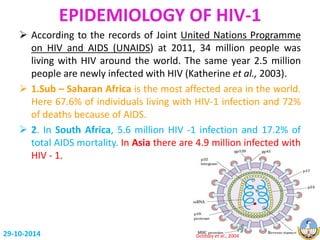
 It consists of nine important genes in its genomic structure. The 
main gene involves in the pathogenicity and infectivity of the 
HIV-1 virus is env gene. It encodes precursor protein 
glycoprotein 160 (gp 160) (David et al., 1998). 
29-10-2014
EPIDEMIOLOGY OF HIV-1 
 According to the records of Joint United Nations Programme 
on HIV and AIDS (UNAIDS) at 2011, 34 million people was 
living with HIV around the world. The same year 2.5 million 
people are newly infected with HIV (Katherine et al., 2003). 
 1.Sub – Saharan Africa is the most affected area in the world. 
Here 67.6% of individuals living with HIV-1 infection and 72% 
of deaths because of AIDS. 
 2. In South Africa, 5.6 million HIV -1 infection and 17.2% of 
total AIDS mortality. In Asia there are 4.9 million infected with 
HIV - 1. 
29-10-2014 Goldsby et al., 2004
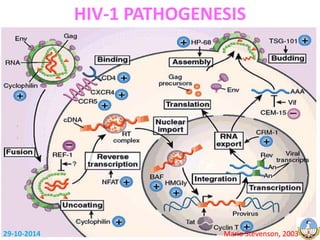
HIV-1 PATHOGENESIS 
29-10-2014 Mario Stevenson, 2003
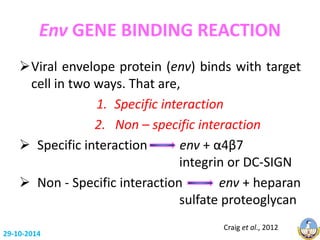
Env GENE BINDING REACTION 
Viral envelope protein (env) binds with target 
cell in two ways. That are, 
1. Specific interaction 
2. Non – specific interaction 
 Specific interaction env + α4β7 
integrin or DC-SIGN 
 Non - Specific interaction env + heparan 
sulfate proteoglycan 
Craig et al., 2012 
29-10-2014
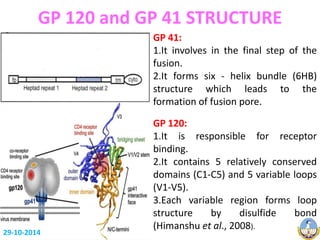
GP 120 and GP 41 STRUCTURE 
GP 41: 
1.It involves in the final step of the 
fusion. 
2.It forms six - helix bundle (6HB) 
structure which leads to the 
formation of fusion pore. 
GP 120: 
1.It is responsible for receptor 
binding. 
2.It contains 5 relatively conserved 
domains (C1-C5) and 5 variable loops 
(V1-V5). 
3.Each variable region forms loop 
structure by disulfide bond 
(Himanshu et al., 2008). 
David et al., 1998 
29-10-2014 Miklos et al., 2011
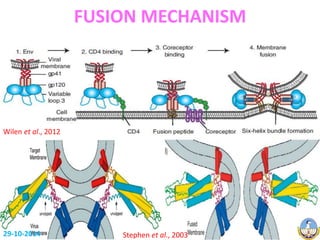
FUSION MECHANISM 
Stephen et al., 2003 
Wilen et al., 2012 
29-10-2014
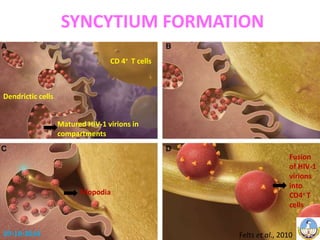
SYNCYTIUM FORMATION 
Dendrictic cells 
CD 4+ T cells 
Matured HIV-1 virions in 
compartments 
Filopodia 
Fusion 
of HIV-1 
virions 
into 
CD4+ T 
cells 
29-10-2014 Felts et al., 2010
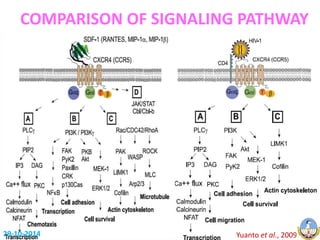
COMPARISON OF SIGNALING PATHWAY 
29-10-2014 Yuanto et al., 2009
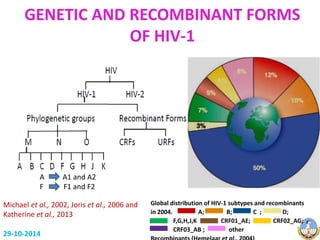
GENETIC AND RECOMBINANT FORMS 
OF HIV-1 
Michael et al., 2002, Joris et al., 2006 and 
Katherine et al., 2013 
A AI, A2 and A3 
F F1 and F2 
29-10-2014 
Global distribution of HIV-1 subtypes and recombinants 
in 2004. A; B; C ; D; 
F,G,H,J,K CRF01_AE; CRF02_AG; 
CRF03_AB ; other 
Recombinants (Hemelaar et al., 2004) 
A A1 and A2 
F F1 and F2
CONCLUSION 
 HIV-1 is a high heterogenicity in nature. Hence, it is very 
challengeable among the investigators to design a vaccine or to 
deliver a drug on target. 
 This review is may be useful for the HIV-1 interested groups 
to understand the pathogenic mechanism of HIV-1 in different 
cells and its genetic forms. 
 This will also provides significant information to find a new 
drug targeting HIV-1 and vaccine preparation.
REFERENCES 
1. Craig B. Wilen, John C. Tilton and Robert W. Doms 2012 HIV: Cell 
Binding and Entry. Cold Spring Harb Perspect Med. 
2. David C. Chan and Peter S. Kim 1998 HIV Entry and Its Inhibition. Cell, 
Vol. 93, 681–684. 
3. Himanshu Garg and Robert Blumenthal 2008 Cell Mol Life Sci 65(20): 
3134–3144. 
4. Jonathan Weber 2001 The pathogenesis of HIV-1 infection British 
Medical Bulletin, 58: 61–72. 
5. Joris Hemelaar, Eleanor Gouws, Peter D. Ghys and Saladin Osmanov 
2006 Global and regional distribution of HIV-1 genetic subtypes and 
recombinants in 2004, AIDS, 20:W13–W23. 
6. Stephen A. Gallo, Catherine M. Finnegan, Mathias Viard, Yossef Raviv, 
Antony Dimitrov, Satinder S. Rawat, Anu Puri, Stewart Durell, Robert 
Blumenthal 2003 The HIV Env-mediated fusion reaction Biochimica et 
Biophysica Acta, 1614, 36– 50. 
7. Susan Moir, Tae-Wook Chun, and Anthony S. Fauci 2011 Pathogenic 
Mechanisms of HIV Disease Annu. Rev. Pathol. Mech. Dis., 6:223–48. 
29-10-2014
REFERENCES 
8. Yuntao Wu , Alyson Yoder 2009 Chemokine Coreceptor Signaling in 
HIV-1 Infection and Pathogenesis, PLoS Pathogens, Volume 5 , Issue 
12 
9. Katherine A. Lau, Justin J.L. Wong 2013 Current trends of HIV 
recombination worldwide, Infectious Disease Reports; volume 
5:s1e4,15-20. 
10. Mario Stevenson 2003 HIV-1 Pathogenesis, Nature medicine,7: 853- 
860. 
11. Michael M Thomson, Lucía Perez-Alvarez, and Rafael Najera 2002 
Molecular epidemiology of HIV-1 genetic forms and its significance for 
vaccine development and therapy, Lancet Infect Dis; 2: 461–71. 
12. Roni Sarkar, Reshmi Pal, Baishali Bal, Ranajoy Mullick, Satarupa 
Sengupta, Kamalesh Sarkar and Sekhar Chakrabarti 2011 Genetic 
Characterization of HIV-1 Strains Among the Injecting Drug Users in 
Nagaland, India. The Open Virology Journal,, 5, 96-102. 
13. Sigall Kassutto and Eric S. Rosenberg 2004 Primary HIV type -1 
infection, Clinical infectious diseases;38;1447-1453 
29-10-2014
THANK YOU 
29-10-2014

HIV-1 PATHOGENESIS AND GENETIC FORMS

  • 1.
    HIV-1 PATHOGENESIS WITH SPECIAL REFERENCE TO GENETIC FORMS PRESENTED BY T. R . Divya, BMS10212, Final year M.Sc., Department of Biomedical Science, School of Basic Medical Sciences, Bharathidasan University, Tiruchirappalli-620 024 UNDER THE GUIDANCE OF Dr. K. Sathiyamurthy Assistant Professor, Clinical Microbiology and Molecular Microbial Pathogenesis Laboratory, Department of Biomedical Science, School of Basic Medical Sciences, Bharathidasan University, Tiruchirappalli-620 024 FINAL PRESENTATION 29-10-2014
  • 2.
    FIRST PRESENTATION 1.Introduction about HIV-1 2. Pathogenesis of HIV-1 in different cells 3. Genetic forms of HIV-1 4. My focus of Self-Study
  • 3.
    INTRODUCTION  HumanImmunodeficiency Virus type-1 (HIV-1) is a double single stranded RNA virus. It belongs to the Family : Retroviridae Genus : Lentivirus Species: Human Immunodeficiency Virus-1 (HIV-1)  It is an enveloped virus enters into the host cells by membrane fusion mechanism (Goldsby et al., 2002).  It consists of nine important genes in its genomic structure. The main gene involves in the pathogenicity and infectivity of the HIV-1 virus is env gene. It encodes precursor protein glycoprotein 160 (gp 160) (David et al., 1998). 29-10-2014
  • 4.
    EPIDEMIOLOGY OF HIV-1  According to the records of Joint United Nations Programme on HIV and AIDS (UNAIDS) at 2011, 34 million people was living with HIV around the world. The same year 2.5 million people are newly infected with HIV (Katherine et al., 2003).  1.Sub – Saharan Africa is the most affected area in the world. Here 67.6% of individuals living with HIV-1 infection and 72% of deaths because of AIDS.  2. In South Africa, 5.6 million HIV -1 infection and 17.2% of total AIDS mortality. In Asia there are 4.9 million infected with HIV - 1. 29-10-2014 Goldsby et al., 2004
  • 5.
    HIV-1 PATHOGENESIS 29-10-2014Mario Stevenson, 2003
  • 6.
    Env GENE BINDINGREACTION Viral envelope protein (env) binds with target cell in two ways. That are, 1. Specific interaction 2. Non – specific interaction  Specific interaction env + α4β7 integrin or DC-SIGN  Non - Specific interaction env + heparan sulfate proteoglycan Craig et al., 2012 29-10-2014
  • 7.
    GP 120 andGP 41 STRUCTURE GP 41: 1.It involves in the final step of the fusion. 2.It forms six - helix bundle (6HB) structure which leads to the formation of fusion pore. GP 120: 1.It is responsible for receptor binding. 2.It contains 5 relatively conserved domains (C1-C5) and 5 variable loops (V1-V5). 3.Each variable region forms loop structure by disulfide bond (Himanshu et al., 2008). David et al., 1998 29-10-2014 Miklos et al., 2011
  • 8.
    FUSION MECHANISM Stephenet al., 2003 Wilen et al., 2012 29-10-2014
  • 9.
    SYNCYTIUM FORMATION Dendricticcells CD 4+ T cells Matured HIV-1 virions in compartments Filopodia Fusion of HIV-1 virions into CD4+ T cells 29-10-2014 Felts et al., 2010
  • 10.
    COMPARISON OF SIGNALINGPATHWAY 29-10-2014 Yuanto et al., 2009
  • 11.
    GENETIC AND RECOMBINANTFORMS OF HIV-1 Michael et al., 2002, Joris et al., 2006 and Katherine et al., 2013 A AI, A2 and A3 F F1 and F2 29-10-2014 Global distribution of HIV-1 subtypes and recombinants in 2004. A; B; C ; D; F,G,H,J,K CRF01_AE; CRF02_AG; CRF03_AB ; other Recombinants (Hemelaar et al., 2004) A A1 and A2 F F1 and F2
  • 12.
    CONCLUSION  HIV-1is a high heterogenicity in nature. Hence, it is very challengeable among the investigators to design a vaccine or to deliver a drug on target.  This review is may be useful for the HIV-1 interested groups to understand the pathogenic mechanism of HIV-1 in different cells and its genetic forms.  This will also provides significant information to find a new drug targeting HIV-1 and vaccine preparation.
  • 13.
    REFERENCES 1. CraigB. Wilen, John C. Tilton and Robert W. Doms 2012 HIV: Cell Binding and Entry. Cold Spring Harb Perspect Med. 2. David C. Chan and Peter S. Kim 1998 HIV Entry and Its Inhibition. Cell, Vol. 93, 681–684. 3. Himanshu Garg and Robert Blumenthal 2008 Cell Mol Life Sci 65(20): 3134–3144. 4. Jonathan Weber 2001 The pathogenesis of HIV-1 infection British Medical Bulletin, 58: 61–72. 5. Joris Hemelaar, Eleanor Gouws, Peter D. Ghys and Saladin Osmanov 2006 Global and regional distribution of HIV-1 genetic subtypes and recombinants in 2004, AIDS, 20:W13–W23. 6. Stephen A. Gallo, Catherine M. Finnegan, Mathias Viard, Yossef Raviv, Antony Dimitrov, Satinder S. Rawat, Anu Puri, Stewart Durell, Robert Blumenthal 2003 The HIV Env-mediated fusion reaction Biochimica et Biophysica Acta, 1614, 36– 50. 7. Susan Moir, Tae-Wook Chun, and Anthony S. Fauci 2011 Pathogenic Mechanisms of HIV Disease Annu. Rev. Pathol. Mech. Dis., 6:223–48. 29-10-2014
  • 14.
    REFERENCES 8. YuntaoWu , Alyson Yoder 2009 Chemokine Coreceptor Signaling in HIV-1 Infection and Pathogenesis, PLoS Pathogens, Volume 5 , Issue 12 9. Katherine A. Lau, Justin J.L. Wong 2013 Current trends of HIV recombination worldwide, Infectious Disease Reports; volume 5:s1e4,15-20. 10. Mario Stevenson 2003 HIV-1 Pathogenesis, Nature medicine,7: 853- 860. 11. Michael M Thomson, Lucía Perez-Alvarez, and Rafael Najera 2002 Molecular epidemiology of HIV-1 genetic forms and its significance for vaccine development and therapy, Lancet Infect Dis; 2: 461–71. 12. Roni Sarkar, Reshmi Pal, Baishali Bal, Ranajoy Mullick, Satarupa Sengupta, Kamalesh Sarkar and Sekhar Chakrabarti 2011 Genetic Characterization of HIV-1 Strains Among the Injecting Drug Users in Nagaland, India. The Open Virology Journal,, 5, 96-102. 13. Sigall Kassutto and Eric S. Rosenberg 2004 Primary HIV type -1 infection, Clinical infectious diseases;38;1447-1453 29-10-2014
  • 15.