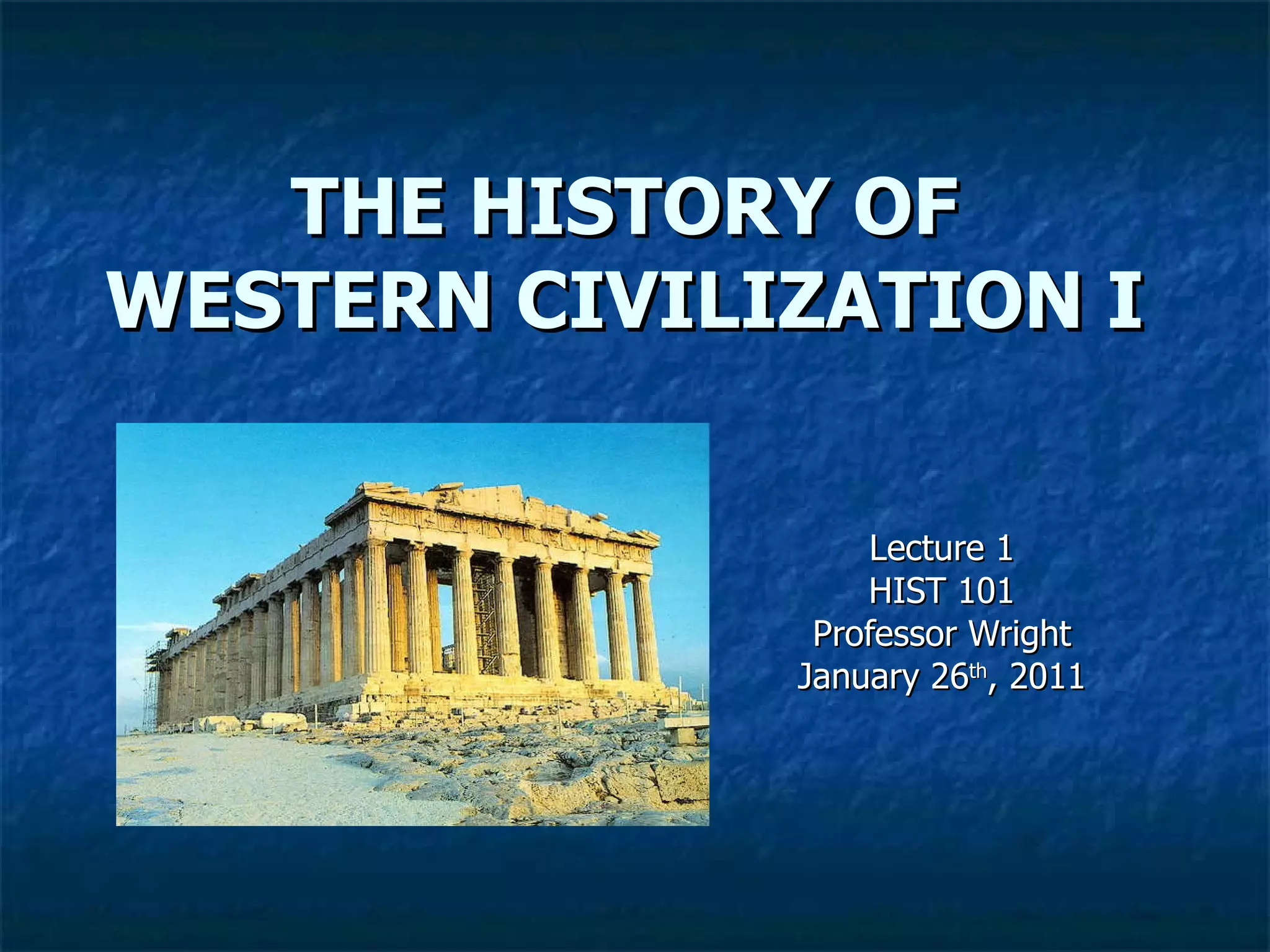
THE HISTORY OF WESTERN CIVILIZATION I Lecture 1 HIST 101 Professor Wright January 26 th , 2011
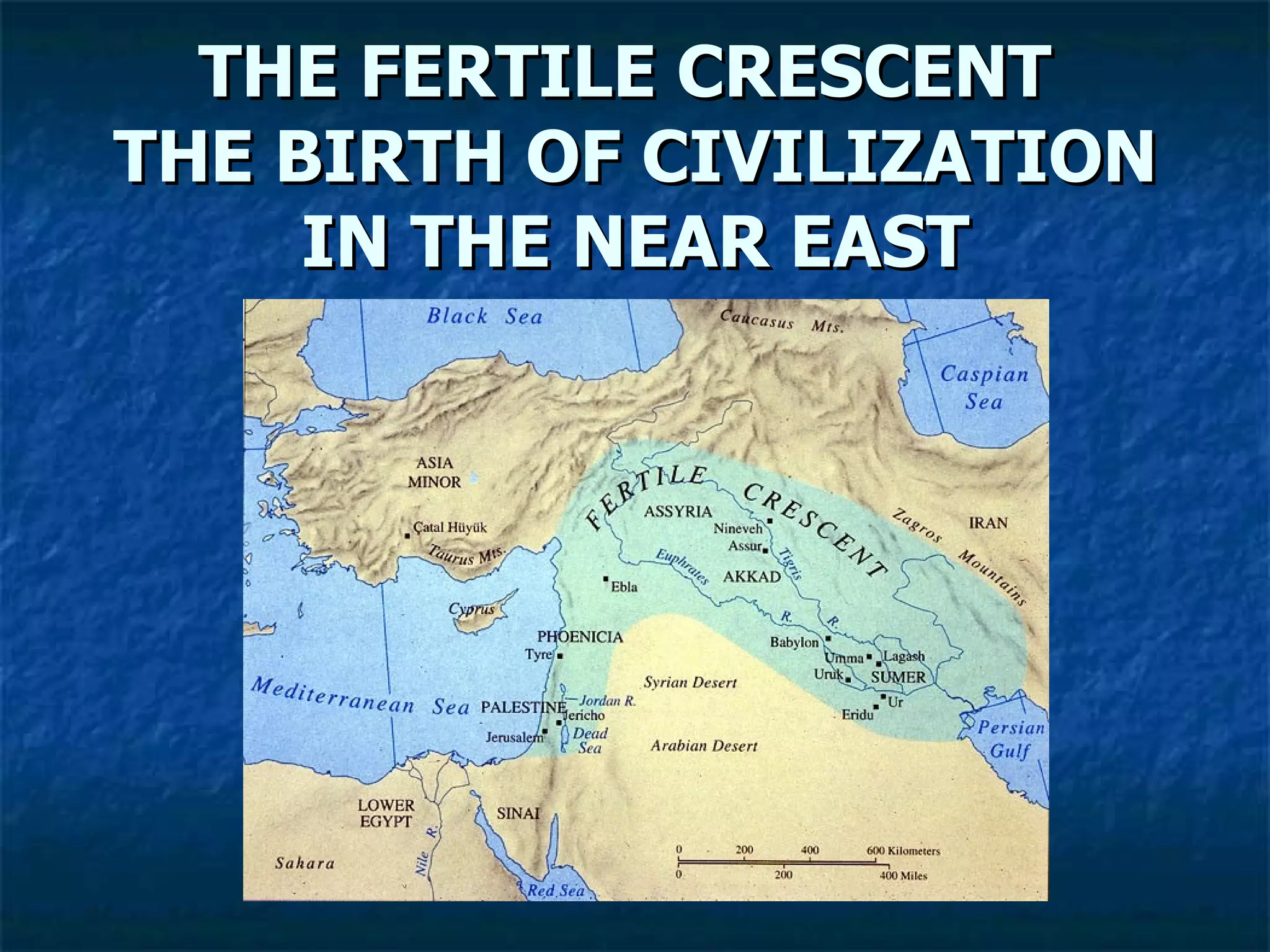
THE FERTILE CRESCENT  THE BIRTH OF CIVILIZATION IN THE NEAR EAST
Civilizations of the Fertile Crescent, 10,000 – 2000 B.C.E.  The Neolithic Era, 10,000 BCE–3000BCE Preceded by Paleolithic Era: hunting + gathering Farming techniques evolve Irrigation + the plow Domestication of plants + animals
Agricultural Revolution 9000-6000 BCE: permanent settlements + domestication of plants/animals.  Two major discoveries: Domestication of plants: collecting wild grain for food, transplanting/growing in new areas Domestication of animals to serve human needs
Possible Causes Of The Agrarian Transformation Shift in climate : retreat of the glaciers (12,000 BCE). Changed distribution + growth of crops  Shift to sedentary farming : due to population growth. Hunters move into new territories
Results of Agricultural Revolution Shift in relationship of man to nature: active, not passive Increase  in food supply. Results: Infant mortality decreases  Populations expand Permanent settlements of greater size + complexity Emergence + growth of  trade  More coordination + organization needed.  *4000-3000 BCE: first cities appear*
Disadvantages of Rise of Agriculture Specialization: possible disaster during famine Vulnerability to disease, population crashes Vulnerability to variations in climate More labor intensive work
Social Consequences and Transformations Eg. 1: Jericho (West Bank of Jordan River) Growth : Expanded to nearly ten acres, 2000-3000 residents Grew into a fortified town with ditches, stone walls, and towers Trade :  Long-distance commercial exchanges  Religious Developments:  Religious structure to regulate social behaviors, i.e. Human skulls: ancestor worship
Jericho: Social Hierarchies Building projects needed organization with a directing, managing function Egalitarianism of hunter-gatherer societies diminished, class divisions emerge  Specializations in economy = inequalities of wealth + status  Food production easier = less farming, increase in other professions  i.e. craftsmen, laborers, merchants, officials
Eg. 2 Abu Hureyra Overview: Excavated 1972 + 1973  Modern day N. Syria Skeletons found, 10,000-7000 yrs old  Inhabitants cultivated domesticated seeds Significance : Evidence of transition from foraging to farming  Bones reveal details of daily life + social activities of community
Abu Hureyra: Agricultural Discoveries  Evidence of agricultural cultivation : Genetic make-up in rye grains = evidence of selective planting.  Period of climate change affected wild plant supply. To ensure supply of food plants, cultivation developed. Evidence of vigorous food preparation in deformities of bone structure. Saddle querns uncovered: tools used to grind the grains
Birth of Civilization: Sumer 6000 B.C.E, farming + herding standardized Uniform culture = Sumerian civilization Overview Tigris + Euphrates Rivers 3000-2000 BCE: Sumerians inhabit Over 10,000 square miles
2500 BCE, 12 City-states Each city-state: economically interdependent, geographically independent + isolated  Alluvial plain: more fertile than north Little rainfall, need for irrigation ditches. Community cooperation, rich yield of crops, population growth
Political Organization and Economy 3000 - 2900 BCE: specialized craft industries emerge. Economic interdependence of towns Each city-state ruled by a king, who controlled: Construction of buildings and temples Maintenance of irrigation systems Deliberation of justice Formation and amendment of trade and defense policies Economic resources Election to hereditary Elite: priests, aristocrats, civil administrators, wealthy merchants lived near temples in luxury; the rest in small mud-brick houses
Sumer: Religious Beliefs Polytheistic + Anthropomorphic Subservience + sacrifice to Gods Divination + art of the occult Mythiopic religion –  Enuma Elish Central deities:  An,  god of the sky  Enlil , god of wind. Controlled fertility of soil + storms Enki , god of the earth, rivers, wells, + canals. Waters of creativity - inventions + crafts Ninhursaga , goddess of soil, mountains, + vegetation. Later mother goddess, manifested power by giving birth to kings.
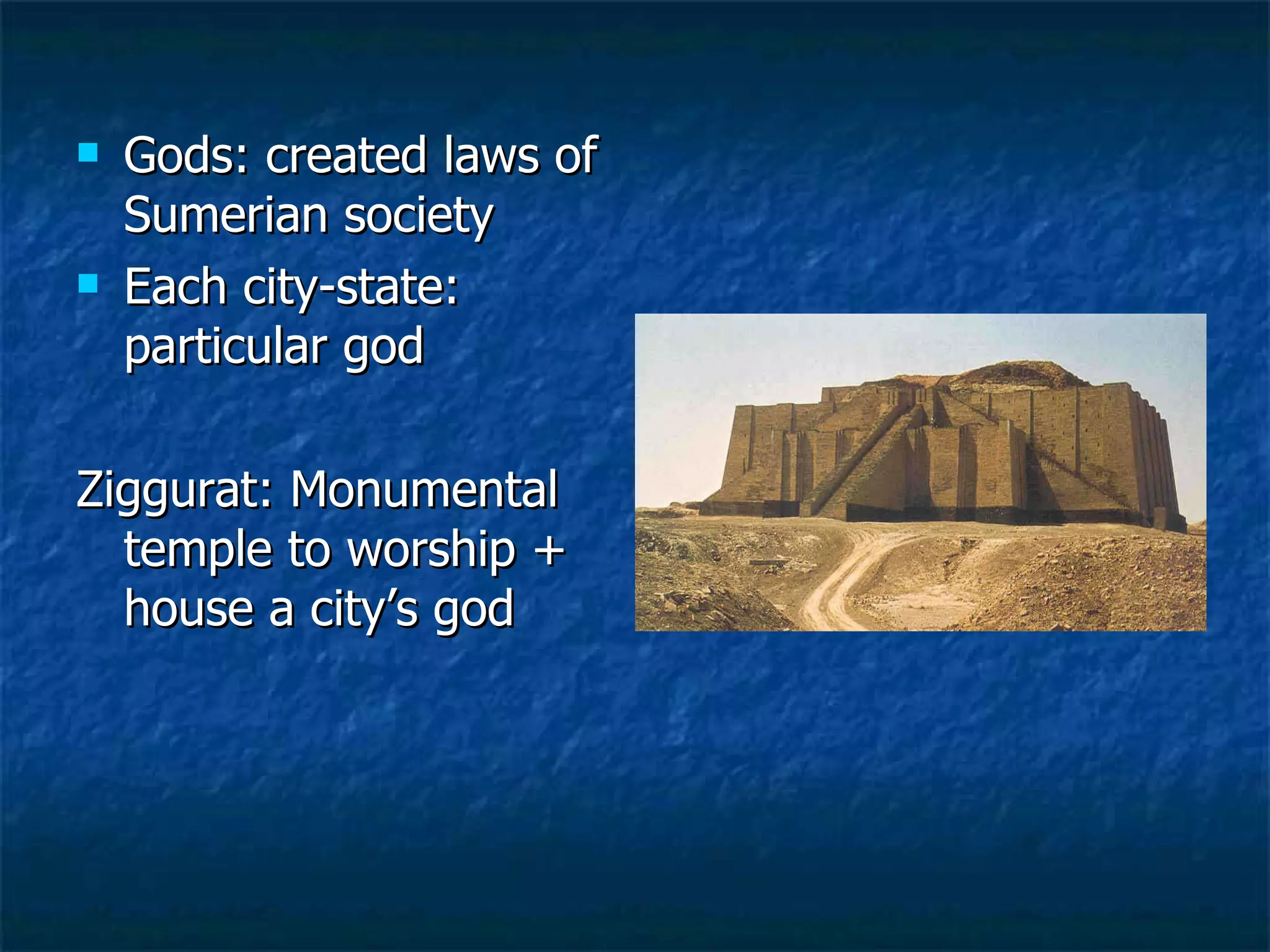
Gods: created laws of Sumerian society Each city-state: particular god  Ziggurat: Monumental temple to worship + house a city’s god
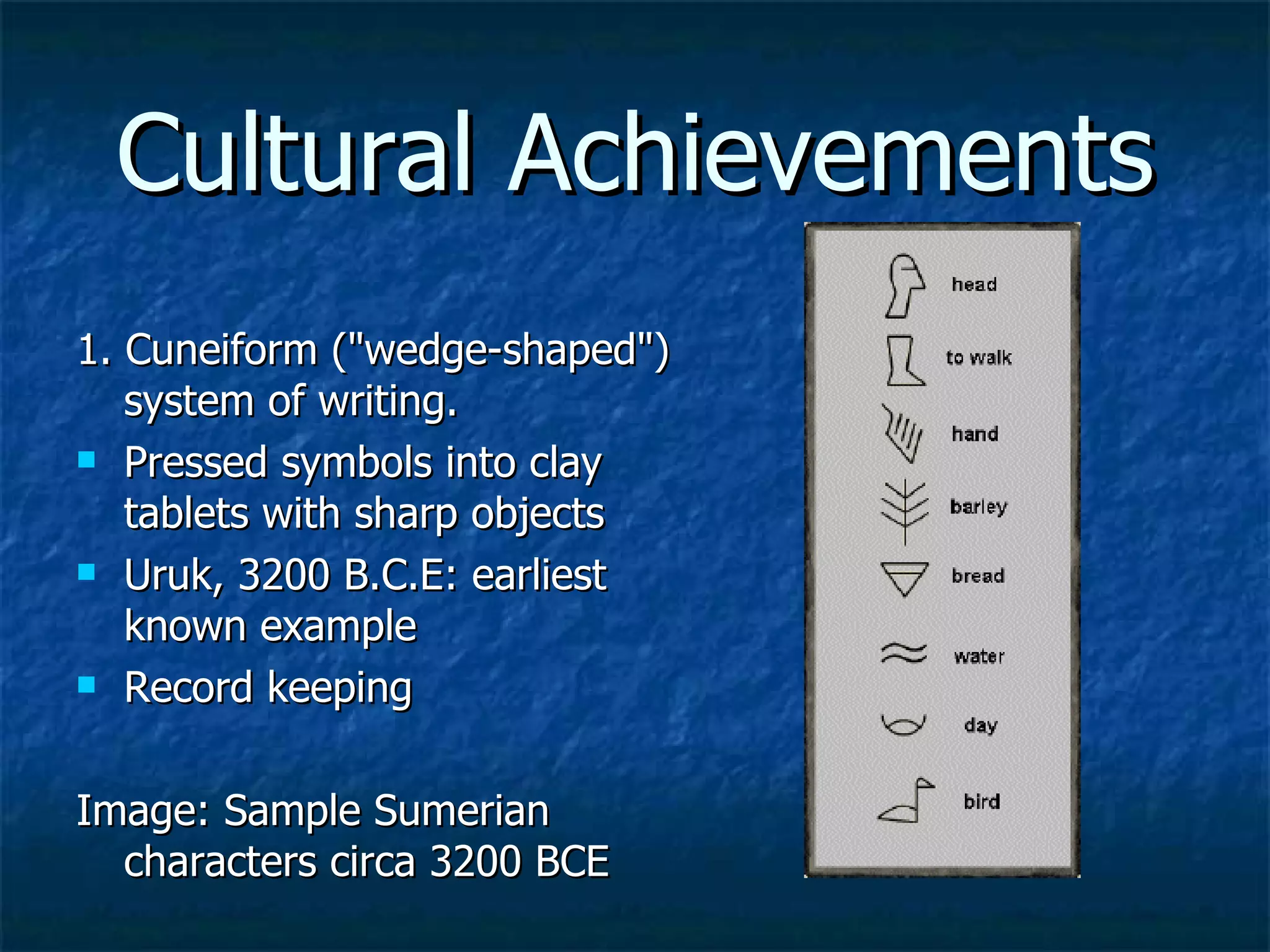
Cultural Achievements 1. Cuneiform ("wedge-shaped") system of writing.  Pressed symbols into clay tablets with sharp objects Uruk, 3200 B.C.E: earliest known example Record keeping Image: Sample Sumerian characters circa 3200 BCE
What did they record?  Quantities of produce + livestock, taxes, accounts, contracts  Literature, i.e.  Epic of Gilgamesh Why did they record?  Growing increase in trade (helped reduce disputes + keep peace)
Other Cultural Achievements 1. Inventions: the plow + the sailboat 2. Innovations in Mathematics 3. Divided circle into 360 degrees + developed counting system based on sixty 4. Potter’s wheel, wagon, + chariot: for transportation + warfare 5. Architecture, i.e. Ziggurats + city walls 6. Mastery of engineering (irrigation systems) 7. Astrology + movements of planets, stars, moon
Political Developments 3360 B.C. to 2400 B.C – Sumerian Civilization Emergence of kings, primarily military leaders, but used idea of Kingship. Power away from temple priests.  Emergence of warring Sumerian city-states, fought for increased territory + power 2400 B.C. to 2200 B.C – Akkadian Kingdom Sumer conquered 2340 BCE by Sargon I, king of city of Akkad.  Unified empire, end hostilities among city-states. How?
1. 1st conscripted army to mobilize laborers for irrigation + flood-control works 2. Akkadian Kings: symbols of unity + semi-divine figures Challenge: Raising Revenue for public buildings, irrigation projects, temples, army Solutions:  Kings leased out farmlands Conquered people to pay regular tribute  Heavy taxes on imported raw materials
2200 – 2000 B.C.E Civil unrest: fall of Akkadian Kingdom  Cities of Sumer: reunited by Ur-Nammu Synthesis of Sumerian + Akkadian cultures Most important innovation: Ur-Nammu + collection of laws *Note: This is a central tradition in Western Civilizations that follow*
Amorite Invasions 2000 B.C. attacks of Amorites + Elamites destroyed Ur Political fragmentation: unity + economy destabilized Two new kingdoms, Babylonia + Assyria  1762 B.C.E –Mesopotamia under rule of King Hammurabi of Babylon
Lecture 1: What do you need to know? 1. Agricultural Revolution: Meaning, Causes, and Results 2. Social Consequences of Agriculture. Examples: Jericho Abu Hureyra 3. Birth of Civilization: Sumer Political Structure and Economy Religious Beliefs 4. Cultural Achievements 5. Civil Unrest – Akkadian and Ammorite Invasions

Historyofwesterncivlecture1edited

  • 1.
    THE HISTORY OFWESTERN CIVILIZATION I Lecture 1 HIST 101 Professor Wright January 26 th , 2011
  • 2.
    THE FERTILE CRESCENT THE BIRTH OF CIVILIZATION IN THE NEAR EAST
  • 3.
    Civilizations of theFertile Crescent, 10,000 – 2000 B.C.E. The Neolithic Era, 10,000 BCE–3000BCE Preceded by Paleolithic Era: hunting + gathering Farming techniques evolve Irrigation + the plow Domestication of plants + animals
  • 4.
    Agricultural Revolution 9000-6000BCE: permanent settlements + domestication of plants/animals. Two major discoveries: Domestication of plants: collecting wild grain for food, transplanting/growing in new areas Domestication of animals to serve human needs
  • 5.
    Possible Causes OfThe Agrarian Transformation Shift in climate : retreat of the glaciers (12,000 BCE). Changed distribution + growth of crops Shift to sedentary farming : due to population growth. Hunters move into new territories
  • 6.
    Results of AgriculturalRevolution Shift in relationship of man to nature: active, not passive Increase in food supply. Results: Infant mortality decreases Populations expand Permanent settlements of greater size + complexity Emergence + growth of trade More coordination + organization needed. *4000-3000 BCE: first cities appear*
  • 7.
    Disadvantages of Riseof Agriculture Specialization: possible disaster during famine Vulnerability to disease, population crashes Vulnerability to variations in climate More labor intensive work
  • 8.
    Social Consequences andTransformations Eg. 1: Jericho (West Bank of Jordan River) Growth : Expanded to nearly ten acres, 2000-3000 residents Grew into a fortified town with ditches, stone walls, and towers Trade : Long-distance commercial exchanges Religious Developments: Religious structure to regulate social behaviors, i.e. Human skulls: ancestor worship
  • 9.
    Jericho: Social HierarchiesBuilding projects needed organization with a directing, managing function Egalitarianism of hunter-gatherer societies diminished, class divisions emerge Specializations in economy = inequalities of wealth + status Food production easier = less farming, increase in other professions i.e. craftsmen, laborers, merchants, officials
  • 10.
    Eg. 2 AbuHureyra Overview: Excavated 1972 + 1973 Modern day N. Syria Skeletons found, 10,000-7000 yrs old Inhabitants cultivated domesticated seeds Significance : Evidence of transition from foraging to farming Bones reveal details of daily life + social activities of community
  • 11.
    Abu Hureyra: AgriculturalDiscoveries Evidence of agricultural cultivation : Genetic make-up in rye grains = evidence of selective planting. Period of climate change affected wild plant supply. To ensure supply of food plants, cultivation developed. Evidence of vigorous food preparation in deformities of bone structure. Saddle querns uncovered: tools used to grind the grains
  • 12.
    Birth of Civilization:Sumer 6000 B.C.E, farming + herding standardized Uniform culture = Sumerian civilization Overview Tigris + Euphrates Rivers 3000-2000 BCE: Sumerians inhabit Over 10,000 square miles
  • 13.
    2500 BCE, 12City-states Each city-state: economically interdependent, geographically independent + isolated Alluvial plain: more fertile than north Little rainfall, need for irrigation ditches. Community cooperation, rich yield of crops, population growth
  • 14.
    Political Organization andEconomy 3000 - 2900 BCE: specialized craft industries emerge. Economic interdependence of towns Each city-state ruled by a king, who controlled: Construction of buildings and temples Maintenance of irrigation systems Deliberation of justice Formation and amendment of trade and defense policies Economic resources Election to hereditary Elite: priests, aristocrats, civil administrators, wealthy merchants lived near temples in luxury; the rest in small mud-brick houses
  • 15.
    Sumer: Religious BeliefsPolytheistic + Anthropomorphic Subservience + sacrifice to Gods Divination + art of the occult Mythiopic religion – Enuma Elish Central deities: An, god of the sky Enlil , god of wind. Controlled fertility of soil + storms Enki , god of the earth, rivers, wells, + canals. Waters of creativity - inventions + crafts Ninhursaga , goddess of soil, mountains, + vegetation. Later mother goddess, manifested power by giving birth to kings.
  • 16.
    Gods: created lawsof Sumerian society Each city-state: particular god Ziggurat: Monumental temple to worship + house a city’s god
  • 17.
    Cultural Achievements 1.Cuneiform ("wedge-shaped") system of writing. Pressed symbols into clay tablets with sharp objects Uruk, 3200 B.C.E: earliest known example Record keeping Image: Sample Sumerian characters circa 3200 BCE
  • 18.
    What did theyrecord? Quantities of produce + livestock, taxes, accounts, contracts Literature, i.e. Epic of Gilgamesh Why did they record? Growing increase in trade (helped reduce disputes + keep peace)
  • 19.
    Other Cultural Achievements1. Inventions: the plow + the sailboat 2. Innovations in Mathematics 3. Divided circle into 360 degrees + developed counting system based on sixty 4. Potter’s wheel, wagon, + chariot: for transportation + warfare 5. Architecture, i.e. Ziggurats + city walls 6. Mastery of engineering (irrigation systems) 7. Astrology + movements of planets, stars, moon
  • 20.
    Political Developments 3360B.C. to 2400 B.C – Sumerian Civilization Emergence of kings, primarily military leaders, but used idea of Kingship. Power away from temple priests. Emergence of warring Sumerian city-states, fought for increased territory + power 2400 B.C. to 2200 B.C – Akkadian Kingdom Sumer conquered 2340 BCE by Sargon I, king of city of Akkad. Unified empire, end hostilities among city-states. How?
  • 21.
    1. 1st conscriptedarmy to mobilize laborers for irrigation + flood-control works 2. Akkadian Kings: symbols of unity + semi-divine figures Challenge: Raising Revenue for public buildings, irrigation projects, temples, army Solutions: Kings leased out farmlands Conquered people to pay regular tribute Heavy taxes on imported raw materials
  • 22.
    2200 – 2000B.C.E Civil unrest: fall of Akkadian Kingdom Cities of Sumer: reunited by Ur-Nammu Synthesis of Sumerian + Akkadian cultures Most important innovation: Ur-Nammu + collection of laws *Note: This is a central tradition in Western Civilizations that follow*
  • 23.
    Amorite Invasions 2000B.C. attacks of Amorites + Elamites destroyed Ur Political fragmentation: unity + economy destabilized Two new kingdoms, Babylonia + Assyria 1762 B.C.E –Mesopotamia under rule of King Hammurabi of Babylon
  • 24.
    Lecture 1: Whatdo you need to know? 1. Agricultural Revolution: Meaning, Causes, and Results 2. Social Consequences of Agriculture. Examples: Jericho Abu Hureyra 3. Birth of Civilization: Sumer Political Structure and Economy Religious Beliefs 4. Cultural Achievements 5. Civil Unrest – Akkadian and Ammorite Invasions