Lecture 10:  The Rise of Christianity
Emergence of Christianity Background Jesus – message + crucifixion Teachings of Paul – Spirit of the Law, universal Early followers   
Roman Empire:  Early Persecutions Nero: early  persecutions Causes of  opposition Martyrdom http://www.fordham.edu/halsall/ ancient/christian-cannibals.html
Tacitus,  Annals 15:47   “ Nero falsely accused and executed with the most exquisite punishments those people called Christians, who were infamous for their abominations
a vast multitude were convicted, not so much for the crime of burning the city, but for hatred of the human race. And perishing they were additionally made into sports: they were killed by dogs by having the hides of beasts attached to them, or they were nailed to crosses or set aflame, and, when the daylight passed away, they were used as nighttime lamps. Even though they were clearly guilty and merited being made the most recent example of the consequences of crime, people began to pity these sufferers, because they were consumed not for the public good but on account of the fierceness of one man
”
Martyrdom of St. Polycarp  “ All the martyrdoms, then, were blessed and noble which took place according to the will of God. For it becomes us who profess greater piety than others, to ascribe the authority over all things to God. And truly, who can fail to admire their nobleness of mind, and their patience, with that love towards their Lord which they displayed?--who, when they were so torn with scourges, that the frame of their bodies, even to the very inward veins and arteries, was laid open, still patiently endured
not one of them let a sigh or a groan escape them; thus proving to us all that those holy martyrs of Christ, at the very time when they suffered such torments, were absent from the body, or rather, that the Lord then stood by them, and communed with them. And, looking to the grace of Christ, they despised all the torments of this world, redeeming themselves from eternal punishment by [the suffering of] a single hour
” The Encyclical Epistle of the Church at Smyrna, Concerning the Martyrdom of St. Polycarp, CHAPTER II, Translated by Roberts-Donaldson
Emperor Diocletian Tetrarchy: the rule of 4 Division of provinces Military reforms Economic reform:  tax increase The Great Persecution
Emperor Constantine Reunification of Empire Economic reforms Battle at Milvian Bridge: Conversion  Edict of Milan: religious freedom City of Constantinople Imperial support = spread of Christianity
Edict of Milan , excerpt “ When I,   Constantine Augustus, as well as I, Licinius Augustus
were considering everything that pertained to the public welfare and security, we thought, among other things which we saw would be for the good of many, those regulations pertaining to the reverence of the Divinity ought certainly to be made first, so that we might grant to the Christians and others full authority to observe that religion which each preferred; whence any Divinity whatsoever in the seat of the heavens may be propitious and kindly disposed to us and all who are placed under our rule
. we have given to those Christians free and unrestricted opportunity of religious worship. When you see that this has been granted to them by us, your Worship will know that we have also conceded to other religions the right of open and free observance of their worship for the sake of the peace of our times
”
Rise of Bishops Sees Hierarchy Jesus to Bishop: Apostolic Succession Papacy
Persecution of “Pagans” Symmachus: resistance of Roman aristocracy "
if long passage of time lends validity to religious observances, we ought to keep faith with so many centuries, we ought to follow our forefathers who followed their forefathers and were blessed in so doing. Let us imagine that Rome herself stands in your presence and pleads with you thus, 'Best of emperors, fathers of your country, respect my length of years won for me by the dutiful observance of rite, let me continue to practice my ancient ceremonies, for I do not regret them. Let me live in my own way, for I am free. This worship of mine brought the whole world under the rule of my laws....”  Relatio III, Prefect and Emperor: The Relationes of Symmachus, AD 384  (1973) translated by R. H. Barrow
Persecution of “Pagans” (II) “
 in all places and all cities the [pagan] temples should be closed at once, and after a general warning, the opportunity of sinning be taken from the wicked. We decree also that we shall cease from making sacrifices. And if anyone has committed such a crime, let him be stricken with the avenging sword...“ Codex Theodosianus, XVI.10.4. "It is Our will that all the peoples who are ruled by the administration of Our Clemency shall practice that religion which the divine Peter the Apostle transmitted to the Romans. According to the apostolic teaching and the doctrine of the Gospel, let us believe in  the one deity  of the father, Son and Holy Spirit, in equal majesty and in a holy Trinity. ... The rest, whom we adjudge demented and insane
.shall be smitten first by divine vengeance and secondly by the retribution of Our own initiative." -  Codex Theodosianus , XVI.1.2.
Persecution of the Jews 1.  Ideology of the Church fathers Eg. "The true image of the Hebrew is Judas Iscariot, who sells the Lord for silver. The Jew can never understand the Scriptures and forever will bear the guilt for the death of Jesus." (St. Augustine) 2.  Legislation Jews + Christians:   marriages, sexual intercourse + community contacts forbidden (306) Easter + Jewish passover: separated (325) Conversion to Judaism: criminal offense
Christian Doctrine:  Defining Orthodoxy Council of Nicaea (325) Nature of Jesus Relationship of son to father The Arian Controversy Nicene Creed Council of Ephesus (449) Ephesus: Jesus as divine
Christian Doctrine:  Defining Orthodoxy (II) Council of Chalcedon (481) Emperor Marcian The Chalcedonian Definition : divine + human Geographical divisions Other Heresies Donatism: lapsed clergy Pelagianism: original sin and free will
The Heresy of Gnosticism Theology of creation Matter vs. Spirit Nature of Jesus Emphasis on knowledge Nag Hammadi  texts Orthodox refutations
Rise of Monasticism Antony – virtues of solitude Asceticism Communal life The Rule of Saint Benedict Role of Women
Christian Pilgrimage Restoration of Jerusalem Rise of relics Cult of the saints + spiritual healing Theological opposition
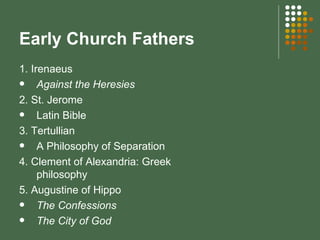
Early Church Fathers 1. Irenaeus Against the Heresies 2. St. Jerome Latin Bible  3. Tertullian A Philosophy of Separation 4. Clement of Alexandria: Greek philosophy 5. Augustine of Hippo The Confessions The City of God
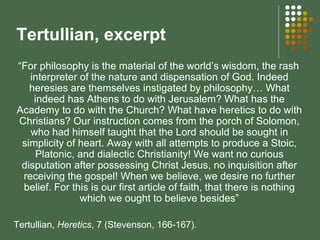
Tertullian, excerpt “ For philosophy is the material of the world’s wisdom, the rash interpreter of the nature and dispensation of God. Indeed heresies are themselves instigated by philosophy
 What indeed has Athens to do with Jerusalem? What has the Academy to do with the Church? What have heretics to do with Christians? Our instruction comes from the porch of Solomon, who had himself taught that the Lord should be sought in simplicity of heart. Away with all attempts to produce a Stoic, Platonic, and dialectic Christianity! We want no curious disputation after possessing Christ Jesus, no inquisition after receiving the gospel! When we believe, we desire no further belief. For this is our first article of faith, that there is nothing which we ought to believe besides” Tertullian,  Heretics , 7 (Stevenson, 166-167).
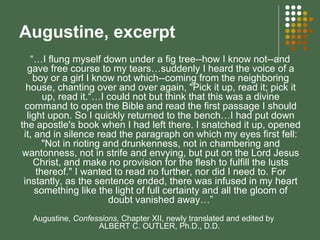
Augustine, excerpt “
 I flung myself down under a fig tree--how I know not--and gave free course to my tears
suddenly I heard the voice of a boy or a girl I know not which--coming from the neighboring house, chanting over and over again, "Pick it up, read it; pick it up, read it.“
I could not but think that this was a divine command to open the Bible and read the first passage I should light upon. So I quickly returned to the bench
I had put down the apostle's book when I had left there. I snatched it up, opened it, and in silence read the paragraph on which my eyes first fell: "Not in rioting and drunkenness, not in chambering and wantonness, not in strife and envying, but put on the Lord Jesus Christ, and make no provision for the flesh to fulfill the lusts thereof." I wanted to read no further, nor did I need to. For instantly, as the sentence ended, there was infused in my heart something like the light of full certainty and all the gloom of doubt vanished away
” Augustine,  Confessions,  Chapter XII, newly translated and edited by  ALBERT C. OUTLER, Ph.D., D.D.

Lecture10riseofchristianityedited

  • 1.
    Lecture 10: The Rise of Christianity
  • 2.
    Emergence of ChristianityBackground Jesus – message + crucifixion Teachings of Paul – Spirit of the Law, universal Early followers   
  • 3.
    Roman Empire: Early Persecutions Nero: early persecutions Causes of opposition Martyrdom http://www.fordham.edu/halsall/ ancient/christian-cannibals.html
  • 4.
    Tacitus, Annals15:47 “ Nero falsely accused and executed with the most exquisite punishments those people called Christians, who were infamous for their abominations
a vast multitude were convicted, not so much for the crime of burning the city, but for hatred of the human race. And perishing they were additionally made into sports: they were killed by dogs by having the hides of beasts attached to them, or they were nailed to crosses or set aflame, and, when the daylight passed away, they were used as nighttime lamps. Even though they were clearly guilty and merited being made the most recent example of the consequences of crime, people began to pity these sufferers, because they were consumed not for the public good but on account of the fierceness of one man
”
  • 5.
    Martyrdom of St.Polycarp “ All the martyrdoms, then, were blessed and noble which took place according to the will of God. For it becomes us who profess greater piety than others, to ascribe the authority over all things to God. And truly, who can fail to admire their nobleness of mind, and their patience, with that love towards their Lord which they displayed?--who, when they were so torn with scourges, that the frame of their bodies, even to the very inward veins and arteries, was laid open, still patiently endured
not one of them let a sigh or a groan escape them; thus proving to us all that those holy martyrs of Christ, at the very time when they suffered such torments, were absent from the body, or rather, that the Lord then stood by them, and communed with them. And, looking to the grace of Christ, they despised all the torments of this world, redeeming themselves from eternal punishment by [the suffering of] a single hour
” The Encyclical Epistle of the Church at Smyrna, Concerning the Martyrdom of St. Polycarp, CHAPTER II, Translated by Roberts-Donaldson
  • 6.
    Emperor Diocletian Tetrarchy:the rule of 4 Division of provinces Military reforms Economic reform: tax increase The Great Persecution
  • 7.
    Emperor Constantine Reunificationof Empire Economic reforms Battle at Milvian Bridge: Conversion Edict of Milan: religious freedom City of Constantinople Imperial support = spread of Christianity
  • 8.
    Edict of Milan, excerpt “ When I, Constantine Augustus, as well as I, Licinius Augustus
were considering everything that pertained to the public welfare and security, we thought, among other things which we saw would be for the good of many, those regulations pertaining to the reverence of the Divinity ought certainly to be made first, so that we might grant to the Christians and others full authority to observe that religion which each preferred; whence any Divinity whatsoever in the seat of the heavens may be propitious and kindly disposed to us and all who are placed under our rule
. we have given to those Christians free and unrestricted opportunity of religious worship. When you see that this has been granted to them by us, your Worship will know that we have also conceded to other religions the right of open and free observance of their worship for the sake of the peace of our times
”
  • 9.
    Rise of BishopsSees Hierarchy Jesus to Bishop: Apostolic Succession Papacy
  • 10.
    Persecution of “Pagans”Symmachus: resistance of Roman aristocracy "
if long passage of time lends validity to religious observances, we ought to keep faith with so many centuries, we ought to follow our forefathers who followed their forefathers and were blessed in so doing. Let us imagine that Rome herself stands in your presence and pleads with you thus, 'Best of emperors, fathers of your country, respect my length of years won for me by the dutiful observance of rite, let me continue to practice my ancient ceremonies, for I do not regret them. Let me live in my own way, for I am free. This worship of mine brought the whole world under the rule of my laws....” Relatio III, Prefect and Emperor: The Relationes of Symmachus, AD 384 (1973) translated by R. H. Barrow
  • 11.
    Persecution of “Pagans”(II) “
 in all places and all cities the [pagan] temples should be closed at once, and after a general warning, the opportunity of sinning be taken from the wicked. We decree also that we shall cease from making sacrifices. And if anyone has committed such a crime, let him be stricken with the avenging sword...“ Codex Theodosianus, XVI.10.4. "It is Our will that all the peoples who are ruled by the administration of Our Clemency shall practice that religion which the divine Peter the Apostle transmitted to the Romans. According to the apostolic teaching and the doctrine of the Gospel, let us believe in the one deity of the father, Son and Holy Spirit, in equal majesty and in a holy Trinity. ... The rest, whom we adjudge demented and insane
.shall be smitten first by divine vengeance and secondly by the retribution of Our own initiative." - Codex Theodosianus , XVI.1.2.
  • 12.
    Persecution of theJews 1. Ideology of the Church fathers Eg. "The true image of the Hebrew is Judas Iscariot, who sells the Lord for silver. The Jew can never understand the Scriptures and forever will bear the guilt for the death of Jesus." (St. Augustine) 2. Legislation Jews + Christians: marriages, sexual intercourse + community contacts forbidden (306) Easter + Jewish passover: separated (325) Conversion to Judaism: criminal offense
  • 13.
    Christian Doctrine: Defining Orthodoxy Council of Nicaea (325) Nature of Jesus Relationship of son to father The Arian Controversy Nicene Creed Council of Ephesus (449) Ephesus: Jesus as divine
  • 14.
    Christian Doctrine: Defining Orthodoxy (II) Council of Chalcedon (481) Emperor Marcian The Chalcedonian Definition : divine + human Geographical divisions Other Heresies Donatism: lapsed clergy Pelagianism: original sin and free will
  • 15.
    The Heresy ofGnosticism Theology of creation Matter vs. Spirit Nature of Jesus Emphasis on knowledge Nag Hammadi texts Orthodox refutations
  • 16.
    Rise of MonasticismAntony – virtues of solitude Asceticism Communal life The Rule of Saint Benedict Role of Women
  • 17.
    Christian Pilgrimage Restorationof Jerusalem Rise of relics Cult of the saints + spiritual healing Theological opposition
  • 18.
    Early Church Fathers1. Irenaeus Against the Heresies 2. St. Jerome Latin Bible 3. Tertullian A Philosophy of Separation 4. Clement of Alexandria: Greek philosophy 5. Augustine of Hippo The Confessions The City of God
  • 19.
    Tertullian, excerpt “For philosophy is the material of the world’s wisdom, the rash interpreter of the nature and dispensation of God. Indeed heresies are themselves instigated by philosophy
 What indeed has Athens to do with Jerusalem? What has the Academy to do with the Church? What have heretics to do with Christians? Our instruction comes from the porch of Solomon, who had himself taught that the Lord should be sought in simplicity of heart. Away with all attempts to produce a Stoic, Platonic, and dialectic Christianity! We want no curious disputation after possessing Christ Jesus, no inquisition after receiving the gospel! When we believe, we desire no further belief. For this is our first article of faith, that there is nothing which we ought to believe besides” Tertullian, Heretics , 7 (Stevenson, 166-167).
  • 20.
    Augustine, excerpt “
I flung myself down under a fig tree--how I know not--and gave free course to my tears
suddenly I heard the voice of a boy or a girl I know not which--coming from the neighboring house, chanting over and over again, "Pick it up, read it; pick it up, read it.“
I could not but think that this was a divine command to open the Bible and read the first passage I should light upon. So I quickly returned to the bench
I had put down the apostle's book when I had left there. I snatched it up, opened it, and in silence read the paragraph on which my eyes first fell: "Not in rioting and drunkenness, not in chambering and wantonness, not in strife and envying, but put on the Lord Jesus Christ, and make no provision for the flesh to fulfill the lusts thereof." I wanted to read no further, nor did I need to. For instantly, as the sentence ended, there was infused in my heart something like the light of full certainty and all the gloom of doubt vanished away
” Augustine, Confessions, Chapter XII, newly translated and edited by ALBERT C. OUTLER, Ph.D., D.D.