24-1
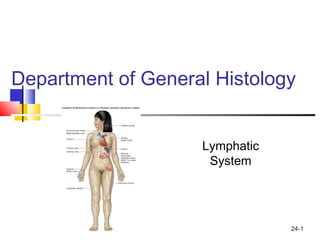
Department of General Histology
Lymphatic
System
24-2
Lymphatic System
 Assists the cardiovascular system by transporting
excess interstitial fluid (lymph) through lymphatic
vessels.
 Lymph is filtered and checked for foreign or
pathologic material, such as cancer cells and
bacteria.
 Lymphatic structures contain certain cells that initiate
an immune response to abnormal materials and
perform other functions essential to homeostasis and
survival.
 Without the primary immune response by the
lymphatic system, the body would be unable to fight
infection and keep itself healthy.
24-3
Functions of the Lymphatic
System
 Fluid and nutrient transport, lymphocyte
development, and the immune response.
 Reabsorbs excess interstitial fluid:
 returns it to the venous circulation
 maintain blood volume levels
 prevent interstitial fluid levels from rising out of
control.
 Transport dietary lipids:
 transported through lacteals
 drain into larger lymphatic vessels
 eventually into the bloodstream.
24-4
Immune Response
 Some cells (B lymphocytes) produce soluble proteins
called antibodies.
 bind to and immobilize the foreign or abnormal agent
 damaging it or identifying it to other elements of the immune
system
 Other cells (T lymphocytes) attack and destroy the
antigen directly.
 Other cells become memory cells (B and T):
 remember the past antigen encounters
 initiate an even faster and more powerful response should
the same antigen appear again
Sponsored
Medical Lecture Notes – All Subjects
USMLE Exam (America) – Practice
24-6
Components of the Lymphatic
System
 Lymph
 Lymphatic Vessels
 Lymphatic Capillaries
 Lymphatic Vessels
 Lymphatic Trunks
 Lymphatic Ducts
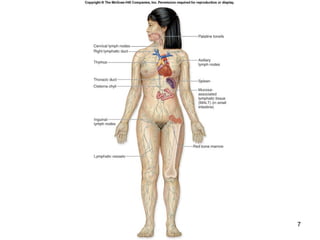
 Lymphatic Organs
 Thymus
 Lymph Nodes
 Spleen
7
24-8
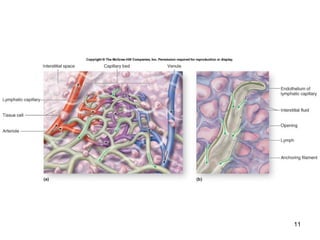
Lymphatic Capillaries
 The lymphatic network begins with
microscopic vessels called lymphatic
capillaries.
 closed-ended tubes that are found in most blood
capillary networks
 similar to a blood capillary in that its wall is an
endothelium
 tend to be larger in diameter, lack a basement
membrane, and have overlapping endothelial cells
 anchoring filaments help hold these endothelial
cells to the nearby tissues
24-9
Lymphatic Capillaries
 Act as one-way valves.
 when interstitial fluid pressure rises, the margins of
the endothelial cell walls push into the lymphatic
capillary lumen and allow interstitial fluid to enter
 when the pressure increases in the lymphatic
capillary, the cell wall margin pushes back into
place next to the adjacent endothelial cell
 fluid “trapped” in the lymph capillary cannot be
released back into the tissues
24-10
Lymphatic Capillaries – Lacteals
 The small intestine contains special types of
lymphatic capillaries called lacteals.
 Lacteals pick up not only interstitial fluid, but also
dietary lipids and lipid-soluble vitamins.
 The lymph of this area has a milky color due to the
lipid and is also called chyle.
11
24-12
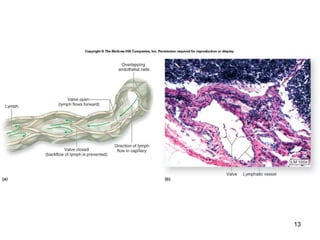
Lymphatic Vessels
 Lymphatic capillaries merge to form larger structures.
 Lymphatic vessels resemble small veins.
 both contain three tunics and both have valves
 Some vessels connect directly to lymphatic organs called lymph
nodes.
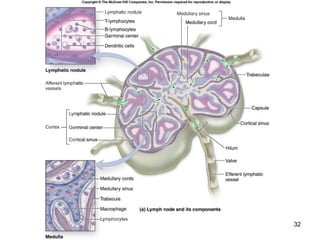
 Afferent lymphatic vessels bring lymph to a lymph node where it
is examined for foreign on pathogenic material.
 Once filtered, the lymph exits the lymph node via efferent
lymphatic vessels.
 Lymph nodes are often found in clusters.
 lymph is repeatedly examined for the presence of foreign or
pathogenic materials
13
24-14
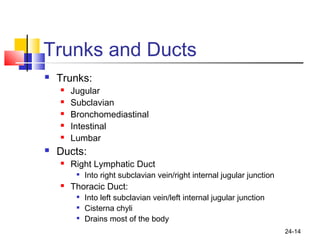
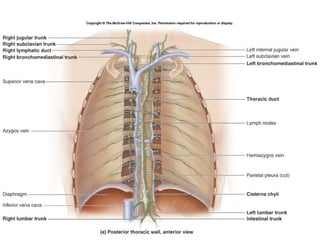
Trunks and Ducts
 Trunks:
 Jugular
 Subclavian
 Bronchomediastinal
 Intestinal
 Lumbar
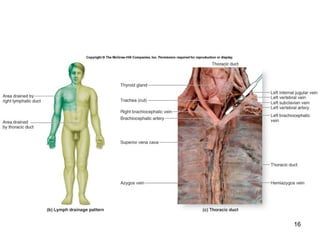
 Ducts:
 Right Lymphatic Duct

Into right subclavian vein/right internal jugular junction
 Thoracic Duct:

Into left subclavian vein/left internal jugular junction

Cisterna chyli

Drains most of the body
15
16
24-17
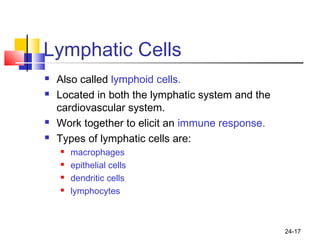
Lymphatic Cells
 Also called lymphoid cells.
 Located in both the lymphatic system and the
cardiovascular system.
 Work together to elicit an immune response.
 Types of lymphatic cells are:
 macrophages
 epithelial cells
 dendritic cells
 lymphocytes
24-18
Types and Functions of
Lymphocytes
 T-lymphocytes (also called T-cells).
 B-lymphocytes (also called B-cells).
 NK cells.
 Migrate through the lymphatic tissues and
monitor them for the presence of antigens.
 Identified according to the tissue or organ
where they mature:
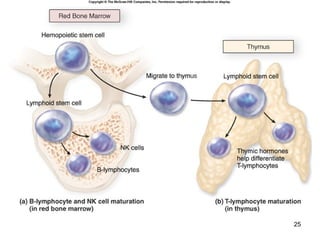
 T-lymphocytes mature in the Thymus
 B-lymphocytes mature in the Bone marrow
24-19
Types and Functions of
Lymphocytes – T-lymphocytes
 Make up about 70–85% of body lymphocytes.
 Plasma membrane contains a coreceptor that can
recognize a particular antigen.
 There are several types of T-lymphocytes, each with
a particular kind of coreceptor.
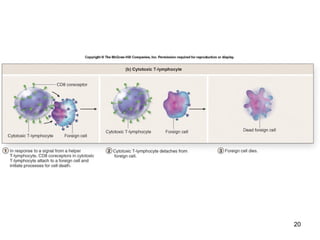
 helper T-lymphocytes
 cytotoxic T-lymphocytes
20
24-21
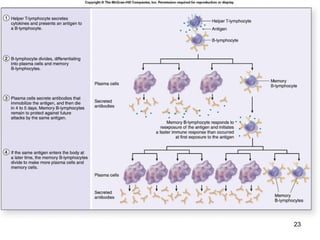
B-Lymphocytes
 Make up about 15–30% of the lymphocytes in the
body.
 Contain antigen receptors that respond to one
particular antigen and cause the production of
immunoglobulins (Ig), or antibodies, that respond to
that particular antigen.
 the five main classes of immunoglobulins are called IgG,
IgA, IgD, IgM, and IgE.
 these immunoglobulins are released by the specific B-
lymphocytes to immobilize or neutralize specific antigens
24-22
Vaccines
 Some vaccines introduce milder or dead
forms of an antigen.
 The body can fight and eliminate the illness
before any symptoms ever develop.
 Depending upon the life span of the particular
memory B-lymphocytes:
 vaccine may provide lifelong immunity, or

periodic booster shots may be needed
23
24-24
NK Cells
 Also called large granular lymphocytes.
 Make up the remaining small percentage of body
lymphocytes.
 NK cells tend to have CD16 receptors.
 NK cells can kill a wide variety of infected cells and
some cancerous cells.
25
24-26
Lymphatic Nodules
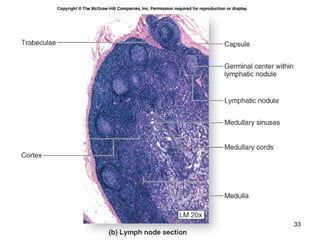
 Oval clusters of lymphatic cells with some extracellular matrix
that are not surrounded by a connective tissue capsule.
 Contains proliferating B-lymphocytes and some macrophages.
 T-lymphocytes are located outside the germinal center.
 Filter and attack antigens.
 In some areas of the body, many lymphatic nodules group
together to form larger structures.
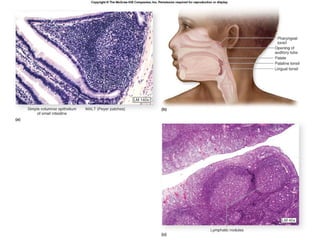
 mucosa-associated lymphatic tissue (MALT) or tonsils
 MALT detect antigens and initiate an immune response
 very prominent in the mucosa of the small intestine, primarily
in the ileum

Peyer patches
 also prevalent in the appendix
24-27
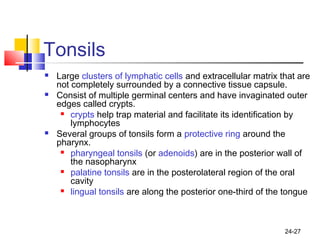
Tonsils
 Large clusters of lymphatic cells and extracellular matrix that are
not completely surrounded by a connective tissue capsule.
 Consist of multiple germinal centers and have invaginated outer
edges called crypts.
 crypts help trap material and facilitate its identification by
lymphocytes
 Several groups of tonsils form a protective ring around the
pharynx.
 pharyngeal tonsils (or adenoids) are in the posterior wall of
the nasopharynx
 palatine tonsils are in the posterolateral region of the oral
cavity
 lingual tonsils are along the posterior one-third of the tongue
28
24-29
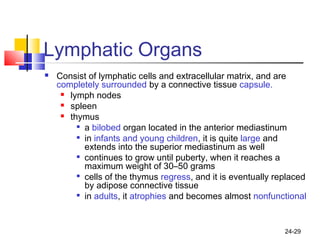
Lymphatic Organs
 Consist of lymphatic cells and extracellular matrix, and are
completely surrounded by a connective tissue capsule.
 lymph nodes
 spleen
 thymus

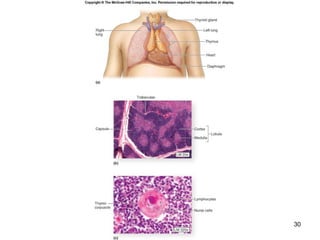
a bilobed organ located in the anterior mediastinum

in infants and young children, it is quite large and
extends into the superior mediastinum as well

continues to grow until puberty, when it reaches a
maximum weight of 30–50 grams

cells of the thymus regress, and it is eventually replaced
by adipose connective tissue

in adults, it atrophies and becomes almost nonfunctional
30
24-31
Lymph Nodes
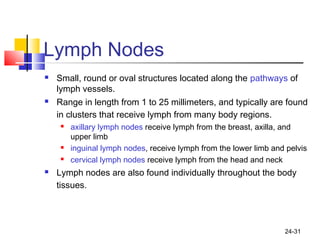
 Small, round or oval structures located along the pathways of
lymph vessels.
 Range in length from 1 to 25 millimeters, and typically are found
in clusters that receive lymph from many body regions.
 axillary lymph nodes receive lymph from the breast, axilla, and
upper limb
 inguinal lymph nodes, receive lymph from the lower limb and pelvis
 cervical lymph nodes receive lymph from the head and neck
 Lymph nodes are also found individually throughout the body
tissues.
32
33
24-34
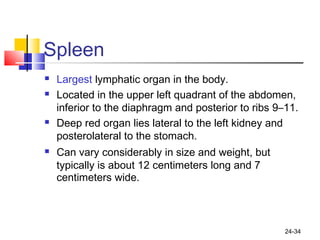
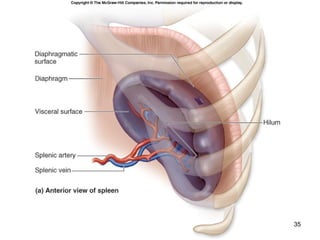
Spleen
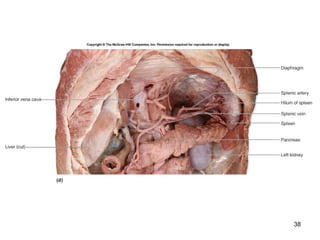
 Largest lymphatic organ in the body.
 Located in the upper left quadrant of the abdomen,
inferior to the diaphragm and posterior to ribs 9–11.
 Deep red organ lies lateral to the left kidney and
posterolateral to the stomach.
 Can vary considerably in size and weight, but
typically is about 12 centimeters long and 7
centimeters wide.
35
36
37
38
24-39
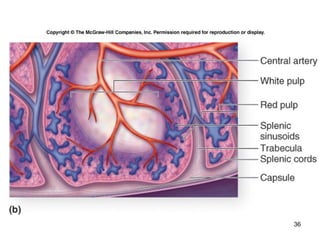
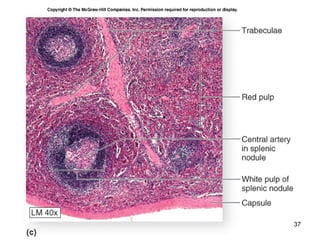
Functions of the Spleen
 Initiates an immune response when antigens are
found in the blood (a white pulp function).
 Serves as a reservoir for erythrocytes and platelets
(red pulp function).
 Phagocytizes old, defective erythrocytes and
platelets (red pulp function).
 Phagocytizes bacteria and other foreign materials.
24-40
Aging and the Lymphatic
System
 The thymus is no longer able to mature and differentiate T-
lymphocytes.
 New T-lymphocytes can be produced only by replication
(mitosis).
 Ability to provide immunity and fight disease decreases.
 Helper T-lymphocytes do not respond to antigens as well, and
do not always reproduce rapidly.
 Fewer B-lymphocytes and other kinds of T-lymphocytes.
 The body’s ability to acquire immunity and resist infection
decreases, making elderly people more susceptible to illnesses
and more likely to become sicker.
 Faltering immune system makes the elderly more prone to
developing cancers.

Histology

  • 1.
    24-1 Department of GeneralHistology Lymphatic System
  • 2.
    24-2 Lymphatic System  Assiststhe cardiovascular system by transporting excess interstitial fluid (lymph) through lymphatic vessels.  Lymph is filtered and checked for foreign or pathologic material, such as cancer cells and bacteria.  Lymphatic structures contain certain cells that initiate an immune response to abnormal materials and perform other functions essential to homeostasis and survival.  Without the primary immune response by the lymphatic system, the body would be unable to fight infection and keep itself healthy.
  • 3.
    24-3 Functions of theLymphatic System  Fluid and nutrient transport, lymphocyte development, and the immune response.  Reabsorbs excess interstitial fluid:  returns it to the venous circulation  maintain blood volume levels  prevent interstitial fluid levels from rising out of control.  Transport dietary lipids:  transported through lacteals  drain into larger lymphatic vessels  eventually into the bloodstream.
  • 4.
    24-4 Immune Response  Somecells (B lymphocytes) produce soluble proteins called antibodies.  bind to and immobilize the foreign or abnormal agent  damaging it or identifying it to other elements of the immune system  Other cells (T lymphocytes) attack and destroy the antigen directly.  Other cells become memory cells (B and T):  remember the past antigen encounters  initiate an even faster and more powerful response should the same antigen appear again
  • 5.
    Sponsored Medical Lecture Notes– All Subjects USMLE Exam (America) – Practice
  • 6.
    24-6 Components of theLymphatic System  Lymph  Lymphatic Vessels  Lymphatic Capillaries  Lymphatic Vessels  Lymphatic Trunks  Lymphatic Ducts  Lymphatic Organs  Thymus  Lymph Nodes  Spleen
  • 7.
  • 8.
    24-8 Lymphatic Capillaries  Thelymphatic network begins with microscopic vessels called lymphatic capillaries.  closed-ended tubes that are found in most blood capillary networks  similar to a blood capillary in that its wall is an endothelium  tend to be larger in diameter, lack a basement membrane, and have overlapping endothelial cells  anchoring filaments help hold these endothelial cells to the nearby tissues
  • 9.
    24-9 Lymphatic Capillaries  Actas one-way valves.  when interstitial fluid pressure rises, the margins of the endothelial cell walls push into the lymphatic capillary lumen and allow interstitial fluid to enter  when the pressure increases in the lymphatic capillary, the cell wall margin pushes back into place next to the adjacent endothelial cell  fluid “trapped” in the lymph capillary cannot be released back into the tissues
  • 10.
    24-10 Lymphatic Capillaries –Lacteals  The small intestine contains special types of lymphatic capillaries called lacteals.  Lacteals pick up not only interstitial fluid, but also dietary lipids and lipid-soluble vitamins.  The lymph of this area has a milky color due to the lipid and is also called chyle.
  • 11.
  • 12.
    24-12 Lymphatic Vessels  Lymphaticcapillaries merge to form larger structures.  Lymphatic vessels resemble small veins.  both contain three tunics and both have valves  Some vessels connect directly to lymphatic organs called lymph nodes.  Afferent lymphatic vessels bring lymph to a lymph node where it is examined for foreign on pathogenic material.  Once filtered, the lymph exits the lymph node via efferent lymphatic vessels.  Lymph nodes are often found in clusters.  lymph is repeatedly examined for the presence of foreign or pathogenic materials
  • 13.
  • 14.
    24-14 Trunks and Ducts Trunks:  Jugular  Subclavian  Bronchomediastinal  Intestinal  Lumbar  Ducts:  Right Lymphatic Duct  Into right subclavian vein/right internal jugular junction  Thoracic Duct:  Into left subclavian vein/left internal jugular junction  Cisterna chyli  Drains most of the body
  • 15.
  • 16.
  • 17.
    24-17 Lymphatic Cells  Alsocalled lymphoid cells.  Located in both the lymphatic system and the cardiovascular system.  Work together to elicit an immune response.  Types of lymphatic cells are:  macrophages  epithelial cells  dendritic cells  lymphocytes
  • 18.
    24-18 Types and Functionsof Lymphocytes  T-lymphocytes (also called T-cells).  B-lymphocytes (also called B-cells).  NK cells.  Migrate through the lymphatic tissues and monitor them for the presence of antigens.  Identified according to the tissue or organ where they mature:  T-lymphocytes mature in the Thymus  B-lymphocytes mature in the Bone marrow
  • 19.
    24-19 Types and Functionsof Lymphocytes – T-lymphocytes  Make up about 70–85% of body lymphocytes.  Plasma membrane contains a coreceptor that can recognize a particular antigen.  There are several types of T-lymphocytes, each with a particular kind of coreceptor.  helper T-lymphocytes  cytotoxic T-lymphocytes
  • 20.
  • 21.
    24-21 B-Lymphocytes  Make upabout 15–30% of the lymphocytes in the body.  Contain antigen receptors that respond to one particular antigen and cause the production of immunoglobulins (Ig), or antibodies, that respond to that particular antigen.  the five main classes of immunoglobulins are called IgG, IgA, IgD, IgM, and IgE.  these immunoglobulins are released by the specific B- lymphocytes to immobilize or neutralize specific antigens
  • 22.
    24-22 Vaccines  Some vaccinesintroduce milder or dead forms of an antigen.  The body can fight and eliminate the illness before any symptoms ever develop.  Depending upon the life span of the particular memory B-lymphocytes:  vaccine may provide lifelong immunity, or  periodic booster shots may be needed
  • 23.
  • 24.
    24-24 NK Cells  Alsocalled large granular lymphocytes.  Make up the remaining small percentage of body lymphocytes.  NK cells tend to have CD16 receptors.  NK cells can kill a wide variety of infected cells and some cancerous cells.
  • 25.
  • 26.
    24-26 Lymphatic Nodules  Ovalclusters of lymphatic cells with some extracellular matrix that are not surrounded by a connective tissue capsule.  Contains proliferating B-lymphocytes and some macrophages.  T-lymphocytes are located outside the germinal center.  Filter and attack antigens.  In some areas of the body, many lymphatic nodules group together to form larger structures.  mucosa-associated lymphatic tissue (MALT) or tonsils  MALT detect antigens and initiate an immune response  very prominent in the mucosa of the small intestine, primarily in the ileum  Peyer patches  also prevalent in the appendix
  • 27.
    24-27 Tonsils  Large clustersof lymphatic cells and extracellular matrix that are not completely surrounded by a connective tissue capsule.  Consist of multiple germinal centers and have invaginated outer edges called crypts.  crypts help trap material and facilitate its identification by lymphocytes  Several groups of tonsils form a protective ring around the pharynx.  pharyngeal tonsils (or adenoids) are in the posterior wall of the nasopharynx  palatine tonsils are in the posterolateral region of the oral cavity  lingual tonsils are along the posterior one-third of the tongue
  • 28.
  • 29.
    24-29 Lymphatic Organs  Consistof lymphatic cells and extracellular matrix, and are completely surrounded by a connective tissue capsule.  lymph nodes  spleen  thymus  a bilobed organ located in the anterior mediastinum  in infants and young children, it is quite large and extends into the superior mediastinum as well  continues to grow until puberty, when it reaches a maximum weight of 30–50 grams  cells of the thymus regress, and it is eventually replaced by adipose connective tissue  in adults, it atrophies and becomes almost nonfunctional
  • 30.
  • 31.
    24-31 Lymph Nodes  Small,round or oval structures located along the pathways of lymph vessels.  Range in length from 1 to 25 millimeters, and typically are found in clusters that receive lymph from many body regions.  axillary lymph nodes receive lymph from the breast, axilla, and upper limb  inguinal lymph nodes, receive lymph from the lower limb and pelvis  cervical lymph nodes receive lymph from the head and neck  Lymph nodes are also found individually throughout the body tissues.
  • 32.
  • 33.
  • 34.
    24-34 Spleen  Largest lymphaticorgan in the body.  Located in the upper left quadrant of the abdomen, inferior to the diaphragm and posterior to ribs 9–11.  Deep red organ lies lateral to the left kidney and posterolateral to the stomach.  Can vary considerably in size and weight, but typically is about 12 centimeters long and 7 centimeters wide.
  • 35.
  • 36.
  • 37.
  • 38.
  • 39.
    24-39 Functions of theSpleen  Initiates an immune response when antigens are found in the blood (a white pulp function).  Serves as a reservoir for erythrocytes and platelets (red pulp function).  Phagocytizes old, defective erythrocytes and platelets (red pulp function).  Phagocytizes bacteria and other foreign materials.
  • 40.
    24-40 Aging and theLymphatic System  The thymus is no longer able to mature and differentiate T- lymphocytes.  New T-lymphocytes can be produced only by replication (mitosis).  Ability to provide immunity and fight disease decreases.  Helper T-lymphocytes do not respond to antigens as well, and do not always reproduce rapidly.  Fewer B-lymphocytes and other kinds of T-lymphocytes.  The body’s ability to acquire immunity and resist infection decreases, making elderly people more susceptible to illnesses and more likely to become sicker.  Faltering immune system makes the elderly more prone to developing cancers.