Mahesh Chandra Sharma
Associate Professor
Department of Commerce
Shaheed Bhagat Singh Eve. College
(University of Delhi) India
Hire Purchase System - Features
 Under the hire purchase system goods are sold on
instalment basis.
 Ownership of the goods is transferred when the last
instalment is paid.
 If the hire purchaser becomes defaulter, the hire vendor has
the right to take away the goods and forfeit the instalments
received as hire charges for the use of goods.
Important Terms
 Hire Purchaser or Hirer
The person/firm is called hire purchaser, who obtains or
has obtained possession of goods from an owner under a
Hire Purchase Agreement.
 Owner or Hire Vendor
The person/firm is called hire vendor, who delivers or has
delivered goods to a hirer under Hire Purchase
Agreement.
 Deposit or Initial Payment or Down Payment
The amount paid by the hirer to the owner at the time of
taking possession of the goods.
Important Terms (Contd.)
 Hire Charges
Hire charges is the amount payable periodically by the hire
purchaser under a Hire Purchase Agreement.
 Cost Price
It is cost of goods to the Hire Vendor.
 Cash Price
It is the price at which goods is sold on cash basis. It
includes Cost Price plus profit margin.
Important Terms (Contd.)
 Hire Purchase Price
It is the price at which Hire Vendor sells goods to Hire
Purchasers on hire purchase basis.
 Hire Purchase Charges or Interest
It is the difference between Hire Purchase Price and Cash
Price.
Total Interest = HPP – Cash Price
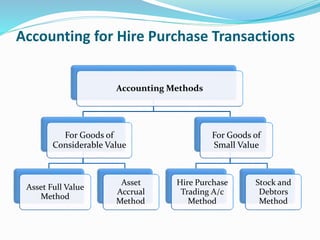
Accounting for Hire Purchase Transactions
Accounting Methods
For Goods of
Considerable Value
Asset Full Value
Method
Asset
Accrual
Method
For Goods of
Small Value
Hire Purchase
Trading A/c
Method
Stock and
Debtors
Method
Asset Full Value Method
 Under this method, goods purchased/sold are treated
as ordinary purchase/sale.
 In the books of hirer, goods purchased are debited to
Asset A/c (being capital goods) and credited to Hire
Vendor’s A/c with full cash price of the asset.
 In the books of hire vendor, goods sold are debited to
Hire Purchaser’s A/c and credited to Hire Sales A/c
with full cash price of the asset.
Asset Accrual Method
 Under this method, goods purchased/sold are not
treated as ordinary purchase/sale. Entries are passed
only with the amount of down payment and
instalments, whenever they become due.
 In the books of hire purchaser, Asset A/c (being capital
goods) is debited only with cash price included in the
each instalment and Interested A/c is debited with the
interest included in the instalment and the total
amount of instalment is credited to Hire Vendor’s A/c.
Note: In practice, the asset Full Value Method is
commonly used.
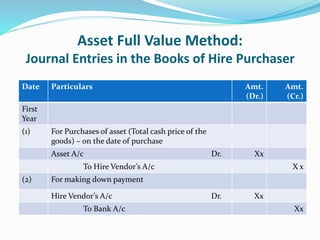
Asset Full Value Method:
Journal Entries in the Books of Hire Purchaser
Date Particulars Amt.
(Dr.)
Amt.
(Cr.)
First
Year
(1) For Purchases of asset (Total cash price of the
goods) – on the date of purchase
Asset A/c Dr. Xx
To Hire Vendor’s A/c X x
(2) For making down payment
Hire Vendor’s A/c Dr. Xx
To Bank A/c Xx
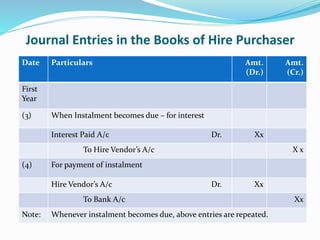
Journal Entries in the Books of Hire Purchaser
Date Particulars Amt.
(Dr.)
Amt.
(Cr.)
First
Year
(3) When Instalment becomes due – for interest
Interest Paid A/c Dr. Xx
To Hire Vendor’s A/c X x
(4) For payment of instalment
Hire Vendor’s A/c Dr. Xx
To Bank A/c Xx
Note: Whenever instalment becomes due, above entries are repeated.
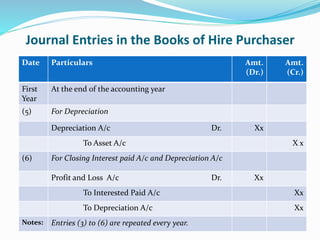
Journal Entries in the Books of Hire Purchaser
Date Particulars Amt.
(Dr.)
Amt.
(Cr.)
First
Year
At the end of the accounting year
(5) For Depreciation
Depreciation A/c Dr. Xx
To Asset A/c X x
(6) For Closing Interest paid A/c and Depreciation A/c
Profit and Loss A/c Dr. Xx
To Interested Paid A/c Xx
To Depreciation A/c Xx
Notes: Entries (3) to (6) are repeated every year.
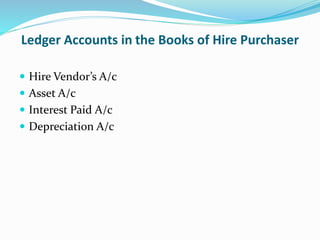
Ledger Accounts in the Books of Hire Purchaser
 Hire Vendor’s A/c
 Asset A/c
 Interest Paid A/c
 Depreciation A/c
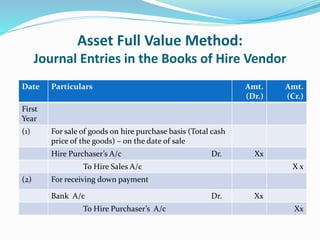
Asset Full Value Method:
Journal Entries in the Books of Hire Vendor
Date Particulars Amt.
(Dr.)
Amt.
(Cr.)
First
Year
(1) For sale of goods on hire purchase basis (Total cash
price of the goods) – on the date of sale
Hire Purchaser’s A/c Dr. Xx
To Hire Sales A/c X x
(2) For receiving down payment
Bank A/c Dr. Xx
To Hire Purchaser’s A/c Xx
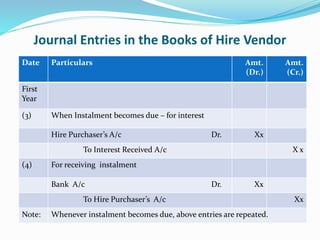
Journal Entries in the Books of Hire Vendor
Date Particulars Amt.
(Dr.)
Amt.
(Cr.)
First
Year
(3) When Instalment becomes due – for interest
Hire Purchaser’s A/c Dr. Xx
To Interest Received A/c X x
(4) For receiving instalment
Bank A/c Dr. Xx
To Hire Purchaser’s A/c Xx
Note: Whenever instalment becomes due, above entries are repeated.
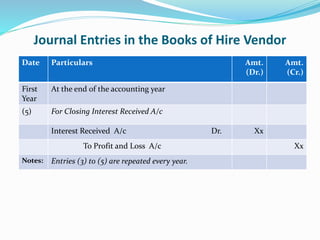
Journal Entries in the Books of Hire Vendor
Date Particulars Amt.
(Dr.)
Amt.
(Cr.)
First
Year
At the end of the accounting year
(5) For Closing Interest Received A/c
Interest Received A/c Dr. Xx
To Profit and Loss A/c Xx
Notes: Entries (3) to (5) are repeated every year.
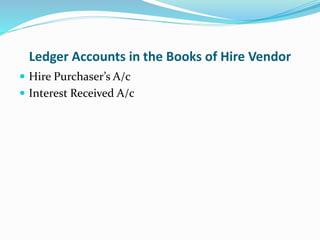
Ledger Accounts in the Books of Hire Vendor
 Hire Purchaser’s A/c
 Interest Received A/c
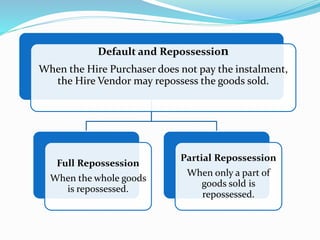
Default and Repossession
When the Hire Purchaser does not pay the instalment,
the Hire Vendor may repossess the goods sold.
Full Repossession
When the whole goods
is repossessed.
Partial Repossession
When only a part of
goods sold is
repossessed.
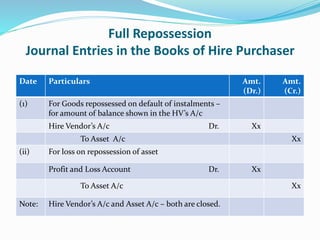
Full Repossession
Journal Entries in the Books of Hire Purchaser
Date Particulars Amt.
(Dr.)
Amt.
(Cr.)
(1) For Goods repossessed on default of instalments –
for amount of balance shown in the HV’s A/c
Hire Vendor’s A/c Dr. Xx
To Asset A/c Xx
(ii) For loss on repossession of asset
Profit and Loss Account Dr. Xx
To Asset A/c Xx
Note: Hire Vendor’s A/c and Asset A/c – both are closed.
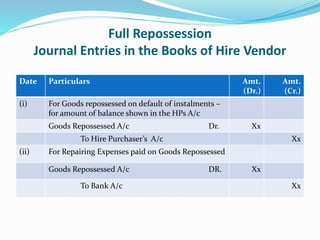
Full Repossession
Journal Entries in the Books of Hire Vendor
Date Particulars Amt.
(Dr.)
Amt.
(Cr.)
(i) For Goods repossessed on default of instalments –
for amount of balance shown in the HPs A/c
Goods Repossessed A/c Dr. Xx
To Hire Purchaser’s A/c Xx
(ii) For Repairing Expenses paid on Goods Repossessed
Goods Repossessed A/c DR. Xx
To Bank A/c Xx
Journal Entries in the Books of Hire Vendor
Date Particulars Amt.
(Dr.)
Amt.
(Cr.)
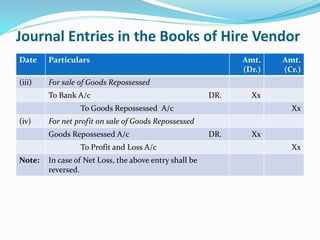
(iii) For sale of Goods Repossessed
To Bank A/c DR. Xx
To Goods Repossessed A/c Xx
(iv) For net profit on sale of Goods Repossessed
Goods Repossessed A/c DR. Xx
To Profit and Loss A/c Xx
Note: In case of Net Loss, the above entry shall be
reversed.
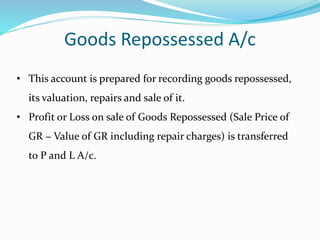
Goods Repossessed A/c
• This account is prepared for recording goods repossessed,
its valuation, repairs and sale of it.
• Profit or Loss on sale of Goods Repossessed (Sale Price of
GR − Value of GR including repair charges) is transferred
to P and L A/c.
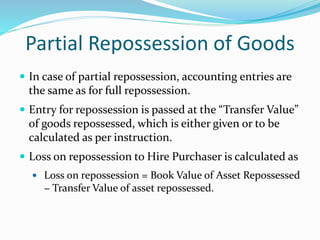
Partial Repossession of Goods
 In case of partial repossession, accounting entries are
the same as for full repossession.
 Entry for repossession is passed at the “Transfer Value”
of goods repossessed, which is either given or to be
calculated as per instruction.
 Loss on repossession to Hire Purchaser is calculated as
 Loss on repossession = Book Value of Asset Repossessed
− Transfer Value of asset repossessed.
Stock and Debtor Method
 For this method, please see my another presentation
on Hire Purchase System Stock and Debtor Method.
Thanks
Please mail me your feedback and suggestions
to
mcsharma1259@gmail.com

Hire purchase system default and repossession

  • 1.
    Mahesh Chandra Sharma AssociateProfessor Department of Commerce Shaheed Bhagat Singh Eve. College (University of Delhi) India
  • 2.
    Hire Purchase System- Features  Under the hire purchase system goods are sold on instalment basis.  Ownership of the goods is transferred when the last instalment is paid.  If the hire purchaser becomes defaulter, the hire vendor has the right to take away the goods and forfeit the instalments received as hire charges for the use of goods.
  • 3.
    Important Terms  HirePurchaser or Hirer The person/firm is called hire purchaser, who obtains or has obtained possession of goods from an owner under a Hire Purchase Agreement.  Owner or Hire Vendor The person/firm is called hire vendor, who delivers or has delivered goods to a hirer under Hire Purchase Agreement.  Deposit or Initial Payment or Down Payment The amount paid by the hirer to the owner at the time of taking possession of the goods.
  • 4.
    Important Terms (Contd.) Hire Charges Hire charges is the amount payable periodically by the hire purchaser under a Hire Purchase Agreement.  Cost Price It is cost of goods to the Hire Vendor.  Cash Price It is the price at which goods is sold on cash basis. It includes Cost Price plus profit margin.
  • 5.
    Important Terms (Contd.) Hire Purchase Price It is the price at which Hire Vendor sells goods to Hire Purchasers on hire purchase basis.  Hire Purchase Charges or Interest It is the difference between Hire Purchase Price and Cash Price. Total Interest = HPP – Cash Price
  • 6.
    Accounting for HirePurchase Transactions Accounting Methods For Goods of Considerable Value Asset Full Value Method Asset Accrual Method For Goods of Small Value Hire Purchase Trading A/c Method Stock and Debtors Method
  • 7.
    Asset Full ValueMethod  Under this method, goods purchased/sold are treated as ordinary purchase/sale.  In the books of hirer, goods purchased are debited to Asset A/c (being capital goods) and credited to Hire Vendor’s A/c with full cash price of the asset.  In the books of hire vendor, goods sold are debited to Hire Purchaser’s A/c and credited to Hire Sales A/c with full cash price of the asset.
  • 8.
    Asset Accrual Method Under this method, goods purchased/sold are not treated as ordinary purchase/sale. Entries are passed only with the amount of down payment and instalments, whenever they become due.  In the books of hire purchaser, Asset A/c (being capital goods) is debited only with cash price included in the each instalment and Interested A/c is debited with the interest included in the instalment and the total amount of instalment is credited to Hire Vendor’s A/c. Note: In practice, the asset Full Value Method is commonly used.
  • 9.
    Asset Full ValueMethod: Journal Entries in the Books of Hire Purchaser Date Particulars Amt. (Dr.) Amt. (Cr.) First Year (1) For Purchases of asset (Total cash price of the goods) – on the date of purchase Asset A/c Dr. Xx To Hire Vendor’s A/c X x (2) For making down payment Hire Vendor’s A/c Dr. Xx To Bank A/c Xx
  • 10.
    Journal Entries inthe Books of Hire Purchaser Date Particulars Amt. (Dr.) Amt. (Cr.) First Year (3) When Instalment becomes due – for interest Interest Paid A/c Dr. Xx To Hire Vendor’s A/c X x (4) For payment of instalment Hire Vendor’s A/c Dr. Xx To Bank A/c Xx Note: Whenever instalment becomes due, above entries are repeated.
  • 11.
    Journal Entries inthe Books of Hire Purchaser Date Particulars Amt. (Dr.) Amt. (Cr.) First Year At the end of the accounting year (5) For Depreciation Depreciation A/c Dr. Xx To Asset A/c X x (6) For Closing Interest paid A/c and Depreciation A/c Profit and Loss A/c Dr. Xx To Interested Paid A/c Xx To Depreciation A/c Xx Notes: Entries (3) to (6) are repeated every year.
  • 12.
    Ledger Accounts inthe Books of Hire Purchaser  Hire Vendor’s A/c  Asset A/c  Interest Paid A/c  Depreciation A/c
  • 13.
    Asset Full ValueMethod: Journal Entries in the Books of Hire Vendor Date Particulars Amt. (Dr.) Amt. (Cr.) First Year (1) For sale of goods on hire purchase basis (Total cash price of the goods) – on the date of sale Hire Purchaser’s A/c Dr. Xx To Hire Sales A/c X x (2) For receiving down payment Bank A/c Dr. Xx To Hire Purchaser’s A/c Xx
  • 14.
    Journal Entries inthe Books of Hire Vendor Date Particulars Amt. (Dr.) Amt. (Cr.) First Year (3) When Instalment becomes due – for interest Hire Purchaser’s A/c Dr. Xx To Interest Received A/c X x (4) For receiving instalment Bank A/c Dr. Xx To Hire Purchaser’s A/c Xx Note: Whenever instalment becomes due, above entries are repeated.
  • 15.
    Journal Entries inthe Books of Hire Vendor Date Particulars Amt. (Dr.) Amt. (Cr.) First Year At the end of the accounting year (5) For Closing Interest Received A/c Interest Received A/c Dr. Xx To Profit and Loss A/c Xx Notes: Entries (3) to (5) are repeated every year.
  • 16.
    Ledger Accounts inthe Books of Hire Vendor  Hire Purchaser’s A/c  Interest Received A/c
  • 17.
    Default and Repossession Whenthe Hire Purchaser does not pay the instalment, the Hire Vendor may repossess the goods sold. Full Repossession When the whole goods is repossessed. Partial Repossession When only a part of goods sold is repossessed.
  • 18.
    Full Repossession Journal Entriesin the Books of Hire Purchaser Date Particulars Amt. (Dr.) Amt. (Cr.) (1) For Goods repossessed on default of instalments – for amount of balance shown in the HV’s A/c Hire Vendor’s A/c Dr. Xx To Asset A/c Xx (ii) For loss on repossession of asset Profit and Loss Account Dr. Xx To Asset A/c Xx Note: Hire Vendor’s A/c and Asset A/c – both are closed.
  • 19.
    Full Repossession Journal Entriesin the Books of Hire Vendor Date Particulars Amt. (Dr.) Amt. (Cr.) (i) For Goods repossessed on default of instalments – for amount of balance shown in the HPs A/c Goods Repossessed A/c Dr. Xx To Hire Purchaser’s A/c Xx (ii) For Repairing Expenses paid on Goods Repossessed Goods Repossessed A/c DR. Xx To Bank A/c Xx
  • 20.
    Journal Entries inthe Books of Hire Vendor Date Particulars Amt. (Dr.) Amt. (Cr.) (iii) For sale of Goods Repossessed To Bank A/c DR. Xx To Goods Repossessed A/c Xx (iv) For net profit on sale of Goods Repossessed Goods Repossessed A/c DR. Xx To Profit and Loss A/c Xx Note: In case of Net Loss, the above entry shall be reversed.
  • 21.
    Goods Repossessed A/c •This account is prepared for recording goods repossessed, its valuation, repairs and sale of it. • Profit or Loss on sale of Goods Repossessed (Sale Price of GR − Value of GR including repair charges) is transferred to P and L A/c.
  • 22.
    Partial Repossession ofGoods  In case of partial repossession, accounting entries are the same as for full repossession.  Entry for repossession is passed at the “Transfer Value” of goods repossessed, which is either given or to be calculated as per instruction.  Loss on repossession to Hire Purchaser is calculated as  Loss on repossession = Book Value of Asset Repossessed − Transfer Value of asset repossessed.
  • 23.
    Stock and DebtorMethod  For this method, please see my another presentation on Hire Purchase System Stock and Debtor Method.
  • 24.
    Thanks Please mail meyour feedback and suggestions to mcsharma1259@gmail.com