© 2013 SISA Information Security Inc.
About SISA:
SISA Information Security was founded in 2003 and has over 300 customers
ranging from healthcare, insurance, banks, hospitality and information technology.
SISA is a leader in Risk Analysis and its tool SISA Assistant is widely used for
HIPAA compliance.
HIPAA Risk Analysis
www.sisainfosec.com
© 2013 SISA Information Security Inc.
© 2013 SISA Information Security Inc.© 2013 SISA Information Security Inc.
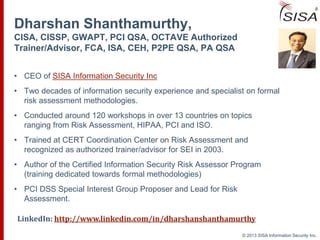
Dharshan Shanthamurthy,
CISA, CISSP, GWAPT, PCI QSA, OCTAVE Authorized
Trainer/Advisor, FCA, ISA, CEH, P2PE QSA, PA QSA
• CEO of SISA Information Security Inc
• Two decades of information security experience and specialist on formal
risk assessment methodologies.
• Conducted around 120 workshops in over 13 countries on topics
ranging from Risk Assessment, HIPAA, PCI and ISO.
• Trained at CERT Coordination Center on Risk Assessment and
recognized as authorized trainer/advisor for SEI in 2003.
• Author of the Certified Information Security Risk Assessor Program
(training dedicated towards formal methodologies)
• PCI DSS Special Interest Group Proposer and Lead for Risk
Assessment.
LinkedIn: http://www.linkedin.com/in/dharshanshanthamurthy
© 2013 SISA Information Security Inc.
Agenda
• Definition
• Background
• Current environment
• Common Risk Analysis Process
• Questions
Objective: Step-by-step approach to HIPAA Risk Analysis
© 2013 SISA Information Security Inc.
Risk Assessment
Risk assessment is the cornerstone of any
information security program, and it is the fastest
way to gain a complete understanding of an
organization's security profile – its strengths and
weaknesses, its vulnerabilities and exposures.
“IF YOU CAN’T MEASURE IT
…YOU CAN’T MANAGE IT!”
© 2013 SISA Information Security Inc.
• Formal risk analysis (or risk assessment)
- Essential component of HIPAA compliance
- Can help organizations identify their most critical
exposures vulnerabilities and — more importantly —
safeguard overall privacy and security
- Forms a basis for determining how risks should be
managed
• Add value by ensuring that resources are directed at the
areas that are most important to management and
governance.
Background
© 2013 SISA Information Security Inc.
HIPAA and Risk Analysis
Administrative Safeguard
Security Management Process
• “Conduct an accurate and thorough assessment of the
potential risks and vulnerabilities to the confidentiality,
integrity, and availability of EPHI held by the covered entity.”
• “Implement security measures sufficient to reduce risks and
vulnerabilities to a reasonable and appropriate level to
comply with §164.306(a). “
© 2013 SISA Information Security Inc.
Risk Analysis: Why is it so critical?
• Control optimization: Protect everything or do RISK Analysis to
know what need to be protected
• Treat helps to prioritize the mitigation process
• Be secure, not just compliant: Effective and Efficient control
deployment
• Was secure yesterday but is it true today? Analyze the
effectiveness of existing control on ongoing basis
• Helps organization to take right decision at the right time
© 2013 SISA Information Security Inc.
Current Environment
• 80% of the organizations don’t have a consistent manner in
assessing risk.
• 4/5 of the organizations have no formal risk appetite defined.
• 47/49 providers, 20/35 health plans and 2/7 of clearing houses
did not have basic formal risk assessment
Source: NIST-OCR 2013
Source: 2013 KPMG Survey
© 2013 SISA Information Security Inc.
Common misconceptions
• Vulnerability Assessment = Risk Analysis
• Risk Analysis = Audit
• Risk Analysis does not require any specific skill
• Risk Analysis is black or white.
• We already know the risk so why conduct formal Risk
Analysis?
• Risk Analysis has no business value and is required only
for compliance purposes just before the audit
• Risk Analysis does not require formal approach. Let me
devise my own.
© 2013 SISA Information Security Inc.
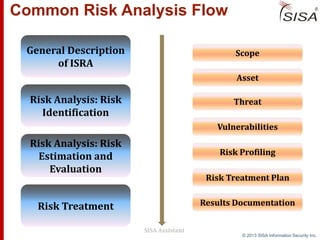
Common Risk Analysis Flow
Risk Treatment
Risk Analysis: Risk
Identification
Risk Analysis: Risk
Estimation and
Evaluation
General Description
of ISRA
SISA Assistant
Risk Profiling
Threat
Vulnerabilities
Scope
Asset
Results Documentation
Risk Treatment Plan
© 2013 SISA Information Security Inc.
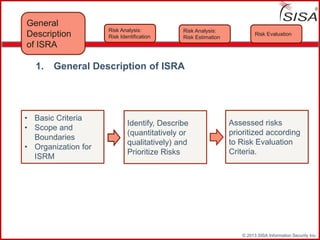
1. General Description of ISRA
• Basic Criteria
• Scope and
Boundaries
• Organization for
ISRM
Identify, Describe
(quantitatively or
qualitatively) and
Prioritize Risks
Assessed risks
prioritized according
to Risk Evaluation
Criteria.
Risk Evaluation
Risk Analysis:
Risk Identification
Risk Analysis:
Risk Estimation
General
Description
of ISRA
© 2013 SISA Information Security Inc.
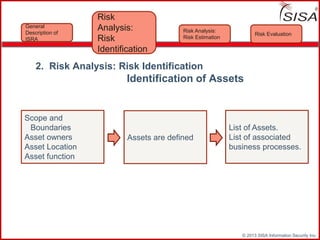
2. Risk Analysis: Risk Identification
Identification of Assets
Scope and
Boundaries
Asset owners
Asset Location
Asset function
Assets are defined
List of Assets.
List of associated
business processes.
Risk Evaluation
Risk Analysis:
Risk Estimation
Risk
Analysis:
Risk
Identification
General
Description of
ISRA
© 2013 SISA Information Security Inc.
2. Risk Analysis: Risk Identification
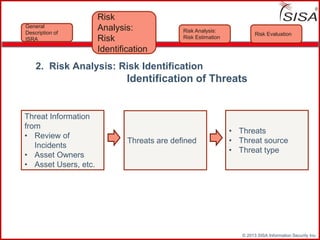
Identification of Threats
Threat Information
from
• Review of
Incidents
• Asset Owners
• Asset Users, etc.
Threats are defined
• Threats
• Threat source
• Threat type
Risk Evaluation
Risk Analysis:
Risk Estimation
Risk
Analysis:
Risk
Identification
General
Description of
ISRA
© 2013 SISA Information Security Inc.
2. Risk Analysis: Risk Identification
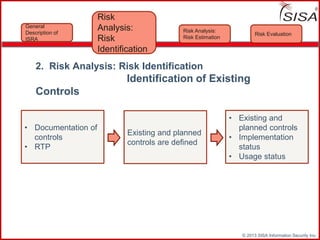
Identification of Existing
Controls
• Documentation of
controls
• RTP
Existing and planned
controls are defined
• Existing and
planned controls
• Implementation
status
• Usage status
Risk Evaluation
Risk Analysis:
Risk Estimation
Risk
Analysis:
Risk
Identification
General
Description of
ISRA
© 2013 SISA Information Security Inc.
2. Risk Analysis: Risk Identification
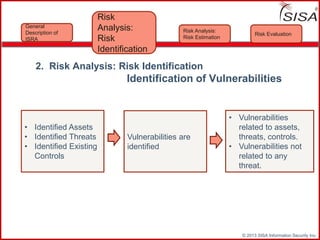
Identification of Vulnerabilities
• Identified Assets
• Identified Threats
• Identified Existing
Controls
Vulnerabilities are
identified
• Vulnerabilities
related to assets,
threats, controls.
• Vulnerabilities not
related to any
threat.
Risk Evaluation
Risk Analysis:
Risk Estimation
Risk
Analysis:
Risk
Identification
General
Description of
ISRA
© 2013 SISA Information Security Inc.
2. Risk Analysis: Risk Identification
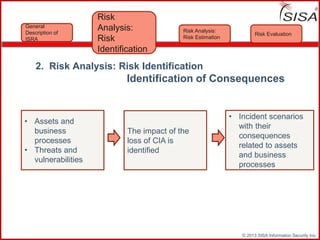
Identification of Consequences
• Assets and
business
processes
• Threats and
vulnerabilities
The impact of the
loss of CIA is
identified
• Incident scenarios
with their
consequences
related to assets
and business
processes
Risk Evaluation
Risk Analysis:
Risk Estimation
Risk
Analysis:
Risk
Identification
General
Description of
ISRA
© 2013 SISA Information Security Inc.
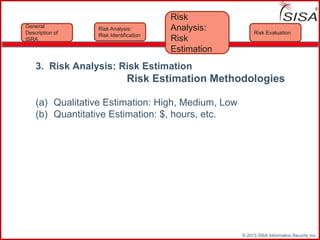
3. Risk Analysis: Risk Estimation
Risk Estimation Methodologies
(a) Qualitative Estimation: High, Medium, Low
(b) Quantitative Estimation: $, hours, etc.
Risk Evaluation
Risk
Analysis:
Risk
Estimation
General
Description of
ISRA
Risk Analysis:
Risk Identification
© 2013 SISA Information Security Inc.
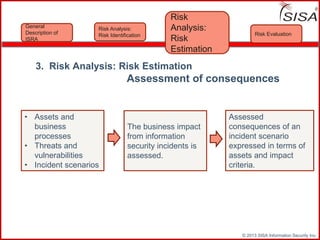
3. Risk Analysis: Risk Estimation
Assessment of consequences
Risk Evaluation
Risk
Analysis:
Risk
Estimation
General
Description of
ISRA
Risk Analysis:
Risk Identification
• Assets and
business
processes
• Threats and
vulnerabilities
• Incident scenarios
The business impact
from information
security incidents is
assessed.
Assessed
consequences of an
incident scenario
expressed in terms of
assets and impact
criteria.
© 2013 SISA Information Security Inc.
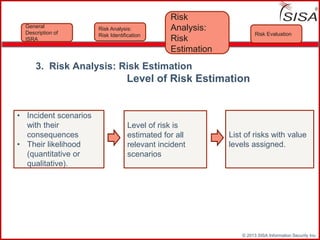
3. Risk Analysis: Risk Estimation
Level of Risk Estimation
Risk Evaluation
Risk
Analysis:
Risk
Estimation
General
Description of
ISRA
Risk Analysis:
Risk Identification
• Incident scenarios
with their
consequences
• Their likelihood
(quantitative or
qualitative).
Level of risk is
estimated for all
relevant incident
scenarios
List of risks with value
levels assigned.
© 2013 SISA Information Security Inc.
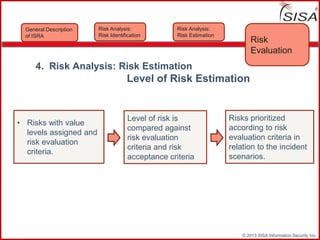
4. Risk Analysis: Risk Estimation
Level of Risk Estimation
General Description
of ISRA
Risk Analysis:
Risk Identification
• Risks with value
levels assigned and
risk evaluation
criteria.
Level of risk is
compared against
risk evaluation
criteria and risk
acceptance criteria
Risks prioritized
according to risk
evaluation criteria in
relation to the incident
scenarios.
Risk
Evaluation
Risk Analysis:
Risk Estimation
© 2013 SISA Information Security Inc.
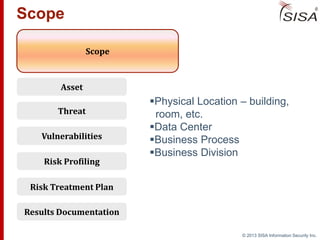
Scope
Physical Location – building,
room, etc.
Data Center
Business Process
Business Division
Risk Profiling
Threat
Vulnerabilities
Scope
Asset
Results Documentation
Risk Treatment Plan
© 2013 SISA Information Security Inc.
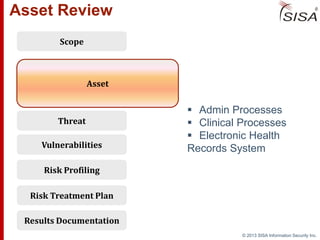
Asset Review
 Admin Processes
 Clinical Processes
 Electronic Health
Records System
Risk Profiling
Vulnerabilities
Scope
Results Documentation
Risk Treatment Plan
Threat
Asset
© 2013 SISA Information Security Inc.
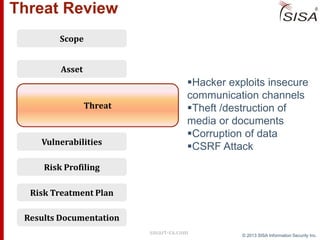
Threat Review
smart-ra.com
Hacker exploits insecure
communication channels
Theft /destruction of
media or documents
Corruption of data
CSRF Attack
Risk Profiling
Vulnerabilities
Scope
Results Documentation
Risk Treatment Plan
Asset
Threat
© 2013 SISA Information Security Inc.
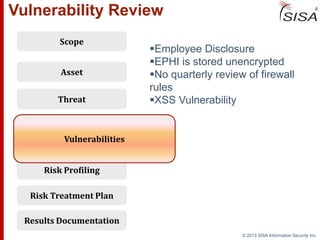
Vulnerability Review
Employee Disclosure
EPHI is stored unencrypted
No quarterly review of firewall
rules
XSS Vulnerability
Risk Profiling
Threat
Scope
Results Documentation
Risk Treatment Plan
Asset
Vulnerabilities
© 2013 SISA Information Security Inc.
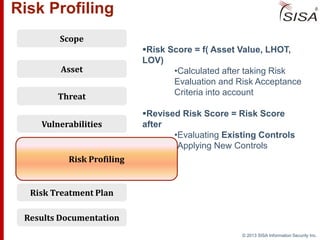
Risk Profiling
Risk Score = f( Asset Value, LHOT,
LOV)
•Calculated after taking Risk
Evaluation and Risk Acceptance
Criteria into account
Revised Risk Score = Risk Score
after
•Evaluating Existing Controls
•Applying New Controls
Vulnerabilities
Threat
Scope
Results Documentation
Risk Treatment Plan
Asset
Risk Profiling
© 2013 SISA Information Security Inc.
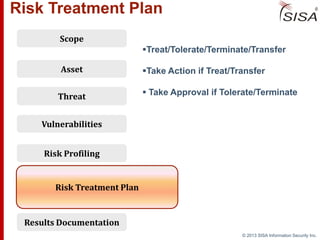
Risk Treatment Plan
Vulnerabilities
Threat
Scope
Results Documentation
Risk Profiling
Asset
Risk Treatment Plan
Treat/Tolerate/Terminate/Transfer
Take Action if Treat/Transfer
 Take Approval if Tolerate/Terminate
© 2013 SISA Information Security Inc.
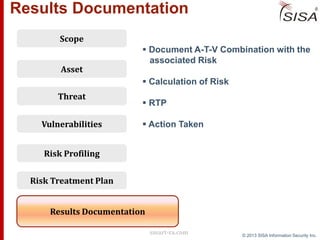
Results Documentation
smart-ra.com

Vulnerabilities
Threat
Scope
Risk Profiling
Risk Treatment Plan
Asset
Results Documentation
 Document A-T-V Combination with the
associated Risk
 Calculation of Risk
 RTP
 Action Taken
© 2013 SISA Information Security Inc.
Scenario – Threat Profiling
We have had people moving from one
department to another and it seems like
some of them continue to have their
previous access rights both to the network
and to the lab area. Consequently PHI is
accessible to more people than required.
© 2013 SISA Information Security Inc.
Questions
Email: dbs@sisainfosec.com
About SISA:
SISA Information Security was founded in 2003 and has over 300 customers
ranging from healthcare, insurance, banks, hospitality and information technology.
SISA is a leader in Risk Analysis and its tool SISA Assistant is widely used for
HIPAA compliance. Sign up on our website to get a FREE 30 day trial.
www.sisainfosec.com
LinkedIn: http://www.linkedin.com/in/dharshanshanthamurthy

Hipaa risk analysis_1.4

  • 1.
    © 2013 SISAInformation Security Inc. About SISA: SISA Information Security was founded in 2003 and has over 300 customers ranging from healthcare, insurance, banks, hospitality and information technology. SISA is a leader in Risk Analysis and its tool SISA Assistant is widely used for HIPAA compliance. HIPAA Risk Analysis www.sisainfosec.com © 2013 SISA Information Security Inc.
  • 2.
    © 2013 SISAInformation Security Inc.© 2013 SISA Information Security Inc. Dharshan Shanthamurthy, CISA, CISSP, GWAPT, PCI QSA, OCTAVE Authorized Trainer/Advisor, FCA, ISA, CEH, P2PE QSA, PA QSA • CEO of SISA Information Security Inc • Two decades of information security experience and specialist on formal risk assessment methodologies. • Conducted around 120 workshops in over 13 countries on topics ranging from Risk Assessment, HIPAA, PCI and ISO. • Trained at CERT Coordination Center on Risk Assessment and recognized as authorized trainer/advisor for SEI in 2003. • Author of the Certified Information Security Risk Assessor Program (training dedicated towards formal methodologies) • PCI DSS Special Interest Group Proposer and Lead for Risk Assessment. LinkedIn: http://www.linkedin.com/in/dharshanshanthamurthy
  • 3.
    © 2013 SISAInformation Security Inc. Agenda • Definition • Background • Current environment • Common Risk Analysis Process • Questions Objective: Step-by-step approach to HIPAA Risk Analysis
  • 4.
    © 2013 SISAInformation Security Inc. Risk Assessment Risk assessment is the cornerstone of any information security program, and it is the fastest way to gain a complete understanding of an organization's security profile – its strengths and weaknesses, its vulnerabilities and exposures. “IF YOU CAN’T MEASURE IT …YOU CAN’T MANAGE IT!”
  • 5.
    © 2013 SISAInformation Security Inc. • Formal risk analysis (or risk assessment) - Essential component of HIPAA compliance - Can help organizations identify their most critical exposures vulnerabilities and — more importantly — safeguard overall privacy and security - Forms a basis for determining how risks should be managed • Add value by ensuring that resources are directed at the areas that are most important to management and governance. Background
  • 6.
    © 2013 SISAInformation Security Inc. HIPAA and Risk Analysis Administrative Safeguard Security Management Process • “Conduct an accurate and thorough assessment of the potential risks and vulnerabilities to the confidentiality, integrity, and availability of EPHI held by the covered entity.” • “Implement security measures sufficient to reduce risks and vulnerabilities to a reasonable and appropriate level to comply with §164.306(a). “
  • 7.
    © 2013 SISAInformation Security Inc. Risk Analysis: Why is it so critical? • Control optimization: Protect everything or do RISK Analysis to know what need to be protected • Treat helps to prioritize the mitigation process • Be secure, not just compliant: Effective and Efficient control deployment • Was secure yesterday but is it true today? Analyze the effectiveness of existing control on ongoing basis • Helps organization to take right decision at the right time
  • 8.
    © 2013 SISAInformation Security Inc. Current Environment • 80% of the organizations don’t have a consistent manner in assessing risk. • 4/5 of the organizations have no formal risk appetite defined. • 47/49 providers, 20/35 health plans and 2/7 of clearing houses did not have basic formal risk assessment Source: NIST-OCR 2013 Source: 2013 KPMG Survey
  • 9.
    © 2013 SISAInformation Security Inc. Common misconceptions • Vulnerability Assessment = Risk Analysis • Risk Analysis = Audit • Risk Analysis does not require any specific skill • Risk Analysis is black or white. • We already know the risk so why conduct formal Risk Analysis? • Risk Analysis has no business value and is required only for compliance purposes just before the audit • Risk Analysis does not require formal approach. Let me devise my own.
  • 10.
    © 2013 SISAInformation Security Inc. Common Risk Analysis Flow Risk Treatment Risk Analysis: Risk Identification Risk Analysis: Risk Estimation and Evaluation General Description of ISRA SISA Assistant Risk Profiling Threat Vulnerabilities Scope Asset Results Documentation Risk Treatment Plan
  • 11.
    © 2013 SISAInformation Security Inc. 1. General Description of ISRA • Basic Criteria • Scope and Boundaries • Organization for ISRM Identify, Describe (quantitatively or qualitatively) and Prioritize Risks Assessed risks prioritized according to Risk Evaluation Criteria. Risk Evaluation Risk Analysis: Risk Identification Risk Analysis: Risk Estimation General Description of ISRA
  • 12.
    © 2013 SISAInformation Security Inc. 2. Risk Analysis: Risk Identification Identification of Assets Scope and Boundaries Asset owners Asset Location Asset function Assets are defined List of Assets. List of associated business processes. Risk Evaluation Risk Analysis: Risk Estimation Risk Analysis: Risk Identification General Description of ISRA
  • 13.
    © 2013 SISAInformation Security Inc. 2. Risk Analysis: Risk Identification Identification of Threats Threat Information from • Review of Incidents • Asset Owners • Asset Users, etc. Threats are defined • Threats • Threat source • Threat type Risk Evaluation Risk Analysis: Risk Estimation Risk Analysis: Risk Identification General Description of ISRA
  • 14.
    © 2013 SISAInformation Security Inc. 2. Risk Analysis: Risk Identification Identification of Existing Controls • Documentation of controls • RTP Existing and planned controls are defined • Existing and planned controls • Implementation status • Usage status Risk Evaluation Risk Analysis: Risk Estimation Risk Analysis: Risk Identification General Description of ISRA
  • 15.
    © 2013 SISAInformation Security Inc. 2. Risk Analysis: Risk Identification Identification of Vulnerabilities • Identified Assets • Identified Threats • Identified Existing Controls Vulnerabilities are identified • Vulnerabilities related to assets, threats, controls. • Vulnerabilities not related to any threat. Risk Evaluation Risk Analysis: Risk Estimation Risk Analysis: Risk Identification General Description of ISRA
  • 16.
    © 2013 SISAInformation Security Inc. 2. Risk Analysis: Risk Identification Identification of Consequences • Assets and business processes • Threats and vulnerabilities The impact of the loss of CIA is identified • Incident scenarios with their consequences related to assets and business processes Risk Evaluation Risk Analysis: Risk Estimation Risk Analysis: Risk Identification General Description of ISRA
  • 17.
    © 2013 SISAInformation Security Inc. 3. Risk Analysis: Risk Estimation Risk Estimation Methodologies (a) Qualitative Estimation: High, Medium, Low (b) Quantitative Estimation: $, hours, etc. Risk Evaluation Risk Analysis: Risk Estimation General Description of ISRA Risk Analysis: Risk Identification
  • 18.
    © 2013 SISAInformation Security Inc. 3. Risk Analysis: Risk Estimation Assessment of consequences Risk Evaluation Risk Analysis: Risk Estimation General Description of ISRA Risk Analysis: Risk Identification • Assets and business processes • Threats and vulnerabilities • Incident scenarios The business impact from information security incidents is assessed. Assessed consequences of an incident scenario expressed in terms of assets and impact criteria.
  • 19.
    © 2013 SISAInformation Security Inc. 3. Risk Analysis: Risk Estimation Level of Risk Estimation Risk Evaluation Risk Analysis: Risk Estimation General Description of ISRA Risk Analysis: Risk Identification • Incident scenarios with their consequences • Their likelihood (quantitative or qualitative). Level of risk is estimated for all relevant incident scenarios List of risks with value levels assigned.
  • 20.
    © 2013 SISAInformation Security Inc. 4. Risk Analysis: Risk Estimation Level of Risk Estimation General Description of ISRA Risk Analysis: Risk Identification • Risks with value levels assigned and risk evaluation criteria. Level of risk is compared against risk evaluation criteria and risk acceptance criteria Risks prioritized according to risk evaluation criteria in relation to the incident scenarios. Risk Evaluation Risk Analysis: Risk Estimation
  • 21.
    © 2013 SISAInformation Security Inc. Scope Physical Location – building, room, etc. Data Center Business Process Business Division Risk Profiling Threat Vulnerabilities Scope Asset Results Documentation Risk Treatment Plan
  • 22.
    © 2013 SISAInformation Security Inc. Asset Review  Admin Processes  Clinical Processes  Electronic Health Records System Risk Profiling Vulnerabilities Scope Results Documentation Risk Treatment Plan Threat Asset
  • 23.
    © 2013 SISAInformation Security Inc. Threat Review smart-ra.com Hacker exploits insecure communication channels Theft /destruction of media or documents Corruption of data CSRF Attack Risk Profiling Vulnerabilities Scope Results Documentation Risk Treatment Plan Asset Threat
  • 24.
    © 2013 SISAInformation Security Inc. Vulnerability Review Employee Disclosure EPHI is stored unencrypted No quarterly review of firewall rules XSS Vulnerability Risk Profiling Threat Scope Results Documentation Risk Treatment Plan Asset Vulnerabilities
  • 25.
    © 2013 SISAInformation Security Inc. Risk Profiling Risk Score = f( Asset Value, LHOT, LOV) •Calculated after taking Risk Evaluation and Risk Acceptance Criteria into account Revised Risk Score = Risk Score after •Evaluating Existing Controls •Applying New Controls Vulnerabilities Threat Scope Results Documentation Risk Treatment Plan Asset Risk Profiling
  • 26.
    © 2013 SISAInformation Security Inc. Risk Treatment Plan Vulnerabilities Threat Scope Results Documentation Risk Profiling Asset Risk Treatment Plan Treat/Tolerate/Terminate/Transfer Take Action if Treat/Transfer  Take Approval if Tolerate/Terminate
  • 27.
    © 2013 SISAInformation Security Inc. Results Documentation smart-ra.com  Vulnerabilities Threat Scope Risk Profiling Risk Treatment Plan Asset Results Documentation  Document A-T-V Combination with the associated Risk  Calculation of Risk  RTP  Action Taken
  • 28.
    © 2013 SISAInformation Security Inc. Scenario – Threat Profiling We have had people moving from one department to another and it seems like some of them continue to have their previous access rights both to the network and to the lab area. Consequently PHI is accessible to more people than required.
  • 29.
    © 2013 SISAInformation Security Inc. Questions Email: dbs@sisainfosec.com About SISA: SISA Information Security was founded in 2003 and has over 300 customers ranging from healthcare, insurance, banks, hospitality and information technology. SISA is a leader in Risk Analysis and its tool SISA Assistant is widely used for HIPAA compliance. Sign up on our website to get a FREE 30 day trial. www.sisainfosec.com LinkedIn: http://www.linkedin.com/in/dharshanshanthamurthy

Editor's Notes

  • #2 Good morning. Its great to be here and talk about a subject that is highly discussed and is at the center stage of discussion following the omnibus rule. For the new 50 minutes or so, we are going to be discussing on HIPAA Risk Analysis or HIPAA Risk Assessment. Technically speaking and going by ISO risk analysis is one of the components of Risk Assessment but since HIPAA Security Rule uses the word risk analysis we be a little liberal in using the word Risk Analysis but for all purposes refer to risk assessment. My central objective of this presentation is a step by step approach to doing a formal Risk Analysis which meets HIPAA and other compliance requirements. As we have less then a hour I would have succeeded in my presentation if I am able to drive home the necessity of doing it correctly.
  • #3 My experience with risk assessments started way back in 90’s when I had an information security project to be done when I was working for a Big 4 audit firms in India. It was pretty good but because we did that quite well following a already designed template. Off course later I went onto study formal risk assessments in depth in CERT Coordination Center in Pittsburgh and there was ocean of a difference when we do a formal risk assessment and a risk assessment which is done not following any methodology or process. When my company went on to become a PCI QSA when PCI SSC was founded, I understood that PCI DSS did not have much on formal risk assessment except that they had one small requirement under 6th milestone (1-6 Priority) and found that my entire team was checking the box because they did not understand it, our customers did not understand it. I later found out that its just not me but the entire community that was doing the same. So I proposed a special interest group under the PCI Council to examine this requirement and give it more teeth. So after working for more than one year on the document, we released a guidance document in November 2012 where I was to present on the same. Later I went to create a course on formal information security risk assessment as I wanted to fix the gap and also developed a product called SISA Assistant which has one of the modules as Risk Assessment as well.
  • #4  OCTAVE Overview
  • #6 Risk exposure decreases significantly when an organization knows exactly where PHI resides and how it is handled. A formal Risk Analysis examines the risks and controls related to three critical areas: People, Process and Technology.
  • #11 Vulnerability: Vulnerability is defined in NIST Special Publication (SP) 800-30 as “[a] flaw or weakness in system security procedures, design, implementation, or internal controls that could be exercised (accidentally triggered or intentionally exploited) and result in a security breach or a violation of the system’s security policy.” Threat: An adapted definition of threat, from NIST SP 800-30, is “[t]he potential for a person or thing to exercise (accidentally trigger or intentionally exploit) a specific vulnerability.” Risk: The net mission impact considering (1) the probability that a particular [threat] will exercise (accidentally trigger or intentionally exploit) a particular [vulnerability] and (2) the resulting impact if this should occur . . . . [R]isks arise from legal liability or mission loss due to— Unauthorized (malicious or accidental) disclosure, modification, or destruction of information 2. Unintentional errors and omissions 3. IT disruptions due to natural or man- made disasters 4. Failure to exercise due care and diligence in the implementation and operation of the IT system.