Information Security Management System
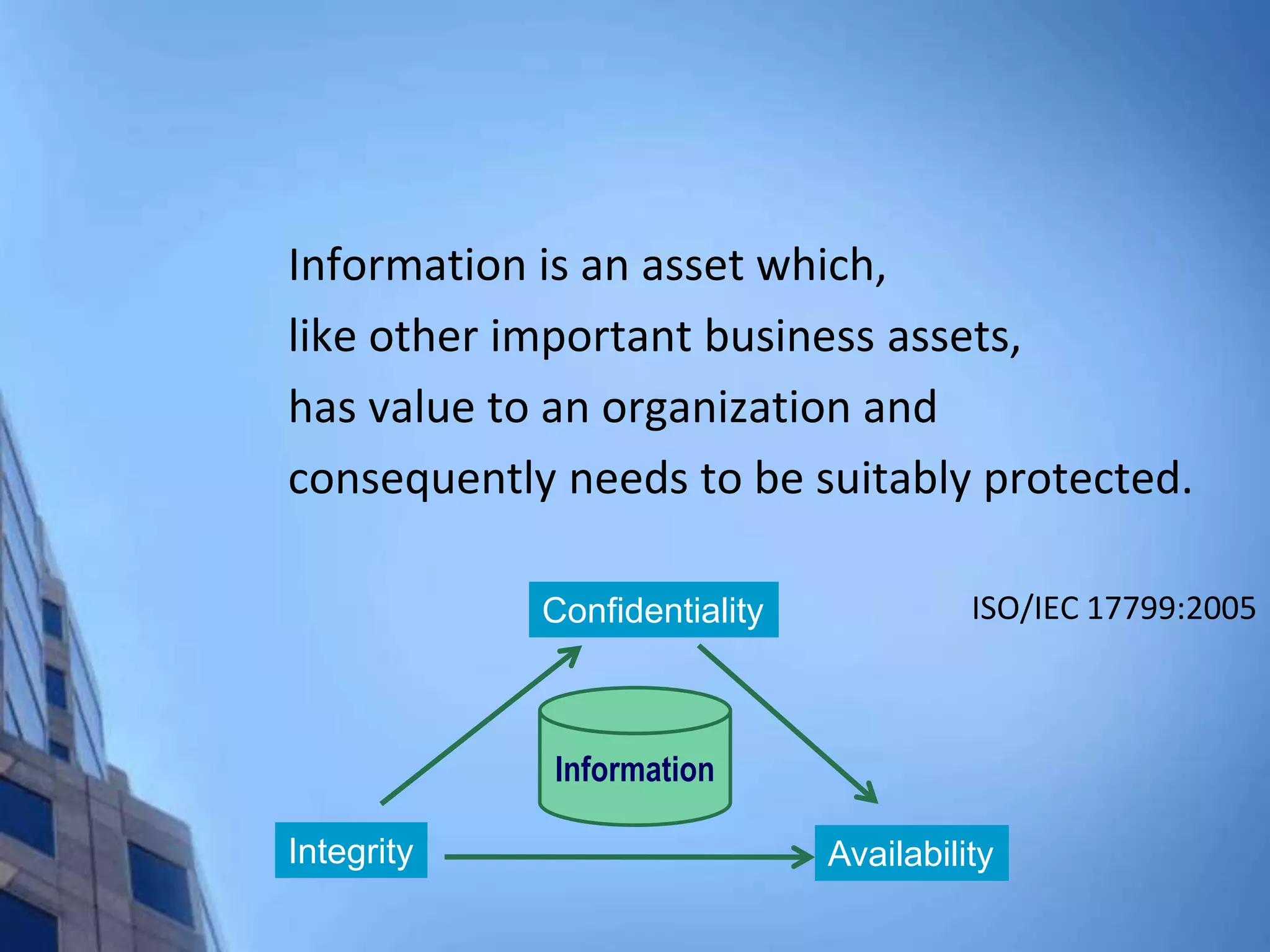
Information is an asset which,
like other important business assets,
has value to an organization and
consequently needs to be suitably protected.
ISO/IEC 17799:2005
Information
Confidentiality
Integrity Availability
Information Security Management is a
top-down, business driven
approach to the management of an
organization’s physical and
electronic information assets
in order to preserve their
• confidentiality,
• integrity and
• availability.
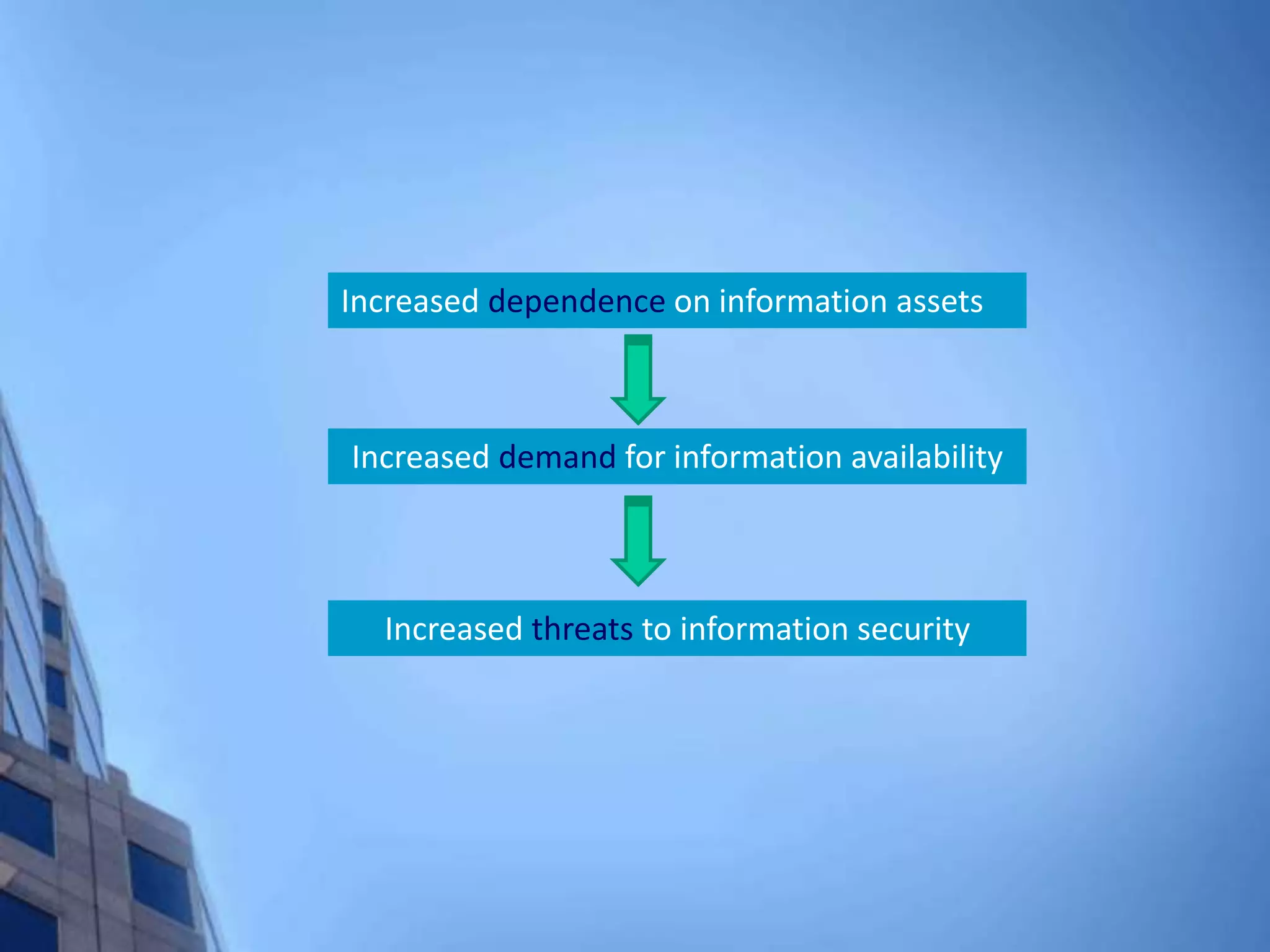
Increased dependence on information assets
Increased demand for information availability
Increased threats to information security
Consequences of Security Breach
 Destroy Image
 Depress the value of the business
 Erode the “bottom line”; and
 Compromise future earnings.
What is ISMS
An ISMS is the means by which
management monitors and controls the security,
minimizing the residual business risk and
ensuring that security continues to fulfill
corporate, customer and legal requirements.
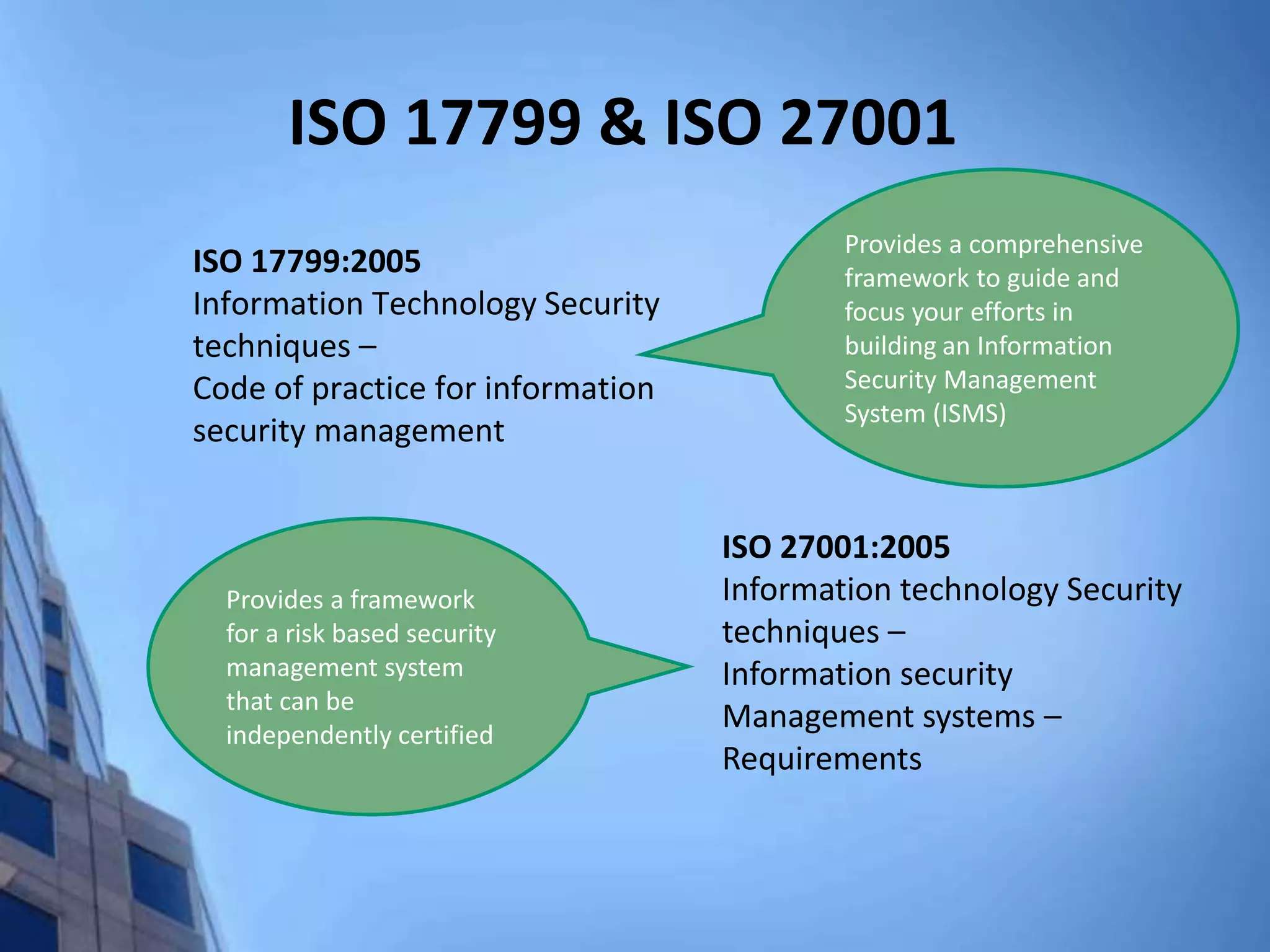
ISO 17799 & ISO 27001
ISO 17799:2005
Information Technology Security
techniques –
Code of practice for information
security management
ISO 27001:2005
Information technology Security
techniques –
Information security
Management systems –
Requirements
Provides a comprehensive
framework to guide and
focus your efforts in
building an Information
Security Management
System (ISMS)
Provides a framework
for a risk based security
management system
that can be
independently certified
ISO 17799
 An Internationally recognized Code of
Practice for information security
management systems (ISMS)
 A comprehensive framework to guide and
focus your efforts in building an Information
Security Management System
 A collection of security best practices along
with implementation guidance
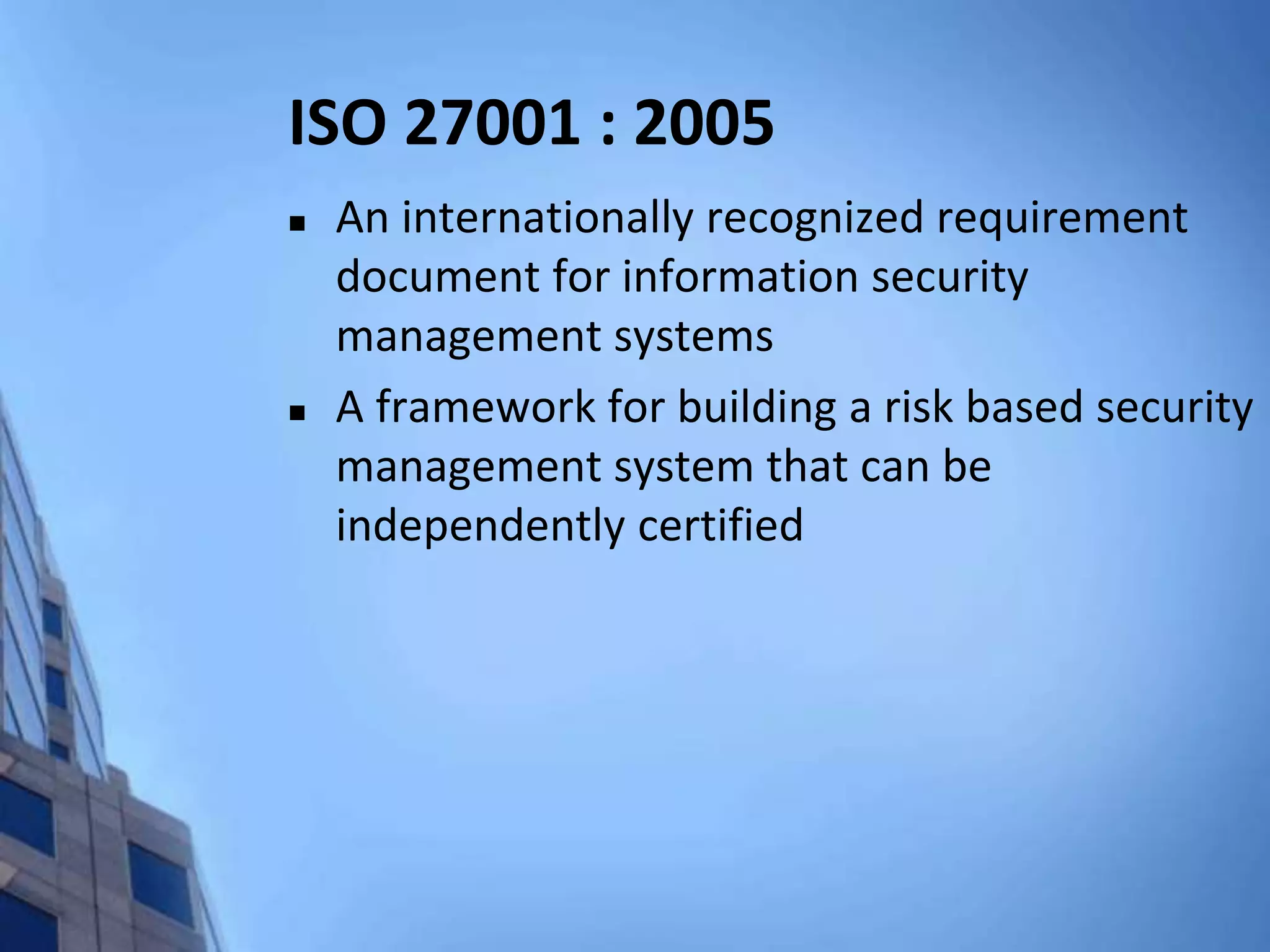
ISO 27001 : 2005
 An internationally recognized requirement
document for information security
management systems
 A framework for building a risk based security
management system that can be
independently certified
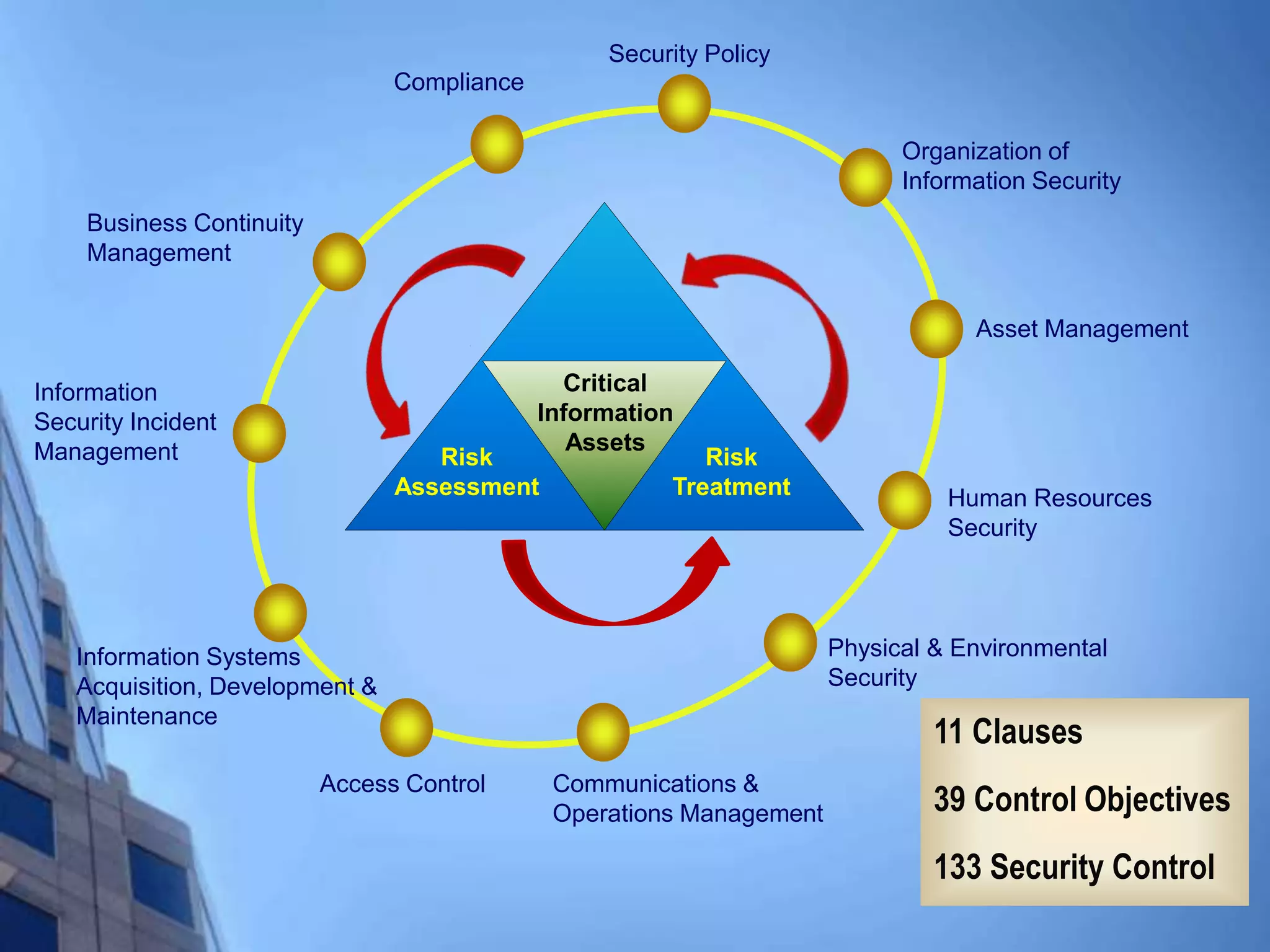
Communications &
Operations Management
Critical
Information
Assets
Risk
Assessment
Risk
Treatment
Compliance
Security Policy
Organization of
Information Security
Asset Management
Human Resources
Security
Physical & Environmental
Security
Access Control
Information Systems
Acquisition, Development &
Maintenance
Information
Security Incident
Management
Business Continuity
Management
11 Clauses
39 Control Objectives
133 Security Control
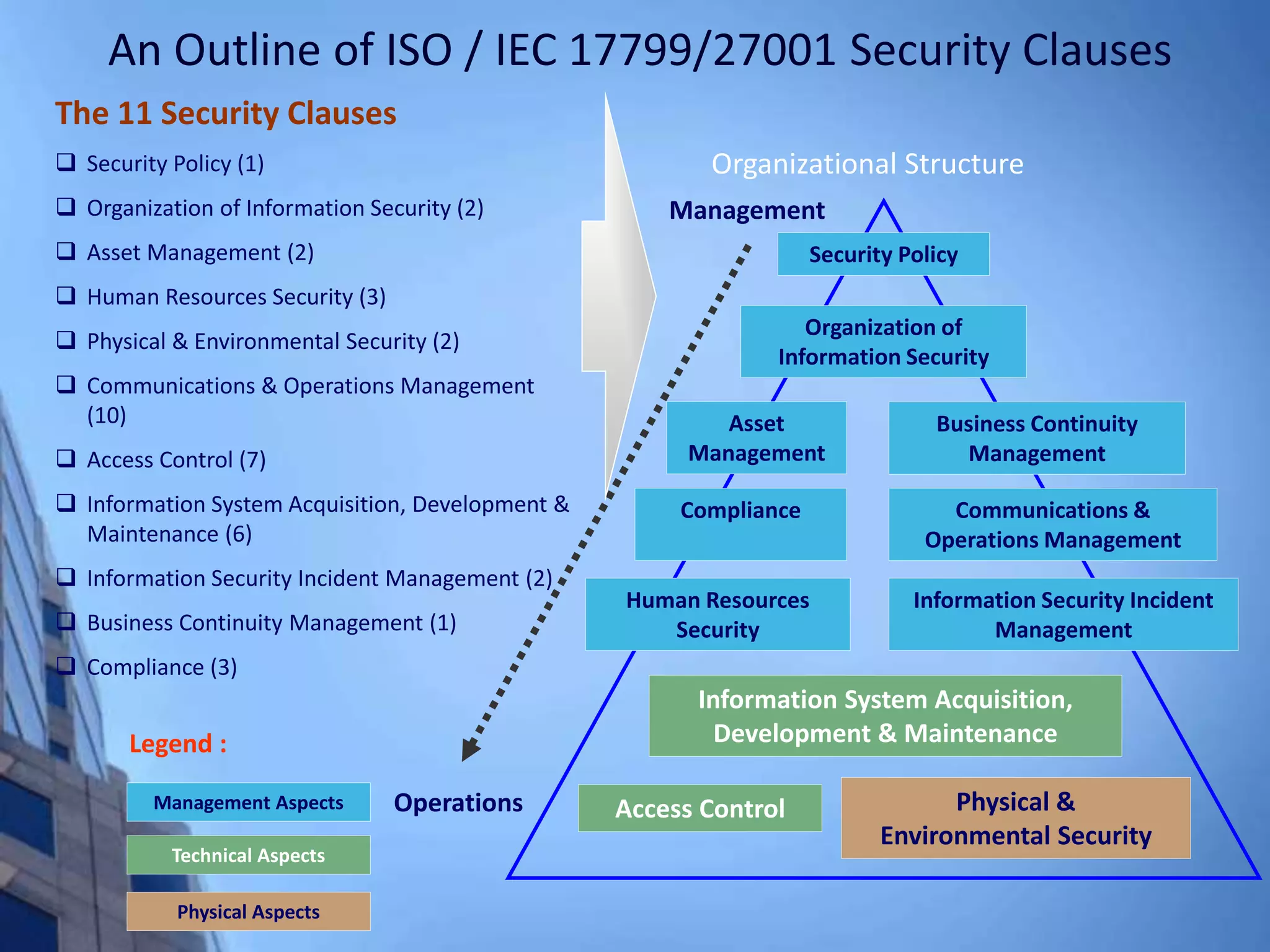
An Outline of ISO / IEC 17799/27001 Security Clauses
Management Aspects
Technical Aspects
Physical Aspects
Legend :
Security Policy
Organization of
Information Security
Asset
Management
Business Continuity
Management
Compliance Communications &
Operations Management
Human Resources
Security
Information Security Incident
Management
Information System Acquisition,
Development & Maintenance
Access Control Physical &
Environmental Security
Operations
Management
Organizational Structure
The 11 Security Clauses
 Security Policy (1)
 Organization of Information Security (2)
 Asset Management (2)
 Human Resources Security (3)
 Physical & Environmental Security (2)
 Communications & Operations Management
(10)
 Access Control (7)
 Information System Acquisition, Development &
Maintenance (6)
 Information Security Incident Management (2)
 Business Continuity Management (1)
 Compliance (3)
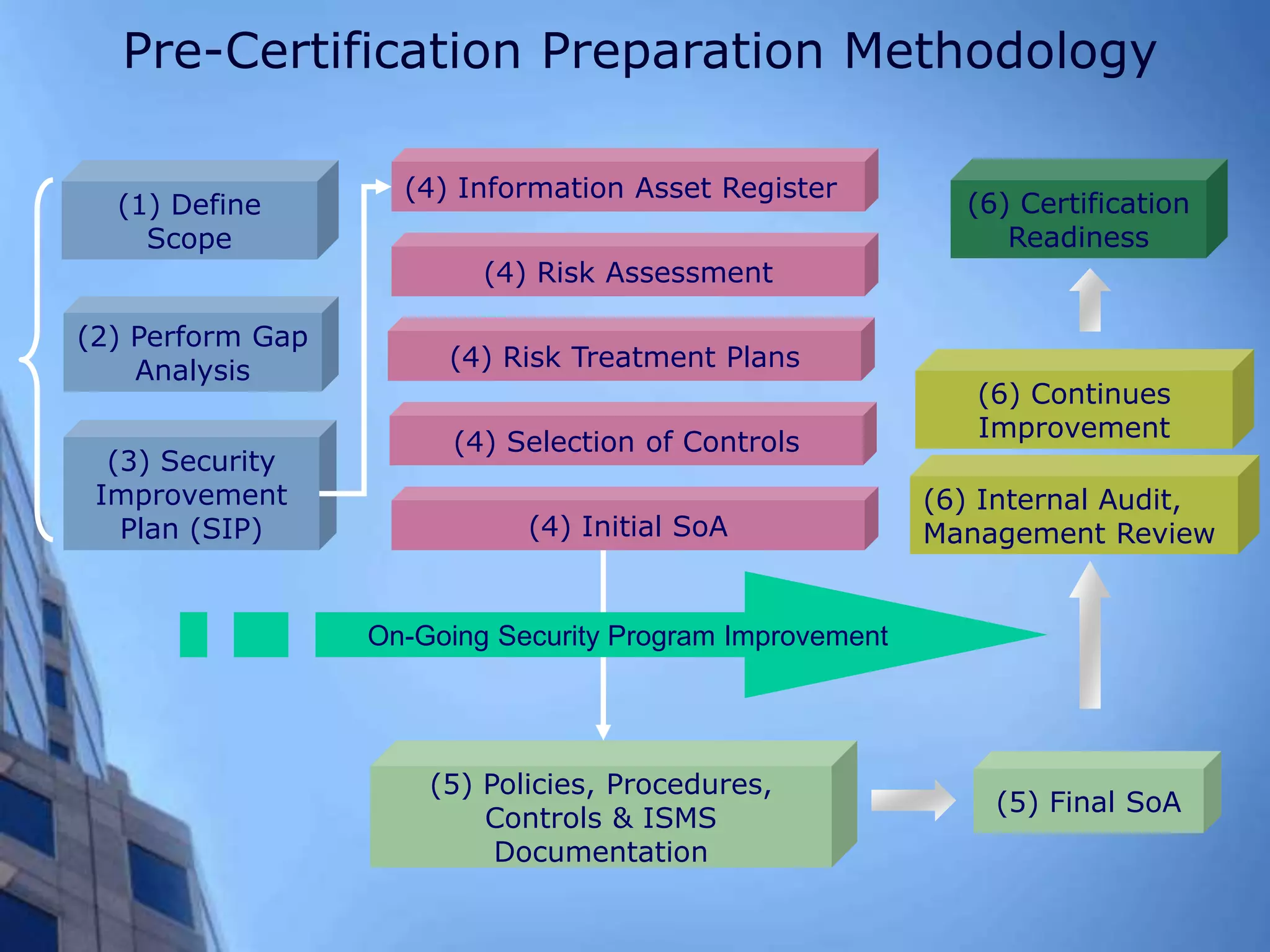
(1) Define
Scope
(2) Perform Gap
Analysis
(3) Security
Improvement
Plan (SIP)
(4) Information Asset Register
(4) Risk Assessment
(4) Risk Treatment Plans
(4) Selection of Controls
(4) Initial SoA
(6) Certification
Readiness
(6) Continues
Improvement
(6) Internal Audit,
Management Review
(5) Policies, Procedures,
Controls & ISMS
Documentation
(5) Final SoA
On-Going Security Program Improvement
Pre-Certification Preparation Methodology
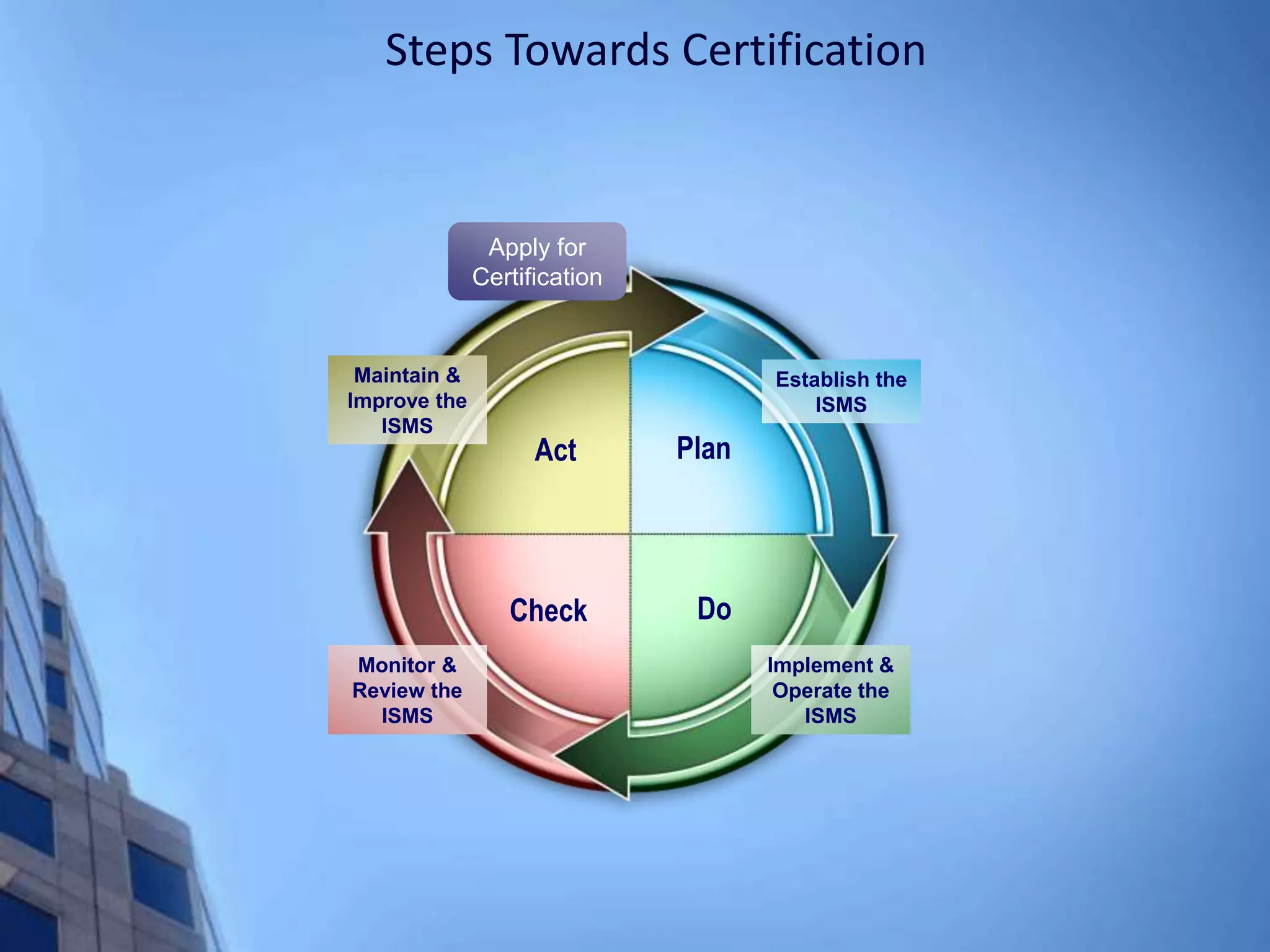
Steps Towards Certification
Plan
Do
Check
Act
Establish the
ISMS
Implement &
Operate the
ISMS
Monitor &
Review the
ISMS
Maintain &
Improve the
ISMS
Apply for
Certification
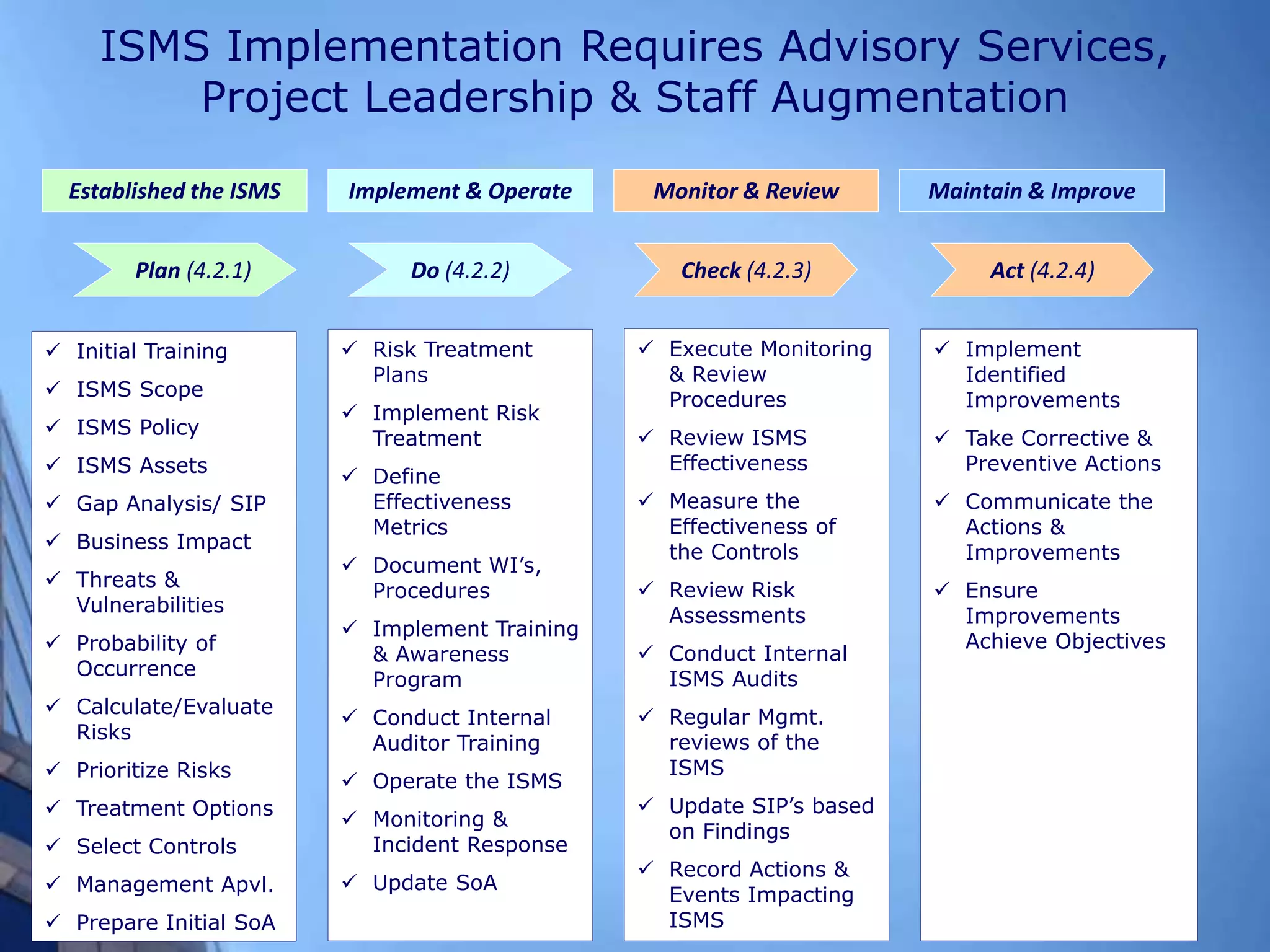
ISMS Implementation Requires Advisory Services,
Project Leadership & Staff Augmentation
Established the ISMS Implement & Operate Monitor & Review Maintain & Improve
Plan (4.2.1) Do (4.2.2) Check (4.2.3) Act (4.2.4)
 Initial Training
 ISMS Scope
 ISMS Policy
 ISMS Assets
 Gap Analysis/ SIP
 Business Impact
 Threats &
Vulnerabilities
 Probability of
Occurrence
 Calculate/Evaluate
Risks
 Prioritize Risks
 Treatment Options
 Select Controls
 Management Apvl.
 Prepare Initial SoA
 Risk Treatment
Plans
 Implement Risk
Treatment
 Define
Effectiveness
Metrics
 Document WI’s,
Procedures
 Implement Training
& Awareness
Program
 Conduct Internal
Auditor Training
 Operate the ISMS
 Monitoring &
Incident Response
 Update SoA
 Execute Monitoring
& Review
Procedures
 Review ISMS
Effectiveness
 Measure the
Effectiveness of
the Controls
 Review Risk
Assessments
 Conduct Internal
ISMS Audits
 Regular Mgmt.
reviews of the
ISMS
 Update SIP’s based
on Findings
 Record Actions &
Events Impacting
ISMS
 Implement
Identified
Improvements
 Take Corrective &
Preventive Actions
 Communicate the
Actions &
Improvements
 Ensure
Improvements
Achieve Objectives
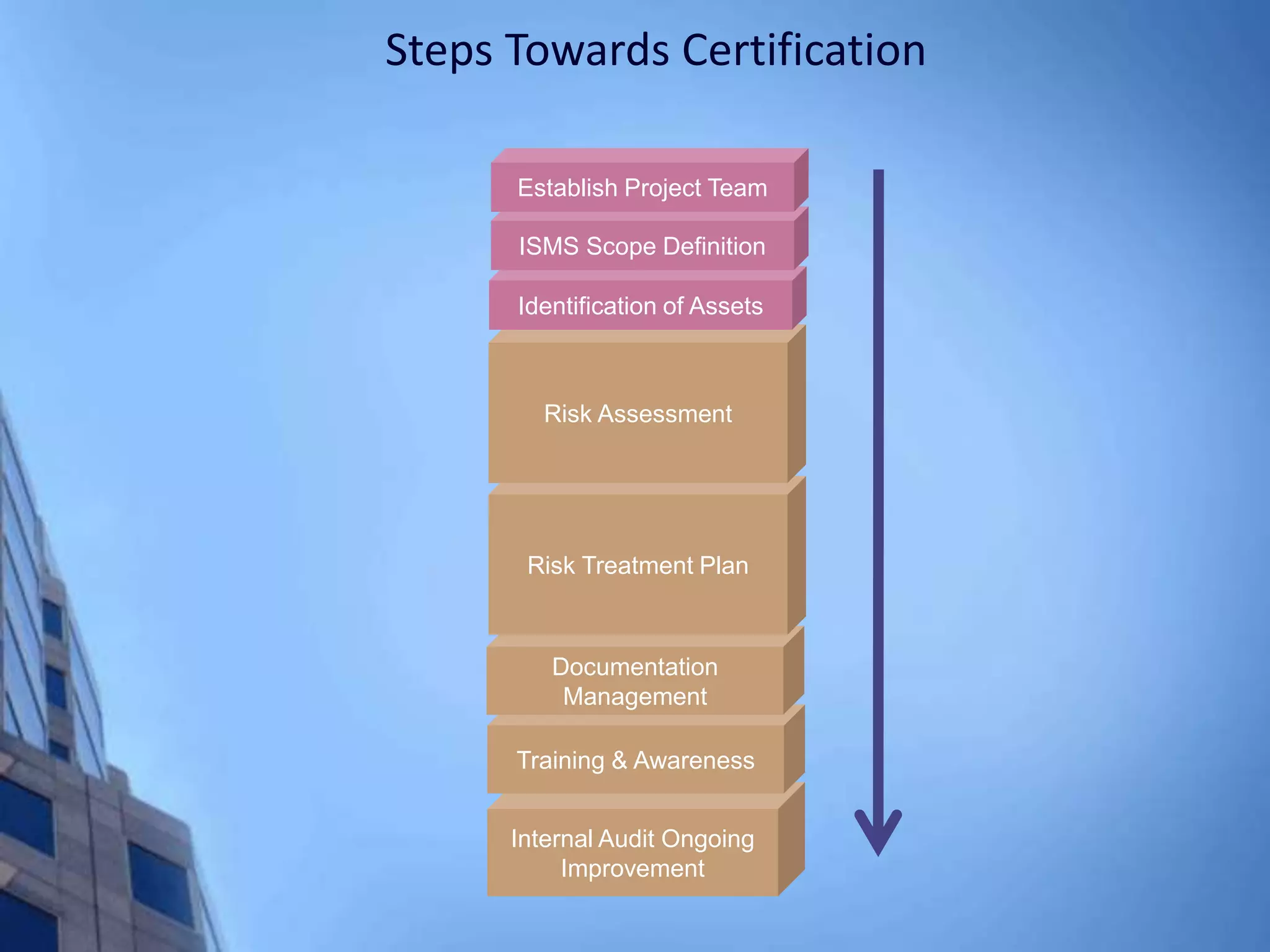
Steps Towards Certification
Internal Audit Ongoing
Improvement
Training & Awareness
Documentation
Management
Risk Treatment Plan
Risk Assessment
Identification of Assets
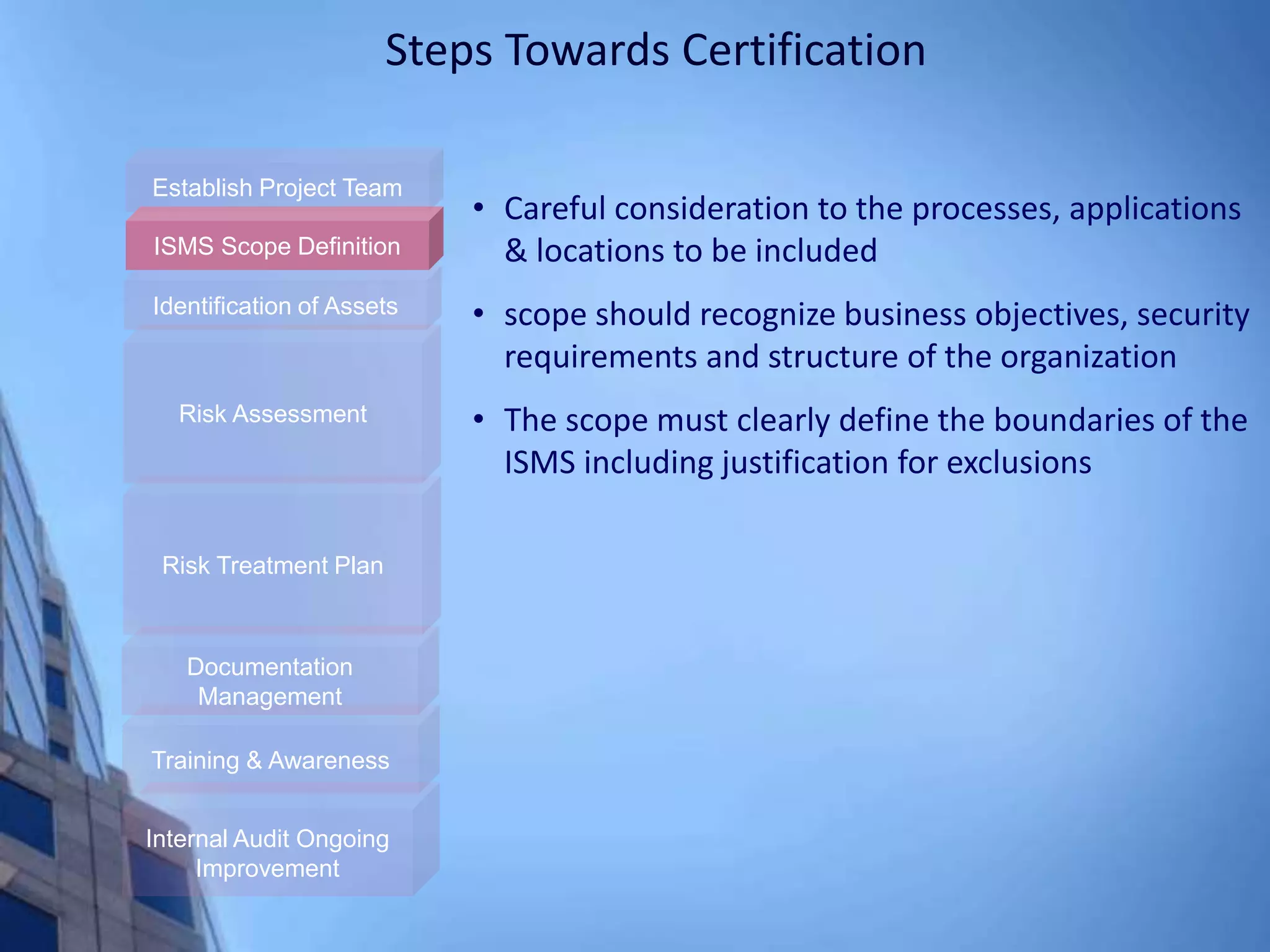
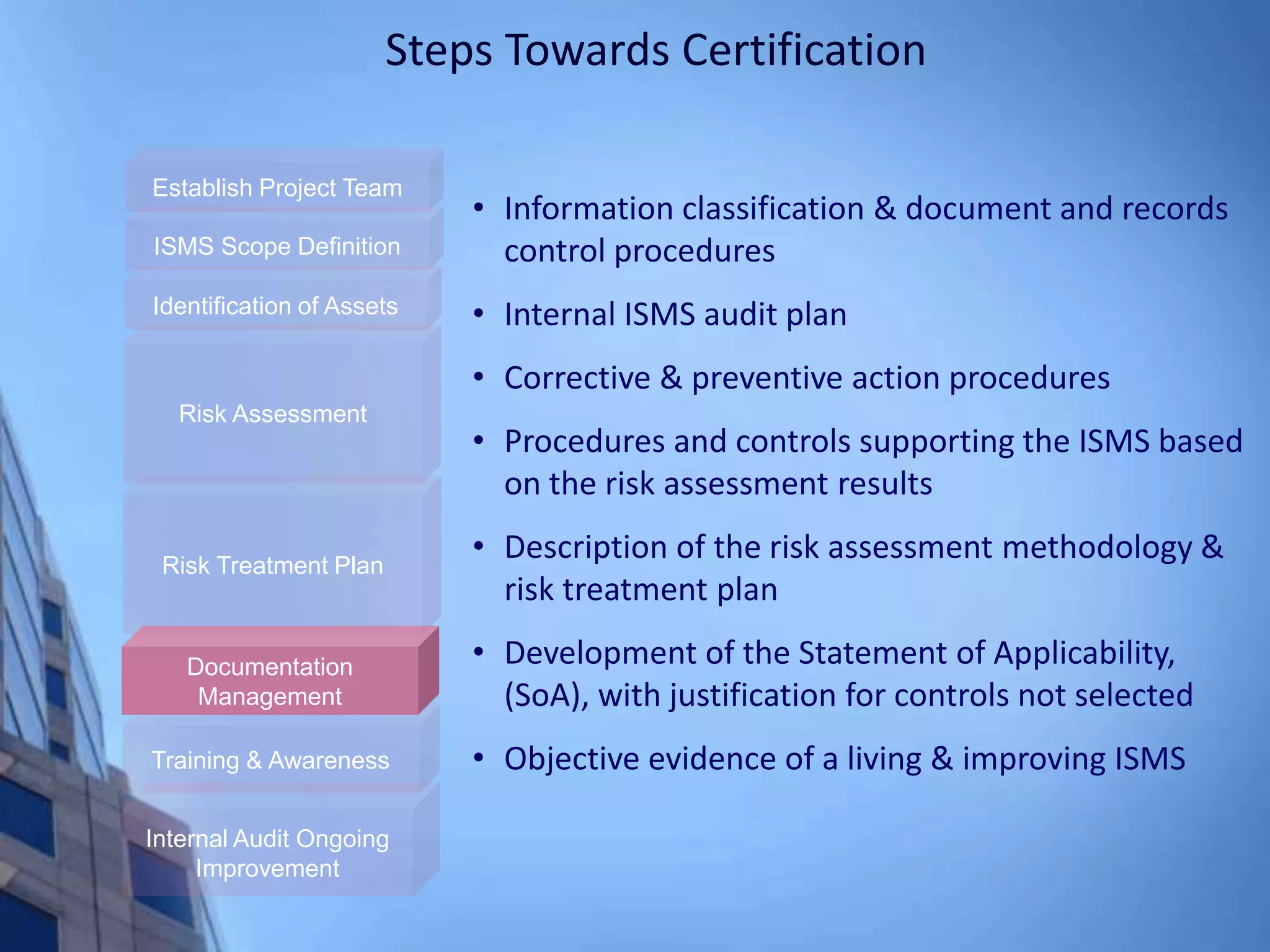
ISMS Scope Definition
Establish Project Team
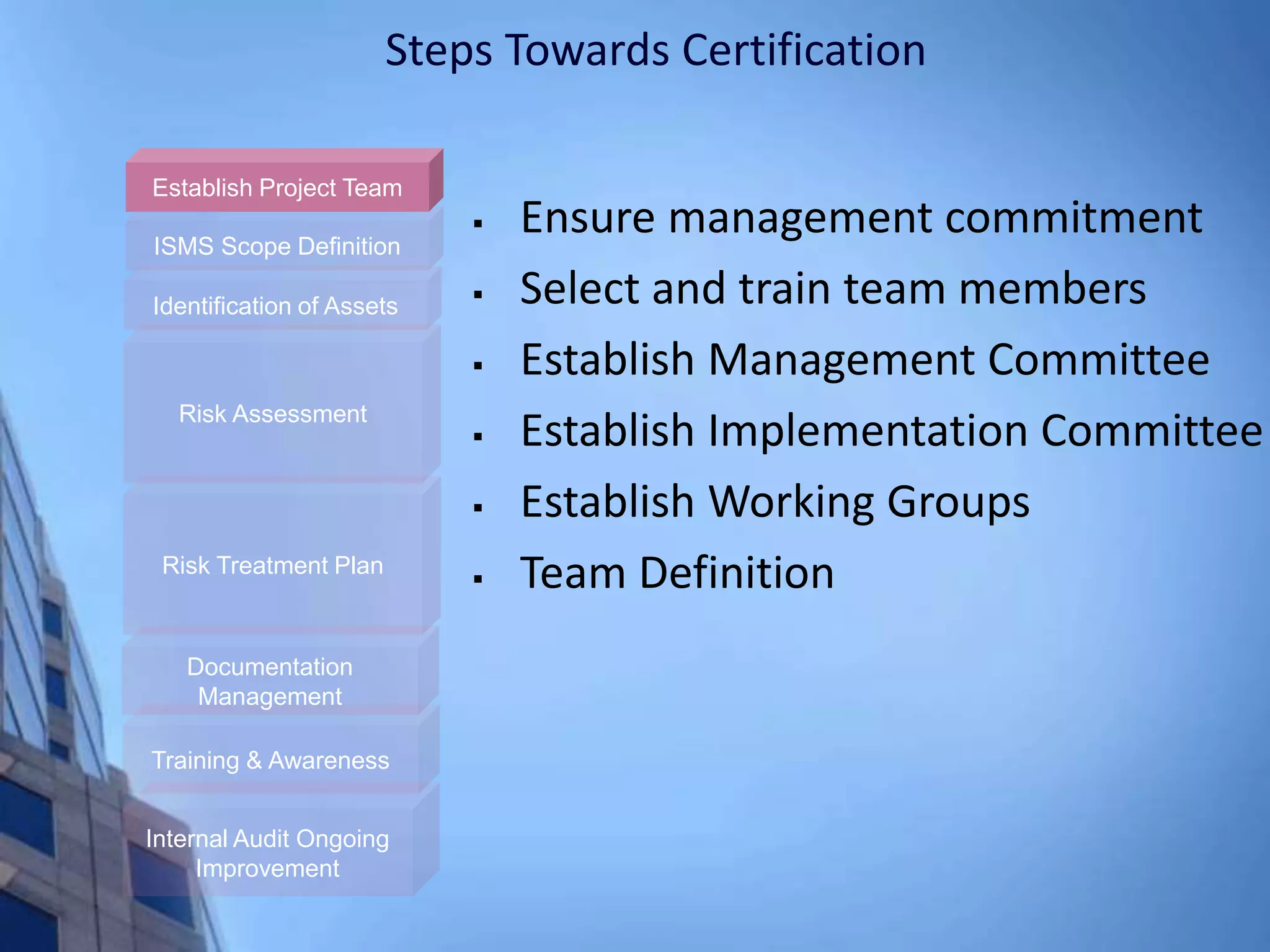
Steps Towards Certification
Internal Audit Ongoing
Improvement
Training & Awareness
Documentation
Management
Risk Treatment Plan
Risk Assessment
Identification of Assets
ISMS Scope Definition
Establish Project Team
 Ensure management commitment
 Select and train team members
 Establish Management Committee
 Establish Implementation Committee
 Establish Working Groups
 Team Definition
Steps Towards Certification
Internal Audit Ongoing
Improvement
Training & Awareness
Documentation
Management
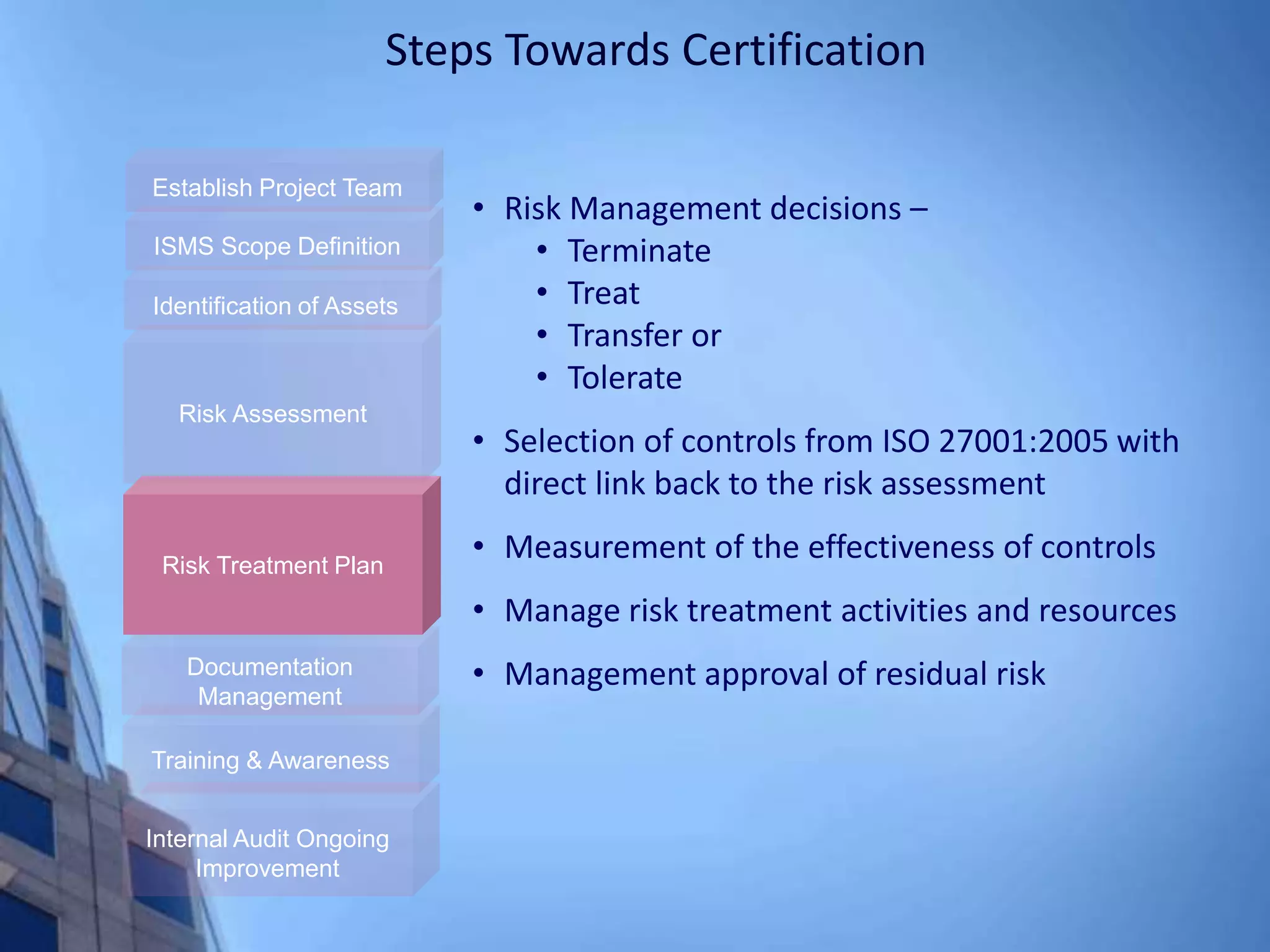
Risk Treatment Plan
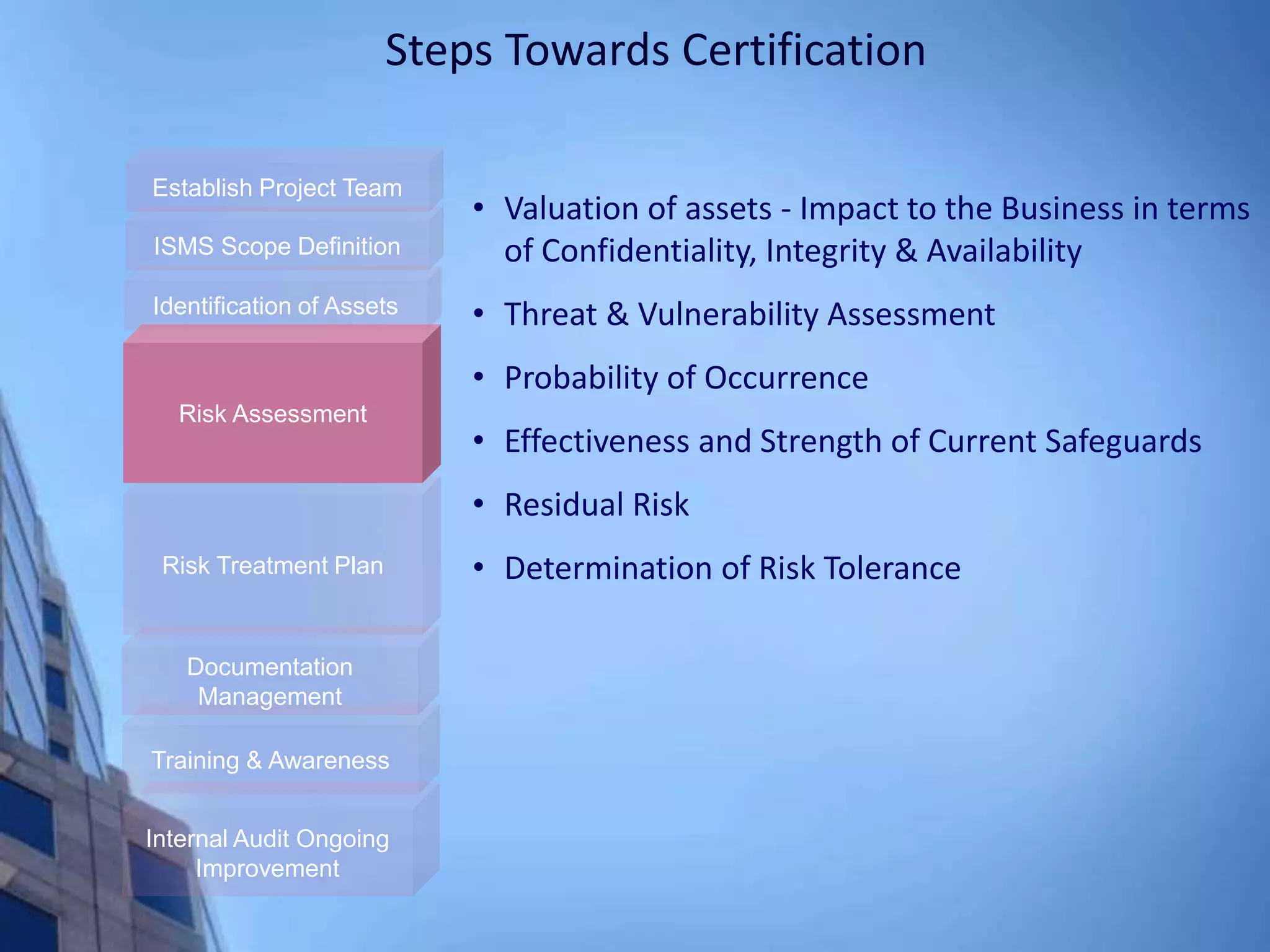
Risk Assessment
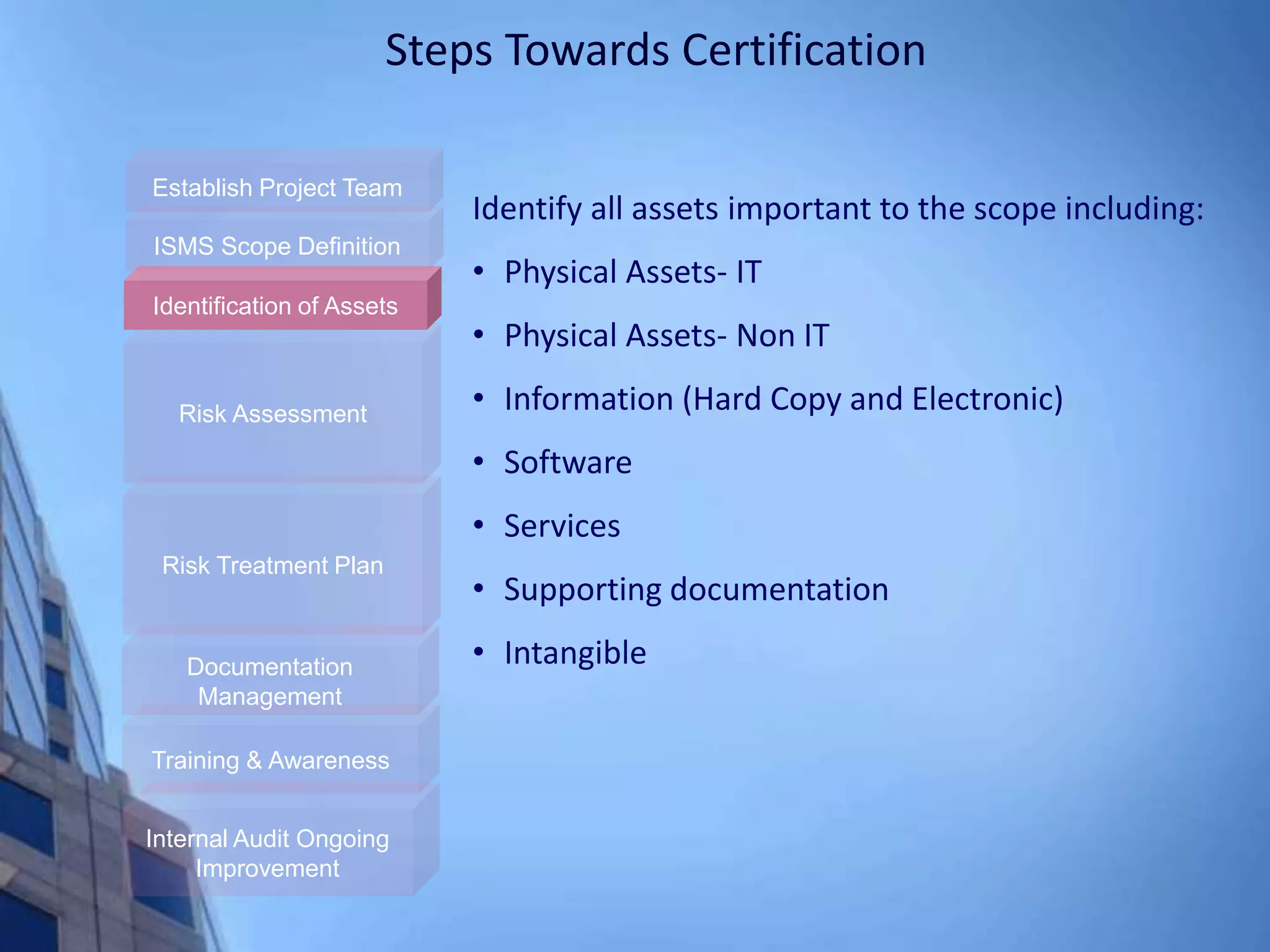
Identification of Assets
ISMS Scope Definition
Establish Project Team
• Careful consideration to the processes, applications
& locations to be included
• scope should recognize business objectives, security
requirements and structure of the organization
• The scope must clearly define the boundaries of the
ISMS including justification for exclusions
Steps Towards Certification
Internal Audit Ongoing
Improvement
Training & Awareness
Documentation
Management
Risk Treatment Plan
Risk Assessment
Identification of Assets
ISMS Scope Definition
Establish Project Team
Identify all assets important to the scope including:
• Physical Assets- IT
• Physical Assets- Non IT
• Information (Hard Copy and Electronic)
• Software
• Services
• Supporting documentation
• Intangible
Steps Towards Certification
Internal Audit Ongoing
Improvement
Training & Awareness
Documentation
Management
Risk Treatment Plan
Risk Assessment
Identification of Assets
ISMS Scope Definition
Establish Project Team
• Valuation of assets - Impact to the Business in terms
of Confidentiality, Integrity & Availability
• Threat & Vulnerability Assessment
• Probability of Occurrence
• Effectiveness and Strength of Current Safeguards
• Residual Risk
• Determination of Risk Tolerance
Steps Towards Certification
Internal Audit Ongoing
Improvement
Training & Awareness
Documentation
Management
Risk Treatment Plan
Risk Assessment
Identification of Assets
ISMS Scope Definition
Establish Project Team
• Risk Management decisions –
• Terminate
• Treat
• Transfer or
• Tolerate
• Selection of controls from ISO 27001:2005 with
direct link back to the risk assessment
• Measurement of the effectiveness of controls
• Manage risk treatment activities and resources
• Management approval of residual risk
Steps Towards Certification
Internal Audit Ongoing
Improvement
Training & Awareness
Documentation
Management
Risk Treatment Plan
Risk Assessment
Identification of Assets
ISMS Scope Definition
Establish Project Team
• Information classification & document and records
control procedures
• Internal ISMS audit plan
• Corrective & preventive action procedures
• Procedures and controls supporting the ISMS based
on the risk assessment results
• Description of the risk assessment methodology &
risk treatment plan
• Development of the Statement of Applicability,
(SoA), with justification for controls not selected
• Objective evidence of a living & improving ISMS
Steps Towards Certification
Internal Audit Ongoing
Improvement
Training & Awareness
Documentation
Management
Risk Treatment Plan
Risk Assessment
Identification of Assets
ISMS Scope Definition
Establish Project Team
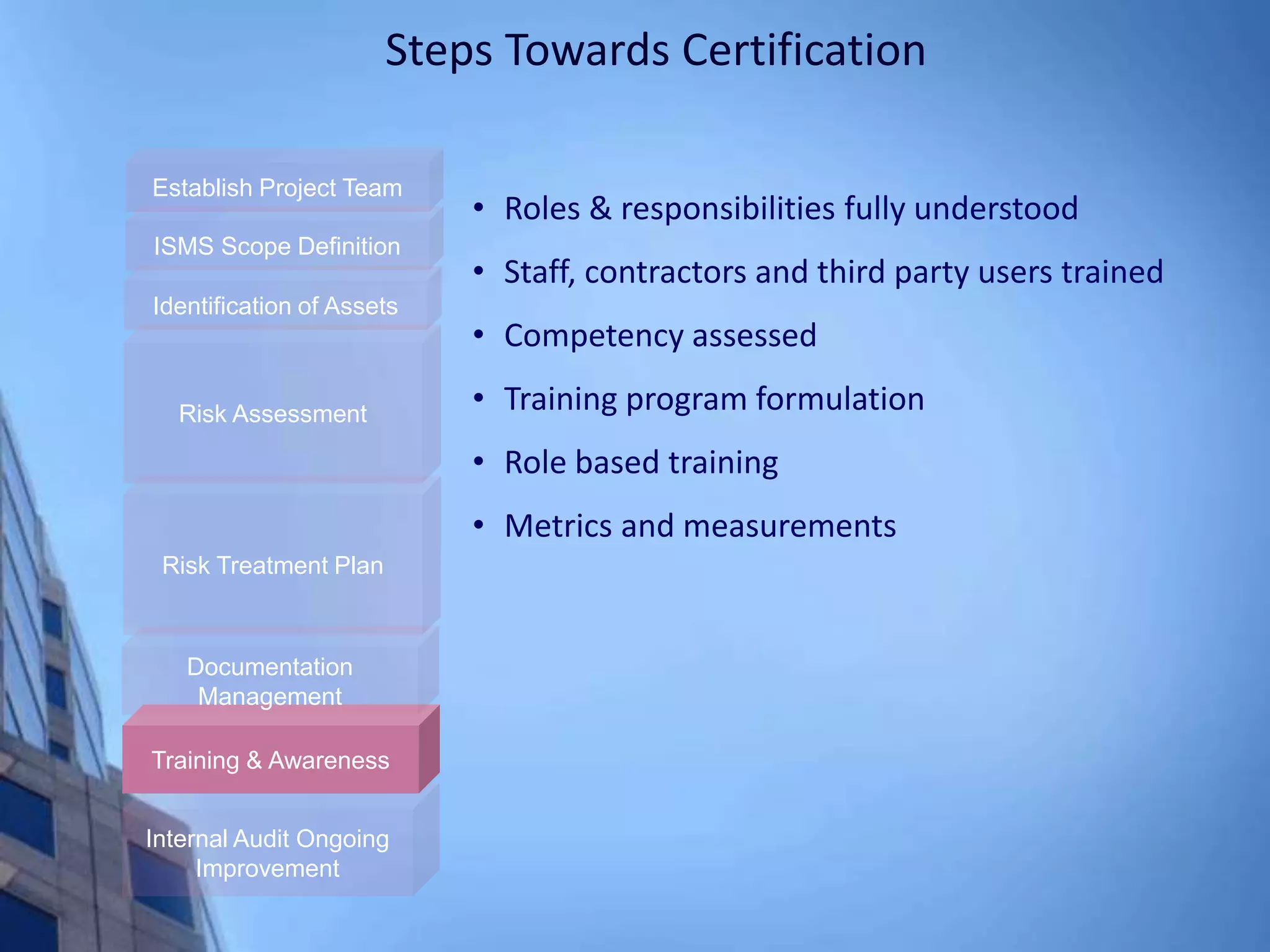
• Roles & responsibilities fully understood
• Staff, contractors and third party users trained
• Competency assessed
• Training program formulation
• Role based training
• Metrics and measurements
Steps Towards Certification
Internal Audit Ongoing
Improvement
Training & Awareness
Documentation
Management
Risk Treatment Plan
Risk Assessment
Identification of Assets
ISMS Scope Definition
Establish Project Team
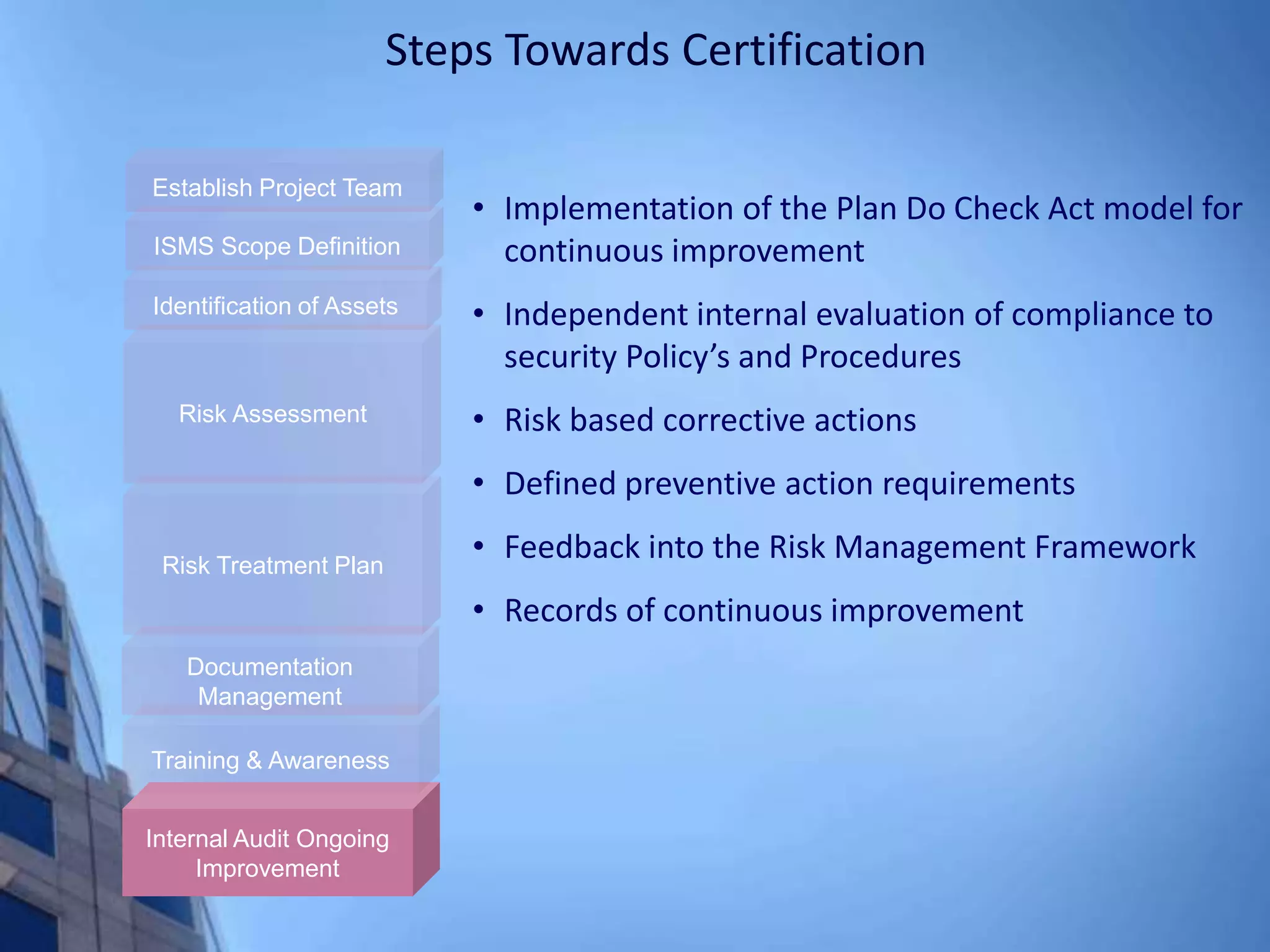
• Implementation of the Plan Do Check Act model for
continuous improvement
• Independent internal evaluation of compliance to
security Policy’s and Procedures
• Risk based corrective actions
• Defined preventive action requirements
• Feedback into the Risk Management Framework
• Records of continuous improvement
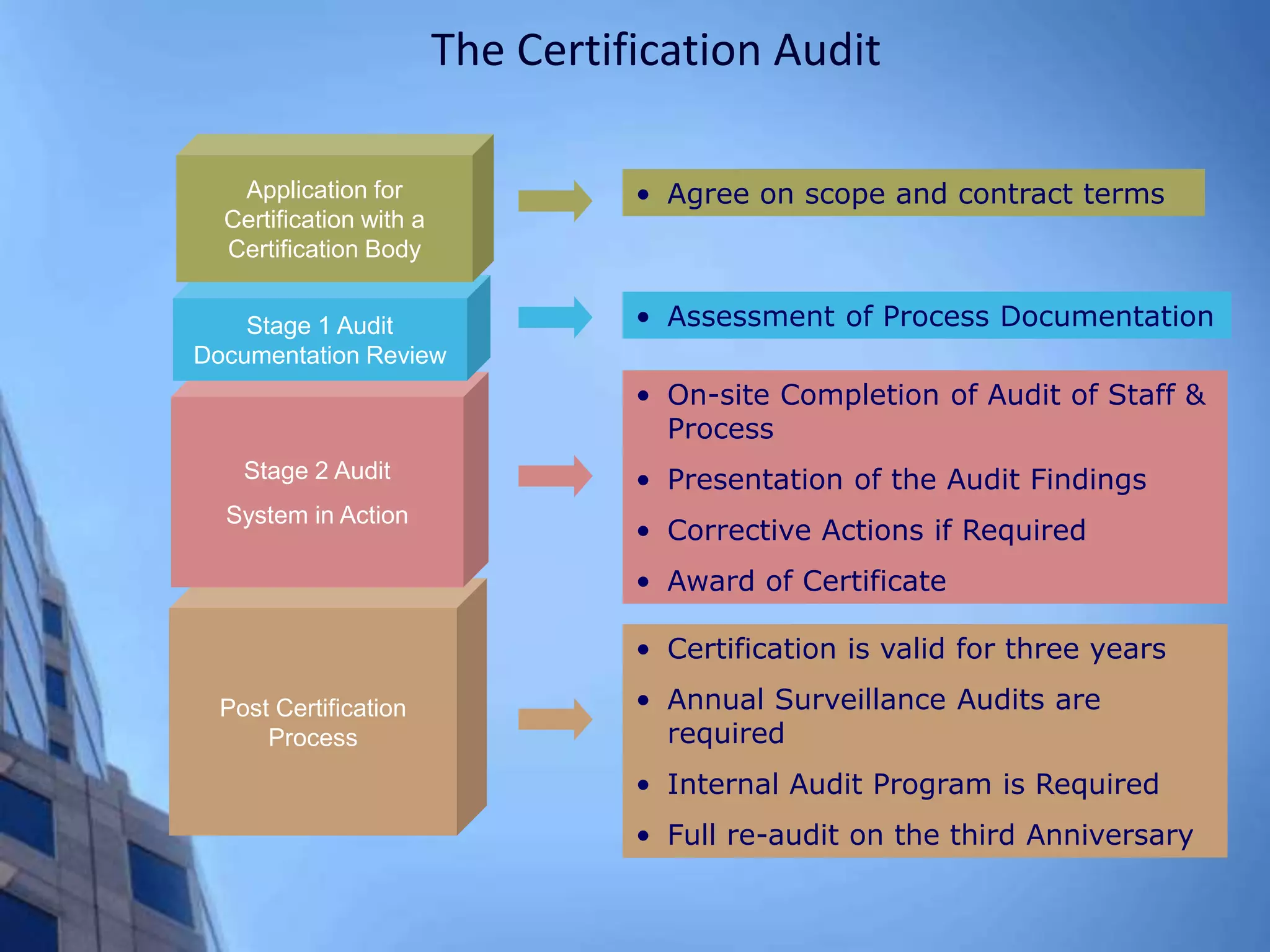
The Certification Audit
Post Certification
Process
Stage 2 Audit
System in Action
Stage 1 Audit
Documentation Review
Application for
Certification with a
Certification Body
• Agree on scope and contract terms
• Assessment of Process Documentation
• On-site Completion of Audit of Staff &
Process
• Presentation of the Audit Findings
• Corrective Actions if Required
• Award of Certificate
• Certification is valid for three years
• Annual Surveillance Audits are
required
• Internal Audit Program is Required
• Full re-audit on the third Anniversary
Thank You

isms-presentation.ppt

  • 1.
  • 2.
    Information is anasset which, like other important business assets, has value to an organization and consequently needs to be suitably protected. ISO/IEC 17799:2005 Information Confidentiality Integrity Availability
  • 3.
    Information Security Managementis a top-down, business driven approach to the management of an organization’s physical and electronic information assets in order to preserve their • confidentiality, • integrity and • availability.
  • 4.
    Increased dependence oninformation assets Increased demand for information availability Increased threats to information security
  • 5.
    Consequences of SecurityBreach  Destroy Image  Depress the value of the business  Erode the “bottom line”; and  Compromise future earnings.
  • 6.
    What is ISMS AnISMS is the means by which management monitors and controls the security, minimizing the residual business risk and ensuring that security continues to fulfill corporate, customer and legal requirements.
  • 7.
    ISO 17799 &ISO 27001 ISO 17799:2005 Information Technology Security techniques – Code of practice for information security management ISO 27001:2005 Information technology Security techniques – Information security Management systems – Requirements Provides a comprehensive framework to guide and focus your efforts in building an Information Security Management System (ISMS) Provides a framework for a risk based security management system that can be independently certified
  • 8.
    ISO 17799  AnInternationally recognized Code of Practice for information security management systems (ISMS)  A comprehensive framework to guide and focus your efforts in building an Information Security Management System  A collection of security best practices along with implementation guidance
  • 9.
    ISO 27001 :2005  An internationally recognized requirement document for information security management systems  A framework for building a risk based security management system that can be independently certified
  • 10.
    Communications & Operations Management Critical Information Assets Risk Assessment Risk Treatment Compliance SecurityPolicy Organization of Information Security Asset Management Human Resources Security Physical & Environmental Security Access Control Information Systems Acquisition, Development & Maintenance Information Security Incident Management Business Continuity Management 11 Clauses 39 Control Objectives 133 Security Control
  • 11.
    An Outline ofISO / IEC 17799/27001 Security Clauses Management Aspects Technical Aspects Physical Aspects Legend : Security Policy Organization of Information Security Asset Management Business Continuity Management Compliance Communications & Operations Management Human Resources Security Information Security Incident Management Information System Acquisition, Development & Maintenance Access Control Physical & Environmental Security Operations Management Organizational Structure The 11 Security Clauses  Security Policy (1)  Organization of Information Security (2)  Asset Management (2)  Human Resources Security (3)  Physical & Environmental Security (2)  Communications & Operations Management (10)  Access Control (7)  Information System Acquisition, Development & Maintenance (6)  Information Security Incident Management (2)  Business Continuity Management (1)  Compliance (3)
  • 12.
    (1) Define Scope (2) PerformGap Analysis (3) Security Improvement Plan (SIP) (4) Information Asset Register (4) Risk Assessment (4) Risk Treatment Plans (4) Selection of Controls (4) Initial SoA (6) Certification Readiness (6) Continues Improvement (6) Internal Audit, Management Review (5) Policies, Procedures, Controls & ISMS Documentation (5) Final SoA On-Going Security Program Improvement Pre-Certification Preparation Methodology
  • 13.
    Steps Towards Certification Plan Do Check Act Establishthe ISMS Implement & Operate the ISMS Monitor & Review the ISMS Maintain & Improve the ISMS Apply for Certification
  • 14.
    ISMS Implementation RequiresAdvisory Services, Project Leadership & Staff Augmentation Established the ISMS Implement & Operate Monitor & Review Maintain & Improve Plan (4.2.1) Do (4.2.2) Check (4.2.3) Act (4.2.4)  Initial Training  ISMS Scope  ISMS Policy  ISMS Assets  Gap Analysis/ SIP  Business Impact  Threats & Vulnerabilities  Probability of Occurrence  Calculate/Evaluate Risks  Prioritize Risks  Treatment Options  Select Controls  Management Apvl.  Prepare Initial SoA  Risk Treatment Plans  Implement Risk Treatment  Define Effectiveness Metrics  Document WI’s, Procedures  Implement Training & Awareness Program  Conduct Internal Auditor Training  Operate the ISMS  Monitoring & Incident Response  Update SoA  Execute Monitoring & Review Procedures  Review ISMS Effectiveness  Measure the Effectiveness of the Controls  Review Risk Assessments  Conduct Internal ISMS Audits  Regular Mgmt. reviews of the ISMS  Update SIP’s based on Findings  Record Actions & Events Impacting ISMS  Implement Identified Improvements  Take Corrective & Preventive Actions  Communicate the Actions & Improvements  Ensure Improvements Achieve Objectives
  • 15.
    Steps Towards Certification InternalAudit Ongoing Improvement Training & Awareness Documentation Management Risk Treatment Plan Risk Assessment Identification of Assets ISMS Scope Definition Establish Project Team
  • 16.
    Steps Towards Certification InternalAudit Ongoing Improvement Training & Awareness Documentation Management Risk Treatment Plan Risk Assessment Identification of Assets ISMS Scope Definition Establish Project Team  Ensure management commitment  Select and train team members  Establish Management Committee  Establish Implementation Committee  Establish Working Groups  Team Definition
  • 17.
    Steps Towards Certification InternalAudit Ongoing Improvement Training & Awareness Documentation Management Risk Treatment Plan Risk Assessment Identification of Assets ISMS Scope Definition Establish Project Team • Careful consideration to the processes, applications & locations to be included • scope should recognize business objectives, security requirements and structure of the organization • The scope must clearly define the boundaries of the ISMS including justification for exclusions
  • 18.
    Steps Towards Certification InternalAudit Ongoing Improvement Training & Awareness Documentation Management Risk Treatment Plan Risk Assessment Identification of Assets ISMS Scope Definition Establish Project Team Identify all assets important to the scope including: • Physical Assets- IT • Physical Assets- Non IT • Information (Hard Copy and Electronic) • Software • Services • Supporting documentation • Intangible
  • 19.
    Steps Towards Certification InternalAudit Ongoing Improvement Training & Awareness Documentation Management Risk Treatment Plan Risk Assessment Identification of Assets ISMS Scope Definition Establish Project Team • Valuation of assets - Impact to the Business in terms of Confidentiality, Integrity & Availability • Threat & Vulnerability Assessment • Probability of Occurrence • Effectiveness and Strength of Current Safeguards • Residual Risk • Determination of Risk Tolerance
  • 20.
    Steps Towards Certification InternalAudit Ongoing Improvement Training & Awareness Documentation Management Risk Treatment Plan Risk Assessment Identification of Assets ISMS Scope Definition Establish Project Team • Risk Management decisions – • Terminate • Treat • Transfer or • Tolerate • Selection of controls from ISO 27001:2005 with direct link back to the risk assessment • Measurement of the effectiveness of controls • Manage risk treatment activities and resources • Management approval of residual risk
  • 21.
    Steps Towards Certification InternalAudit Ongoing Improvement Training & Awareness Documentation Management Risk Treatment Plan Risk Assessment Identification of Assets ISMS Scope Definition Establish Project Team • Information classification & document and records control procedures • Internal ISMS audit plan • Corrective & preventive action procedures • Procedures and controls supporting the ISMS based on the risk assessment results • Description of the risk assessment methodology & risk treatment plan • Development of the Statement of Applicability, (SoA), with justification for controls not selected • Objective evidence of a living & improving ISMS
  • 22.
    Steps Towards Certification InternalAudit Ongoing Improvement Training & Awareness Documentation Management Risk Treatment Plan Risk Assessment Identification of Assets ISMS Scope Definition Establish Project Team • Roles & responsibilities fully understood • Staff, contractors and third party users trained • Competency assessed • Training program formulation • Role based training • Metrics and measurements
  • 23.
    Steps Towards Certification InternalAudit Ongoing Improvement Training & Awareness Documentation Management Risk Treatment Plan Risk Assessment Identification of Assets ISMS Scope Definition Establish Project Team • Implementation of the Plan Do Check Act model for continuous improvement • Independent internal evaluation of compliance to security Policy’s and Procedures • Risk based corrective actions • Defined preventive action requirements • Feedback into the Risk Management Framework • Records of continuous improvement
  • 24.
    The Certification Audit PostCertification Process Stage 2 Audit System in Action Stage 1 Audit Documentation Review Application for Certification with a Certification Body • Agree on scope and contract terms • Assessment of Process Documentation • On-site Completion of Audit of Staff & Process • Presentation of the Audit Findings • Corrective Actions if Required • Award of Certificate • Certification is valid for three years • Annual Surveillance Audits are required • Internal Audit Program is Required • Full re-audit on the third Anniversary
  • 25.