Understanding
HIPAA
Impact and Importance in
Information Security….
Manasdeep
(manasdeeps@gmail.com)
#aboutme
• Information Security Consultant
• Interested in Compliance and Penetration Testing
• Have a flair in writing for Information Security
• Like to learn and demonstrate latest security attack vectors and
technologies
Agenda
• What is HIPAA?
• Why HIPAA was needed?
• Who are the covered entities (CE) and Business Associates (BA) ?
• Three Pillars of HIPAA Compliance
• Critical success factor for achieving HIPAA compliance
• Actions to Reduce Liability & Risks
• Q&A
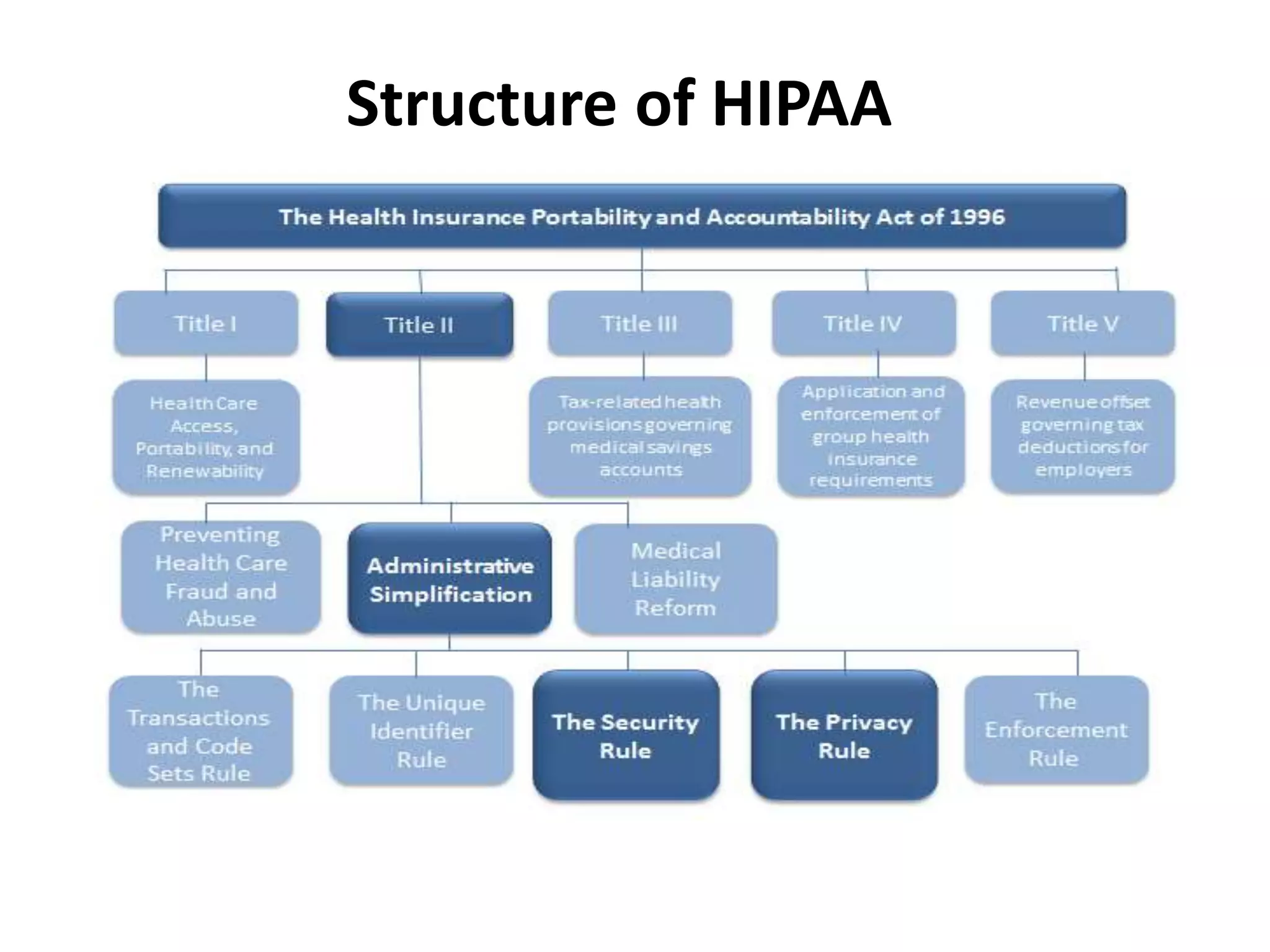
Structure of HIPAA
HIPAA Components in Focus
HIPAA is the Federal Health Insurance
Portability and Accountability Act of 1996.
Administered by the U.S. Department of
Health and Human Services (HHS).
Implementation and civil enforcement are overseen
by the HHS Office for Civil Rights (OCR).
HIPAA Privacy Rule, protects the privacy of
individually identifiable health information;
HIPAA Security Rule sets national standards for the security of
electronic protected health information;
HIPAA Breach Notification Rule, which requires covered entities and
business associates to provide notification following a breach of
unsecured protected health information
Why HIPAA was needed?
1. Insurance companies denied coverage to employees that had a pre-existing
condition, even if employees were previously covered by another employer.
2. No standardization for billing formats and codes used to file claims
3. No standardization for billing formats and codes used to file claims
Basic information, such as patient name and treatment date,
was formatted differently by each payer
4. Insurance coding was very complex, there were many errors
Companies often rejected many claims and delayed payments to providers
High cost for administration
HL7,
ICD-10
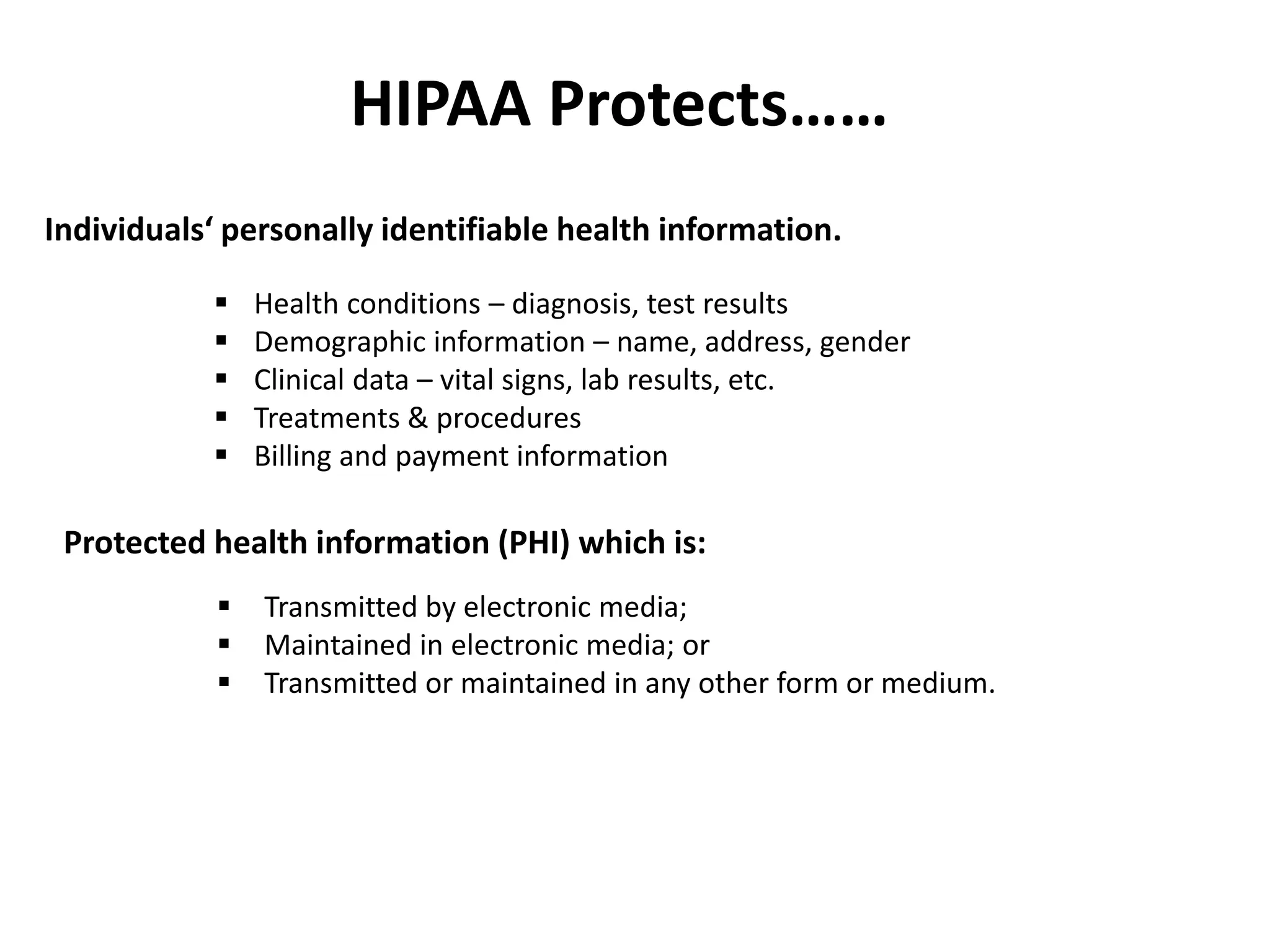
HIPAA Protects……
Individuals‘ personally identifiable health information.
 Health conditions – diagnosis, test results
 Demographic information – name, address, gender
 Clinical data – vital signs, lab results, etc.
 Treatments & procedures
 Billing and payment information
Protected health information (PHI) which is:
 Transmitted by electronic media;
 Maintained in electronic media; or
 Transmitted or maintained in any other form or medium.
Pillars of HIPAA
Privacy Rule
 Notice of privacy practices
 Rights over PHI
 Access to PHI
 Uses and disclosures
 Accounting of disclosures
Security Rule
 Administrative
 Physical
 Technical
Breach notification requirements for:
 Covered Entities (CE) and
 Business Associates (BA)
Breach Notification Rule
Extent of HIPAA Applicabilty
Covered Entities
Any healthcare organization
that stores, processes, or
transmits personal health
information
Entity that involve the use or
disclosure of protected health
information on behalf of, or provides
services to, a covered entity.
Business Associates
Business associate services can be in :
legal;
actuarial;
accounting;
consulting;
data aggregation;
management;
administrative;
accreditation; and
financial.
Covered Entities can be:
Health Plan
Health Care Provider
Health Care Clearinghouse
Breach Notification
What to do?
• Risk Assessment of Breach
• Notification to Individuals impacted by breach
• within 60 days of discovery of a breach
• It depends by State law, too
Focus on:
• Content of Notification
• Notification to the media
• Notification to the Secretary
• Notification by a business associate
• Law enforcement delay
• Burden of Proof
HHS – “Wall of Shame”
https://ocrportal.hhs.gov/ocr/breach/breach_r
eport.jsf
THANK YOU !!
- Manasdeephttp://reflect-infosec.blogspot.in/
https://twitter.com/manasdeep
https://in.linkedin.com/in/manasdeep

Understanding HIPAA

  • 1.
    Understanding HIPAA Impact and Importancein Information Security…. Manasdeep (manasdeeps@gmail.com)
  • 2.
    #aboutme • Information SecurityConsultant • Interested in Compliance and Penetration Testing • Have a flair in writing for Information Security • Like to learn and demonstrate latest security attack vectors and technologies
  • 3.
    Agenda • What isHIPAA? • Why HIPAA was needed? • Who are the covered entities (CE) and Business Associates (BA) ? • Three Pillars of HIPAA Compliance • Critical success factor for achieving HIPAA compliance • Actions to Reduce Liability & Risks • Q&A
  • 4.
  • 5.
    HIPAA Components inFocus HIPAA is the Federal Health Insurance Portability and Accountability Act of 1996. Administered by the U.S. Department of Health and Human Services (HHS). Implementation and civil enforcement are overseen by the HHS Office for Civil Rights (OCR). HIPAA Privacy Rule, protects the privacy of individually identifiable health information; HIPAA Security Rule sets national standards for the security of electronic protected health information; HIPAA Breach Notification Rule, which requires covered entities and business associates to provide notification following a breach of unsecured protected health information
  • 6.
    Why HIPAA wasneeded? 1. Insurance companies denied coverage to employees that had a pre-existing condition, even if employees were previously covered by another employer. 2. No standardization for billing formats and codes used to file claims 3. No standardization for billing formats and codes used to file claims Basic information, such as patient name and treatment date, was formatted differently by each payer 4. Insurance coding was very complex, there were many errors Companies often rejected many claims and delayed payments to providers High cost for administration HL7, ICD-10
  • 7.
    HIPAA Protects…… Individuals‘ personallyidentifiable health information.  Health conditions – diagnosis, test results  Demographic information – name, address, gender  Clinical data – vital signs, lab results, etc.  Treatments & procedures  Billing and payment information Protected health information (PHI) which is:  Transmitted by electronic media;  Maintained in electronic media; or  Transmitted or maintained in any other form or medium.
  • 8.
    Pillars of HIPAA PrivacyRule  Notice of privacy practices  Rights over PHI  Access to PHI  Uses and disclosures  Accounting of disclosures Security Rule  Administrative  Physical  Technical Breach notification requirements for:  Covered Entities (CE) and  Business Associates (BA) Breach Notification Rule
  • 9.
    Extent of HIPAAApplicabilty Covered Entities Any healthcare organization that stores, processes, or transmits personal health information Entity that involve the use or disclosure of protected health information on behalf of, or provides services to, a covered entity. Business Associates Business associate services can be in : legal; actuarial; accounting; consulting; data aggregation; management; administrative; accreditation; and financial. Covered Entities can be: Health Plan Health Care Provider Health Care Clearinghouse
  • 10.
    Breach Notification What todo? • Risk Assessment of Breach • Notification to Individuals impacted by breach • within 60 days of discovery of a breach • It depends by State law, too Focus on: • Content of Notification • Notification to the media • Notification to the Secretary • Notification by a business associate • Law enforcement delay • Burden of Proof HHS – “Wall of Shame” https://ocrportal.hhs.gov/ocr/breach/breach_r eport.jsf
  • 11.
    THANK YOU !! -Manasdeephttp://reflect-infosec.blogspot.in/ https://twitter.com/manasdeep https://in.linkedin.com/in/manasdeep